a treasure-trove of literature
treasure found hidden with no evidence of ownership
(and our other authors) or get HELP Reading, Downloading and Converting files)
or
SEARCH the entire site with Google Site Search
|
Project Gutenberg
Australia a treasure-trove of literature treasure found hidden with no evidence of ownership |
BROWSE the site for other works by this author (and our other authors) or get HELP Reading, Downloading and Converting files) or SEARCH the entire site with Google Site Search |
A Project Gutenberg of Australia eBook

Title:      The Endeavour Journal of Sir Joseph Banks
Author:     Sir Joseph Banks (1743-1820)
eBook No.:  0501141h.html
Edition:    1
Language:   English
Character set encoding:     HTML--Latin-1(ISO-8859-1)--8 bit
Date first posted:          November 2005
Date most recently updated: November 2005


Project Gutenberg of Australia eBooks are created from printed editions
which are in the public domain in Australia, unless a copyright notice
is included. We do NOT keep any eBooks in compliance with a particular
paper edition.

Copyright laws are changing all over the world. Be sure to check the
copyright laws for your country before downloading or redistributing this
file.

This eBook is made available at no cost and with almost no restrictions
whatsoever. You may copy it, give it away or re-use it under the terms
of the Project Gutenberg of Australia License which may be viewed online at
http://gutenberg.net.au/licence.html

To contact Project Gutenberg of Australia go to http://gutenberg.net.au
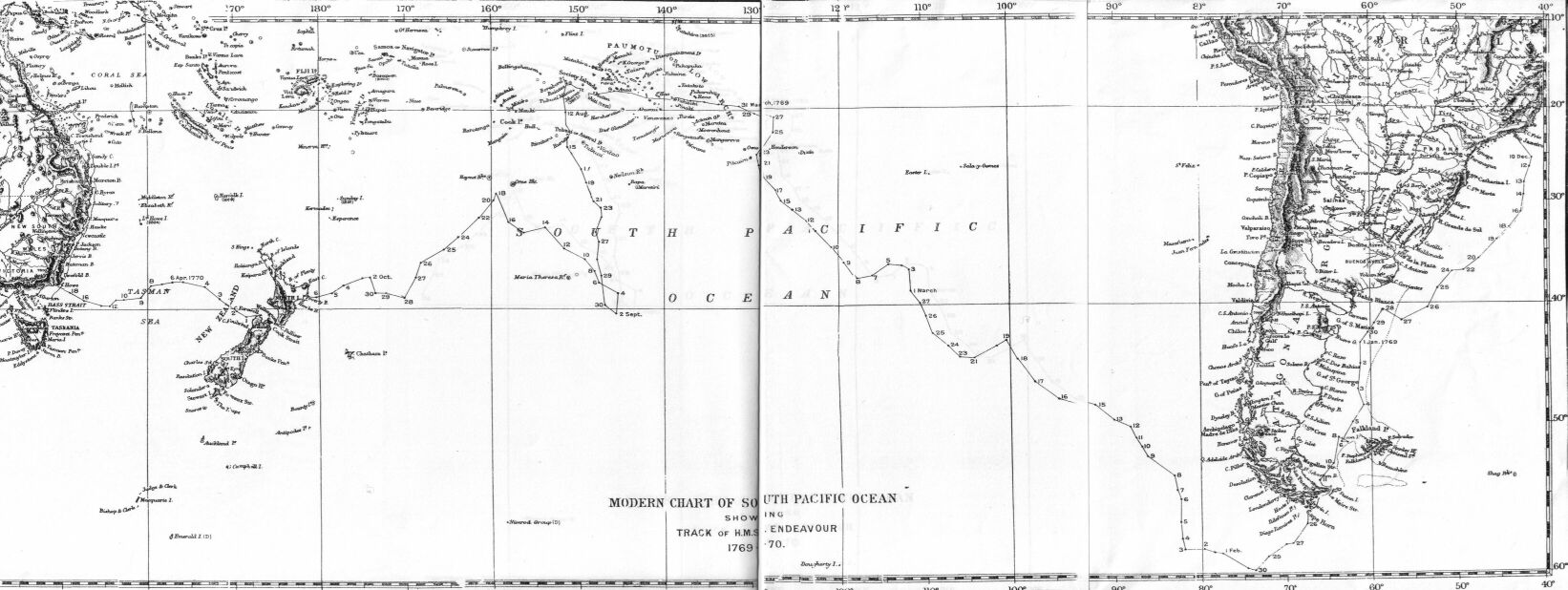
Modern Chart showing track of Endeavour
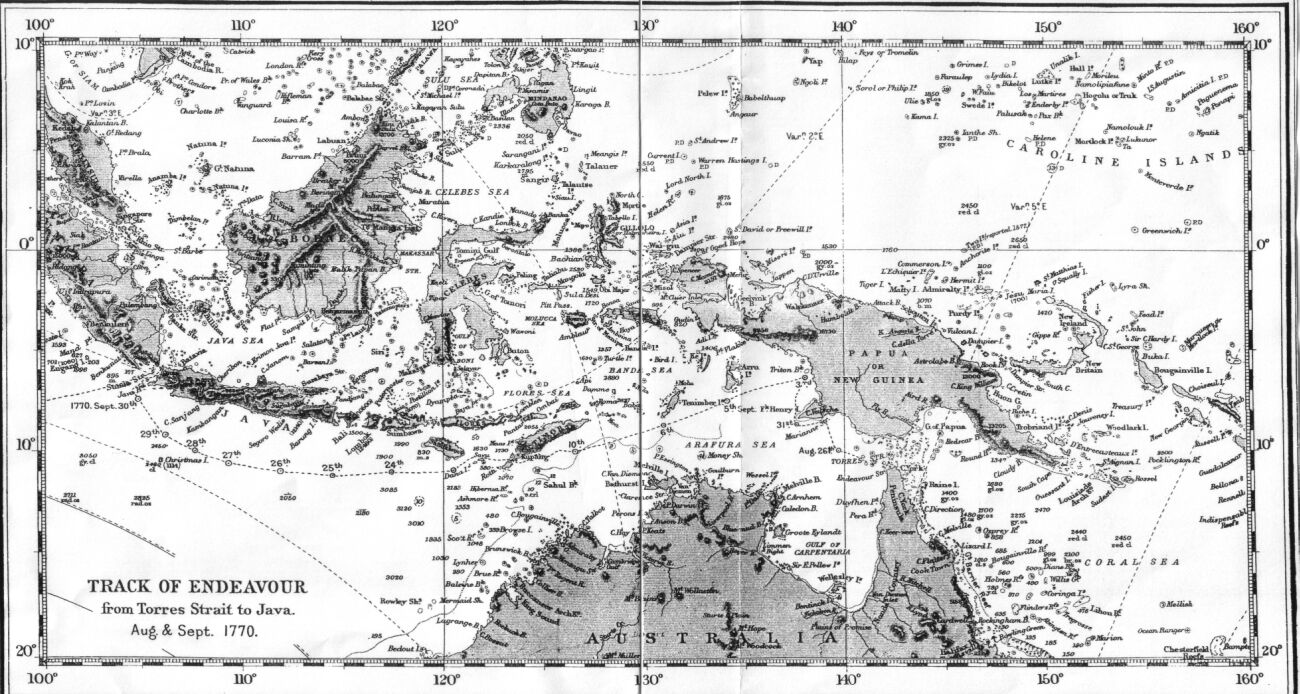
Track of Endeavour from Torres Strait to Java
The text file of this work was prepared in 1962 from the manuscript
"The Endeavour Journal of Sir Joseph Banks, 1768—1771" held at the
State Library of NSW.

Illustrations have been taken from:
CAPTAIN COOK'S JOURNAL DURING HIS FIRST VOYAGE ROUND THE WORLD
MADE IN H.M. BARK "ENDEAVOUR" 1768-71
EDITED BY CAPTAIN W.J.L. WHARTON, R.N., F.R.S.
AUGUST 1768
Departed Plymouth
SEPTEMBER 1768
Coast of Spain
Arrived Madeira
Departed Madeira
OCTOBER 1768
Crossed Equator
NOVEMBER 1768
Continent of South America
DECEMBER 1768
Rio de Janeiro described
JANUARY 1769
Terra del Fuego sighted
APRIL 1769
Georges Land sighted
Arrival Port Royal Bay
JULY 1769
Depart Otahite
AUGUST 1769
Crossed Tropick
MANNERS AND CUSTOMS OF SOUTH SEA ISLANDS. 1769
OCTOBER 1769
Arrived New Zealand
APRIL 1770
New Holland sighted
Botany Bay reached
AUGUST 1770
New Guinea Coast
SEPTEMBER 1770
Savu reached
SOME ACCOUNT OF THAT PART OF NEW HOLLAND NOW CALLED NEW SOUTH WALES
ACCOUNTS OF SAVU AND ISLANDS NEAR SAVU
SOME ACCOUNT OF PRINCES ISLAND
MARCH 1771
Table Bay
APRIL 1771
French Vessels
MAY 1771
Depart St Helens for England
After having waited in this place ten days, the ship, and everything belonging to me, being all that time in perfect readyness to sail at a moments warning, we at last got a fair wind, and this day at 3 O'Clock in the even weigd anchor, and set sail, all in excellent health and spirits perfectly prepard (in Mind at least) to undergo with Chearfullness any fatigues or dangers that may occur in our intended Voyage.
Wind still fair, but very light breezes; saw this Even a shoal of those fish which are particularly calld Porpoises by the seamen, probably the Delphinus Phocaena of Linnaeus, as their noses are very blunt.
Wind fair and a fine Breeze; found the ship to be but a heavy sailer, indeed we could not Expect her to be any other from her built, so are obligd to set down with this Inconvenience, as a nescessary consequence of her form; which is much more calculated for stowage, than for sailing.
Little wind today; in some sea water, which was taken on board to season a cask, observed a very minute sea Insect, which Dr Solander describd by the name of Podura marina. In the Evening very calm; with the small casting net took several specimens of Medusa Pelagica, whose different motions in swimming amus'd us very much: among the appendages to this animal we found also a new species of oniscus. We took also another animal, quite different from any we had Ever seen; it was of an angular figure, about 3 inches long and one thick, with a hollow passing quite through it. On one end was a Brown spot, which might be the stomach of the animal.
Four of these, the whole number that we took, adherd together when taken by their sides; so that at first we imagind them to be one animal, but upon being put into a glass of water they very soon separated and swam briskly about the water.
Wind foul: Morning employd in finishing the Drawings of the animals taken yesterday till the ship got so much motion that Mr Parkinson could not set to his Pencil; in the Evening wind still Fresher so much as to make the night very uncomfortable.
Wind still Foul, ship in violent motion, but towards Evening much more quiet: Now for the first time my Sea sickness left me, and I was sufficiently well to write.
Wind Freshend again this morn; observ'd about the Ship several of the Birds calld by the seamen Mother Careys chickens, Procellaria Pelagica Linn. which were thought by them to be a sure presage of a storm, as indeed it provd, for before night it blew so hard as to bring us under our Courses, and make me very sea sick again.
Still Blew, Mother Careys chickens had not yet left us, but towards night wind slackened so that we were again tolerably easy; by our reckoning we must make some part of the coast of Spain before Morning.
This Morn about 7 saw the coast of Gallicia between Cape Ortegal and Finisterre; weather tolerably fine, so that we could use the casting net, which brought up two kinds of Animals, different from any before taken; they came up in Clusters, both sorts indifferen[t]ly in each Cluster, tho much fewer of the Horned ones than of the others. They seem to [be] two species of one genus, but are not at all reducible to any genus hitherto describd.
Blew fresh this morn. We were employd all day in describing the animals taken yesterday; found them to be of a new genus and of the same with that taken on the 28 of August Calld the genus Dagysa from the likeness of one Species to a Gem. Towards Even wind fair Settled tolerably fine.
Calm today; we were employd in fishing with the casting net and were fortunate in taking several specimens of Dagysa saccata adhering together, sometimes to the Lengh of a yard or more, and shining in the water with very beautifull Colours; but another insect which we took today was possest of more beautiful Colouring than any thing in nature I have ever seen, hardly excepting gemms. He is of a new genus and calld [] of which we took another species who had no beauty to boast, but this which we called opalinum shone in the water with all the splendor and variety of colours that we observe in a real opal; he livd in the Glass of salt water in which he was put for examination several hours; darting about with great agility, and at every motion shewing an almost infinite variety of changeable colours. Towards the Evening of this day a new phaenomenon appeard, the sea was almost coverd with a small species of Crabbs Cancer depurator of Linnaeus, floating upon the surface of the water, and moving themselves with tolerable agility, as if the surface of the water and not the bottom was their Proper station. Here again as usual our casting net was of great service, we took with it as many as were wanted, and went to bed well contented with the Produce of the day.
I forgot to mention yesterday that two birds were caught in the rigging, who probably had come from Spain, as we were not then distant above 5 or 6 Leagues, this morning another was caught, and brought to me, but so weak that it dyed in my hand almost immediately; they were all three of the same species, and not describd by Linnaeus, we calld them Motacilla velificans, as they must be sailors who would venture themselves aboard a ship which is going round the world. But to make some balance to our good fortune now become too prevalent, a misfortune happned this morn, equaling almost the worst which our enemies could have wishd; the morn was calm and Richmond employd in searching for what should appear on the surface of the water, a shoal of dagysa's were observd and he Eagar to take some of them threw the cast-net fastned to nothing but his wrist, the string slippd from him and the net at once sunk into the profound never more to torment its inhabitants but Leaving us for some time intirely without a resource, plenty of animals coming past the ship, and no netts but in the hold, stowd under so many things that it was impossible even to hope for their being got out today at least, however an old hoop net was fastned to a fishing rod, and with it one new speces of Dagysa was caught and calld Lobata.
Fine and calm this morn, immence numbers of Dagysa Lobata floated by, and were taken by our new contrivance, some of them in clusters as many as 14 together, united by a Lobe on the underside. Towards the Middle of the day the sea was almost coverd with dagysa's of different kinds among which two intirely new ones were taken, rostrata and strumosa, but neither of these were observd hanging in clusters as most of the other Species had been, indeed whether from the badness of the new machine or their scarcity I cannot say; only one of rostrata and two of strumosa were taken. It is now time to give some account of the genus of Dagysa, of which there are already six species taken, all agreeing in many particulars vastly well but cheifly in this very singular one, that they have a hole at each end, which holes Communicate by a tube, often as large as the body of the animal, by the help of which they swim with some degree of activity when seperated from each other, for several sorts are seen most generaly Joind together, gemma more particularly which adhere in clusters of some hundreds irregularly shap'd; in the midst of these were generaly found a few specimens of cornuta, from which circamstance we may Judge that they are very nearly allied.
It seems singular that no naturalist before this time should have taken notice of thise animals as they abound so much where the ship now is, not twenty Leagues from the coast of Spain; from hence however great hopes may be formd, that the inhabitants of the deep have been but little examind, and as Dr Solander and my self shall have probably greater opportunity in the course of this voyage than any one has had before us, it is a very incouraging circumstance to hope that so large a feild of natural history has remaind almost untrod, even till this time, and that we may be able from this circumstance alone (almost unthought of when we embarkd in the undertaking) to add considerable Light to the science which we so eagerly Pursue.
This Evening a large quantity of the Carcinium opalinum which may be calld opal insect came under the ships stern, making the very sea appear with uncommon bea[u]ty, their colours appearing with vast brightness even at the depth of two or three fathoms, tho they are not more than three lines long and one broad.
On examining the Dagysa's which were taken yesterday, several small animals were found Lodgd in the hollow parts of their bodys, and some in the very substance of the flesh, which seems to be their food, as many of the dagysas were full of scars which had undoubtedly been the Lodgment of these animals some time before; upon a minute inspection they provd to be animals not to be class'd under any of Linnaeus's genera tho nearly related to Oniscus, from which Circumstance the name of Onidium was given to the new genus, and to them was added an animal taken the 28th of August and mentiond in the second Page by the name of Oniscus Macropthalmos.
In one circumstance these insects differ from any hitherto describd, and in that they all three agree, viz the having two Eyes joind together under one common membrane, without the least distinction or division between them, which circumstance alone seems a sufficient reason for constituting a new genus.
The wind was now fair and we went very pleasantly on towards our destind port, tho rather too fast for any natural Enquiries, for my own part I could well dispence with a much slower pace, but I fancy few in the ship, Dr Solander excepted, are of the same opinion, tho I beleive Every body envyed our easy contented countenances during the last Calm, which brought so much food to our pursuits.
Blew fresh today, but the wind was very fair so nobody complaind, nor would they was the wind much stronger, so impatient has the Calms and foul wind made every body; by the reckoning we were off Cape St Vincent so shall soon bid adieu to Europe for some time.
Since the northerly wind began to blow it has not varied a point, the Sea is now down and we go pleasantly on at the rate of about 6 Knotts; could any contrivance be found by the help of which new subjects of natual history could be taken Dr Solander and myself would be Quite happy, we are forc'd to be content; three days are now passd since any thing has been taken or indeed seen, except a stray turtle who swam by the ship about noon, but was left far behind before any instrument by which he might have been taken could possibly have been got to hand.
Today for the first time we dind in Africa, and took our leave of Europe for heaven alone knows how long, perhaps for Ever; that thought demands a sigh as a tribute due to the memory of freinds left behind and they have it; but two cannot be spard, twold give more pain to the sigher, than pleasure to those sighd for. Tis Enough that they are rememberd, they would not wish to be too much thought of by one so long to be seperated from them and left alone to the Mercy of winds and waves.
Wind fair but rather slackend upon us, nothing however was observ'd, we expected to have made Porto Santo tonight but did not.
This morn Porto Santo and Madeira were in full veiw, they were seen at day break, indeed we had a little overshot them; as the wind was rather scanty we had however no doubt of fetching in at night. Accordingly at ten tonight came to an anchor in Fonchiale bay.
This morn about 11 the product boat (as it is calld by English Sailors) which is the boat from the oficers of health who must give leave before any ships crew can land, came on board, and we immediately went on shore in the town of Fonchiale, the Capital of the Island, situate in Latitude 32:40 North, calld so from the Fennel which grows in plenty upon the rocks in its neighbourhood and which is calld Funcho in the Portugese Language. Here we immediately went to the house of the English Consul Mr Cheap, one of the first merchants in the place, where we were receivd with uncommon marks of civility; he insisted upon our taking possession of his house and living intirely with him during our stay which we did and were by him furnishd with every accomodation that we could wish. Leave was procurd by him for us to search the Island for whatever natural productions we might find worth taking notice of, people were also employd to procure for us fish and shells which we could not have spard time to have collected ourselves, horses and Guides were also got for Dr Solander and myself to carry us to any part of the Island which we might chuse to visit. But our very short stay which was only five Days inclusive made it impossible to go to any distance, so we contented ourselves with collecting as much as we could in the neighbourhood of the town, never going above three miles from it during our whole stay.
The season of the year was undoubtedly the worst for both plants and insects, being the hight of the vintage, when nothing is green in the countrey but just on the verge of small brooks, by which these vines are waterd; we made shift however to collect specimens of several plants, etc.: of which a catalogue follows as it is not worth while to mix them in the Journal, where they would take up much room.
The five days which we remained upon the Island were spent so exactly in the same manner, that it is by no means nescessary to divide them, I shall therefore only say, that in general we got up in the Morn, went out on our researches, retur[n]d to dine, and went out again in the Evening; one day however we had a visit from the Governor, of which we had notice before and were obligd to stay at home, so that unsought honour lost us very near the whole day, a very material part of the short time we were allowd to stay upon the Island: we however contrivd to revenge ourselves upon his excellency, by an Electrical machine which we had on board; upon his expressing a desire to see it we sent for it ashore, and shockd him full as much as he chose.
While at this place we were much indebted to Dr Heberden, the cheif Physitian of the Island, and brother to the Physitian of that name at London; he had for many years been an inhabitant of the Canaries and this Island, and had made several observations cheifly philosophical, some however were Botanical, describing the trees of the Island: of these he immediately gave us a copy, together with such specimens as he had in his possession, and indeed spard no pains to get for us such living specimens of such as could be procurd in flower.
We tryed here to learn what Species of wood it is which has been imported into England, and is now known to Cabinet makers by the name of Madeira mahogeny, but without much success, as we could not learn that any wood had been exported out of the Island by that name; the wood however of the tree calld here Vigniatico, Laurus indicus Linn. bidds fair to be the thing, it being of a fine grain and brown like mahogeny, from which it is dificult to distinguish it, which is well shewn at Dr Heberdens house where in a bookcase vigniatico and mahogeny were placd close by each other, and were only to be known asunder by the first being not quite so dark colourd as the other.
As much of the Island as we saw shewd evidently the signs of a volcano having some time or other possibly produced the whole; as we saw no one peice of stone which did not evidently shew signs of having been burnt, some very much, especialy the sand which was absolutely cinders. Indeed we did not see much of the countrey, but we were told that the whole was like the specimen we saw of it.
When you first aproach it from seaward it has a very beautifull appearance, the sides of the hills being intirely coverd with vineyards almost as high as the eye can distinguish, which make a constant appearance of verdure tho at this time nothing but the vines remaind green, the grass and herbs being intirely burnt up except near the sides of the rills of water by which the vines are waterd, and under the shade of the vines themselves; tho these very few Species of plants were in perfection the greater part being burnt up.
The people here in general seem to be as idle, or rather uninformd a set as I ever yet saw; all their instruments, even those with which their wine, the only article of trade in the Island is made, are perfectly simple and unimprovd. Their method is this: the Grapes are put into a square wooden vessel, of dimensions according to the size of the vineyard to which it belongs, into which the servants get (having taken off their stockins and Jackets) and with their feet and Elbows squeeze out as much of the Juice as they can; the stalks etc. are then collected, tyed together with a rope and put under a square peice of wood which is pressd down by a Leaver, to the other end of which is fastned a stone that may be raisd up at pleasure by a screw; by this way and this only they make their wine, and by this way probably Noah made his when he had newly planted the first vineyard after the general destruction of mankind and their arts; tho it is not impossible that he might have used a better, if he rememberd the ways he had seen us'd before the flood.
It was with great dificulty that some (and not as yet all) of them were persuaded not long ago to graft their vines and by this means bring all the fruit of a vineyard to be of one sort, tho before the vine which it producd had been spoild by different sorts of bad ones which were nevertheless sufferd to grow, and taken as much care of as the best, because they added to the quantity of the wine. Yet were they perfectly acquainted with the use of grafting, and constantly practisd it on their chestnut trees, by which means they were brought to bear sooner much than they would have done had they been allowd to remain unimprovd.
Wheel carriages I saw none in the Island of any sort or kind, indeed their roads are so intolerably bad that if they had them they could scarcely make use of them: they have however some horses and mules, wonderfully clever in traveling upon them, notwithstanding which they bring to town every drop of wine they make upon mens heads, in vessells made of goat skins. The only imitation of a carriage they have, is a board a little hollowd out in the middle, to one end of which a pole is tyed by a strap of whitleather, the whole machine comeing about as near the perfection of a European cart as an Indian canoe does to a boat with this they move the pipes of wine about the town. Indeed I suppose they would never have made use even of this had not the English introd[u]ced vessels to put their wine in which were rather too large to be carried by hand, as they used to do every thing else.
A speech of their late governeur is recorded here, which shews in what light they are lookd upon even by the Portugese, (themselves I beleive far behind all the rest of Europe, except possibly the Spaniards): it was very fortunate said he that this Island was not Eden in which Adam and Eve dwelt before the fall, for had it been so the inhabitants here would never have been induc'd to put on Cloaths; so much are they resolvd in every particular to follow exactly the paths of their forefathers.
Indeed were the people here only tolerably industrious, there is scarcely any Luxury which might [not] be produc'd that either Europe or the Indies afford, owing to the great difference of Climate observable in ascending the hills; this we experien[c]d in a visit to Dr Heberden, who lives about two miles from the town, we left the Thermometer when we set out at 74 and found it there at 66. Indeed the hills produce almost spontaneously vast plenty of Wallnutts, chestnutts, and apples, but in the town you find some few plants natives of both the Indies, whose flourishing state put it out of all doubt that were they taken any care of they might have any quantity of them. Of these I mention some: the Banana tree, (Musa sapientum Linn.) in great abundance; the guava (Psidium pyriferum Linn.) not uncommon; the pine apple, Bromelia ananas Linn. of this I saw some very healthy plants in the provadores Garden; Mango, Mangifera indica Linn. one plant also of this in the same garden Bearing fruit every year; Cinnamon, Laurus cinnamomum Linn. very healthy plants of this I saw on the top of Dr Heberdens house at Fonchiale, which had stood there through the winter without any kind of Care having been taken of them. These without mentioning any more seem very sufficient to shew that the tenderest plants might be cultivated here without any trouble; yet the indolence of the inhabitants is so great, that even that is too much for them; indeed the policy of the English here is to hinder them as much as possible from growing any thing themselves except what they find their account in taking in exchange for Corn, tho the people might with much Less trouble and expence grow the corn themselves. What corn grows here, which indeed is not much, is of a most excellent quality, Large graind, and very fine; their meat also is very good, mutton, pork, and beef more especialy, of which what we had on board the ship was agreed by all of us to be very little inferior to our own; tho we Englishmen value ourselves not a little on our peculiar excellence in that production. The fat of this was white like the fat of mutton, yet the meat Brown, and coarse graind as ours, tho much smaller.
The town of Fonchiale is situated at the Bottom of the Bay, very ill Built, tho larger than the size of the Island seems to deserve. The houses of the bettermost people are in general large but those of the poorer sort very small, and the streets very narrow and uncommonly ill pavd. The Churches here have abundance of ornaments, cheifly bad pictures and figures of their favourite saints in lac'd cloaths; the Convent of the Franciscans indeed which we went to See had very little ornament; but the neatness with which those fathers kept everything was well worthy of commendation, especialy their infirmary, the contrivance of which deserves to be taken particular notice of; it was a long room, on one side of which were windows, and an altar for the convenience of administering the sacrament to the sick; on the other were the wards, each just capable of containing a bed, and lind with white duch tiles; to every one of these was a door communicating with a gallery which ran paralel to the great room, so that any of the sick might be supplied with whatever they wanted without disturbing their neighbours.
In this Convent was a curiosity of a very singular nature; a small chapel whose whole lining, wainscote, and ceiling, was intirely compos'd of human bones, two large thigh bones across, and a skull in each of the openings. Among these was a very singular anatomical curiosity, a skull in which one side of the Lower jaw was perfectly and very firmly fastned to the upper by an ossification, so that the man whoever he was must have livd some time without being able to open his mouth, indeed it was plain on the other side that a hole had been made by beating out his teeth, and in some measure damaging his Jaw bone, by which alone he must have receivd his nourishment.
I must not leave these good fathers without mentioning a thing which does great credit to their civility, and at the same time shews that they are not bigots to their religion: we visited them on Thursday Even just before their supper time; they made many apologies that they could not ask us to sup, not being prepard; but said they, if you will come tomorrow, notwithstanding it is fast with us, we will have a turkey roasted for you.
There are here, beside friarys, 3 or 4 houses of nunns. To one of these (Sa'nta Clara) we went, and indeed the ladies did us the honour to express great pleasure in seeing us there; they had heard that we were great Philosophers, and expected much from us, one of the first questions that they askd was, when it would thunder; they then desird to know if we could put them in a way of finding water in their convent, which it seems they were in want of; but notwishstanding our answers to these questions were not quite so much to the purpose as they expected, they did not at all cease their civilities, for while we stayd, which was about half an hour, I am sure there was not the fraction of a second in which their tongues did not go at an uncommonly nimble rate.
It remains now that I should say something of the Island in general, and then take my leave of Madeira till some other opportunity offers of visiting it again, for the climate is so fine that any man might wish it was in his power to live here under the benefits of English laws and liberty.
The hills here are very high, much higher than any one would imagine, Pico Ruevo the highest is 5068 ft which is much higher than any land that has been measured in Great Britain; indeed as I hinted before the whole Island has probably been the production of a Volcano, notwishstanding which its fertility is amazing, all the sides of the hills are coverd with vines to a certain hight, above which are woods of chestnut and pine of immense extent; and above them forests of wild timber of kinds not known in Europe, which amply supply the inhabitants with whatever they may want. Among these some there were whose flowers we were not able to procure and consequently could not settle their Genera, particularly those calld by the Portugese Mirmulano and Pao branco, both which, and especialy the first, from the Beauty of their leaves promise to be a great ornament to our European gardens.
The inhabitants here are supposd to be about 80,000; and from the town of Fonchiale (its custom house I mean) the King of Portugal receives 20000 pounds a year, after having paid the Governor and all expences of every kind, which may serve to shew in some degree the consequence which this little Island is of to the crown of Portugal; was it in the hands of any other people in the world its value might easily be doubled, from the excellence of its climate capable of bearing any kind of crop, a circumstance which the Portugese do not make the least advantage of.
The Coin current here is intirely Spanish, for the Balance of trade with Lisbon being in disfavour of this Island all the Portugese money naturaly goes there, to prevent which Spanish money is allowd to pass: it is of three denominations, Pistereens, Bitts, and ½ bitts; the first worth about 1 shilling, the 2nd 6 pence, the third 3 pence; they have also Portugese money of Copper, but so scarce that I did not in my stay there see a single peice.
This Evening every thing being ready for sea, we went on board, and at 8 o'Clock got under way with a very light breeze.
Light Breezes all day, without any event worth writing about.
Still almost calm, which gave us an opportunity of taking with the casting nett a most beautifull species of Medusa, of a colour equaling if not exceeding the finest ultramarine; it was describd and calld Medusa azurea.
This morn wind foul, saw however some rocks call'd in the old charts Salvages which lay to the northward of the Canarys.
No land in sight this morn, towards noon almost calm, many fish were about the ship, but our fishermen could not contrive to catch any of them.
This morn we were calld up very early to see the pike of Teneriffe, which now for the first time appeard at a vast distance much above the clouds (I mean those which form a bank near the Horizon); the hill itself was so faint, that no man who was not used to the appearance of land at a great distance could tell it from a cloud, it soon however appeard something clearer and a sketch was made of it.
While we were engagd in looking at the hill a fish was taken which was describ'd and called Scomber serpens; the seamen said they had never seen such a one before except the first lieutenant, who rememberd to have taken one before just about these Islands; Sr Hans Sloane in his Passage out to Jamaica also took one of these fish which he gives a figure of, Vol.1,T.1, f.2.
The Pike continued in sight almost all day, tho sometimes obscurd by the clouds; at sunset however its appearance was most truely elegant, the rays of the sun remaining upon it sometime after it was set and the other land quite Black, and giving it a warmth of colour not to be express'd by painting.
This Morn the Pike appeard very plain and immensely above the clouds, as may well be imagin'd by its hight which Dr Heberden of Madeira who has been himself upon it communicated to us, 15,396 feet. The Dr also says that tho there is no eruption of visible fire from it, yet heat issues from the chinks near the top so strongly that a person who putts his hand upon these is scalded; from him we receivd among many other favours some salt which he supposes to be the true natron or nitrum of the ancients, and some native sulphur exceedingly pure, both which he collected himself on the top of the mountain, where large quantities, especialy of the salt, are found on the surface of the Earth.
Wind continued to blow much as it had done so we were sure we were well in the trade; now for the first time we saw plenty of flying fish, whose bea[u]ty especialy when seen from the cabbin windows is beyond imagination, their sides shining like burnishd silver; when seen from the Deck they do not appear to such advantage as their backs are then presented to the view, which are dark colourd.
Went as usual and as we expect to go these next two months; flying fish are in great plenty about the ship. About one today we crossd the tropick, the night most intolerably hot, the Thermometer standing all night at 78 in the cabbin tho every window was open.
About one this morn a flying fish was brought into the cabbin, the first that had been taken; it flew aboard, I suppose chasd by some other fish, or maybe merely because he did not see the ship; at breakfast another was brought, which had flown into Mr Green the Astronomers Cabbin. This whole day we saild at the rate of 7 knotts, sometimes a fathom or two more the wind being rather stronger than it usualy is in the trade.
Wind rather slackend; three birds were today about the ship, a swallow, to all appearance the same as our European one, and two motacillas, about night fall one of the latter was taken; about 11 a shoal of Porpoises came about the ship, and the fisgig was soon thrown into one of them but would not hold.
This morn calm; employd in drawing and describing the bird taken yesterday, calld it Motacilla avida; while the drawing was in hand it became very familiar, so much so that we had a brace made for it in hope to keep it alive; as flies were in amazing abundance onboard the ship we had no fear of plentiful supply of provision.
About noon a young shark was seen from the Cabbin windows following the ship, who immediately took a bait and was caught on board; he provd to be the Squalus Charcharias of Linn[aeus] and assisted us in clearing up much confusion which almost all authors had made about that species; with him came on board 4 sucking fish, echineis remora Linn. who were preserved in spirit. Notwistanding it was twelve O'Clock before the shark was taken, we made shift to have a part of him stewd for dinner, and very good meat he was, at least in the opinion of Dr Solander and myself, tho some of the Seamen did not seem to be fond of him, probably from some prejudice founded on the species sometimes feeding on human flesh.
This Morn at day break made the Island of Bonavista, one of the Cape Verde Islands: Mr Buchan employd in taking views of the land; Mr Parkinson busy in finishing the sketches made of the shark yesterday.
This Evening the other Motacilla avida was brought to us, it differd scarce at all from the first taken, except that it was something larger; his head however gave us some good, by supplying us with near twenty specimens of ticks, which differd but little from the acarus vicinus Linn; it was however described and calld Motacilla.
This Morn Bonetos were in great plenty about the ship, we were calld up early to see one that had been struck, found it to be the Scomber Pelamis Linn., had a drawing made of it; I confess however that I was a good deal disapointd, expecting to find the animal much more bea[u]tifull than it provd, tho its colours were extreemly lively, especialy the blue lines on the Back (which equald at least any ultramarine); yet the name, and accounts I had heard from all who had seen them, made me expect an animal of a much greater variety of colour, this consisting of no other than blue lines on the back crossing each other, a gold and purple changeable on the sides, and white with black lines on the bottom of the sides and belly.
After having examind and drawn the animal we proceeded to disect him, and in the course of the operation were much pleasd by the infinite strength we observd in every part of him, specialy the stomack, the coats of which were uncommonly strong especialy about the sp[h]incter, or extremity by which the digested meat is discharged; this I suppose is intended to crush and render usefull the scales and bones of fishes which this animal must continualy swalow without seperating them from the flesh.
From the inside of its scales we took a small animal who seemd to be a louse (if I may so call it) as it certainly stuck to him and preyd upon the Juices which it extra[c]ted by sucktion, probably much to his disquiet; it provd to be monoculus piscinus Linn. which Baster has given a figure of in his Opera subcessive, but has by some unlucky accident mistaken the head to be the tail, and the tail the head, and the ovaria for antennae.
In the inside of the fish were also found two animals which preyd upon him, one in his very flesh tho near the membrane which covers the intestines, Fasciola Pelamines Mss, the other in the stomach sipunculus piscium Mss.
This morn two swallows were about the ship, tho we must now be 60 Leagues at least from any land, at night one of them is taken and proved to be Hirundo domestica Linn.
This morn the other swallow was found dead upon the deck; now for the first time we have lost the trade, and expected calm and squally weather till we shall cross the line.
The trade had now lasted us pretty free from squalls or calms these [] days it has been in general between [] but ever since we have been in it the air has been uncommonly damp, every thing more than usualy liable to mould, and all Iron work to rust, the air has seldom been Clear, but a haize in it which was even perceiveable to the human frame.
Today quite calm, I went out in a boat and took dagysa strumosa, medusa porpita, the same which we before calld asurea, mimus volutator, and cimex [] who runns upon the water here in the same manner as C. Lacustris does on our ponds in England. Towards even two small fish were taken under the stern, they were following a shirt which was towing and showd not the least signs of fear, so that they were taken with a landing net without the least difficulty. Balistes monoceros Linn.
Weather pretty good, at night a squall with Lightning and rain, another swallow came to the ship today and was taken with the snippers as soon as he went to roost.
Blew fresh this morn with heavy rain; towards noon five swallows came on board and were taken at roosting time, and provd like all we have taken before to be H. domestica Linn.
This morn calm; went out in the boat and took what is calld by the Seamen a Portugese man of war, Holothuria Physalis Linn; also Medusa velella L. onidium spinosum Mss, Diodon Erinaceus Mss, dagysa vitrea Mss, Helix Janthina Linn,--violacea Mss and procellaria Oceanica Mss. The Holothuria proved to be one of the most bea[u]tifull sights I had ever seen, it consisted of a small bladder in shape much like the air bladder of fishes, from the bottom of which descended a number of strings of bright blue and red, some three or four feet in length which if touchd stung the person who touchd them in the same manner as nettles, only much stronger: on the top of this Bladder was a membrane which he turnd either one way or the other as the wind blew to receive it, this was veind with pink in an uncommonly beautifull manner, in short the whole together was one of the most beautifull sights I have seen among the mollusca, tho many of them are beautifull.
The floating shells H. Janthina and violacea from their particularity deserve also to be mentiond, they are found floating on the top of the water by means of a small cluster of Bubbles filld with air, which are composd of a tenacious slimey substance, not easily parting with its contents; these keep him suspended on the surface of the water and serve as a hiding for his Eggs, and it is probable that he never goes down to the bottom, or willingly comes near any shore, as his shell is of so brittle a construction that few fresh water snails are so thin.
Every shell contains within it about a teaspoonfull of Liquid, which it easily discharges on being touched, this is of a most beautifull red purple colour and easily dies linnen clothes; it may be well worth inquiry whether or not this is the purpura of the ancients as the shell is certainly found in the Mediterranean. We have not yet taken a sufficient quantity of the shells to try the experiment, probably we shall do soon.
Procellaria oceanica differs very little from P. pelagica Linn, but from his place of abode so far south and some small difference in plumage it is more than likely that he is different in species.
A fine Breze today; employd in figuring etc. what was taken yesterday.
This morn a shark calld us out of our bedds, and was soon hookd, but as soon broke his hold and went off: at noon went out in the boat but found nothing on the surface of the water; on returning home however found on the sterm of the ship two new species of Lepas vittata and midas, they were both sticking to the bottom in company with the anatifera, of which there was great abundance. After dinner calld upon deck by another shark, who had been lately wounded by a harpoon, but he was two cunning after his misfortune to bite at our baits, which we much Lamented as he had sucking fish upon him that were quite white, probably a species not yet describd.
Went out in the boat today, took plenty of Helix Janthina and some few of violacea, shot the black toed gull of Penn. Zool. It had not yet been describd according to Linnaeus's system, so calld it Larus crepidatus; its food here seems to be cheifly Helixes which appeard probable at least, on account of its dung being of a lively red colour, much like that which was procurd from the shells.
I was drove home from this excursion by a very heavy squall of rain, which intirely wetted me through long before it was possible to return to the ship, however I receivd no other harm from the ducking than the present inconvenience of being so thoroughly wet. The remainder of today was very squally, with much rain; indeed it has been so ever since we lost the trade, and the people who have been here before say that it is generaly so in these latitudes; I can liken it to nothing so much as April in England, when it is very showery, the weather is never certain for two hours, or indeed half the time, tho calms spend much the greatest part of our time in idleness.
Today much like yesterday, very squally; saw a dolphin, and admired the infinite beauty of his colour as he swam in the water, but in vain, he would not give us even a chance of taking him.
A shark, squalus carcharias Linn. taken this morn, and with him two pilot fish; at noon calm, I went out in the boat and took several Blubbers. The pilot fish Gasterosteus ductor Linn. is certainly as bea[u]tyfull a fish as can be imagind: it is of a light blue with cross streaks of darker colour; it is wonderful to see them about a Shark, swimming round him without expressing the least signs of fear; what their motive for doing so is I cannot guess as I cannot find that they get any provision by it, or any other emolument, except possibly the company of the shark keeps them free from the attacks of Dolphins or other large fish of prey, who would otherwise devour them.
The blubbers taken today were Beroe Labiata and Marsupialis Mss, the first of which made a pretty appearance in the water, by reason of its swimmers, which line its sides like fringes, and are of a changeable fire colour; Callirhoe bivia Mss, the most lifeless lump of Jelly I have seen, it scarcely seems to be possessd of life but for one or two motions we saw it make.
Calm this Morn; a shark was taken, but not one pilot fish attended him, which is rather uncommon as they seldom are without a shoal of from ten to twenty. At noon I went in the boat, and took the Sallee man Phyllodoce velella Linn. who is a Sailor tho inferior in size to the Portugese man of war, yet not without its beauty, cheifly from the charming blue of its bottom; its sail is transparent but not moveable, so it trusts itself to the mercy of the winds without being able to turn to windward as the Portugese man of war maybe can? We saw several of the latter today, and observd many small fish under their tentacula who seemd to shelter there as if with its stings it could defend them from large enemies.
Calm today but so squally and rainy that I dar'd not venture out with the boat.
Ventur'd out today, but found the surface of the water so ruffled that nothing at all floated upon it, I had the good fortune however to see a bird of the shearwater kind which I shot, and it provd to be not describd; it was about as large as the common but differd from it in being whiter, especialy about the face: calld it Procellaria crepidata, as its feet were like the gulls shot last week, black without but white near the leggs.
A large shoal of fish were all this day under the shipp's stern, playing about, but refusing to take bait; we however contrivd to take one of them with a fish gigg, which provd not describd; it was in make and appearance like a Carp, weighing near two pounds, its sides were ornamented with narrow yellow lines and its finns almost intirely coverd with scales: calld it Chaetodon cyprinaceus.
A fine breeze of wind started up last night which held us all day, so I found it impossible to go out in the boat; tonight however to make these 24 hours not intirely unprofitable I had the opportunity of seeing a Phenomenon I had never before met with, a lunar rainbow which appeard about ten O'Clock very faint and almost or quite without colour, so that it could be tracd by little More than an appearance which lookd like shade on a cloud.
This morn went out in the boat but caught no one thing, I had never been before so unfortunate. In the Evening a breeze of wind sprung up from SE by S which makes us hope we had got the S.E. trade.
Wind continued to blow fresh so we had little doubt of the reality of yesterdays hopes. This evening trying as I have often (foolishly no doubt) done to exercise myself by playing tricks with two ropes in the Cabbin I got a fall which hurt me a good deal and alarmd me more, as the blow was on my head, and two hours after it I was taken with sickness at my stomack which made me fear some ill consequence.
Today thank God I was much better and easd of all apprehensions, the wind continuing fair and I had given over all thoughts of boat expeditions for some time at least.
Quite well today, employd in describing and attending the Draughtsmen.
Trade continues. Today the cat killd our bird M. Avida who had lived with us ever since the 29th of Septr intirely on the flies which he caught for himself; he was hearty and in high health so that probably he might have livd a great while longer had fate been more kind.
Trade had got more to the Southward that it usualy had been, which was unlucky for me as I proposd to the Captain to touch for part of a day at least at the Island of Ferdinand Norronha, which he had no objection to if we could fetch it: that however seemd very uncertain. This Evening we saw 6 or 7 large fish of the whale kind which the Seamen calld Grampuses tho I think they were very different from the fish commonly so calld; they were however Certainly of the whale kind and blew throug[h] two? pipes on the top of their heads. They had heads smaller and rounder than those fish in general have and very low back finns and very small tails; thus much was all that I could see as they never came within two cables lengh of the ship.
Trade today was still more to the Southward, almost due South, so that we tackd and stood to the eastward lest we should fall in with the coast of Brazil to the Northward of Cape Frio.
Wind today as fair as we could wish, ship layd up so well that it renewd our hopes of touching at the Island.
About noon today we experiencd what the Seamen call a white squall, that is a gust of wind which came upon us quite unawares, unattended with a cloud as squalls in general are and therefore took us quite unprepard; it was however very slight so no ill consequence ensued except Mr Parkinson and his potts going to leward, which diverted us more than it hurt him.
This morn about 8 O'Clock crossed the Aequinoctial line in about 33 degrees West Longitude from Greenwich, at the rate of four knotts which our seamen said was an uncommonly good breeze, the Thermometer standing at 29. (The Thermometers used in this voyage are two of Mr Birds making after Farenheights scale, which seldom differ above a degree from each other and that not till they are as high as 80, in which case the medium between the two instruments is set down.) This Evening the ceremony of ducking the ships company was performed as always customary on crossing the line, when those who have crossd it before Claim a right of ducking all that have not, the whole of the ceremony I shall describe.
About dinner time a list was brought into the cabbin containing the names of every body and thing aboard the ship, in which the dogs and catts were not forgot; to this was affixd a petition, sign'd 'the ships company,' desiring leave to examine every body in that List that it might be know[n] whether or not they had crossd the line before. This was immediately granted; every body was then calld upon the quarter deck and examind by one of the lieutenants who had crossd, he markd every name either to be duckd or let off according as their qualifications directed. Captn Cooke and Doctor Solander were on the Black list, as were my self my servants and doggs, which I was oblig'd to compound for by giving the Duckers a certain quantity of Brandy for which they willingly excusd us the ceremony.
Many of the Men however chose to be duckd rather than give up 4 days allowance of wine which was the price fixd upon, and as for the boys they are always duckd of course; so that about 21 underwent the ceremony which was performd thus:
A block was made fast to the end of the Main Yard and a long line reved through it, to which three Cross peices of wood were fastned, one of which was put between the leggs of the man who was to be duckd and to this he was tyed very fast, another was for him to hold in his hands and the third was over his head least the rope should be hoisted too near the block and by that means the man be hurt. When he was fas[t]ned upon this machine the Boatswain gave the command by his whistle and the man was hoisted up as high as the cross peice over his head would allow, when another signal was made and immediately the rope was let go and his own weight carried him down, he was then immediately hoisted up again and three times served in this manner which was every mans allowance. Thus ended the diversion of the day, for the ducking lasted till almost night, and sufficiently diverting it certainly was to see the different faces that were made on this occasion, some grinning and exulting in their hardiness whilst others were almost suffocated and came up ready enough to have compounded after the first or second duck, had such proceeding been allowable.
It is now time that I should say something of the climate and degree of heat since crossing the tropick, as we have been for some time within the bounds which were supposd by the ancients to be uninhabitable on account of their heat.
Almost immediately on crossing the tropick the air became sensibly much damper than usual, tho not materialy hotter, the thermometer then in general stood from 80 to 82. The nearer we approachd to the calms still the damper every thing grew, this was perceivable even to the human body and very much so, but more remarkably upon all kinds of furniture: every thing made of Iron rusted so fast that the knives in peoples pockets became almost useless and the razors in cases not free. All kinds of Leather became mouldy, Portfolios and truncks coverd with black leather were almost white, soon after this mould adheerd to almost every thing, all the books in my Library became mouldy so that they were obligd to be wiped to preserve them. About this time we came into the calms which we met with earlier than usual; the thermometer was then at 83 and we sufferd from the heat and damp together. Bathing however kept me in perfect health, tho many of the ship[s] company were ill of bilious complaints which however were but of short duration.
This continued till we got the S.E. trade, when or a little before the glass fell to 88 and soon to 78 and 79, but the dampness continued yet; to that I cheifly attribute the ill success of the Electrical experiments of which I have wrote an account on separate papers that the different experiments may appear at one view.
The air during the whole time sin[c]e we crossed the tropick and indeed sometime before has been nearly of the same temperature throughout the 24 hours, the Thermometer seldom rising above a degree during the time the sun is above the horizon. The windows of the cabbin have been open without once being shut ever since we left Madeira.
Last night and today the weather has been squally, wind rather fresh but keeping very much to the Southward; great plenty of flying fish have been about the ship few or none of which have been seen since we left the N.E. trade.
Fine weather but Wind rather too much to the Southward. We are today nearly in the latitude of the Island of Fernand de Norhona, so that I am not without hopes of making it if rightly laid down; night however put an end to our hopes for the present at least, and left us in no very agreable situation as shoals and foul ground is laid down all round the Islands.
Fine breeze today, our hopes of seeing the Island were again renewd but without success, so at night we judge ourselves to be past it and that the longitude is wrong laid down.
Wind East very pleasant, we now gave up all thoughts of the Island. This Evening the sea appeard uncommonly bea[u]tifull, flashes of light coming from it perfectly resembling small flashes of lightning, and these so frequent that sometimes 8 or ten were visible at the same moment; the seamen were divided in their acco[u]nts some assuring us that it proceeded from fish who made the light by agitating the salt water, as they calld it, in their darting at their prey, while others said that they had often seen them and knew them to be nothing but blubbers (Medusas). This made us very Eager to procure some of them, which at last we did one by the help of the landing net. They prov'd to be a species of Medusa which when brought on board appeard like metal violently heated, emitting a white light; on the surface of this animal a small Lepas was fixd exactly the colour of it, which was almost transparent not unlike thin starch in which a small quantity of blue is disolv'd. In taking these animals three or 4 species of Crabbs were taken also but very small, one of which gave light full as much as a glow-worm in England tho the Creature was not so large by 10/9ths; indeed the sea this night seemd to abound with light in an uncommon manner, as if every inhabitant of it furnishd its share, which might have been the case tho none kept that property after being brought out of the water except these two.
This Morn employd in Examining the things caught last night, which being taken by the light of our lamps (for the wind which blows in at the windows always open will not suffer us to burn candles) we could hardly then distinguish into genera, much less into species, had the good fortune to find that they were all quite new. Calld them Medusa pellucens, Lepas pellucens,[], Clio [], Cancer fulgens and Cancer amplectens, but we had the misfortune to loose two more species of Crabbs overboard by the tumbling of a glass overboard in which they were containd.
In the Evening the Sea was lighted in the same manner as it was last night only not near so strongly; we renewd however our endeavours to take some of the light carriers, not without success as two new species of Crabbs were taken one of which was very singular.
Nothing to be done today, found however that the crabbs taken yesterday were both new, calld them vitreus and Crassicornis.
A shoal of small fish were today under our stern who attended the ship for some time; she had however too much way through the water for our instruments so we could not take any of them.
This day was quite void of Events, the wind however was very fair and we now approachd the place where we were next to refresh ourselves apace.
This morn the sun was immediately over our heads notwiths[t]anding which the Thermometer was no higher than 77. Since we left the calms under the line the weather has grown cooler by gradual degrees, now we reckon it quite moderate after having felt the heat of 83 so lately.
This Even I for the first time (for other people had seen them much before) observd two Light spots in the heavens apearing much like the milky way, one the largest and brightest Bore S. by E. the other about South.
Still as we got more to the westward the wind became more favourable, today it was almost aft and has been all along creeping to the northward.
The thermometer kept still gradualy falling as the wind got more to the northward, which appears odd as the North wind should now be the warm wind; we were not yet however enough to the Southward to find much alteration. Wind this morn was North-east, at noon North by west, between this place and mid channel it has changd from South by East. The Trade being to the Northward upon this coast has been observd long ago, tho I question whether our navigators are sufficiently apprisd of it. Piso in his Natural history of the Brasils says that the winds along shore are constantly to the Northward from October to March and to the southward from March to October. Dampier also who certainly had as much experience as most men says the same thing, advising ships outward bound to keep to the westward where they are almost certain to find the Trade more Eastward than in mid channel, where it sometimes is due South or within ½ a point of it as we ourselves experienced.
Today light winds and very pleasant weather, the Thermometer was never above 76. Towards evening the colour of the water was observd to change upon which we sounded and found ground at 32 fathom; the lead was cast three times between 6 and 10 without finding a foot difference in the depth or quality of the bottom, which was incrusted with coral; we supposd this to be the tail of a great shoal laid down in all our charts by the name of Albrolhos, on which Ld Anson struck soundings in his outward bound passage.
This morn at four no ground with 100 Fathoms of Line. About noon long ranges of a yellowish colour appeard upon the sea, many of them very large, one (the largest) might be a mile in lengh and 3 or 400 yards wide. The seamen in general affirmd roundly that they were the spawn of fishes and that they had often seen the same appearance before; upon taking up some of the water so coloured we found it to be causd by innumerable small atoms, each pointed at the end and of a yellowish colour, none of them above a quarter of a line in lengh; in the microscope they appeard to be fasciculi of small fibres interwove one within the other, not unlike the nidi of some Phryganeas which we call caddices. What they were or for what purposes designd we could not even guess, nor so much as distinguish whether their substance was animal or vegetable.
At day break today we made the Land which Provd to be the Continent of S. America in Lat. 21.16; about ten we saw a fishing boat who told us that the countrey we saw belongd to the Captainship of Espirito Santo.
Doctor Solander and myself went on board this boat in which were 11 men (9 of whom were blacks) who all fishd with lines. We bought of them the cheif part of their cargo consisting of Dolphins, two kinds of large Pelagick Scombers, Sea Bream and the fish calld in the West Indies Welshman, for which they made us pay 19 shillings and Sixpence. We had taken Spanish silver with us which we imagind was the currency of the Continent, we were therefore not a little surprizd that they askd us for English shillings and preferrd two which we by accident had to the Pistereens, tho they after some words took them also. The Business of these people seemd to be going a good distance from land and catching large fish, which they salted in bulk in a place in the middle of their boat made for that purpose; in this place was about 2 Quintals of fish laid in salt which they offerd to sale for 16 shillings, and would doubtless have taken half the money had we been inclind to buy them, but fresh provisions was all we wanted and the fresh fish they had which we bought servd the whole ships company.
Their provision for the Sea consisted of a cask of water and a bag of the flour of Cassada which they call Farinha de Pao or wooden flour, a very proper name for it which indeed tastes more like powderd chipps than any thing else.
Their method of drinking out of their cask of water was truely primitive and pleasd me much. The cask was large, as broad as the boat and exactly fitted a place in the Ballast made for it, they consequently could not get at the bottom of it to put in a tap by which the water might be drawn out. To remedy this dificulty they made use of a cane about three feet long hollow and open at each end; this the man who wanted to drink desired his neighbour to fill for him, which he did by putting it into the cask, and laying the palm of his hand over the uppermost hole hinderd the water from running out of the other, to which the drinker applyd his mouth and the other taking off his hand lett the liquor run into the drinkers mouth till he was satisfied.
Soon after we came on board a Sphynx was taken which provd to be quite a new one, and a small bird also who was the Tanagra Jacarini of Linn; it seemd however from Linnaeus description as well as Edwards's and Brissons that neither of them had seen the Bird which was in reality a Loxia nitens.
The fish Brought on board provd to be Scomber anxia and Falcatus, Coryphoena Hipparis Sparus pagrus and Sciaena rubens; the second and last not being before describd we calld them by these names.
Afternoon the wind came about South and South by East and it soon came on to blow fresh which we were not at all accustomd to, so we Boarded it along shore without gaining much.
This morn wind continued South and South by west but is more moderate, but still more sea than we should chuse were we directors of the winds and waves.
We however stood in with the land till we found ourselves in a large bay the shores of which were very flat; in the middle of this bay were some large hills which lay far inland and made the prospect very remarkable, as expressd in the view. At this time we were by guess within five miles of the shore and our water had decreasd gradualy till we had less than five fathom; it was about four in the Evening so our Captain thought proper to put about and stand off to sea; in the Evening the wind freshend a little but was not near so troublesome as last night.
Wind more moderate this morn; we stood in with the land and made it nearly in the same place as we left it last night, our soundings being from 15 to 10 fathoms.
After dinner the wind came more to the Eastward and freshend, and little peices of Seaweed now came floating by the ship which we took and it provd to be Sargaso fucus natans, which is generaly supposd to increase upon the surface of the sea in the same manner as duck weed Lemna does on fresh water without having any root; this however plainly shewd that it had been rooted in the Coral rock on the bottom, as two specimens particularly had large lumps of the coral still adhering to their bottoms. Among the weed we got were some few animals but scarcely worth mentioning, one Balistes but quite a fry so young that it was impossible to referr it to its species; a worm also was in it which provd to be Neireis pelagica.
In the course of this night we ran over a small bank on which the water suddenly shoald to 7 fathom and kept thereabouts for some time, it however deepend gradualy.
Light breezes to day, the wind much more fair than it has been so that we began to get to the Southward. The Thermometer today was no more than 72, so that we felt cold or cool at least, tho we could [not] prevail on ourselves to shut the cabbin windows as we are soon to come into much warmer weather.
Just before dark the Land was seen ahead which we supposed to be an Island off Cape Frio so we hoped to be the lengh of Cape Frio by tomorrow morn.
This morn we were abreast of the land which proved as we thought last night to be the Island just without Cape Frio, which is calld in some maps the Isle of Frio; the wind was fair and we passd it with a pleasant Breeze hoping tomorrow to get into the harbour. About noon we saw the hill calld Sugar Loaf which is just by the harbours mouth, but it was a long way off yet so there were no hopes of reaching it this night.
The shore from Cape Frio to this place has been one uninterruptd beach of the whitest Colour I ever saw which they tell me is a white sand.
This Evening wind still continued fair but very little, we now saw the Sugar Loaf very plain but could not tonight reach it, so shortend sail; we had seen for some time a small vessel under the land which seemd to steer into the harbour as well as we.
The Land all along this Coast has been exceedingly high inland except in the bay mentiond on the 7th: the mountains seen now about Rio Janeiro were immensely high so that some of our people compared them with the Pike of Tenerife, tho I do not myself think they deserve a comparison so much higher is the Pike. Notwithstanding the hills are high and begin to rise near the shore the beach is sandy and appears to be of a firm sand.
In the Course of this Evening we aproachd very near the Land and found it very cold, to our feelings at least; the Thermometer at ten O'Clock stood at 68¼ which gave us hopes that the countrey would be cooler than we should expect from the accounts of travellers, especially Mr Biron who says that no business is done here from 10 till 2 on account of the intense heat.
This Morn the Harbour of Rio Janeiro was right ahead about 2 leagues off but it being quite Calm we made our aproaches very slowly. The sea was inconceveably full of small vermes which we took without the least dificulty; they were almost all new except Beroe labiata, Medusa radiata, fimbriata and Chrystallina, Dagysa []. Soon after that a fishing boat Came a board and sold us three Scombers which proved to be new and were calld Salmoneus; his baites were Clupea Chinensis of which we also procurd specimens.
As soon as we came well into the River the Captn sent Mr Hicks his first Leutenant with a midshipman to get a pilot and stood up the river expecting him down very soon. He did not nor did the boat till we were on the point of dropping an anchor just under the town; the boat then came without either of our officers, in exchange for whom came a Subaltern Portugese who seemd to have no kind of Business with us; the Cockswain brought word from the Leutenant that he was detaind on shore till the Captain should go off. Soon after we came to an anchor a ten Oard boat came alongside the ship with 12 or 14 soldiers in it who rowed round us without taking any notice of us or saying a word; a quarter of an hour after came a boat in which was a Disembargador and a Colonel of a Portugese rejument who askd us many questions which at first seemd to discourage our stay, as telling us that the Governor would furnish us with any quantity of water in two days. In the conclusion however he was immensely civil telling us that the Governor would give us every assistance in his power; that the Leutenant had not been confind but on account of the Practica had not been allowd to go on shore, he should now however be sent on board immediately; that the Captain was welcome to go on shore now but he wishd the rest of the crew might remain on board till the Paper they drew up had been delivered.
This morn Captn Cooke went ashore, Dr Solander and myself impatiently waiting for his return which he promisd should be the moment he had spoke with the viceroy, who would no doubt tell him that the practica paper had been deliverd and we were all at liberty to come ashore when we pleasd. About twelve he came on board with a Portugese officer in his boat who had been put there by order of the viceroy, out of a compliment as he termd it, and an English gentleman Mr Forster by name a Leutenant in the Portugese service. The Captn told us that we could not be allowd to have a house or sleep ashore, so the Viceroy had told him, but Mr Forster told us that he had given orders that no person but the Captn and such common sailors as were requird to be upon duty should be permitted to go ashore, and that we the passengers were probably particularly objected to. We however in the Evening dress'd ourselves and attempted to go ashore under pretence of a visit to the Viceroy, but were stopd by the Guard boat whose officer told us that he had particular orders, which he could not transgress, to Lett no officer or Passenger except the Captain pass the boat; after much conversation to no purpose we were obligd to return on board and the Captn went ashore to remonstrate to the viceroy about it, but could get no answer but that it was the King of Portugals orders and consequently must be.
This morn the Captn went again ashore and told the viceroy that it was nescessary to give the ship a heel, in which case it would be almost impossible for the gentlemen who were passengers to stay on board her; the viceroy as I suppose misunderstood him, and supposing that he wanted to have the ship hove down said that if the ship was reported by one of his carpenters ( who should be sent on board) to want such repairs he would give her all nescessaries for so doing; in that case the Gentlemen should have a house ashore, but gave him to understand that a centinel would be put at the door with orders not to let us stir out or any one come in on any pretence whatever.
The Captn went ashore again and remonstrated particularly against the Centinel that was put in his boat whenever he landed or came aboard, which he was told was a compliment but now found to be a guard. He received no satisfactory answers or rather none at all but that it is the King of Portugals orders.
Tird with waiting and remonstrating only in words, both the Captn and myself sent ashore written memorials (of which mine is subjoind as well as another with the answers) which complain of his excellency the viceroys behaviour to us as a Kings ship as almost a breach of treaty.
Answers to our memorials came on board in which the Captn is told that he has no reason to complain, as such usage as he has receivd has been constantly the custom of the Ports of Brasil and that the Viceroy himself servd an English ship just in the same manner at Bahia; as for me I am told that as I have not brought proper credentials from the Court of Lisbon it is impossible that I can be permitted to land.
Both the Captn and myself sent answers to his excellencys memorials this morn by the Leutenant, who had orders not to suffer a guard to be put into his boat but if the Guard boat insisted upon it to return on board. The boat let him pass, but the viceroy as soon as he heard that he had come ashore without a guard orderd Centinels to be put into the boat, and on the Leutenant refusing to go on board unless the Centinels are taken out, orderd the boats crew to be taken into custody, the boat detaind and the leutenant to be sent on board in a guard boat under care of an officer. When he came on board he reported what he has seen, that the men in our pinnace made not the least resistance, notwithstanding which the soldiers who took them into custody behavd with great indecency, striking them many times and thrusting them out of the boat. The same guard boat also brought back the letters unopend.
This Evening it blew very hard at about South, Puffs coming off about three minutes distant from each other, which seldom lasted above half a minute but in that time were as violent as I ever saw.
At this time Our long boat came on board with 4 cask of rum in her, she with difficulty fetchd the ship and soon after by some mismanagemen[t] which I cannot account for broke adrift, carrying with her my small boat which was made fast to her; we had now no boat on board but a small 4 oard yawl, which was immediately sent after her and took her in tow, but notwithstanding all that could be done by the people who rowd in the long boat and those who towd in the yawl she was very soon out of sight, and we were under the greatest uneasiness well knowing that she drove directly upon the reef of Rocks which Runns out from the point of Ilhoa das Ferreiras, just to Leward of where we lay. After remaining in this situation till two in the morning our people cam[e] onboard and told us that the Long boat was sunk, but that they had left her riding to her grapling tho full of water; as for my boat they had in returning to the ship faln in with a reef of rocks, in which dangerous situation they had been obligd to cut her adrift: this was poor comfort tho we were glad to find the people safe, yet the Loss of our long boat which we much feard was perhaps the greatest misfortune that could happen to people who were going as we were upon discoverys.
I should have mentiond that on the detainder of our boats crew a petty officer was sent ashore with the memorials and a letter from the Captn demanding the Boat and men, who was sufferd quietly to go ashore on taking a soldier out of the guard boat; the only answer he got was verbal that the affair could not be settled as yet.
This morn the yawl, now the only boat we had, was sent ashore to ask assistance: they returnd about nine and brought with her our boat and crew that had been detaind, as well as another of the Viceroys which had orders to assist us in searching for our boats.
The people who came in the Pinnace declard that they never made the least resistance but said that the soldiers struck them often, that they were confind in a loathsome dungeon where their companions were cheifly Blacks who were chaind, but the Cockswain purchasd a better apartment for seven petacks (about as many shilling English).
Our situation this whole day was better imagind than describd: the Shore boat came onboard at noon that the people might have their victuals but brought no news of the Longboat. Tird with expectation I confess I had almost given over all hopes of ever seeing her again, when Just at dark night the pinnace came bringing with her both the boats and all their contents: we now immediately passd from our disagreable though[t]s to a situation as truly happy, and concluded with defying the Viceroy and all that he could do to us.
Letters came from the Viceroy to both the Captn and myself, in which he told me very politely that it is not in his power to permit to go ashore; in the captns he raises some doubts of our ship being a Kings ship, so I who could ground my pretensions to going ashore on no other Foundation thought it best to drop them, hoping that by and by when things were more quiet I might have an opportunity of smugling myself ashore.
This morn I sent my servants ashore at day break who stayd till dark night and brought off many plants and insects.
The viceroys answer to the Captns last memorial came on board in which the Captn is accusd of smugling, which made us all angry but our venting our spleen against the Viceroy will be of very little service to us.
My servants went ashore again and brought off many plants etc.
This morn Dr Solander went into the town as surgeon of the Ship, to visit a friar who had desird that the surgeon might be sent to him; he receivd civilities from the people rather more than he could expect.
I myself went ashore this morn before day break and stayd till dark night; while I was ashore I met several of the inhabitants who were very civil to me, taking me to their houses where I bought of them stock for the ship tolerably cheap, a porker midlingly fat for 11 shill, a muscovy duck something under two shils etc.
The countrey where I saw it abounded with vast variety of Plants and animals, mostly such as have not been describd by our naturalists as so few have had an opportunity of coming here; indeed no one that I know of even tolerably curious has been here since Marcgrave and Piso about the year 1640, so it is easy to guess the state in which the nat hist of such a countrey must be.
To give a Cataloge of what I found would be a trouble very little to the purpose, as every particular is mentiond in the general catalogues of this place. I cannot however help mentioning some which struck me the most and consequently gave me particular pleasure: these were cheifly the parasitick plants especialy renealmias, for I was not fortunate enough to see one epidendron, and the different species of Bromelia, many not before describd had I been fortunate enough to see fructifications which I did of very Few. B. Karratas I saw here growing on the decayd trunk of a tree 50 feet high at least, which it had so intirely coverd that the whole seemd to be a tree of Karratas. The growth of the [] also pleasd me much tho I had before got a very good Idea of it from Rumphius, who has a very good figure of the tree in his Herb: Amboin. Tab: Add to these the whole Contrey Coverd with the Beatifull blossom of Malpigias, Bannisterias, Pasifloras, not to Forget Poinciana and Mimosa sensitiva and a beatifull species of Clutia of which I saw great plenty, in short the wildest Spotts here were varied with a greater quantity of Flowers as well as more beatifull ones than our best devisd gardens, a sight infinitely pleasing to the Eye for a short time tho no doubt it would soon tire with the continuance of it.
The birds of many species especialy the smaller ones sat in great abundance on the bough's, many of them coverd with most Elegant plumage. I shot Loxia Brasiliensis and saw several specimens of them. In sects also were here in great abundance, many species very fine but much more Nimble than our Europaeans especialy the Butterflies, which almost all flew near the topps of the trees and were very difficult to come at except when the sea breeze flew fresh, which kept them low down among the trees where they might be taken. Humming birds I also saw of one species but could not shoot them.
The banks of the Sea and more remarkably all the Edges of small brooks were coverd with innumerable quantities of small Crabbs, cancer vocans Linn, one hand of which is very large. Among these were many both whose hands were remarkably small and of equal size: these my black servant told me were females of the others, and indeed all I examind, which were many, provd to be females tho whether realy of the same species with vocans I cannot determine on so short an acquaintance.
I saw but little cu[l]tivation and that seemd to be taken but little pains with; grass land was the cheif on which were many Lean cattle feeding and lean they might well be, for almost all the species of grass which I observd here were creepers, and consequently so close to the ground that tho there might be upon them a sufficient bite for horses or sheep yet how horned cattle could live at all was all that appeard extraordinary to me.
I also saw their gardens or small patches in which they cultivate many sorts of European garden stuff as Cabbage, peas, beans, kidney beans, turnips, white raddishes, pumkins, etc. but all much inferior to ours except perhaps the last; here also they grow water melons and pine apples the only Fruits which I have seen them cultivate. The water melons are very good but the Pines much inferior to those I have tasted in Europe; hardly one I have yet had could have been reckond among the midling sort, many were worse than I have seen sent from table in England where nobody would Eat them, tho in general they are very sweet they have not the least flavour; but more of their Fruits by and by.
In these gardens grow also Yamms and Mandihoca or Cassada which supplys the place of Bread here, for as our Europaean bread corn will not grow here all the Flour they have is brought from Portugal at a large expence, too great for even the midling people to purchase much more the inferior ones.
This morn when the Boats returnd from watering they brought word that they heard it said in the town that people were sent out in search of some of our people who were ashore without leave: this we concluded meant either Dr Solander or myself which made it nescessary for us to go no more ashore while we stayd.
These three days nothing material hapned, Every thing went on as usual only we if possible increasd our haste to be gone from this place.
This Morn our boat returning from shore brought us the very disagreable news that Mr Forster, who I before mentiond, was taken into custody chargd with having smuggled things ashore from our ship: this charge tho totaly without foundation was lookd upon as a sufficient reason for his being put into prison, but we beleive the real cause to be his having shewn some countenance to his Countrey men, as we heard at the same time that five or six Englishmen residing in the town and a poor Portugese who used to assist our people in buying things were all put into prison also without any reason being given.
This Morn thank god we have got all we want from these illiterate impolite gentry, so we got up our anchor and saild to the point of Ilhoa dos cobras, where we were to lay and wait for a fair wind which shoud come every night from the Land. We were fortunate in the arrival of a Spanish Brig comeing from Buenos Ayres with Letters for Spain which arrivd about a week ago; her officers were receivd ashore with all possible politeness and allowd to take a house without the least hesitation. The Captn Don Antonio de Monte Negro y Velasco with all possible politeness offerd to take our letters to Europe which we accepted of as a very Fortunate circumstance and sent them on board this morn.
We remaind without any Sea breeze.
This Morn early a dead calm, we attemptd to tow down with our boats and came near abreast of Santa Cruz their cheif Fortification, when to our great surprize the Fort fird two shot at us one of which went just over our Mast: we immediately brought to and sent ashore to enquire the reason, were told that no order had come down to allow us to pass without which no ship was ever sufferd to go below that fort. We were now obligd to send to town to know the reason of such extraordinary behavior, the Answer came back about 11 that it was a mistake, for the Brigadier had forgot to send the letter which had been wrote some days: it was however sent by the boat and we had leave to proceed. We now began to weigh our anchor which had been droppd in foul ground when we were fird at, but it was hung so fast in a rock that it could not be got out while the Land breeze blew, which today continued almost till four in the Even; as soon as the Sea breeze came we filld our sails and carrying the ship over the anchor tripd it but were obligd to sail back almost as far as we had towd the ship in the Morn.
This day and yesterday the air was crowded in an uncommon manner with Butterflies cheifly of one sort, of which we took as many as we pleasd on board the ship, their quantity was so large that at some times I may say many thousands were in view at once in almost any direction you could look, the greatest part of them much above our mast heads.
No land breeze today so we are confind in our disagreable situation without a possibility of moving: many curses were this day expended on his excellence.
This morn weighd and stood out to sea. As soon as we came to Santa Cruz the pilot desired to be dischargd and with him our enemy the guard boat went off, so we were left our own masters and immediately resolved to go ashore on one of the Islands in the mouth of the harbour: their ran a great swell but we made shift to land on one calld Raza, on which we gatherd many species of Plants and some insects. Alstromeria salsilla was here in tolerable plenty and Amarillis mexicana, they were the most specious plants; we stayd till about 4 oClock and then came aboard the ship heartily tired, for the desire of doing as much as we could in a short time had made us all exert ourselves in a particular manner tho exposd to the hottest rays of the sun just at noonday.
Now we are got fairly to Sea and have intirely got rid of these troublesome people I cannot help spending some time in describing them tho I was not myself once in their town, yet my intelligence coming from Dr Solander who was, and our Surgeon Mr Monkhouse a very sensible man who was ashore every day to buy our provisions, I think cannot err much from truth.
The town of Rio de Janiero the capital of the Portugese dominions in America situate on the banks of the River of that name, both are call'd I apprehend from the Roman saint Januarius accord[in]g to the Spanish and Portugese custom of naming their discoveries from the Saint on whose feast they are made.
It is regular and well built after the fashion of Portugal, every house having before its windows a Lattice of wood behind which is a little balcony. For size it is much larger and I could have thought, probably little inferior to any of our Countrey towns in England Bristol or Liverpool not excepted; the streets are all straight intersecting each other at Right angles and have this peculiar Convenience, that much the greater number lay in one direction and are commanded by the Gunns of their citadel calld St Sebastian which is situate on the top of a hill over looking the town.
It is supplyd with water by an aqueduct which brings it from the neighbouring hills upon two stories of arches, said in some places to be very high; the water that this brings is conveyd into a fountain in the great square immediately opposite the Governors palace, which is guarded by a sentry who has sufficient work to keep regularity and order among so many as are always in waiting at this place; there is also water laid into some other part of the town but how it is brought there I could not hear, only that it was better than the fountain which is exceedingly indifferent, so much so as not to be likd by us tho we had been two months at sea in which time our water was almost continualy bad.
The Churches here are very fine dressd out with more ornaments even than those in Europe, and all parts of their religion is carried on with more shew; their processions in particular are very extrordinary, every day one or other of the parishes go in solemn order with all the insignia of their church, altar, host etc. through their parish, begging for what they can get and praying in all form at every Corner of a street.
While we were there one of the largest churches in the town was rebuilding and for that reason the parish belonging to it had leave to walk through the whole City, which they did once a week and collected much money for the carrying on of their Edifice: at this ceremony all boys under a certain age were obligd to attend nor were the gentlemens sons ever excusd. Each of these were dressd in a Black cassock with a short red Cloak reaching half way down their shoulders, and carried in his hand a Lanthorn hung on the End of a pole about 6 or 7 feet long, the light caused by this (for there were always at least 200 Lights) is greater than can be imagind; I myself who saw it out of the cabbin windows call[d] together my mess mates and shewd it to them imagining that the town was on fire.
Besides this traveling religion a man who walks the streets has opportunity enough to shew his attachment to any saint in the Calendar, for every corner and almost every house has before it a little cupboard in which some Saint or other keeps his Residence, and least he should not see his votaries in the night he is furnishd with a small lamp which hangs before his little glass window: to these it is very customary to pray and sing hymns with all the vociferation imaginable, as may be imagind when I say that I and every one Else in the Ship heard it very distinctly every night tho we lay at least half a mile from the town.
The Goverment of this place Seems to me to be much more despotick even than that of Portugal tho many precautions have been taken to render it otherwise. The Cheif Magistrates are the Viceroy, the Governour of the town and a Council whose number I could not Learn, but only that the Viceroy had in this the casting vote: without the consent of this Council nothing material should be done, yet every day shews that the Viceroy and Governour at least if not all the rest do the most unjust things without consulting any one. Puting a man into prison without giving him a hearing and keeping him there till he is glad at any rate to get out without asking why he was put in, or at best sending him to Lisbon to be tried there without letting his family here know where he is gone to, is very common.
This we experien[c]d while here, for every one who had interpreted for our people, and some who had only assisted in buying provisions for them, were put into Jail merely I suppose to shew us their power. I should however except from this one John Burrish an officer in their customs, a man who has been here 13 years and is so compleatly become a Portugese that he is known by no other name than Don John: he was of service to our people, tho what he did was so clogd with a suspicious fear of offending the Portugese as renderd it disgustfull. It is nescessary that any one who should Come here should know his Character, which is mercenary tho contented with a little as the present given to him demonstrated, which consisted of 1 dozn of beer 10 galls of Brandy 10 peices of ships beef and as many of Pork: this was what he himself askd for, and sent on board the Cagg for the spirit and with this he was more than satisfied.
They have a very extrordinary method of keeping people from traveling --to hinder them I suppose from going into any districk where gold or diamonds may be found, as there are more of such than they can possibly guard, which is this: there are certain bounds beyond which no man must go, these vary every month at the discretion of the Vic[e]roy, sometimes they are a few sometimes many Leagues Round the City: Every man must in consequence of this come to town to know where the Bounds are, for if he is taken by the guards who constantly patrole on their edges he is infallibly put in prison, even if he is within them, unless he can tell where they are.
The inhabitants here are very numerous, they consist of Portugese, negroes, and Indians aborigines of the countrey. The township of Rio, whose extent I could not learn but was only told that it was but a small part of the Capitanea or province, is said to contain 37,000 whites and about 17 negroes to each white, which makes their numbers 629,000 and the number of inhabitants in all 666,000. As for the Indians they do not live in this neighbourhood tho many of them are always here doing the Kings work, which they are obligd to do by turns for small pay for which purpose they come from their habitations at a distance. I saw many of them as the guard boat was constantly rowd by them, they are of a light copper colour with long lank black hair; as to their policy or manner of living when at home I could not learn any thing about it.
The military here consist of 12 regiments of Regulars, 6 Portugese and 6 Creolians and as many of Provincial militia who may be assembled upon occasion. To the regulars the inhabitants shew great deference, for as Mr Forster an English Gentleman in their service told me, if any of the people were not to pull off their hatts when they meet an officer he would immediately knock them down, which custom renders the people remarkably Civil to strangers who have at all a gentlemanlike appearance. All the officers of these regiments are expected three times a day to attend at the Sala or Viceroys levee, where they formaly ask for commands, where their constant answer is there is nothing new: this policy is Intended as I have been told to prevent them from going into the countrey which it most effectualy does.
This town as well as all others in South America belonging either to Spanyards or Portugese has long been infamous for the unchastity of its women; the people who we talkd with here confirmd the accounts declaring, especialy Mr Forster, that he did not beleive there was one modest woman in the township, which I must own appeard to me a most wonderfull assertion but I must take it for granted as I had not even the least opportunity to go among them. Dr Solander who was ashore declares however that as soon as it was night the windows were every one furnishd with one or more women, who as he walkd along with two more gentlemen gave nosegays to which ever of them each preferrd, which Complement the gentlemen returnd in kind, notwithstanding which each of them threw away whole hatfulls of flowers in their walk tho it was not a long one.
Assassinations are I fancy more frequent here than in Lisbon as the churches still take upon them to give protection to criminals: one accident of the kind happned in the sight of S. Evans our Cockswain, a man who I can depend upon, who told me he saw two people talking together to all appearance in a freindly manner, when one on a sudden drew a knife and stabbd the other twice and ran away pursued by some negroes who saw the fact likewise, but what the farther Event of this was I could not learn.
Thus much for the town and its inhabitants. I shall now speak of the countrey which I know rather more of than of the other as I was ashore one whole day: in that time I saw much Cleard ground but cheifly of an indifferent quality, tho doubtless there is such as is very good as the sugar and tobacco which is sent to Europe from hence plainly testifies; but all that I saw was employd in Breeding cattle of which they have great plenty, tho their pastures are the worst I ever saw on account of the shortness of the grass, and consequently the beef sold in the market tho it is tolerably cheap is so lean that an Englishman can hardly Eat it. I likewise saw great plantations of Iatropha manikot, which is calld in the West Indies Cassada and here Farina de Pao, i.e. wooden meal, a very proper name, for the cakes they make with it taste as if they were made of Sawdust and yet it is the only bread which is Eat here--for European bread is sold at nearly the rate of a shilling a pound, and is also exceeding bad on account of the flour which is generaly heated in its passage from Europe.
The Countrey produces many more articles but as I did not see them or hear them mentiond I shall not set them down, tho doubtless it is capable of bringing any thing that our West India Islands do, notwithstanding this they have neither Coffee or chocolate but import both from Lisbon.
Their fruits however I must not pass over in Silence, they have several I shall particularly mention those that were in season while we were there, which were Pine apples, Melons, water melons, oranges, Limes, Lemons, sweet Lemons, citrons, Plantanes, Bananes, Mangos, Mamme apples, acajou apples and nutts, Jamboira, another sort which bears a small black fruit, Coco nutts, Palm nuts of two kinds, Palm berries. Of these I must seperately give my opinion, as no doubt it will seem strange to some that I should assert that I have eat many of them and especialy pine apples better in England than any I have met with here. Begin then with the pines as the Fruit from which I expected the most, they being I beleive natives of this countrey, tho I cannot say I have seen or even heard of their being at this time wild any where in this neighbourhood: they are cultivated much as we do cabbages in Europe or rather with less care, the plants being set between bedds of any kind of garden stuff and sufferd to take their chance, the price of them in the Market is seldom above and generaly under a vintain which is 3 halfpence. All that Dr Solander and myself tasted we agreed were much inferior to those we had eat in England; tho in general they were more Juicy and sweet yet they had no flavour but were like sugar melted in water. Their Melins are still worse from the Specimen we had, for we got but one, which was perfectly mealy and insipid; their water melons however are very good for they have some little flavour or at least a degree of acid which ours have not. Oranges are large and very juicy, we thought them good, doubtless better than any we had tasted at home, but probably Italy and Portugal produce as good had we been there in the time of their being in perfection. Lemons and limes are like ours, Sweet Lemons are sweetish and without flavour, Citrons have a sickly faint taste otherwise are like them. Mangos were not in perfection but promisd to be a very fine fruit, they are about the size of a peach, full of a melting yellow pulp not unlike that of a summer peach which has a very gratefull flavour, but in all we had it was spoild by a taste of turpentine which I am told is not found in the ripe ones. Bananas are in shape and size like a small thick sausage, coverd with a thick yellow rind, which is peeld off and the fruit within is of a consistence which might be expected from a mixture of Butter and flour but a little Slimey, its taste is sweet with a little perfume. Plantanes differ from these in being longer and thinner and having less lusciousness in their taste: both these fruits were disagreable to most of our people but after some use I became tolerably fond of them. Acajou or casshou is shapd like an apple but larger, he taste very disagreab[l]e sourish and bitter, the nut grows at the top of them. Mamme apples are bigger than a Codlin in England, Coverd with a deep yellow skin, the pulp on the inside is very insipid or rather disagreable to the taste, and full of small round seeds coverd with a thick mucilage which continualy Cloy your mouth. Jamboira is the same as I saw at Madeira, a fruit calculated more to please the smell than the taste; the other sort are small and black and resemble much the taste of our English bilberries. Coco nutts are so well known in England that I need only say I have tasted as good there as any I met with here. Palm nutts of two sorts, one long and shapd like dates the other round, both these are rosted before their kernels are Eatable and Even then they are not so good a[s] Coco nuts. Palm berries appear much like Black grapes, they are the fruit of Bactris minor, but for Eating have scarce any pulp covering a very large stone and what there is has nothing but a light acid to recommend it. Here are also the fruits of several species of prickle pears which are very insipid. Of Europaean Fruits I saw apples but very mealy and insipid and one peach which was also a very bad one.
Tho this Countrey should produce many and very valuable druggs we could not find any in the apothecarys shops but Pareira Brava and Balsam Copivi, of both which we bought at excessive cheap prices and had very good of the sort. I fancy the drug trade is cheifly carried on to the northward as is that of the Dying woods, at least we could hear nothing of them here.
For manufactures I know of none carried on here except that of Cotton hammocks, which are usd for people to be carried about in as we do Sedan chairs, these are made cheifly by the Indians. But the cheif riches of the countrey comes from the mines, which are situated far up in the countrey, indeed no one could tell me how far, for even the situation of them is as carefully as possible conceald and Troops are continualy employd in guarding the Roads that lead to them, so that it is next to impossible for any man to get a sight of them except those who are employd there; at least no man would attempt it from mere curiosity for every body who is found on the road without being able to give a good account of himself is hangd immediately.
From these mines a great quantity of gold certainly comes but it is purchasd at a vast expence of lives; 40,000 negroes are annualy imported on the Kings accompt for this purpose, and notwithstanding that the year before last they dyed so fast that 20,000 more were obligd to be draughted from the town of Rio.
Pretious stones are also found here in very large quantities, so large that they do not allow more than a certain quantity to be collected in a year, which is done thus: a troop of people are sent into the Countrey where they are found and orderd to return when they have collected a certain quantity, which they sometimes do in a month more or less, then they return and after that it is death for any one to be found in the Countrey on any pretence whatever till the next year.
Diamonds Topazes of several different qualities and amethysts are the stones that are cheifly found. Of the first I did not see any but was told that the viceroy had by him large quantities and would sell them on the King of Portugals account, but in that case they would not be at all cheaper than those in Europe. Topazes and amethysts I bought a few of for specimens; the former were divided into three sorts of very different value, Calld here pinga dogua Qualidade premeiro and segondo, and chrystallos ormerilles; they were sold large and small good and bad together by octavos or the eighth part of an ounce, the first sort 4sh:9d; 2[nd sort] 4:0; 3[rd sort] [] . Amethysts [] [] [] . But it was smugling in the highest degree to have any thing to do with them formerly there were Jewelers here who wo[r]kd stones, but about 14 months ago orders came from the Court of Portugal that no more stones should be wrought here except on his account; the Jewellers were immediately orderd to bring all their tools to the Viceroy which they were obligd to do, and from that time to this have not been sufferd to do any thing for their support. Here are however a number of slaves who work stones for the King of Portugal.
The Coin current here is either that of Portugal especialy 36 shill peices, or Coin made here which is much debasd, especialy the silver which are calld petacks, of which there are two sorts one of less value than the other, easily distinguishable by the number of rees markd on the outside, but they are little used; they also have Copper coin like that in Portugal, 5 and 10 rey peices, two of the latter are worth 3 halfpence, 40 petacks are worth 36 shillings.
The harbour of Rio de Janeiro is certainly a very good one: the Entrance is not wide but the Sea breeze which blows every morning makes it easy for any ship to go in before the wind, and when you get abreast the town it increases in breadth prodigiously so that almost any number of ships might lay in 5 or 6 fathom water oozey bottom. It is defended by many works, especialy the entrance where it is narrow, there is their strongest fortification calld Santa Cruz and another opposite it; there is also a platform mounting about 22 gunns without that just under the Sugar Loaf on the sea side, but that seems intirely calculated to hinder the Landing of an Enemy in a sandy bay from whence there is a passage to the back part of the town, which is intirely void of Defence except that the whole town is open to the Gunns of the Citadel St Sebastian as I said before. Between Santa Cruz and the town are several small batteries of 5 to 10 gunns and one pretty large one calld Berga Leon. Immediately before the town is Ilhoa dos Cobras, an Island fortified all round, which seems incapable of doing much mischeif from its immense size, at least it would take more men to defend it even tolerably in case of an attack than could Possibly be spard from a town totaly without Lines or any defence round itself. As for Santa Cruz, their cheif fortification on which they most rely seems very incaple of making any great resistance if smartly attackd by shipping: it is a stone fort which mounts many gunns indeed, but they lie tier above tier and are consequently very open to the atack of a ship which may come within 2 cable lengh's or less of them. Besides they have no supply of water there but what they have from a cistern in which they catch rain, or in times of Drouth are supplyd from the adjacent countrey; this they have been obligd to build above ground Least the water should taint by the heat of the climate, which a free access of air prevents; a shot consequently which fortunately should break that cistern would reduce the defenders to the utmost nescessity.
I was told by a person who certainly knew and I beleive meant to inform me right, that a little to the southward just without the South head of the harbour was a bay in which boats might land with all facility without an obstruction, as there is no kind of work there, and from this bay it is not above three hours march to the town, which you aproach on the Back part where it is as defenceless as the Landing place; but this seems incredible yet I am inclind to beleive it of these people whose cheif policy consists in hindering people from looking about them as much as possible. It may therefore be as my informer said that the existence of such a bay is but lately found out, indeed was it not for that policy I could beleive any thing of their stupidity and ignorance, when the Governor of the town Brigadier General Don Pedro de Mendoza y Furtado ask'd the Captain of our ship whether the transit of Venus which we were going to observe was not the passing of the North star to the South pole, which he said he always understood it to be.
The river and indeed the whole coast abounds with greater variety of Fish than I have ever seen; seldom a day passd in which we had not one or more new species brought to us, indeed the bay is the most convenient place for fishing I have ever seen for it abounds with Islands between which there is shallow water and proper beaches for drawing the Seine. The sea also without the bay is full of Dolphins and large mackrell of several sorts who very readily bite at hooks which the inhabitants tow after their boats for that purpose, in short the Countrey is Capable with a very little industry of producing infinite plenty both of nesscessaries and luxuries: was it in the hands of Englishmen we should soon see its consequence, as things are tolerably plentifull even under the direction of the Portugese, who I take to be without exception the laziest as well as the most ignorant race in the whole world.
The Climate here is I fancy very good, the Countrey certainly is very wholesome, during our whole stay the Thermometer was never above 83. We had however a good deal of Rain and once it blew very hard. I am rather inclind to think that this countrey has rather more rain than those in the same northern Latitude are observd to have, not only from what happend during our short stay but from Marcgrave who gives us metereological observations on this Climate for 3 years: you may observe that it raind here in those years almost every other Day throughout the year, but more especialy in May and June in which months it raind along without Ceasing.
This morn at day break a dolphin was taken and soon after a shark appeard who took the bait very readily, and during the time that we were playing him under the cabbin window it cast something out of his mouth that either was or appeard very like its stomack, this it threw out and drew in again many times. I have often heard from seamen that they can do it but never before saw anything like it before. (this circumstance which by mistake is attributed to this shark belongs to one taken the 11th).
A very heavy swell last night and this morn: we Judge that it has blown very hard to the Southward and in this particular think ourselves obligd to the viceroy of Brasil who by his dilatoryness in supplying us kept us out of it, the swell however carried away our fore top galant mast. The sea is today coulord with infin[it]e small Particles the same as those seen Novr 7th and laying like them in broad streaks.
Today also we see large quantities of the same small particles.
This morn took a shark who cast up his stomack when hookd or at least appears so to do, it proves to be a female and on being opend 6 young ones were taken out of her, five of which were alive and swam briskly in a tub of water, the 6th was dead and seemd to have been so for some time.
Wind fair today, no events.
Fair wind today likewise, at night a squall with thunder and lightning which made us hoist the Lightning chain.
Wind Foul, blew fresh all day, in the evening saw a sail standing to the northward.
Less wind but a great swell.
Wind fair.
Wind foul, blew rather fresh, so the ship heeld much which made our affairs go on rather uncomfortably.
Calm at night, wind to the northward; we began to feel ourselves rather cool tho the thermometer was at 76 and shut two of the Cabbin windows, all which have been open ever since we left Madeira.
Charming fair wind and fine weather; the people were employd in preparing a new suit of sails for the bad weather we are to expect. Therm 70.
Fair wind today and rather warmer than it has been. During the course of last night we had a very heavy squall which tho it did not last above 10 minutes yet in that time blew as hard as it has done since we have been on board the ship.
Foul wind and little of it.
This morn quite calm. A very large shoal of Porpoises came close to the ship, they were of a kind different from any I have seen but so large that I dared not throw the gig into any of them, some were 4 yards long, their heads quite round but their hinder parts compressd, they had one fin upon their backs like a porpoise and white lines over their eyes also a spot of white behind the fin; they stayd above ½ an hour about the ship. When they were gone Dr Solander and myself went out in the boat and shot one species of Mother Careys chickens and two shearwaters, both provd new, Procellaria Gigantea and sandaliata. The Carey was one but ill describd by Linnaeus, Procellaria fregata. While we were out the people were employed in bending the new set of sails for Cape Horn.
This morn calm again: went out shooting, killd another new procellaria, aequorea, and many of the sorts we had seen yesterday; caught Holothuria angustata, a species of floating helix much smaller than those under the line, Phyllodoce velella very small, sometimes not so large as a silver penny ye: I beleive the common species; in the evening went out again, killd an albatross Diomedaea exulans, who measurd 9 ft 1 inch between the tipps of his wings, and struck one turtle testudo caretta.
Fair wind and steady tho but little of it.
Christmas day; all good Christians that is to say all hands get abominably drunk so that at night there was scarce a sober man in the ship, wind thank god very moderate or the lord knows what would have become of us.
Blows fresh today. A vast many birds are about the ship cheifly procellarias, all that we shot last week and one more who is quite Black without spot or speck that can be seen as he flies. Towards even many beds of seaweed came past the ship which the seamen call rockweek, but none near enough to the ship for us to catch them tho we were constantly prepard.
Blows strong this evning, at night came to under a balancd mizzen till day light when it grows more moderate. The water has been discoulerd all day 50 fathom. All this day I have smelt a singular smell from windward tho the people in the ship did not take notice of it, it was like rotten seaweed and at some times very strong.
During the whole of this gale we had many procellarias about the ship, at some times immense numbers, who seemd perfectly unconcernd at the badness of the weather or the hight of the sea but continued often flapping near the surface of the water as if fishing.
Less wind, the sea soon falls; the water both yesterday and today has been a good deal discolourd. Sound and find 48 fathom.
Fair wind, water very white, sounded 46 fathom, about 4 in the Even 44. We observd now some feathers and peices of reed to float by the ship which made us get up the hoave net to see what they were; soon after some drowned Carabi and Phalaenae came past which we took and employd the hoave till dark night taking many specimens. Lat. 41:48. This morn a large sphinx [] came off probably from the land and was taken.
This morn fine weather, water whiter than ever almost of a clay colour; sounded 47 fathom. Plenty of insects passd by this morn, many especialy of the carabi, alive, some grylli and one Phalaena. I stayd in the main chaians from 8 till 12 dipping for them with the hoave and took vast numbers. In the evening Many Phalenae and two papilios came flying about the ship, of the first took about 20 but the last would not come near enough to be taken and at last flew away; they appeard Large. We have also both yesterday and today taken several Ichneumons flying about the rigging. All the seamen say that we cannot be less than 20 leagues from the land, but I doubt Grylli especialy coming so far alive as they must float all the way upon the water. They ground their opinion cheifly on the sounding [s] which have been all along sand of different colours, which had we been nearer the land would have been intermixd with shells; their experience on this coast must however be but slight.
This whole day the evening especialy has been a series of calms and squalls, towards night a thunderstorm in which the lightning was remarkably bright, and rangd in long streaks sometimes horizontal and sometimes perpendicular, the thunder was not loud but continued an immence while with a noise in some claps so like the flapping of sails that had I not been upon dcek I should not have beleivd it to be thunder. Just before the storm we had an appearance of land to the westward which all who had not been in these latitudes before imagind to be real; it made like a long extent of lowish land and two Islands to the Northward of it, the South end was buried in the clouds; this lasted about ½ an hour and then rose gradualy up and disapeard.
Lat. 42:31. A sea lion was enterd in the log book of today as being seen but I did not see him. I saw however a whale coverd with barnacles as the seamen told me, he appeard of a reddish colour except his tail which was black like those to the Northward.
No insects seen today; the water changed to a little better colour. On looking over those taken yesterday find 31 species of land insects all so like in size and shape to those of England etc. that they are scarcely distinguishable, probably some will turn out identicaly the same. We ran among them 160 miles by the log without reckoning any part of last night, tho they were seen till dark, and most of this southing. Our latitude made us nearly opposite Baye Sans Fond near which place Mr Dalrymple supposes there to be a passage quite through the Continent of America. It should seem by what we have seen that there should be at least a very large river, and that probably at this time much flooded: if even that could have so great an effect as (supposing us to be 20 leagues from the land) discolouring the water to almost a clay Colour and bringing of insects who never fly 20 yards such as grylli and one aranea.
I lament much not having tasted the water at the time which never occurrd to me, but probably the difference of saltness would have been hardly perceptible to the taste and my Hydrostatick balance being broke I had no other method of trying it.
New years day today made us pass many Compts and talk much of our hopes for success in the year 69. Many whales were about the ship today and much sea weed in large lumps but none near enough to be caught.
In the Evening rather squally; the true sea green colour upon the surface of the water was often to be seen now between the squalls, or rather under the black clouds when they were about half a mile from the ship. I had often heard of it before but never seen it in any such perfection, indeed most of the seamen said the same, it was very bright and perfectly like the stone calld aquamarine.
Fresh breezes today. In the Evening, Lat. about 45:30, met with some small shoals of the red lobsters which have been seen by almost every one who has pass'd these seas. They were however so far from couloring the sea red as Dampier and Cowley say that I may affirm that we never saw more than a few hundreds of them at a time, we took however several in the Casting and hoave netts and describd them by the name of Cancer Gregarius.
Lat: 47:17, all hands looking out for Pepys's Island; about observing time an appearance was seen to the westward so like an Island that we bear away after it almost assurd that it is Land as the midshipman at the mast head declard; for half an hour, which time he had steadily lookd at it, it did not alter its appearance at all, however about 4 we were convincd that we were in chace of Cape fly away as the seamen call it, no signs of Island or any thing else appearing where it ought to have been.
This Evening many large bunches of sea weed came by the ship; we caught some of it with hooks, it was of an immense size every leaf 4 feet long and the stalk about twelve, the footstalk of each leaf was swelld into a long air vessel. Mr Gore tells me that he has seen this weed grow quite to the top of the water in 12 fathom, if so the swelld footstalks are probably the trumpet grass or weed of the Cape of Good Hope; we describd it however as it appeard and calld it Fucus Giganteus. Here were also this Evening large quantities of a small bird somewhat like Mother Careys chickens but rather larger and grey on the back, and plenty of Albatrosses indeed we have seen more or less of them every day for some time.
Blew fresh today and night: the officer of the watch told me that in the night the sea was very much illuminated in patches of many Yards wide which appeard of a pale light colour.
Fair wind: the sea very light at night more so than ever I had seen it, so that the ships course and every curl of a wave was of a light colour, but none of the light patches seen last night were now observd, which were cheifly remarkable as the animals there must have shone without being agitated. In some of the water taken up observd a small insect of a conical figure, very nimble, who movd himself with a kind of whorl of legs or tentacula round the base of the cone; we could not find any nereides or indeed any other insect than this in the water but were not able to prove that he causes the light so deferrd our observations on him till the morning.
Blew fresh foul wind, forcd to throw away the insects taken last night from the ship having so much motion. The Southeast wind now became very cold, to us at least so lately come from the Torrid Zone. Therm at noon 48. All hands bend their Magellan Jackets (made of a thick woolen stuff allowd them by the goverment calld fearnought) and myself put on flannel Jacket and waistcoat and thick trousers. In the Evening blew strong, at night a hard gale, ship brought too under a mainsail; during the course of this my Bureau was overset and most of the books were about the Cabbin floor, so that with the noise of the ship working, the books etc. running about, and the strokes our cotts or swinging beds gave against the top and sides of the Cabbin we spent a very disagreable night. We this morn expected to have made Falklands Islands where we intended to put in for a small time, so the missing of them which we much fear was a great disapointment to me, as I fear I shall not now have a single oppertunity of observing the produce of this part of the world.
Blew strong, yet the ship still Laying too, now for the first time saw some of the Birds calld Penguins by the southern navigators; they seem much of the size and not unlike alca pica but are easily known by streaks upon their faces and their remarkably shrill cry different from any sea bird I am acquainted with. We saw also several seals but much smaller than those which I have seen in Newfoundland and black, they generaly appeard in lively action leaping out of the water like porpoises, so much so that some of our people were deceivd by them mistaking them for fish.
About noon weather much more moderate; set the lower sails; before night sea quite down tho the wind still stood at south east. The sea rises and falls quicker in these latitudes than it does about England, which we have observd Ever since we came into variable winds way to the South of the tropicks. During this whole gale we observed vast plenty of birds about us, Procellarias of all the kinds we have before mentiond, the grey ones of the 3d of this month and a kind? all black, procell. aquinoctialis? Linn. but could not discern whether or not their beaks were yellow, and plenty of Albatrosses; indeed I have generaly observd a much greater quantity of birds upon wing in gales of wind than in moderate weather, owing perhaps to the tossing of the waves which must render swimming very uneasy; in this situation they must be oftener seen than when they set on the water.
The ship during this gale has shewn her excellence in laying too remarkably well, shipping scarce any water tho it blew at times vastly strong; the seamen in general say that they never knew a ship lay too so well as this does, so lively and at the same time so easy.
Smooth water and fair wind: many Seals and Penguins about the ship, the latter leaping out of the water and diving instantly so that a person unusd to them might easily be deceivd and take them for fish; plenty also of Albatrosses and whales blowing very near the ship. We were now too sure that we had missd Fauklands Islands and probably were to the Westward of them.
The ship has been observd to go much better since her shaking in the last gale of wind, the seamen say that it is a general observation that ships go better for being what they call Loosnen in their Joints, so much so that in chase it is often customary to knock down Stantions etc. and make the ship as loose as possible.
Clouds to the westward appear so like land this morn that even our first Lieutenant who prided himself on His judgement in this particular was deceivd. Wind vereable and calmer, many seals and some Albatrosses but none of those whitish birds which we saw in the gale of wind.
Fine weather: Seals plentifully today and a kind of birds different from any we have before seen, they were black and a little larger than pidgeons, plump like them and easily known by their flapping their wings quick as they fly contrary to the custom of sea birds in general. This evening a shoal of Porpoises swam by the ship different from any I have seen, spotted with large dabbs of white and white under the belly, in other respects as swimming etc. like common porpoises only they leap rather more nimbly, sometimes lifting their whole bodys out of the water.
This morn at day break saw the land of Terra del Fuego, by 8 O'Clock we were well in with it, the weather exceedingly moderate. Its appearance was not near so barren as the writer of Ld Ansons voyage has represented it, the weather exceedingly moderate so we stood along shore about 2 Leagues off, we could see trees distinctly through our glasses and observe several smokes made probably by the natives as a signal to us. The captain now resolved to put in here if he can find a conv[en]ient harbour and give us an opportunity of searching a countrey so intirely new.
The hills within land seemd to be high and on them were many patches of snow, but the sea coast appeard fertile especialy the trees of a bright verdure, except in places exposd to SW wind which were distinguishable by their brown appearance; the shore itself sometimes beach and sometimes rock. At 4 in the evening wind came on shore so stood off.
This morn make the land again soon after which it dropd calm, in which time we took Beroe incrassata, Medusa limpidissima and plicata and obliquata, Alcyonium anguillare, probably the thing that Shelvocke mentions in his Voyage round the world page 60, Alcyonium frustrum. After dinner a small breeze sprung up and to our great Joy we discoverd an opening into the land and stood in for it in great hopes of finding a harbour; however after having ran within a mile of the shore were obliged to stand off again as there was no appearance of shelter and the wind was on shore.
When we were nearest in we could plainly discover with our glasses spots in which the colour of white and yellow were predominant which we judg'd to be flowers, the white were in large clusters almost every where, the yellow in small spots or patches on the side of a hill coverd with a beautifull verdure; the trees could now be distinguishd very plainly and seemd to be 30 or 40 feet high with flat bushy tops, their trunks in many places were bare and resembled rocks a good deal till the glasses cleard up the deception.
Among the things taken today observd ulva intestinalis and corrallina officin[alis]. The wind very vereable all day, at nine this even the Three Brothers and Sugar Loaf were in sight and we stood gently along shore in hopes to be at the streights mouth by the Morning.
About 6 this even the gentlemen upon deck observd the Sugar Loaf coverd with a cloud for a short time which left it intirely white, they judgd it to have been a fall of snow upon the hill but as I did not myself see it I cannot give my opinion.
This morn at day break we were at the streights mouth and stood in a little way, but the tide turning against us soon set us out again; at ½ past 8 tide again turnd in our favour but soon after wind came foul so were forcd to turn to windward; the wind soon freshning made us pitch most violently, so much that our Gib netting was quite under water. At 12 today Lat: 54:42. Staten land is much more craggy than Terra del Fuego tho the view of it in Ld Ansons Voyage is exaggerated. About 4 it blew very hard and the tide turning against us quickly drove us out of the streights the second time. At night less wind tho still South West, stood into the Streights the third time and had another violent pitching bout, the tide turnd against us before we are half through so in the morning.
we found ourselves the third time drove out, wind SSW, Short sea and ship pitching most violently. The Captn stood into a bay just without Cape St Vincent and while the ship plyd off and on Dr Solander and myself went ashore in the boat and found many plants, about 100, tho we were not ashore above 4 hours; of these I may say every one was new and intirely different from what either of us had before seen. The countrey about this bay was in general flat, here is however good wood and water and vast plenty of fowl and in the cod of the bay a flat coverd with grass where much hay might be made. The bay itself is bad affording but little shelter for shipping and in many Parts of it the bottom rocky and foul. This however may be always known in these Countreys by the beds of Fucus Giganteus which constantly grow upon the rock and are not seen on sand or owse; they are of an immence lengh, we sounded upon them and had 14 fathom water; as they seem to make a very acute angle with the bottom in their situation on the water it is difficult to guess how long they may be, but probably they are not less than one half longer than the depth of the water, which gives their lengh to be 126 feet, a wonderfull lengh for a stalk not thicker than a mans thumb.
Among other things the bay affords there is plenty of winters bark, easy to be known by its broad leaf like a laurel of a light green colour and blueish underneath, the bark is easily stripd off with a bone or stick as ours are barkd in England; its virtues are so well known that I shall say little except that it may be us'd as a spice even in culinary matters and is found to be very wholesome. Here is also plenty of wild celery apium antescorbuticum, scurvy grass cardamine antescorbutica, both which are as pleasant to the taste as any herbs of the kind found in Europe and I beleive possess as much virtue in curing the scurvy.
The trees here are cheifly of one sort, a Kind of Birch Betula antarctica with very small leaves, it is a light white wood and cleaves very straight; sometimes the trees are 2 or 3 feet in diameter and run 30 or 40 feet in the bole; possibly they might in cases of nescessity supply topmasts. Here are also great plenty of cranberries both white and red, Arbutus rigida. Inhabitants I saw none but found their hutts in two places, once in a thick wood and again close by the beach; they are most unartificaly made, Conical but open on one side where was marks of fire so that probably the fire servd them instead of a door.
Stopd tide this morn in a bay on the Terra del Fuego side of the water, probably Prince Maurice's Bay, which servd our purpose very well; at 10 tide turnd and we stood out and by dinner came to an anchor in the Bay of Good Success. Several Indians were in sight near the Shore.
After dinner went ashore on the starboard side of the bay near some rocks which make smooth water and good landing. Before we had walkd 100 yards many Indians made their appearance on the other side of the bay, at the End of a sandy beach which makes the bottom of the bay, but on seeing our numbers to be ten or twelve they retreated. Dr Solander and myself then walkd forward 100 yards before the rest and two of the Indians advanc'd also and set themselves down about 50 yards from their companions. As soon as we came up they rose and each of them threw a stick he had in his hand away from him and us, a token no doubt of peace, they then walkd briskly towards the other party and wavd to us to follow, which we did and were receivd with many uncouth signs of freindship. We distributed among them a number of Beads and ribbands which we had brought ashore for that purpose at which they seem'd mightily pleasd, so much so that when we embarkd again aboard our boat three of them came with us and went aboard the ship. Of these one seemd to be a Preist or conjuror or at least we thought him to be one by the noises he made, possibly exorcising every part of the ship he came into, for when any thing new caught his attention he shouted as loud as he could for some minutes without directing his speech either to us or to any one of his countreymen.
They eat bread and beef which we gave them tho not heartily but carried the largest part away with them, they would not drink either wine or spirits but returnd the glass, tho not before they had put it to their mouths and tasted a drop; we conducted them through the greatest part of the ship and they lookd at every thing without any marks of extrordinary admiration, unless the noise which our conjurer did not fail to repeat at every new thing he saw might be reckond as such.
After having been aboard about 2 hours they expressd a desire of going ashore and a boat was orderd to carry them. I went with them and landed them among their countreymen, but I can not say that I observd either the one party curious to ask questions or the other to relate what they had seen or what usage they had met with, so after having stayd ashore about ½ an hour I returnd to the ship and the Indians immediately marchd off from the shore.
This morn very early Dr Solander and myself with our servants and two Seamen to assist in carrying baggage, accompanied by Msrs Monkhouse and Green, set out from the ship to try to penetrate into the countrey as far as we could, and if possible gain the tops of the hills where alone we saw places not overgrown with trees. We began to enter the woods at a small sandy beach a little to the westward of the watering place and continued pressing through pathless thickets, always going up hill, till 3 o'Clock before we gaind even a near view of the places we intended to go to. The weather had all this time been vastly fine much like a sunshiny day in May, so that neither heat nor cold was troublesome to us nor were there any insects to molest us, which made me think the traveling much better than what I had before met with in Newfoundland.
Soon after we saw the plains we arrivd at them, but found to our great disapointment that what we took for swathe was no better than low bushes of birch about reaching a mans middle; these were so stubborn that they could not be bent out of the way, but at every step the leg must be lifted over them and on being plac'd again on the ground was almost sure to sink above the anckles in bog. No traveling could possibly be worse than this which seemd to last about a mile, beyond which we expected to meet with bare rock, for such we had seen from the tops of lower hills as we came: this I particularly was infinitely eager to arrive at expecting there to find the alpine plants of a countrey so curious. Our people tho rather fatigued were yet in good spirits so we pushd on intending to rest ourselves as soon as we should arrive at plain ground.
We proceeded two thirds of the way without the least difficulty and I confess I thought for my own part that all difficulties were surmounted when Mr Buchan fell into a fit. A fire was immediately lit for him and with him all those who were most tird remaind behind, while Dr Solander Mr Green Mr Monkhouse and myself advancd for the alp which we reachd almost immediately, and found according to expectation plants which answerd to those we had found before as alpine ones in Europe do to those which we find in the plains.
The air was here very cold and we had frequent snow blasts. I had now intirely given over all thoughts of reaching the ship that night and though[t] of nothing but getting into the thick of the wood and making a fire, which as our road lay all down hill seemd very easy to accomplish, so Msrs Green and Monkhouse returnd to the people and appointed a hill for our general rendevous from whence we should proceed and build our wigwam. The cold now increased apace, it might be near 8 O'Clock tho yet exceedingly good daylight so we proceeded for the nearest valley, where the short Birch, the only thing we now dreaded, could not be ½ a mile over. Our people seemd well tho cold and Mr Buchan was stronger than we could have expected. I undertook to bring up the rear and se[e] that no one was left behind. We passd about half way very well when the cold seemd to have at once an effect infinitely beyond what I have ever experienced. Dr Solander was the first who felt it, he said he could not go any fa[r]ther but must lay down, tho the ground was coverd with snow, and down he laid notwithstanding all I could say to the contrary. Richmond a black Servant now began also to lag and was much in the same way as the dr: at this Juncture I dispatchd 5 forwards of whom Mr Buchan was one to make ready a fire at the very first convenient place they could find, while myself with 4 more staid behind to persuade if possible the dr and Richmond to come on. With much persuasion and intreaty we got through much the largest part of the Birch when they both gave out; Richmond said that he could not go any further and when told that if he did not he must be Froze to death only answerd that there he would lay and dye; the Dr on the contrary said that he must sleep a little before he could go on and actualy did full a quarter of an hour, at which time we had the welcome news of a fire being lit about a quarter of a mile ahead. I then undertook to make the Dr Proceed to it; finding it impossible to make Richmond stir left two hands with him who seemd the least affected with Cold, promising to send two to releive them as soon as I should reach the fire. With much difficulty I got the Dr to it and as soon as two people were sufficiently warmd sent them out in hopes that they would bring Richmond and the rest; after staying about half an hour they returnd bringing word that they had been all round the place shouting and hallowing but could not get any answer. We now guess'd the cause of the mischeif, a bottle of rum the whole of our stock was missing, and we soon concluded that it was in one of their Knapsacks and that the two who were left in health had drank immoderately of it and had slept like the other.
For two hours now it had snowd almost incessantly so we had little hopes of seeing any of the three alive: about 12 however to our great Joy we heard a shouting, on which myself and 4 more went out immediately and found it to be the Seaman who had wakd almost starvd to death and come a little way from where he lay. Him I sent back to the fire and proceeded by his direction to find the other two, Richmond was upon his leggs but not able to walk the other lay on the ground as insensible as a stone. We immediately calld all hands from the fire and attempted by all the means we could contrive to bring them down but finding it absolutely impossible, the road was so bad and the night so dark that we could scarcely ourselves get on nor did we without many Falls. We would then have lit a fire upon the spot but the snow on the ground as well as that which continualy fell renderd that as impracticable as the other, and to bring fire from the other place was also impossible from the quantity of snow which fell every moment from the branches of the trees; so we were forc'd to content ourselves with laying out our unfortunate companions upon a bed of boughs and covering them over with boughs also as thick as we were able, and thus we left them hopeless of ever seeing them again alive which indeed we never did.
In these employments we had spent an hour and a half expos'd to the most penetrating cold I ever felt as well as continual snow. Peter Briscoe, another servant of mine, began now to complain and before we came to the fire became very ill but got there at last almost dead with cold.
Now might our situation truely be calld terrible: of twelve our original number 2 were already past all hopes, one more was so ill that tho he was with us I had little hopes of his being able to walk in the morning, and another very likely to relapse into his fitts either before we set out or in the course of our journey: we were distant from the ship we did not know how far, we knew only that we had been the greatest past of a day in walking it through pathless woods: provision we had none but one vulture which had been shot while we were out, and at the shortest allowance could not furnish half a meal: and to compleat our misfortunes we were caught in a snow storm in a climate we were utterly unaquainted with but which we had reason to beleive was as inhospitable as any in the world, not only from all the accounts we had heard or read but from the Quantity of snow which we saw falling, tho it was very little after midsummer: a circumstance unheard of in Europe for even in Norway or Lapland snow is never known to fall in the summer.
The Morning now dawnd and shewd us the earth coverd with snow as well as all the tops of the trees, nor were the snow squalls at all less Frequent for seldom many minutes were fair together; we had no hopes now but of staying here as long as the snow lasted and how long that would be God alone knew.
About 6 O'Clock the sun came out a little and we immediately thought of sending to see whether the poor wretches we had been so anzious about last night were yet alive, three of our people went but soon returnd with the melancholy news of their being both dead. The snow continued to fall tho not quite so thick as it had done; about 8 a small breeze of wind sprung up and with the additional power of the sun began (to our great Joy) to clear the air, and soon after we saw the snow begin to fall from the tops of the trees, a sure sign of an aproaching thaw. Peter continued very ill but said he thought himself able to walk. Mr Buchan thank god was much better than I could have expected, so we agreed to dress our vulture and prepare ourselves to set out for the ship as soon as the snow should be a little more gone off: so he was skinnd and cut into ten equal shares, every man cooking his own share which furnishd about 3 mouthfulls of hot meat, all the refreshment we had had since our cold dinner yesterday and all we were to expect till we should come to the ship.
About ten we set out and after a march of about 3 hours arrivd at the beach,, fortunate in having met with much better roads in our return than we did in going out, as well as in being nearer to the ship than we had any reason to hope; for on reviewing our track as well as we could from the ship we found that we had made a half circle round the hills, instead of penetrating as we thought we had done into the inner part of the cuntrey. With what pleasure then did we congratulate each other on our safety no one can tell who has not been in such circumstances.
Peter was very ill today and Mr Buchan not at all well, the rest of us thank god in good health tho not yet recoverd from our fatigue.
It blew fresh without and made such a heaving swell in the bay that no one could go ashore and even the ship was very uncumfortable, rolling so much that one could scarcely stand without holding.
The swell still continued and we were again hinderd from going ashore tho the loss of two days out of the short time we had to stay here made the Dr and myself ready to venture any risk. The officer who was sent to attempt landing returnd bringing word that it was absolutely impossible without great danger of staving the boat, if even that would do. Both yesterday and today a good deal of snow fell in squalls.
Last night the weather began to moderate And this morn was very fine, so much so that we landed without any difficulty in the bottom of the bay and spent our time very much to our satisfaction in collecting shells and plants. Of the former we found some very scarce and fine particularly limpits of several species: of these we observd as well as the shortness of our time would permit that the limpit with a longish hole at the top of his shell is inhabited by an animal very different from those which have no such holes. Here were also some fine whelks, one particularly with a long tooth, and infinite variety of Lepades, Sertularias, Onisci etc. etc. etc. much greater variety than I have any where seen, but the shortness of our time would not allow us to examine them so we were obligd to content ourselves with taking specimens of as many of them as we could in so short a time scrape together.
We returnd on board to dinner and afterwards went into the Countrey about two miles to see an Indian town which some of our people had given us intelligence of; we arrived at it in about an hour walking through a path which I suppose was their common road tho it was sometimes up to our knees in mud. The town itself was situate upon a dry Knowl among the trees, ,which were not at all cleard away, it consisted of not more than twelve or fourteen huts or wigwams of the most unartificial construction imaginable, indeed no thing bearing the name of a hut could possibly be built with less trouble. They consisted of a few poles set up and meeting together at the top in a conical figure, these were coverd on the weather side with a few boughs and a little grass, on the lee side about one eighth part of the circle was left open and against this opening was a fire made. Furniture I may justly say they had none: a little, very little dry grass laid round the edges of the circle furnishd both beds and chairs, and for dressing their shell Fish (the only provision I saw them make use of) they had no one contrivance but broiling them upon the Coals. For drinking indeed I saw in a corner of one of their hutts a bladder of some beast full of water: in one side of this near the top was a hole through which they drank by elevating a little the bottom which made the water spring up into their mouths.
In these few hutts and with this small share or rather none at all of what we call the nescessaries and conveniences of life livd about 50 men women and children, to all appearance contented with what they had nor wishing for any thing we could give them except beads; of these they were very fond preferring ornamental things to those which might be of real use and giving more in exchange for a string of Beids than they would for a knife or a hatchet.
As this is to be the last time of our going ashore on this Island I take this opportunity to give an account of such things the shortness of my stay allowd me to observe.
Notwithstanding almost all writers who have mentiond this Island have imputed to it a want of wood, soon after we first saw it even at the distance of some leagues, we plainly distinguish'd that the largest part of the countrey particularly near the sea coast was coverd with wood, which observation was verified in both the bays we put into, in either of which firing might have been got close by the beach in any quantity, and some trees which to all appearance might be fit for repairing a vessel or even in case of necessity to make masts.
The hills are high tho not to be calld mountains, the tops of these however are quite bare and on them frequent patches of snow were to be seen, tho the time of the year when we were there answerd to the beginning of July in England. In the valleys between these the Soil has much the appearance of Fruitfullness and is in some places of a considerable depth; at the bottom of almost every one of these runs a brook the water of which in general has a reddish Cast like that which runs through turf bogs in England but is very well tasted.
Quadrupeds I saw none in the Island, exept the Seals and Sea lions which we often saw swimming about in the bay might be calld such, but Dr Solander and myself when we were on the top of the highest hill we were upon observ'd the footsteps of a large beast imprinted on the surface of a bog, but could not with any probability guess of what kind it might be.
Land birds there are very Few. I saw none larger than an English blackbird except hawks and a vulture, but water fowl are much more plentyfull; in the first bay we were in I might have shot any quantity of ducks or geese but would not spare the time from gathering plants. In the other we shot some but probably the Indians in the neighbourhood had made them shy as well as much less plentiful, at least so we found them.
Fish we saw few nor could with our hooks take any fit to eat. Shell fish however are in the greatest abundance, limpits, muscles, Clams etc. none of them delicate yet such as they were we did not despise them.
Insects there are very few and not one species either hurtfull or troublesome; all the time we have been here we have seen neither gnat nor musqueto a circumstance which few if any uncleard countrey but this can boast of.
Of Plants here are many species and those truly the most extrordinary I can imagine, in stature and appearance they agree a good deal with the Europaean ones only in general are less specious, white flowers being much more common among them than any other colours. But to speak of them botanicaly, probably No botanist has ever enjoyd more pleasure in the contemplation of his Favourite pursuit than Dr Solander and myself among these plants; we have not yet examind many of them, but what we have have turnd out in general so intirely different from any before describd that we are never tird with wondering at the infinite variety of Creation, and admiring the infinite care with which providence has multiplied his productions suiting them no doubt to the various climates for which they were designd. Trees here are very Few, Birch Betula antarctica, Beach Fagus antarcticus, winters bark Winterana aromatica, the two first for timber the other for its excellent aromatick bark so much valued by Physicians are all worth mentioning; and of Plants we could not ascertain the virtues not being able to converse with the Indians who may have experiencd them, but the Scurvy grass Cardamine antescorbutica and wild Celery Apium antarcticum may easily be known to contain antescorbutick virtues capable of being of great service to ships who may in futurity touch here. Of these two therefore I shall give a short description. Scurvy grass is found plentifully in damp places near springs, in general every where near the beach especialy at the watering place in the Bay of Good Success; when young and in its greatest perfection it lays flat on the ground, having many bright green leaves standing in pairs opposite each other with an odd one at the end which makes in general the 5th on a footstalk; after this it shoots up in stalks sometimes 2 feet high at the top of which are small white blosoms which are succeeded by long podds. The whole plant much resembles that that is calld Ladys Smock or Cuckold flower in England only that the flowers are much smaller. Wild Celery resembles much the Celery in our gardens only that the leaves are of a deeper green, the flowers like it stand in small tufts at the tops of the Branches and are white; it grows plentifully near the Beach, generaly in the first soil which is above spring tides, and is not easily mistaken as the taste resembles Celery or parsley or rather is between. Both these herbs we us'd plentifully while we stayd here putting them in our soup etc., and found the benefit from them which seamen in general find from vegetable diet after having been long deprivd of it.
The inhabitants we saw here seemd to be one small tribe of Indians consisting of not more than 50 of all ages and sexes. They are of a reddish Colour nearly resembling that of rusty iron mixd with oil: the men large built but very clumsey, their hight from 5 ft 8 to 5 ft 10 nearly and all very much of the same size, the women much less seldom exceeding 5 ft. Their Cloaths are no more than a kind of cloak of Guanicoe or seal skin thrown loose over their shoulders and reaching down nearly to their knees; under this they have nothing at all nor any thing to cover their feet, except a few of them had shoes of raw seal hide drawn loosely round their instep like a purse. In this dress there is no distinction between men and women, except that the latter have their cloak tied round their middle with a kind of belt or thong and a small flap of leather hanging like Eve's fig leaf over those parts which nature teaches them to hide; which precept tho she has taught to them she seems intirely to have omitted with the men, for they continualy expose those parts to the view of strangers with a carelessness which thoroughly proves them to have no regard to that kind of decency.
Their ornaments of which they are extreemly fond consist of necklaces or rather Solitaires of shells and braceletts which the women wear both on their wrists and legs, the men only on their wrists, but to compensate for the want of the other they have a kind of wreath of brown worsted which they wear over their Foreheads so that in reality they are more ornamented than the women.
They paint their faces generaly in horizontal lines just under their eyes and sometimes make the whole region of their eyes white, but these marks are so much varied that no two we saw were alike: whether as marks of distinction or mere ornaments I could not at all make out.
They seem also to paint themselves with something like a mixture of grease and soot for particular occasions, as when we went to their town there came two out to meet us who were dawb'd with black lines all manner of ways so as to form the most diabolical countenance imaginable, and these two seemd to exorcise us or at least made a loud and long harangue which did not seem to be address'd either to us or any of their countreymen.
Their language is guttural especialy in some particular words which they seem to express much as an Englishman when he hawks to clear his throat, but they have many words that sound so ft enough. During our stay among them I could learn but two of their words, Nalleca which signified beads, at least so they always said when they wanted them instead of the ribbands or other trifles which I offerd them, and oouda which signified water, or so they said when we took them ashore from the ship and by signs ask'd where water was: oouda was their answer, making the sign of drinking and pointing to our casks as well as to the place where we put them ashore and found plenty of water.
Of Civil goverment I saw no signs, no one seemd to be more respected than another nor did I ever see the least appearance of Quarreling or words between any two of them. Religion also they seemd to be without, unless those people who made strange noises that I have mentiond before were preists or exorcisers which opinion is merely conjectural.
Their food at least what we saw them make use of was either Seals or shell fish. How they took the former we never saw but the latter were collected by the women, whose business it seemd to be to attend at low water with a basket in one hand, a stick with a point and barb in the other, and a satchel on their backs which they filld with shell fish, loosning the limpits with the stick and putting them into the basket which when full was emty'd into the satchel.
Their arms consisted of Bows and arrows, the former neatly enough made the latter neater than any I have seen, polishd to the highest degree and headed either with glass or flint very neatly; but this was the only neat thing they had and the only thing they seemd to take any pains about. Their houses which I have describd before are the most miserable ones imaginable and furniture they have none.
That these people have before had intercourse with Europaeans was very plain from many instances: first from the Europaean Commodities of which we saw Sail Cloth, Brown woolen Cloth, Beads, nails, Glass etc., and of them especialy the last (which they used for pointing their arrows) a considerable quantity; from the confidence they immediately put in us at our first meeting tho well acquainted with our superiority; and from the knowledge they had of the use of our guns which they very soon shewd, making signs to me to shoot a seal who was following us in the boat which carried them ashore from the ship. They probably travel and stay but a short time at a place, so at least it should seem from the badness of their houses which seem intirely built to stand but for a short time; from their having no kind of household furniture but what has a handle adapted to it either to be carried in the hand or on the back; from the thinness of their Cloathing which seems little calculated even to bear the summers of this countrey much less the winters; from their food of shell fish which must soon be exhausted at any one place; and from the deserted huts we saw in the first bay we came to where people had plainly been but a short time before, probably this spring.
Boats they had none with them but as they were not sea sick or particularly affected when they came onboard our ship, possibly they might be left at some bay or inlet which passes partly but not all the way through this Island from the Streights of Magellan, from which place I should be much inclind to beleive these people have come as so few ships before us have anchord upon any part of Terra del Fuego.
Their dogs which I forgot to mention seem also to indicate a commerce had some time or other with Europaeans, they being all of the kind that bark, contrary to what has been observd of (I beleive) all dogs natives of America.
The weather here has been very uncertain tho in general extreemly bad: every day since the first more or less snow has fallen and yet the glass has never been below 38: unseasonable as this weather seems to be in the middle of summer I am inclind to think it is generaly so here, for none of the plants appear at all affected by it, and the insects who hide themselves during the time a snow blast lasts are the instant it is fair again as lively and nimble as the finest weather could make them.
Saild this morn, the wind Foul, but our keeping boxes being full of new plants we little regarded any wind provided it was but moderate enough to let the draughtsmen work, who to do them justice are now so used to the sea that it must blow a gale of wind before they leave off.
Weather pleasant but a little cold wind came to the Northward and we get a little westing.
At day break this morn there was land almost all round us, which we judged to be Terra del Fuego not far from the streights and attributed the little way we had made to the streng[t]h of the current setting us to the Eastward. Our old Freind the Sugar Loaf was now in sight who seemd to have followd us, for he was certainly much nearer to us now than he was when we saw him last on the other side of the streights.
Many Islands about us today: weather very moderate: one of the Islands was surrounded by small pointed rocks standing out of the water like the Needles.
Ever since we left the streights the albatrosses that have flown about the ship have either been or appeard much larger than those seen before we enterd them, but the weather has never been moderate enough to give us an opportunity of getting out a boat to shoot any of them.
Wind today Northwest: stood in with some Islands which were large, we could not tell for certain whether we saw any part of the main. The little Island mentiond yesterday was in view, and beyond that the land made in a bluf head, within which another appeard tho but faintly which was farther to the Southward; possibly that might be Cape Horn, but a fog which overcast it almost immediately after we saw it hinderd our making any material observations upon it, so all we can say is that it was the Southermost land that we saw and does not ill answer to the description [of] Cape Horn given by the French, who place it upon an Island and say that it is composd of two bluff headlands: v. Navigat aux terres australes tom 1. pag. 356.
Weather vastly moderate today, wind foul so we were sorry that we had ran away from the land last night.
Wind came to the northward and we got some little westing, possibly today we were to the westward of the cape, at least a great swell from the NWt makes it certain that we were to the Southward of it. Many large albatrosses d. exulans were about the ship whose backs were very white; at noon a shag Pelecanus antarcticus came on board the ship and was taken. Soon after dinner saw an Island to the northward possibly Diego Ramires.
Pleasant breezes but a heavy swell from NNW continued and made it likely that we were past the Cape, tho we had made but little westing.
Wind still Foul and swell continued; today at noon lat. 59.00.
At noon today Lat 60.04: near calm: almost all navigators have met with Easterly winds in this Lat. so we were in hopes to do the same: towards Even wind got to the Southward.
Wind SE: stood to the westward with very fine weather.
Calm this morn: went out in the boat and Killd Diomedea antarctica, Procellaria antarctica and turtur. Diomedaea antarctica the Black billd albatross is much like the common but differs from him in being scarce half as large and having a bill intirely black. Procellaria lugens the Southern shear water differs from the common one in being less and darker colourd on the back, but is easily distinguishd by his flight which is heavy, and two fascia or streaks of white under his wings which are very conspicuous when he flies. Procellaria turtur Mother Careys dove is of the peteril kind about the size of a barbary dove, of a light silvery blue upon the back which shines beautifully as he flies which he does very swiftly keeping generaly near the surface of the water; more or less of these birds have been seen very often since we left the lat. of Fauklands Island where in a gale of wind we saw immense quantities of them.
This morn calm and Foggy much like the weather on the Banks of Newfoundland; after dinner went in the boat and shot Procellaria fuliginosa, Turtur, gigantea and Fregata. I saw also a small bird not larger than a blackbird who flew quick flapping his wings like a partridge, but was not able to get a shot at him, probably he was of the alca tribe.
Calm again: went out and shoot Diomedaea Exulans Albatross or Alcatrace, differing from those seen to the Northward of Streights of La Maire in being much larger and often quite white on the back between the wings, tho certainly the same species; Diomedaea antarctica Lesser black billd Albatross; diomedaea profuga Lesser Albatross with a party colourd bill, differing from the last in few things except the bill the upper and under sides of which were yellow and between them black; and Procellaria vagabunda. Therm. 41.
Blew brisk today, made some northing and westing; we now began to account ourselves certainly past the cape and the Captain (as in his orders was recommended) resolvd to stand as far to the westward as the winds will allow him to do. Two crabs were taken today in the cloaths that hang overboard to tow.
I had been unwell these three or four days and today was obligd to keep the Cabbin with a bilious attack, which tho quite slight alarmd me a good deal, as Captn Wallis had in the Streights of Magellan such an attack which he never got the better of throughout the whole voyage.
All but calm today: myself a little better than yesterday, well enough to eat part of the Albatrosses shot on the third, which were so good that every body commended and Eat heartily of them tho there was fresh pork upon the table. The way of dressing them is thus: Skin them overnight and soak their carcases in Salt water till morn, then parboil them and throw away the water, then stew them well with very little water and when sufficiently tender serve them up with Savoury sauce.
Foul wind, myself something better.
Myself better again, in the evening ship made a little westing.
Fair wind, blew fresh.
Blew fresh all last night which has given us a good deal of westing. This morn some sea weed floated past the ship and my servant declares that he saw a large beetle fly over her: I do not beleive he would deceive me and he certainly knows what a beetle is, as he has these 3 years been often employd in taking them for me.
During all last night the ship has pitchd very much so that there has been no sleeping for land men. Today misty with little wind.
Fair wind, stand to the westward.
Foul wind, but prodigious fine weather and smooth water makes amends to us at least.
Wind still Foul and blew fresh, at night a little mended.
Wind South, water soon became smooth, at night little wind.
Calm this morn: went in the boat and killd Procellaria velox, Nectris munda and fuliginosa, which two last are a new genus between Procellaria and Diomedea: this we reckon a great acquisition to our bird collection. My stay out today was much shortned by a breeze of wind which brought me aboard by 11 o clock and before night blew very fresh.
All last night and this morn it has blown very fresh, wind South, so that we have 3 reefs in the topsails for the first time since we left the streights of La Maire.
Blew fresh yet and wind stood, so we went well to the westward. In the evening more moderate; I ventur'd upon deck for the first time and saw several porpoises without any pinna dorsalis, black on the backs, under the belly and on the noses white; also a kind of Albatross different from any I have seen, he being black all over except the head and bill which were white.
Fair weather, ship stood NW.
Went very slowly through the water tho pleasan[t]ly for the ship had scarcely any motion.
Wind still foul but very moderate and the ship almost without motion.
Still no swell from the west tho the ship had fresh way through the water. A bird not seen before attended the ship about the size of a pidgeon, black above and light colourd underneath, darting swiftly along the surface of the water in the same manner as I have observd the Nectris to do of which genus he is probably a species.
This morn settled rain and scarce any wind, the whole evening small puffs of wind and rain and calms succeeded each other.
Calm: went out in the boat, shott Procellaria velox, fuliginosa and velificans. At night wind came to the east tho very little of it, it was however a matter of comfort to have any as we have not had the name of East in the wind since 31st of Janry.
At 12 last night the wind settled at NE; this morn found studding Sails set and the ship going at the rate of 7 knotts, no very usual thing with Mrs Endeavour.
Almost calm so that we trembled for the continuance of our east wind and soon after noon it left us; at night Rain and dirty weather wind N.
Blew fresh, before dinner handed all topsails. Albatrosses began to be much less plentifull than they have been. Lat. 41.8'.
Moderate and fine, the weather began to feel soft and comfortable like the spring in England.
Weather fine with a pleasant breeze. In the evening a great many Porpoises of a very large size came about the ship; they differ'd from any I have seen before in being very much larger, in having their back fins a great deall higher in proportion, and in every one having a white spot on each side of his face as large as the crown of a hat but of an oval shape.
Fine weather and very pleasant, began the new month by pulling off an under waistcoat.
Rather squally this morn and had been so all night: it did not however blow up to a gale tho the ship had a good deal of motion, indeed I began to hope that we were now so near the peacefull part of the Pacifick ocean that we may almost cease to fear any more gales.
Calm: went in the boat and killd Procellaria velox, 2 velificans, 3 sordida, 4 melanopus, 5 lugens, agilis and Diomedaea exulans. The Albatross very brown exactly the same as the first I killd, which if I mistake not was nearly in the same latitude on the other side of the continent. Caught Holothuria obtusata, Phillodoce velella exactly the same as those taken on the other side of the continent except in size, which in these did not exceed that of an English sixpence. Also Dagysa vitrea the same as that taken off Rio de Janeiro; now however we had an opportunity of seeing its ext[r]ordinary manner of breeding which is better to be understood from the drawing than any description I can give; suffice it therefore to say that the whole progeny 15 or 20 in number hung in a chain from one end of the mother, the oldest only or the largest adhering to her and rest to each other.
While in the boat among a large quantity of birds I had killd, 69 in all, caught 2 Hippoboscas forest flies, both of one species different from any described. More than probably these belongd to the birds and came off with them from the land. I found also this day a large Sepia cuttle fish laying on the water just dead but so pulld to peices by the birds that his Species could not be determind; only this I know that of him was made one of the best soups I ever eat. He was very large, differd from the Europaeans in that his arms instead of being (like them) furnished with suckers were armd with a double row of very sharp talons, resembling in shape those of a cat and like them retractable into a sheath of skin from whence they might be thrust at pleasure.
The weather is now become pleasan[t]ly warm and the Barnacles upon the ships bottom seemd to be regenerate, very few only of the old ones remaining alive but young ones without number scarce bigger than Lentils.
Fine weather, the ship goes 5 knotts without rowling or pitching which she has not done this great while; this we attribute to the empty water cask [s] in the fore hold having been filld with salt water yesterday.
There were several bonitos about the ship or at least fish something like them.
Fine weather but foul wind, it now begins to be very hot. Therm. 70 and damp, with prodigious dews at night greater than any I have felt, this renews our uncomfortably damp situation, every thing beginning to mould as it did about the aequinoctial line in the Atlantick.
Weather wind and heat continued, dew to night as strong as ever.
Wind weather heat and dew as yesterday. No Albatrosses have been seen since the 4th, and for some days before that we had only now and then a single one in sight so conclude we have parted with them for good and all.
Rains today with uncommonly large and heavy drops, accompanied with calms and small puffs of wind all round the Compass; in the Evening a SE wind took the ship aback and before night blew brisk.
Fine weather wind right aft. A tropick bird was seen by some of the people but myself did not see him.
Fine weather continued, wind aft and very pleasant.
Wind and weather much the same as yesterday. Tho it had blown a steady breeze of wind these three days no sea at all was up, from whence we began to conclude that we pass'd the Line drawn between the Great South Sea and the Pacifick ocean by the Council of the Royal Society, notwithstanding we are not yet within the tropicks.
Wind continued fair but in the even flaggd a little; we began to imagine that it must be the trade, at least if it continues we resolv'd [to] call it so.
Almost calm to day tho not quite enough for going out in the boat. I saw a tropick bird for the first time hovering over the ship but flying very high; if my eyes did not deceive me it differd from that describd by Linnaeus, Phaeton aethereus, in having the long feathers of his tail red and his crissum black.
Towards even set the servants to work with a dipping net who took Mimus volutator and Phyllodoce velella, both exactly the same as those we have seen in the Atlantick ocean. Lat. 30.45, Long. 126.23.45.
Very light winds today shifting from South to East: at noon an alarm of Land being seen which proved at night to be no more than a fog bank tho it certainly remaind many hours without any change in its appearance.
The tropick birds this Evening made a noise as they flew over the ship not unlike some gulls.
All but calm all this day: many tropick birds were about the ship. The sea today was remarkably quiet so that the ship had little or no motion.
This night happend an occultation of Saturn by the moon, which Mr Green observ'd but was unlucky in having the weather so cloudy that the observation was good for little or nothing.
Calm almost, but the ship stole through this remarkably smooth water so that I do not think it worth while to have a boat hoisted out; by observation to day they find that she has gone these two days much faster than the log which they tell me is very often the case in light winds when the ship goes before them.
Our water which was taken aboard at Terra del Fuego has remaind till this time perfectly good without the least change, an instance which I am told is very rare, especialy as in our case when water is brought from a cold climate into a hot one. This however has stood it without any damage and now drinks as brisk and pleasant as when first taken on board, or better, for the red colour it had at first is subsided and it is now as clear as any English spring water.
Most of this day as yesterday almost calm, at night a small breeze came on from ENE so that the ship went 4 knotts.
Squally weather all night with heavy rain: this morn much the same, the rain so heavy that the Cabbin was twice baild of more than a bucket full at a time, all which came in at the crevises of the weather quarter window, for there was no leak of any consequence in any other part of the cabbin. The Wind was at N and brought with it a hot damp air which affected (I may safely say) every man in the ship more or less; towards even however it shifted towards the west and was much dryer.
Pleasant breeze, ship went N by W. Some flying fish were seen this morn and several procellarias cheifly of the brown sorts as sordida.
Very fine as yesterday: many tropick birds were about the ship, as indeed there has been every day since I first mentiond them but still more of them as the weather was finer. Lat. today [] . Long. [] . When I look on the charts of these Seas and see our course, which has been Near a streight one at NW since we left Cape Horne, I cannot help wondering that we have not yet seen land. It is however some pleasure to be able to disprove that which does not exist but in the opinions of Theoretical writers, of which sort most are who have wrote any thing about these seas without having themselves been in them. They have generaly supposd that every foot of sea which they beleivd no ship had passd over to be land, tho they had little or nothing to support that opinion but vague reports, many of them mentiond only as such by the very authors who first publishd them, as for instance the Orange Tree one of the Nassau fleet who being separated from her Companions and drove to the westward reported on her joining them again that she had twice seen the Southern continent; both which places are laid down by Mr Dalrymple many degrees to the eastward of our track, tho it is probable that he has put them down as far to the westward as he thought it possible that she could go.
To streng[t]hen these weak arguments another Theory has been started which says that it is Nescessary that so much of the South sea as the authors of it call land should be so, otherwise this wor[l]d would not be properly bal[a]nc'd as the quantity of Earth known to be situated in the Northern hemisphere would not have a counterpoise in this. The number of square degrees of their land which we have already chang'd into water sufficiently disproves this, and teaches me at least that till we know how this globe is fixd in that place which has been since its creation assignd to it in the general system, we need not be anxious to give reasons how any one part of it counterbalances the rest.
Calm this morn: went out in the boat and shot Tropick bird Phaeton erubescens, and Procellaria atrata, velox and sordida. Took Turbo fluitans floating upon the water in the same manner as Helix Janthina, Medusa Porpita exactly like those taken on the other side of the continent, and a small Cimex? which also was taken before but appears to be a larva, if so probably of some animal that lives under water, as I saw many but none that appeard perfect tho they were enough so to propagate their species or copulate at least. In examining the Phaetons found that what appeard to me a black crissus as they flew was no other than their black feet; on them was plenty of a very curious kind of acarus Phaetintis which either was or appeard to be viviparous.
Besides what was shot today there were seen Man of war birds pelecanus aquilus, and a small bird of the Sterna? kind calld by the seamen egg birds, which were white with red beaks about the size of sterna hirundo. Of these I saw several just at night fall who flew very high and followd one another all standing towards the NNW; probably there is land on that point as we were now not far from the Lat and Longitude in which Quiros saw his southermost Islands Incarnation and St Jno Baptist.
Fresh breeze of wind today, the ship layd no better than west so we were forcd to give over our hopes on the NNW point. Many man of war birds were about the ship today and some egg birds, I shot 3 of the first but none of them fell onboard the ship. All today the weather very hot and damp, Thermometer 80, which it never was at sea before except in the calms under the line.
Most troublesome weather, calms and squalls with very heavy rain but the wind will not stirr. Many Egg birds seen today and some few Tropick.
Blew fresh still, wind as foul as ever. The officer of the watch reported that in the middle watch the water from being roughish became on a sudden as smooth as a mill pond, so that the ship from going only 4 knotts at once increasd to six, tho there was little or no more wind than before this, and a log of wood which was seen to pass by the ship by several people made them beleive that there was land to windward.
At 8 when I came on deck the signs were all gone, I saw however two birds which seemed to be of the sterna? kind both very small, one quite white and another quite black who from their appearance probably could not venture far from Land.
Today by our reckoning we crossed the tropick.
Wind continued much the same but more moderate, few or no birds were about the ship but some sea weed was seen by some of the people, only one bed.
This even one of our marines threw himself overboard and was not miss'd till it was much too late even to attempt to recover him. He was a very young man scarce 21 years of age, remarkably quiet and industrious, and to make his exit the more melancholy was drove to the rash resolution by an accident so trifling that it must appear incredible to every body who is not well accquainted with the powerfull effects that shame can work upon young minds.
This day at noon he was sentry at the Cabbin door and while he was on that duty one of the Capts servants being calld away in a hurry left a peice of seal skin in his charge, which it seems he was going to cut up to make tobacco pouches some of which he had promisd to several of the men; the poor young fellow it seems had several times askd him for one, and when refus'd had told him that since he refusd him so trifling a thing he would if he could steal one from him, this he put in practise as soon as the skin was given into his charge and was of course found out immediately as the other returnd, who was angry and took the peice he had cut off from him but declard he would not complain to the officers for so trifling a cause.
In the mean time the fact came to the ears of his fellow soldiers, who stood up for the honour of their Core 13 in number so highly that before night, for this hapned at noon, they drove the young fellow almost mad by representing his crime in the blackest coulours as a breach of trust of the worst consequence: a theft committed by a sentry upon duty they made him think an inexcusable crime, especialy when the thing stole was given into his charge: the Sargeant particularly declard that if the person acgreivd would not complain he would, for people should not suffer scandal from the ill behaviour of one. This affected the young fellow much, he went to his hammock, soon after the Sargeant went to him calld him and told him to follow him upon deck. He got up and slipping the Sargeant went forward, it was dusk and the people thought he was gone to the head and were not convincd that he was gone over till half an hour after it hapned.
This whole day calms succeeded by hard squalls with much rain, which weather the seamen call trolly lollys; the wind went more than once round the Compass which made us hope that we were near the trade at least. Few or no birds and no tropick birds.
Weather much like yesterday, no birds, at night a little more setled.
Calm today: one tropick bird was seen this morn. After dinner a Shark came the first we had seen in these seas, he greedily took the bait but the line being old broke, very soon he however returnd with the hook and chain hanging out of his mouth but would not take the second bait.
Calm again. Bent a new shark line in the even a shark alongside took the bait but broke the new line just as we were going to hoist him in, I am told by the people that common fishing line will never last above a year if ever so much care is taken of it.
Some birds and bonitos seen this morn but none after I came upon deck.
Pleasant breeze of wind which is the trade: some few tropick birds seen this morn. Myself not quite well a little inflammation in my throat and swelling of the glands.
Something better today. As my complaint has something in it that at least putts me in mind of the scurvy I took up the lemon Juice put up by Dr Hulmes direction and found that which was concentrated by evaporating 6 Galls into less than 2 has kept as well as any thing could do. The small Cagg in which was lemon juice with one fifth of brandy was also very good tho large part of it had leak'd out by some fault in the Cagg; this therefore I began to make use of immediately drinking very weak punch made with it for my common liquor.
Many birds today about noon passd by the ship making a noise something like gulls, they were black upon the back and white under the belly probably of the sterna kind; in company with them were 20 or 30 Men of war birds soaring over the flock, probably the whole were in pursuit of a shoal of fish.
Several of the same kinds of birds seen today as were seen yesterday, also many Egg-birds; the trade continued to blow fresh with very pleasant weather.
At 10 this morn my servant Peter Briscoe saw the Land which we had almost passd by, we stood towards it and found it to be a small Island (Lagoon Island) about 1½ or 2 miles in lengh. Those who were upon the topmast head distinguishd it to be nearly circular and to have a Lagoon or pool of water in the middle which occupied much the largest part of the Island. About noon we were Close to it within a mile or thereabouts and distinctly saw inhabitants upon it of whoom we counted 24. They appeard to us through our glasses to be tall and to have very large heads or possibly much hair upon them, 11 of them walkd along the beach abreast of the ship with each a pole or pike as long again as himself in his hand and every one of them stark naked and appearing of a brown copper colour; as soon however as the ship had fairly pass'd the Island they retird higher up on the beach and seemd to put on some cloaths or at least cover themselves with something which made them appear of a light colour.
The Island was coverd with trees of many very different verdures; the Palms or Cocoa nut trees we could plainly distinguish particularly two that were amazingly taller than their fellows and at a distance bore a great resemblance to a flag. The land seemd all very low tho at a distance several parts of it appeard high yet when we came near them they provd to be clumps of Palms. Under the shade of these were the houses of the natives in places cleard of all underwood so that pleasanter groves can not be imagind, at least so they appeard to us whose eyes had so long been unus'd to any other objects than water and sky.
After dinner land was again seen which we came up with at sunset; it provd a small Island not more than ¾ of a mile in lengh but almost round, we ran within less than a mile of it but saw no signs of inhabitants nor any Cocoa nut trees, or indeed any that bore the least resemblance to Palms tho there were many sorts of trees or at least many varieties of verdure.
In the neighbourhood of both this and the other Island were many birds, man of war birds and a small black sort of sterna? with a white spot on his head which the seamen calld Noddies but said that they were much smaller than the West Indian Noddies.
While we were near the Island a large fish was taken with a towing line baited with a peice of Pork rind cut like a swallows tail [small sketch] the seamen calld it a King fish Scomber lanceolatus.
Less wind this morn than yesterday with some showers of rain. While we were at dinner word was brought down that there was land in sight from the mast head, and found it a low Island but of much greater extent than either of those seen yesterday being from 10 to 15 leagues in circumference. Myself remaind at the mast head the whole evening admiring its extrordinary structure: in shape it appeard to be like a bow the wood and string of which was land and the parts within occupied by a large lake of water, which bore about the same proportion to the land as the void space within the bow does to the string and wood. The string of the bow was a flat beach without any signs of vegetation on it but heaps of sea weed laying in ridges as higher or lower tides had left them; this was 3 or 4 Leagues long and appeard not more than 200 yards wide in any part tho doubtless as flat objects foreshorten themselves so much it might be much more. The Horns or angles of the bow were two large tufts of Cocoa nut trees and much the largest part of its arch was filld up likewise with trees of different hights and appearances, a small part of it however was in my opinion low and like the string. Here some thought there was an opening into the Pool in the center and myself cannot say there was not, indeed it was at so great a distance that all must be conjecture.
Along the low beach or bowstring we saild within less than a league of the shore till sunsett when we judg'd ourselves about half way between the two horns, we then brought too and sounded, 130 fathom of line out and no ground; night which came on here almost instantly after sunset made us lose sight of the land before the line was well hauld in. We then steerd by the sound of the breakers which were very distinctly heard in the ship till we were clear of all.
That this land was inhabited appeard clearly by three smoaks in different parts of the Island which we saw repeated several different times, probably as signals from one to the other of our aproach. Our 2nd Lieutenant affirmed that he saw from the deck many inhabitants in the first clump of Trees, that they were walking to and fro as if on their ordinary business without taking the least notice of the ship, he saw also many houses and Canoes hauld up under the trees. To this I only say that I did not see them or know that any one else had till the ship had passd the place ½ an hour.
Pleasant breeze, at ½ past 11 land in sight again, at 3 came up with it, proved to be two distinct Islands with many small ones near them Joining by reefs under water.
The Islands themselves were long thin strips of land ranging in all directions sometime ten or more miles in lengh but never more than a quarter of a mile broad; upon them were many Cocoa nut and other trees and many inhabitants several of whoom came out in Canoes as far as the reefs but would not come without them; 6 particularly who for some time walkd along shore abreast of the ship, on our passing the end of the Island launchd two Canoes with great quickness and dexterity and 3 getting into each the[y] put off as we thought intending to come to us. The ship was brought to and we waited some time but they like their fellows came no farther than the reef, where they stoppd and waited for two messengers who we saw dispatchd from the great canoes wading and swimming towards them along the reef, they met and after a council I suppose resolvd not to come off. The ship after waiting some time stood off and when 2 or 3 miles from the shore was followd by a canoe with a sail, but not thinking it worth while to bring too for her she soon gave over the chase and returnd to the reef.
The people seemd as well as we could judge (who were a good ½ mile from the shore) to be about our size and well made, of a dark brown complexion, stark naked, wearing their hair tied back with a fillet which passd round their head and kept it sticking out behind like a bush. The greatest number of them carried in their hands two weapons, one a slender pole from 10 to 14 feet in lengh at one end of which was a small knob or point not unlike the point of a spear, the other not above 4 feet long made much like a paddle as possibly it was intended, for their canoes were very different in size. The two which we saw them launch seemd not intended to carry more than barely the 3 men who got into each of them, others there were which had 6 and some 7 men; one of these hoisted a sail which did not seem to reach above 6 feet high above the boat, this (as soon as they came to the reef and stoppd their boat) they took down and converted into a shed to shelter them from a small shower of rain which then fell. The Canoe which followd us to sea hoisted a sail not unlike an English lugsail and near as lofty as an English boat of the same size would have carried.
The people on the shore made many signals but whether they meant to frighten us away or invite us ashore is dificult to tell: they wavd with their hands and seemd to beckon us to them but they were assembld together with clubs and staves as they would have done had they meant to oppose us. Their signs we answerd by waving our hats and shouting which they answerd by shouting again. Our situation made it very improper to try them farther, we wanted nothing, the Island was too trifling to be an object worth taking possession of; had we therefore out of mere curiosity hoisted out a boat and the natives by attacking us oblige us to destroy some of them the only reason we could give for it would be the desire of satisfying a useless curiosity. We shall soon by our connections with the inhabitants of Georges Island (who already know our strengh and if they do not love at least fear us) gain some knowledge of the customs of these savages; or possibly persuade one of them to come with us who may serve as an interpreter and give us an opportunity hereafter of landing where ever we please without running the risk of being obligd to commit the cruelties which the Spaniards and most others who have been in these seas have often brought themselves under the dreadfull nescessity of being guilty of, for guilty I must call it.
This morn at day break Land in sight again, by 8 O'Clock came up with an Island made up like the last of narrow slips of land and reefs of rocks, the greatest part of the land lookd green and pleasant but it was without cocoa nut trees or any sign of inhabitants.
I purposely omit to mention the size of these Islands as it is almost impossible to guess at, and very dificult to give an idea of the contents of narrow strips of land which run one within another as a ribband thrown carelessly down would do. If you measure the lengh of it, it 4 or 5 times exceeds the space of sea that it occupies, if the circumference, such land of 100 Leagues in circumference would scarce contain 100 square miles; if the Space of sea that they occupy you err as much, for of that 20, 40 nay sometimes 100 parts are sea for one of land, tho that sea is so shut in by banks and reefs that no ship can get into it.
Pleasant breeze but we have as yet found the trade hardly so strong as it was in the Atlantick. At 2 O'Clock Land was seen from the masthead, the ship stands for it and about sunset came abreast of it distant 2 leagues. It prove'd an Island larger than any we had seen as it extended 6 or 7 leagues, it was every where coverd with plenty of large trees probably Cocoa nuts and it is also inhabited as we judge from a smoak rising from among the trees; in everything it appeard exactly of the same nature with the rest which we have seen. We could plainly distinguish it in some places broken off into reefs behind which we saw distant land and thence judg'd that there was a lagoon within it; the land however appeard to be broader than any we had seen before.
Fine weather and pleasant breeze. It is now almost night and time for me to wind up the clue of my this days lucubrations, so as we have found no Island I shall employ the time and paper which I had allotted to describe one in a work which I am sure will be more usefull at, if not more entertaining to all future navigators, by describing the method which we took to cure Cabbage in England; which Cabbage we have eat every day since we left Cape Horne and have now good store of, remaining as good at least to our palates and full as green and pleasing to the eye as if it was bought fresh every morning at Covent Garden market. Our Steward has given me the receipt which I shall copy exactly false spelling exceptd.
Take a strong Iron bound cask for no weak or wooden bound one should ever be trusted in a long voyage, take out the head and when the whole is well cleand cover the bottom with salt. Then take the Cabbage and stripping off the outside leaves take the rest leaf by leaf till you come to the heart which cut into four; these leaves and heart lay upon the Salt about 2 or 3 inches thick and sprinkle Salt pretty thick over them and lay cabbage upon the salt stratum super thick till the cask is full. Then lay on the head of the cask with a weight which in 5 or 6 days will have pressd the cabbage into a much smaller compass. After this fill up the cask with more cabbage as before directed and Head it up. N.B. the Cabbage should be gatherd in dry weather some time after sun rise that the dew may not be upon it. Halves of cabbages are better for keeping than single leaves.
Last night a halo was observ'd round the moon which was followd by a very disagreable night, the wind being all round the compass and sometimes blowing very fresh with severe thunder and lightning and very heavy rain.
This morning the wind from N to NW, the weather very hazey and thick. About 9 it cleard up a little and showd us Osnabrug Island discoverd by the Dolphin in her last voyage, it was distant about 6 leagues and appeard like a very short cone. Very light winds NW. About one land was seen ahead in the direction of Georges Land, it was however so faint that very few could see it. Soon after it was seen off the deck kin the same faint manner but appearing high. Our distance when it was first seen was 25 leagues. At sun set the ship was nearly abreast Osnabrug Island 2 or 3 leagues from it, it appeard to have many trees upon it but in some parts the rocks were quite bare.
At this time it remaind in dispute whether what had been so long seen to the Westward was realy land or only vapours; myself went to the Masthead but the sunset was cloudy and we could see nothing of it.
As soon as I came down a shark att the stern attackd the net in which tomorrows dinner was towing to freshen, we hookd and took him just as it became dark.
Up at 5 this morn to examine the shark who proves to be A blew Shark Squalus glaucus, while we were doing it 3 more came under the Stern of which we soon caught 2 which were common grey Sharks Squalus Carcharias, on one of whom were some sucking fish Echinus remora. The seamen tell us that the blew shark is worst of all sharks to eat, indeed his smell is abominably strong so as we had two of the better sort he was hove overboard.
Little wind and variable with Squalls from all points of the Compass bringing heavy rain. Georges Island in sight appearing very high in the same direction as the land was seen last night, so I found the fault was in our eyes yesterday tho the non-seers were much more numerous in the ship than the seers.
Today and yesterday many birds were about the ship among which a bird which I took to be the common tropick bird Phaeton aethereus was one, he was about the size of our tropick bird but differd from him in having black barrs upon his back and the long feathers in his tail white, so much I say but the weather was so uncertain that I could not go out to shoot one.
Calm this even, at sunset Georges Land appeard plain tho we had not neard it much: since the clouds went from the tops of the hills it appeard less high than it did tho it certainly is very high.
As I am now on the brink of going ashore after a long passage thank god in as good health as man can be I shall fill a little paper in describing the means which I have taken to prevent the scurvy in particular.
The ship was supplyd by the Admiralty with Sower crout which I eat of constantly till our salted Cabbage was opend which I preferd as a pleasant substitute. Wort was servd out almost constantly, of this I drank from a pint or more every evening but all this did not so intirely check the distemper as to prevent my feeling some small effects of it. About a fortnight ago my gums swelld and some small pimples rose in the inside of my mouth which threatned to become ulcers, I then flew to the lemon Juice which had been put up for me according to Dr Hulmes method describd in his book and in his letter which is inserted here: every kind of liquor which I usd was made sour with the Lemon juice No 3 so that I took near 6 ounces a day of it. The effect of this was surprizing, in less than a week my gums became as firm as ever and at this time I am troubled with nothing but a few pimples on my face which have not deterrd me from leaving off the juice intirely.
Very nearly calm all last night, Georges Land was now but little nearer to us than last night, the tops of the hills were wrap'd in clouds. About 7 a small breze sprung up and we saw some Canoes coming off to us, by ten or eleven they were up with us. I forbear to say any thing about either people or canoes as I shall have so many better opportunities of observing them: we however bought their cargoes consisting of fruits and cocoa nuts which were very acceptable to us after our long passage.
This morn early came to an anchor in Port Royal bay King George the thirds Island. Before the anchor was down we were surrounded by a large number of Canoes who traded very quietly and civily, for beads cheifly, in exchange for which they gave Cocoa nuts Bread fruit both roasted and raw some small fish and apples. They had one pig with them which they refus'd to sell for nails upon any account but repeatedly offerd it for a hatchet; of these we had very few on board so thought it better to let the pig go away than to give one of them in exchange, knowing from the authority of those who had been here before that if we once did it they would never lower their price. As soon as the anchors were well down the boats were hoisted out and we all went ashore where we were met by some hundreds of the inhabitants whose faces at least gave evident signs that we were not unwelcome guests, tho they at first hardly dare aproach us, after a little time they became very familiar. The first who aproachd us came creeping almost on his hands and knees and gave us a green bough the token of peace, this we receivd and immediately each gatherd a green bough and carried in our hands. They march'd with us about ½ a mile then made a general stop and scraping the ground clean from the plants that grew upon it every one of the principals threw his bough down upon the bare place and made signs that we should do the same: the marines were drawn up and marching in order dropd each a bough upon those that the Indians had laid down, we all folowd their example and thus peace was concluded. We then walkd into the woods followd by the whole train to whoom we gave beads and small presents. In this manner we walkd for 4 or 5 miles under groves of Cocoa nut and bread fruit trees loaded with a profusion of fruit and giving the most gratefull shade I have ever experienced, under these were the habitations of the people most of them without walls: in short the scene we saw was the truest picture of an arcadia of which we were going to be kings that the imagination can form.
Our pleasure in seeing this was however not a little allayd by finding in all our walk only 2 hogs and not one fowl. The Dolphins people who were with us told us that the people who we saw were only of the common sort and that the bettermost had certainly removd, as a proof of this they took us to the place where the Queens palace formerly stood of which there was no traces left. We howev[e]r resolved not to be discouraged at this but to proceed tomorrow morning in search of the place to which these superior people had retreated, in hopes to make the same peace with them as we have done with our freinds the blackguards.
This morn several Canoas came on board among which were two in which were people who by their dress and appearance seemd to be of a rank superior to those who we had seen yesterday. These we invited to come on board and on coming into the Cabbin each singled out his freind, one took the Captn and the other me, they took off a large part of their cloaths and each dress'd his freind with them he took off: in return for this we presented them with each a hatchet and some beads. They made many signs to us desiring us to go to the places where they livd to the SW of where we lay; the boats were hoisted out and we took them with us and immediately proceeded according to their directions.
After rowing about a league they beckon'd us in shore and shewd us a long house where they gave us to understand that they livd; here we landed and were met by some hundreds of inhabitants who conducted us into the long house. Matts were spread and we were desired to set down fronting an old man who we had not before seen, he immediately orderd a cock and hen to be brought which were presented to Captn Cook and me, we accepted of the present. Then a peice of Cloth was presented to each of us perfumd after their manner not disagreably which they took great pains to make us understand. My peice of Cloth was 11 yards long and 2 wide: for this I made return by presenting him with a large lacd silk neckcloth I had on and a linnen pocket handkercheif, these he immediately put on him and seemd to be much pleasd with.
After this ceremony was over we walkd freely about several large houses attended by the ladies who shewd us all kind of civilities our situation could admit of, but as there were no places of retirement, the houses being intirely without walls, we had not an opportunity of putting their politeness to every test that maybe some of us would not have faild to have done had circumstances been more favourable; indeed we had no reason to doubt any part of their politeness, as by their frequently pointing to the matts on the ground and sometimes by force seating themselves and us upon them they plainly shewd that they were much less jealous of observation than we were.
We now took our leave of our freindly cheif and proceeded along shore for about a mile when we were met by a throng of people at the head of whoom appeard another cheif. We had learn'd the ceremony we were to go through which was to receive the green bough which was always brough[t] to us at every fresh meeting and to ratifie the peace of which that was the emblem by laying our hands on our breasts and saying Taio, which I imagine signifies freind. The bough was here offerd and accepted and in return every one of us said Taio. The cheif then made us signs that if we chose to eat he had victuals ready: we accepted the offer and dind heartily on fish and bread fruit with plantains etc. dressd after their way, raw fish was offerd to us which it seems they themselves eat. The adventures of this entertainment I much wish to record particularly, but am so much hurried by attending the Indians ashore almost all day long that I fear I shall scarce understand my own language when I read it again.
Our cheifs own wife (ugly enough in conscience) did me the honour with very little invitation to squat down on the mats close by me: no sooner had she done so than I espied among the common croud a very pretty girl with a fire in her eyes that I had not before seen in the countrey. Unconscious of the dignity of my companion I beckond to the other who after some intreatys came and sat on the other side of me: I was then desirous of getting rid of my former companion so I ceas'd to attend to her and loaded my pretty girl with beads and every present I could think pleasing to her: the other shewd much disgust but did not quit her place and continued to supply me with fish and cocoa nut milk. How this would have ended is hard to say, it was interupted by an accident which gave us an opportunity of seeing much of the peoples manners. Dr Solander and another gentleman who had not been in as good company as myself found that their pockets had been pickd, one had lost a snuff box the other an opera glass.
Complaint was made to the cheif, and to give it weight I started up from the ground and striking the but of my gun made a rattling noise which I had before used in our walk to frigh[t]en the people and keep them at a distance. Upon this as a signal every one of the common sort (among whom was my pretty girl) ran like sheep from the house leaving us with only the cheif his 3 wives and two or three better dressd than the rest whose quality I do not yet guess at. The cheif then took me by the hand to the other end of the house where lay a large quantity of their cloth, this he offerd to me peice by peice making signs that if it would make me amends I might take any part or all. I put it back and by signs told him that I wanted nothing but our own which his people had stole. On this he gave me into charge of my faithfull companion his wife who had never budged an inch from my elbow; with her I sat down on the mat and convers'd by signs for near ½ an hour after which time he came back bringing the snuff box and the case of the opera glass, which with vast pleasure in his countenance he returnd to the owners, but his face soon changed when he was shewn that the case was empty which ought to have been full. He then took me by the hand and walkd along shore with great rapidity about a mile. By the way he receivd a peice of cloth from a woman which he carried in his hand. At last we came to a house in which we were receivd by a woman; to her he gave the cloth he had and told us to give her some beads. The cloth and beads were left on the floor by us and she went out, she stayd about ¼ of an hour and then returnd bringing the glass in her hand with a vast expression of joy on her countenance, for few faces have I seen which have more expression in them than those of these people. The beads were now returnd with a positive resolution of not accepting them and the Cloth was as resolutely forcd upon Dr Solander as a recompence for his loss. He then made a new present of beads to the lady and our ceremonies ended we returnd to the ship admiring a policy at least equal to any we had seen in civilizd countries, excercisd by people who have never had any advantage but meer natural instinct uninstructed by the example of any civilizd countrey.
This morn we landed at the watering place bringing with us a small tent which we set up. In doing this we were attended by some hundreds of the natives who shewd a deference and respect to us which much amazd me. I myself drew a line before them with the butt end of my musquet and made signs to them to set down without it, they obeyd instantly and not a man attempted to set a foot within it, above two hours were spent so and not the least disorder being committed. We propos'd to walk into the woods and see if today we might not find more hoggs etc. than when we last visited them supposing it probable that a part of them at least had been drove away on our arrival: this in particular tempted us to go away, with many other circumstances, as our old man (an Indian well known to the Dolphins) attempted by many signs to hinder us from going into the woods. The tent was left in charge of a Midshipman with the marines 13 in number. We marchd away and were absent above 2 hours. A little while before we came back we heard several musquet shots. Our old man immediately calld us together and by waving his hand sent away every Indian who followd us except 3 every one of whoom took in their hands a green bough: on this we suspected that some mischeif had happned at the tent and hastend home with all expedition. On our return we found that an Indian had snatchd a sentrys musquet from him unawares and run off; the midshipman (may be) imprudently orderd the marines to fire. they did fire into the thickest of the flying croud some hundreds in number several shot, and pursueing the man who stole the musquet killd him dead but whether any others were killd or hurt no one could tell. No Indian was now to be seen about the tent but our old man, who with us took all pains to reconcile them again; before night by his means we got together a few of them and explaining to them that the man who sufferd was guilty of a crime deserving of death (for so we were forcd to make it) we retird to the ship not well pleasd with the days expedition, guilty no doubt in some measure of the death of a man who the most severe laws of equity would not have condemnd to so severe a punishment.
No canoes about the ship this morning, indeed we could not expect any as it is probable that the news of our behaviour yesterday was now known every where, a circumstance which will doubtless not increase the confidence of our freinds the Indians. We were rather surprizd that the Dolphins old man who seemd yesterday so desirous of making peace was not come on board today; some few people were upon the beach but very few in proportion to what we saw yesterday. At noon went ashore the people rather shy of us as we must expect them to be till by good usage we can gain anew their confidence.
Poor Mr Buchan the young man who I brought out as lanscape and figure painter was yesterday attackd by an epileptick fit, he was today quite insensible, our surgeon gives me very little hopes of him.
At two this morn Mr Buchan died, about nine every thing was ready for his interment he being already so much changd that it would not be practicable to keep him even till night. Dr Solander Mr Sporing Mr Parkinson and some of the officers of the ship attended his funeral. I sincerely regret him as an ingenious and good young man, but his Loss to me is irretrevable, my airy dreams of entertaining my freinds in England with the scenes that I am to see here are vanishd. No account of the figures and dresses of men can be satisfactory unless illustrated with figures: had providence spard him a month longer what an advantage would it have been to my undertaking but I must submit.
Our two freinds the cheifs of the west came this morn to see us. One I shall for the future call Lycurgus from the justice he executed on his offending subjects on the 14th, the other from the large size of his body I shall call Hercules. Each of these brought a hog and bread fruit ready dressd as a present for which they were presented in return with a hatchet and a nail each. Hercules's present is the largest he seems indeed to be the richest man.
In the afternoon we all went ashore to measure out the ground for the tents, which done Cap Cooke and Mr Green slept ashore in a tent erected for that purpose after having observd an eclipse of one of the satellites of Jupiter.
This morn at day break all hands were ashore and employd in getting up the tents and making a defence round them. The ground we have pitchd upon is very sandy which makes it nescessary to support it with wood, for the doing of this our people cut the boughs of trees and the Indians very readily assisted them in bringing them down to the place. Three sides of our fort are to be thus guarded the other is bounded by a river on the banks of which water cask[s] are to be placd.
The Indians brought down so much provision of Cocoa nuts and bread fruit today that before night we were obligd to leave off buying and acquaint them by signs that we should not want any more for 2 days; every thing was bought for beads, a bead about as large as a pea purchasing 4 or 6 breadfruits and a like number of Cocoa nutts.
My tents were got up before night and I sept ashore in them for the first time. The lines were guarded round by many Sentries but no Indian atempted to come near them during the whole night.
This morn Lycurgus and his wife come to see us and bring with them all their household furniture and even houses to be erected in our neighbourhood, a circumstance which gave me great pleasure as I had spard no pains to gain the freindship of this man who seemd more sensible than any of his fellow cheifs we have seen. His behavior in this Instance makes us not doubt of having gaind his confidence at least.
Soon after his arrival he took me by the hand and led me out of the lines, signing that I should accompany him into the woods, this I made no dificulty of dooing as I was desirous of knowing how near us he realy intended to settle. I followd him about a quarter of a mile when we arrivd at a small house or rather the awning of a canoe set upon the shore, which seemd to be his occasional habitation; here he unfolded a bundle of their cloaths and cloth'd me in two garments, one red cloth the other very pretty matting, after this we returnd to the tents. He eat pork and bread fruit which was brought him in a basket using salt water instead of sauce, and then retird into my bedchamber and slept about half an hour.
About dinner time Lycurgus's wife brought a hansome young man about 22 to the tents whoom they both seemd to acknowledge as their son. At night he and another chief who had also visited us went away to the westward, but Lycurgus and his wife went towards the place I was at in the morning which makes us not doubt of their staying with us for the future.
Mr Monkhouse our surgeon walkd this evening into the woods and brought back an account of having seen the body of the man who was shot on the 15th. It was placd on a kind of Bier supported by stakes and coverd by a small hut which seemd to have been built for the purpose; the body was wrappd up in cloth and near it were plac'd war instruments a hatchet some hair a cocoa nut and a cup of water. Farther he did not examine on account of the stench of the body which was intolerable. They also [saw] two more huts of the same kind in one of which they saw the bones of the person who had lain there quite dry. A custom so new as this appears to be surprized us all very much, but whether all who die are thus disposd of or it is a peculiar honour shewn to those who dye in war is to be cleard up by future observation.
Raind hard all this day at intervals, so much so that we could not stir at all, the people however went on briskly with the fortification in spite of weather. Lycurgus dind with us, he imitates our manners in every instance already holding a knife and fork more handily than a Frenchman could learn to do in years. Notwistanding the rain some provisions are brought to the market which is kept just without the lines; indeed ever since we have been here we have had more breadfruit every day than both the people and hogs can eat, but in the pork way we have been so poorly supplyd that I beleive fresh pork has not been servd to the ships company above once.
Several of our freinds at the tents this morn, one whoom from his grim countenance we have calld Ajax and at one time thought to be a great king. He had on his canoe a hog but he chose rather to sell it at the market than give it to us as a present; which we account for by his having in the morning receivd a shirt in return for a peice of cloth, which made him fear that had he given the hog it might have been taken into the bargain--a conduct very different from that of our freind Lycurgus who seems in every instance to place a most unbounded confidence in us.
Pleasant weather, our freinds as usual come early to visit us, Hercules with two piggs and a Dolphins ax which he wishd to have repaird as it acordingly was. Lycurgus brought 2 large fish an acceptable present as that article has always been scarce with us. Trade brisk today; since our new manufacture of hatchets has been set on foot we get some hogs tho our tools are so small and bad that I only wonder how they can stand one stroke.
The flies have been so troublesome ever since we have been ashore that we can scarce get any business done for them; they eat the painters colours off the paper as fast as they can be laid on, and if a fish is to be drawn there is more trouble in keeping them off it than in the drawing itself.
Many expedients have been thought of, none succeed better than a mosquito net which covers table chair painter and drawings, but even that is not sufficent, a fly trap was nesscessary to set within this to atract the vermin from eating the colours. For that purpose yesterday tarr and molasses was mixt together but did not succeed. The plate smeard with it was left on the outside of the tent to clean: one of the Indians observing this took an opportunity when he thought that no one observd him to take some of this mixture up into his hand, I saw and was curious to know for what use it was intended, the gentleman had a large sore upon his backside to which this clammy liniament was applyd but with what success I never took the pains to enquire.
Hercules gave us today a specimen of the musick of this countrey: 4 people performd upon flutes which they sounded with one nostril while they stopd the other with their thumbs, to these 4 more sang keeping very good time but during ½ an hour which we stayd with them they playd only one tune consisting of not more than 5 or 6 notes. More I am inclind to think they have not upon their instruments which have only two stops.
Mr Green and myself went today a little way upon the hills in order to see how the roads were. Lycurgus went with us but complaind much in the ascent saying that it would kill him. We found as far as we went, possibly 3 miles, exceeding good paths and at the farthest part of our walk boys bringing wood from the mountans, which we look upon to be a sure proof that journey will be easy whenever we atempt to go higher.
In our return I visited the Tomb or Bier in which was deposited the body of the man who was shot. I lifted up the cloth and saw part of the body already dropping to peices with putrefaction about him and indeed within all parts of his flesh were abundance of maggots of a species of Beetle very comon here.
Such an advance of putrefaction in 8 days for it was no more since he was shot is almost past credit but what will not a hot climate and plenty of insects do.
We had this evening some conversation about an ax which was brought in the morning by Hercules, it wanting grinding. Its make was very different from that of our English ones, several gentlemen were of opinion that it was a French one, some went so far as to give it as their opinion that some other ship had been here since the Dolphin. The difficulty however appeard to me at least easily solvd by supposing axes to have been taken in the Dolphin as trade, in which case old ones might have been bought of the make of any countrey, for many such I suppose there are in every old iron shop in London.
Dr Solander and myself went along shore to the eastward in hopes of finding something worth observation by inlarging our ground. For about 2 miles the countrey within us was flat and fertile, the hills then came very near the waters edge and soon after quite into the sea so that we were obligd to climb over them. This barren countrey continued for about 3 miles more when we came to a large flat full of good houses and wealthy looking people; here was a river much more considerable than our own, it came out of a very deep and beautifull valley and was where we crossd it near 100 yards wide tho not quite at the sea. About a mile farther than this river we went when the Land became again as barren as possible, the rocks every where projecting into the sea, so we resolvd to return. Soon after this resolution one of the natives made us an offer of refreshment which we accepted. He was remarkable for being much the whitest man we had seen.
On examining him more nearly his skin was dead pale without the least signs of Complexion in any part of it, some parts were lighter than others but the darkest was lighter than any of our skins, his hair and eyebrows and beard were as white as his skin, his eyes bloodshot, he apeard to be very short sighted, his whole body was scurfy and dmaybe disease had been the cause of his colour; if not we shall see more such. In our return met Lycurgus who seem'd much rejoicd at seeing us as did all his women, to shew their regard I suppose they all cry'd most heartily.
I do not know by what accident I have so long omitted to mention how much these people are given to theiving. I will make up for my neglect however today by saying that great and small cheifs and common men all are firmly of opinion that if they can once get possession of any thing it immediately becomes their own. This we were convincd of the very second day we were here, the cheifs were employd in stealing what they could in the Cabbin while their dependants took every thing that was loose about the ship, even the glass ports not escaping them of which they got off with 2. Lycurgus and Hercules were the only two who had not yet been found guilty, but they stood in our opinion but upon tickilish ground as we could not well suppose them intirely free from a vice their countrey men were so much given up to.
Last night Dr Solander lent his knife to one of Lycurgus's women who forgot to return it, this morn mine was missing. I could give no account of it so resolvd to go to Lycurgus and ask him whether or not he had stole it trusting that if he had he would return it.
I went and taxd him with it. He denyd knowing any thing concerning it, I told him I was resolvd to have it returnd. On this a man present produc'd a rag in which was tied up 3 knives, one was Dr Solanders the other a table knife the other no one laid claim to. With these he marchd to the tents to make restitution while I remaind with the women who much feard that he would be hurt; when come there he restord the two knives to their proper owners and began immediately to search for mine in all the places where he had ever seen it lay. One of my servants seeing what he was about brought it to him, he had it seems laid it by the day before and did not know of my missing it. Lycurgus then burst into tears making signs with my knife that if he was ever guilty of such an action he would submit to have his throat cut. He returnd immediately to me with a countenance sufficiently upbraiding me for my suspicions; the scene was immediately changd, I became the guilty and he the innocent person, his looks affected me much. A few presents and staying a little with him reconcild him intirely; his behavior has however given me an opinion of him much superior to any of his countreymen.
Plenty of trade this morn indeed we have always had enough of bread fruit and cocoa nuts, refreshments maybe more nescessary for the people than pork tho they certainly do not like them so well.
Our freinds as usual at the tents today but do nothing worthy record.
The day passd as usual. Lycurgus and a freind of his (who eats most monstrously) dind with us, we christend him Epicurus. At night they took their leave and departed but Lycurgus soon returnd with fire in his eyes, seizd my arm and signd to me to follow him. I did and he soon brought me to a place where was our butcher, who he told me by signs had either threatned or atempted to cut his wives throat with a reaphook he had in his hand. I signd to him that the man should be punishd tomorrow if he would only clearly explain the offence, for he was so angry that his signs were almost unintelligible. He grew cooler and shewd me that the Butcher had taken a fancy to a stone hatchet which lay in his house, this he offerd to purchase for a nail: His wife who was their refus'd to part with it upon which he took it and throwing down the nail threatned to cut her throat if she atempted to hinder him; in evidence of this the hatchet and nail were produc'd and the butcher had so little to say in his defence that no one doubted of his guilt. After this we parted and he appeard satisfied but did not forget to put me in mind of my promise that the butcher should tomorrow be punished.
This day we found that our freinds had names and they were not a little pleasd to discover that we had them likewise; for the future Lycurgus will be calld Tübourai tamaide and his wife Tomio and the three women who commonly come with him Terapo, Terarü and Omie. As for our names they make so poor a hand of pronouncing them that I fear we shall be obligd to take each of us a new one for the occasion.
Many of our freinds were with us very early even before day, some strangers with them. Terapo was observd to be among the women on the outside of the gate, I went out to her and brought her in, tears stood in her eyes which the moment she enterd the tent began to flow plentifully. I began to enquire the cause; she instead of answering me took from under her garment a sharks tooth and struck it into her head with great force 6 or 7 times. a profusion of Blood followd these strokes and alarmd me not a little; for two or 3 minutes she bled freely more than a pint in quantity, during that time she talkd loud in a most melancholy tone. I was not a little movd at so singular a spectacle and holding her in my arms did not cease to enquire what might be the cause of so strange an action, she took no notice of me till the bleeding ceas'd nor did any Indian in the tent take any of her, all talkd and laugh'd as if nothing melancholy was going forward; but what surpriz'd me most of all was that as soon as the bleeding ceas'd she lookd up smiling and immediately began to collect peices of cloth which during her bleeding she had thrown down to catch the blood. These she carried away out of the tents and threw into the sea, carefully dispersing them abroad as if desirous that no one should be reminded of her action by the sight of them; she then went into the river and after washing her whole body returnd to the tents as lively and chearfull as any one in them.
After breakfast Mr Molineux came ashore and the moment he enterd the tent fixing his eyes upon a woman who was setting there declard her to be the Dolphins Queen, she also instantly acknowledg'd him to be a person who she had before seen. Our attention was now intirely diverted from every other object to the examination of a personage we had heard so much spoken of in Europe: she appeard to be about 40, tall and very lusty, her skin white and her eyes full of meaning, she might have been hansome when young but now few or no traces of it were left.
As soon as her majesties quality was known to us she was invited to go on board the ship, where no presents were spard that were thought to be agreable to her in consideration of the service she had been of to the Dolphin. Among other things a childs dol was given to her of which she seemd very fond. On her landing she met Hercules who for the future I shall call by his real name Tootahah. She shewd him her presents: he became uneasy nor was he satisfied till he had also got a doll given to him, which now he seemd to preferr to a hatchet that he had in return for presents, tho after this time the dolls were of no kind of value.
The men who visited us constantly eat with us of our provisions, but the women never had been prevaild on to taste a morsel; today however they retird sometime after dinner into the servants apartment and eat there a large quantity of plantains, tho they could not be persuaded to eat with us, a mystery we find it very dificult to account for.
My first business this morning was to see the promise I had made to Tubourai and Tomio of the butchers being punishd performd, a promise they had not faild to remind me of yesterday when the croud of people who were with us hinderd it from being performd. In consequence of this I took them on board of the ship where Capt Cooke immediately orderd the offender to be punishd; they stood quietly and saw him stripd and fastned to the rigging but as soon as the first blow was given interfered with many tears, begging the punishment might cease a request which the Captn would not comply with.
On my return ashore I proceeded to pay a visit to her majesty Oborea [as] I shall for the future call her. She I was told was still asleep in her Canoeawning, where I went intending to call up her majesty but was surprizd to find her in bed with a hansome lusty young man of about 25 whose name was Obadée. I however soon understood that he was her gallant a circumstance which she made not the least secret of. Upon my arrival Her majesty proceeded to put on her breeches which done she clothd me in fine cloth and proceeded with me to the tents.
At night I visited Tubourai as I often did by candle light and found him and all his family in a most melancholy mood: most of them shed tears so that I soon left them without being at all able to find out the cause of their greif. Ouwhá the Dolphins old man and another who we did not know had prophesied to some of our people that in 4 days we should fire our guns: this was the 4th night and the circumstance of Tubourai crying over me as it was interpreted alarmd our officers a good deal. The sentrys are therefore doubled and we sleep tonight under arms.
A very strict watch was kept last night as intended, at 2 in the morn myself went round the point, found every thing so quiet that I had no kind of doubts.
Our little fortification is now compleat, it consists of high breastworks at each end, the front palisades and the rear guarded by the river on the bank of which are placd full Water cask[s], at every angle is mounted a swivel and two carraige guns pointed the two ways by which the Indians might attack us out of the woods. Our sentrys are also as well releivd as they could be in the most regular fortification.
About 10 Tomio came running to the tents, she seizd my hand and told me that Tubourai was dying and I must go instantly with her to his house. I went and Found him leaning his head against a post. He had vomited they said and he told me he should certainly dye in consequence of something our people had given him to eat, the remains of which were shewn me carefully wrapd up in a leaf. This upon examination I found to be a Chew of tobacco which he had begg'd of some of our people, and trying to imitate them in keeping it in his mouth as he saw them do had chewd it almost to powder swallowing his spittle. I was now master of his disease for which I prescribd cocoa nut milk which soon restor'd him to health.
This morn in walking round the point I saw a canoe which I suppose to have come from a distance by her having a quantity of fresh water in her in Bamboes; in every other respect she is quite like those we have seen, her people however are absolute strangers to us. Before noon our freinds visit us as usual and the day passed without any events.
About 10 this morn the astronomical quadrant which had been brought ashore yesterday was miss'd, a circumstance which alarmd us all very much. It had been laid in Captn Cook's birth where no one slept, the telescopes were in my tent safe. Every place was searchd aboard and ashore but no such thing to be found. It appeard very improbable that the Indians could have carried so large a thing out of the tents without being observd by the sentries, our people might have stole [it] as it was packd up in a deal case and might by them be suppos'd to contain nails or some kind of traffick; a large reward was therefore offerd to any one who could find it and all hands sent out to search round the fort, upon a supposition that the Indians would immediately quit a prize that could be of so little use to them. In about an hour all returnd, no news of the Quadrant. I now went into the woods to get intelligence no longer doubting but that it was in the hands of the Indians. Tubourai met me crossing the river and immediately made with 3 straws in his hand the figure of a triangle: the Indians had opend the cases. No time was now to be lost; I made signs to him that he must instantly go with me to the place where it was, he agreed and out we set acompanied by a midshipman and Mr Green, we went to the Eastward. At every house we went past Tubourai enquird after the theif by name, the people readily told him which way he had gone and how long ago it was since he pass'd by, a circumstance which gave great hopes of coming up with him. The weather was excessive hot, the Thermometer before we left the tents up at 91 made our journey very tiresome. Sometimes we walk'd sometimes we ran when we imagind (which we sometimes did) that the chase was just before us till we arrivd at the top of a hill about 4 miles from the tents: from this place Tubourai shew'd us a point about 3 miles off and made us understand that we were not to expect the instrument till we got there. We now considerd our situation, no arms among us but a pair of pocket pistols which I always carried, going at least 7 miles from our fort where the Indians might not be quite so submissive as at home, going also to take from them a prize for which they had venturd their lives. All this considerd we thought it proper that while Mr Green and myself proceeded the midshipman should return and desire captn Cooke to send a party of men after us, telling him at the same time that it was impossible we could return till dark night. This done we proceeded and in the very spot Tubourai had mentiond were met by one of his own people bringing part of the Quadrant in his hand. We now stop'd and many Indians gatherd about us rather rudely, the sight of one of my pistols however instantly checkd them and they behav'd with all the order imaginable, tho we quickly had some hundreds surrounding a ring we had markd out on the grass. The box was now brought to us and some of the small matters such as reading glasses etc. which in their hurry they had put into a pistol case, this I knew belongd to me, it had been stole out of the tents with a horse pistol in it which I immediately demanded and had immediately restord. Mr Green began to overlook the Instrument to see if any part or parts were wanting, several small things were, and people were sent out in search of them some of which returnd and others did not; the stand was not there but that we were informd had been left behind by the theif and we should have it on our return, and answer which coming from Tubourai satisfied us very well; nothing else was wanting but what could easily be repaird so we pack'd all up in grass as well as we could and proceeded homewards. After walking about 2 miles we met Captn Cooke with a party of marines coming after us, all were you may imagine not a little pleasd at the event of our excursion.
The Captn on leaving the Tents left orders both for the ship and shore, which were that no canoes should be suffer'd to go out of the bay but that nobodys person should be seizd or detaind, as we rightly guessd that none of our freinds had any hand in the theft. These orders were obeyd by the 1st Lieutenant who was ashore, but the second aboard seeing some canoes going along shore sent a boat to fetch them back; the boatswain commander did so and with them brought Dootahah, the rest of their crews leap'd overboard, he was sent ashore prisoner. The 1st Lieutenant of course could not do less than confine him which he did to the infinite dissatisfaction of all the Indians, this we heard from them 2 miles before we reachd the tents on our return. Tubourai, Tomaio and every Indian that we let in Joind in lamenting over Dootahah with many tears. I arrivd about a quarter of an Hour before the Captn during which time this scene lasted; as soon as he came he orderd him to be instantly set at liberty which done he walkd off sulky enough tho at his departure he presented us with a pig.
Dr Solander and myself who have all along acted in the capacity of market men attended this morn but no kind of provisions were brought, indeed few Indians appeard except the servants of Dootahah who very early took away his Canoe. Soon after Tubia (Obereas right hand man who was with her in the Dolphins time) came and overhauld every part of her canoe which had also been detaind, seemd satisfied with what he saw so much so that he would not take it away. About noon several fishing boats came abreast the tents, they however parted with very few fish. In the course of the whole day a small quantity of bread fruit was got cheifly in a present and 6 Cocoa nuts only were bought, a very disagreable change this from our former situation; we have now no cocoa nuts and not ¼ enough of bread fruit for the people, who have scarce ever before faild to turn away the latter from the market and purchase of the other from 3 to 400 a day.
In the course of the day I went into the woods. The Indians were civil but every where complaind of the ill usage Dootahah had met with, they said that he had been beat and pulld by the hair; I endeavour'd all I could to convince them that no violence had been offerd to them but without success, I fear the Boatswain has been rougher in his usage of him than he chuses to acknowledge. Tupia stayd with us all day and at night slept in Oboreas Canoe not without a bedfellow tho the gentleman cannot be less than 45.
No trade this morn but a little fish so we are for the first time in distress for nescessaries. I went into the woods to Tubourai and perswauded him to give me 5 long baskets of bread fruit, a very seasonable supply as they contain above 120 fruits. A very few Indians appear today before the fort, fewer than yesterday. After dinner came a messenger from Dootahah requesting a shirt and a hatchet (he had been here yesterday with the same demand) I suppose in return for the hog he gave us on his release; the Captn sent him back telling him that he would tomorrow visit him and bring the things himself. In the Evening I went into the woods, found the Indians as usual civil but complaining much of the treatment Dootahah had met with on the 2nd.
This morn Obadée (her majesties bedfellow) came pretty early to visit us or rather himself to take a view of her canoe. He carefully overhauld every thing in it and complaind of the Loss of some trifling thing I could not understand what; after this he brought every thing out of it and deliverd them into my charge desiring that they might be taken care of, after which he left us. A very small quantity of Bread fruit brought this morn. At breakfast time came two messengers from Dootahah to put the captn in mind of his promise of Visiting him. Accordingly at 9 the boat set out carrying the Captn Dr Solander and myself. We arrivd in about an hour, Eparre his residence being about 4 miles from the tents. An immence throng of people met us on the shore crowding us very much tho they were severely beat for so doing by a tall well looking [man] who lacd about him with a long stick most unmercifully, striking all who did not get out of his way without intermission till he had cleard us a path sufficient to go to Dootahah, who was seated under a tree attended by a few grave looking old men. With him we sat down and made our presents consisting of an ax and a gown of Broad cloth made after their fashion and trimmd with tape, with these he seemd mightily satisfied. Soon after this Oborea joind us and with her I retird to a house adjacent where I could be free from the suffocating heat occasiond by so large a crowd of people as were gatherd about us. Here was prepard for our diversion an entertainment quite new to us, a wrestling match at which the other gentlemen soon joind us. A large court yard raild round with Bamboo about 3 feet high was the scene of this diversion; at one end of this Dootahah was seated and near him was left seats for us but we rather chose to range at large among the spectators than confine ourselves to any particular spot.
The diversion began by the combatants some of them at least walking round the yard with a slow and grave pace every now and then striking their left arms very hard, by which they causd a deep and very loud noise, which it seems was a challenge to each other or any one of the company who chose to engage in the exercise. Within the house stood the old men ready to give applause to the victor and some few women who seem'd to be here out of compliment to us, as much the larger number absented themselves upon the occasion.
The general challenge was given as I before said, the particular one soon followd it by which any man singled out his antagonist, it was done by joining the finger ends of both hands even with the breast and then moving the Elbows up and down. If this was accepted the challenged immediately returnd the signal and instantly both put themselves in an attitude to engage, which they very soon did striving to seize each other by the hands hair or the cloth they had round their middles, for they had no other dress. This done they attempted to seize each other by the thigh which commonly decided the contest in the fall of him who was thus taken at disadvantage; if this was not soon done they always parted either by consent or their freinds interferd in less than a minute, in which case both began to clap their arms and seek anew for an antagonist either in each other or some one else.
When any one fell the whole amusement ceasd for a few moments, in which time the old men in the house gave their aplause in a few words which they repeated together in a kind of tune.
This lasted about 2 hours, all which time the man who we observd at our first Landing continued to beat the people who did not keep at a proper distance most unmercifully. We understood that he was some officer belonging to Dootahah and was calld his Tom'te.
The wrestling over the gentlemen informed me that they understood that 2 hoggs and a large quantity of Bread fruit etc. was cooking for our dinners, news which pleasd me very well as my stomach was by this time sufficiently prepard for the repast. I went out and saw the ovens in which they were now buried, these the Indians readily shewd me telling me at the same time that they would soon be ready and how good a dinner we should have. In about half an hour all was taken up but now Dootahah began to repent of his intended generosity; he thought I suppose that a hog would be lookd upon as no more than a dinner and consequently no present made in return, he therefore changd his mind and ordering one of the pigs into the boat sent for us who soon collected together and getting our Knives prepard to fall too, saying that it was civil of the old gentleman to bring the provisions into the boat where we could with ease keep the people at a proper distance, who in the house would have crouded us almost to death. His intention was however very different from ours for instead of asking us to eat he ask'd to go on board of the ship, a measure we were forcd to comply with and row 4 miles with the pig growing cold under our noses before he would give it to us. Aboard however we dind upon this same pig and his majesty eat very heartily with us. After dinner we went ashore, the sight of Dootahah reconcild to us acted like a charm upon the people and before night bread fruit and cocoa nuts were brought to sell in tolerable plenty.
Plenty of bread-fruit at market this morn but few cocoa nuts. After dinner Dootahah visited the tents bringing 5 baskets of breadfruit and some cocoa nuts; he went to the eastward and slept tonight at the long house. Trade rather slack this morn, but we have so muc bread-fruit before hand from the trade and presents of yesterday that [it] is immaterial whether we buy any or not today.
After dinner Dootahah came in a double canoe, after him came another bringing 4 hogs and one of these he orderd out of the boat with some bread fruit. I undertook to coax him out of the rest but had not the success I could have wishd, he would part with only one more and for that both the Captn and myself were obligd to go aboard with him and give him a broad ax.
Msrs Molineux and Green went to the eastward today in the pinnace intending to purchase hoggs. They went 20 miles, saw many hogs and one turtle but the people would part with neither one nor the other, they belongd they said to Dootahah and without his leave they could not sell them. We now begin to think that Dootahah is indeed a great king much greater than we have been usd to imagine him, indeed his influence upon the late occasion as well as today has prov'd to be so great that we can hardly doubt it. Mr Green measurd today a tree which he saw, it provd to be 60 yards in circumference. He brought home some boughs of it but they were thrown overboard before I could see them so the species of this monstrous tree remains a doubt with us.
This morn I fix'd my little boat before the door of the Fort, it serves very well for a place to trade in. Trade is not now as it has been, formerly we usd to buy enough for all hands between sunrise and 8 O'Clock now attendance must be given all day or little can be done.
Cocoa nuts have been for some days rather scarce, we are therefore obligd for the first time to bring out our nails. Last night our smallest size about 4 inches long were offerd for 20 Cocoa nutts, accordingly this morn several came with that number so that we had plenty of them. Smaller lots as well as bread fruit sold as usual for beads.
Soon after breakfast Came Oborea, Obadee and Tupia bringing a hog and some breadfruit; they stayd with us till night then took away their canoe and promisd to return in 3 days. We had to day 350 Cocoa nuts and more bread fruit than we would buy so that we aproach our former plenty.
This morn Captn Cooke planted divers seeds which he had brought with him in a spot of ground turnd up for the purpose. They were all bought of Gordon at Mile End and sent in bottles seald up, whether or no that method will succeed the event of this plantation will shew. Plenty of Bread fruit and cocoanuts again today. Towards evening Tubourai and Tomio returnd from the west and seemd extreemly glad to see all of us.
We have now got the Indian name of the Island, Otahite, so therefore for the future I shall call it. As for our own names the Indians find so much dificulty in pronouncing them that we are forcd to indulge them in calling us what they please, or rather what they say when they attempt to pronounce them. I give here the List: Captn Cooke Toote, Dr Solander Torano, Mr Hicks Hete, Mr Gore Toárro, Mr Molineux Boba from his Christian name Robert, Mr Monkhouse Mato, and myself Tapáne. In this manner they have names for almost every man in the ship.
Cocoa nuts were brought down so plentifully this morn that by ½ past 6 I had bought 350: this made it nescessary to drop the price of them least so many being brought at once we should exhaust the countrey and want hereafter; notwistanding I had before night bought more than a thousand at the rates of 6 for an amber coulourd bead, 10 for a white one, and 20 for a fortypenny nail.
Cocoa nuts very plentifull this morning. About breakfast time Dootahah visits us. Immediately after while I sat trading in the boat at the door of the fort a double Canoe came with several women and one man under the awning. The Indians round me made signs that I should go out and meet them, by the time I had got out of the boat they were within ten yards of me. The people made a lane from them to me. They stopd and made signs for me to do the same. The man in company with them had in his hand a large bunch of boughs; he advancd towards me bringing two, one a young plantain the other [] . Tupia who stood by me acted as my deputy in receiving them and laying them down in the boat: 6 times he passd backwards and forwards in the same manner and bringing the same present. Another man than came forward having in his arms a large bundle of cloth, this he opend out and spread it peice by peice on the ground between the women and me, it consisted on nine peices. Three were first laid. The foremost of the women, who seemd to be the principal, then stepd upon them and quickly unveiling all her charms gave me a most convenient opportunity of admiring them by turning herself gradualy round: 3 peices more were laid and she repeated her part of the ceremony: the other three were then laid which made a treble covering of the ground between her and me, she then once more displayd her naked beauties and immediately marchd up to me, a man following her and doubling up the cloth as he came forwards which she immediately made me understand was intended as a present for me. I took her by the hand and led her to the tents acompanied by another woman her freind, to both of them I made presents but could not prevail upon them to stay more than an hour. In the evening Oborea and her favourite attendant Othéothéa pay us a visit, much to my satisfaction as the latter (my flame) has for some days been reported either ill or dead.
Our Freinds with us this morn in very good time as they generaly are, very shortly after sunrise plenty of cocoa nuts etc. at the market. After it was over, about 10 O'Clock, I walkd into the woods with my gun, as I generaly did to spend the heat of the day in the Indian houses where I could be cool from the shade of the trees which every where grow about them. In my return I met Tubourai near his house; I stopd with him, he took my gun out of my hand, cockd it and holding it up in the air drew the trigger, fortunately for him it flashd in the pan. Where he had got so much knowledge of the use of a gun I could not conceive but was sufficiently angry that he should attempt to exersise it upon mine, as I had upon all occasions taught him and the rest of the Indians that they could not offend me so much as even to touch it. I scolded him severely and even threatned to shoot him. He bore all patiently but the moment I had crossd the river he and his family bag and baggage movd of to their other house at Eparre.
This step was no sooner taken than I was informd of it by the Indians about the fort. Not willing to lose the assistance of a man who had upon all occasions been particularly usefull to us I resolv'd to go this evening and bring him back, acordingly as soon as dinner was over I set out acompanied by Mr Molineux. We found him setting in the middle of a large circle of people, himself and many of the rest with most melancholy countenances some in tears; one old woman on our coming into the circle struck a sharks tooth into her head many times till it foamd with blood but her head seemd to have been so often excersisd with this expression of greif that it was become quite callous, for tho the crown of it was coverd with blood enough did not issue from the wounds to run upon her cheeks. After some few assurances of forgiveness Tubourai agreed to return with us, in consequence of which resolution a double canoe was put off in which we all returnd to the tents before supper time, and as a token of a renewal of freindship both him and his wife slept in my tent all night.
About 11 one of the natives atempted to scale our walls intending no doubt to steal whatever he could find, but seeing himself observd he made off much faster than any of our people could follow him.
Our freinds Dootahah, Oborea, Otheothea etc. at the tents this morn as usual. It being Sunday Captn Cooke proposd that divine service should be celebrated but before the proper time of doing it most of our Indian freinds were gone home to eat. I was resolvd however that some should be present that they might see our behaviour and we might if possible explain to them (in some degree at least) the reasons of it. I went therefore over the river and brought back Tubourai and Tomio and having seated them in the tent plac'd myself between them. During the whole service they imitated my motions, standing setting or kneeling as they saw me do, and so much understood that we were about something very serious that they calld to the Indians without the fort to be silent; notwisthstanding this they did not when the service was over ask any questions nor would they attend at all to any explanation we attempted to give them. We have not yet seen the least traces of religion among these people, maybe they are intirely without it.
In the course of last night one of the Indians was clever enough to steal an Iron bound cask; it was indeed without the fort but so immediately under the eye of the Sentry that we could hardly beleive the possibility of such a thing having [happened] when we lookd at the place. The Indians however acknowledg'd it and seemd inclind to give intelligence, in consequence of which I set off in pursuit of it and tracd it to a part of the bay where they told me it had been put into a canoe. The thing was not of consequence enough to pursue with any great spirit so I returnd home where I found Oborea, Otheothea, Obadee etc. At night Tubourai made many signs that another cask would be stole before morning, and thinking I suppose that we did not sufficiently regard them himself his wife and family came to the place where the cask[s] lay and making their beds said that they would themselves take care that no one should steal them. On being told this I went to them and explaining to them that a Sentry was this night put over those particular casks they agreed to come and sleep in my tent, but insisted upon leaving a servant to assist the sentry in case the theif came, which he did about 12 and was seen by the Sentry who fird at him on which he retreated most expeditiously.
The morning wet and disagreable. We hauld the Seine in several parts of the bay without the least success; the Indians are so fond of fish and so expert in catching it, using almost every method we do in Europe, that our want of success is not at all to be wonderd at. Tonight Tubourai, Tamio, Oborea, Obadee and Otheothea slept in my tent. At midnight the water casks were again atempted and two shot fird at the theif which alarmd my bedfellows not a little, they were however soon quieted by my going out and bringing back word of the reason of the firing.
Fine weather. Oborea and her freinds went early to Eparre as the rest of our cheifs did yesterday in 18 double canoes, so that we are quite dull for want of company in the tents. Tubourai and Tamio slept with me as usual.
Fine weather and good market, the apples begin now to be ripe and are brought in in large quantities very cheap so that apple pies are a standing dish with us.
This morning Tubourai who had slept [with] me as usual was observd by my servant to have an uncommonly large nail under his Cloaths, this I was informd of and knowing that no such had been either given or dispos'd of in trade was obligd to suspect my freind of theft. I therefore went instantly to his house and chargd him with it, he immediately confessd but atempted to keep his booty by telling me that the nail was gone to Eparre. I became much in earnest and a few threats soon produc'd the stolen goods. I was more hurt at the discovery than he was, I firmly beleive he was the only Indian I trusted and in him I had placd a most unbounded confidence, this event shews more than he could bear: 7 of these nails lay in a basket in one of the tents and on examining it 5 were missing. I thought it nesscessary after this discovery to bring the offender to the tents to receive judgement which I did. Every body there was of opinion that his fault was pardonable. I confess that upon thinking over the circumstances I blam'd myself more for leaving the nails in his way than him for stealing them. It was therefore resolvd that if he brought back the other 4 he should be forgiven and his fault forgot: this I told him and he agreed readily, but instead of performing his part he and his family movd off before night taking with them all their furniture.
Rain and very disagreeable weather so that we had but little trade. About 10 Oborea came to the fort and brough[t] a large present of bread fruit, she had with her Otheothea and her other maids of honour as we call them but Obadee her gentleman attendant was absent. We enquird the reason, she told us that she had dismiss'd him; about 8 however he came by torch light and going to the house in the woods where she slept slept with her.
Sunday, Divine service performd, at which was present Oborea, Otheothea, Obadee, etc. all behav'd very decently. After dinner Obadee who had been for some time absent returnd to the fort. Oborea desird he might not be let in, his countenance was however so melancholy that we could not but admit him. He lookd most piteously at Oborea, she most disdainfully at him; she seems to us to act in the character of a Ninon d'Enclos who satiated with her lover resolves to change him at all Events, the more so as I am offerd if I please to supply his place, but I am at present otherwise engag'd; indeed was I free as air her majesties person is not the most desireable.
This morning showery and cool, seemingly a good opportunity of going upon the hills. I went accompanied only by Indians, indeed all of them but one soon left me, he however accompanied me during my whole walk. The paths were very open and clear till I came to the woods but afterwards very bad, so much so that I could not reach the top of the lowest of the two high hills seen from the fort, which was all I intended. I was in some measure however recompens'd by finding several plants which I had not before seen, with which I returnd before sunset, and had Oborea, Obadee and Otheothea to sleep with me in my tent.
Trade very slack today, so much so that we have only Cocoa nuts for the sick, and the people are obligd to have bread servd them at dinner.
We had receivd repeated messages from Dootahah signifying that if we would go and visit him we should have 4 hogs for our pains; in consequence of this our first Lieutenant was sent today with orders to go to him and try if by any civilities he could shew him he could procure them. He found him removd from his old residence at Eparre to a place calld Tettaháh about 5 miles farther. He was reciv'd with great cordiality, one hog was immediately producd and he was told that the others should be brough[t] somewhere from a distance if he would stay till next morning. This he did not at all scruple, the morning came however without the hogs so he was obligd to return with the one he had got over night not a little dissatisfied with Dootahahs nonperformance of his promises.
Msrs Monkhouse and Green atempted this day to climb the same hill that I attempted on the 22nd, with much the same success; they got however higher than I did but could not reach the summit.
Tubourai and Tamio made their appearance at the fort for the first time since the breach of the 19th, he in particular seemd much frightned nor did my behavior to him give him much comfort. I had resolvd not to restore him either to my freindship or confidence unless he restord the nails which he seemd to have no intention of dooing; after staying a little time he went home sulky as he came.
Mr Monkhouse who I think is rather too partial to Tubourai went this morn to his house intending to persuade him to come to the tents. He made many excuses, he was hungry, he must sleep, his head achd, in short he would not nor did not come. Tamio however did but took alarm at my being absent who was aboard of the ship and soon departed.
This day Mr Monkhouse went to Eparre with Tubourai and Tamio. Market tolerable. Mr Hicks in his return from Dootahah brought word that if the Captn would go over the 4 piggs would be given to him: this producd a resolution of going tomorrow, tho we none of us much credited his promise, yet we would leave no stone unturnd to keep him in good humour. I omitted to mention on the 25th that the longboat being very leaky was hauld dry and her bottom found to be eat intirely through by the worm, which surprizes us much as the Dolphins boats met with no such inconvenience: her bottom was payd with brimstone and tallow. The pinnace which has been in the water as long as her is totaly untouchd which we atribute to hers being painted with white lead and oil.
This morn the pinnace set out for the Eastward with the Captn Dr Solander and myself. Dootahah was removd from Tettahah where Mr Hicks saw him on the 24th to Atahourou, about 6 miles farther, a place to which the boat could not go. We were resolv'd not to be disapointed so walkd afoot. It was evening before we arrivd, we found him setting under a tree with a vast croud about him as usual; we made our presents in due form consisting of a yellow stuff peticoat etc. which were graciously receivd, and a hog immediately [brought] with many promises of more in the morning. Night came on apace, it was nescessary to look out for lodgings; as Dootahah made no offer of any I repaird to my old Freind Oborea who readily gave me a bed in her canoe much to my satisfaction. I acquainted my fellow travelers with my good fortune and wishing them as good took my leave. We went to bed early as is the custom here: I strippd myself for the greater convenience of sleeping as the night was hot. Oborea insisted that my cloths should be put into her custody, otherwise she said they would certainly be stolen. I readily submitted and laid down to sleep with all imaginable tranquility. About 11 I awakd and wanting to get up felt for my clothes in the place in which I had seen them laid at night but they were missing. I awakd Oborea, she started up and on my complaining of the Loss candles were immediately lit. Dootahah who slept in the next canoe came to us and both went in search of the theif, for such it seems it was who had stolen my coat and waistcoat with my pistols powder horn etc., they returnd however in about ½ an hour without any news of the stolen goods. I began to be a little alarmd, my musquet was left me, but that by my neglect the night before was not loaded; I did not know where Captn Cooke or Dr Solander had disposd of themselves, consequently could not call upon them for assistance; Tupia stood near me awakd by the Hubbub that had been raisd on account of my Loss; to him I gave my Musquet charging him to take care that the theif did not get it from him, and betook myself again to rest, telling my companions in the boat that I was well satisfied with the pains that Oborea and Dootahah had taken for the recovery of my things. Soon after I heard their musick and saw lights near me; I got up and went towards them, it was a heiva or assembly according to their custom. Here I saw Captn Cooke and told my melancholy story, he was my fellow sufferer, he had lost his stockins and two young gentlemen who were with him had lost each a Jacket. Dr Solander was away we neither of us knew where: we talkd over our losses and agreed that nothing could be done toward recovering them till the morning, after which we parted and went to our respective sleeping places.
At day break we rose according to the custom of our companions. Tupia was the first man I saw, atending with my Musquet and the remainder of my cloaths, his faith had often been tried, on this occasion it shone very much. Oborea took care to provide me with cloth to supply the place of my lost Jacket so that I made a motley apearance, my dress being half English and half Indian. Dootahah soon after made his apearance; I pressd him to recover my Jacket but neither he nor Oborea would take the least step towards it so that I am almost inclind to beleive that they acted principals in the theft. Indeed if they did it may be said in their excuse that they knew I had in my pockets a pair of pistols, weopons to them more dreadfull than a cannon to a man marching up to its mouth: could they get possession of them they thought no doubt that they would be as usefull to them as to us; self defence and preservation therefore in this case came in opposition to the laws of hospitality, duties to which mankind usualy give the preference in all cases.
About 8 Dr Solander returnd from a house about a mile off where he had slept: he had met with more honest companions than we had for nothing of his was missing. We spent the most of the morning in trying to persuade our freinds either to restore our cloaths or give us some hogs acording to promise, but neiether could we do, so we were forcd to set out for the boat with only the pig got yesterday, dissatisfied enough with our expedition.
In our return to the boat we saw the Indians amuse or excersise themselves in a manner truly surprizing. It was in a place where the shore was not guarded by a reef as is usualy the case, consequently a high surf fell upon the shore, a more deadfull one I have not often seen: no European boat could have landed in it and I think no Europaean who had by any means got into [it] could possibly have saved his life, as the shore was coverd with pebbles and large stones. In the midst of these breakers 10 or 12 Indians were swimming who whenever a surf broke near them divd under it with infinite ease, rising up on the other side; but their cheif amusement was carried on by the stern of an old canoe, with this before them they swam out as far as the outermost breach, then one or two would get into it and opposing the blunt end to the breaking wave were hurried in with incredible swiftness. Sometimes they were carried almost ashore but generaly the wave broke over them before they were half way, in which case the[y] divd and quickly rose on the other side with the canoe in their hands, which was towd out again and the same method repeated. We stood admiring this very wonderfull scene for full half an hour, in which time no one of the actors atempted to come ashore but all seemd most highly entertaind with their strange diversion.
Carpenters employd today in repairing the long boat which is eat in a most wonderfull manner, every part of her bottom is like a honeycomb and some of the holes 1/8th of an inch in diameter, such a progress has this destructive insect made in six weeks.
The day of Observation now aproaches. The weather has been for some days fine, tho in general since we have been upon the Island we have had as much cloudy as clear weather, which makes us all not a little anxious for success. In consequence of hints from Lord Morton the Captn resolves to send a party to the eastward, and another to Imáo, an Island in sight of us, thinking that in case of thick weather one or the other might be more successfull than the observatory. The Carpenters work very hard to finish the long boat. I resolve to go on the Imáo expedition.
The boat could not be got ready till after dinner when we set out; we rowd most of the night and came to a grapling just under the land of Imáo.
Soon after day break we saw an Indian canoe and upon hailing her she shewed us an inlet through the reef, into [which] we pulld and soon fixd upon a Coral rock about 150 yards from the shore as a very proper situation for our Observatory; it was about 80 yards long and 60 broad and had in hte middle of it a bed of white sand large enough for our tents to stand upon. The 2nd Lieutent and people therefore immediately set about it while I went upon the main Island to trade with the inhabitants for provisions, of which I soon bought a sufficient supply. Before night our observatory was in order, telescopes all set up and tried etc. and we went to rest anxious for the events of tomorrow; the evening having been very fine gave us however great hopes of success.
Various were the Changes observd in the weather during the course of last night, some one or other of us was up every half hour who constantly informd the rest that it was either clear or Hazey, at day break we rose and soon after had the satisfaction of seeing the sun rise as clear and bright as we could wish him. I then wishd success to the observers Msrs Gore and Monkhouse and repaird to the Island, where I could do the double service of examining the natural produce and buying provisions for my companions who were engagd in so usefull a work. About eight a large quantity of provisions were procurd when I saw two boats coming towards the place where I traded; these I was told belongd to Tarróa the King of the Island who was coming to pay me a visit. As soon as the boats came near the shore the people formd a lane; he landed bringing with him his sister Nuna and both came towards the tree under which I stood. I went out and met them and brought them very formaly into a circle I had made, into which I had before sufferd none of the natives to come. Standing is not the fashion among these people, I must provide them a seat,, which I did by unwrapping a turban of Indian cloth which I wore instead of a hat and spreading it upon the ground; upon which we all sat down and the kings present was brought Consisting of a hog, a dog and a quantity of Bread fruit Cocoa nuts etc. I immediately sent a canoe to the Observatory to fetch my present, an adze a shirt and some beads with which his majesty seemd well satisfied. Tubourai and Tamio who came with us now came from the observatory; she said that she was related to Tarroa and brought him a present, a long nail and a shirt, which she gave to Nuna. After the first Internal contact was over I went to my Companions at the observatory carrying with me Tarroa, Nuna and some of their cheif atendants; to them we shewd the planet upon the sun and made them understand that we came on purpose to see it. After this they went back and myself with them. I spent the rest of the day in examining the produce etc. of the Island and found it very nearly similar to that of Otahite, the people exactly the same, indeed we saw many of the Identical same people as we had often seen at Otahite, and every one knew well every kind of trade we had and the value it bore in that Island. The hills in general came nearer to the water and flats were consequently less, and less Fertile, than at Otahite--the low point near which we lay was composd intirely of sand and coral. Here neither Breadfruit nor any usefull vegetables would grow; it was coverd over with Pandanus tectorius and with these grew several plants we had not seen at Otahite, among them Iberis [] , which Mr Gore tells me is the plant calld by the voyagers scurvy grass which grows plentifully upon all the low Islands.
At sunset I came off having purchasd another hog from the King. Soon after my arrival at the tent 3 hansome girls came off in a canoe to see us, they had been at the tent in the morning with Tarroa, they chatted with us very freely and with very little perswasion agreed to send away their carriage and sleep in [the] tent, a proof of confidence which I have not before met with upon so short an acquaintance.
We prepard ourselves to depart, in spite of the intreaties of our fair companions who persuaded us much to stay. What with presents and trade our stock of Provisions was so large that we were obligd to give away a large quantity. This done we put off and before night arrivd at the tents, where we had the great satisfaction that the observation there had been attended with as much success as Mr Green and the Captn could wish, the day having been perfectly clear not so much as a cloud interveining. We also heard the melancholy news that a large part of our stock of Nails had been purloind by some of the ships company during the time of the Observation, when every body was ashore who had any degree of comand. One of the theives was detected but only 7 nails were found upon him our of 100 Wt and he bore his punishment without impeaching any of his acomplices. This loss is of a very serious nature as these nails if circulated by the people among the Indians will much lessen the value of Iron, our staple commodity.
During our absence at Imao an old woman of some consequence, a relation of Tamio, was dead and was plac'd not far from the fort to rot above ground as is the custom of the Island. I went this morn to see her. A small square was neatly raild in with Bamboe and in the midst of it a Canoe awning set up upon two posts, in this the body was laid coverd with fine cloth. Near this was laid fish etc. meat for the gods not for the deceasd, but to satisfie the hunger of the deitys least they shoud eat the body, which Tubourai told us they would certainly do if this ceremony was neglected. In the front of the square was a kind of stile or place lower than the rest, where the relations of the deceasd stood when they cry'd or bled themselves, and under the awning were numberless rags containing the blood and tears they had shed. Within a few yards were two occasional houses; in one of them some of the relations constantly remaind generaly a good many; in the other the cheif male mourner resided and kept a very remarkable Dress in which he performd a ceremony, both which I shall describe when I have an opportunity of seeing it in perfection which Tubourai promises me I shall soon have.
This day we kept the Kings birthday which had been delayd on account of the absence of the two observing parties; several of the Indians dind with us and drank his majesties health by the name of Kihiargo, for we could not teach them to pronounce a word more like King George. Tupia however to shew his Loyalty got most enormously drunk.
In walking into the woods yesterday I saw in the hands of an Indian an Iron tool made in the shape of the Indian adzes, very different I was sure from any thing that had been carried out or made either by the Dolphin or this ship. This excited my curiosity, much the more so when I was told that it did not come out of either of those ships but from two others which came here together. This was a discovery not to be neglected. With much dificulty and labour I at last got the following account of them, viz, that in their month of Pepére which answers to our January 1768 2 Spanish ships came here commanded by a man whoom they calld To Otterah; that they lay 8 days in a bay calld Hidea, some leagues to the eastward of Matavie where the ship now lies; that during their stay they sent tents ashore and some slept in them; that they were cheifly connected with a cheif whose name was Orétte, whose younger brother they carried away with them promising to return in nine months; that they had on board their ships a woman; and that on their departure they stood to the westward as long as they were seen from the Island. I was very particular in these inquiries as the Knowledge got by them may be of some consequence. The methods I took to gain this account would be much too tedious to mention: one of my greatest dificulties was to determine of what nation they were which was done thus, I pointed to our colours and ask'd whether the ships had such or not. No, was the answer when the question was thouroughly understood. I opend a large sheet of Flaggs and askd which of them they had: Tubourai lookd stedfastly over them and at last pitchd upon the Spanish ensign and to that he adhered tho we tryd him over and over.
We were this morn visited by several of Dootahahs relations women especialy, probably to sound us upon the score of our usage at Atahourou. We had resolvd at that place rather to put up with our losses than to mattow or frighten the Indians, the consequence of which we knew to be scarcity of provisions; we therefore treated these people very well, making them presents to tempt them to come again and bring Dootahah, king of the hogs as we calld him and certainly have always found him.
Fresh proofs of the Spanish ships every day in thing[s] of theirs which have been left here, among the rest a course shirt and a woolen jacket both of manufacture different from any English.
Yesterday and today the Heiva no Meduah or funeral ceremony walkd. My curiosity was raisd by his most singular dress. I was desirous of knowing what he did during his walk; I askd Tubourai, at the same time desird leave to atend him tomorrow which upon my consenting to perform a character was readily granted. Tomorrow therefore I am to be smutted from head to foot and to do whatever they desire me to do. Bread fruit has for some time been scarce with us; about 10 days ago the trees were thinnd all at once from their being a great shew of fruit; every one was employd in making Mahie for about a week. Where the breadfruit we now have comes from we cannot tell, but we have more than the woods in our neighbourhood can supply us with. Probably our consumption has thinnd the trees in this neighbourhood, as the Dolphins who came here about this time saw great plenty all the time they stayd; if this is the case what we now get may be brought from some neig[h]bouring place where the trees are not yet exhausted.
This evening according to my yesterdays engagement I went to the place where the medua lay, where I found Tubourai, Tamio, Hoona the Meduas daughter and a young Indian prepard to receive me. Tubourai was the Heiva, the three others and myself were to Nineveh. He put on his dress, most Fantastical tho not unbecoming, the figure annexd will explain it far better than words can. I was next prepard by stripping off my European cloths and putting me on a small strip of cloth round my waist, the only garment I was allowd to have, but I had no pretensions to be ashamd of my nakedness for neither of the women were a bit more coverd than myself. They then began to smut me and themselves with charcoal and water, the Indian boy was compleatly black, the women and myself as low as our shoulders. We then set out. Tubourai began by praying twice, one near the Corps again near his own house. We then proceeded towards the fort: it was nesscessary it seems that the procession should visit that place but they dare not to do it without the sanction of some of us, indeed it was not till many assurances of our consent that they venturd to perform any part of their ceremonies. To the fort then we went to the surprize of our freinds and affright of the Indians who were there, for they every where fly before the Heiva like sheep before a wolf. We soon left it and proceeded along shore towards a place where above 100 Indians were collected together. We the Ninevehs had orders from the Heiva to disperse them, we ran towards them but before we cam[e] within 100 yards of them they dispers'd every way, running to the first shelter, hiding themselves under grass or whatever else would conceal them. We now crossd the river into the woods and passd several houses, all were deserted, not another Indian did we see for about ½ an hour that we sepnt in walking about. We the Ninevehs then came to the Heiva and said imatata, there are no people; after which we repaird home, the Heiva undressd and we went into the river and scrubbd one another till it was dark before the blacking would come off.
This Evening Tubourai came to the tents bringing a bow and arrows, in consequence of a challenge Mr Gore had given him sometime ago to shoot. This challenge was however misunderstood, Tubourai meant to try who could shoot the farthest, Mr Gore to shoot at a mark and neither was at all practisd in what the other valued himself upon. Tubourai to please us shot in his way; he knelt down and drew the bow and as soon as he let slip the string droppd the bow from his hand, the arrow however went 274 yards.
In my mornings walk today I met a company of traveling musicians; they told me where they should be at night so after supper we all repaird to the place. There was a large concourse of people round this band, which consisted of 2 flutes and three drums, the drummers acompanying their musick with their voices; they sung many songs generaly in praise of us, for these gentlemen like Homer of old must be poets as well as musicians. The Indians seeing us entertaind with their musick, askd us to sing them an English song, which we most readily agreed to and receivd much applause, so much so that one of the musicians became desirous of going to England to learn to sing. These people by what we can learn go about from house to house, the master of the house and the audience paying them for their musick in cloth, meat, beads or any thing else which the one wants and the other can spare.
Mr Monkhouse our surgeon met to day with an insult from an Indian, the first that has been met with by any of us. He was pulling a flower from a tree which grew on a burying ground and consequently was I suppose sacred, when an Indian came behind him and struck him; he seiz'd hold of him and attempted to beat him, but was prevented by two more who coming up seizd hold of his hair and rescued their companion after which they all ran away.
I lay in the woods last night as I very often did. At day break I was calld up by Mr Gore and went with him shooting, from which party we did not return till night when we saw a large number of Canoes in the river behind the tents, of which we had this account. Last night an Indian was clever enough to steal a Coal rake out of the fort without being perceivd. In the Morning it was missing and Captn Cooke being resolvd to recover it, as also to discourage such atempts for the future, went out with a party of men and seizd 25 of their large sailing Canoes which were just come in from Tethuroa, a neighbouring Island, with a supply of fish for the inhabitants of this. The Coal rake was upon this soon brought back but Captn Cooke thought he had now in his hands an opportunity of recovering all the things which had been stolen: he therefore proclaimd to every one that till all the things which had been stolen from us were brought back the boats should not stir, a list of these was immediately drawn up and read several times to the Indians, who readily promisd that every thing should be brought back. Great application was made to me in my return that some of these might be releasd. I did not till I got to the fort understand the reason of their being detaind, and when I did nothing apeard so plain as that no one of them should on any account be let go from favour, but the whole kept till the things were [returnd] if ever they were, which I much doubted as the Canoes pretty certainly did not belong to the people who had stolen the things. I confess had I taken a step so violent I would have seizd either the persons of the people who had stolen from us, most of whoom we either knew or shrewdly suspected, or their goods at least instead of those of people who are intirely unconcernd in the affair and have not probably interest enough with their superiors (to whoom all valuable things are carried) to procure the restoration demanded.
Some few presents today but no trade at all. We found ourselves today involvd in an unexpected dificulty with regard to the boats: they were loaded with provisions which their owners must live upon or starve, in consequence of which they ask leave to go and take them out and are allowd to do so as much as they can eat. We are not able however to distinguish the true owners, so many avail themselves of this indulgence by stealing their neighbours which we cannot prevent, indeed in a few days more the whole consisting cheifly of fish (curd to keep about that time) will be spoild.
Some presents today but no trade. Several petitions for canoes backd by our principal freinds but none complied with. In the afternoon the body of the old woman which lay near us was removd, but to what place or on what account we could not learn.
This morn Mr Gore and myself went to Oparre to shoot Ducks, little thinking what the consequence of our expedition would be; for before we had half filld our baggs we had frigh[t]ned away Dootahah and all his household and furniture, a matter of no small diversion to us to find his majesty so much more fearfull than his ducks.
This morn the boat was sent to get Ballast for the ship; the officer sent in her not finding stones convenient began to pull down a burying ground. To this the Indians objected much and [a] messenger came to the tents saying that they would not suffer it. I went with the 2nd Lieutenant to the place. They had desird them to desist from destroying the burying ground they had began upon, but shewd them another. The officer however though[t] it best not to molest any thing of the kind and sent the people to the river where they gatherd stones very Easily without a possibility of offending anybody.
The fish in the Canoes stink most immoderately so as in some winds to render our situation in the tents rather disagreable. This evening Oborea, Otheothea and Tuarua came to visit us for the first time since the affair of the Jacket; they were very desirous of sleeping in the fort but my Marque [e] was full of Indians and no one else chose to entertain them, so they were obligd to repair to their Canoes to sleep there rather out of humour.
This morn early Oborea and Co came to the tents bringing a large quantity of provisions as a present, among the rest a very fat dog. We had lately learnt that these animals were eat by the Indians and esteemed more delicate food than Pork, now therefore was our oportunity of trying the experiment. He was immediately given over to Tupia who finding that it was a food that we were not acustomd to undertook to stand butcher and cook both. He killd him by stopping his breath, holding his hands fast over his mouth and nose, an operation which took up above a quarter of an hour; he then proceeded to dress him much in the same manner as we would do a pig, singing him over the fire which was lighted to roast him and scraping him clean with a shell. He then opend him with the same instrument and taking out his entrails pluck etc. sent them to the sea where they were most carefully washd, and then put into Cocoa nut shells with what blood he had found in him. The stones were now laid and the dog well coverd with leaves laid upon them. In about two hours he was dressd and in another quarter of an hour compleatly eat. A most excellent dish he made for us who were not much prejudicd against any species of food; I cannot however promise that an European dog would eat as well, as these scarce in their lives touch animal food, Cocoa nut kernel, Bread fruit, yams etc., being what their masters can best afford to give them and what indeed from custom I suppose they preferr to any kind of food.
This Morning came Oámo, a cheif we had not before seen; with him came a boy and a young woman to whoom all the people present shewd a most uncommon respect, every one taking their garments from their shoulders and wrapping them round their breasts. We were upon this very desirous of shewing them all the respect we could as well as learning who they were: we could not however prevail upon the woman to come into the tents tho she seemd very desirous of it, the people all joind in preventing her by their advice at some times almost using force; the boy was in the same manner kept without. Dr Solander met him by accident close by the gate and laying hold of his hand he followd him in before the people were aware; those in the tents however very soon sent him out again. Upon inquiry we find that this boy is son to Oamo and Oborea who are husband and wife, but have long ago been parted by a mutual consent which gives both leave to enjoy the pleasures of this life without controul from their former engagements. The girl about 16 is intended for his wife but he being not more than 8 years old they have not yet cohabited together.
Our visiters returnd early this morn, Oborea, Otheothea, Oamo etc. etc. The latter begins to shew himself a very sensible man by the shrewd questions he asks about England its manners and customs etc. Much interest is made to procure the release of the boats, indeed Captn Cooke is now tird of keeping them as he finds that not the least motion is made towards returning any of the stol'n goods; four of them are therefore set at liberty.
Our Freinds with us as usual. One of our seamen a Portugese was last night missing; as there was no news of him this Morning we concluded that he was run away and meant to stay among the Indians. Captn Cooke therefore offerd a hatchet to any man who would bring him back, one soon offerd and returnd with him at night. He said that two Indians seizd him and stopping his mouth forcd him away, but as he was out of the fort after a woman this account apeard improbable, the man was however not punishd.
Our freinds all went to the westward last night; nothing material happend during our solitude. The market has been totaly stoppd ever since the boats were seizd, nothing being offerd to sale but a few apples; our freinds however are liberal in presents so that we make a shift to live without expending our bread, which and spirits are the most valuable articles to us. Late in the evening Tubourai and Tamio returnd from Eparre bringing with them several presents, among the rest a large peice of thick cloth which they desird that I would carry home to my Sister Opia, and for which they would take no kind of return. They are often very inquisitive about our families and remember any thing that is told them very well.
Prayers today it being sunday, soon after Potattow and Polotheara came to see us.
At 3 O'clock this morn Captn Cooke and myself set out to the eastward in the pinnace, intending if it was convenient to go round the Island, the weather calm and pleasant. We rowd till 8 and then went ashore in a district calld Ohiana governd by a cheif calld Ahio, who favourd us with his company to breakfast. Here we saw our old acquaintances Titùboalo Hoona, who carried me immediately to their House near which was placd the body of the old woman which was removd from Matavie on the 16th. This it seems was the estate which descended to Hoona by inheritance from her and it was on that account nescessary that she should be brought here. From hence we proceeded on foot, the boat atending within call, till we came to Ahidea the place where the Spanyards were said to lay. We met with the cheif their freind Orétte, whose brother Outorrou went with them. Our inquiries here were very particular and we had the account I have before given confirmd; they shewd us also the place where the ships lay, which is situate on the west side of the great bay under the shelter of a small Island calld Boooúrou near which is another calld Taawirry. The breach in the reef was here very large but the shelter for ships indifferent. We saw also the place where their tents were pitchd: they pointed out the hole in which each pole stood and shewd one corner in which they set up a cross I had made for them, and said Turu turu which in their language signifies the knees. In searching about upon this spot I found a small peice of potsheard or tile, a sure proof tho a small one that in place at least the indians had not deceivd me.
Soon after this we took boat and askd Tituboaro to go with us. He refusd and advisd us not to go: on the other side of the bay he said livd people who were not subjects to Dootahah and who would kill him and us. On seeing us put balls into our musquets he however consented to go with us. We rowd till dark at which time we arrivd at the bottom of the deep bay; we were not yet among our enemies, we might go ashore and sleep with safety. We did so but found few houses, here were however some double canoes whose owners were known to us; they provided us with supper and lodgins, for my share of which I was indebted to Ourattooa a Lady remarkable among us for the ceremonies she performd on the 12th of May last.
At day break we turnd out to see a little of the countrey about us which we did not arrive at last night till dark. We found the traces of Canoes having been hauld inland and the people told us that the Island was in this place very narrow and that they draggd their canoes quite across cheifly over soft boggs.--We now prepard to set out for the other Kingdom for so we are told it is, Calld Tiarreboo and governd by Waheatua, as ours is called Oboreonoo and governd by Dootahah. Tituboalo is in better spirits now than yesterday, they will not kill us he says but they have got no meat. Indeed we had not since we came out seen a bit of breadfruit; we thought that we might have exhausted it in this part of the Island but hop'd to find plenty in the other, the people of which if enemies had certainly not traded with us. After a few miles rowing we landed in a District calld Annuúhé, the Name of the chief of which was Maraitátá (the burying place of men) and his father Pahairedo (the stealer of boats) names which did not a little confirm Tituboalos relation. These gentlemen however notwithstanding their terrible titles receivd us with all manner of civility, gave us provisions and after some delay sold us a very large hog for a hatchet. We saw among the crowd only two people whose faces we knew and not one bead or ornament which came out of our ship, tho there were several European ones; in one of the houses lay 2 12 pound shot one of which was markd with the English broad arrow, these they said had been given them by Toottero the Spanish commander.--We now walkd forward on foot till we came to the district which particularly belonged to Waheatua, it was situate on the westernmost point of the large bay before mentiond, a large and most fertile flat. On it was a river so large that we were obligd to ferry over in a canoe and our Indian train to swim, which they did with as much facility as a pack of hounds taking the water much in the same manner. Here were no houses but ruind remains of very large ones. We proceeded along shore and found at last Waheatua setting near some pretty Canoe awnings which seemd to be intended to furnish him with lodgins, he was a thin old man with very white hair and beard; with him was a well looking woman of about 25 year old whose name was Toudidde, we had heard her name mentiond very often and by what the people told she was a woman of much consequence in this part of the Island, answering in some measure to what Oborea is in the other. From this place Tearre son to Waheatua acompanied us after having sold us a hog. The countrey we went through was more cultivated than any thing we have seen in the Island; the brooks were every where bankd into narrow channels with stone and the very sea was confind by a wall of stone also. The houses were not very large or very numerous but the large canoes which were hauld up every where along shore almost innumerable; they were of a different built from those which we have seen at Oboreonoo, longer and their heads and sterns higher. Upon these were kind of crotches which we suppos'd were to support large images many of which we saw hanging up in their houses; their awnings also were supported on pillars. At almost every point was a morai or burying place and many within land. They were like those of Oboreonoo raisd into the form of the roof of a house, but these were cleaner and better kept and also ornamented with many carvd boards set upright, on the tops of which were various figures of birds and men; on one particularly a figure of a cock painted red and yellow in imitation of the feathers of that bird. In some of them were figures of men standing on each others heads which they told me was the particular ornament of Burying grounds.-- But fertile as this countrey was we did no[t] get or even see a single breadfruit, the trees were intirely bared, the people seemd to live intirely on Ahee Fagifera which were plentifull here.
After tiring ourselves with walking we calld up the boat but both our Indians were missing, they had it seems staid behind at Waheatuas, depending upon a promise we had made to the old man of returning and sleeping with him (a promise we were often forcd to make without any intention of performing it). Tearee and another went with us. We rowd till we came abreast a small Island calld Tuarrite when it became dark and our Indians piloted us ashore to a place where they said that we might sleep; it was a deserted house and near it was a very snug cove for the boat to lay, so we wanted nothing but Victuals of which article we had met with very little since morning. I went into the woods, it was quite dark so that neither people nor victuals could I find except one house where I was furnishd with fire, a breadfruit and a half and a few ahees, with which and a duck or 2 and a few curlews we were forcd to go to sleep, which I did in the awning of a Canoe that followd us belonging to Tearee.
This morn at day break we rose and agreed to stay here an hour or two in hopes to get some provision: salt beef we had with us but nothing of the bread kind, for that we depended on the natives who had on all former occasions been both able and willing to supply us with any quantity of Breadfruit. I went out meaning to go among the houses; in my way I went through several burying grounds (Marai) on the pavements of which I saw several vertebrae and sculls of men laying about as if no care was taken to bury them, in every thing else they were quite like what we had seen before. In my excursion I could not procure the least supply of provision so we were forcd to set out in hopes of meeting some countrey where provision was less scarce. We walkd and the boat followd us. In about 3 miles we arrivd at a place where were several large canoes and a number of people with them; we were not a little surprizd to find that these people were our intimate acquaintance, several at least, who we had often seen at the tents and other places, Towia who we were told was brother to Towdidde, Roudero etc. Here we thought ourselves sure o getting a supply of provisions and apply'd to our friends accordingly. They told us we should have some if we would wait, we did till we were out of patience; we then desird them to get us some cocoa nuts the kernels of which make a substitute for bread, they said yes but nobody went up the trees. We were resolvd to [have] them at least so calling for a hatchet we threatned to cut down the trees if our demands were not complied with; nobody objected to our doing so if we chose it, nor did any body atempt to climb the trees to supply us. Just now however we luckily saw two men busy in stripping a parcel of them, these we obligd to sell their stock consisting of 16, with these we embarkd taking with us Tuahow one of our Indians who had returnd to us last night long after dark. When we in the boat talkd over this behaviour of our freinds we were inclind to beleive that they were strangers here, and consequently had not the disposal of the provisions; indeed we never had before met with any dificulty in getting from them any provisions of which they had enough.
The reef here was irregular and the ground very foul so that the boat was continualy surroundd with breakers. We followd a canoe which led us to a passage where by waiting for a slatch of still water we got out, tho not without danger, for the sea broke quite across almost as soon as the boat was clear. We were now off the SW end of the Island. The land apeard very barren, no reef to shelter the coast and the hills every where butting out to the sea without any flatts; here were however some houses and inhabitants, and on ledges of the hills here and there a little breadfruit and higher up large quantities of Faé. This lasted for about a League when we again saw the reef and a flat on which we went ashore by the recomendation of our Indian guide, who told us that the countrey was rich and good. The name of this district or whennua was Ahowe: the cheif Mathiabo soon came down to us, he seemd a total stranger both to us and our trade. His subjects brought down plenty of Cocoa nuts and about 20 breadfruits, which latter we bought at a very dear rate, while his majesty sold us a pig for a glass bottle preferring that to any thing we could give him. We saw here an English goose and a turkey cock which they told us had been left by the Dolphin, both of them immensely fat and as tame as possible, following the Indians every where who seemd immensely fond of them. In a long house in this neighbourhood I saw a sight quite new to me: 15 underjaw bones of men were fastned to a semicircular peice of board and hung up at one end of it, they appeard quite fresh, not one at all damagd even by the Loss of a tooth. I askd many questions about them but the people would not attend at all to me and either did not or would not understand either words or signs upon that subject. On our departure from hence Mathiabo desird leave to acompany us which was granted, he provd a good pilot but persuaded us to land often, 5 or 6 times in as many miles. In all these districts we saw nothing remarkable; the general face of the countrey was greener than on our side of the Island and the hills were coverd with wood almost down to the waters edge, the flats in general small but fertile enough. At last we opend a large bay, which being opposite to as large a one on the other side almost intersects the Island at the place over which they drag their canoes; about 2 thirds down this bay we resolvd to lodge at a large house which we saw and which Mathiabo informd us belongd to a freind of his. From this place many Canoes came off to meet us and in them some very hansome women who by their behaviour seemd to be sent out to entice us to come ashore, which we most readily did, and were receivd in a very freindly manner by Wiverou who was cheif of the district which was calld Owiourou. He orderd his people to assist us in dressing our provisions, of which we had now got a tolerable stock about 30 breadfruit some plantains and fish, enough to last us two days. I stuck close to the women hoping to get a snug lodging by that means as I had often done; they were very kind, too much so for they promisd more than I ask'd, but when they saw that we were resolvd to stay they dropd off one by one and at last left me jilted 5 or 6 times and obligd to seek out for a lodging myself. Supper was by this time ready and we repaird to that part of the house where Wiverou was to eat it; he sent for his at the same time and Mathiabo supping with us we made a snug party. As soon as we had done we began to think of sleeping and askd for a bed. We were shown a part of the house where we might lay; we then sent for our cloaks and began to prepare ourselves, myself as my constant custom was by stripping myself and sending my cloaths into the boat, covering myself only with a peice of Indian cloth after their fashion which I have done ever ever since I had my Jacket etc. stolen at Atahourou. Mathiabo complaind of cold and a cloak was sent for for him also, Captn Cooke and myself agreed that he had behavd so well to us that there was not the least doubt of his honesty. We laid down, Mathiabo did not come, I imagin'd that he was gone to wash as the Indians always do in the evening. I was almost asleep when an Indian who was a stranger to me came and told me that he was gone off with the Cloak, I did not beleive him but laid down again.
Tuahow our Indian then came and confirmd the report; I then found it was high time to give chase so I leapd up and declard my case to the company, shewing one of my pocket pistols which I always kept with me. They took the alarm and began to walk of, I seizd however the best looking man I could see and told him that if he did not find out where Mathiabo was I would shoot him in his stead. The threat had the desird effect: he offerd to accompany me in the chase: the Captn myself and him set out as hard as we could run and in about ten minutes met a man bringing back the cloak; but our freind Mathiabo was fled and by that means escapd a severe thrashing which we had decreed to be a proper reward for his breach of trust. When we returnd every body was gone from the house; we quickly however made them sensible that our anger was intirely confind to Mathiabo and they all returnd, Wiverou and his wife taking up their lodging within 10 feet of us.
About 5 O'Clock our sentry awakd us with the alarming intelligence of the boat being missing, he had he said seen her about ½ an hour before at her grapling which was about 50 yards from the shore, but that on hearing the noise of Oars he lookd out again and could see nothing of her. We started up and made all possible haste to the waterside, the morn was fine and starlight but no boat in sight. Our situation was now sufficiently disagreable: the Indians had probably attackd her first and finding the people asleep easily carried her, in which case they would not fail to attack us very soon, who were 4 in number armd with one musquet and cartouch box and two pocket pistols without a spare ball or charge of powder for them. In about a quarter of an hour however we had the satisfaction to see the boat return, which had drove from her grapling by some effect of the tide probably as it was perfectly calm.
As soon as the boat returnd we got our breakfast and set out. The first district on which we landed was the last in Tiarreboo, it was governd by Omóe. He was employd in building a house for which purpose he wanted a hatchet very much and was inclind to offer any price for it but our stock was quite spent; after some conversation we found that he would not deal for nails and put off the boat. He and his wife Whannoouda followd in a canoe; we took them into the boat and after rowing about a league they desird we would put ashore, which we did and found his people who had brought a very large hog. We had much chafering about the price of it, it was worth any ax we had in the ship but we had no ax at all in the boat. We therefore told Omoe that if he would come to Matavie with his hog he should have a large ax and a nail into the bargain for his trouble; which he after having consulted his wife readily agreed to, and gave us a large peice of cloth as a pledge of his intention to perform this agreement.
At this place we saw a singular curiosity, a figure of a man made of Basket work, roughly but not ill designd; it was 7 feet high and two bulky in proportion to its hight; the whole was neatly coverd with feathers, white to represent skin and black to represent hair and tattow; on the head were three protuberances which we should have calld horns but the Indians calld them tata ete, little men. The image was calld by them Maúwe; they said it was the only one of the kind in Otahite and readily atempted to explain its use, but their language was totaly unintelligible and seemed to referr to some customs to which we are perfect strangers.--After this we got into the boat and rowd several miles before we went ashore. When we did we saw nothing remarkable but a burying ground whose pavement was unusualy neat; it was ornamented by a pyramid about 5 feet high coverd intirely with the fruits of Pandanus [tectorius] and Crataeva [gynandra]. In the middle of all near the Pyramid was a small image of stone very roughly workd, the first instance of carving in stone I have seen among these people, and this they seemd to value as it was coverd from the weather with a kind of shed built purposely over it; near it were three sculls of men laid in order, very white and clean and quite perfect. From hence we proceeded to Papárra, the district of our freinds Oama and Oborea, where we proposd to sleep tonight; we came there an hour before night and found that they were both from home, they were gone to Matavie to see us. This did not alter our resolution of sleeping here and we chose for that purpose the house of Oborea, which tho small was very neat and had nobody in it but her father who was very civil to us. After having setled our matters we took a walk towards a point on which we had from far observd trees of Etoa, Casuarina equisetifolia, from whence we judgd that thereabouts would be some marai; nor were we disapointed for we no sooner arrivd there than we were struck with the sight of a most enormous pile, certainly the masterpeice of Indian architecture in this Island so all the inhabitants allowd. Its size and workmanship almost exceeds beleif, I shall set it down exactly. Its form was like that of Marais in general, resembling the roof of a house, not smooth at the sides but formd into 11 steps, each of these 4 feet in hight making in all 44 feet, its lengh 267 its breadth 71. Every one of these steps were formd of one course of white coral stones most neatly squard and polishd, the rest were round pebbles, but these seemd to have been workd from their uniformity of size and roundness. Some of the coral stones were very large, one I measurd was 3½ by 2½ feet. The foundation was of Rock stones likewise squard, one of these corner stone[s] measurd 4ft:7in by 2ft:4in. The whole made a part of one side of a spatious area which was walld in with stone, the size of this which seemd to be intended for a square was 118 by 110 paces, which was intirely pavd with flat paving stones. It is almost beyond beleif that Indians could raise so large a structure without the assistance of Iron tools to shape their stones or mortar to join them, which last appears almost essential as the most of them are round; it is done tho, and almost as firmly as a European workman would have done it, tho in some things it seems to have faild.
The steps for instance which range along its greatest lengh are not streight, they bend downward in the middle forming a small Segment of a circle: possibly the ground may have sunk a little under the greatest weight of such an immense pile, which if it happend regularly would have this effect. The labour of the work is prodigious: the quarry stones are but few but they must have been brought by hand from some distance at least, as we saw no signs of quarry near it tho I lookd carefully about me; the coral must have been fishd from under water, where indeed it is most plentifull but generaly coverd with 3 or 4 feet water at least and oftenest with much more. The labour of forming them when got must also have been at least as great as the getting them; they have not shewn us any way by which they could square a stone but by means of another, which must be most tedious and liable to many accidents by the breaking of tools. The stones are also polished and as well and truly as stones of the kind could be by the best workman in Europe, in that particular they excell owing to the great plenty of a sharp coral sand which is admirably adapted to that purpose and is found everywhere upon the seashore in this neighbourhood. About 100 yards to the west of this building was another court or pavd area in which were several ewhattas, a kind of altars raisd on wooden pillars about 7 feet high, on these they offer meat of all kinds to the gods; we have seen large Hogs offerd and here were the Sculls of above 50 of them besides those of dogs, which the preist who accompanied us assurd us were only a small part of what had been here sacrafisd. This marai and aparatus for sacrafice belongd we were told to Oborea and Oamo. The greatest pride of an inhabitant of Otahite is to have a grand Marai, in this particular our freinds far exceed any one in the Island, and in the Dolphins time the first of them exceeded every one else in riches and respect as much. The reason of the difference of her present apearance from that I found by an accident which I now relate: in going too and coming home from the Marai our road lay by the the sea side, and every where under our feet were numberless human bones cheifly ribbs and vertebrae. So singular a sight surprizd me much; I enquird the reason and was told that in the month calld by them Owiráhew last, which answers to our December 1768, the people of Tiarreboo made a descent here and killd a large number of people whose bones we now saw; that upon this Occasion Oborea and Oamo were obligd to fly for shelter to the mountains, that the Conquerors burnt all the houses which were very large and took away all the hoggs etc., that the turkey and goose which we had seen with Mathiabo were part of the spoils, as were the jaw bones which we saw hung up in his house; they had been carried away as trophies and are usd by the Indians here in exactly the same manner as the North Americans do scalps.
After having slept last night without the least interuption we proceeded forwards but during the whole day saw little or nothing worth observation. We bought a little bread fruit which article has been equaly scarce all round the Island, more so even than it is at Matavie. At night we came to Atahourou, the very place at which we were on the 28th of May: here we were among our intimate freinds, who expressd the pleasure they had in entertaining us by giving us a good supper and good beds, in which we slept the better for being sure of reaching Matavie tomorrow night at the farthest. Here we learnd that the bread fruit (a little of which we saw just sprouting upon the trees) would not be fit to use in less than 3 months.
Proceed homewards without meeting any thing new, the countrey we pass'd by and over being the same as we had gone over on the 28th of last month. The day turnd out rainy and bad, the only bad weather we have had since we left the ship, in which instance we are certainly fortunate as we had neither of us a change of Cloaths with us, so little did either of us expect to go round the Island when we set out from Matavie.
All our freinds crouded this morn to See us and tell us that they were rejoicd at our return, nor were they empty handed, most of them brought something or other. The Canoes were still in the river: Captn Cooke finding that there was no likelihood now of any of the stolen goods being restord resolvd to let them go as soon as he could. His freind Potattow sollicited for one which was immediately [granted?] as it was imagind the favour was askd for some of his freinds, but no sooner did he begin to move the boat than the real owners and a number of Indians opposd him, telling him and his people very clamorously that it did not belong to them. He answerd that he had bought it of the Captn and given a pig for it. The people were by this declaration satisfied and had we not luckily overheard it he would have taken away this and probably soon after have sollicited for more. On being detected he became so sulky and ashamd that for the rest of the day neither he or his wife would open their mouths or look streight at any of us.
This morn very early Mr Monkhouse and myself set out, resolving to follow the cour[s]e of the valley down which our river comes in order to see how far up it was inhabited etc. etc. When we had got about 2 miles up it we met several of our neighbours coming down with loads of breadfruit upon their backs. We had often wonderd from whence the small supplys of breadfruit we had came, as there was none to be seen upon the flats, but they soon explaind the mystery, shewing us breadfruit trees planted on the sides of the hills and telling us at the same time that when the fruit in the flats faild this became ready for use, which had been by them planted upon the hills to preserve the succession. The quantity was they informd us much less than was in the low land and not sufficient by any means to supply all the interval of scarcity; when this was exhausted they must live upon ahee nuts, Plantains, and Vae, a wild plantain which grows very high up in the mountains. How the Dolphins who were here much about this time came to find so great plenty of Breadfruit upon the trees is to me a mystery, unless perhaps the seasons of this fruit alter; as for their having met with a much larger supply of hoggs fowls etc. than we have done I can most readily account for that, as we have found by constant experience that these people may be frightned into any thing. They have often describd to us the terrour which the Dolphins guns put them into and when we ask how many people were killd they number names upon their fingers, some ten some twenty some thirty, and then say worrow worow the same word as is usd for a flock of birds or a shoal of fish: the Journals also serve to confirm this opinion. 'When” say they 'towards the latter end of our time provisions were scarce a party of men were sent towards Eparre to get hoggs etc. an office which they had not the smallest dificulty in performing, for the people as they went along the shore drove out their hoggs to meet them and would not allow them to pay any thing for them.'
We proceeded about 4 miles farther and had houses pretty plentifully on each side the river, the vally being all this way 3 or 400 yards across. We were now shewn a house which we were told would be the last we should see, the master offerd us Cocoa nutts and we refreshd ourselves. Beyond this we went maybe 6 miles (it is dificult to guess distances when roads are bad as this was, we being generaly obligd to travel along the course of the river) we passd by several hollow places under stones where they told us that people who were benighted slept. At lengh we arrivd at a place where the river was bankd on each side with steep rocks, and a caskade which fell from them made a pool so deep that the Indians said we could not go beyond it, they never did, their business lay upon the rocks on each side on the plains above which grew plenty of Vae. The avenues to these were truly dreadfull, the rocks were nearly perpendicular, one near 100 feet in hight, the face of it constantly wet and slippery with the water of numberless springs; directly up the face even of this was a road, or rather a succession of long peices of the bark of Hibiscus tiliaceus which servd them as a rope to take hold of and scramble up from ledge to ledge, tho upon those very ledges none but a goat or an Indian could have stood. One of these ropes was near 30 feet in lengh. Our guides offerd to help us up this pass but rather recomended one lower down a few hundred yards which was much less dangerous, tho we did not chuse to venture, as the sight which was to reward our hazard was nothing but a grove of Vae trees which we had often seen before.
In the whole course of this walk the rocks were almost constantly bare to the view, so that I had a most excellent opportunity of searching for any apearance of minerals but saw not the smallest. The stones every where shewd manifest signs of having been at some time or other burnd; indeed I have not seen a specimen of stone yet in the Island that has not the visible marks of fire upon it, small peices indeed of the hatchet stone may be without them but I have peices of the same species burnd almost to a pumice, the very clay upon the hills gives manifest signs of fire. Possibly the Island owes its original to a volcano which now no longer burns; or Theoreticaly speaking, for the sake of those authors who balance this globe by a proper weight of continent placed near about these latitudes, that so nesscessary continent may have been sunk by Dreadfull earthquakes and Volcanos 2 or 300 fathoms under the sea, the tops of the highest mountains only still remain[in]g above water in the shape of Islands: an undoubted proof that such a thing now exists to the great emolument of their theory, which was it not for this proof would dhave been already totaly demolishd by the Course our ship made from Cape Horn to this Island.
Very little company today. I employd myself in planting a large quantity of the seeds of Water melons, Oranges, Lemons, limes etc. which I had brought from Rio de Janeiro; they were planted on both sides of the fort in as many varieties of soil as I could chuse. I have very little Doubt of the former especialy coming to perfection as I have given away large quantities among the natives and planted also in the woods; they now continualy ask me for seeds and have already shewd me melon plants of their raising which look perfectly well. The seeds that Captn Cooke sewd have provd so bad that no one has come up except mustard, even the Cucumbers and melons have faild, owing probably to the method of their being packd which was in small bottles seald down with rosin.
This morn I saw the operation of Tattowing the buttocks performd upon a girl of about 12 years old, it provd as I have always suspected a most painfull one. It was done with a large instrument about 2 inches long containing about 30 teeth, every stroke of this hundreds of which were made in a minute drew blood. The patient bore this for about ¼ of an hour with most stoical resolution; by that time however the pain began to operate too stron[g]ly to be peacably endurd, she began to complain and soon burst out into loud lamentations and would fain have persuaded the operator to cease; she was however held down by two women who sometimes scolded, sometimes beat, and at others coaxd her. I was setting in the adjacent house with Tomio for an hour, all which time it lasted and was not finishd when I went away tho very near. This was one side only of her buttocks for the other had been done some time before. The arches upon the loins upon which they value themselves much were not yet done, the doing of which they told causd more pain than what I had seen. About dinner time many of our freinds came, Oamo, Otheothea, Tuarua etc.
We begin now to prepare in earnest for our departure, the sails were today carried on board and bent, the guns also were taken on board. Our freinds begin now to beleive that we are realy preparing for our departure, a circumstance which they have of late much doubted. This evening we had a second visit from Teareederry and Toimata, the people again paying them the same respect as on the 21st of June: poor Toimata was again baulkd in her desire of seeing the fort, Oamo insisting that she should not come in. Soon after these had left us some of our freinds came to inform us that Monaamia the man who stole the Quadrant was landed and meant this night to make an atempt upon us; all were ready to assist us and several, Tuanne Matte especialy, very desirous of sleeping in the Fort, which probably was the reason why this arch theif did not this night exercise his abilities.
The carpenters were this morn employd in taking down the gates and palisades of our little fortification to make us firewood for the ship, when one of the Indians without made shift to steal the staple and hook of the great gate. We were immediately app[r]ised of the theft to the great affright of our visiters of whoom the bell tent was full; their fears were however presently quieted and I (as usual) set out on my ordinary occupation of theif catching. The Indians most readily joind me and away we set full cry much like a pack of fox hounds, we ran and walkd and walkd and ran for I beleive 6 miles with as little delay as possible, when we learnt that we had very early in the chase passd our game who was washing in a brook, saw us a coming and hid himself in the rushes. We returnd to the place and by some intelligence which some of our people had got found a scraper which had been stole from the ship and was hid in those very rushes; with this we returnd and soon after our return Tubourai brought the staple.
Our freinds with us as usual, the fort more and more dismantled. Our freinds seem resolvd to stay till we got tho the greatest part of them are absolutely without victuals; we have been for some days obligd to spare them every little assistance that we can and the best of them are most thankfull for a single basket of apples. Notwithstanding this we had 4 small pigs brought today from Oborea and Polotheara.
Our freinds with us early in the morning as usual, some I beleive realy sorry at the aproach of our departu[r]e others desirous to make as much as they can of our stay. Several of the people were this evening out on liberty. Two foreign seamen were together and one had his knife stolen; he atempted to recover it, may be roughly, for the Indians attackd him and wounded him greivously with a stone over his eye, the other was also slightly wounded in the head; the people who had done this immediately fled to the mountains.--Two of our marines left the fort some time last night or this morn without leave. Their doing this at a time when our departure is so near makes us suspect them of an intention of staying among these people; nothing however has been said about them today in hopes of their returning which they have not yet done.
We are told by the Indians this morn that our people do not intend to return; they are they say gone up into the mountains where our people cannot get at them and one is already married and become an inhabitant of Otahite. After some deliberation however Tuanne matte and Patea undertook to carry our people to the place where they were; they were known to have no arms so two were thought sufficient for the service, a midshipman and a marine, who set off without loss of time. We were now quite ready for the sea so no time was to be lost in recovering the deserters. The Indians gave us but little hopes of our people bringing them back: one certain method remaind however in our power, the seizing of some of their principal people and detaining them, which was immediately resolvd upon. Oborea, Potattow, Polotheara, Tubourai, Tamio, Tuarua, Otheothea and Tetuahitea and Nuna were in the fort and were told that they would not be permitted to go from it till our people returnd. At first they were not at all alarmd, they hardly beleivd us in earnest till they saw the Pinnace come ashore and soon after go away to the westward, the[y] immediately suspected what was the case, that she was gone to fetch Dootahah. They were now alarmd but depending on our having usd them well on all occasions shewd but little signs of either discontent or fear, but assurd us that the people should be brought back as soon as possible. In the evening Dootahah was brought on board, Lieutenant Hickes who had been sent on the service found him at Tettahah and easily took him or rather stole him from the people. Night came on, it was thought unsafe to let the prisoners remain in the fort, which was totaly dismantled; Oborea, Potattow and Tubourai were orderd to the ship; in going into the boat they expressd much fear and shed many tears. The Captn staid on board with them, I slept ashore and the rest of the prisoners in my tent. About 8 our Indians came back with the two deserters but brought the disagreable news of one of the people who had been sent after them being seizd by the Indians, who declard that they would not release them till Dootahah had his liberty. The news was sent aboard and a boat came off immediately for Nuna and Tuanne matte. They were sent to the ship, a boat armd went immediately in search of the people and in her the latter and Tupia who was our voluntary prisoner.
The night was spent tolerably well, the women cryd a little at first but were soon quieted by asurances that at all events they should not be hurt. At day break a large number of people gatherd about the fort many of them with weapons; we were intirely without defences so I made the best I could of it by going out among them. They wer[e] very civil and shewd much fear as they have done of me upon all occasions, probably because I never shewd the least of them but have upon all our quarrels gone immediately into the thickest of them. They told me that our people would soon return. Acordingly about 8 they did safe and sound, we saw them through our glasses go up the side and immediately dischargd our prisoners, making each such a present as we though[t] would please them with which some were well content. The prisoners from the ship were by this time coming ashore. They were receivd with much joy by the multitude; I met them from the boat but no sign of forgiveness could I see in their faces, they lookd sulky and affronted. I walkd with Oborea along the beach: 4 hoggs were soon offerd me, two from her and as many from Dootahah, I refusd them however positively unless they would sell them which they refusd to do. The rest of the morning was employd in getting the tents aboard, which was done by dinner time and we dind on board. The small bower had been got up and the stock found to be so much worm eaten that we are obligd to make a new one, and as we have no hopes of the best bower being in better repair it is probable that we shall not get to sea this day or two.
This morn Tupia came on board, he had renewd his resolves of going with us to England, a circumstance which gives me much satisfaction. He is certainly a most proper man, well born, cheif Tahowa or preist of this Island, consequently skilld in the mysteries of their religion; but what makes him more than any thing else desireable is his experience in the navigation of these people and knowledge of the Islands in these seas; he has told us the names of above 70, the most of which he has himself been at. The Captn refuses to take him on his own account, in my opinion sensibly enough, the goverment will never in all human probability take any notice of him; I therefore have resolvd to take him. Thank heaven I have a sufficiency and I do not know why I may not keep him as a curiosity, as well as some of my neighbours do lions and tygers at a larger expence than he will probably ever put me to; the amusement I shall have in his future conversation and the benefit he will be of to this ship, as well as what he may be if another should be sent into these seas, will I think fully repay me. As soon as he had made his mind known he said that he would go ashore and return in the evening, when he would make a signal for a boat to be sent off for him; he took with him a miniature picture of mine to shew his freinds and several little things to give them as parting presents. After dinner we went ashore to the Marai no Dootahah of which I was desirous to have a drawing made and had not yet done it. We no sooner landed than several of our freinds, those who were not totaly afronted at the imprisonment of the day before yesterday, came to meet us; we proceeded with them to Dootahahs house where was Oborea etc. They were glad to see us and a perfect reconciliation ensued, in consequence of which they promisd to visit us tomorrow morning to take their leave of us, as we told them that we should sail before noon. With them was Tupia who most willingly returnd in the boat with us aboard the ship where he took up his lodgins for the first time.
About 10 this morn saild From Otahite leaving our freinds Some of them at least I realy beleive personaly sorry for our departure, notwisthstanding the confinement of the day before yesterday had frigh[t]ned and affronted them as much as possible, yet our nearest freinds came on board at this Critical time except only Tubourai and Tamio. We had Oborea, Otheothea, Tayoa, Nuna, Tuanna Matte, Potattou, Polotheara etc. on board when the anchor was weighd; they took their leaves tenderly enough, not without plenty of tears tho intirely without that clamourous weeping made use of by the other Indians, several boats of whoom were about the ship shouting out their lamentations, as vyeing with each other not who should cry most but who should cry loudest--a custom we had often condemned in conversation with our particular freinds as savouring more of affected than real greif.
Tupia who after all his struggles stood firm at last in his resolution of acompanying us parted with a few heartfelt tears, so I judge them to have been by the Efforts I saw him make use of to hide them. He sent by Otheothea his last present, a shirt to Potamai, Dootahah's favourite mistress. He and I went then to the topmast head where we stood a long time waving to the Canoes as they went off, after which he came down and shewd no farther signs of seriousness or concern.
In the Evening Tethuroa in sight; before night it appears clearly to be a very low Island and but small, which with Tupias declaring that there were no fixd inhabitants upon it only the people of Otahite who went there for a few days to fish, determind us to content ourselves with what we had seen and stand on in search of Urietea, which he describd to be a well peopled Island as large as Otahite.
Before Noon today two Islands are in sight which Tupia calls Huahine and Ulhietea, both of them make high and large.
Calm all last night, this morn hazey so that no land is seen; light breezes and calms succeeding each other all morn. Our Indian often prayd to Tane for a wind and as often boasted to me of the success of his prayers, which I plainly saw he never began till he saw a breeze so near the ship that it generaly reachd her before his prayer was finishd. At sunset a pleasant breeze. Owahine and Ulhietea very plainly seen.
This morn we were very near the Island; some Canoes very soon came off but appeard very much frightned, one however came to us bringing a cheif and his wife, who on Tupia's assurances of Freindship from us came on board. They were like the Otahite people in Language, dress, tattow, in short in Every thing. Tupia has always said that the people of this Island and Urietea will not steal, in which they indeed differ much from our late freinds if they only keep up to their Character.
Soon after dinner we came to an anchor in a very fine bay calld by the natives Owalla and immediately went ashore. As soon as we landed Tupia squatted down on the ground and ranging us on one side and the Indians on the other began to pray, our cheif who stood opposite to him answering him in kind of responses. This lasted about a quarter of an hour in which time he sent at different intervals two hankercheifs and some beads he had prepard for the purpose as presents to Eatua; these were sent among many messages which pass'd backwards and forwards with plantains, malapoides etc. In return for this present to the gods which it seems was very acceptable we had a hog given for our Eatua, which in this case will certainly be our bellys.
Went ashore this morn and walkd up the hills; found the productions here almost exactly similar to those of Otahite; upon the hills the rocks and clay were burnt if any thing more than they were in that Island. The people also were almost exactly like our late [friends] but rather more stupid and lazy, in proof of which I need only say that we should have gone much higher up the hills than we did if we could have perswauded them to accompany us, whose only excuse was the fear of being killd by the fatigue. Their houses are very neat and their boathouses particularly very large, one of those I measurd 50 long paces in lengh 10 broad and 24 ft high: the Gothick arch of which it consisted was supported on one side by 26, on the other by 30 pillars or rather clumsey thick posts of about 2 ft high and one thick. Most of these were carvd with heads of men, boys or other devices, as the rough fancy and more rough workmanship of these stone hatchet furnishd gentrey suggested and executed. The flats were filld with very fine breadfruit trees and an infinite number of Cocoa nuts, upon which latter the inhabitants seemd to depend much more than those of Otahite; we saw however large spaces occupied by lagoons and salt swamps upon which neither breadfruit nor Cocoa nuts would thrive.
This morning went to take a farther view of a building which we had seen yesterday and admird a good deal, taking with us Tupias boy Tayeto for himself was too much engagd with his freinds to have time to accompany us. The boy told us that it was calld Ewharre no Eatua or the house of the god but could not explain at all the use of it. It consisted of a chest whose lid was nicely sewd on and thatched over very neatly with palm nut leaves, the whole was fixd upon two poles by little arches of carvd wood very neat; these poles seemd to be usd in carrying it from place to place tho when we saw it it was supported upon two posts. One end of the chest was open with a round hole within a square one, this was yesterday stopd up with a peice of cloth which least I should offend the people I left untouchd, but to day the cloth and probably the contents of the chest were removd as there was nothing at all in it.
Trade today does not go on with any spirit, the people when any thing is offerd will not take it on their own judgement, but take the opinion of 20 or 30 people about them which takes up much time; we however got 11 piggs.
This morn trade rather better: got 3 very large hogs and some piggs by producing hatchets, which had not been before given and we hop'd to have had no occasion for in an Island which had not before been seen by Europaeans. In the afternoon go to Sea.
The Island of Huahine differs scarce at all from that of Otahite either in its productions or in the customs of the people. In all our searches here we have not found above 10 or 12 new plants, a few insects indeed and a species of scorpions which we did not see at Otahite. This Island seems however this year at least to be a month forwarder than the other, as the ripeness of the Cocoa nuts now full of kernel and the new breadfruit, some of which is fitt to Eat, fully evinces. Of the Cocoa nut kernels they make a food which they call Poe by scraping them fine and mixing them with yams also scrapd; these are put into a wooden trough and hot stones laid among them, by which means a kind of Oily hasty pudding is made which our people relishd very well especialy fryd.
The men here are large made and stout, one we measurd was 6ft 3 high and well made; the women very Fair, more so than at Otahite tho we saw none so hansome. Both Sexes seem'd to be less timid as well as less curious, the firing of a gun frightned them but they did not fall down as our Otahite freinds at first generaly did. On one of their people being taken in the fact of stealing and seizd upon by the hair they did not run away, but coming round inquird into the cause and seemingly at least approving of the Justice recomended a beating for the offender which was immediately put in practise.
When they first came on board the ship they seemd struck with a sight so new and wonderd at every thing that was shewn to them, but did not seem to search and inquire for matters of curiosity even so much as the Otahite people did, tho they had before seen almost every thing we had to shew them.
At noon today come to an anchor at Ulhietea in a bay Calld by the natives Oapoa, the entrance of which is very near a small Islet Calld Owhattera. Some Indians soon came on board expressing signs of fear, they were two Canoes each of which brought a woman, I suppose as a mark of confidence, and a pig as a present. To each of these ladies was given a spike nail and some beads with which they seemd much pleasd. Tupia who has always expressd much fear of the men of Bola Bola says that they have conquerd this Island and will tomorrow come down and fight with us, we therefore lose no time in going ashore as we are to have today to ourselves. On landing Tupia repeated the ceremony of praying as at Huahine after which an English Jack was set up on shore and Captn Cooke took possession of this and the other three Islands in sight viz. Huahine Otahah and Bola Bola for the use of his Britannick majesty. After this we walk together to a great Marai calld Tapodeboatea whatever that may signifie; it is different from those of Otahite being no more than walls about 8 feet high of Coral Stones (some of an immense size) filld up with smaller ones, the whole ornamented with many planks set upon their ends and carvd their whole lengh. In the neighbourhood of this we found the altar or ewhatta upon which lay the last sacrafice, a hog of about 80 pounds weight which had been put up there whole and very nicely roasted. Here were also 4 or 5 Ewharre no Eatua or god houses which were made to be carried on poles. One of these I examind by putting my hand into it: within was a parsel about 5 feet long and one thick wrappd up in matts, these I tore with my fingers till I came to a covering of mat made of platted Cocoa nut fibres which it was impossible to get through so I was obligd to desist, especialy as what I had already done gave much offence to our new freinds. From hence we went to an adjoining long house where among several things such as rolls of cloth etc. was standing a model of a Canoe about 3 feet long upon which were tied 8 under jaw bones of men. Tupia told us that it was the custom of these Islanders to cut off the Jaw bones of those who they had killd in war; these were he said the jaw bones of Ulhietea people but how they came here or why tied thus to a canoe we could not understand, we were therefore contented to conjecture that they were plac'd there as a trophy won back from the men of Bola Bola their mortal enemies. Night now came on apace but Dr Solander and myself walkd along shore a little way and saw an Ewharre no Eatua , the under part of which was lind with a row of Jaw bones which we were also told were those of Ulhietea men. We saw also Cocoa nut trees the stemms of which were hung round with nutts so that no part of them could be seen, these we were told were put there that they might dry a little and be prepard for making poe; we saw also a tree of Ficus prolixa in great perfection, the trunck or rather congeries of roots of which was 42 paces in circumference.
Dr Solander and myself walkd out this morn and saw many large Boathouses like that describd at Huahine page 303 and 401. On these the inhabitants were at work making and repairing the large Canoes calld by them Pahee, at which business they workd with incredible cleverness tho their tools certainly were as bad as possible. I will first give the dimensions and description of one of their boats and then their method of building. Its extreme lenght from stem to stern not reckoning the bending up of both those parts 51 feet; breadth in the clear at the top forward 14 inches, midships 18, aft 15; in the bilge forward 32 inches, midships 35, aft 33; depth midships 3 ft 4; hight from the ground she stood on 3ft 6; her head raisd without the figure 4ft 4 from the ground, the figure 11 inches; her stern 8 ft 9, the figure 2 feet. Alongside of her was lashd another like her in all parts but less in proportion being only 33 feet in her extreme lengh. The form of these Canoes is better to be expressd by a drawing than by any description. This annexd may serve to give some Idea of a section: aa is the first seam, bb the second, cc the third. The first stage or keel under aa is made of trees hollowd out like a trough for which purpose they chuse the longest trees they can get, so that 2 or three make the bottom of their largest boats (some of which are much larger than that describd here as I make a rule to describe every thing of this kind from the common size); the next stage under bb is formd of streght plank about 4 feet long and 15 inches broad and 2 inches thick; the next stage under cc is made like the bottom of trunks of trees hollowd into its bilging form; the last or that above cc is formd also out of trunks of trees so that the moulding is of one peice with the plank. This work dificult as it would be to an Europaean with his Iron tools they perform without Iron and with amazing dexterity; they hollow with their stone axes as fast at least as our Carpenters could do and dubb tho slowly with prodigious nicety; I have seen them take off a skin of an angular plank without missing a stroke, the skin itself scarce 1/16 part of an inch in thickness. Boring the holes throug[h] which their sewing is to pass seems to be their greatest dificulty. Their tools are made of the bones of men, generaly the thin bone of the upper arm; these they grind very sharp and fix to a handle of wood, making the instrument serve the purpose of a gouge by striking it with a mallet made of a hard black wood, and with them would do as much work as with Iron tools was it not that the brittle Edge of the tool is very liable to be broke.
When they have prepard their planks etc. the keel is layd on blocks and the whole Canoe put together much in the same manner as we do a ship, the sides being supported by stantions and all the seams wedg'd together before the last sewing is put on, so that they become tolerably tight considering that they are without calking.
With these boats they venture themselves out of sight of land; we saw several of them at Otahite which had come from Ulhietea and Tupia has told us that they go voyages of twenty days, whether true or false I do not affirm. They keep them very carefully under such boathouses as are describd p.[], one of which we measurd today 60 yards by 11.
Weather worse than yesterday, in the course of last night it blew very fresh, this morn rainy. Walk out but meet little worth observation. Saw a double pahie such as that describd yesterday but much larger, she had upon her an awning supported by pillars which held the floor of it 4 feet at least above the deck or upper surface of the boat; also a trough for making Poe poe or sour paste carvd out of hard black stone such as their hatchets are made of, it was 2 ft 7 long and 1 ft 4 broad, very thick and substantial and supported by 4 short feet, the whole neatly finishd and perfectly polishd tho quite without ornaments. Today as well as yesterday every one of us who walkd out saw many Jaw bones fix'd up in houses as well as out of doors, a confirmation of their taking them instead of scalps.
Weather mended a little. Dr Solander and myself go upon the hills in hopes of finding new plants but ill rewarded; return home at night having seen nothing worth mentioning.
Foul wind. The Captn attempts to go out of the reef at another passage situate between the two Islets of Opourourou and Taumou. The ship turning to windward within the reef in doing which she narrowly escapes going ashore, the Quartermaster in the chains calld out 2 fathom; the ship drawing at least 14 feet made it impossible that such a shoal could be under her Keel, so either the man was mistaken or she went along the edge of a coral rock many of which are here as steep as a wall.
Soon after this we came to an anchor and I went ashore but saw nothing but a small marai ornamented with 2 sticks about 5 feet long, each hung with Jaw bones as thick as possible and one having a skull stuck on its top.
This morn get to sea and turn to windward all day. Find that the two Islands Ulhietea and Otahah are inclosed by one reef: Tupia says that there is a large pasage through[h] it between them and a harbour within it, also another fronting a large bay on the Eastermost end of Otahah.
Foul wind Continues last night, the ship has faln much to leward. Before night however we have gaind our loss and something more, as we discover a low Island ahead which Tupia tells us is calld by the natives Tupi; he says that it is low without a harbour and yields nothing but Cocoa nuts and fish.
Turn to leward all night and all day again, so much that at night Tupi is not in sight.
Wind still baffles us as much as ever. This morn hoisted out a boat and sent ashore on the Island of Otahah in which Dr Solander and myself took a passage. We went through a large breach in the reef situate between two Islands calld Toahattu and Whennuaia within which we found very spatious harbours, particularly in one bay which was at least 3 miles deep. The inhabitants as usual so that long before night we had purchasd 3 hoggs, 21 fowls and as many yams and plantains as the boat would hold. Indeed of these last we might have had any quantity and a more useful refreshment they are to us in my opinion even than the pork; they have been for this week past boild and servd instead of bread; every man in the ship is fond of them and with us in the Cabbin they agree much better than the Bread fruit did which sometimes gripd us. But what makes any refreshments of this kind the more acceptable is that our bread is at present so full of vermin that notwistanding all possible care I have sometimes had 20 at a time in my mouth, every one of which tasted as hot as mustard.
The Island itself seemd more barren than Ulhietea tho much like it in produce, bread fruit being less plentyfull than Plantains and Cocoa nuts. The people perfectly the same, so much so that I did not observe one new custom or any thing Else among them worth mention; they were not very numerous but flockd from all Quarters to the boat wherever she went bringing with them whatever they had to sell. Here as well as in the rest of the Islands they paid us the same Compliment they are used to pay to their own Kings, uncovering their shoulders and lapping their Garments round their breasts; here particularly they were so scrupulously observant of it that a man was sent with us who calld out to every one we met telling him what we were and what he was to do.
The wind last night has favourd us a little so that we are this morn close under the Island of Bola Bola, whose high craggy peak seems on this side at least totaly inaccessible to men; round it is a large quantity of low land which seems very barren. Tupia tells us that between the shore and the mountain is a large salt lagoon, a certain sign of barrenness in this climate; he however tells us that there are upon the Island plenty of Hogs and fowls as well as the vegetables we have generaly met with.
We see but few people on the shore, Tupia tells us that they are gone to Ulhietea where we shall find them. He says also that there is no breach in the reef on this side the Island but on the other there is one large enough for the ship to go in and a good harbour within it.
This morn wind right on end. See a new Island calld by Tupia Maurua, he says it is fertile and yeilds plentifully all kinds of provision, but that there is no breach in the reef large enough for the ship to go into.
Still turning to windward with the wind right in our teeth, towards evening however it mends and gives us hopes that we may tomorrow morn come to an anchor in Ulhietea. Tupia today shewes us a large breach in the reef of Otahah through which the ship migh[t] conveniently pass into a large bay, where he says there is good anchorage. We have now a very good opinion of Tupias pilotage, especialy since we observd him at Huahine send a man to dive down to the heel of the ships rudder; this the man did several times and reported to him the depth of water the ship drew, after which he has never sufferd her to go in less than 5 fathom water without being much alarmd.
The wind right off the land of Ulhietea mak[in]g it dificult to get in tho we see a good inlet; after turning to windward till afternoon we however at last get hold of anchorage in the mouth of it. Many canoes came immediately about the ship bringing all sorts of trade so that before night we have purchas'd several piggs and fowls and a large quantity of Plantains and Cocoa nutts.
On attempting to warp the ship in this even the anchor was found to be fast in a rock; at least no attempts could stir it till night when the tide (which runs strong through the inlet) turnd, the ship then going over the anchor tripd it herself.
Dr Solander and myself have spent this day ashore and been very agreably entertaind by the reception we have met with from the people, tho we were not fortunate enough to meet with one new plant. Everybody seemd to fear and respect us but nobody to mistrust us in the smallest degree, men women and children came crouding after us but no one shewd us the least incivility, on the contrary wherever there was dirt or water to pass over they strove who should carry us on their backs. When we came to the houses of the principal people we were receivd with a form quite new to us. The people who generaly followd us rushd into them before us leaving however a lane sufficiently wide for us to pass; when we came in we found them rangd on each side a long mat spread upon the ground, at the farther end of which sat one or more very young women or children neatly dressd, who without stirring expected us to come up to them and make them presents, which we did with no small pleasure for prettier children or better dressd we had no where seen. One of these Tettuas as they were calld was about 6 years old, her ahou or gown was red and round her head was wound a large quantity of Tamou (plaited hair) an ornament they value more than any thing they have. She sat at the farther end of a mat 30 feet long on which no one of the spectators presumd to set a foot notwistanding the crowd, leaning upon the arm of a well looking well dressd woman about 30, possibly her nurse. We walkd up to her, as soon as we aproachd she stretchd out her hand to receive the beads we were to give, but had she been a princess royal of England giving her hand to be kissd no instruction could have taught her to have done it with a better grace. So much is untaught nature superior to art that I have seen no sight of the kind that has struck me half so much.
Gratefull possibly for the presents we had made to these girls the people in our return tryd every method to Oblige us; particularly in one house the master orderd one of his people to dance for our amusement which he did thus:
He put upon his head a large cylindrical basket about 4 feet long and 8 inches in diameter, on the front of which was fastned a facing of feathers bending forwards at the top and edged round with sharks teeth and the tail feathers of tropick birds: with this on he dancd moving slowly and often turning his head round, sometimes swiftly throwing the end of his headdress or whow so near the faces of the spectators as to make them start back, which was a joke that seldom faild of making every body laugh especialy if it happned to one of us.
We had also an opportunity of seeing the inside of the Ewharre no eatua so often mentiond. There were 3 of them much ornamented with jaw bones and very full of bundles lapd up with their cloth; these the people opned with some perswasion and in them we found complete skulls with their lower jaw bones in their proper places. Perhaps these were the skulls of those of the victorious party who died in battle and the jaw bones fastnd on the outside were those of the conquerd, but for this conjecture I had no authority from the Indians who seemd to avoid as much as possible any questions upon the subject.
This day went along shore in the opposite direction to that we took yesterday, intending to spend most of our time in purchasing stock, which we have always found the people readyer to part with at their houses and selling cheaper than at the market. In the course of our walk we met a set of stroling dancers Calld by the Indians Heiva who detaind us 2 hours and during all that time entertaind us highly indeed. They consisted of 3 drums, 2 women dancers and 6 men; these Tupia tells us go round the Island as we have seen the little Heivas do at Otahite, but differ from those in that most of the people here are principal people, of which assertion we had in the case of one of the women an undoubted proof.
I shall first describe their dresses and then their dances. The women had on their heads a quantity of tamou or plaited hair which was rolled and between the interstices of it flowers of Gardenia were stuck making a head dress truly Elegant. Their shoulders arms and breasts as low as their arms were bare, below this they were coverd with black cloth and under each shoulder was placd a bunch of black feathers much as our ladies nosegays or Bouquets. On their hips rested a quantity of cloth pleated very full which reachd almost up to their arms and fell down below into long peticoats reaching below their feet, which they managd with as much dexterity as our opera dancers could have done; these pleats were brown and white alternately but the peticoats were all white.
In this dress they advancd sideways keeping excellent time to the drums which beat brisk and loud; they soon began to shake their hips giving the folds of cloth that lay upon them a very quick motion which was continued during the whole dance, they sometimes standing, sometimes sitting and sometimes resting on their knees and elbows and generaly moving their fingers with a quickness scarce to be imagind. The chief entertainment of the spectators seemd however to arise from the Lascivious motions they often made use of which were highly so, more indeed than I shall atempt to describe.
One of these girls had in her ear 3 pearls, one of them very large but so foul that it was worth scarce any thing, the other two were as large as a midling pea and of a good and clear water as well as shape. For these I offerd at different times any price the owner would have but she would not hear of parting with them; I offerd once the price of 4 hogs down and any thing she would ask beside, but she would not hear of it. Indeed they have always set a value upon their pearls, if tolerably good, almost equal to our valuation supposing them as they always are spoild by the drilling.
Between the dances of the women (for they sometimes rested) the men acted a kind of interlude in which they spoke as well as dancd. We were not however sufficiently vers'd in their language to be able to give an account of the Drama.
We had often heard Tubia speak of Lands belonging to him which had been taken away by the Bola Bola men: these he tells us now are situate in the very bay where the ship lies. On going ashore this morning the inhabitants confirmd What he has told us and shewd us several different whennuas which they all acknowledged belong of right to him. The largest number of the people here are it seems the so much feard Bola Bola men, and we are told that tomorrow Opoony the King of that Island will come to visit us. We are much inclind to receive him civily as we have met with so civil a reception from his subjects.
Dr Solander and myself go upon the hills accompanied by several Indians, who carried us by excellent paths so high that we plainly saw the other side of the Island and the passage through which the ship went out of the reef between the Islets of Opoorooroo and Tamou. Our walk did not turn out very profitable as we found only two plants that we had not seen before.
In coming down again we saw the game that the Indians call Erowhaw, which is no more than pitching a kind of light lances headed with hard wood at a mark: of this amusement they seem to be very fond but none that we saw now excelld in doing it, not above one in 12 striking the mark which was the bole of a plantain tree about 20 yards distant.
Went in the boat to the Southward with the Captn etc. Saw two inlets in the reef and good harbours within them; they were both situate close to Islets, one having one on each side of it (indeed in general I have seen Breaches in Reefs almost wherever there are Islands upon them. The people all along shore were very poor, so much so that after all our days work we did not procure either hog or fowl nor indeed did we see either.
Yesterday Opoony the King of Bola Bola sent his Compts and a present of hogs and Fowls to the King of the ship, sending word also that he would in person wait upon him today. We therefore all hands staid at home in hopes of the honour of his excellencys visit. We were disapointed in our expectations not disagreably for instead of his majesty came 3 hansome lively girls who staid with us the morning and took off all regret for the want of his majesties company.
In the evening we all went to see the great king and thank him for his civilities particularly of this morning. The King of the Tatatoas or Club men who have conquerd this and are the terror of all other Islands we expected to see young lively hansome etc. etc. but how were we disapointed when we were led to an old decrepid half blind man who seemd to have scarce reason enough left to send hogs, much less galantry enough to send ladies.
We learnd from Opoony yesterday that his cheif residence was at Otahah, to this place he proposd to acompany us. As today Captn Cooke and Dr Solander went upon the expedition myself staid at home. They proceeded with Opoony and all his train, many Canoes, to a bay in Otahah calld Obooto-booto, his majesties cheif residence; here the houses were very large and good and the Canoes also finer than any the gentlemen had before seen. Such a prelude made them expect much from the owners of so fine houses, a boat load of hogs was the least they thought of, especialy as they had plenty of Spartan money to pay for them; but alas, the Gentlemen who had fatigued themselves with building the houses, chose to refresh themselves with eating the hogs; so that after the whole day was spent a small number only were procurd in proportion to what were expected. Myself staid at home this morning and traded for some provisions and curiosities; in the afternoon took Mr Parkinson to the Heiva that he might scetch the dresses. The dancing was exactly the same as I had seen it before except that another woman was added to the two I saw before. The interludes of the men were varied, they gave us 5 or 6 which resembled much the Drama of an English stage dance. Most of my Freinds were constan[t]ly at the Heiva. Their names I set down and relationships as they are cheifly one family (1) Tiarree no Horoa a King or cheif; (2) Whannooutooa wife to 1; (3) Otoobooi sister to 2; (4) Orai Elder brother to 2; (5) Tettuanue younger brother to 2; (6) Otehammena dancing girl; (7) Ouratooa Do; (8) Mattehea father to 1; (9) Opipi mother to 1.
Dr Solander and self went along shore to gather plants, buy hogs or any thing else that might occurr. We took our course towards the Heiva and at last came up to it; it has gradualy moved from very near us till now it is 2 Leagues off, Tupia tells us that it will in this manner move gradualy round the Island. Our Freinds receivd us as usual with all manner of civility, dancing and giving us after the amusement a very good dinner as well as offering us a quantity of their Cloth by way of present, which we should have accepted had we not been full stockd with it before. We now understood a little more of the interludes than we had formerly done. I shall describe one as well as I can. The men dancers were divided into two parties differing in the colour of their clothes, one brown the other white. The cheif of the brown ones gave a basket of meat to the rest his servants that they might take care of it; the white represented theives who atempted to steal it several times, dancing all the time. Several different expedients they make use of without success till at last they found the watchmen asleep; they then gently went up to them and lifting them off from the basket, which for security sake they had placd in the middle of them, they went off with their prize. The others woke and danced but seem'd to shew little regret for their loss or indeed hardly to miss the basket at all.
This morn spent in trading with the Canoes for whatever they would bring, resolving to sail as soon as they left off to bring provision, which about noon they did and we again Launchd out into the Ocean in search of what chance and Tupia might direct us to.
Myself sick all day.
Tupia talks of an Island which he calls Mannúa, he says that we shall see it tomorrow morning but points out its place upon our weather bow so we shall probably go to leward of it.
Get rid of sea sickness today. Tupias Island not in sight, he tells us that it is et-pa (we are past it) for the same word is usd by them for the setting of the sun and the leaving behind of an Island. He says however that tomorrow or next day we shall see another which he calls Oheter-a.
At noon today high land in sight which proved to be Tupias Island of Oheter-a. At night we were close in with it. He sayd that there were many other Islands from south to south west of us most of their names beginning with Ohete, none however were in sight. Many Albecores have been about the ship all the evening, Tupia took one and had not his rod broke would probably have taken many. He usd an Indian fish hook made of mother of pearl so that it servd at the same time both for hook and bait.
Close under the land: a boat was sent from the ship in which Dr Solander and myself took a passage, she rowd right in for the land on which several natives appeard armd with long lances. The boat standing along shore not intending to land till she got round the next point made them (I beleive) think that we were afraid of them. The main body about 60 sat down upon the shore and sent two of their number forwards, who after walking sometime abreast of us leap'd into the water intending to swim to us but were soon left behind; two more then atempted the same thing and were in like manner left behind; a single man then ran forwards and taking good start of the boat fetchd her easily, but when he was alongside I could not persuade the officer of the boat to take him, notwisthstanding it was so fair an opportunity of making freinds with a people who certainly lookd upon us as their enemies. He was therefore left behind as was another who followd his example.
We now came round a point where all our followers left us. We had opend a large bay at the bottom of which we saw another body of men armd like the former; here we hopd to land and pushd towards the place. The natives had pushd off a canoe which came out to meet us. As soon as it aproachd us we lay upon our oars and calld to them that we were freinds and would give them nails if they would come to us; they after a very little hesitation came up to the boats stern and took the nails that were given them, seemingly with great satisfaction, but in less than a minute seemd to have formd a design of boarding our boat and taking her, in pursuance of which 3 leapd almost in an instant into our boat and the others brought up the canoe which had flown off a little intending probably to follow their countrey mens example. The first who came in the boat was close to me, he instantly snatchd my powder horn out of my pocket which I immediately laid hold of and wrenchd out of his hand, not without some dificulty; I then laid my hand on his breast and attempted to shove him overboard but he was two strong for me and kept his place. The officer orderd a musquet to be fir'd over their heads his own having mis'd fire, two were immediately fird and they all instantly leapd into the water; one of our people however inconsiderately leveld a 3d at one of them who was swimming and the ball gras'd his forehead but I beleive did him no material harm, as he recoverd his boat and stood up in her as active as ever. The canoe now stood for the shore where were a large number of people collected I beleive 200; our boat also pulld in but found the land guarded all round with a shoal upon which the sea broke much, so was obligd to go along shore in hopes of finding a more convenient landing place. We saw the canoe go ashore where the people were assembled who came down to her seemingly very eager to enquire into our behavior to them; soon after a single man came along shore armd with a long lance, he came abreast of the boat and then began to dance and shake his weapon calling out in a very shrill voice, which we understood from Tupia was a defiance sent from the people. We rowd along shore and he attended us sometime, we found it however impracticable to land and as for the gen lemans tricks we gave ourselves very little concern about them: we therefore resolvd to return to the bay and try if it would be practicable to land where the Canoe did, hoping that if we should not the people would at least come and make peace either on the shoal or in their Canoes of which we saw only two in the Island, which was one more than Tupia allowd them who said they had but one.
As we rowd gently along shore our defying champion was joind by another likewise armd with a lance and dressd with a large cap of the tail feathers of tropick birds and his body coverd, as indeed many of them were, with stripes of different coulourd cloths, yellow red and brown; he (who we now calld Harlequin) danc'd as the other had done only with much more nimbleness and dexterity. These two were soon after Joind by an older looking man likewise armd who came gravely down to the beach and hailing us askd from whence we came, Tupia answerd him from Otahite. The three then went peaceably along shore till the boat came to a shoal upon which a few people were collected; they talkd together and soon after began to p-orah or pray very loud to which Tupia made his responses but continued to tell us that they were not our freinds. We after this enterd into a parley with them, telling them that if they would lay by their arms which were lances and clubbs we would come ashore and truck with them for whatever they would bring; they agreed but upon condition that we should lay down our musquets, an article which we did not think fit to comply with, so our negotiation dropt for the present at least. After a little time however they took courage and came nearer to the boat, near enough to begin to trade which they did very fairly for a smal quantity of cloth and some of their weapons, but as they gave us no hopes of provisions or indeed any thing else unless we would venture through a narrow channel to the shore we put off the boat and left them.
In this expedition we labourd under many disadvantages: we left the ship in a hurry taking with us no kind of arms but our musquets, which without bayonets would have made but a poor resistance against these peoples weapons all meant to fight hand to hand; but what was worst of all was the dificulty of landing which we could not do without wetting ourselves and arms unless we had venturd through the passage I have spoke of, which was so small that tho the weather was perfectly fine the sea often broke right across it, so that had we gone in and the least surf rose we could never have got out again but must have remaind the night in shoal water, liab[l]e to any stratagems that our enemies might devise, ill furnishd as we were to oppose their boarding us by swimming to which we were always liable.
The Island to all apearance that we saw was more barren than any thing we have seen in these seas, the cheif produce seeming to be Et-a (the wood of which make their weapons); indeed every where along shore where we saw plantations they were coverd by trees of this kind planted between them and the sea. It is without a reef and the ground in the bay we were in so foul and corally that tho a ship might come almost close to the shore she could not possibly anchor. The water was clearer than I ever saw it, I saw distinctly the ground at 25 fathoms depth.
The people seemd strong lusty and well made but were rather browner than those we have left behind; they were not tattowd on their backsides, but instead of that had black marks about as broad as my hand under their armpits the sides of which were deeply indented, they had also circles of smaller ones round their arms and legs. Their dress was indeed most singular as well as the cloth with which they were dressd which I shall first describe. It was made of the same materials as the inhabitants of the other Islands make use of and generaly died of a very bright and deep yellow. Upon this was on some sorts spread a composition which coverd it like oil colour or varnish, it was either red or of a dark lead colour; upon this again was painted stripes in many different patterns with infinite regularity much in the same way as some lute string silks in England are wove, all the streight lines upon them drawn with such accuracy that we were almost in doubt whether or not they were stampd on with some kind of press. The red cloth was painted in this manner with black, the lead coulord with white. Of this cloth, generaly the lead coulourd, they had on a short jacket that reachd about their Knees made of one peice with a hole through which they put their heads, the sides of which hole was contrary to any thing I have seen before stichd with long stitches. This was confind to their bodies by a peice of Yellow cloth which pass'd behind their necks and came across their breasts in two broad stripes crossing each other, it was then collected round their waists in the form of a belt, under which was another of the red cloth so that the whole made a very gay and warlike apearance. Some had on their heads caps as before describd made of the tails of tropick birds, but they did not become them so well as a peice of white or lead colourd cloth which the most of them had wound on like a small turban.
Their arms consisted of long lances made of the etoa or hard wood well polishd and sharpnd at one end; of these there were some near 20 feet long and scarce so thick as three fingers; they had also clubs or pikes of the same wood about 7 feet long, well polishd and sharpned at one end into a broad point. How expert they may be in the use of these weapons we cannot tell but the weapons themselves seem more intended for shew than use, as the lance was not pointed with the stings of Sting rays, and the clubs or pikes which must do more execution by their weight than their sharpness were not more than half so heavy as the smallest I have seen in the other Islands. Defensive weapons I saw none, they however guarded themselves against such weapons as their own by matts folded and laid upon their breasts and bellys under their other cloths.
Of the few things we saw among these people every one was ornamented infinitely superior to any thing we had before seen: their cloth was better coulourd as well as nicely painted, their clubs were better cut out and polishd, the Canoe which we saw tho a very small and very narrow one was nevertheless carvd and ornamented very highly. One thing particularly in her seemd to be calculated rather for the ornaments of a thing that was never intended to go into the water than a boat, which was two lines of small white feathers that were placd on the outside of the canoe which were when we saw them totaly wet with the water.
After leaving these unhospitable people we Stood to the Southward as usual and had in the evening a great dew which wetted every thing.See Manners and Customs of S Sea Islands, below
Crossd the tropick this morn, wind North and weather very pleasant; at night wind rather variable.
Soon after we rose this morn we were told that land was in sight; it provd to be a cloud but at first sight was so like land that it deceivd every man in the ship, even Tupia gave it a name. The ship bore down towards it but in about 3 hours all hands were convincd that it was but a cloud.
A heavy swell from the SW all day so we are not yet under the Lee of the continent: in the Even no wind. Our Taros (roots of the Yam kind calld in the W. Indies Cocos) faild us today, many of them were rotten; they would probably have kept longer had we had either time or opportunity of drying them well, but I beleive that at the best they are very much inferior to either Yamms or potatoes for keeping.
SE swell continues today with little wind at N.
Weather and swell much as yesterday; some of our people tell me that they have seen Albatrosses both yesterday and the day before.
A Large Albatross about the ship most of the day. Little wind, the swell less than yesterday but still troublesome, at night a heavy Dew.
A fine breeze at NW. Some Pintado birds (Proc. capensis) about the ship. This day our Plantains faild us, they were all eat, not one ever was rotten. Indeed since we left Ulhietea the Hogs have almost intirely subsisted upon them, of which we have no small number who I fear will feel the loss of them most sensibly as not one I beleive has yet eat the smallest proportion of English food.
Fresh breeze of wind but little sea. Several Albatrosses and Pintado birds about the ship today.
Light breeze. Our hogs and fowls begin to die apace, of the latter a great many, want of proper food and cold which now begins to pinch even us is I suppose the cause. Afternoon calm, many Albatrosses and Pintado birds about the ship.
The morning was calm. About 9 it began to flow fresh with rain which came on without the least warning, at the same time a water spout was seen to leward; it appeard to me so inconsiderable that had I not been shewd it I should not have particularly notic'd the apearance; it resembled a line of thick mist, as thick as a midling tree, which reachd not in a strait line almost to the waters edge and in a few minutes totaly disapeard; its distance I suppose made it appear so trifling, as the Seamen judg'd it not less than 2 or 3 miles from us. Many Birds about the ship, Pintado, Common and Southern Albatross.
Less wind today but the swell occasiond by yesterdays wind still troublesome. Birds today about the ship Pintado, Common and Southern Albatross and a shearwater in size and shape like the common, but grey or whitish on the head and back. It was this day a twelvemonth since we left England, in consequence of which a peice of cheshire cheese was taken from a locker where it had been reservd for this occasion and a cask of Porter tappd which provd excellently good, so that we livd like English men and drank the hea[l]ths of our freinds in England.
Few birds today cheifly Albatrosses, few pintados. In the evening several grampuses about the ship.
Pleasant breeze: birds today as plentifull as ever, Albatrosses of both kinds, Pintados and grey shearwaters.
Birds as yesterday with the addition of a kind of shearwater, quite black, the same as was seen and shot on the 21st of March last in our passage to the westward (p. atrata). Tupia not well today, he complains of a pain in his stomach; his distemper probably proceeds from cold of which we have for some days past had more than from our latitude we shoud have expected. One of the seamen Rayden by name was this morn found so drunk that he had scarce any signs of life and in about an hour he expird. Where he could have got his liquor is a mystery which however nobody seems to enquire into, probably not fairly. I have more than once had occasion to congratulate myself on my prudence in not taking wine on board at Madera, as I beleive I may safely say that there is not a cask on board the ship that has not been tap'd to the great dissatisfaction of the owners, who in general have had the comfort to find the gentlemen honest enough not to have filld up with salt water; in some cases however this was not a Consideration of much comfort as many of the casks were 2/3 empty and some quite.
Very moderate and pleasant, scarce any motion; few or no birds about the ship. In the course of last night a phenomenon was seen in the heavens which Mr Green says is either a comet or a Nebulus he does not know which, the Seamen have observd it these 3 nights.
Our Comet is this morn acknowledged and proves a very large one but very faint. Tupia as soon as he saw it declard that the people of Bola bola would upon the sight of it kill the people of Ulhietea who would as many as could fly into the mountains. More sea today than yesterday heaving in from WSW. Several birds, Pintados, Albatross's of both kinds, the little silver backd bird which we saw off Faukland Isles and Cape Horn, Pr. velox and grey shearwater. Peter saw a green bird about the size of a dove, the colour makes us hope that it is a land bird, it took however not the least notice of the ship. Some sea weed was also seen to pass by the ship but as it was a very small peice our hopes are not very sanguine on that head. The thermometer today 52 which pinches us much who are so lately come from a countrey where it was seldom less than 80. A swell from SW.
Blows fresh this morn with a good deal of sea; about 7 in the morn a heap of sea weed passd the ship. An immense quantity of birds are about her today: Albatrosses of both kinds which are easily distinguishd one from the other by their beaks, which in one is white in the other black; also large black shearwaters and a smaller sort with grey backs, Pintados; but above all many millions I may safely say of the small bird mentiond yesterday about as large as a dove, greyish on the back, some with a dark colourd mark going in a crooked direction on that and its wings. I try'd today to catch some of these numerous attendants with a hook but after the whole morning spent in the atempt caught only one Pintado which provd to be Procellaria capensis of Linnaeus.
[appeared after 14 August 1769]
We have now seen 17 Islands in these Seas and been ashore upon 5 of the most principal ones. Of these the Language manners and customs have agreed almost exactly, I should therefore be tempted to conclude that those of the Islands we have not seen differ not materialy at least from them. The account I shall give of them is taken cheifly from Otahite where I was well acquainted with their most interior policy, as I found them to be a people so free from deceit that I trusted myself among them almost as freely as I could do in my own countrey, sleeping continualy in their houses in the woods with not so much as a single companion. Whither or not I am right in judging their manners and customs to be general throughout these seas any one who gives himself the trouble of reading this Journal through will be as good a Judge as myself.
All the Islands I have seen are very populous all along the sea coast, where are generaly large flats coverd with a vast many breadfruit and Cocoa nut trees. Here are houses almost every 50 yards with their little plantations of Plantains, the tree that makes their cloth etc. but the inland parts are totaly uninhabited except in the vallies where are rivers and even there are but a small propo[r]tion of people to what live upon the flats. They are of the larger size of Europaeans, all excellently made, and some handsome both men and women, the only bad feature they have is their noses which are in general flat, but to balance this their teeth are almost without exception even and white to perfection, and the eyes of the women especialy are full of expression and fire. In Colour they differ very much: those of inferior rank who are obligd in the excersise of their professions, fishing especialy, to be much exposd to the sun and air are of a dark brown; the superiors again who spend most of their time in their houses under shelter are seldom browner (the women especialy) than that kind of Brunette which many in Europe preferr to the finest red and white. Complexion indeed they seldom have tho some I have seen shew a Blush very manifestly; this is perhaps owing to the thickness of their skins, but that fault is in my opinion well compensated by their infinite smoothness much superior to any thing I have met with in Europe.
The men as I have before said are rather large, I have measurd one 6 feet 3½; the superior women are also as large as Europaeans but the inferior sort generaly small, some very small owing possibly to their early amours which they are much more addicted to than their superiors. Their hair is almost universaly black and rather coarse: this the women wear always cropt short round their ears, the men on the other hand wear it in many various ways, sometimes cropping it short, sometimes letting [it] grow very long and tying it at the top of their heads or letting it hang loose on their shoulders etc. Their beards they also wear in many different fashions always however plucking out a large part of them and keeping that that is left very clean and neat. Both sexes eradicate every hair from under their armpits and they look upon it as a great mark of uncleanliness in us that we did not do the same.
During our stay in these Islands I saw some not more than 5 or 6 who were a total exception to all I have said before. They were whiter even than us but of a dead Colour like that of the nose of a white horse; their eyes hair eyebrows and beards were also white; they were universaly short sighted and lookd always unwholesome, their skins scurfy and scaly and eyes often full of Rheum. As they had no two of them any connextions with one another I conclude that the difference of colour etc. was totaly accidental and did not at all run in families.
So much for their persons. I shall now mention their method of Painting their bodies or Tattow as it is calld in their language. This they do by inlaying the colour of Black under their skins in such a manner as to be indelible; every one is markd thus in different parts of his body according may be to his humour or different circumstances of his life. Some have ill designd figures of men, birds or dogs, but they more generaly have this figure Z eitheir simply, as the women are generaly marked with it, on every Joint of their fingers and toes and often round the outside of their feet, or in different figures of it as square, circles, crescents etc. which both sexes have on their arms and leggs; in short they have an infinite diversity of figures in which they place this mark and some of them we were told had significations but this we never learnt to our satisfaction. Their faces are in general left without any marks, I did not see more than one instance to the contrary. Some few old men had the greatest part of their bodies coverd with large patches of black which ended in deep indentations like coarse imitations of flame, these we were told were not natives of Otahite but came there from a low Island called Noouoora.
Tho they are so various in the application of the figures I have mentiond that both the quantity and situation of them seems to depend intirely upon the humour of each individual, yet all the Islanders I have seen (except those of Ohiteroa) agree in having all their buttocks coverd with a deep black; over this most have arches drawn one over another as high as their short ribbs, which are often ¼ of an inch broad and neatly workd on their edges with indentations etc. These arches are their great pride: both men and women shew them with great pleasure whether as a beauty or a proof of their perseverance and resolution in bearing pain I can not tell, as the pain of doing this is almost intolerable especialy the arches upon the loins which are so much more susceptible of pain than the fleshy buttocks.
Their method of doing it I will now describe. The colour they use is lamp black wich they prepare from the smoak of a kind of oily nutts usd by them instead of candles; this is kept in cocoa nut shells and mixt with water occasionaly for use. Their instruments for pricking this under the skin are made of Bone or shell, flat, the lower part of this is cut into sharp teeth from 3 to 20 according to the purposes it is to be usd for and the upper fastned to a handle. These teeth are dippd into the black liquor and then drove by quick sharp blows struck upon the handle with a stick for that purpose into the skin so deep that every stroke is followd by a small quantity of Blood, or serum at least, and the part so markd remains sore for many days before it heals.
I saw this operation performd on the 5th of July on the buttocks of a girl about 14 years of age; for some time she bore it with great resolution but afterwards began to complain and in a little time grew so outrageous that all the threats and force her freinds could use could hardly oblige her [to] indure it. I had occasion to remain in an adjoining house an hour at least after this operation began and yet went away before it was finished, tho this was the blacking of only one side of her buttocks the other having been done some weeks before.
It is done between the ages of 14 and 18 and so essential it is that I have never seen one single person of years of maturity without it. What can be a sufficient inducement to suffer so much pain is difficult to say; not one Indian (tho I have askd hundreds) would ever give me the least reason for it; possibly superstition may have something to do with it, nothing else in my opinion could be a sufficient cause for so apparently absurd a custom. As for the smaller marks on the fingers, arms etc. they may be intended only for beauty; Our European ladies have found the Convenience of patches, and something of that kind is more usefull here, where the best complexions are much inferior to theirs, and yet whiteness is esteemd the first Essential in beauty.
They are certainly as cleanly a people as any under the sun except in their lousyness, every one of them wash their whole bodies in the running water as soon as they rise in the morn, at noon, and before they sleep at night; and if they have not such water near their houses as often happens, they will go a good way to it; as for their lice had they the means only they would certainly be as free from them as any inhabitants of so warm a climate could be. Those to whoom combs were given provd this, for those who I was best acquainted with kept themselves very clear while we staid by the use of them; as for their eating lice it is a custom which none but children and those of the inferior people can be chargd with. Their cloths also as well as their persons are kept almost without spot or stain; the superiour people spend much of their time in repairing, dying, etc. the cloth, which seems to be a genteel amusement for the ladies here as it is in Europe.
Their Clothes are either of a kind of cloth made of the Bark of a tree, or matts of several different sorts. Of all these and their manner of making them I shall speak in another place, here I shall only mention their method of covering and adorning their Persons, which is of course most various as they never form dresses, or sew any two things together. It must be a peice of cloth which is generaly 2 yards wide and 11 long, is sufficient Clothing for any one, and this they put on in a thousand different ways, often very genteel. Their dress of form however is, in the women, a kind of Peticoat (Parou) wrappd round their hipps, and reaching about the middle of their leggs; 1, 2 or 3 peices of thick cloth about 2½ yards long and one wide (Te buta) through a hole in the middle of which they put their heads, and suffer the sides of it to hang before and behind them, the open edges serving to give their arms liberty of moving; round the ends of this, about as high as their wastes, are tied 2 or 3 large peices of thin Cloth, and sometimes another or two thrown over their shoulders loosely, for the rich seem to shew their greatest pride in wearing a large quantity of cloth. The dress of the men differs but little from this; their bodys are rather more bare, and instead of the petticoat they have a peice of Cloth passed between their leggs and round their waists (Maro) which keeps up the strictest rules of decency, and at the same time gives them rather more liberty to use their limbs than the womens dress will allow. Thus much of the richer people, the poorer sort have only a small allowance of cloth given them from the tribes or families to which they belong, and must use that to the best advantage.
It is reckond no shame for any part of the body to be exposd to view except those which all mankind hide; it was no uncommon thing for the richest of the men to come to see us with a large quantity of cloth rolld round their loins, and all the rest of their bodies naked, tho the cloth wrappd round them was sufficient to have clothd a dozn people. The women at sun set always bard their bodys down to the navel, which seemd to be a kind of easy undress to them as to our ladies to pull off any finery that has been usd during the course of the day, and change it for a loose gown and capachin.
Both sexes shade their faces from the sun with little bonnets of cocoa nut leaves which they make occasionaly in a very few minutes, some have these made of fine matting but that is less common. Of matting they have several sorts, some very fine, which is usd in exactly the same manner as Cloth for their dresses, cheifly in rainy weather, as their cloth will not bear the least wett.
Ornaments they have very few, they are very fond of earings but wear them only in one ear. When we came they had them of their own, made of Shell, stone, berries, red pease, and some small pearls which they wore 3 tied together; but our beads very quickly supplyd their place; they also are very fond of flowers, especialy of the Cape Jasmine of which they have great plenty planted near their houses; these they stick into the holes of their ears, and into their hair, if they have enough of them which is but seldom. The men wear feathers often the tails of tropick birds stuck upright in their hair, they have also a kind of wiggs made upon one string of the hair of men, dogs, or Cocoa nut strings, which they tie under their hair upon the back of their heads; I have seen them also wear whimsical garlands made of a variety of flowers stuck into a peice of the rind of plaintain, or of scarlet pease stuck upon a peice of wood with gum, but these are not common. Their great pride of Dress seems to be centerd almost in what they call Tamou, which is human hair platted, scarce thicker than common thread, of this I may easily affirm that I have peices above a mile in lenght worked upon an end without a single Knot, and I have seen 5 or 6 of such peices wound round the head of one woman, the effect of which if done with taste was most becoming. Thus much of their common dresses, their dancing dresses I have describd in the Island of Ulhietea and that of the Heiva I shall when I come to their mourning ceremonies. They have also several more suited to particular ceremonies which I had not an opportunity of seeing, tho I was very desirous, as the singular taste of those promise much novelty at least if not something worth imitation in whatever they take pains with.
I had almost forgot the Oil with which they anoint their heads, monoe it is calld in their language, a custom more disagreable to Europeans than any other among them. This is made of Cocoa nut oil in which some sweet woods or flowers are infusd; the oil is most commonly very rancid and consequently the wearers of it smell most disagreably, at first we found it so but very little use reconcild me at least very compleatly to it. These people are free from all smells of mortality and surely rancid as their oil is it must be preferrd to the odoriferous perfume of toes and armpits so frequent in Europe.
The houses or rather dwellings of these people are admirably calculated for the continual warmth of their climate. They do not build them in villages or towns but seperate each from the other according to the size of the estate the owner of the house possesses; they are always in the woods and no more ground is cleard away for each house than is Just sufficient to hinder the Dropping of the branches from rotting the thatch with which they are coverd, so that you step from the house immediately under shade and that the most beautifull imaginable. No countrey can boast such delightfull walks as this, the whole plains where the people live are coverd with groves of Breadfruit and cocoa nut trees without underwood; these are intersected in all directions by the paths which go from one house to the other, so the whole countrey is a shade than which nothing can be more gratefull in a climate where the sun has so powerfull an influence. They are built without walls so that the air coold by the shade of the trees has free access in whatever direction it happens to blow. I shall describe one of the middle size which will give an Idea of all the rest as they differ scarce at all in fashion.
Its lengh was 24 feet, breadth 11, extreem high[t] 8½, hight of the eaves 3½; it consisted of nothing more than a thatchd roof of the same form as in England supported by 3 rows of posts or pillars, one on each side and one in the middle; the floor was coverd some inches deep with soft hay upon which here and there were laid matts for the convenience of setting down; this is almost the only furniture as few houses have more than one stool which is the property of the master of the family and constantly usd by him, and most are intirely without. These houses serve them cheifly to sleep in and make their cloth etc., they generaly Eat in the open air under the shade of the next tree if the weather is not rainy. The matts which serve them to set upon in the day time are also their beds at night; the Cloth which they wear in the day serves for covering, and a little wooden stool, block of wood or a bundle of cloth for a pillow. Their order is generaly this, near the middle lay the master of the house and his wife and with them the rest of the married people, next to them the unmarried women, next to them at some small distance the unmarried men; the Servants, Toutous as they are calld, generaly lay in the open air or if it rains come just within shelter. Thus all privacy is banishd even from those actions which the decency of Europaeans keep most secret: this no doubt is the reason why both sexes express the most indecent ideas in conversation without the least emotion; in this their language is very copious and they delight in such conversation beyond any other. Chastity indeed is but little valued especialy among the midling people; if a wife is found guilty of a breach of it her only punishment is a beating from her husband. Notwithstanding this some of the Eares or cheifs are I beleive perfectly virtuous. They indeed tho they have no decency in conversation have privacy; most or all of them have small houses which when they move are tied upon their Canoes; these have walls made of Cocoa nut leaves etc. in them they constantly sleep, man and wife, generaly lifting them off from their canoes and placing them on the ground in any situation they think proper.
Besides these there are another kind of houses much larger. One in our neighbourhood measurd lengh 162 feet, breadth 28½, high[t] of one of the middle row of pillars 18. These we conjecturd to be common to all the inhabitants of a district and raisd and kept up by their joint labour, of use maybe for any meetings or consultations, for the reception of any visitants of consequence, etc.; such we have also seen usd as dwelling houses by the very principal people, some of them much larger than this which I have here describd.
In the article of food these happy people may almost be said to be exempt from the curse of our forefather; scarcely can it be said that they earn their bread with the sweat of their brow when their cheifest sustenance Bread fruit is procurd with no more trouble than that of climbing a tree and pulling it down. Not that the trees grow here spontaneously but if a man should in the course of his life time plant 10 such trees, which if well done might take the labour of an hour or thereabouts, he would as compleatly fulfill his duty to his own as well as future generations as we natives of less temperate climates can do by toiling in the cold of winter to sew and in the heat of summer to reap the annual produce of our soil, which when once gatherd into the barn must be again resowd and re-reapd as often as the Colds of winter or the heats of Summer return to make such labour disagreable.
O fortunati nimium sua si bona norint
may most truly be applied to these people; benevolent nature has not only supplyd them with nescessaries but with abundance of superfluities. The Sea about them in the neighbourhood of which they always live supplys them with vast variety of fish better than what is generaly met with between the tropicks, but these they get not without some trouble; every one desires to have them and there is not enough for all, tho while we remaind in these seas we saw above species more perhaps than our own Island can boast of. I speak now only of what is more properly calld Fish; but almost every thing which comes out of the sea is eat and esteemd by these people, Shellfish, lobsters, Crabbs, even Sea insects and what the seamen call blubbers of many kinds conduce to their support. Some of the last indeed that are of a tough nature are prepard by suffering them to stink; custom will make almost any meat palatable and the women especialy are very fond of this, tho after they had eat it I confess I was not extreemly fond of their company.
Besides the Bread fruit the earth almost spontaneously produces Cocoa nuts, Bananas of 13 sorts the best I have ever eat, Plantains but indiffer[e] nt, a fruit not unlike an apple which when ripe is very pleasant, Sweet potatoes, Yamms, Cocos, another kind of Arum known in the East Indies by the name of Arum [] , a fruit known there by the name of [Eug mallacc] and reckond most delicious, Sugar cane which the inhabitants eat raw, a root of the Salop kind Calld by the inhabitants Pea, the root also of a plant calld Ethee and a fruit in a Pod like a large Hull of a Kidney bean, which when roasted eats much like Chestnuts and is call[d] Ahee; besides a fruit of a tree which they call wharra in appearance like a pine apple, the fruit of a tree calld by them Nono, the roots and perhaps leaves of a fern and the roots of a plant calld Theve which 4 are eat only by the poorer sort of people in times of scarcity.
For tame animals they have Hogs, fowls and doggs, which latter we learn'd to eat from them and few were there of the nicest of us but allowd that a S-Sea dog was next to an English lamb; this indeed must be said in their favour that they live intirely upon vegetables, probably our dogs in England would not eat half as well. Their pork is certainly most excellent tho sometimes too fat, their fowls are not a bit better rather worse maybe than ours at home, often very tough.
Tho they seem to esteem flesh very highly yet in all the Islands I have seen the quantity they have of it is very unequal to the number of their people, it is therefore seldom usd among them. Even their most principal people have it not every day or even week, tho some of them had piggs that we saw quarterd upon different Estates as we send Cocks to walk's in England; when any of these kill a hog it seems to be divided almost equaly among all his dependands himself taking little more than the rest. Vegetables are their cheif food and of these they eat a large quantity. Cookery seems to have been little studied here: they have only two methods of applying fire, broiling, or baking as we calld it which is done thus. A hole is dug in depth and size according to what is to be prepard seldom exceeding a foot in depth, in this a heap is made of wood and stones alternately laid; fire is then put to it which by the time it has consumd the wood has heated the stones sufficiently just enough to discolour any thing which touches them. The heap is then divided; half is left in the hole the bottom of which is pavd with them, on them any kind of provisions are laid always neatly wrappd up in leaves, the whole is then coverd with leaves on which are laid the remaining hot stones then leaves again 3 or 4 inches thick and over them any ashes rubbish or dirt that lays at hand. In this situation it remains about 2 hours in which time I have seen a midling hog very well done, Indeed I am of opinion that victuals dressd this way are more juicy if not more Equably done than by any of our European methods, large fish more especialy. Bread fruit cookd in this manner becomes soft and something like a boild potatoe, tho not quite so farinaceous as a good one yet more so than the midling sort. Of this 2 or 3 dishes are made by beating it with a stone pestil till it make a paste, mixing water or Cocoa nut liquor with it and adding ripe plantains, bananas, sour paste etc.
As I have mentiond Sour paste I will proceed to de[s]cribe what it is. Bread fruit by what I can find remains in season only 9 or 10 of their 13 months so that a reserve of food must be made for those months when they are without it. To do this the fruit is gatherd when just upon the point of ripening and laid in heaps where it undergoes a fermentation and becomes disagreably sweet; the core is then taken out which is easily done as a small pull at the stalk draws it out intire, and the rest of the fruit thrown into a hole dug for that purpose generaly in their houses; the sides and bottom of which are neatly lind with grass; the whole is coverd with leaves and heavy stones laid upon them. Here it undergoes a second fermentation and becomes sourish in which condition it will keep as they told me many months. Custom has I suppose made this agreable to their palates tho we dislikd it extreemly, we seldom saw them make a meal without some [of] it in some shape or other.
As the whole making of this Mahai as they call it depends upon fermentation I suppose it does not always succeed. It is done at least always by the old women who make a kind of superstitious mystery of it. No one except the people employd by them is allowd to come even into that part of the house where it is; I myself spoild a large heap of it only by inadvertenly touching some leaves that lay upon it as I walkd by the outside of the house where it was. The old directress of it told me that from that circumstance it most certainly would fail and immediately pulld it down before my face, who did less regret the mischeif I had done as it gave me an opportunity of se[e]ing the preparation which perhaps I should not otherwise have been allowd to do.
To this plain diet prepard with so much simplicity salt water is the universal sauce; those who live at the greatest distance from the sea are never without it keeping it in large bamboes set up against the sides of their houses. When they eat a cocanut shell full of it always stands near them, into which they dip every morsel especialy of fish and often leave the whole soaking in it, drinking at intervals large supps of it out of their hands, so that a man may use ½ a pint of it at a meal. They have also a sauce made of the Kernels of cocoa nutts fermented till they dissolve into a buttery paste and beat up with salt water; the taste of this is very strong and at first was to me most abominably nauseous, a very little use however reconcild me intirely to it so much that I should almost preferr it to our own sauces with fish. It is not common among them, possibly it is thought ill management among them to use cocoa nuts so lavis[h]ly, or we were on the Islands at the time when they were scarce ripe enough for this purpose.
Small fish they often eat raw and sometimes large ones. I myself by being much with them learnt to do the same insomuch that I have made meals often of raw fish and bread fruit, by which I learnt that with my stomach at least it agreed as well as dressd and if any thing was still easier of digestion, howsoever contrary this may appear to the common opinion of the people at home.
Drink they have none but water and cocoa nut Juice, nor do they seem to have any method of Intoxication among them. Some there were who drank pretty freely of our liquors and in a few instances became very drunk but seemd far from pleasd with their intoxication, the individuals afterwards shunning a repitition of it instead of greedily desiring it as most Indians are said to do.
Their tables or at least apparatus for Eating are set out with great neatness tho the small quantity of their furniture will not admit of much Elegance. I will describe the manner in which one of their principal people is servd; they commonly eat alone unless some stranger makes a second in their mess.
He setts commonly under the shade of the next tree or on the shady side of the house; a large quantity of leaves either of Bread fruit or Banana are neatly spread before him which serves instead of a table cloth, a basket is then set by him which contains his provisions and two cocoa nut shells, one full of fresh water the other of salt. He begins by washing his hands and mouth thoroughly with the fresh water which he repeats almost continualy throughout the whole meal. He then takes part of his provision from the basket. Supose (as it often did) it consisted of 2 or 3 bread fruits, 1 or 2 small fish about as big as a perch in England, 14 or 15 ripe bananas or half as many apples: he takes half a breadfruit, peels of the rind and takes out the core with his nails; he then cramms his mouth as full with it as it can possibly hold, and while he chews that unlapps the fish from the leaves in which they remain tied up since they were dressd and breaks one of them into the salt water; the rest as well as the remains of the bread fruit lay before him upon the leaves. He generaly gives a fish or part of one to some one of his dependants, many of whoom set round him, and then takes up a very small peice of that that he has broke into the salt water in the ends of all the fingers of one hand and sucks it into his mouth to get with it as much salt water as possible, every now and then taking a small sup of it either out of the palm of his hand or the cocoa nut shell. In the mean time one of the standers by has prepard a young cocoa nut by peeling of the outer rind with his teeth (an operation which at first appears very surprizing to Europeans but depends so much upon a sl[e]ight that before we left the Islands many of us were ourselves able to do it, even myself who can scarce crack a nut) which when he chuses to drink he takes from him and boring a hole through the shell with his finger or breaking the nut with a stone drinks or sucks out the water. When he has eat his bread fruit and fish he begins with his plantains, one of which makes no more than a mouthful if they are as big as black puddings; if he has apples a shell is nescessary to peel them, one is pickd of the ground where they are always plenty and tossd to him, with this he scrapes or cutts off the skin rather awkwardly as he wastes almost half the apple in doing it. If he has any tough kind of meat instead of fish he must have a knife, for which purpose a peice of Bamboo is tossd him of which he in a moment makes one by splitting it transversly with his nail, with which he can cut tough meat or tendons at least as readily as we can with a common knife. All this time one of his people has been employd with a stone pestle and a block of wood beating breadfruit which by much beating and sprinkling with water he Reduces to the consistence of soft paste; he then takes a vessel made like a butchers tray and in it he lays his paste mixing it with either bananas sour paste or making it up alone according to the taste of his master; to this he adds water pouring it on by degrees and squeezing it often through his hand till it comes to the consistence of thick custard; a large cocoa nut shell full of this he then sets before his master who supps it down as we would do a custard if we had not a spoon to eat it with; and his dinner is then finishd by washing his hands and mouth, cleaning the cocoa nut shells and putting any thing that may be left into the basket again.
It may be thought that I have given rather too large a quantity of provision to my eater when I say he has eat 3 bread fruits each bigger than two fists, 2 or 3 fish and 14 or 15 plantains or Bananas, each if they are large 6 or 7 inches long and 4 or 5 round, and conclude his dinner with about a quart of a food as substantial as the thickest unbaked custard; but this I do affirm that it is but few of the many of them I was acquainted with that eat less and many a great deal more. But I shall not insist that any man who may read this should beleive it as an article of faith; I shall be content if politeness makes him think as Joe Millers freind said, 'Well Sir as you say so I beleive it but by g-d had I seen it myself I should have doubted it excedingly'.
I have said that they seldom eat together the better sort hardly ever, even two brothers or sisters have each their respective baskets one of which contains victuals the other cocoa nut shells etc. for furniture of their seperate tables. These were brought every day to our tents to those of our freinds who having come from a distance chose to spend the whole day or sometimes 2 or 3 in our company; these two relations would go out and setting down upon the ground within a few yards of each other turn their faces different ways and make their meals without saying a word to each other.
The women carefully abstain from eating with the men or even any of the victuals that have been prepard for them. All their victuals are prepard seperately by boys and kept in a shed by themselves where they are lookd after by the same boys who attend them at their meals; notwithstanding this when we visited them at their houses the women with whoom we had any particular acquaintance or freindship would constantly ask us to partake of their meals, which we often did, eating out of the same basket and drinking out of the same cup. The old women however would by no means allow the same liberty but would esteem their victuals polluted if we touchd them; in some instances I have seen them throw them away when we had inadvertently defil'd them by handling the vessels which containd them.
What can be the motive for so unsocial a custom I cannot in any shape guess, especialy as they are a people in every other instance fond of society and very much so of their women. I have often askd the reason of them but they have as often evaded the question or given me no other answer but that they did it because it was right, and expressd much disgust when I told them that in England men and women eat together and the same victuals; they however constantly affirm that it does not proceed from any superstitious motive, Eatua they say has nothing to do with it. But whatever the motive may be it certainly affects their outward manners more than their principles: in the tents for instance we never saw an instance of the women partaking of our victuals at our table, but we have several [times] seen them go 5 or 6 together into the servants apartment and there eat very heartily of whatever they could find, nor were they at all disturbd if we came in while they were doing [it] tho we had before usd all the intreatys we were masters of to invite them to partake with us. When a woman was alone she would often eat even in our company, but always took care to extort a strong promise that we should not let her countrey people know what she had done.
After their meals and in the heat of the day they often sleep, middle ag'd people especialy, the better sort of whoom seem to spend most of their time in eating or sleeping. The young boys and girls are uncommonly lively and active and the old people generaly more so than the middle ag'd ones, which perhaps is owing to the excessive venery which the heat of the climate and their dissolute manners tempt them to. Diversions they have but few: shooting with the bow is the cheif one I have seen at Otahite which is confind almost intirely to the cheifs; the[y] shoot for distance only with arrows unfledgd, kneeling upon one knee and dropping the bow from their hands at the instant of the arrows parting from it. I measurd a shot that Tubourai Tamite made, 274 yards, yet he complaind that as the bow and arrows were bad he could not shoot so far as he ought to have done. At Ulhietea bows were less common, but the people amusd themselves by throwing a kind of Javelin 8 or 9 feet long at a mark which they did with a good deal of force and dexterity, often striking the body of a plantain tree their mark in the very center, but I could never observe that either these or the Otahite people stakd any thing but seemd to contend merely for the honour of victory.
Musick is very little known to them which is the more wonderfull as they are very fond of it. They have only two instruments the flute and the drum. The former is made of a hollow bamboo about a foot long in which is 3 holes; into one of these they blow with one nostril stopping the other with the thumb of the left hand, the other two they stop and unstop with the fore finger of the left and middle finger of the right hand; by this means they produce 4 notes and no more of which they have made one tune that serves them for all occasions, to which they sing a number of songs pehay as they call them generaly consisting of two lines affecting a coarse metre and generaly in Rhime. May be they would appear more musical if we well understood the accent of their language but are as downright prose as can be wrote. I shall give two or 3 specimens of songs made upon our arrival:
Te de pahai de parow-a
Ha maru no mina.
E pahah Tayo malama tai ya
No Tabane tonatou whannomiya

E Turai eattu terara patee whennua toai
Ino o maio Pretane to whennuaia no Tute.
At any time of the day when they are lazy they amuse themselves by singing these couplets but especialy after dark. Their candles are then lighted which are made of the kernel of a nut abounding much in oil; many of these are stuck upon a skewer of wood one below the other and give a very tolerable light which they often keep burning an hour after dark and if they have many strangers in the house it is sometimes kept up all night--a kind of guard maybe upon the chastity of the ladies who upon such occasions are very shy of receiving any mark of regard from their lovers.
Their Drumms they manage rather better: they are made of a hollow block of wood coverd with sharks skin, with these they make out 5 or 6 tunes and accompany the flute not disagreably; they know also how to tune two drums of Different notes into concord which they do nicely enough. They also tune their flutes if two play upon flutes which are not in unison, the short one is leng[t]hned by adding a small roll of leaf which is tied round the end of it and movd up and down till their ears (which are certainly very nice) are satisfied. The drumms are usd cheifly in their heivas which are at Otahiti no more than a set of musicians, 2 drums for instance two flutes and two singers, who go about from house to house and play; they are alway receivd and rewarded by the master of the family who gives them a peice of cloth or whatever else he can best spare and while they stay, 3 or 4 hours maybe, receives all his neighbours who croud his house full. This diversion the people are extravagantly fond of most likely because like concerts asemblys etc. in Europe they serve to bring the Sexes easily together at a time when the very thoughts of meeting has opend the heart and made way for pleasing Ideas. The grand Dramatick heiva which we saw at Ulhietea is I beleive occasionaly performd in all the Islands but that I have so fully Describd in the Journal of that Island Augst ye 3d 7th and 8th that I need say no more about it.
Besides this they dance especialy the young girls whenever they can collect 8 or 10 together, singing most indecent words using most indecent actions and setting their mouths askew in a most extrordinary manner, in the practise of which they are brought up from their earlyest childhood; in doing this they keep time to a surprizing nicety, I might almost say as true as any dancers I have seen in Europe tho their time is certainly much more simple. This excercise is however left off as soon as they arrive at Years of maturity for as soon as ever they have formd a connection with a man they are expected to leave of Dancing Timorodee as it is calld.
One amusement more I must mention tho I confess I hardly dare touch upon it as it is founded upon a custom so devilish, inhuman, and contrary to the first principles of human nature that tho the natives have repeatedly told it to me, far from concealing it rather looking upon it as a branch of freedom upon which they valued themselves, I can hardly bring myself to beleive it much less expect that any body Else shall. It is this that more than half of the better sort of the inhabitants of the Island have like Comus in Milton enterd into a resolution of enjoying free liberty in love without a possibility of being troubled or disturbd by its consequences; these mix together with the utmost freedom seldom cohabiting together more than one or two days by which means they have fewer children than they would otherwise have, but those who are so unfortunate as to be thus begot are smotherd at the moment of their birth. Some of these people have been pointed out to me by name and on being askd have not denyd the fact, who have contracted intimacies and livd together for years and even now continue to do so, in the course of which 2, 3 or more children have been born and destroyd.
They are calld Arreoy and have meetings among themselves where the men amuse themselves with wrestling etc. and the women with dancing the indecent dances before mentiond, in the course of which they give full liberty to their desires but I beleive keep strictly up to the appearances of decency. I never was admitted to see them, one of our gentlemen saw part of one but I beleive very little of their real behavior tho he saw enough to make him give credit to what we had been told.
This custom as indeed it is natural to suppose Owes as we were told its existence cheifly to the men. A Woman howsoever fond she may be of the name of Arreoy and the liberty attending it before she conceives, generaly desires much to forfeit that title for the preservation of her child: in this she has not the smallest influence; if she cannot find a man who will own it she must of course destroy it; and if she can, with him alone it lies whether or not it shall be preserv'd: sometimes it is, but in that case both the man and woman forfeit their title of Arreoy and the privelege annext thereunto, and must for the future be known by the term Whannownow, or bearer of children: a title as disgracefull among these people as it ought to be honourable in every good and well governd society. In this case the man and woman generaly live together as man and wife for the remainder of their lives.
The great facility with which these people have always procurd the nescessaries of life may very reasonably be thought to have originaly sunk them into a kind of indolence which has as it were benumbnd their inventions, and prevented their producing such a variety of Arts as might reasonably be expected from the aproaches they have made in their manners to the politeness of the Europeans. To this may also be added a fault which is too frequent even among the politest nations, I mean an invincible attachment to the Customs which they have learnt from their forefathers which these people are indeed in this degree excusable for: they derive their original not from Creation but from the womb of an inferior divinity who was herself with those of equal rank descended from the God Causer of Earthquakes; they therefore look upon it as a Kind of Sacriledge to attempt to amend Customs which they suppose to have had their original either from their deities or their first ancestors, who they hold as little inferior to the divin[i]ties themselves.
The thing in which they shew the most ingenuity is the making and dying of their Cloth: in the description of these especialy the latter I shall be rather diffuse, as I am not without hopes that my countrey men may receive some advantage either from the things themselves or at least by hints derivd from them.
The Material of which it is made is the interior bark or liber of 3 sorts of trees, the Chinese paper mulberry Morus Papyrifera, the Breadfruit tree Sitodium altile, and a tree much resembling the wild fig tree of the west Indians Ficus prolixa. Of the first which is calld by them Äouta the finest and whitest cloth is made which is worn cheifly by the principal people, it is likewise the properest for dying especialy with the Colour of red; of the second which is calld by them ooroo is made a cloth inferior to the former in whiteness and softness, worn cheifly by people of inferior degree; of the third which is much the most rare is made a coarse harsh Cloth of the colour of the deepest brown paper, which is the only one they have that at all resists water. It is much valued, the greatest quantity of it is perfumd and usd by the most principal people as a Morning dress.
These three trees are cultivated with much care especialy the former which covers the largest part of their cultivated land. Young plants of them only are us'd of 1 or 2 years growth, whose great merit is to be thin, streight, and tall, without branches; to prevent the growth of which they pluck off with great care all the lower leaves and their Gemms, as often as there is any appearance of a tendency to produce branches.
Their Method of manufacturing the Bark is the same in all the sorts: one description of it will therefore be Sufficient: first then, the thin cloth they begin to make thus. When the trees are arrivd at a sufficient size they are drawn up and the roots and topps cut of and strippd of their leaves; the best of the Aouta are in this state about 3 or 4 feet long and as thick as a mans finger but the ooroo are considerably larger. The bark of these rods is then slit up longitudinaly and in this manner drawn off the stick; when all are stripd the bark is carried to some brook or running water into which it is laid to soak with stones upon it and in this situation it remains some days. When sufficiently soakd the women servants go down to the river, and stripping themselves set down in the water and scrape the peices of bark, holding them against a flat smooth board, with the shell calld by the English shell merchants Tygers tongue Tellina Gargadia, dipping it Continualy in Water untill all the outer green bark is rubbd and washd away and nothing remains but the very fine fibres of the inner bark. This work is generaly finishd in the afternoon; in the evening these peices are spread out upon Plantain leaves. In doing this I suppose there is some dificulty as the mistress of the family generaly presides, all that I could observe was that they laid them 2 or 3 layers thick, and seemd very carefull to make them every where of equal thickness; so that if any part of a peice of Bark was scrapd thinner than it ought, another peice of the same thin quality was laid over it, in order to render it of the same thickness as the next. When laid out in this manner the size of the peice of cloth [is] 11 or 12 yards long and not more than a foot broad, for as the longitudinal fibres are all laid lenghwise they do not expect it to stretch in that direction tho they well know how considerably it will in the other. In this state they suffer it to remain till morning, by which time a large proportion of the water with which when laid out it is thouroughly soakd is either draind off or evaporated and the fibres begin to adhere together, so that the whole may be lifted from the ground without dropping in peices. It is then taken away by the women servants who beat it in the following manner: they lay it upon a long peice of wood one side of which is very Even and flat, which side is put under the Cloth; as many women then as they can muster or as can work at the board begin; each is furnishd with a battoon made of a very hard wood calld by the natives Etoa (Casuarina equisetifolia) these are about a foot long and square with a handle; on each of the 4 faces of the square are many small furrows of as many different fineness, in the first or coarsest not more than [15] in the finest one [56] which cover the whole face of the side. With the coarsest then they begin, keeping time with their strokes in the same manner as smiths or Anchor smiths, and continue until the Cloth which extends itself very fast under these strokes shews by the too great thinness of the Grooves which are made in it that a finer side of the beater is requisite; in the same manner they proceed to the finest side with which they finish, unless the Cloth is to be of that very fine sort which they call Hoboo which is almost as thin as muslin. For the making of this they double the peice several times and beat it out again and afterwards bleach it in the sun and air which in these Climates cause whiteness in a very short time, but I beleive that the finest of their Hoboo does not come to either its whiteness or softness untill it has been worn some time, then washd and beat over again with the very finest beaters. Of this thin cloth they have as many different sorts almost as we have of Linnen, distinguishing it into different finenesses and the different materials of which it is made. Each peice is from 9 to 15 yards in lengh and about 2 and a half broad and serves them for Cloths in the day and bedding at night. When by use it is sufficiently worn and become dirty it is carried to the river and washd, cheifly by letting it soak in a gentle stream fasned to the bottom by a stone, or if very dirty wringing it and squeesing it gently; several of the peices of Cloth so washd are then laid on each other and being beat with the coarsest side of the beater adhere together and become a cloth as thick as coarse broad cloth, then which nothing can be more soft or delicious to the feel. This however is not the case with it immediately after being beat: it is then stiff as if newly starchd and some parts not adhering together as well as others it looks ragged, and is also of various thicknesses wherever any faults were in the Cloth from whence it was made; to remedy this is the business of the mistress of the family and principal women of it, who in this, and dying, seem to amuse themselves as our English women do in making Caps, ruffles, etc.; and in this they spend the greatest part of their time. They are furnishd with each a k[n]ife made of a peice of Bamboo cane, to which they make, by splitting it diagonally with their nails, an edge which with great ease cuts any kind of cloth or soft substance; and a certain quantity of a Paste made of the root of a Plant which serves them also for food, and is calld by them Pea (Chaitaea Tacca): with the former they cut off any ragged edges or ends which may not have been sufficiently fixd down by the Beating; and with the Paste they fasten down others which are less ragged, and also put on patches upon any part which may be thinner than the rest, generaly finishing their work, if intended for the best, by pasting a compleat covering of the finest thin Cloth or Hoboo over the whole. They make the thick Cloth also sometimes of thin, only half worn, and which having been worn by cleanly people is not soild enough to require washing; of this it is sufficient to paste the Edges together, which is done with the same paste. This thick cloth, made in either of these ways, is usd either for the garment calld Maro, which is a long peice passd between the legs and round the waste that serves instead of breeches; or the Tebuta as it is calld, a garment usd equally by both sexes instead of a Coat or gown, which exactly resembles that worn by the inhabitants of Peru and Chili that is calld by the Spanyards Poncho.
The cloth itself both thick and thin resembles most the finest cottons in softness especialy in which article it even exceeds them. Its tenderness (for it tears by the smallest accident) makes it very impossible that it can ever be usd in Europe; indeed it is properly adapted to a hot climate; I usd it to sleep in very often in the Islands and always found it far cooler than any English cloth, and that it much prevented perspiration or else, by drying it up immediately, the disagreable sensation of it.
Having thus describd their manner of making the Cloth I shall proceed to their method of dying it. They have principaly two Colours in which they excell, Red and Yellow; the first of these is most beautifull, I might almost venture to say a more delicate colour than any we have in Europe, aproaching however nearest to Scarlet; the second is a good bright colour but of no particular excellence. They also upon some occasions dye brown and black but so seldom that I had not an opportunity during my stay to see the methods or learn the materials which they make use of; I shall therefore say no more of these Colours than that they were so indifferent in their qualities that they did not much raise my curiosity to enquire concerning them.
To begin then with the red, in favour of which I shall premise that I beleive no Voyager has past these seas but he has said something in praise of this colour, the brightness and elegance of which is so great that it cannot avoid being taken notice of by the slightest observer. This colour is made by the admixture of the Juices of two vegetables neither of which in their seperate state have the least tendency to the colour of Red, nor have any Parts of them that I have at least been able to observe any circumstance relating to them from whence any one should be led to conclude that the colour of red was at all latent in them. They are Ficus tinctoria which is calld by them Matte the same name as the colour and Cordia Sebestena orientalis calld Etou; of these the fruits of the first and the leaves of the second are usd in the following manner.
The fruits which are about as large as a rounceval pea or very small Gooseberry, produce upon breaking off the stalk close to them each one drop of a milky liquor resembling the Juice of a fig tree in Europe, for indeed the tree itself is a kind of wild fig tree. This liquor the women collect, breaking off the footstalk and shaking the drop which hangs to the little fig into a small quantity of cocoa nut water: to sufficiently prepare a gill of Cocoanut water will require 3 or 4 quarts of the little figs, tho I never could observe that they had any rule in Proportioning the quantity except observing the Cocoa nut water, which was to be of a Whey colour when a sufficient quantity of the Juice of the little figs was mixd among it. When this liquor is prepard the leaves of the Etou are brought which are well wetted in it, they are then laid upon a Plantain leaf and the Women begin first gently to turn and shake them about; afterwards as they grow more and more flaccid by this operation to squeese them a little, increasing the pressure gradualy, all which is done merely to prevent the leaves from breaking; still as they become more flaccid and spongy they supply them with more of the juice. In about 5 minutes the Colour begins to appear on the Veins of the leaves of the Etou and in 10 or a little more all is finishd and ready for straining, at which time they press and squeese the leaves as hard as they possibly can. The method of straining is this: they have for the purpose a large quantity of the fibres of a kind of Cyperus Grass (Cyperus stupeus) calld by them Mooo, which the boys prepare very nimbly by drawing the stalks of it through their teeth or between two little sticks until all the green bark and the branny substance which lays between them is gone. In a covering of these fibres then they invelop the leaves and squeesing or wringing them strongly express the dye which turns out very little more in quantity than the liquor employd; this operation they repeat several times, soaking as often the leaves in the dye and squeesing them dry again until they have sufficiently extracted all their virtue, when they throw away the remaining leaves keeping however the Möoo which serves them instead of a brush to lay the colour upon the Cloth. The receptacle usd for the liquid dye is constantly a Plantain leaf, whether from any property it may have agreable to the colour, or the great ease with which they are always got and the facility of dividing one and making of it many small cups in which the dye may be distributed to every one in company I do not know. Their method of laying it on the Cloth is this: they take it up in the fibres of the Möoo and rubbing that gently over the Cloth spread the outside of it with a thin coat of dye. This of the thick cloth, the thin they very seldom dye more than the edges of; some indeed I have seen dyed through as if it had been soakd in the dye, but had not near so elegant a colour as that on which a thin coat only was laid on the outside.
Though the Etou leaf is the most generaly usd and I beleive produces the finest colour, yet there are several more which being mixd with the Juice of the little figs produce a red colour, as Tournefortia Sericea which they call Taheinoo; Convolvulus brasilienis, Pohue the Eurhe; Solanum latifolium, Ebooa. From the use of these different plants or from different proportions of materials many varieties of the colour are observable among their cloths, some of which are very conspicuously superior to others.
When the women have been employd in dying cloth they industriously preserve the colour upon their fingers and nails upon which it shews with its greatest beauty. They look upon this as no small ornament and I have been sometimes inclind to beleive that they even borrow the dye of each other merely for the purpose of dying their fingers; whether it is esteemd as a beauty, a mark of their housewifry in being able to dye, or their riches in having cloth to dye I know not.
Of what use this preparation may be of to my Countreymen either in itself or in any hints which may be drawn from an admixture of vegetable substances so totaly different from any thing of the kind that is practis'd in Europe, I am not enough vers'd in Chymistry to be able to guess, I must however hope that it will be of some. The latent qualities of vegetables have already furnishd our most valuable dyes; no one from an inspection of the Plants could guess that any coulour was hid under the herbs of Indigo, Woad, Dyers weed, or indeed the most of the Plants whose leaves are usd in dying, and yet those latent qualifications have when discoverd produc'd Colours without which our dyers could hardly go on with their Trades.
The Painter whoom I have with me tells me that the nearest imitation of the colour that he could mak[e] would be by mixing together vermilion and Carmine, but even that would not equal the delicacy of it tho a body colour, and the Indian only a stain in the way that the Indians use it. I can not say much for its standing: they commonly keep their cloth white till the very time when it is to be us'd and then dye it as if conscious that it would soon fade. I have however usd Cloth dy'd with it myself for a fortnight or three weeks, in which time it has very little alterd itself and by that time the Cloth was pretty well wore. Of it I have also some now in chests which a month ago when I lookd into them had very little alterd their colour; the admixture of fixing drugs would however certainly not a little conduce to its standing.
So much for their Red: their yellow though a good colour has certainly no particular excellence to recommend it in which it is superior to our known Yellows: it is made of the bark of the Root of a shrub calld by them Nono (Morinda umbellata) this they scrape into water and after it has soakd there a sufficient time strain the water and dip the cloth into it. The wood of the root is no doubt furnishd in some degree with the same property as the Bark but not having any vessels in which they can boil it it is useless to the inhabitants. The genus of Morinda seems worthy of being examind as to its propertys in dying; Browne in his hist of Jamaica mentions 3 species whose roots he says are usd to dye a brown colour, and Rumphius says of his Bancudus angustifolia, which is very nearly allied to our Nono, that it is usd by the inhabitants of the East Indian Islands as a fixing drug for the colour of red with which he says it particularly agrees. They also dye Yellow with the fruits of a tree calld by them Tamanu (Calophyllum Inophyllum) but their method I never had the fortune to see; it seems however to be cheifly esteemed by them for the smell which it gives to the cloth, a smell that is more agreable to an Indian than a Europaean nose.
Besides their cloth the women make several kinds of matting which serves them to sleep upon, and the finest for cloths: with the last they take much pains, especialy with that sort which is made of the Bark of the Tree calld by them Poorou, Hibiscus tiliaceus, of which I have seen matting almost as fine as coarse cloth. But the most beautifull sort, calld by them Vanne, which is white and extreemly glossy and shining is made of the leaves of a sort of Pandanus calld by them Wharra, of which we had not an opportunity of seing either flowers or fruit. The rest of their Möeäs as they call them which serve to set down or sleep upon are made of a variety of sorts of Rushes, grass etc.: these they are extreemly nimble in making and indeed every thing which is platted, baskets of a thousand different patterns, some very neat etc. As for occasional Baskets or Paniers made of a Cocoa nut leaf, or the little Bonnets which they wear to shade the eyes from the sun of the same material, every one knows how to make them at once; as soon as the sun was pretty high the women who had been with us since morning sent generaly out for cocoa nut leaves of which they made such bonnets in a few minutes, which they threw away as soon as the sun became again low in the afternoon. These however serve merely for a shade, coverings to their heads they have none except their hair for these bonnets or shades only fit round their heads not upon them.
Besides these things they make netts for fishing in the same manner as we do, Ropes of about an inch, and lines, of the Poorou; threads with which they sew together their canoes, and also belts, of the fibres of the Cocoa nut, platted either round or flat very neatly; all their twisting work they do upon their thighs in a manner very dificult to describe and indeed unnecessary, as no European can want to learn how to do an operation which his instruments will do for him so much faster than it possibly can be done by hand. But of all the strings that they make none are so excellent as the fishing lines etc. which are made of the bark of a kind of frutescent nettle calld by them Erowa (Urtica argentea) which grows in the mountains and is consequently rather scarce; of this they make the lines which are employd to take the briskest and most active fish as bonetos, Albecores etc. As I never made experiments with it I can only ascertain its strengh by saying that it was infinitely stronger than silk lines which I had on board made by the best fishing shops in London, tho not so thick by almost half.
In every expedient for taking fish they are vastly ingenious. Their Seines, netts for fish to mesh themselves in etc. are exactly like ours: they strike fish with harpoons made of Cane and pointed with hard wood in a more dextrous manner than we can do with ours that are headed with Iron, for we who fasten lines to ours need only lodge them in the fish to secure it, while they on the other hand throwing theirs quite from them must either mortaly wound the fish or loose him. Their hooks indeed as they are not made of Iron must be very different from ours in construction. They [are] of two sorts, first that calld by them Witte witte which is usd for towing, of which fig 1 is the profile and fig 2 the view of the bottom part. The shank (a) is made of mother of Pearl the most glossy that can be got, the inside or naturaly bright side of which is put undermost as in fig 2; (b) is a tuft of white dogs or hogs hair which serves may be to imitate the tail of a fish. These hooks require no bait. They are usd with a fishing rod of Bamboo; the people who go out with them having found by the flights of birds which constantly attend shoals of Bonetos where they are, Paddle their Canoes as swift as they can across them and seldom fail to take some. This Indian invention seems far to exceed any thing of the kind which I have seen among Europaeans, and is certainly more successful than any artificial flying fish or other thing which is generaly usd for the taking of Bonitos, so far it deserves imitation at any time when the taking of Bonitos is at all desirable.
The other sort of hooks which they have are made likewise of mother of Pearl or some hard shell, and as they can not make them bearded as our hooks they supply that fault by making the points turn much inwards as in the annexd figure; they hae them of all sizes and catch with them all kinds of fish very successfully I beleive. The manner of making them is very simple, every fisherman makes them for himself. The shell is first cut by the edge of another shell into square peices; these are formd with files of Coral which work in a manner surprizing to any one who does not know how sharp Corals are; a hole is then bord in the middle by a drill which is no more than any stone that may have a sharp corner in it tied to a hand[l]e of cane, which is turnd in the hand like a Chocolate mill untill the hole is made; the file then comes into the hole and compleats the hook which is done in such a one as the figure shews in less than a quarter of an hour.
In their carpenters, joiners and stone cutters work etc. they are almost as little obligd to the use of tools as in making these hooks: an axe of Stone in the shape of an adze, a chisel or gouge made of a human bone, a file or rasp of Coral, skin of Sting rays, and coral sand to polish with, are a sufficient set of tools for building a house and furnishing it with boats, as well as for quarrying and squaring stones for the pavement of any thing which may require it in the neighbourhood. Their stone axes are made of a black stone not very hard but tolerably tough; they are of different sizes, some that are intended for felling weigh 3 or 4 Pounds, others which are usd only for carving not so many ounces. Whatever these tools want in goodness is made up by the industry of the people who use them. Felling a tree is their greatest labour, a large one requires many hands to assist and some days before it can be finishd, but when once it is down they manage it with far greater dexterity than is credible to an Europaean. If it is to be made into boards they put wedges into it, and drive them with such dexterity (as they have told me--for I never saw it) that they divide it into slabs of 3 or 4 inches in thickness, seldom meeting with an accident if the tree is good. These slabs they very soon dubb down with their axes to any given thinness; in this work they certainly excell; indeed their tools are better adaptd for it than any other performance; I have seen them dubb of the first rough coat of a plank at least as fast as one of our carpenters could have done it; and in hollowing, where they have liberty to raise large floors of the wood, they certainly work quicker, owing to the weight of their tools: those who are masters of this business, will take of a surprizing thin coat from a whole plank, without missing a stroke; they can also work upon a peice of wood of any shape as well as they can upon a flat one, for in making their canoes every peice is formd first into its proper shape, bilging or flat: for as they never bend a Plank all the bilging peices must be shap'd by hand which is done intirely with axes. They have small axes for carving also but all their carvd work was so bad and in so very mean a taste that it scarce deservd that name. Yet they love much to have carvd work and figures stuck about their canoes, the great ones especialy, which generaly have a figure of a man at the head and another at the stern of them. Their marai's also are ornamented with different kinds of figures, one sort of which represent many men standing on Each others heads; they have also the figures of animals, and Planks whose faces are carvd in patterns of squares and circles etc. but every part of their carving is in an equaly bad taste. All their work however acquires a certain neatness in the finishing for they polish every thing, even the side of a canoe or a Post of a house, with Coral sand rubbd on in the outer husk of a Cocoa nut and rays skin, which makes them very smooth and neat.
Their Boats all at least that I have seen of them may be divided into two general classes. The first which are calld by the natives Ivahah are the only sort which are usd at Otahite; they serve for fishing, and for short trips to sea but do not at all seem calculated for long ones. The others again which are calld Pahei and are usd by the inhabitants of the Societies Isles viz. Ulhietea, Bola Bola, Huaheine etc. are rather too clumsey for fishing, for which reason the inhabitants of those Isles have also Ivahas but are much better adapted for long voyages than the others. The figure below gives a section of both the kinds of which fig. I is the Ivahah and fig. II the Pahei.
To begin then with the Ivahah these boats differ very much in lengh, I have measurd them from 10 ft to 72, but by no means proportionaly in breadth, for that of 10 feet was about 1 in breadth and that of 72 scarce 2, nor is their hight increasd in a much greater proportion. They may be subdivided into three sorts, the fighting ivahah, the common sailing or fishing ivahah, and the traveling ivahah. The fighting Ivahah is by far the largest; the head and stern of these boats are considerably raisd above the body of them in a semicircular form, the latter especialy which is 17 or 18 feet in hight when the body of the boat is scarcely 3. These boats never go to sea singly: two are always fastned together side by side at the distance of about 2 feet by strong poles of wood [which] go across them, and upon them is built a stage in the fore part, about 10 or 12 feet long and a little broader than the two boats; this is supported by pillars about 6 feet high and upon it stand the people who fight with slings, spears etc.; below are the rowers who are much less engagd in the battle on account of their confind situation but who receive the wounded from the stage and furnish fresh men to ascend in their room. This much from description for I never saw any of their battles. The Sailing and fishing Ivahahs vary in size from about 40 feet in lengh to the smallest I have mentiond, but those which are under 25 feet in lengh seldom or never carry sail; their Sterns only are raisd and those not above 4 or 5 feet; their heads are quite flat and have a flat board projecting forwards beyond them about 4 feet. Those which I have calld traveling Ivahas differ from these in nothing but their being constantly joind 2 and 2 together in the same manner as the fighting ones, and having a small neat house 5 or 6 feet broad and 7 or 8 long fastned upon the fore part of them, in which the principal people, who use them very much, set when they are carried from place to place. The sailing Ivahas have also sometimes this house upon them when they are joind two and two together, which is but seldom however; indeed the difference between these two consists almost intirely in the rigging, and I have divided them into two more because they are generaly seen employd in very different occupations than from any real difference in their built. All Ivahas however agree in that they are built wall sided and with flat bottoms, in which they differ from the Pahie fig. II: whose sides are built rounding out, or bilging as it is calld, and her bottom sharp which answers in some measure instead of a Keel.
These Pahies differ very much in size. I have seen them from 60 to 30 feet in lenght but like the Ivahas they are very narrow in proportion to their lengh: one that I measurd was 51 feet in lengh, in breadth at the top (a) only 1½ ft and in the bilge (b) 3 feet, which is about the general proportion; their round sides however make them capable of carrying much greater burthens and being much more safe sea boats, in consequence of which they are usd merely for fighting and making long voyages; for the purposes of fishing and traveling along shore the natives of the Islands where these are cheifly usd have Ivahas. The fighting Pahies which are the largest are fitted in the same manner as the fighting Ivahas, only as they carry far greater burthens the stages are proportionaly larger. The Sailing ones are most generaly fastned two and two together: for this purpose the middling sizd ones are said to be the best and least liable to accidents in stormy weather; in these if we may credit the reports of the inhabitants they make very long voyages, often remaining out from home several months, visiting in that time many different Islands of which they repeated to us the names of near a hundred. They cannot however remain at sea above a fortnight or 20 days tho they live as sparingly as possible, for want of proper provisions and places to put them in safe, as well as water of which however they carry a tolerable stock in hollow Bamboes.
All these imbarkations which indeed are all that I saw us'd in any of the Islands are disproportionaly narrow in respect to their lengh, Which causes them to be so very Easily overset that not even the Indians dare venture in them till they are fitted with a contrivance to prevent this inconvenience; which is done either by fastening two together side by side as has been before describd, in which case one supports the other and they become the most steady Veh[i]cle that can be imagind, or if one of them is to go out single a log of wood fas[t]ned to two poles which are tied across the boat serves to balance it tolerably, tho not so securely but that I have seen the Indians overset them very often. This is upon the same principles as that usd in the flying Proa of the Ladrone Isles describd in Ld Ansons voyage, where it is calld an outrigger; indeed the vessels themselves enough resemble the flying Proa to make it appear at least possible that either that is a very artfull improvement of these or these a very aukward imitation of that.
These boats are paddled along with large paddles which have a long handle and a flat blade resembling more than any thing I recollect a Bakers peel; of these generaly every one in the boat has one except those who set under the houses and with these they push themselves on pretty fast through the water. They are so leaky however that one person at least is employd almost constantly in throwing out the water. The only thing in which they excell is landing in a surf, for by reason of their great lengh and high sterns they would land dry in a surf when our boats could scarcely land at all, and in the same manner put off from the shore as I have often experienc'd.
When fitted for sailing they have either one or two Masts fitted to a frame which is above the canoe; they are made of a single stick; in one that I measurd of 32 feet in lengh the mast was 25 ft high which seems to me to be about the common proportion. To this is fastned a sail of about one third longer but narrow, of a triangular shape, pointed at the top and the outside curvd; it is borderd all round with a frame of wood and has no contrivance either for reefing or furling, so that in case of bad weather it must be intirely cut away, but I fancy in these moderate climates they are seldom brought to this necessity; the material of which it is made is universaly Matting. With these sails their Canoes go at a very good rate and lay very near the wind, probably on account of their sail being borderd with wood which makes them stand better than any bowlines could possible do. On the top of this sail they carry an ornament which in taste resembles much our Pennants, it is made of feathers and reaches down to the very water so that when blown out by the wind it makes no inconsiderable shew. They are indeed fond of ornaments in all parts of their boats; they commonly in the good ones have a figure at the stern; in the Paheis which rise rounding both at the head and stern they have a figure at both, and the smaller ivahas have commonly a small carvd pillar standing upon their stern.
Considering these people as intirely destitute of Iron they build these Canoes very well. Of the Ivahas the foundation is always the trunks of one or more trees, hollowd out; the ends of these are Slopd off, and sewd together with the fibres of the Husk of the cocoanut; the sides of them are then raisd with plank, sewd together in the same manner. The Paheis as they are much better embarkations so they are built in a more ingenious manner. Like the others they are laid upon a long keel which however is not above 4 or 5 inches deep; upon this they raise with two ranges of Plank each of which is about 18 inches high and about 4 feet in lengh. Such a number of peices must necessarily be framd and fitted together before they are sewd and this they do very dexterously, supporting the Keel by ropes made fast to the top of the house under which they work and then each plank by a stantion: so that the canoe is compleatly put together before any one part of her is fastned to that which is next to it, and in this manner supported till the sewing is compleated. This however soon rotts in the salt water: it must be renewd once a year at least, in doing which the canoe is intirely taken to peices and every plank examind, by which means they are always in good repair. The best of them are however very leaky for as they use no calking the water must run in at every hole through which the sewing is past; this however is no great inconvenience to them who live in a climate where the water is always warm, and go barefoot.
For the convenience of keeping these Paheis dry we saw in the Islands where they are usd a peculiar sort of houses which were built on purpose for their reception, and put to no use but that; they are built of Poles stuck upright in the ground and tied together at the top so that they make a kind of Gothick arch; the sides of these are compleatly coverd with Thatch down to the ground but the ends are left open. One of these I measurd, 50 paces in lengh, 10 in breadth and 24 feet high, and this was of the midling size.
The people excell much in predicting the weather, a circumstance of great use to them in their short voyages from Island to Island. They have many various ways of doing this but one only that I know of which I never heard of being practisd by Europaeans, that is foretelling the quarter of the heavens from whence the wind shall blow by observing the Milky Way, which is generaly bent in an arch either one way or the other: this arch they conceive as already acted upon by the wind, which is the cause of its curving, and say that if the same curve continues a whole night the wind predicted by it seldom fails to come some time in the next day; and in this as well as their other predictions we found them indeed not infallible but far more clever than Europaeans.
In their longer Voyages they steer in the day by the Sun and in the night by the Stars. Of these they know a very large part by their Names and the clever ones among them will tell in what part of the heavens they are to be seen in any month when they are above their horizon; they know also the time of their annual appearing and disapearing to a great nicety, far greater than would be easily beleivd by an Europaean astronomer.
For their Method of dividing time I was not able to get a compleat Idea of it, I shall however set down what little I know. In speaking of Time either past or to come they never use any term but Moons, of which they count 13 and then begin again: this of itself sufficiently shews that they have an Idea of the Solar year but how they manage to make their 13 months agree with it I never could find out: that they do however I beleive because in mentioning the names of months they very frequently told us the fruits that would be in season in each of them, the sort of weather that was usual in them etc. They have also a name for the 13 months collectively but they never use it in speaking of time, they use it only in explaining the mysteries of their religion: in their metaphorical way they say that the Year Tettowmatatayo was the daughter of their cheif Divinity Taroataihetoomoo and that she in process of time brought forth the months, who in their turn produc'd the days, of which they count 29 in every month including one on which the moon is invisible. Every one of these has its respective name and is again subdivided into 12 parts containing about 2 hours each, 6 for the day and 6 for the night, each of which has likewise its respective name; in the day time they guess the divisions of these parts very well, but in the night tho they have the same number of divisions as in the day seem very little able to tell at any time which of them it then is, except the cleverer among them who know the stars.
In counting they proceed from 1 to 10, having a different name for each number; from thence they say one more, 2 more etc. till the number 20, which after being calld in the general count 10 more acquires a new name, as we say a score; by these scores they count till they have got 10 of them, which again acquires a new name, 200; these again are counted till they get 10 of them, 2000; which is the largest denomination I have ever heard them make use of and I suppose is as large as they can ever have occasion for, as they can count 10 of these 20,000 without any new term. In measures of space they are very poor, indeed one fathom and ten fathoms are the only terms I have heard among them; by these they convey the size of any thing as a house, a boat, depth of the sea etc.; but when they speak of distances from one place to another they have no way but time of making themselves understood, but by the number of days it takes them in their canoes to go the distance.
Their Language appeard to me to be very soft and tuneable, it abounds much with vowels and was very easily pronounc'd by us when ours was to them absolutely impracticable. I shall instance particularly my own name which I took much pains to teach them and they to learn: after three days fruitless trials I was forc'd to select from their many attempts the word Tabáne, the only one I had been able to get from them that had the least similitude to it. Again Spanish or Italian words they pronouncd with ease provided they ended with a vowel, for few or none of theirs end with a consonant.
I cannot say that I am enough acquainted with it to pronounce whether or not it is copious. In one respect however it is beyond measure inferior to all European languages, which is its almost total want of inflexion both of Nouns and verbs, few or none of the former having more than one Case or the latter one tense. Notwithstanding this want however we found it very easy to make ourselves understood in matters of common necessaries, howsoever paradoxical that may appear to an European.
The[y] have certain Suffixa and make very frequent use of them, which puzzled us at first very much tho they are but few in number. An instance or two may be necessary to make myself understood as they do not exist in any modern European language. One asks another Harre hea? where are you going? the other answers Ivahinera, to my Wives; on Which the first questioning him still farther Ivahinera? to your wives do you say? is answered Ivahinereia, Yes I am going to my wives. Here the suffixa era and eia save several words to both parties.
From the vocabularies given in Le Mair's voyage (See Histoire des navigations aux Terres australes Tom 1. p.410) it appears clearly that the Languages given there as those of the Isles of Solomon and the Isle of Cocos are radicaly the identical same languages as those we met with, the greatest number of words differing in little but the greater number of consonants. The languages of New Guinea and Moyse Isle have also many words Radicaly the same, particularly their Numbers, tho they are so obscurd by a multitude of consonants that it is scarce possible that they should be found out by any but one in some measure acquainted with one of the Languages; for instance
New Guinea Hissou fish, is found to be the same as the Otahite Eia by the medium of Ica of the Isles of Solomon; Talingan ears, in Otahite Terrea; Limang a hand, Lima or Rima; Paring cheeks Paparea; Isle of Moyse Sou Sou Breasts, Eu; Mattanga Eyes, Mata. They calld us says the author Tata, which in Otahite signifies men in general; besides several more.
That the people who inhabit this numerous range of Isles should have originaly come from one and the same place and brought with the[m] the same numbers and Language, which latter especialy have remaind to this time not materialy alterd, is in my opinion not at all past beleif, but that the Numbers of the Island of Madagascar should be the same as all these is almost if not quite incredible. I shall give them from a book calld a Collection of voyages by the Duch East India Company Lond. 1703. p. 116, where supposing the author Who speaks of ten numbers and has only nine to have lost the fifth their similarity is beyond dispute.
Madagascar Otahite Cocos Isle  New Guinea
Issa       Tahie   Taci        Tika
Rove       Rua     Loua        Roa
Tello      Torou   Tolou       Tola
Effat      Hea     Fa          Fatta
Enning     Whene   Houno       Wamma
Fruto      Heta    Fitou       Fita
Wedo       Whearu  Walou       Walla
Sidai      Heva    Ywou        Siwa
Scula      Ahourou Ongefoula   Sangafoula
It must be rememberd however that the author of this voyage during the course of it touchd at Java and several more of the East Indian Isles as well as Madagascar, so that supposing by any misarangement of his papers that he has given the numerals of some of those Isles for those of Madagascar our wonder will be much diminishd; for after having tracd them from Otahite to New Guinea it should seem not very wonderfull to carry them a little farther to the East Indian Isles, which from their situation seem not unlikely to be the place from whence our Islanders originaly have come; but I shall wave saying any more on this subject till I have had an opportunity of myself seeing the customs etc. of the Javans, which this Voyage will in all probab[i]lity give me an opportunity of doing.
All the Isles I was upon agreed perfectly as far as I could understand them; the people of Ulietea only chang'd the t of the Otahiteans to a k, calling Tata which signifies a man or woman Kaka, a circumstance which made their Language much less soft. The people of Ohiteroa as far as I could understand their words which were only shouted out to us seemd to do the same thing, and add many more consonants and harshness's which made their Language still more untuneable. I shall give a few of their words from whence an Idea may be got of their language.
Eupo the Head             Booa a hog
Ahewh the Nose            Moa fowl
Roourou the Hair          Eurèe a dog
Outou the mouth           Eùre-Eùre Iron
Nihëo the teeth           Ooroo Bread fruit
Arrero the Tongue         Hearee Cocoa nuts
Meu-eumi the Beard        Mia Bananes
Tiarraboa the throat      Vaèe wild Plantanes
Tuamo the shoulders       Poe Beads
Tuah the Back Poe         Matawewwe Pearl
Öima the Breast           ahow a garment
Eu the Nipples            Avee a fruit like apples
Oboo the Belly            ahee another like Chestnuts
Rema the arm              Ewharre a house
Aporema the hand          Whennua a high Island
Manneow the fingers       Motu a low one
Mieu the Nails            Toto Blood
Towhe the Buttocks        Aeve bone
Hoowhah the thighs        Äeo flesh
Avai the legs             Mäe fat
Tapoa the feet            Huru-huru Hair
Eraou a tree              Miti good
Ama a Branch              Eno Bad
Tiäle a flower            A Yes
Huero fruit               ima no
Etummoo the stem          Paree ugly
Aaa the root              Pororee Hungry
Eiherre herbaceous plants Pia Full
Oooopa a pidgeon          Tuhea Lean
Avigne a parroquet        Timahah Heavy
A-a another species       Mama Light
Mannu a Bird              Poto short
Mora a duck               Roa tall
Mattow a fish hook        Nenenne sweet
Toura a rope              Mala-mala bitter
Mow a shark               Whanno to go Far
Mahimahi a Dolphin        Harre to go
Mattera a fishing rod     Arrea to stay
Eupea a Net               Enoho to remain or tarry
Mahanna the Sun           Rohe-rohe to be tird
Malama the Moon           Maa to Eat
Whettu a star             Inoo to Drink
Whettu-euphe a Comet      Ete to understand
Erai the sky              Warriddo to steal
Eatta a cloud             Waridde to be angry
Teparahie to beat
Among people whose dyet is so simple and plain Distempers cannot be suppos'd to be so frequent as among us Europeans, we observd but few and those cheifly cutaneous as erysipelas and scaly eruptions upon the skin. This last was almost if not quite advanc'd to Leprosy; the people who were in that state were secluded from society, living by themselves each in a small house built in some unfrequented place where they were daily supplyd with provisions; whither these had any hopes of releif or were doom'd in this manner to languish out a life of solitude we did not learn. Some but very few had ulcers upon different parts of their bodies, most of which lookd very virulent; the people who were afflicted with them did not however seem much to regard them, leaving them intirely without any application even to keep off the flies. Acute distempers no doubt they have but while we stayd upon the Island they were very uncommon, possibly in the rainy season they are more frequent. Among the numerous acquaintance I had upon the Island only one was taken ill during our stay; her I visited and found her as is their custom left by everybody but her three children who sat by her; her complaint was cholick which did not appear to me at all violent; I askd her what medicines she took, she told me none and that she depended intirely upon the preist who had been trying to free her from her distemper by his prayers and ceremonies, which she said he would repeat till she was well, shewing me at the same time Branches of the (Thespesia Populnea) which he had left with her. After this I left her and, whether by the ceremonies of the preist or the goodness of her constitution I know not, in three days time she came down to our tents compleatly recoverd.
I never hapned to be present when their preists performd their ceremonies for the cure of sick people, but one of our gentlemen who was informed me that it consisted in nothing but the preist repeating certain fixd sentences during which time he platted the leaves of the Cocoa nut tree into different figures, neat enough, some of which he fas[t]ned to the fingers and toes of the sick man, who [was during] the time uncoverd as in respect to the prayers, the whole ceremony almost exactly resembling their method of praying at the Marai's which I shall by and by describe. That they have however besides these operations of Preistcraft a knowledge of Medecine not to be despis'd we were abundantly convinc'd of by the following fact. The Spanish ship which visited this Island about 17 months before we came brought with it the Venereal disease and that in a most virulent degree; these people have often describd to me in most pathetick terms the shocking symptoms with which the poor wretches were afflicted who were first seizd by this filthy distemper, which in their Language they call by a name of Nearly the same but a more extensive signification than rotteness in English; their hair and nails dropd off and their very flesh rotted from their bones so that they dyed miserable objects shunnd by their nearest relations, fearfull least they themselves might be tainted with the dreadfull Contagion. Yet shocking as these symptoms were they had even at the time when we came there found a method of cure and that I should suppose not of a despicable nature, as we saw no one during the whole of our stay in whoom the distemper arrivd to any hight and some who went from us for their cure returnd in a short time perfectly recover'd. When first we discoverd this distemper among these people we were much alarmd, fearing that we ourselves had notwithstanding our many precautions brought it among them; but upon strict inquiry we found that one of our people had been infected within 5 days after our arrival and when we a little better understood the Language the natives explaind the matter fully to us.
That they have skillfull Chirurgeons among them we easily gatherd from the dreadfull scars of wounds which we frequently saw that had been cur'd, some of which were far greater than any I have seen any where else, and these were made by stones which these people know how to throw with slings with great dexterity and force. One man I particularly recolect whose face was almost intirely destroyd, his nose one cheek and one eye being beat in and all the bones there flatted down so that the hollow would receive a mans fist, yet this dreadfull wound was heald clean without any ulcer remaining. Tupia who has had several wound[s] has had one made by a spear of his countrey headed with the bone of a stingrays tail which has peircd quite through his body, entering at his back and coming out just under his breast, yet this has been so well curd that the remain[in]g scar is as smooth and as small as any I have seen from the cures of our best European surgeons.
Vulnerary herbs they have many, nor do they seem at all nice in the choice of them so they have plenty of such herbaceous plants as yeild mild juices devoid of all acridity, such as chickweed groundsell etc. in England. With these they make fomentations which they frequently apply to the wound, taking care to cleanse it as often as possible, the patient all the time observing great abstinence; by this method if they have told us true their wounds are curd in a very short time. As for their medicines we learn'd but little concerning them; they told us indeed freely that such and such plants were good for such and such distempers, but it requird a much better knowledge of the language than we were able to obtain during our short stay to understand the method of application even of those they attempted to explain to us.
Their Manner of Disposing of their dead as well as the ceremonies relating to their mourning for them are so remarkable that they deserve a very particular description. As soon as any one is dead the House is immediately filld with their relations who bewail their Loss with Loud lamentations, especialy those who are the farthest removd in blood from or who profess the least greif for the deceasd; the nearer relations and those who are realy affected spend their time in more silent sorrow, while the rest join in Chorus's of Greif at certain intervals between which they laugh, talk and gossip as if totaly unconcernd; this lasts till day light on the Morn after their meeting, when the body being shrowded in their cloth is laid upon a kind of Bier on which it can conveniently be carried upon mens shoulders. The priests office now begins; he prays over the body, repeating his sentences, and orders it to be carried down to the sea side; here his prayers are renewd, the Corps is brought down near the waters edge and he sprinkles water towards but not upon it, it is then removd 40 or 50 yards from the sea and soon after brought back and this ceremony repeated which is done several times. In the mean time a house has been built and a small space of ground round it raild in; in the center of this house are posts set up for the supporting of the bier which as soon as the ceremonies are finishd is brought here and set upon them, where the Corps is to remain and putrifie in state to the no small disgust of every one whose business requires them to pass near it.
These houses of corruption, Tu papow as they are calld here, are of a size proportionate to the rank of the Person containd in them; if he is poor they merely cover the bier and these generaly have no railing round them, the largest I ever saw was 11 yards in lengh. They are ornamented according to the abilities and inclinations of the surviving relations, who never fail to lay a profusion of Good Cloth about the body and often almost cover the outside of the house; the two ends which are open are also hung with kind of garlands of the Fruits of the Palm nut (Pandanus) Cocoa nut leaves knotted by the Preists in kind of Mystick knots, and a plant calld by them Ethee no ta Marai (terminalia) which is particularly consecrated to funerals. Near the House is also laid fish, fruits and cocoa nut or Common water or such provisions as can well be spard, not that they suppose the dead any way capable of eating this provision, but think that if any of their gods should descend upon that place and being hungry find that these preparations had been neglected he would infalibly satisfy his appetite with the flesh of the dead corps.
No sooner is the corps fixd up within the House or ewhatta as they call it than the ceremony of mourning begins again. The women (for the men seem to think lamentations below their dignity) assemble Led on by the nearest relation, who walking up to the door of the House swimming almost in tears strikes a sharks tooth several times into the crown of her head, on which a large effusion of blood flows, which is carefully caught in their linnen and thrown under the Bier. Her example is imitated by the rest of the women and this ceremony is repeated at the interval of 2 or 3 days as long as the women chuse or can keep it up, the nearest relation thinking it her duty to Continue it longer than any one else. Besides the blood which they beleive to be an acceptable present to the deceasd, whose soule they beleive to exist and hover about the place where the body lays observing the actions of the survivors, they throw in Cloths wet with tears, of which all that are shed are carefully preservd for that purpose, and the younger people cut off their hair either all or in part and throw that also under the Bier.
When these ceremonies have been performd for two or three days the men, who till now seemd to be intirely insensible of their loss, begin their part which the Nearest relations take in turns. They dress themselves in a dress so extrordinary that I question whether words can give a tolerable Idea of it, I therefore refer intirely to the annexd figure. In this dress they patrole the woods early in the morn and late at night, preceeded by 2 or 3 boys who have nothing upon them but a small peice of Cloth round their wrists and are smutted all over with Charcoal; these sable emissaries run about their principal in all directions as if in pursuit of people on whoom he may vent the rage inspird by his sorrow, which he does most unmercifully if he catches any body, cutting them with his stick the edge of which is set with sharks teeth, but this rarely or never happens for no sooner does this figure appear than every one who see either him or his emissaries fly inspird with a sort of religious awe, fly with the utmost speed, hiding wherever they think themselves the most safe but by all means quitting their Houses if they lie even near the path of this dreadfull apparition.
These ceremonies continue for 5 moons decreasing however in frequency very much towards the latter part of that time. The body is then taken down from the ewhatta, the bones washd and scrapd very clean, and burried according to the rank of the person either within or without some one of their Marais or places of publick worship; and if it is one of their Earees or cheifs his Scull is preservd and being wrappd up in fine Cloth is plac'd in a kind of case made for that purpose which stands in the marai. The mourning then ceases unless some of the women who find themselves more than commonly afflicted by the Loss repeat the ceremony of Poopooing or bleeding themselves in the head, which they do at any time or in any place where they happen to be when the whim takes them. The ceremonies however are far from Ceasing at this time. Frequent prayers are to be said by the preist and frequent offerings made for the benefit of the deceasd, or more properly for that of the Preists who are well paid for their prayers by the surviving relations. During this ceremony Emblematical devices are made use of: a young plantain tree signifies the Deceased and a bunch of feathers the Deity invokd; opposite to this the preist places himself often attended by relations of the deceasd and always furnish'd with a small offering of some kind of Eatables intended for the God; he begins by adressing the God by a set form of sentences and during the time he repeats them employs himself in weaving Cocoa nut leaves into different forms, all which he disposes upon the Grave where the bones have been deposited; the Deity is then adressed by a shrill scritch usd only on that occasion and the offering presented to his representative, the little tuft of feathers, which after this is removd and every thing else left in statu quo, to the no small Emolument of the Rats who quickly devour the offering.
Religion has been in ages, is still in all Countreys Cloak'd in mysteries unexplicable to human understanding. In the South Sea Islands it has still another disadvantage to present to any one who has a desire to investigate it--the Language in which it is conveyd, at least many words of it, are different from those usd in common conversation, so that tho Tupia often shewd the greatest desire to instruct us in it he found it almost impossible; in short it is only needfull to remember how dificult it would be to reconcile the apparent inconsistencies of our own religion to the faith of an infidel, and to recolect how many excellent discourses are daily read to instruct even us in the faith which we profess, as articles of excuse in my favour when I declare that I know less of the religion of these people than of any other part of their policy. What I do know however I shall here write down wishing that inconsistencies may not appear to the eye of the candid reader as absurdities.
This Universe and its marvelous parts must strike the most stupid with a desire of knowing from whence themselves and it were producd. Their Preists however have not Ideas sufficiently enlarg'd to adopt that of Creation: that this world should have been originaly created from nothing far surpasses their comprehension. They observd however that every animal and every plant producd new ones by procreation and adopted the Idea; hence it is necessary to suppose two original beings one of whom they call Ettoomoo and the other which they say was a rock Tepapa; these at some very remote period of time, and by the common means allowd to us males and females their children, begat all that is seen or known of by us; some things however they imagine have increasd among themselves, as the Stars, the different species of plants, and even the different divisions of Time; the Years say they producd the Months who intermingling with each other produc'd the days.
The First man say they was the Issue of a Connection between two of their inferior deities or Eatuas who at that time inhabited the Earth. He was when first born round like a ball but his mother with great care drew out each Limb and formd him as we now are, after which he was Calld Eothe which signifies finishd. When he arrivd at maturity the Stings of nature made him very desirous of Excersising those faculties with which the males of all animals are indued; his mother was the only female he could find and consequently the Object of his attempts; ignorant however what part of her he was in search of he made several unsuccessfull efforts, at Last however chance leading him right he begat a daughter whoom also he compressd and begat another, nor could for several generations have one son; at last however he had one who by the asistance of his many Sisters peopled this world and is the ancestor of us all.
Their Gods are numerous; they are divided into two Classes, the Greater and the Lesser Gods and of each Class are some of Both Sexes. The cheif of all is Tarroati'ettoomoo the procreator of all things whoom they emphaticaly stile the Causer of Earthquakes; his Son Tane was however much more generaly calld upon as supposd to be the more active deity. The Men worshipd the male Gods and the Women the Females, the Men however supply the office of Preist for both sexes.
They beleive in a heaven and a hell, the first they call Tairua l'orai the other Tiahoboo. Heaven they describe as a place of Great happines and hell is only a place enjoying less of the luxuries of life; to this they say that the souls of the interior people go after death and those of the cheifs and rich men to the other. This is one of the strongest instances to shew that their religion is totaly independent of Morality: no actions regarding their neighbours are supposd to come at all under the Cognizance of the Deity, a humble regard only is to be shewn him and his assistance askd on all occasions with much Ceremony and some sacrafice, from whence are derivd the Perquisites of the Preists.
The Tahowa or Preist is here a hereditary Character. They are numerous and all ranks of People have preists among them, the cheif is generaly however the younger brother of some very Good Family and is respected in a degree next to their kings. All ranks of preists are commonly more learned than the laity; their learning consists cheifly in knowing well the names and ranks of the different Eatuas or divinities, the origin of the universe and all its parts etc.; these things have been handed down to them in set sentences of which those who are clever can repeat an almost infinite number, in doing which few words occur the same as those usd in common conversation, which greatly increasd the dificulty we found in Gaining a knowledge of their Theology.
Besides religion the Practise of Physick and the knowledge of Navigation and Astronomy is in the Possession of the Preists. The name indeed of preist, Tahowa, signifies a Man of Knowledge, so that even here the Preists Monopolize the greatest part of the learning of the Countrey in much the same manner as they formerly did in Europe; the practise of which gains them profit as well as respect each in his particular order, for each order has preists of its own nor will the preists of the Manahounies do any thing for a Toutou who is below them in rank.
Marriage is [in] these Islands no more than an agreement between the man and the woman totaly independent of the preist, it is in general I beleive pretty well kept unless they agree to seperate, which is done with as little trouble as they came together. Few people however enter this state but rather chuse freedom in their Amours, tho bought at the inhuman expence of murthering their children, whose fate is in that case intirely dependant on the father; who if he does not chuse to acknowledge both them and the woman and engage to contribute his part towards their support, orders them to be strangled which is instantly put in execution. If our preists have excelld theirs in persuading us that the Sexes can not come lawfully together without having bought their benediction, they have done it by intermingling it so far with religion that the fear of punishment from above secures their power over us; but these untaught parsons have securd to themselves the profit of two operations without being driven to the necessity of so severe a penalty on the refusal, viz. Tattowing or painting their bodies and Circumsizing. Neither of these can be done by any but preists, and as the highest degree of shame follows the wanting either the people are as much necessitated to make use of them as if bound by the highest ties of Religion, of which both customs are totaly independent. For the first they give no reason but that their ancestors did the same, for the other Cleanliness in hot climates always will be a sufficient reason. For both these operations they are paid by every one according to his abilities in the same manner as weddings Christnings etc. etc. are paid for in Europe.
Their places of publick worship, which they call Marai, are square enclosures of very different sizes, from 10 to 100 yards in diameter; at one end of these is a heap or built up pile of stones near which the bones of the principal people are interrd, those of their dependants laying all round on the outside of the wall. Near or in these enclosures are often placd planks carvd into different figures and very frequently images of many men standing on each others heads; these however are in no degree the objects of adoration, every prayer and sacrafise being here offerd to the Invisible deities.
Near or even within the Marai are one or more large altars raisd upon high posts 10 or 12 feet above the ground which are calld Whatterow: on these are laid the offerings, Hogs, dogs, fowls, fruits or what ever else the piety or superfluity of the owner thinks proper to dedicate to the gods. Both these places are reverencd in the highest degree, no man aproaches them without taking his Cloths from off his shoulders and no woman is on any account permitted to enter them. The women however have Marais of their own where they worship and sacrifice to their Godesses.
Of these Marais each family of consequence has one which serves him and his dependants; as each family values itself upon its antiquity so are these esteemd. In the Society Isles especialy Ulhietea were some of great antiquity particularly that of Tapodeboatea; the building of these is rough and coarse but the stones of which they are composd immensely large. At Otahite again where either from frequent wars or other accidents many of the most ancient families are extinct they have tried to make them as elegant and expensive as possible, of which sort is that of Oamo describd in the Journal of going round the Island.
Besides their Gods each Island has a Bird to which the Title of Eatua or God is given, for instance Ulietea has the Heron and Bola Bola a kind of Kingfisher; these birds are held in high respect and by no means killd or molested. They are thought to be givers of Good or Bad fortune but no kind of Worship is offerd to them.
Tho I dare not assert that these people, to whoom the art of writing and consequently of Recording Laws etc. is totaly unknown, live under a regular form of Goverment, Yet the Subordination which takes place among them very much resembles the early state of the feudal laws by which our Ancestors were so long Governd, a System evidently formd to secure the Licentious Liberty of a few while the Greater part of the Society are unalterably immersd in the most abject Slavery.
Their Orders are Earee ra hie which answers to King; Earee, Baron; Manahouni, Vassel; and Toutou, Villain. The Earee ra hie is always the head of the Best family in the countrey; to him great respect is paid by all ranks but in Power he seemd to us inferior to several of the Principal Earees, nor indeed did he once appear in the transacting of any part of our business. Next to him in Rank are the Earees, each of whoom hold one or more of the Districts into which the Island is divided (in Otahite there may be about 100 such districts); which are by the Earees parceld out to the Manahounies, who cultivate each his part and for the use of it owe their Cheif service when calld upon and provisions, especialy when he travels, which he often does accompanied by many of his freinds and their families often amounting to near 100 principals beside their attendants. Inferiour to the Manahounes are the toutous who are upon almost the same footing as the Slaves in the East indian Islands, only that they never appeard to us transferrable from one to the other; these do all kinds of Laborious work, till the land, fetch wood and water, dress the victuals, under the direction however of the Mistris of the family, catch fish etc. Besides these are the two classes of Erate and Towha which seem to answer to Yeoman and Gentleman as they came between Earee and Manahouni; but as I was not acquainted with the existence of these classes during our stay on the Island I know little of their real situation.
Each of the Earees kept a kind of Court and hade a large attendance cheifly of the Younger brothers of their own family and of other Earees; among these were different officers of the Court, as Heewa no t'Earee Whanno no t'Earee, who were sometimes sent to us upon business. Of all these Courts Dootahah's was the most splendid, indeed we were almost inclind to believe that he acted as Locum tenens for Otou the Earee rahie, his nephew, as he livd upon an estate belonging to him and we never could hear that he had any other publick place of residence.
The Earees or rather the districts which they Possess are obligd in time of a general attack to furnish each their Quota of soldiers for the service of the Publick. Those of the Principal districts which Tupia recolected when added together amounted to 6680 men to which army it is probable that the small Quotas of the rest would not make any great addition.
Besides these publick wars, which are to be headed by the Earee ra hie, any private difference between two Earees is decided by their own people without at all disturbing the tranquility of the Publick. Their weapons are Slings which they use with great dexterity, pikes headed with the stings of sting Rays, and Clubbs of 6 or 7 feet long made of a very heavy and hard wood. With these they fight by their own account very obstinately, which appears the more probable as the Conquerors give no Quarter to Man Woman or Child who is unfortunate enough to fall into their hands during or for some hours after the Battle, that is till their Passion is subsided. Otahite at the time of Our being there was divided into two Kingdoms, Oporeonoo the larger and Tiarrebo the smaller. Each had its seperate king etc. etc. who were at Peace; the king of Oporeonoo however Calld himself king of both in just the Same manner as most European Monarchs usurp the Title of king over kingdoms over which they have not the least influence.
It is not to be expected that in a Goverment of this kind Justice can be strictly administerd, we saw indeed no signs of Punishments during our stay. Tupia however always insisted upon it that Theft was punishd with death and smaller crimes in proportion: in cases of Adultery the offenders were in the power of the offended party who if he takes them in the fact frequently kills them both. All punishments however were the business of the injurd party, who if superior to him who committs the crime easily executes them by means of his more numerous attendants; equals seldom chuse to molest each other unless countenancd by their superior who assists them to defend their unjust acquisitions. The cheifs however to whoom in reality all kinds of Property belong punish their dependants for crimes committed against each other, and the dependants of others if caught doing wrong within their districts.
Blows very fresh with a heavy sea; the ship was very troublesome all last night and is not less so today. Many birds are about but not so many as yesterday, there are however all the sorts.
Wind still fresher, ship lays too. Bird[s] of all the sorts before mentiond in great numbers round her. In the evening the weather moderates and the sea falls fast. At night the comet was seen brighter than when last observd but the tail was something shorter, which when last seen measurd 42 degrees in lengh. Great sea from WSW. At 4 lat. 40¡.
Sea quite down, a pleasant breeze. Few birds today about the ship, cheifly Pintado birds and black beakd Albatrosses.
Almost calm, few birds as yesterday. In the Evening a light breeze springs up and the sun sets among many dark black clouds edg'd with fiery red, which is lookd upon by some seamen as a sure sign of a gale of wind.
In the morn a pleasant breeze which increasd gradualy till about 4 when it blew fresh; about 6 hard rain came on which made both sea and wind fall in a very short time. Many birds were seen today, all of the 2nd and two that had not been seen before, probably varieties of the common albatross; one at a distance appeard snow white but nearer was easily seen to be thickly powderd over with small grey spotts, the other milk white except the tipps of the wings which were black as in Gannetts. Saw a peice of rock weed.
Moderate all day: few individuals of Birds but all the sorts of yesterday.
Blows fresh: many birds, all the sorts of yesterday and one added to the number, a shearwater of the common size (of a sea gull) black above and white underneath except his chin and neck which were black. A seal seen.
Little wind in the morn, at noon calm with rain; few birds seen all of the common sorts. Great swell from SW.
Fair wind, light breeze and very pleasant weather: a small peice of sea weed was seen; few birds only the Pintado and small shearwater.
This morn a fog bank was seen upon our quarter which much resembled land, we bore after it but were soon convincd of our mistake. More birds than yesterday: Pintado birds, both the albatrosses, the small grey backd bird like a dove (Mother Careys dove), the grey backd shearwater of the 31st, and a small kind of Mother Careys chicken black above and white underneath.
Fine weather and few birds.
Moderate. Saw another of the small bird of the 20th which are the only two that have yet been observd. Swell from SSW.
Almost calm all last night; weather today very uncertain, breezes succeeding calms. Few birds are about the ship, two were however seen swimming in the water that were perfectly white and appeard larger than Albatrosses.
Weather much as yesterday; swell from SSW.
Fresh breeze of wind but fair abundance of birds are again about the ship, both the Albatrosses, Pintados, grey backd shearwater, black backd d¡ of the 7th, Dove. In the even it blew hard, myself far from well, complaint much like sea sickness.
Weather rather more moderate but still blows fresh. My self rather better but still very sick at the stomach which continualy supplys a thin acid liquor which I discharge by vomit. Birds as yesterday.
Moderate, few birds; myself quite well.
Moderate this morn, several pintados and albatrosses; in the evening quite calm.
Quite calm today go out in the boat and shoot Procellaria velox (the dove of the 31st), vagabunda (the grey backd shearwater of the same day), Passerina (the small mother Careys chicken of the 10th). Took with the dipping net Medusa vitrea, Phillodoce velella to one specimen of which stuck Lepas anatifera, Doris complanata, Helix violacea, Cancer..... Very few birds were to be seen, there were however some Albatrosses and a kind of Shearwater quite black which I was not fortunate enough to shoot. A large hollow swell from the South.
Uncertain weather, Calms and light breezes often succeeding each other; few birds about the ship.
Pleasant breeze: some birds about us, Albatrosses and black and grey shearwaters.
Moderate. Few birds cheifly Albatrosses and Pintados; towards night a large flock of Black shearwaters are seen that do not change their place but keep hovering as if some prey was under them; two whales were also seen. Southerly swell still continued.
Moderate today. Several birds are about the ship cheifly Pintados and Albatrosses; in the evening another flock of Black shearwaters passd the ship and soon after two whales were seen.
Dr Solander has been unwell for some days so today I opend Dr Hulme's Essence of Lemon Juice, Mr Monkhouse having prescribd it for him, which provd perfectly good, little if at all inferior in taste to fresh lemon juice. We also today made a pye of the North American apples which Dr Fothergill gave me, which provd very good, if not quite equal to the apple pyes which our freinds in England are now eating, good enough to please us who have been so long deprivd of the fruits of our native Countrey. In the main however we are very well off for refreshments and provisions of most species: our ships beef and Pork are excellent as are the peas; the flour and oatmeal which have at some times faild us are at present and have in general been very good. Our water is as sweet and has rather more spirit than it had when drank out of the river at Otahite. Our bread indeed is but indifferent, occasiond by the quantity of Vermin that are in it, I have often seen hundreds nay thousands shaken out of a single bisket. We in the Cabbin have however an easy remedy for this by baking it in an oven, not too hot, which makes them all walk off, but this cannot be allowd to the private people who must find the taste of these animals very disagreable, as they every one taste as strong as mustard or rather spirits of hartshorn. They are of 5 kinds, 3 Tenebrios, 1 Ptinus and the Phalangium cancroides; this last is however scarce in the common bread but was vastly plentyfull in white Deal bisket as long as we had any left.
Wheat was allowd to the ships company which has been boild for their breakfasts 2 or 3 times a week in the same manner as firmity is made; this has I beleive been a very usefull refreshment to them as well as an agreable food, which myself and most of the officers in the ship have constantly breakfasted upon in the cold weather; the grain was originaly of a good quality and has kept without the least damage. This however cannot be said of the Malt of which we have plainly had two kinds, one very good but that has been some time ago us'd; that that is at present in use is good for nothing at all, it has been originaly of a bad light grain and so little care has been taken in the making of it that the tails are left in with innumerable other kinds of Dirt; add to all this that it has been damp'd on board the ship so that with all the care that can be usd it will scarce give a tincture to water. Portable Soup is very good, it has now and then requird an airing which has hinderd it from moulding. Sour Crout is as good as ever and I have not the least doubt of its remaining so.
So much for the Ships Company. We ourselves are hardly as well of as them; our live stock consists of 17 Sheep, 4 or 5 fowls, as many S. Sea hogs, 4 or 5 Muscovy ducks, an English boar and sow with a litter of piggs; in the use of these we are rather sparing as the time of our Getting a supply is rather precarious. Salt Stock we have nothing worth mentioning except a kind of Salt Beef which was put up by one Mellish a butcher at New Crane Stairs, which is by much the best salt meat I have ever tasted, and Our Salted Cabbage, see p.210 which is now as good as it was then.
Our Malt liquors have answerd extreemly well: we have now both small beer and Porter upon tap as good as I ever drank them, especialy the latter which was bought of Sam. & Jno. Curtiss at Wapping New Stairs. The Small beer had some art usd to make it keep, it was bought of Bruff & Taylor in Hog Lane near St Giles's. Our wine I cannot say much for tho I beleive it to be good in its nature, we have not a glass fine these many months I beleive cheifly owing to the Carelessness or ignorance of the Steward.
Weather very moderate: some birds seen, in the morning a flock. A peice of sea weed and a peice of wood or something that lookd like it and was coverd with Barnacles were seen from the ship.
Fine weather and fair wind: several birds seen of most of the usual sorts.
Blows fresh today: fewer birds in sight than usual in such weather. Several large leaves of sea weed have been seen to go by the Ship today but no heaps of it.
Blows fresh still. A good deal of sea weed has been seen this morn some in heaps as much together as would fill a large wheelbarrow; after dinner a Seal is seen asleep upon the water which gives new life to our hopes. In the evening a shoal of Porpoises black upon the back, white under the belly and upon the nose, with either no back fin or one placd very far behind. Few birds today, but some of almost all the kinds we have usualy seen.
Blows fresh all day: some but not many birds seen, several heaps of sea weed pass by the ship.
Pleasant weather: birds more plentiful than usual in such weather; about noon saw one like a snipe but less and with a short bill which I judge to be a land bird. Mr Gore saw a bird which he calls a Port Egmont hen which he describes to be brown on the back, like a gull in size and shape, but flyes like a crow flapping its wings. Some large heaps of sea weed have been seen; some of the gentlemen upon deck think that the colour of the water is chang'd consequently we are in soundings.
Pleasant weather: several small peices of weed go by the ship; one was taken with the hoave or dipping net, it seemd not to have been long at sea as it was not much broken or rubbd.
Very little wind and yet vast quantities of small birds are about the ship which has been to us a very uncommon sight in such fine weather; a Seal seen from the ship. Several peices of sea weed are taken and among them a peice of wood quite overgrown with sertularias; it must have been a long time at Sea yet more hopes are drawn from this than the sea weed, as we now have in our possession a part of the produce of our Land of Promise. Among the weed are many sea insects which are put into spirits weed wood and all, so we shall at least have this to shew. Several whales have been seen today.
Calm: I go in the boat and take up Dagysa rostrata, Serena, polyedra, Beroe incrassata, coarctata, medusa vitrea, Phyllodoce velella, with several other things which are all put in spirits. See a seal but cannot come near him to shoot. Shoot Diomedea exulans, Procellaria velox, pallipes, Latirostris, longipes and Nectris fuliginosa.
Calm almost this morn. About 5 a sudden squall came on with such violence that the officer of the watch was obligd to settle the topsails, it did not however last above 5 minutes; this we look upon as a sure sign of land as such squalls are rarely (if ever) met with at any considerable distance from it. I go in the boat and kill Procellaria capensis, longipes and latirostris. In the course of the day several peices of sea weed are taken up of species very new and one peice of wood coverd with Striated Barnacles Lepas Anserina?
Now do I wish that our freinds in England could by the assistance of some magical spying glass take a peep at our situation: Dr Solander setts at the Cabbin table describing, myself at my Bureau Journalizing, between us hangs a large bunch of sea weed, upon the table lays the wood and barnacles; they would see that notwisthstanding our different occupations our lips move very often, and without being conjurors might guess that we were talking about what we should see upon the land which there is now no doubt we shall see very soon.
Several small peices of sea weed are seen today but no heaps; weather pleasant, breeze rather of the gentlest. Towards evening we were entertaind by a large shoal of Porpoises like those of the 30th of last month; they came up to the ship in prodigious circl[in]g action leaping out of the water sometimes 2 or 3 feet high as nimbly as Bonetos; immediately after them came a number of a larger sort quite black who movd very heavy in the water; both these troops kept their course by the ship without taking much notice of her probably in pursuit of some prey.
Our old enemy Cape fly away entertaind us for three hours this morn all which time there were many opinions in the ship, some said it was land and others Clouds which at last however plainly appeard. 2 Seals passd the ship asleep and 3 of the birds which Mr Gore calls Port Egmont hens, Larus Catarrhactes, and says are a sure sign of our being near land. They are something larger than a crow, in flight much like one, flapping their wings often with a slow motion; their bodies and wings of a dark chocolate or soot colour, under each wing a small broadish bar of dirty white which makes them so remarkable that it is hardly possible to mistake them. They are seen as he says all along the Coast of America and in Faulklands Isles; I myself remember to have seen them at Terra del Fuego but by some accident did not note them down. Just before sun set we were much entertaind by a shoal of Porpoises like those seen yesterday; they kept in sight of the ship for near an hour, all that while as if in hot pursuit of some prey, leaping out of the water almost over each other; they might be very justly compard to a pack of hounds in full cry only their numbers which were some thousands made them a much more considerable object; sometimes they formd a line near ¼ of a mile in lengh, sometimes contracted them selves into a much smaller compass, keeping the water wherever they went in a foam so that when they were so far from the ship that their bodys could not be distinguishd any man would have taken them for breakers.
This morn a Port Egmont hen and a seal were seen pretty early. At ½ past one a small boy who was at the mast head Calld out Land. I was luckyly upon deck and well I was entertaind, within a few minutes the cry circulated and up came all hands, this land could not then be seen even from the tops yet few were there who did not plainly see it from the deck till it appeard that they had lookd at least 5 points wrong. Weather most moderate. We came up with it very slowly; at sun set myself was at the masthead, land appeard much like an Island or Islands but seemd to be large. Just before a small shark was seen who had a very piked nose something like our dog fish in England.
This morn the Land plainly seen from the deck appears to be very large; about 11 a large smoak was seen and soon after several more, sure sign of inhabitants. After dinner dropd calm: myself in little boat shot Nectris munda and Procellaria velox, took with the dipping net Dagysa gemma and a good deal of Fucus, sertularia etc., the examination of which is postpond till we shall have more time than we are likely to have at present. In the Evening a pleasant breeze. At sunset all hands at the mast head; Land still distant 7 or 8 leagues, appears larger than ever, in many parts 3, 4 and 5 ranges of hills are seen one over the other and a chain of Mountains over all, some of which appear enormously high. Much difference of opinion and many conjectures about Islands, rivers, inlets etc., but all hands seem to agree that this is certainly the Continent we are in search of.
This morn the land very near us makes in many white cliffs like chalk; the hills are in general clothd with trees, in the valleys some appear to be very large; the whole of the appearance not so fruitfull as we could wish. Stood in for a large bay in hopes of finding a harbour; before we are well within the heads saw several Canoes standing across the bay, who after a little time returnd to the place they came from not appearing to take the least notice of us. Some houses were also seen which appeard low but neat, near one a good many people were collected who sat down on the beach seemingly observing us, possibly the same as we saw in the canoes as they landed somewhere near that place. On a small peninsula at the NE head we could plainly see a regular paling, pretty high, inclosing the top of a hill, for what purpose many conjectures were made: most are of opinion or say at least that it must or shall be either [a] park of Deer or a feild of oxen and sheep. By 4 oclock came to an anchor near 2 miles from the shore. The bay appears to be quite open without the least shelter: the two sides of it make in high white Cliffs, the middle is low land with hills gradualy rising behind one another to the chain of high mountains inland. Here we saw many great smoaks, some near the beach others between the hills, some very far within land, which we lookd upon as great indications of a populous countrey.
In the evening went ashore with the marines etc. March from the boats in hopes of finding water etc. Saw a few of the natives who ran away immediately on seeing us; while we were absent 4 of them attackd our small boat in which were only 4 boys, they got off from the shore in a river, the people followd them and threatned with long lances; the pinnace soon came to their assistance, fird upon them and killd the cheif. The other three draggd the body about 100 yards and left it. At the report of the musquets we drew together and went to the place where the body was left; he was shot through the heart. He was a middle sizd man tattowd in the face on one cheek only in spiral lines very regularly formd; he was coverd with a fine cloth of a manufacture totaly new to us, it was tied on exactly as represented in Mr Dalrymples book p.63; his hair was also tied in a knot on the top of his head but no feather stuck in it; his complexion brown but not very dark.
Soon after we came on board we heard the people ashore very distinctly talking very loud no doubt, as they were not less than two miles distant from us, consulting probably what is to be done tomorrow.
We could see with our glasses but few people on the beach; they walkd with a quick pace towards the river where we landed yesterday, most of these without arms, 3 or 4 with long Pikes in their hands. The captn orderd three boats to be mannd with seamen and marines intending to land and try to establish a communication with them. A high surf ran on the shore. The Indians about 50 remaind on the farther side of the river; we lookd upon that as a sign of fear, so landing with the little boat only the Captn Dr Solander, Tupia and myself went to the river side to speak to them. As soon almost as we appeard they rose up and every man producd either a long pike or a small weapon of well polishd stone about a foot long and thick enough to weigh 4 or 5 pounds, with these they threatned us and signd to us to depart. A musquet was then fird wide of them the ball of which struck the water, they saw the effect and immediately ceasd their threats. We though[t] that it was prudent to retreat till the marines were landed and drawn up to intimidate them and support us in case of nesscessity. They landed and marchd with a Jack carried before them to a little bank about 50 yards from the river, which might be about 40 broad; here they were drawn up in order and we again advancd to the river side with Tupia, who now found that the language of the people was so like his own that he could tolerably well understand them and they him. He immediately began to tell them that we wanted provisions and water for which we would give them Iron in exchange: they agreed to the proposal but would by no means lay by their arms which he desird them do: this he lookd upon as a sign of treachery and continualy told us to be upon our guard for they were not our freinds. Many words passd the cheif purport of which was that each side desird the other to come over to them; at last however an Indian stripd himself and swam over without arms, he was followd by two more and soon after by most of the rest who brought with them their arms. We gave them Iron and beads, they seemd to set little value upon either but especialy upon the iron the use of which they certainly were totaly ignorant of. They caught at whatever was offerd them but would part with nothing but a few feathers: their arms indeed they offerd to exchange for ours which they made several atempts to snatch from us; we were upon our guard so much that their attempts faild and they were made to understand that we must kill them if they snatchd any thing from us. After some time Mr Green in turning himself about exposd his hanger, one of them immediately snatchd it, set up a cry of exultation and waving it round his head retreated gently. It now appeard nescessary for our safeties that so daring an act should be instantly punishd, this I pronouncd aloud as my opinion, the Captn and the rest Joind me on which I fird my musquet which was loaded with small shot, leveling it between his shoulders who was not 15 yards from me. On the shot striking him he ceasd his cry but instead of quitting his prize continued to wave it over his head retreating as gently as before; the surgeon who was nearer him, seeing this fird a ball at him at which he dropd. Two more who were near him returnd instantly, one seizd his weapon of Green talk, the other attempted to recover the hanger which the surgeon had scarce time to prevent. The main body of them were now upon a rock a little way in the river. They took the water returning towards us, on which the other three, for we were only 5 in number, fird on them. They then retird and swam again across the river. On their landing we saw that 3 were wounded, one seemingly a good deal hurt: we may hope however that neither of them were killd as one of the musquets only was loaded with ball, which I think I saw strike the water without taking effect, and Tupias gun which was the last that was fird I clearly saw strike two men low down upon their legs, who probably would be so lame as to walk with difficulty when they landed.
The Indians retird gently carrying with them their wounded and we reembarkd in our boats intending to row round the bay, see if there might be any shelter for the ship on the other side, and attempt to land there where the countrey appeard to be much more fruitfull than where we now were. The bottom of the bay provd to be a low sandy beach on which the sea broke most prodigiously so that we could not come near it; within was flat, a long way inland over this water might be seen from the mast head probably a lagoon but in the boat we could see no entrance into it. We had almost arrivd at the farthest part of the bay when a fresh breze came in from the seaward and we saw a Canoe sailing in standing right towards [us], soon after another padling. The Captn now resolvd to take one of these which in all probability might be done without the least resistance as we had three boats full of men and the canoes seemd to be fishermen, who probably were without arms. The boats were drawn up in such a manner that they could not well escape us: the padling canoe first saw us and made immediately for the nearest land, the other saild on till she was in the midst of us before she saw us, as soon as she did she struck her sail and began to paddle so briskly that she outran our boat; on a musquet being fird over her she however immediately ceasd padling and the people in her, 7 in all, made all possible haste to strip as we thought to leap into the water, but no sooner did our boat come up with her than they began with stones, paddles etc. to make so brisk a resistance that we were obligd to fire into her by which 4 were killd. The other three who were boys leapd overboard, one of them swam with great agility and when taken made every effort in his power to prevent being taken into the boat, the other two were more easily prevaild upon. As soon as they were in they squatted down expecting no doubt instant death, but on finding themselves well usd and that Cloaths were given them they recoverd their spirits in a very short time and before we got to the ship appeard almost totaly insensible of the loss of their fellows. As soon as they came onboard we offerd them bread to eat of which they almost devourd a large quantity, in the mean time they had Cloaths given them; this good usage had such an effect that they seemd to have intirely forgot every thing that had happned, put on chearfull and lively countenances and askd and answerd questions with a great deal of curiosity. Our dinner came, they expressd a curiosity to taste whatever they saw us eat, and did; salt pork seemd to please them better than any thing else, of this they eat a good deal. At sunset they eat again an enormous quantity of Bread and drank above a quart of water each; we then made them beds upon the lockers and they laid down to sleep with all seeming content imaginable. After dark loud voices were heard ashore as last night. Thus ended the most disagreable day My life has yet seen, black be the mark for it and heaven send that such may never return to embitter future reflection. I forgot to mention in its proper place that we pickd up a large pumice stone floating in the bay in returning to the ship today, a sure sign that there either is or has been a Volcano in this neighbourhood.
In the middle of last night one of our boys seemd to shew more reflection than he had before done sighing often and loud; Tupia who was always upon the watch to comfort them got up and soon made them easy. They then sung a song of their own, it was not without some taste, like a Psalm tune and containd many notes and semitones; they sung it in parts which gives us no indifferent Idea of their taste as well as skill in musick. The oldest of them is about 18, the middlemos[t] 15, the youngest 10; the midlemost especialy has a most open countenance and agreable manner; their names are Taáhourange, Koikerange, and Maragooete, the two first brothers. In the morning they were all very chearfull and eat an enormous quantity, after that they were dressd and ornamented with bracelets, ancklets and necklaces after their own fashion. The boats were then hoisted out and we all got into them: the boys express'd much joy at this till they saw that we were going to land at our old Landing place near the river, they beggd very much that they might not be set ashore at that place where they said were Enemies of theirs who would kill and eat them. The Captn resolvd to go ashore at that place and if the boys did not chuse to go from us, in the evening to send a boat with them to the part of the bay to which they pointed and calld their home. Accordingly we went ashore and crossd the river. The boys at first would not leave us. No method was usd to persuade them; it was even resolvd to return and carry them home when on a sudden they seemd to resolve to go and with tears in their eyes took leave. We then went along a swamp intending to shoot some ducks of which there was great plenty; the countrey was quite flat; the Sergeant and 4 marines attended us walking upon a bank abreast of us which overlookd the countrey. We proceeded about a mile when they Calld out that a large body of Indians was marching towards us, we drew together and resolvd to retreat; before we had put this in execution the 3 boys rose out of a bush in which they were hid and put themselves again under our protection. We went upon the beach as the clearest place and walkd briskly towards the boats. The Indians were in two parties, one marchd along the bank before spoke of, the other came round by the morass where we could not see them; on seing us draw together they ceasd to run as they had done and walkd but gently on, a circumstance most fortunate for us, for when we came to our boats the pinnace was a mile at least from her station, (sent their by the officer ashore to pick up a bird he had shot); the small boat only remaind, which was carried over the river, and without the midshipman who was left to attend her: the consequence of this was that we were obligd to make 3 trips before we were all over to the rest of the party. As soon as we were well drawn up on the other side the Indians came down, not in a body as we expected, but 2 and 3 at a time, all armd and soon increasd to a considerable number; we now despaird of making peace with men who were not to be frightned with our small arms. As the ship lay so far from the shore that [she] could not throw a shot there, we resolvd to reembark as our stay would most likley be the cause of killing still more people: we were begining to go towards the boats when on a sudden one of the boys calld out that the people there were their freinds and desird us to stay and talk with them, we did and much conversation past but neither would the boys swim over to them nor they to the boys. The bodys both of the man who was killd yesterday, and he who was killd the day before, were left upon the beach. The first lay very near us, to it the boys went and coverd it with part of the cloths we had given them; soon after a single man unarmd swam over to us (the uncle of Maracouete, the younger boy), he brought in his hand a green bough, probably emblem of peace; we made him many presents after having receivd his bough which he presented to Tupia our interpr[e]ter. We askd him to go onboard of the ship but he refusd so we left him, but all the 3 boys chose rather to return with us than stay with him.
As soon as we had retird and left him to himself he went and gatherd a green bough; with this in his hand he aproachd the body with great ceremony, walking sideways, he then threw the bough towards it and returnd to his companions who immediately sat down round him and remaind above an hour, hearing probably what he said without taking the least notice of us, who soon returnd to the ship. From thence we could see with our glasses 3 men cross the river in a kind of Catamaran and take away the body which was carried off upon a pole by 4 men.
After dinner the Captn desird Tupia to ask the boys if they had now any objection to going ashore at the same place, as taking away the body was probably a ratification of our peace. They said they had not and went most nimbly into the boat in which two midshipmen were sent; they went ashore willingly but soon returnd to the rocks, wading into the water and begging hard to be taken in again; the orders were positive to leave them so they were left. We observd from the ship a man in a catamaran go over the river and fetch them to a place where 40 or 50 were assembled: they sat till near sunset without stirring. They rose then and the 3 boys appeard who had till now been conceald by being surrounded with people, they left the party came down upon the beach and 3 times wavd their hands towards the ship, then nimbly ran and joind the party who walkd leisurely away towards the place where the boys live. We therefore hope that no harm will happen to them especialy as they had still the cloaths which we gave them on. After sunset loud voices were heard as usual in the bottom of the bay.
This morn We took our leave of Poverty bay with not above 40 species of Plants in our boxes, which is not to be wonderd at as we were so little ashore and always upon the same spot; the only time we wanderd about a mile from the boats was upon a swamp where not more than 3 species of Plants were found.
Weather this day was most moderate: several Canoes put off from shore and came towards us within less than a quarter of a mile but could not be persuaded to come nearer, tho Tupia exerted himself very much shouting out and promising that they should not be hurt. At last one was seen coming from Poverty bay or near it, she had only 4 people in her, one who I well rememberd to have seen at our first interview on the rock: these never stopd to look at any thing but came at once alongside of the ship and with very little persuasion cam[e] on board; their example was quickly followd by the rest 7 Canoes in all and 50 men. They had many presents given to them notwithstanding which they very quickly sold almost every thing that they had with them, even their Cloaths from their backs and the paddles out of their boats; arms they had none except 2 men, one of whom sold his patoo patoo as he calld it, a short weapon of green talk of this shape intended doubtless for fighting hand to hand and certainly well contrivd for splitting sculls as it weigh[s] not less than 4 or 5 pounds and has sharp edges excellently polishd.
We were very anxious to know what was become of our poor boys, therefore as soon as the people began to lose their first impressions of fear that we saw at first disturbd them a good deal we askd after them. The man who first came on board immediately answerd that they were at home and unhurt and that the reason of his coming on board the ship with so little fear was the account they had given him of the usage they had met with among us.
The people were in general of a midling size tho there was one who measurd more than 6 feet, their colour dark brown. Their lips were staind with something put under the skin (as in the Otahite tattow) and their faces markd with deeply engravd furrows Colourd also black and formd in regular spirals; of these the oldest people had much the greatest quantity and deepest channeld, in some not less than 1/16 part of an inch. Their hair always black was tied on the tops of their heads in a little knot, in which was stuck feathers of various birds in different tastes according to the humour of the wearer, generaly stuck into the knot, sometimes one on each side the temples pointing forwards which made a most disagreable apearance; in their Ears they generaly wore a large bunch of the down of some bird milk white. The faces of some were painted with a red colour in oil some all over, others in parts only, in their hair was much oil that had very little smell, more lice than ever I saw before! and in most of them a small comb neatly enough made, sometimes of wood sometimes of bone, which they seemd to prize much. Some few had on their faces or arms regular scars as if made with a sharp instrument: such I have seen on the faces of negroes. The inferior sort were clothd in something that very much resembled hemp; the loose strings of this were fastned together at the top and hung down about 2 feet long like a petticoat; of these garments they wore 2, one round their shoulders the other about their wastes. The richer had garments probably of a finer sort of the same stuff, most beatifully made in exactly the same manner as the S. American Indians at this day, as fine or finer than one of them which I have by me that I bough[t] at Rio de Janeiro for 36 shillings and was esteemd uncommonly cheap at that price. Their boats were not large but well made, something in the form of our whale boats but longer; their bottom was the trunk of a tree hollowd and very thin, this was raisd by a board on each side sewd on, with a strip of wood sewd over the seam to make it tight; on the head of every one was carvd the head of a man with an enormous tongue reaching out of his mouth. These grotesque figures were some at least very well executed, some had eyes inlaid of something that shone very much; the whole servd to give us an Idea of their taste as well as ingenuity in execution, much superior to any thing we have yet seen.
Their behaviour while on board shewd every sign of freindship, they invited us very cordialy to come back to our old bay or to a small cove which they shewd us nearer to it. I could not help wishing that we had done so, but the captn chose rather to stand on in search of a better harbour than any we have yet seen. God send that we may not there have the same tragedy to act over again as we so lately perpetrated: the countrey is certainly divided into many small principalities so we cannot hope that an account of our weapons and management of them can be conveyd as far as we in all probability must go and this I am well convincd of, that till these warlike people have severly felt our superiority in the art of war they will never behave to us in a freindly manner.
About an hour before sunset the canoes left us, and with us three of their people who were very desirous to have gone with them but were not permitted to return to the Canoes. What their reason for so doing is we can only guess, possibly they may think that their being on board will induce us to remain here till tomorrow when they will return and renew the traffick by which they find themselves so great gainers. The people were tolerably chearfull, entertaind us with dancing and singing after their custom, eat their suppers and went to bed very quietly.
During last night the ship saild some leagues which as soon as the 3 men saw they began to lament and weep very much, Tupia with dificulty could comfort them. About 7, 2 Canoes apeard; they left no sign unmade which might induce them to come to the ship. One at last venturd, out of her came an old man who seemd to be a cheif from the finenes of his garment and weapon, patoo patoo, which was made of Bone (he said of a whale); he staid but a short time on board but when he went took with him our 3 guests much to our as well as their satisfaction.
In sailing along shore we could clearly see several spots of land cultivated, some fresh turnd up and laying in furrows like ploughd land, others with plants growing upon them some younger and some older; we also saw in two places high rails upon the Ridges of hills, but could only guess that they belong to some superstition as they were in lines not inclosing any thing. Before noon another Canoe appeard carrying 4 people; she came within about ¼ of a mile of us and there (I beleive) performd several ceremonies, the man in the bow of her sometimes seeming to ask and offer peace, at others seeming to threaten with a weapon he held in his hand, sometimes dancing sometimes singing. Tupia talkd much to him but could not persuade him to come to the ship. About this time very distant land was seen to the Southward forming a very large bay.
About dinner time the ship was hauling round an Island calld by the inhabitants Teahoa, by us Portland, the ship on a sudden came into very broken ground which alarmd us all a good deal; the officers all behavd with great steadyness and in a very short time we were clear of all dangers; we never had less than 7 fathom but the soundings hardly ever were twice the same jumping from 11 to 7, which made us very glad once more to get deep water under us. The Island lay within a mile of us making in white cliffs, a long spit of low land running from it towards the main. On the sides of these cliffs sat a vast quantity of people looking at us, these probably observd some confusion in the manoevre of the ship for 5 Canoes almost immediately put off from the shore full of armd people; they came so near us shouting and threatning that at last we were in some pain least they [should seize] our small boat which had been lowerd down to sound and now towd along side. A musquet was therefore fird over them: the Effect of this was rather to encourage them than otherwise so a great gun was orderd to be prepard and fird wide of them loaded with grape, on this they all rose in their boats and shouted but instead of continuing the chase drew all together and after a short consultation went quietly away. About half an hour after this we hawld in with the land again and two more canoes came off, one armd the other a small fishing boat with only 4 men in her; they came tolerably near and answerd all the questions Tupia askd them very civily; we could not persuade them to come on board but they came near enough to receive several presents which we hove over board to them, with these they seem'd very much pleasd and went away. At night the ship came to an anchor; many fires were kept up on shore possibly to shew us that our freinds there were too much upon their guard to be surprizd.
Brisk breeze of wind: 9 Canoes came after the ship this morn, whether with war or peace we cannot tell for we soon left them behind. We found that the land within Teahoura or Portland Isle makes another Island or peninsula, both sides of this the natives have calld Teracaco so that is in all likelyhood the name of it. Before noon we were almost surrounded with land; that nearest us made in green hills without the white Clifts which we have generaly seen, the appearance more fertil tho we can not distinguish any cultivation as we did yesterday; on the tops of the hills were several palings like those seen yesterday. Towards evening stood in for a place that had the appearance of an opening which provd no harbour so stood off again with a pleasant breeze. A very large canoe soon put off carrying 18 or 20 men armd who tho they could not get within a mile of us shouted and threatned most prodigiously; after this the white cliffs and more barren land began again to appear. At night pleasant light breeze, stood along shore.
This morn high mountains inland were in sight on the tops of which the snow was not yet melted, the countrey near the shore low and unfavourable; in one place was a patch of something yellow that bore much resemblance to a corn feild, probably some kind of flaggs decayd as is common in swampy places, at a distance some detachd groves of trees upon the flat that appeard very high and tapering. Several canoes had put off from shore in the morning and came towards us, about 10 O'Clock 5 were together seemingly holding a consultation after which they pulld towards the ship in a body as if resolvd to attack her, 4 more were coming after them from the shore. This manoevre was not to be disregarded: the canoes were large, we judgd that they could not contain less than 150 people, every one armd with a sharp pike of hard wood and their little hand instrument calld patoopatoo; were they to attempt any thing daring there could not fail to be a dreadfull slaughter among such a croud of naked men were we nesscesitated to fire among them; it was therefore though[t] proper to fire a gun over their heads as the effect of that would probably prevent any designs they might have formd from being put into execution. They were by this time within 100 yards of the ship singing their war song and threatning with their pikes; the gun was levelld a little before their first boat and had the desird effect, for no sooner had they seen the grape which scatterd very far upon the water than they paddled away in great haste. We all calld out that we were freinds if they would only lay down their arms. They did so and returnd to the ship; one boat came close under the quarter and taking off his Jacket offerd it to sale, but before any body had time to bid for it she dropd astern as did the rest, refusing to come to the ship again because they were afraid that we should kill them, so easily were these warriors convincd of our superiority.
Before noon we plainly saw that there was a small river ashore but no signs of shelter near it. About this time 6 more armd canoes came off from the land, they got together about ½ a mile from the ship and threatned most furiously with their lances paddles etc. After they had done this for some time they came nearer and Tupia talkd with them from the stern; they came into better temper and answerd his questions relating to the names of the countreys kings etc. very civily; he desird them to sing and dance and they did so. He often told them that if they would come to the ship without their arms we should be freinds with them; at last one boat venturd and soon after 3 or 4 more, they put all their arms into one boat which stayd at a distance while the others came to the ship and receivd presents, after which they went away. One of these men had hanging round his neck a peice of Green stone seemingly semitransparent, some of our people imagind it to be a Jewel, myself thought it no more than the green stone of which most of their tools and ornaments are made.
In the evening the countrey flat: upon it were 3 or 4 prodigiously pretty groves of tall trees; near one of them was a square inclosure made with close and very high rails, what was within it we could not guess. Some thunder and lightning this even, weather otherwise vastly moderate. Many shoals of small fish about the ship.
Snow was still to be seen upon the mountains inland. In the morn we were abreast of the Southermost Cape of a large bay, the northermost of which is Portland Isle; the bay itself was calld Hawks bay. From this point several canoes came of with netts and other fishing implements in them; they came along side with a little invitation and offerd to trade, we gave them Otahite cloth for their fish which they were excessively fond of, often snatching it from one another. With us they dealt tolerably fairly tho they sometimes cheated us by bargaining for one thing and sending up another when they had got their prise; after they had sold all their fish they began to put the stones with which they sink their netts into baskets and sell them but this was soon stoppd as we were not in want of such commodities. About this time an armd boat came alongside and offerd to trade for their Jackets. One of them had on one made of furr, this the Captn wanted to buy and bargaind for it offering a peice of Red baize; the bargain was struck and the baize sent down but no sooner had the man got hold of it than he began with amazing coolness to pack up both it and his furr jacket in a basket, intirely deaf to the Captns Demands, and the canoe immediately dropd astern. A small consultation now ensued among the boats after which they all returnd alon[g]side and the fishermen again offerd fish to sale which was accepted and trade renewd. The little Tayeto, Tupias boy, was employd with several more to stand over the side and reach up what was bought: while he was doing this one of the men in a canoe seizd him and draggd him down, 2 then held him in the fore part of the Canoe and three more in her paddled off as did all the other boats. The marines were in arms upon deck, they were orderd to fire into the Canoe which they did; at lengh one man dropd, the others on seeing this loosd the boy who immediately leapd into the water and swam towards the ship; the large boat on this returnd towards him but on some musquets and a great gun being fird at them left off the chase. Our boat was lowerd down and took up the boy frigh[t]ned enough but not at all hurt. What number were killd in the boats we cannot tell, probably not many as the people who fird at the boat in which the boy was were obligd to fire wide of her least they should strike him, and the other boats had only a few shots fird at them; when they attempted to return some of the gentlemen who lookd through glasses said however that they saw three carried up the beach when the boats landed who were either dead or much wounded. From this daring attempt the point was calld Cape Kidnappers.
As soon as Tayeto was a little recoverd from his fright he brought a fish in to Tupia and told him that he intended it as an offering to his Eatua or god in gratitude for his escape. Tupia approvd it and orderd him to throw it into the sea which he did.
In the evening pleasant breeze. The land to the southward of Cape Kidnappers made in bare white cliffs barren enough to appearance.
Mountains coverd with snow were in sight again this morn so that there is probably a chain of them runs within the countrey. Land makes in smooth hills like downs with little or no wood in sight; after breakfast white cliffs again look as barren as ever. Vast shoals of fish were about the ship, pursued by as large flocks of brownish birds a little bigger than a pigeon Nectris munda. Their method of fishing was amusing enough, a whole flock of birds would follow the fish who swam fast along: they continualy plungd themselves under water and soon after rose again in another place, so that the whole flock vanishd sometimes, at others a large part of it and rose again often where you did not expect them, and in less than a minutes time they were down again and so alternately as long as we saw them. Before dinner we were abreast of another cape which made in a bluff rock, the upper part of a reddish coulourd stone or clay the lower white; beyond this the Countrey appeard pleasant with little smooth hills like downs. The Captn thought it not nescessary to proceed any farther on this side of the coast so the ships head was again turnd to the northward and the cape from thence call Cape Turnagain. At night we were off Hawks bay and saw two monstrous fires inland on the hills: we are now inclind to think that these and most if not all the great smoaks and fires that we have seen are made for the convenience of clearing land for tillage, but for whatever purposes intended they are a certain indication that where they are the countrey is inhabited.
Foul wind, ship turning to windward off Hawks bay. A seal was seen floating on the water asleep. At night calm.
Fair wind: a whale was seen this morn. In the evening a small boat with 5 people in her came off from Teracaco, the peninsula within Portland Isle; they with much difficulty overtook the ship; 2 of them who seemd to be the cheif people came on board with very little invitation and orderd the other three their servants to stay in the boat. They soon expressd satisfaction at their treatment and came down into the cabbin where they very soon informd us that they would sleep with us and not think of going ashore that night. We remonstrated much against this telling them that tomorrow morn the ship might be at a great distance from where she now was; they were however resolvd and we were obligd to let them sleep in the ship, into which they consented to have their canoe hoisted which was accordingly done. The countenance of one of these men was the most open I have ever seen, I was prejudicd much in their favour and surely such confidence could not be found in the breasts of designing people. They expressd great curiosity and surprize, attending to any thing that was shewn to them and thankfully accepted the presents which were made them but would not eat with us; their servants however were not at all scrupolous on that head for they eat most enormously almost every thing they could get.
Pleasant breeze all last night so that in the morn we were off Table cape. Our guests expressd some surprize at finding themselves so far from home but had their boat hoisted out and went ashore abreast of the ship. We saild very briskly, soon passd Poverty bay; the countrey beyond it seemd to be fertile with few or no cliffs. About noon we passd by a remarkable white Cliff of a triangular shape not unlike the Gable End of a farm house; this same cliff we had seen from the sea when first we made the land and from its triangular shape had compard it to a latteen sail, it was now calld Gable End Foreland. Just here 3 Canoes came off, one man from them venturd on board but soon went back and the boats dropd astern. In the evening many shoals of very small brown shrimps passd by the ship that coulurd the water as if dirt had been thrown into it.
During last night it once blew very fresh: in the morn the weather was pleasant tho we felt ourselves rather cold, the Therm 50¡. Several canoes followd us and seemd very peaceably inclind, inviting us to go into a bay they pointed to where they said that there was plenty of fresh water; we followd them in and by 11 came to an anchor. We then invited two who seemd by their dress etc. to be cheifs to come on board, they immediately accepted our invitation; in the mean time those who remaind in the canoes traded with our people for whatever they had in their boats most fairly. The Cheifs who were two old men, the one Dressd in a Jacket ornamented after their manner with dogs skin, the other in one coverd almost intirely with small tufts of red feathers, receivd our presents and staid with us till we had dind. When we went into the boat to go ashore they accompanied us. The evening was rainy with heavy squalls of wind, we rowd almost round the bay but found so much surf every where that we were forcd to return; at last we told this resolution to our cheifs who calld to the people ashore telling them to bring off a canoe for them which was immediately done, and they went ashore in her promising to return the next morn and bring of fish and sweet potatoes etc. We returnd on board but in the course of the evening it became fair and we went ashore. We were receivd with great freindship by the natives in general who seemd carefull of giving us umbrage by collecting in too great bodies: each family or the inhabitants of 2 or 3 houses which generaly stood together were collected in a body, 15 or 20 men women and children, these sat on the ground never walking towards us but inviting us to them by beckoning with one hand movd towards the breast. We made them small presents, walkd round the bay, and found a place for watering where the people are to land tomorrow and fill some at least of our empty cask.
This morn at day break the waterers went ashore and soon after Dr Solander and myself; there was a good deal of Surf upon the beach but we landed without much difficulty. The natives sat by our people but did not intermix with them; they traded however for cloth cheifly, giving whatever they had tho they seemd pleasd with observing our people as well as with the gain they got by trading with them. Yet they did not neglect their ordinary occupations: in the morn several boats went out fishing, at dinner time every one went to their respective homes and after a certain time returnd. Such fair appearances made Dr Solander and myself almost trust them. We rangd all about the bay and were well repaid by finding many plants and shooting some most beautifull birds; in doing this we visited several houses and saw a little of their customs, for they were not at all shy of shewing us any thing we desird to see, nor did they on our account interrupt their meals the only employment we saw them engagd in.
Their food at this time of the year consisted of Fish with which instead of bread they eat the roots of a kind of Fern Pteris crenulata, very like that which grows upon our commons in England. These were a little roasted on the fire and then beat with a stick which took off the bark and dry outside, what remaind had a sweetish clammyness in it not disagreable to the taste; it might be esteemd a tolerable food was it not for the quantity of strings and fibres in it which in quantity 3 or 4 times exceeded the soft part; these were swallowd by some but the greater number of people spit them out for which purpose they had a basket standing under them to receive their chewd morsels, in shape and colour not unlike Chaws of Tobacco.
Tho at this time of the year this most homely fare was their principal diet yet in the proper seasons they certainly have plenty of excellent vegetables, tho we have seen no sign of tame animals among them except doggs, very small and ugly. Their plantations were now hardly finishd but so well was the ground tilld that I have seldom seen even in the gardens of curious people land better broke down. In them were planted sweet potatoes, cocos and some one of the cucumber kind, as we judgd from the seed leaves which just appeard above ground; the first of these were planted in small hills, some rangd in rows other in quincunx all laid by a line most regularly, the Cocos were planted in flat land and not yet appeard above ground, the Cucumbers were set in small hollows or dishes much as we do in England. These plantations were from 1 or 2 to 8 or 10 acres each, in the bay might be 150 or 200 acres in cultivation tho we did not see 100 people in all. Each distinct patch was fencd in generaly with reeds placd close one by another so that scarce a mouse could creep through.
When we went to their houses Men women and children receivd us, no one shewd the least signs of fear. The women were plain and made themselves more so by painting their faces with red ocre and oil which generaly was fresh and wet upon their cheeks and foreheads, easily transferrable to the noses of any one who should attempt to kiss them; not that they seemd to have any objection to such familiarities as the noses of several of our people evidently shewd, but they were as great coquetts as any Europaeans could be and the young ones as skittish as unbroke fillies. One part of their dress I cannot omit to mention: besides their cloth which was very decently rolld round them each wore round the lower part of her waist a string made of the leaves of a highly perfumd grass, to this was fastned a small bunch of the leaves of some fragrant plant which servd as the innermost veil of their modesty. Tho the men did not so frequently use paint upon their faces yet they often did: one especialy I observd whose whole body and garments were rubbd over with dry Ocre, of this he constantly kept a peice in his hand and generaly rubbd it on some part or other of him.
One peice of cleanliness in these people I cannot omit as I beleive it is almost unexamp[l]ed among Indians. Every house or small knot of 3 or 4 has a regular nescessary house where every one repairs and consequently the neighbourhood is kept clean which was by no means the case at Otahite. They have also a regular dunghil upon which all their offalls of food etc. are heapd up and which probably they use for manure.
In the evening all the boats being employd in carrying on board water we were likely to be left ashore till after dark; the loss of so much time in sorting and putting in order our specimens was what we did not like so we applied to our freinds the Indians for a passage in one of their Canoes. They readily launchd one for us, but we in number 8 not being usd to so ticklish a convenience overset her in the surf and were very well sousd; 4 then were obligd to remain and Dr Solander, Tupia, Tayeto and myself embarkd again and came without accident to the ship well pleasd with the behaviour of our Indian freinds who would the second time undertake to carry off such Clumsy fellows.
The surf being so great on the shore that water was got with great difficulty made the Captn resolve to leave the bay this morn, which he did tho the wind was foul so the whole day was spent in turning to windward.
This morn found ourselves gone backwards, Tegadu bay which we left yesterday was now to windward of us. Several canoes came alon[g]side and told us that there was a small bay to leward of us where we might anchor in safety and land in the boats without a surf where there was fresh water; we followd their directions and they soon brought us into a bay calld Tolaga where at 1 we anchord. Many Canoes came from the shore and all traded for fish, curiosities etc. very honestly. After dinner we went ashore and found as they had told us a small cove where the boat might land without the least surf, and water near it, so the Captn resolvd to wood and water here.
This morn Dr Solander and myself went ashore botan[i]zing and found many new plants. The people behavd perfectly well, not mixing with or at all interrupting our people in what they were about but on the contrary selling them whatever they had for Otahite cloth and Glass bottles, of which they were uncommonly fond.
In our walks we met with many houses in the vallies that seemd to be quite deserted, the people livd on the ridges of hills in very slight built houses or rather shedds. For what reason they have left the vallies we can only guess, maybe for air, but if so they purchase that convenience at a dear rate as all their fishing tackle and lobster potts of which they have many must be brought up with no small labour.
We saw also as extrordinary natural curiosity. In pursuing a valley bounded on each side by steep hills we on a sudden saw a most noble arch or Cavern through the face of a rock leading directly to the sea, so that through it we had not only a view of the bay and hills on the other side but an opportunity of imagining a ship or any other grand object opposite to it. It was certainly the most magnificent surprize I have ever met with, so much is pure nature superior to art in these cases: I have seen such places made by art where from an appearance totaly inland you was led through an arch 6 feet wide and 7 high to a prospect of the sea, but here was an arch 25 yards in lengh, 9 in breadth and at least 15 in hight. In the evening we returnd to the watering place in order to go on board with our treasure of plants, birds etc. but were prevented by an old man who detaind us some time in shewing the excercise of this countrey, arms, lance and patopato as they are calld. The lance is made of hard wood from 10 to 14 feet long very sharp at the ends, the patopatoo is made of stone or bone about a foot long shapd [] . A stick was given him for an enemy, to this he advancd with most furious aspect brandishing his lance which he held with vast firmness; after some time he ran at the stick and supposing it a man run through the body he immediately fell upon the upper end of it, laying on most unmercifull blows with his patopatoo any one of which would probably have split most sculls; from hence I should be led to conclude that they give no quarter.
Went ashore this morn and renewd our searches for plants etc. with great success. In the mean time Tupia who staid with the waterers had much conversation with one of their preists; they seemd to agree very well in their notions of religion only Tupia was much more learned than the other and all his discourse was heard with much attention. He askd them in the course of his conversation with them many questions, among the rest whether or no they realy eat men which he was very loth to beleive; they answered in the affirmative saying that they eat the bodys only of those of their enemies who were killd in war.
All this day it raind without intermission so hard that notwithstanding our wishing neither Dr Solander or myself could go ashore. In the course of the day very few canoes came on board and not more than 8 or 10 Indians came down to the waterers.
Several Canoes came on board at day break and traded as usual. Dr Solander went with the Captn to examine the bottom of the bay, myself went ashore at the watering place to collect Plants. He saw many people who behavd very civily to the boats crew shewing them every thing they wanted to See; among other nicknacks he bought of a boys top shap'd like what boys play with in England which they made signs was to be whippd in the same manner; he found also several new plants. Myself found some plants and went to the top of the hill above the watering place to see a fence of poles which we had Observd from the ship: it was on a hill almost inaccessible by wood and steepness, we however climbd it and found several deserted houses near the rails which only consisted of Poles of 14 or 16 feet high set in two rows, each pole 10 feet from the next; the 2 rows were about 6 feet distant joind on the topps by a few sticks laid across sloping like the roof of a house; this rail work with a ditch which was paralel to it went about 100 yards down the hill in a kind of curve, but for what purpose it had been intended I could not at all guess. The people of the watering place at our desire sung their war song in which both men and women joind, they distorted their faces most hideously roling their eyes and putting out their tongues but kept very good time often heaving most loud and deep sighs.
This morn we went ashore in an Island on the left hand as you come into the bay calld by the natives Tubolai. Here we saw the largest canoe we had met with: her lengh was 68½ feet, her breadth 5, hight 3:6: she was built with a sharp bottom made in 3 peices of trunks of trees hollowd, the middlemost of which was much longer than either of the other two; Her gunnel planks were in one peice 62 ft 2 in lengh carvd prettily enough in bass releif, the head was also richly carvd in their fashion. We saw also a house larger than any we had seen tho not more than 30 feet long, it seemd as if it had never been finishd being full of chipps. The woodwork of it was squard so even and smooth that we could not doubt of their having among them very sharp tools; all the side posts were carvd in a masterly stile of their whimsical taste which seems confind to the making of spirals and distorted human faces. All these had clearly been removd from some other place so probably such work bears a value among them.
While Mr Sporing was drawing on the Island he saw a most strange bird fly over his head; he describd it about as large as a kite and brown like one, his tail however was of so enormous a [length] that he at first took it for a flock of small birds flying after him. He who is a grave thinking man and is not at all given to telling wonderfull stories says he judg'd it to be at least yards in lengh.
Our water having been compleat the day before yesterday and nothing done yesterday but getting on board a small quantity of wood and a large supply of excellent Celary, with which this countrey abounds, we this morn saild tho the wind was foul. We turnd to windward all day and at night according to custom found ourselves to leward of the place we had left in the morning.
Fine breeze: some canoes followd the ship in the morn but could not come up with her. Before noon we passd by a Cape which the Captn judgd to be the eastermost point of the countrey and therefore calld it East Cape, at least till another is found which better deserves that name.
Breeze continued fair: Countrey very pleasant to appearance. Several canoes came off and threatned us at a distance which gave us much uneasiness, as we hop'd that an account of us and what we could and had done had spread farther than this; we had now our work to begin over again and heartily joind in wishing that it might be attended with less bloodshed than our late unfortunate Rencounters. After a little time one of the canoes came almost close to the ship and soon after we saw an immense large canoe coming from the shore crowded full of People, all armd with long lances. They came near and receivd signals from the boat that was near us: we Judgd there could not be less than 60 people in her, 16 padlers of a side, besides some who did not paddle and a long row of people in the middle from stem to stern crowded as close as possible. On a signal from the small canoe the[y] pulld briskily up towards the ship as if to attack. It was judgd right to let them see what we could do, least should they come to extremities we might be obligd to fire at them in which case numbers must be killd out of such a croud: a gun loaded with grape was therefore fird ahead of them: they stop'd padling but did not retreat: a round shot was then fird over them: they saw it fall and immediately took to their paddles rowing ashore with more haste than I ever saw men, without so much as stopping to breathe till they got out of sight. The countrey from whence they came and indeed all round about appeard to be well wooded and pleasant; several small clusters of houses were seen interspersd with trees appearing very pleasant, some had a fence of pails round them others were to appearance quite open. Towards evening 3 or 4 Canoes came off unarmd but would scarce venture within musquet shot of us.
Calm in the morn: at sun rise we counted 45 Canoes who were coming towards us from different parts of the shore; 7 soon came up with us and after some conversation with Tupia began to sell Muscles and lobsters of which they had great plenty. In the beginning they dealt fair but soon began to cheat, taking what we gave them without making any return; one who had done so on being threatned began to defy us and laugh, on which a musquet was fird over the boat which instan[t]ly brough[t] him back and made trade very regular for some time. At lengh the cabbin and gun room having got as much as they wanted the men were allowd to come to the gangway and trade for themselves, and I must say that there was not the same care taken to prevent their being cheated as had been before, by which neglect the Indians soon began to cheat with impunity and to despise our threats; the consequence of which was that as soon as they had sold all they had got one of the boats pulld forward and seeing some linnen which was hanging overboard a man in her untied it without ceremony and put it into his bundle. He was calld to but instead of returning it let his boat drop astern and laughd at us. A musquet was fird over him which did not at all spoil his mirth, small shot was then fird at him which struck him upon the back; heated I suppose he was, for he regarded it less than most men would do a stripe, just shrinking his body without ceasing to bundle up the very linnen he had stole which he was at that moment employd about. The boats dropd astern about 100 yards and several musquet balls were fird near them but they continued their song of Defiance till the ship had left them 3 or 400 yards; a round shot was then fird which went over them and struck the water 3 or 4 times at a large distance beyond them. This effectualy shewd them that they could not easily get out of our reach for they immediately began to paddle and proceeded quite ashore without stopping to look behind them.
Just at night fall we were under a small Island from whence came off a large double canoe, or rather 2 canoes lash'd together at the distance of about a foot which was coverd with boards so as to make a kind of deck; she came pretty near the ship and the people in her talkd with Tupia with much seeming freindship, but when it was just dark they ran their canoe close to the ship and threw in 3 or 4 stones after which they padled ashore.
Pass this morn between an Island and the main which appeard low and sandy with a remarkable hill inland, flat and smooth as a mole hill tho very high and large. Many canoes and people were seen along shore: some followd us but could not overtake us. A Sailing canoe that had chasd us ever since day break came up with us and provd the same double canoe as pelted us last night which made us prepare for another volley of their ammunition, dangerous to nothing on board but our windows. The event provd as we expected for after having saild with us an hour they threw their stones again; a musquet was fird over them and they dropd astern not I beleive at all frightned by the musquet but content with having shewd their courage by twice insulting us. We now begin to know these people and are much less afraid of any daring attempt from them than we were. At 12 the countrey appeard low with small clifts near the shore but seemingly very fertile inland. We saw plainly with our glasses villages larger than any we had before seen situated on the topps of cliffs in places almost inaccessible, besides which they were guarded by a deep fosse and a high paling within it, so that probably these people are much given to war. In the evening the countrey low as before: many towns were in sight larger than those at noon, always situated like them on the topps of cliffs and fenc'd in the same manner; under them upon the beach were many very large canoes, some hundreds I may safely say, some of which either had or appeard to have awnings but not one of them were put off. From all these circumstances we judgd the countrey to be much better peopled hereabouts and inhabited by richer people than we had before seen, may be it was the residence of some of their princes. As far as we have yet gone along the coast from Cape Turnagain to this place the people have acknowledgd only one cheif, Teratu: if his dominion is realy so large he may have princes or governors under him capable of Drawing together a vast many people: for himself he is always said to live far inland.
Continent appeard this morn barren and rocky but many Islands were in sight, cheifly inhabited with such towns upon them as we saw yesterday; 2 Canoes put off from one but could not overtake us. At breakfast a cluster of Islands and rocks were in sight which made an uncommon appearance from the number of perpendicular rocks or needles (as the seamen call them) which were in sight at once: these we calld the Court of Aldermen in respect to that worthy body and entertaind ourselves some time with giving names to each of them from their resemblance, thick and squat or lank and tall, to some one or other of those respectable citizens. Soon after this we passd an Island on which were houses built on the steep sides of cliffs inaccessible I had almost said to birds, how their inhabitants could ever have got to them much surpassd my comprehension; at present however we saw none so that these situations are probably no more than places to retire to in case of Danger which are totaly evacuated in peaceable times. At 12 the Continent appeard still rocky and barren, few houses were seen, they were not built in towns but stood seperate. About dinner time 3 Canoes came alongside of much the most simple construction of any we have seen, being no more than the trunks of trees hollowd out by fire without the least carving or even the addition of a washboard on their gunnels; the people in them were almost naked and blacker than any we had seen only 21 in all, yet these few despicable gentry sang their song of defiance and promisd us as heartily as the most respectable of their countrey men that they would kill us all. They remaind some time out of stones throw but at last venturd close to the ship; one of our people gave them a rope from the side to save them the trouble of Padling, this they accepted and rewarded the man who gave it by thrusting at him with a pike which however took no effect; they then went a few yards from the ship and threw a lance into her which struck nobody; a musquet was fird over them on which they all went off. Late in the evening the ship came into a bay which appeard well shelterd by Islands and gave hopes for the morn. Several Canoes with people like the last came about the ship and talkd very civily to us. A bird was shot from the ship in their sight as it swam on the water, this they took up and tied to a fishing line that was towing astern for which they were rewarded with a peice of cloth. Notwisthstanding all this they became very saucy Just at night singing their song of Defiance and attempting to tow away the buoy of the anchor; 2 or 3 musquets were fird over them which had not the least effect, they threatned hard and promisd that tomorrow they would return with more force and kill us all and dispatchd a boat who told us that he was going to another part of the bay for assistance.
Our freinds meant to be still better than their word for they visited us twice in the night intending I suppose to wake us if we should be asleep, but as they found us not so they went away as they came without saying a single word. In the morn they returnd with the earlyest day break, about 150 men in 10 or 12 Canoes all armd with pikes lances and stones. We all got up to see the event. An hour and a half was spent in conversation sometimes civil sometimes otherwise: our resolution was that as we had in vain shewd them the power of musquets by firing near them and killing the bird yesterday we would on the first provacation they gave us fire at them with small shot, the last resource we had to shew them our superiority without taking away their lives. They at lengh offerd to trade for their arms and sold two weapons very fairly, but took a price for the third and refusd to send it up but offerd it for a second; the second was sent down but a third was requird instead of the weapon being parted with; this was a convenient time for the execution of our project as the man who had thus cheated us swaggerd prodigiously, having paddled the boat a few yards from the ship. Accordingly a musquet ball was fird through the bottom of the boat and small shot at the offender which struck him and another who sat next him, on which the canoe was immediately paddled off and remaind about 100 yards from the ship; but what was truly surprizing was that tho the men who were shot bled a good deal not one of the other boats went near them or enquird at all how much or in what manner they were hurt.
They returnd to the ship and renewd trade for their arms, a large quantity of which they sold without attempting to play any tricks; at last however one gentleman padled off with two different peices of cloth which had been given for one weapon, he got about 100 yards from the ship and thought himself safe. A musquet was fird after him which fortunately struck the boat Just at the waters edge and consequently made 2 holes in her; the people in her and the rest of the Canoes padled hard, as a finishing stroke to convince them of our superiority a round shot was fird over them and not a boat stoppd till they got ashore. Soon after this the Captn went in the boats to seek a place for the ship to stay that she might observe the transit of Mercury; it raind and as we were sure of staying 5 days Dr Solander and myself stayd on board. The Indians ashore were neither freinds nor foes, they shewd however much fear whenever our boats approachd them. After dinner the ship removd to the place he had found where were great plenty of birds, much Celery and good hopes of fish.
This morn some canoes came off but brought nothing to sell. One old man whose name was Torava came on board; he seemd to be the cheif both today and yesterday but in all the transactions of yesterday he was observd to behave sensibly and well, laying in a small canoe always near the ship and at all times speaking civily to those on board. With some persuasion he venturd down into the cabbin and had presents, Cloth, Iron etc. given him; he told us that the Indians were now very much afraid of us, we promisd freindship if they would supply us with provision at their own price.. After breakfast we went ashore on the banks of a river. The Indians who were on one side made all the signs of freindship imaginable, beckoning to us to land among them; it suited our convenience for hawling the sein and shooting Birds of which there were great numbers to land on the other side and it was not without much persuasion that they about noon venturd over to us.
The Sein was hawld with no success but several Birds were shot, like sea pies but Black with red bills and feet, the trawl and drudge were also today employd and caught nothing but a few shells. The people who stayd by the boats saw two Indians fight on some quarrel of their own: they began with Lances which were soon taken from them by the old men but they were allowd to continue their battle, which they did like Englishmen with their fists for sometime after which all of them retird behind a little hill so that our people did not see the event of the combat.
Went ashore: Indians as yesterday very tame. Their habitations certainly were at a distance as they had no houses but slept under the bushes. The bay may be a place to which parties of them often resort for the sake of shell fish which are here very plentifull; indeed where ever we went, on hills or in valleys in woods or plains, we continualy met with vast heaps of shells often many waggon loads together, some appearing to be very old; where ever these were it is more than probable that Parties of Indians had at some time or other taken up their residence, as our Indians had made much such a pile about them. The countrey in general was very barren but the topps of the hills were coverd with very large Fern, the roots of which they had got together in large quantities as they said to carry away with them. We did not see any kind of cultivation.
In the evening I walkd up the river which at the mouth looks very fine and broad, it in 2 miles or less shoald to nothing. The countrey inland was still more barren than that near the sea side.
Rain and most disagreable weather all day kept us on board as well as the Indians from coming off to us.
Fine weather: many Canoes came off, in them our freind Torava. While he was along side he saw 2 Canoes coming from the opposite side of the bay on which he immediately went ashore with all the canoes, telling us that he was afraid; he however soon returnd finding I suppose that the canoes had not in them the people he expected. In the two boats came an amazing number of fish of the macarel kind which the people sold for little or nothing, so that all hands had today fish enough.
We went ashore and botanizd with our usual good success which could not be doubted in a countrey so totaly new. In the evening we went to our friends the Indians that we might see the method in which they slept: it was as they had told us on the bare ground without more shelter than a few shrubbs over their heads, the women and children were placd innermost or farthest from the sea, the men lay in a kind of half-circle around them and on the trees close by them were rangd their arms in order, so no doubt they are afraid of an attack from some enemy not far off. They do not acknowledge any superior king which all we have before seen have done, so possibly these are a set of outlaws from Teratu's kingdom; their having no cultivation or houses makes it clear at least that it is either so or this is not their real habitation. They say however that they have houses and a fort somewhere at a distance but do not say that even there is any cultivation.
At day break this morn a vast number of boats were on board almost loaded with macarel of 2 sorts, one exactly the same as is caught in England. We concluded that they had caught a large shoal and sold us the overplus what they could not consume, as they set very little value upon them. It was however a fortunate circumstance for us as by 8 O'clock the ship had more fish on board than all hands could eat in 2 or 3 days, and before night so many that every mess who could raise salt cornd as many as will last them this month or more. After an early breakfast the astronomer went on shore to Observe the transit of Mercury which he did without the smallest cloud intervening to Obstruct him, a fortunate circumstance as except yesterday and today we have not had a clear day for some time.
About noon we were alarmd by the report of a great gun fird from the ship, the occasion of which was this: two canoes came to the ship very large and full of people, they shewd by their behaviour that they were quite strangers or at least so much so as not to be at all afraid; they soon enterd into trade and almost immediately cheated by taking the Cloth which was given to them without returning that which was bargaind for. On this they immediately began to sing their war song as if to defy any revenge those on board might chuse to take, this enragd the 2nd lieutenant so much that he leveld a musquet at the man who had still got the cloth in his hand and shot him dead. The canoes went off to some distance but did not go quite away. It was nescessary to send a boat ashore, so least they might atempt to revenge his death upon the boat A round shot was fird over them which had the desird Effect of putting them to flight immediately. The news of this event was immediately brought on shore to our Indians who were at first a little alarmd and retreated from us in a body; in a little time however they returnd on their own accords and acknowledgd that the dead man deservd his punishment--unaskd by us, who thought his fate severe knowing as we did that small shot would have had almost or quite as good an effect with little danger to his life, which tho forfeited to the laws of England we could not but wish to spare if it could be done without subjecting ourselves to the derision and consequently to the attacks of these people; which we have now learnt to fear not least they should kill us, but least we should be reducd to the nescessity of killing a number of them which must be the case should they ever in reality attack us.
A little before sunset we went home with the Indians to see them eat their supper. It consisted of fish, shell fish, lobsters and birds: these were dressd either by broiling them upon a skewer which was stuck into the ground leaning over the fire, or in ovens as we calld them at Otahite which were holes in the ground filld with provision and hot stones and coverd over with leaves and Earth. Here we saw a woman who mournd after their fashion for a dead relation. She sat on the ground near the rest who (except one) seemd not at all to regard her: the tears constantly trickled down her cheeks; she repeated in a low but very mournfull voice words which we did not at all understand, still at every sentence cutting her arms, face or breast with a shell she held in her hand, so that she was almost coverd with blood, a most affecting spectacle. The cutts she made however were so managd as seldom to draw blood and when they did to peirce a very small way into the flesh; but this si not always the case with them, for many we have seen and some were among these very people who had shocking large scarrs on their arms, thighs, breasts, cheaks etc. which they told us had been done in this manner and upon this occasion; may be they proportion the depth of their cutts to the regard they have for the deceasd.
This day was employd in an excursion to view the large river at the bottom of the bay which lay at some distance from it. The mouth of it provd to be a good harbour with water sufficient for our ship but scarce for a larger, the stream in many places very wide with large flats of mangroves which at low water are coverd. We went up about a league where it was still wider than at the mouth and divided itself into innumerable channels seperated by mangrove flatts, the whole several miles in breadth, the water shoal, so we agreed to stop our disquisition here and go ashore to dine. A tree in the neighbourhood on which were many shaggs nests and old shaggs setting by them confirmd our resolution; an attack was consequently made on the Shaggs and about 20 soon killd and as soon broild and eat, every one declaring that they were excellent food as indeed I think they were. Hunger is certainly most excellent sauce, but since our fowls and ducks have been gone we find ourselves able to eat any kind of Birds (for indeed we throw away none) without even that kind of seasoning. Fresh provision to a seaman must always be most acceptable if he can get over the small prejudices which once affected several in this ship, most or all of whoom are now by vertue of good example compleatly curd. Our repast ended we proceeded down the river again. At the mouth of it was a small Indian village where we landed and were most civily receivd by the inhabitants who treated us with hot cockles, at least a small flat shell fish, most delicious food, Tellina . Near the village was the ruins of an old Indian Eppah or Fort which we went to see. It was situate on the point of a peninsula inaccessible on three sides from the steepness of the cliffs; the fourth was guarded by a ditch the bank of which nearest the fort could not be less than 20 feet high, there has also been pallisades both on the Inside and outside of he ditch but of these nothing was left but thick posts almost rotten. Was any ship to winter or stay any time here this would be a most excellent place to set up tents as it is sufficiently spatious.
Rain and blowing weather all this day so that no canoes came off nor did we go ashore. An oyster bank had been found at the river by the wooding place, about ½ a mile up on the starboard hand Just above a small Island which is coverd at high water; here the longboat was sent and soon returnd deep loaded with I sincerly beleive as good oysters as ever came from Colchester and about the same size. They were laid down under the booms and employd the ships company very well who I verily think did nothing but Eat from the time they came on board till night, by which time a large part were expended, but that gave us no kind of uneasiness as we well knew that not the boat only but the ship might be easily loaded in one tide almost, as they are dry at half Ebb.
Two canoes came early this morn who appeard to be strangers who had heard of us by the caution and fear they shewd in approaching the ship; two of them were however persuaded to come on board and the rest traded for what they had very fairly. A small canoe also came from the other side of the bay and sold some large fish which had been taken the day before yesterday, as yesterday it blew too [hard] for any Canoes to go to Sea. After breakfast we all went ashore to see an Indian Fort or Eppah in the neighbourhood, uncertain however what kind of reception we should meet with as they might be Jealous of letting us into it, where probably all their valuable effects were lodgd. We went to a bay where were two, we landed first near a small one the most beautifuly romantick thing I ever saw. It was built on a small rock detachd from the main and surroundd at high water, the top of this was fencd round with rails after their manner but was not large enough to contain above 5 or 6 houses; the whole appeard totaly inaccessible to any animal who was not furnishd with wings, indeed it was only aproachable by one very narrow and steep path, but what made it most truly romantick was that much the largest part of it was hollowd out into an arch which penetrated quite through it and was in hight not less than 20 yards perpendicular above the water which ran through it. The inhabitants on our aproach came down and invited us to go in but we refusd intending to visit a much larger and more perfect one about a mile off, we spent however some little time in making presents to their women. In the mean time we saw the inhabitants of the other come down from it, men women and children about 100 in number, and march towards us; as soon as they came near enough they wav'd and calld horomai and set down in the bushes near the beach (a sure mark of their good intentions). We went to them and made a few presents and askd leave to go to their heppah which they with joy invited us to do and immediately accompanied us to it. It was calld Wharretoowa and was situate on the end of a hill where it Jutted out into the sea which washd two sides of it, these were sufficiently steep but not absolutely inaccessible; up one of the land sides which was also steep went the road, the other was flat and open to the side of the hill. The whole was inclosd by a pallisade about 10 feet high made of strong pales bound together with withs; the weak side next the hill had also a ditch the face of which next the pallisade we measurd to be 20½ feet in depth. Besides this over the pallisade was built a fighting stage which the [y] call Porava, which is a flat stage coverd with boughs of trees upon which they stand to throw darts or stones at their assailants out of danger of their weapons. The dimensions of it were thus: the hight from the ground 20½ feet, breadth 6ft 6, the lengh 43 feet. Upon it were laid bundles of darts and heaps of stones ready in case of an attack. One of the Young men at our desire went up to shew their method of fighting and another went to the outside of the ditch to act assailant; they both sung their war song and dancd with the same frigh[t]full gesticulations as we have often seen them, threatning each other with their weapons; this I suppose they do in their attacks to work themselves to a sufficient fury of courage, for what we call calm resolution is I beleive found in few uncivilizd people. The side next the road was also defended by a stage like this but much lower, the other two were by their steepness and the pallisade thought sufficiently secure. The inside was divided into I beleive 20 larger and smaller divisions, some of which containd not more than 1 or 2 houses others 12 or 14; every one of these were enclosd by its own pallisade tho not so high and strong as the general one. In these were vast heaps of Dryd fish and fern roots pild up in heaps, so much that had they had water I should have though[t] them well prepard for a siege but that must be fetchd from a brook below, so probably they do not use to beseige a town as we do in Europe. Without the fence were many houses and large netts which I suppose were brought in upon any alarm; there was also about ½ an acre of Gourds and sweet potatoes planted, the only Cultivation we have seen in the bay.
Rainy and blowing weather today so we did not go ashore, indeed there was little temptation for we hade got by much the greatest number or perhaps all the plants that the season afforded.
But midling weather. As we were resolvd to stay no longer here we all went ashore, the boats to get as much Celery and Oysters as possible, Dr Solander and myself to get as many green plants as possible of sea stock for finishing scetches etc., so an enormous number of all these articles came on board. Dr Solander who was today in a cove different from that I was in saw the natives catch many lobsters in a most simple manner: they walkd among the rocks at low water about middle deep in water and still felt about with their feet till they felt one, on which they divd down and constantly brought him up. I do not know whether I have before mentiond these lobsters but we have had them in tolerable plenty in almost every place we have been in and they are certainly the largest and best I have ever eat.
Little wind and that foul, sail however. Several canoes were on board and in one of them Torava who sayd that as soon as ever we are gone he must go to his heppah or fort, for the freinds of the man who was killd on the 9th threatend to revenge themselves upon him as being a freind to us.
Wind foul as yesterday. Many Islands were seen but neither the main or them appeard at all Fertile or well inhabited; only one town was seen all day and no people, indeed we were rather too far off.
Foul wind and blowing fresh, so that we did not come near enough to the land to make many observations.
Fine weather and Fair wind today repayd us for yesterdays Tossing. The countrey appeard pleasant and well wooded. At 7 we were abreast of a remarkable bare point jutting far into the sea; on it stood many people who seemd to take but little notice of us but talkd together with much earnestness. In about ½ an hour we saw canoes put off almost at the same time from several different places and come towards us, on which these people also put off a small Canoe they had with them and came likwise towards us, she soon came up with us and had in her 20 people and soon after another with 35. They sung the song of Defiance as usual which we took very little notice of, in about ½ an hour they threw 3 or 4 stones on board and then departed towards the shore; we though[t] we were quite clear of them but they soon returnd as if inclind (which I beleive is the common policy of these people) to provoke us to shew them whether we had or not arms superior to theirs. Tupia who I beleive guessd that they were coming to attack us immediately went upon the poop and talkd to them a good deal, telling them what if they provokd us we should do and how easily we could in a moment destroy them all. They answerd him in their usual cant 'come ashore only and we will kill you all'. Well, said Tupia, but while we are at sea you have no manner of Business with us, the Sea is our property as much as yours. Such reasoning from an Indian who had not had the smallest hint from any of us surprizd me much and the more as these were sentiments I never had before heard him give a hint about in his own case. All his preaching however had little effect for they soon renewd their stone attack, on which a musquet ball was fird through one of their boats on which they dropd astern and left us. At night the ship was in a place which some people conjecturd to be a channel betwixt an Island and the main, others a deep bay, where she came to an anchor.
This morn two Canoes came from the land who said they knew Torava and calld Tupia by his name. We took some of them onboard who behavd very well. Afterwards canoes came from the other side of the bay who likewise mentiond Toravas name and sent a young man into the ship Who told us that he was the old mans grandson: we never suspected him to have had so much influence. In the evening it came on thick and misty so we came to an anchor not a little pleasd to find our selves at least in a peaceable countrey.
Weather still thick and hazey. We had yesterday resolvd to employ this day in examining the bay so at day break we set out in the boats. A fresh breeze of wind soon carried us to the bottom of the bay, where we found a very fine river broad as the Thames at Greenwich tho not quite so deep, there was however water enough for vessels of more than a midling size and a bottom of mud so soft that nothing could possibly take damage by running ashore. About a mile up this was an Indian town built upon a small bank of Dry sand but totaly surrounded by Deep mud, so much so that I beleive they meant it a defence. The people came out in flocks upon the banks inviting us in, they had heard of us from our good freind Torava; we landed and while we stayd they were most perfectly civil, as indeed they have always been where we were known but never where we were not. After this visit we proceeded and soon met with another town with but few inhabitants. Above this the banks of the river were compleatly cloathd with the finest timber my Eyes ever beheld, of a tree we had before seen but only at a distance in Poverty bay and Hawks bay; thick woods of it were every where upon the Banks, every tree as streight as a pine and of immense size: still the higher we came the more numerous they were.
About 2 leagues from the mouth we stopd and went ashore. Our first business was to measure one of these trees: the woods were swampy so we could not range far, we found one however by no means the largest we had seen which was feet in circumference and in hight without a branch; but what was most remarkable was that it, as well as many more that we saw, carried its thickness so truely up to the very top that I dare venture to affirm that the top where the lowest branch took its rise was not a foot less in diameter than where we measurd, which was about 8 feet from the ground. We cut down a young one of these trees; the wood provd heavy and solid, too much so for mast but would make the finest Plank in the world, and might possibly by some art be made light enough for mast as the pitch pine in America (to which our Carpenter likened this timber) is said to be lightned by tapping.
As far as this the river had kept its depth and very little decreasd even in breadth; the Captn was so much pleasd with it that he resolvd to call it the Thames. It was now time for us to return, the tide turning downwards gave us warning so away we went and got out of it into the bay before it was dark. We rowd for the ship as fast as we could but nigh[t] overtook us before we could get w[i]th[i]n some miles of it. It blew fresh with showers of rain, in this situation we rowd till near 12 and then gave over and running under the land came to a grapling and all went to sleep as well as we could.
Before daybreak we set out again. It still blew fresh with mizling rain and fog so that it was an hour after day before we got a sight of the ship. However we made shift to get on board by 7 tird enough, and lucky it was for us that we did, for before 9 it blew a fresh gale so that our boat could not have rowd ahead so that had we been out we must have either gone ashore or shelterd ourselves under it. Before evening however it moderated so that we got under way with the Ebb tide but did little or nothing.
This morn we weighd with the Ebb but breeze was so light that the Captn went into the boat and dr Solander with him. There were many Canoes about the ship with which I traded for their clothes, arms etc. of which I had got few so I stayd on board, they sold cheifly for paper. In the course of this commerce one young man who was upon Deck stole a half minute glass which was in the Binnacle and was catchd attempting to go off with it. The first Lieutenant took it into his head to flogg him for his crime. He was accordingly seezd but when they atempted to tie him to the shrowds the Indians on board made much resistance: I heard it and came upon deck: they then began to call for their arms which were handed them out of the boats and one canoe atempted to come up the ships side. Just then Tupia came upon deck, they ran to him immediately, he assurd them that their freind would not be killd he would only be whippd, on which they were well satisfied. He endurd the discipline and as soon as he was let go an old man who perhaps was his father beat him very soundly and sent him down into the canoes, into which they all went and dropd astern, saying that they were afraid to come any more near us. They venturd however at last but stayd a very short time promising however at their departure to return with fish which they never performd.
Very light breezes: we have got but little as yet by Tideing. In the morn 2 small canoes came off and promisd to return at night with fish but did not.
Strong breeze off the land so we soon got clear of the bay. Land in the morn appeard unfruitfull, few or no houses were seen; in the Evening large sands which extended some way into the countrey in little hills as I have seen in England. At night we came to an anchor in a small open bay; our fishing lines were tried and we soon caught a large number of fish which were calld by the seamen Sea bream, as many as I beleive the ships company could eat in 2 days.
The countrey had a tolerably good appearance. In the morn some stragling houses and 3 or 4 fortified towns were in sight, near which was a large quantity of Cultivation; in the Evening 7 large canoes came off carrying about 200 Indians. Two of them who said they had heard of us came on board and receivd our presents: this did not however hinder some of their companions from cheating as usual by offering to trade and keeping what they had got without sending up what they had offerd. Our usual punishment was inflicted, small shot, which made the offender immediately relinqu[i]sh his prize (an old pair of Black breches) which he threw into the water on seeing a second musquet presented. His companions however as soon as they thought themselves out of our reach began an usual to defy us which made us think it nescessary to shew them what we could do, a conduct surely most right when it can be done without hurting them: musquets were fird near them which made them draw a little farther off, a round shot was then fird over their heads on which they all set off for the shore most stoutly.
Two small canoes came off early in the morn and told us that they had heard of yesterdays adventure, they came on board and traded queitly for whatever they had: soon after two larger ones came from a distance, they calld the others to them and then All came up together to the ship. The strangers were numerous and appeard rich: their Canoes were well carvd and ornamented and they had with them many weapons of patoo patoos of stone and whales bones which they value much; they had also ribbs of whales of which we had often seen imitations in wood carvd and ornamented with tufts of Dogs hair. The people themselves were browner than to the Southward as indeed they have been ever since we came to Opoorage, and they had a much larger quantity of Amoco or black stains upon their bodys and faces; almost universaly they had a broad spiral on each buttock and many had their thighs almost intirely black, small lines only being left untouchd so that they lookd like stripd breeches. In this particular, I mean Amoco, almost every different tribe seem to vary their customs: we have some days seen Canoes where every man has been almost coverd with it, and at the same time others where scarce a man has had a spot except his lipps black'd, which seems to be always Essential. These people would not part with any of their arms etc. for any price we could offer; at last however one producd an axe of Talk and offerd it for Cloth, it was given and the Canoe immediately put off with it. A musquet ball was fird over their heads on which they immediately came back and returnd the cloth but soon after put off and went ashore.
In the afternoon other Canoes came off and from some inattention of the officers were sufferd to cheat unpunishd and unfrightned. This put one of the Midshipmen who had sufferd upon a droll tho rather mischeivous revenge. He got a fishing line and when the Canoe was close to the ship hove the lead at the man who had cheated, with so good success that he fastned the hook into his backside, on which he pulld with all his might and the Indian kept back, so the hook soon broke in the shank leaving its beard in his backside, no very agreable legacy.
Light breeze. Several canoes came off and traded for fish but were most abominably saucy, continualy threatning us, at last they began to heave stone[s] with more courage than any boats we had seen. This made it nescessary to punish them: the Captn went upon the Poop where they immediately threw at him, he leveld a gun loaded with small shot at the man who held a stone in his hand in the very action of throwing and struck him. He sunk down so immediately into the Canoe that we suspected he was materialy hurt; this however did not prevent another Canoe from coming up with stones in their hands who met another load of small shot at about 50 yards distant which struck several of them and at once stopd their speed. The two canoes which had been fird at went immediately for the shore, the others dropd astern and we left them behind. The land appeard rocky and full of Islands, the Continent behind them rose in a gradual slope and seemd fertile; some cultivation was in sight. In the even foul wind.
Foul wind continued and this morn the ship was 2 leagues at least to leward of yesterday. The Continent rose in gentle hills but did not appear so fertile when near it as it did at a distance; several large heppas were in sight one the largest we have seen, to appearance far inland.
Wind as foul as ever and the ship moved more to leward, so we res[o]lvd to bear away for a bay which we had Passd. We did so and by 10 came to an anchor in a most spatious and well shelterd harbour or rather collection of harbours almost innumerable formd by Islands.
Canoes crowded upon us from all quarters so that we soon had 37 large and small about us; the people in them traded very fairly for what they had and shewd much fear of us, especialy if they saw any thing like a gun which they were well acquainted with. They became however soon a little more bold and while we were at dinner one of them went to the Buoy which they atempted to tow away: a musquet was fird over them without effect [and?] small shot at them but they were too far off for that to take effect. A ball was then fird at them which was thought to strike one of them as they immediately threw out the Buoy which by this time they had got into their Canoe; a round shot was then fird over them which struck the water and then went ashore; 2 or 3 canoes landed immediately and the men ran about on the beach as if in search of it. After this we calld to them and in a little time they all returnd to the ship.
By this time she was properly moor'd and the Boats out, so we set out for the shore. At our parting from the ship not a canoe stirrd which we Judgd a good sign, but no sooner had we set a foot on the shore about ¾ of a mile from the ship but every Canoe put off in a moment and pulld towards us. We were in a sandy cove behind the two heads of which the most of them landed, one or 2 only in sight; out of these they came running with every man his arms, others appeard on the tops of the hills and numbers from behind each head of the Cove so that we were in a moment surrounded by (the gentlemen in the ship say) 5 or 600 men tho we I beleive never saw more than 200 of them. We now every man expected to be attackd but did not chuse to begin hostilities so the Captn and myself marchd up to meet them. They crouded a good deal but did not offer to meddle with us, tho every man had his arms almost lifted up to strike. We brought them towards the party and made a line signing to them that they were not to pass it: they did not at first but by this time a party from the other side had come up and mixd with our people. They now began to sing their war song but committed no hostility till 3 steppd to each of our boats and attempted to draw them ashore. It was now time to fire, we whose Guns were loaded with small shot did so which drove them back. One man attempted to Rally them; he who was not 20 yards from us came down towards us waving his Patoo patoo and calling to his companions; Dr Solander whose gun was not dischargd fird at him on which he too ran. They now got upon rising ground about us from whence we dislogd them by firing musquet balls, none of which took effect farther than frightning them. In this way we were about ¼ of an hour, resolving to maintain our ground, when the ship had brought her broadside to bear and fird at the Indians who were on the topps of the hills. The balls went quite over them notwithstanding which they went off and at last left us our cove quite to ourselves, so that the musquets were laid down upon the ground and all hands employd in gathering Cellery which was here very plentifull. An Old Indian now appeard who had been on board in the morn with two more, they came immediately to us and provd to be his wife and brother. He said that another brother of his was struck with the small shot and askd whether he would dye: we told him no and gave him a musquet ball with some small shot telling him that it was the latter with which he was struck, but that if they again attackd us we would shoot them with the former which would infallibly kill them.
After this we went into the boats and rowd to another Cove in the same Island near which was a high hill from whence we might have a good view of the bay. We climbd up it and from thence saw that the bay we were in was indeed a most surprizing place: it was full of an innumerable quantity of Islands forming as many harbours, which must be as smooth as mill pools as they Landlock one another numberless times. Every where round us we could see large Indian towns, houses and cultivations: we had certainly seen no place near so populous as this one was very near us, from whence several Indians came to us taking however great pains to shew us that they were unarmd. They acompanied us down to the boat. Night coming on we went onboard carrying much Celery, the only plant of any use even to us, for of all the places I have landed in this was the only one which did not produce one new vegetable.
Several canoes came off to the ship very Early but sold little or nothing, indeed no merchandice that we can shew them seems to take with them. Our Island cloth which usd to be so much esteemd has now intirely lost its value: they have for some days told us that they have of it ashore and shewd us small peices in their Ears which they said was of their own manufacture, this at once accounts for their having been once so fond of it and now setting so little value upon it. Towards noon however they sold a little dryd fish for paper cheifly or very white Island Cloth. Among other things they told us that the man who was shot at with small shot on the [2] 7th was dead, 3 shot they said struck his Eye and I suppose found there an easy passage to his brain.
In the Even we went ashore upon the Continent: the people receivd us very civily and as tame as we could wish. One general observation I here set down, that they Always after one nights consideration have acknowledgd our superiority but hardly before: I have often seen a man whose next neighbour was wounded or killd by our shot not give himself the trouble to enquire how or by what means he was hurt, so that at the time of their attacks they I beleive work themselves up into a kind of artificial Courage which does not allow them time to think much.
Several Canoes were on board by Day break and sold some things cheifly for Indian Cloth and quart bottles. The day misty and stewy: the boats were on shore on the Island which we searchd on the 29th with so little success that we did not think it worth while to go ashore.
It is now a long time since I have mentiond their custom of Eating human flesh, as I was loth a long time to beleive that any human beings could have among them so brutal a custom. I am now however convincd and shall here give a short account of what we have heard from the Indians concerning it. At Taoneroa the first place we landed in on the Continent the boys who we had on board mentiond it of their own accords, asking whether the meat they eat was not human flesh, as they had no Idea of any animal but a man so large till they saw our sheep: they however seemd ashamd of the custom, saying that the tribe to which they belongd did not use it but that another very near did. Since that we have never faild wherever we went ashore and often when we convers'd with canoes to ask the question; we have without one exception been answerd in the affirmative, and several times as at Tolaga and today the people have put themselves into a heat by defending the Custom, which Tubia who had never before heard of such a thing takes every Occasion to speak ill of, exhorting them often to leave it off. They however as universaly agree that they eat none but the bodies of those of their enemies who are killd in war, all others are buried.
Boats went ashore on the Island again. I do not know what tempted Dr Solander and myself to go there where we almost knew nothing was to be got but wet skins, which we had very sufficiently for it raind all the time we were ashore as hard as I ever saw it.
Many Canoes were on board in the morn, one very large which carried 82 people. After breakfast Dr Solander and myself went ashore on the Continent; we found few plants and saw but few people but they were most perfectly civil; we went by their invitation to their little town which was situated in the bottom of a cove without the least defence. One of the old men here shewd us the instruments with which they stain their bodies which was exactly like those usd at Otahite. We saw also here the man who was shot at on the 29th in atempting to steal the Buoy; the ball had gone through the fleshy part of his arm and grazd his breast; the wound was open to the air without the smallest application upon it yet it had as good an appearance and seemd to give him as little pain as if he had had the best dressings to it. We gave him a musquet ball and with a little talking to he seemd very fully sensible of the escape he had had.
In the Even we went ashore on another Island where were many more people than we had seen in the morn, who livd in the same peacable stile and had very large plantations of sweet potatoes, yamms etc. all about their village. They receivd us much as our freinds in the morning had done and like them shewd much satisfaction at the little presents of necklaces etc. which were given to them.
Our Old man came on board and brought with him his brother who had been shot with small shot on the 29th; it had slanted along his thigh which I suppose had not less than 100 shotts in it. This wound was likewise without any application and seemd to give him little or no pain but was crusted over with a hard crust, natures plaister, equal maybe when she chuses to apply it to any that art has contrivd.
After breakfast we went ashore at a large Indian fort or heppah; a great number of people immediately crouded about us and sold almost a boat load of fish in a very short time. They then went and shewd us their plantations which were very large of Yamms, Cocos, and sweet potatoes; and after having a little laught at our seine, which was a common kings seine, shewd us one of theirs which was 5 fathom deep and its lengh we could only guess, as it was not stretchd out, but it could not from its bulk be less than 4 or 500 fathom. Fishing seems to be the cheif business of this part of the countrey; about all their towns are abundance of netts laid upon small heaps like hay cocks and thatchd over and almost every house you go into has netts in it making.
After this they shewd us a great rarity 6 plants of what they calld Aouta from whence they made cloth like the Otahite cloth; the plant provd exactly the same, as the name is the same, as is usd in the Islands, Morus papyrifera Linn., the same plant as is usd by the Chinese to make paper. Whether the Climate does not well agree with it I do not know, but they seemd to value it very much and that it was very scarce among them I am inclind to beleive, as we have not yet seen among them peices large enough for any use but sticking into the holes of their Ears. In the afternoon we went to a very distant part of the bay, the people here were very few. All but one old man ran away from us; he accompanied us where ever we went and seemd much pleasd with the little presents we made him. Near where we landed was a little fort built upon a small rock, surrounded by the sea at high water and accessible only by a ladder. We expressd a desire to go there; he said there was his wife but if we would promise to practice no indecencies towards her he would accompany us; this we most readily did and he was as good as his word. The ascent was so difficult that tho there were stepps and a pole we found it dangerous enough. When we came up there were in it 3 women who on our first coming cried, but presents soon put them into better humour. There were in all only 3 houses, but the situation as I have before describd was so steep that the inhabitants of them might easily defend themselves against almost any force that could be brought against them.
A small spirt of fair wind before day break made us heave up the anchor in a great hurry, but before we were well underway it was as foul as ever so we were obligd to atempt turning out. Many canoes came from all parts of the bay which is by far the most populous place we have been in. In the middle of the day we were becalmd and caught many fish with hooks. About 10 at night as we were going through the outer heads on a sudden we wer[e] becalmd so that the ship would neither wear nor stay: in a moment an eddy tide took hold of us and hustled us so fast towards the land that before the Officers resolvd what was best to be done the ship was within a Cables lengh of the breakers, we had 13 fathom water but the ground so foul that they dar'd not drop an anchor. The eddy now took another turn and set her along shore opening another bay but we were too near the rocks to trust to that: the pinnace was orderd to be hoisted out in an instant to take the ship in tow, Every man in her was I beleive sensible of the Danger we were in so no one spard to do his best to get her out fast. The event however shewd how liable such situations must be to Confusion: they lowerd down too soon and she stuck upon a gun: from this she must be thrust by main force, in doing which they had almost ove[r]set her which would have tumbled out her oars: no man thought of running in the gun: at last that was done and she was afloat, her crew was soon in her and she went to her duty. A faint breeze of wind now sprung up off the land and with that and towing she to our great Joy got head way again, at a time when she was so near the shore that Tupia who was not sensible of our danger was conversing with the Indians ashore, who made themselves very distinctly heard notwithstanding the roaring of the breakers.
We were all happy in our breeze and fine clear moonlight; myself went down to bed and sat upon my cott undressing myself when I felt the ship strike upon a rock, before I could get upon my leggs she struck again. I ran upon deck but before I could get there the danger was over; fortunately the rock was to wind ward of us so she went off without the least damage and we got into the proper channel, where the officers who had examind the bay declard there to be no hidden dangers--much to our satisfaction as the almost certainty of being eat as soon as you come ashore adds not a little to the terrors of shipwreck.
In the morn we were clear of all our dangers and at sea to our no small satisfaction notwithstanding the wind was as foul as possible.
Wind not much better than yesterday.
Very light breeze: we have ran off so far from the land that we can distinguish nothing upon it. In the evening fair wind.
Fair wind tho but little of it. Many Canoes came off who shewd much fear of us and after some time said that they had heard of our Guns. Tupia at last persuaded them to come under the stern and after having bought of them some of their cloths, which they sold very fairly, began to enquire about the countrey. They told him that at the distance of three days rowing in their canoes, at a place calld Moorewhennua, the land would take a short turn to the southward and from thence extend no more to the West. This place we concluded must be Cape Maria Van Diemen, and finding these people so intelligent desird him to enquire if they knew of any Countries besides this or ever went to any. They said no but that their ancestors had told them to the NW by N or NNW was a large countrey to which some people had saild in a very large canoe, which passage took them up a month: from this expedition a part only returnd who told their countreymen that they had seen a countrey where the people eat hogs, for which animal they usd the same name (Booah) as is usd in the Islands. And have you no hoggs among you? said Tupia.--No.--And did your ancestors bring none back with them?--No.--You must be a parcel of Liars then, said he, and your story a great lye for your ancestors would never have been such fools as to come back without them. Thus much as a specimen of Indian reasoning. After much conversation our freinds left us but promisd to return at night and bring with them fish, which they did and sold it very reasonably.
This morn we were near the land which was as barren as it is possible to conceive: hills within hills and ridges even far inland were coverd with white sand on which no kind of vegetable was to be seen, it was conjecturd by some that the wind blow[s] the sand quite across it. Some Indian forts or Heppah's were seen and from them some canoes put off but did not overtake us.
Wind as heard hearted as ever: we turnd all day without loosing any thing, much to the credit of our old Collier, who we never fail to praise if she turns as well as this.
Wind etc. as yesterday.
Wind as foul as ever and rather overblows so that in this days turning we lost all we had [gaind?] last week.
Blows almost as fresh as it did yesterday but rather more fair; a heavy swell from the west made us almost conclude that there was no land to the Northward of us.
More moderate but not more fair: we begin to think this Cape our Ne plus ultra.
We stood out to sea yesterday and last night so that we could in the morn only Just see the land from the mast head: stood in for it and at night made it plain.
This morn we were in with the land which trends a little to the Southward so we hoped that our troubles are nearly at an end; during the days turning however we contrivd to lose near a leag[u]e, no great comfort to us.
Still more to leeward this morn and in the even still more. On a rock pretty near us an Indian fort was seen through our glasses which we all thought was encircled with a mud wall; if so tis the only one of the kind we have seen.
Stood out to sea last night: tonight were in with the land and found we had gaind something as we did also the last time we stood far off, which made the seamen conclude that some small current along shore must be the reason why we could never get any thing by our short trips.
Some hopes of a fair wind in the morn but they soon left us and it began to blow hard with violent claps of thunder, on which we again stood out to sea.
Wind not quite so bad as yesterday but a great swell from the West hinderd the ship much.
Swell as yesterday but the wind has come more to the Southward so that we cannot come in with the land at all.
Little wind more favourable than yesterday so that at night the land was seen from the Mast head.
Land in sight, an Island or rather several small ones most probably 3 Kings, so that it was conjecturd that we had Passd the Cape which had so long troubled us. Calm most of the Day: myself in a boat shooting in which I had good success, killing cheifly several Gannets or Solan Geese so like Europaean ones that they are hardly distinguishable from them. As it was the humour of the ship to keep Christmas in the old fashiond way it was resolvd of them to make a Goose pye for tomorrows dinner.
Christmas day: Our Goose pye was eat with great approbation and in the Evening all hands were as Drunk as our forefathers usd to be upon the like occasion.
This morn all heads achd with yesterdays debauch. Wind has been Easterly these 3 or 4 days so we have not got at all nearer the Island than we were.
Blows very hard a[t] SE so that we were again drove off the Land, not much displeasd as we all rejoicd much that it was not an on shore wind.
Wind now SW right on shore but thank god we have so good an offing that we are in not the least danger. All our sea people said that they never before were in so hard a summers Gale.
Wind more moderate but still blows prodigiously fresh with a monstrous sea. No such summer Gales as this to the Norward sayd our Captn.
Blew very fresh still tho the heart of the Gale seemd to be broke: we have been driven much to the Northward so that today we once more passd in sight of Cape Maria and the 3 Kings.
Wind as yesterday, sea something abated: stood in for the Land which we had not now seen for some time: dared not venture very near as the wind was right on shore, it appeard very sandy and barren.
The new year began with more moderate weather than the old one ended with, but wind as foul as ever. We venturd to go a little nearer the land which appeard on this side the cape much as it had done on the other, almost intirely occupied by vast sands: our Surveyors suppose the Cape shapd like a shoulder of mutton with the Knuckle placd inwards, where they say the land cannot be above 2 or 3 miles over and that here most probably in high winds the sea washes quite over the sands which in that place are low.
Weather not yet setled: in the morn we stood S and soon lost sight of the land which we saw no more all day.
Stood in for the land with weather more moderate than it has been for some days past: it appeard high but the sides of the hills often interspersd with long tracts of sand even high up, their bottoms were every where coverd with it. Many Albatrosses were about the ship today swimming upon the water in small companies 10 or 20 together.
Stood rather nearer the land than yesterday but not near enough to see whether or not it was inhabited: indeed we were obligd to hawl off rather in a hurry for the wind freshning a little we found ourselves in a bay which it was a moot point whether or not we could get out of: indeed I beleive most people thought that we should not till a lucky change in the wind at once allowd us to weather every thing, to our no small Joy who had so lately been in so severe and long a Gale of wind blowing right upon the shore which we had now just weatherd.
Blew fresh and we stood out all day maybe rather too sensible of the danger we had escapd yesterday.
Calm today: myself in the Boat shot Procellaria longipes, velox and Diomedaea exulans (the Albatross). I had an opportunity to see this last setting upon the water and as it is commonly said by seamen that they cannot in a calm rise upon the wing I tryd the experiment. There were two of them, one I shot dead, the other who was near him swam off near as fast as my small boat could row; we gave chase and came up a little; he attempted to fly by taking the moment of a waves falling but did not succeed. I who was so far off that I knew I could not hurt him fird at him to make his attempts more vigourous, which had the effect for the third effort he got upon the wing, tho I beleive had it not been for a little swell upon the water he could not have done it.
Calm again: Myself shooting killd Procellaria longipes and melanopus and saw a turtle Just before sunset who being awake divd immediately. What wind there was was fair tho scarce a breath of it, yet even that made us hope for better times.
Our fair wind continued but still so little of it that was there any plenty of Birds or hopes of new ones I could outrow the ship in much. More Land just in sight.
Much as yesterday, Land in sight but so faintly seen that a Landsman would scarce distinguish it from Clouds.
In the morn a breeze of fair wind put us all into high spirits. The countrey we passd by appeard fertile, more so I think than any part of this countrey I have seen, rising in gentle slopes not over wooded but what trees there were well grown. Few signs of inhabitants were seen, a fire and a very few houses. About noon we passd between the main and a small Island or rock which seemd almost totaly coverd with birds probably Gannets; towards evening a very high hill was in sight but very distant.
Calm this morn, some fish were caught: in the even foul wind. Our high hill has been sometimes seen and sometimes wrapped up in clouds, some of our people think it is as high as the Pike of Teneriffe; tho I cannot be of half that opinion yet it is certainly in appearance very like it.
This morn we were abreast of the great hill but it was wrappd up in clouds and remaind so the whole day; it is probably very high as a part of its side which was for a moment seen was coverd with snow. The countrey beyond it appeard very pleasant and fertile, the sides of the hills sloping gradualy; with our glasses we could distinguish many white lumps in companies of 50 or 60 together which probably were either stones or tufts of grass but bore much the resemblance of flocks of sheep. At night a small fire which burnd about ½ an hour made us sure that there were inhabitants of whoom we had seen no signs since the 10th.
This morn soon after day break we had a momentary view of our great hill the top of which was thick coverd with snow, tho this month answers to July in England. How high it may be I do not take upon me to judge, but it is certainly the noblest hill I have ever seen and it appears to the utmost advantage rising from the sea without another hill in its neighbourhood one 4th part of its hight. At sun set the top appeard again for a few minutes but the whole day it was coverd with clouds.
In a large bay calld in the Draughts Murderers bay. We stood across it all day: at night had the appearance of a harbour just ahead of us on the shore of which the natives made a fire: resolvd to stand off and on all night and in the morn go in.
In the course of the last night we were drove to the Eastward more than we had any reason to expect, so much that we found ourselves in the morn past the harbour we intended to go into. Another however was in sight into which we went: the land on both sides appeard most miserably barren till we got pretty deep in when it began to mend by gradual degrees. Here we saw some canoes who instead of coming towards us went to an Indian town or fort built upon an Island nearly in the middle of the passage, which appeard crowded with people as if they had flockd to it from all parts; as the ship aproachd it they wavd to us as if to invite us to come to them but the moment we had passd by they set up a loud shout and every man brandishd his weapons which none of them were without. The countrey about us was now very fertile to appearance and well wooded so we came to an anchor about long cannon shot from the fort, from whence 4 Canoes were immediately dispatchd to reconoitre I suppose and in case they were able to take us, as they were all well armd. The men in these boats were dressd much as they are represented in Tasmans figure, that is 2 corners of the cloth they wore were passd over their shoulders and fastned to the rest of it just below their breast, but few or none had feathers in their hair. They rowd round and round the ship defying and threatning us as usual and at last hove some stones aboard which we all expected to be a prelude of some behaviour which would oblige us to fire upon them; but just at this time a very old man in one of the boats express'd a desire of coming on board, which we immediately encouraged, and threw a rope into his canoe by which she was immediately hawld up along side and the old man (contrary to the opinion of all the other Indians who went so far as to hold him fast for some time) came on board, where he was receivd in as freindly a manner as we possibly could and had many presents given to him, with which he returnd to the canoes who immediately joind in a war dance-- whether to shew their freindship or enmity it is impossible to say, we have so often seen them do it upon both those occasions. After this they retird to their town and we went ashore abreast of the ship where we found good wood and water and caught more fish in the Seine than all our people could possibly destroy, besides shooting a multitude of Shaggs. The countrey however did not answer so well to Dr Solander and myself as to the ship, we finding only 2 new plants in the whole even.
At day break this morn 3 Canoes and about 100 Indians came to the ship bringing their women with them, a sign tho not a sure one of peacable inclinations. Soon after our longboat put off from the ship with Cask in her, they atempted to follow her on which a musquet loaded with small shot was fird at them which made them immediately return, tho as they were full 100 yards from the ship it is improbable that blood was drawn from any of them. They had in their canoes some fish which they offerd to sell and we to buy, so a man in a small boat was dispatchd among them to trade; he bought several bundles which they sold very fairly when one Indian seeing his opportunity snatchd at the trade which he had in his hand, but missing immediately put himself in a posture of defence flourishing his patoo-patoo as if he meant to strike. A musquet load of small shot was fird at him a few of which struck his knee, the rest missd him, on which they all left of to trade but paddled peaceably enough round the ship and at last came under the stern to Tupia and discoursd with him about their antiquity and Legends of their ancestors.
The women in these canoes and some of the men had a peice of Dress which we had not before seen--a bunch of black feathers made round and tied upon the top of their heads which it intirely coverd, making them look twice as large as they realy were. On seeing this my Judgement paid an involuntary compliment to my fair English countrey women; for led astray by this head dress which in some measure resembles their high foretops I was forward to declare it as my opinion that these were much the hansomest women we had seen upon the coast, but upon their nearer aproach I was convincd that nothing but the head dress had misled me as I saw not one who was even tolerably hansome.
After dinner we went in the boat towards a cove about a mile from the ship. As we rowd along something was seen floating upon the water which we took to be a dead seal; we rowd up to it and it provd to our great surprize to be the body of a Woman who seemd to have been dead some time. We left it and proceeded to our cove where we found a small family of Indians who were a little afraid of us as they all ran away but one; they soon however returnd except an old man and a child who staid in the woods but not out of sight of us; of these people we inquird about the body we had seen. They told Tupia that the woman was a relation of theirs and that instead of Burying their dead their custom was to tie a stone to them and throw them into the sea, which stone they supposd to have been unloosd by some accident.
The family were employd when we came ashore in dressing their provisions, which were a dog who was at that time buried in their oven and near it were many provision baskets. Looking carelessly upon one of these we by accident observd 2 bones, pretty clean pickd, which as apeard upon examination were undoubtedly human bones. Tho we had from the first of our arrival upon the coast constantly heard the Indians acknowledge the custom of eating their enemies we had never before had a proof of it, but this amounted almost to demonstration: the bones were clearly human, upon them were evident marks of their having been dressd on the fire, the meat was not intirely pickd off from them and on the grisly ends which were gnawd were evident marks of teeth, and these were accidentaly found in a provision basket. On asking the people what bones are these? they answerd, The bones of a man.--And have you eat the flesh?--Yes.--Have you none of it left?--No.--Why did not you eat the woman who we saw today in the water?--She was our relation.--Who then is it that you do eat?--Those who are killd in war.--And who was the man whose bones these are?--5 days ago a boat of our enemies came into this bay and of them we killd 7, of whoom the owner of these bones was one.--The horrour that apeard in the countenances of the seamen on hearing this discourse which was immediately translated for the good of the company is better conceivd than describd. For ourselves and myself in particular we were before too well convincd of the existence of such a custom to be surprizd, tho we were pleasd at having so strong a proof of a custom which human nature holds in too great abhorrence to give easy credit to.
This morn I was awakd by the singing of the birds ashore from whence we are distant not a quarter of a mile, the numbers of them were certainly very great who seemd to strain their throats with emulation perhaps; their voices were certainly the most melodious wild musick I have ever heard, almost imitating small bells but with the most tuneable silver sound imaginable to which maybe the distance was no small addition. On enquiring of our people I was told that they had observd them ever since we have been here, and that they begin to sing at about 1 or 2 in the morn and continue till sunrise, after which they are silent all day like our nightingales.
A small canoe came this morn from the Indian town: as soon as they came along side Tupia began to enquire into the truth of what we had heard yesterday and was told over again the same story. But where are the sculls, sayd Tupia, do you eat them? Bring them and we shall then be convinced that these are men whose bones we have seen.--We do not eat the heads, answerd the old man who had first come on board the ship, but we do the brains and tomorrow I will bring one and shew you.--Much of this kind of conversation passd after which the old man went home.
Among other things that the Indians told us yesterday one was that they expected their enimies to come and revenge the death of the 7 men, and some of our people thought they said that they had intelligence that they were to come as today; which made us observe the Indians town where we thought the people more quiet than usual and seemingly not atending their usual occupations of fishing etc. and no one canoe atempted to come near the ship. After breakfast we went in the pinnace to explore some parts of the bay which we had not seen, as it was immensely large or rather consisted of numberless small Harbours, coves etc.; we found the countrey on our side of the Bay very well wooded every where but on the opposite side very bare. In turning a point today we saw a man in a small canoe fishing who to our surprize shewd not the least fear of us. We went to him and quite alongside his Canoe, he all the while following his occupation. On our desiring him he took up his netts and shewd us his machine, which was a circular net about 7 or 8 feet in diameter extended by 2 hoops; the top of this was open and to the bottom was tied sea Ears etc. as bait; this he let down upon the ground and when he thought that fish enough were asembled over it he lifted it up by very gentle and even motion, so that the fish were hardly sensible of being lifted till they were almost out of the water. By this simple method he had caught abundance of fish and I beleive it is the general way of Fishing all over this coast, as many such netts have been seen at almost every place we have been in. In this bay indeed fish were so plenty that it is hardly possible not to catch abundance whatever way is made use of.
In the course of this days excursion we shot many shaggs from their nests in the trees and on the rocks. These birds we roast or stew and think not bad provisions, so between shaggs and fish this is the place of the greatest plenty of any we have seen.
Indians came this morn from another part of the bay where they said was a town which we had not seen: they brought plenty of fish which they sold for nails of which they hade by this time learnt the value.
Our old man came this morn according to his promise, with the heads of 4 people which were preservd with the flesh and hair on and kept I suppose as trophies, as posibly scalps were by the North Americans before the Europaeans came among them; the brains were however taken out as we had been told, maybe they are a delicacy here. The flesh and skin upon these heads were soft but they were somehow preservd so as not to stink at all.
We made another excursion today. The bay every where where we have yet been is very hilly, we have hardly seen a flat large enough for a potatoe garden. Our freinds here do not seem to feel the want of such places as we have not yet seen the least apearance of cultivation, I suppose they live intirely upon fish dogs and Enemies.
Dr Solander and myself were fishing today with hook and line and caught an immence number of fish every where upon the rocks in 4 or 5 fathom water. We have indeed immence plenty, the Seine is hawld every night and seldom fails to furnish us with as much fish as we can possibly destroy.
Made an excursion today in the pinnace in order to see more of the Bay. While Dr Solander and Myself were botanizing the captn went to the top of a hill and in about an hour returnd in high spirits, having seen the Eastern sea and satisfied himself of the existence of a streight communicating with it, the Idea of which had Occurd to us all from Tasmans as well as our own observations.
Disagreable day squally with rain so we all staid at home. Mr Monkhouse told me today that the day before yesterday he was ashore in a place where were many Indian houses deserted: here he saw several things tied up to the branches of trees, particularly hair of a man which he brought away with him, enough to have made a sizeable wig. This inducd him to think the place he had seen was a place consecrated to religious purposes. Possibly it was as they certainly have such places among them tho I have not yet been lucky enough to meet with them.
Went today to the Heppah or Town to see our freinds the Indians, who receivd us with much confidence and civility and shewd us every part of their habitations which were neat enough. The town was situated upon a small Island or rock divided from the main by a breach in a rock so small that a man might almost Jump over it; the sides were every where so steep as to render fortifications even in their way almost totaly useless, accordingly there was nothing but a slight Palisade and one small fighting stage at one end where the rock was most accessible. The people brought us several Bones of men the flesh of which they had eat, which are now become a kind of article of trade among our people who constantly ask for and purchase them for whatever trifles they have. In one part we observd a kind of wooden Cross ornamented with feathers made exactly in the form of a Crucifix cross. This engagd our attention and we were told that it was a monument for a dead man, maybe a Cenotaph as the body was not there: thus much they told us but would not let us know where it was. All the while we were among the Indians they kept still talking something about gunns and shooting people which we could not at all understand. They did it however so much that it engagd us all so much that we talkd about it in our return, but the more we thought the more dark was the subject till we came on board, when on mentioning [it] I was told that on the 21st one of our officers who went out on pretence of fishing came to the heppah intending at a distance to look at the people: but 2 or 3 canoes coming off towards his boat he imagind that they meant to attack him and in consequence thereof fird 3 musquets, one with shot and 2 with ball, at them on which they very precipitately retird, as well they might who probably came out with freindly intentions (so at least their behaviour both before and since seems to shew) and little expected so rough usage from people who had always acted in a freindly manner to them, and whoom they were not at all conscious of having offended.
Dr Solander and myself (who have now nearly exhausted all the Plants in our neighbourhood) went today to search for Mosses and small things, in which we had great success gathering several very remarkable ones. In the evening we went out in the Pinnace and fell in with a large family of Indians, who have now begun to disperse themselves as I beleive is their custom into the different creeks and coves where fish is most plenty, a few only remaining in the Heppah or town to which they all fly in times of danger. These people came a good way to meet us at a place where we were shooting shags and invited us to the place where the rest of them were, 20 or 30 in number, men, women, children, Dogs etc. We went and were receivd with all possible demonstrations of freindship, if the numberless huggs and kisses we got from both sexes old and young in return for our ribbands and beads may be accounted such: they also sold and gave us a good many fish with which we went home well pleasd with our new acquaintance.
Went today to take an other view of our new streights the Westermost end of which the Captn was not quite sure of; we found however a hill in a tolerably convenient situation upon which we got and saw the Streight quite open and 4 or 5 leagues wide. We then erected a small monument of stone such a[s] 5 stout men could do in half an hour and laid in it musquet balls beads shot etc. that if perchance any Europeans should find and pull it down they will be sure it is not Indian workmanship. This done we returnd to our dinners of Shags and fish which we had shot and caught in coming and were dressd by the boats crew. In the place we had apointed to dine in was a family of Indians who as usual behavd with much freindship and civility to us, shewing us water etc. from whence we went to the town from whence Indians came on the 19th which was in this arm of the bay. Here we were receivd as usual, every body seemd glad to see us and conducted us through the whole works. The town was much like the other, situated upon an Island or rock so steep in all parts that it was almost in danger of our necks that we climbd up to it; like the other it had also only one fighting stage; it containd maybe from 80 to 100 houses about as many as the other. Just as we were going away our freinds took so great a fancey to our merchandise that they filld our boat full of Dryd fish for which they took nails, ribbands, Paper etc.
Indians came aboard in the morn and traded a little, afterwards the Dr and myself went ashore but could find no plants at all. We have I beleive got all that are in our neighbourhood, tho the immense thickness of the woods which are almost renderd impassable by climbing plants intangling every way has not a little retarded us.
This morn at day break it Raind very hard but not enough to disturb the concert of our little musical [neighbours] which we every morning attend to with the greatest pleasure, they sung their time till the sun disturbd them as usual; the rain however continued the whole day.
This morn Our Old Man (Topaa by name, he that came first on board the ship) came with 3 more Indians in a canoe and unfolded the story of the 19th, saying that 2 Indians were struck with the balls one of whoom was dead, this causd a good deal of conversation in the ship and totaly unfolded the whole affair which had till now been kept a secret from most people. After breakfast the Captn and Dr Solander went out in the Pinnace, myself went ashore to air plants etc. etc. In the even when we all returnd Tupia who had been with some of our people and seen the Indians Told us that what we heard in the morn was absolutely false, that so far from dead nobody was even hurt by the shot. Our Freind Topaa is he says given too much to Lying.
Bad weather today rainy: myself out gathering Shells in which I had some success.
Day but indifferent so of course but little could be done. Dr Solander and myself fishd a little in the Evening and had good sport.
Raind this morn very hard, as hard I think as it possibly could; our poor little wild musicians were totaly disturbd by it. In the Even it came on to blow very hard, so much so that the ship drove and for the first time in the Voyage we had 3 anchors down.
Still rainy so little could be done today, indeed little remaind to be done.
Fine weather: the ship began to prepare for sailing so the Dr and myself employd ourselves in getting together our last specimens of seeds, shells etc. I stayd at the watering place, he went with the Captn to the farther Heppah who wanted to buy Dry fish for sea stock, and did buy so much that at last the Old men fairly told him that he must go away or he would leave them without provisions, which they enforcd by some threats; matters were however so well conducted that they parted peacably.
One of our gentlemen came home to day abusing the natives most heartily whoom he said he had found to be given to the detestable Vice of Sodomy. He, he said, had been with a family of Indians and paid a price for leave to make his adresses to any one young woman they should pitch upon for him; one was chose as he thought who willingly retird with him but on examination provd to be a boy; that on his returning and complaining of this another was sent who turnd out to be a boy likewise; that on his second complaint he could get no redress but was laught at by the Indians. Far be it from me to attempt saying that that Vice is not practisd here, this however I must say that in my humble opinion this story proves no more than that our gentleman was fairly trickd out of his cloth, which none of the young ladies chose to accept of on his terms, and the master of the family did not chuse to part with.
Prevented from sailing by our hay which had been so thoroughly soked by the late rains that it was too wet to put on board. Some conversation passd today concerning a report we heard yesterday. Two of our boats went out different ways and returnd at different times; the people of one said that they had met a double canoe who told them that they had a few days ago lost a female child who they suspected had been stole and eat by some of their neighbours; the other said that they had also met a double canoe whose people told them that they had yesterday eat a child, some of whose bones they sold them. From hence many of our gentlemen were led to conclude that thefts of this kind are frequent among these Indians. This story in my opinion throws very little light upon the subject as I am inclind to beleive that our two boats who went out at very different times in the morn both in the same direction, one only farther than the other, saw one and the same canoe and only differently interpreted the conversation of the people, as they know only a few words of the language, and eating people is now always the uppermost Idea in their heads. This however I must say, that when such families have come off to the ship even with an intention to fight with us they have very often brought Women and young children in arms as if they were afraid to leave them behind.
Ship employd in Warping herself into a better berth for sailing, When after the anchor was carried out a fortunate eddy wind blew her into it. Our Old Man Topaa was on board, of whoom Tupia askd many questions concerning the Land etc. His answers were nearly as follows: 'that the streights which we had seen from the hills were realy a passage into the Eastern sea; that the Land to the South consisted of 2 Islands or several which might be saild round in 3 or 4 days in their canoes; that he knew of no other great land than that we had been upon, Aehia no Mauwe, of which Terawhitte was the southern part; that he beleivd his ancestors were not born there but came originaly from Heawye (the place from whence Tupia and the Islanders also derive their origin) which lay to the Northward where were many lands; that neither himself his father or his grandfather ever heard of ships as large as this being here before, but that [they] have a tradition of 2 large vessels, much larger than theirs, which some time or other came here and were totaly destroyd by the inhabitants and all the people belonging to them killd'. This Tupia says is a very old tradition, much older than his great grandfather, and relates to two large canoes which came from Olimaroa, one of the Islands he has mentiond to us. Whether he is right, or whether this is a tradition of Tasmans ships whose size in comparison to their own they could not from relation conceive a sufficient Idea of, and whoom their Warlike ancestors had told them they had destroyd, is dificult to say. Tupia all along warnd us not to beleive too much any thing these people told us; For says he they are given to lying, they told you that one of their people was killd by a musquet and buried Which was absolutely false.
Myself and the Dr went ashore today to wind up our bottoms and fell in by accident with the most agreable Indian family we had seen upon the coast, indeed the only one in which we have observd any order or subordination. It consisted of 17 people; the head of it was a pretty child of about 10 years old who they told us was the owner of the land about where we wooded, the only instance of property we have met with among these people. He and his mother (who mournd for her husband tears of blood according to their custom) sat upon matts, the rest sat round them; houses they had none, nor did they attempt to make for themselves any shelter against the inclemencies of the weather which I suppose they by custom very easily endure. Their whole behaviour was so affable, obliging and unsuspicious that I should certainly have accepted their invitation of staying the night with them had not the ship been to sail in the morn. Most unlucky I shall always esteem it that we did not sooner get acquainted with these people, from whoom we might have learnt more in a day of their manners and dispositions than from all that we have yet seen.
Foul wind continued but we contrivd to turn out and get into the streights, which are to be calld Cooks streights. Here we were becalmd and almost imperceptibly drawn by the tide near the land. The lead was dropd and gave 70 fathom; soon after saw an apearance like breakers towards which we drove fast. It was now sunset and night came on apace. The ship drove into this which provd to be a strong tide which set her directly upon a rock to which she aproachd very near, when the anchor was dropd which brought her up about a Cables lengh from it; now we were sensible of the force of the tide which roard like a mill stream and ran at 4 knotts at least when it came in its strongest pushes, for it varied much. It ran in this manner till 12 O'Clock, when with the slack water we got up the anchor with great dificulty which lay in 70 fathom, and a light breeze from the Northward cleard very soon from our dangers.
Sensible again of the Violence of the tides here which past us in great ripples, even in the middle of the streights, tho they were judgd to be 5 leagues over in the narrowest part. A large hill was seen with much snow upon it on the SW side: at noon we were almost abreast of it and clear of the streights, it provd to be so far inland that we could hardly trace its outline so probably it is very high indeed. The land between us and it was flat for a large extent but seemd barren and swampy Land, after this barren and sandy and rounded away fast to the Southward; a small smoak upon it in the Even was the only sign of inhabitants that we saw.
As some of the officers declard last night that they though[t] it probable that the land we have been round might communicate by an Isthmus situate somewhere between where we now are and Cape Turnagain (tho the Whole distance is estimated at no more than 90 miles) the captn resolv'd to stand to the Northward till he should see that cape, which was accordingly done in the morning the wind being fair tho but a light breeze. As soon as we were in with the land it appeard more fertile than any we had seen for some time, and the flatts larger, but the weather was so hazey that we could not make use of our glasses. About this time 3 Canoes put off from the shore and followd us and had patience to do so till 3 O'Clock, when they overtook us and immediately with very little invitation came on board. They appeard richer and more cleanly than any people we have seen since we were in the Bay of Islands, and their canoes were also ornamented in the same manner as those we had formerly seen on the N and this side of the Island, but have not now seen since the river Thames if even there; they were also more civil in their behavior and on having presents made them immediately made presents to us in return (an instance we have not before met with in this Island). All these things inclind me to beleive that we were again come into the Dominions of Teratu but on asking them they said no he was not their King.
Weather rather more clear than Yesterday. On the land white chalky cliffs appeard such as we us'd to see; by 11 O'Clock Cape Turnagain was in sight which convincd every body that the land was realy an Island on which we once more turnd our heads to the southward.
Stood along shore nearer the land than when we passd it before: it made in low hills which seemd pretty well clothd with trees but at the bottom of them was lowish land making in tables, the topps of which were coverd with white sand that through the glass had much the appearance of ripe corn; between these were a few vallies in which were wood and in one of these we saw a few houses. In the Evening the countrey rather mended upon us I suppose, as many fires were seen by which I suppose it to be better inhabited.
Calm this morn: 2 Canoes came off and sold us a few fish and some of their fishing hooks made upon a peice of wood, which I beleive serves instead of bait in towing as the mother of Pearl does on the Islanders towing hooks. Light breeze: the land did not look to so much advantage as when we passd it in our passage to the Northward.
This morn the seamen all imagind that we had passd the mouth of the streights when to our surprize the great snowy hill which we had seen on the 7th appeard right ahead. At nigh[t] however we were abreast of the streights which was it not for the hill might be dificult to find in Cloudy weather.
Calm which gave me an opportunity of going out in the boat and shooting some Albatrosses. The air today was so hazey that we could scarce see the least traces of land and yet the snow on the top of the mountain was very visible.
Shooting again, killd Nectris munda and Procellaria saltatrix. While I was out 4 Canoes came off from the shore which I had not the least suspicion of, as we were farther from the shore than ever canoes had come before. Signals were made but as the ship was right in the wake of the sun none of them were seen by us till we saw the canoes themselves, when we immedi[a]tely pulld for the ship and got aboard I beleive without the Indians ever seing us so much was their attention taken up with looking at the ship; indeed if they had no bad consequence could have ensued as they were so timourous that they hardly dard venture within call of the ship. They stayd but a little while and then went away, not time enough to get ashore before it was dark, for at sunset we saw them not more than half way between us and the shore. I had two or three oppertunities this even of seeing Albatrosses raise from the Water which they did with great ease; maybe when they are not able to do so (which I have seen) is when they are Gorgd with food.
Calm again: at Noon I went out and shot in less than an hour 6 Albatrosses: had the calm continued I beleive I might have shot 60, but a fair breeze of wind came which made me not much regret the Loss of the rest.
Land this morn lookd fertile enough. We had now enterd upon a new Island on which few signs of inhabitants were seen: a fire however made us certain that howsoever thin they might be it was not totaly destitute of them. All day the Weather was very clear. In the morn early Mr Gore imagind that he saw land to the S. Eastward.
This morn we were close onboard of the land which made in ridges not unlike the South Sea Islands (between the tropicks); the tops of these were bare but in the Valleys was plenty of wood. On the SE part was an opening which had all possible appearance of an excellent harbour; near this on the top of a hill we saw two people setting. Mr Gore notwi[th]standing Yesterdays run was of opinion that what he saw yesterday morning might be land, so he declard on the Quarter deck: on which the Captn who resolvd that nobody should say he had left land behind unsought for orderd the ship to be steerd SE.
All yesterday, last night and this morn we stood for Mr Gore's land but not seing any and at noon today finding ourselves in Lat.45..17 Every body in the ship was convincd, except possibly Mr Gore, that it was impossible to have on the 17th seen as far as where we were now, so we again stood to the Westward. At night it was Haizey and a large shoal of Bottle nosd Porpoises were about the ship, soon after which it began to flow brisk but fair.
Last night about one the officer of the watch came down to the captn with the disagreable news of land right ahead and very near, which the wind which blew strong blew directly upon; we were soon however set at ease by the Captn comeing down and telling us that it was only a white cloud. In the morn it blew hard and before noon (to our great surprize) land was indeed in sight very high and far off. Many conjectures were made whether or not it was part of the land we had left but that can only be determind by future observations. We had most of us put great confidence in the intelligence we had got of the Indians in the last anchoring place, notwithstanding Tupia had even then warnd us much not to depend upon the people who he said he was sure were liars. We had been told however at different times by the inhabitants of both the towns that the streights realy joind the two seas and that the land to the Southward might be saild round in three or four days: the first we had found to be true and from thence there appeard the highest probability that the other was so likewise, nor could we devise any reason the Indians could have in wishing to deceive us, especialy as we had ask'd the question of two different societies who we had reason to think had not had any intercourse in the intermediate time, which had made us rather stretch the bounds of probability in allowing the practicability of a canoe sailing round the first part of the land we had seen in the time given. There was however between the farthest part of both the lands a space which we had not seen of more than 20 leagues in lengh: supposing that to be a streight the Indians certainly could not see over it, and the countrey they inhabited being very thinly peopled they might at this time be ignorant that there was land beyond it. This much for conjectures, but be it remembred that they are merely such and upon a subject that future observations will most probably clear up. Tho we saw the land by noon and at that time we had a fresh breeze of Wind, yet it dropping nearly calm soon after we were at night very distant from it. We had however soundings a great way off and the land appeard very high, so that we once more cherishd strong hopes that we had at last compleated our wishes and that this was absolutely a part of the Southern continent; especialy as we had seen a hint thrown out in some books that the Duch, not contented with Tasmans discoveries, had afterwards sent other ships who took the land upon the same lat. as he made it in and followd it to the Southward as high as Lat 64¡S.
This morn we were close in with the land which appeard flat, sandy and very barren near the shore but rising into high hills inland. We stood in pretty near to it but saw no signs of inhabitants. W[ind] Southerly all day blowing fresh.
Weather rather more moderate but still foul so that we saw again today the same part of the coast as yesterday.
Still more moderate but will not let us proceed at all to the southward.
At noon today calm which gives us hopes that we may have a fair wind. As we have now been 4 days upon nearly the same part of the coast without seing any signs of inhabitants I think there is no doubt that this part at least is without inhabitants.
Fresh breeze of wind and fair so we went along shore briskly but kept so far off from it that no observations could be made: we can only say that we did not see any fires, other signs of people we could not have seen by reason of our distance had they been ever so numerous or conspicuous. In the evening the land ahead inclind a good deal to the West. We were now on board of two parties, one who wishd that the land in sight might, the other that it might not be a continent: myself have always been most firm for the former, tho sorry I am to say that in the ship my party is so small that I firmly beleive that there are no more heartily of it than myself and one poor midshipman, the rest begin to sigh for roast beef.
Wind whiffling all round the compass, at night settled at SW and blew hard.
Still Blew hard, in some squalls very much so. Thermometer today at noon was 48 which pinchd us a little.
Weather a little more moderate but no standing upon legs without the assistance of hands as yet: hope however that the heart of this long-winded gale is broke according to the sea phraze.
Weather a little more moderate so that we got a little respite and our different occupations went on as usual. Opend today a Cask of Cabbage put up by the receipt p. 210 of this Journal which provd most excellently good, scarce at all worse for keeping in my opinion.
Wind variable and weather sufficiently troublesome.
More moderate but a heavy swell from SW made the ship very troublesome.
More moderate but SW swell almost as high as ever which gave great spirits to the no Continent party.
Pleasant weather and fair wind so that we ran in towards the land. In the morn 1 or 2 Penguins were about us that swam as fast as the ship saild making a noise something like the shreiking of a goose; the[y] seemd to be like Diomedaea demersa but whether they were or not I cannot be certain. In the evening ran along shore but kept so far of that little could be seen; a large smoak was however, which at night shewd itself in an immence fire on the side of a hill which we supposd to be set on fire by the natives; for tho this is the only sign of people we have seen yet I think it must be an indisputable proof that there are inhabitants, tho probably very thinly scatterd over the face of this very large countrey.
Thick misty weather, the smoak of last nights fire still in sight. A point of land seen this morn which inclind much to the Westward was supposd by the no Continents the end of the land; towards even however it cleard up and we Continents had the pleasure to see more land to the Southward.
Very moderate and exceedingly clear. Land seen as far as South so our unbeleivers are almost inclind to think that Continental measures will at last prevail.
Almost calm so we remaind in the same place nearly all day, to[o] far from the land to see any thing of it at least to depend upon our observations.
Little wind and fair, which carried us to the Southward far enough to ascertain that the appearance seen to the Southward in the eve of the 6th was nothing but clouds, tho from its fixd and steady appearance nobody at that time doubted in the least its being land.
At the first dawn of day a ledge of rocks were discoverd right to leward and very near us, so we had much reason to be thankfull that the wind in the night had been very gentle otherwise we must in all human probability have ran right among them, at least we could have had no chance of escaping them but by hearing them as there was no moon. The land appeard barren and seemd to end in a point to which the hills gradualy declind--much to the regret of us Continent mongers who could not help thinking this, a great swell from SW and the broken ground without it a pretty sure mark of some remarkable Cape being here. By noon we were pretty near the land which was uncommonly barren; the few flat places we saw seemingly produc'd little or nothing and the rest was all bare rocks, which were amazingly full of Large Veins and patches of some mineral that shone as if it had been polishd or rather lookd as if they were realy pavd with glass; what it was I could not at all guess but it certainly was some mineral and seemd to argue by its immense abundance a countrey abounding in minerals, where if one may judge from the corresponding latitudes of South America in all human probability something very valuable might be found.
Blew fresh all day but carried us round the Point to the total demolition of our aerial fabrick calld continent.
Fresh gales still and wind that will not let us get to the northward. We stood in with the shore which provd very high and had a most romantick appearance from the immence steepness of the hills, many of which were conical and most had their heads coverd with snow, on their sides and bottoms was however a good deal of wood, so much we could see and no more and the wind baulking us would not let us stand nearer the shore than two leagues.
Blew hard all day: immense quantities of Albatrosses and other sea birds were seen which we had been without for some time.
Wind fair but still blew fresh with very unsetled weather. In the evening we saw a harbour, stood in towards it and found it to have all the appearances of a good one but it was too late to stand near. The countrey about it was high inland tho not so much so as that seen on the 11th as there was no snow on any part of it. Here were veins in the rocks, very large, filld with a whiteish appearance different from what we saw on the 9th. The sides of the hills appeard to be well wooded and the countrey in general as fertile as in so hilly a countrey could be expected, but not the least signs of inhabitants.
Stood along shore with a fair breeze and passed 3 or 4 places that had much the appearance of harbours, much to my regret who wishd to examine the mineral appearances from which I had formd great hopes. The countrey rose immediately from the sea side in steep hills which however were tolerably coverd with wood; behind these were another ridge of hills coverd in many places with snow, which from its pure whiteness and smoothness in the morn and the many cracks and intervals that appeard among it at night we conjecturd to be newly falln.
Little wind in the morn, towards Even a brisk breeze. The countrey today appeard coverd with steep hills, whose sides were but ill wooded but on their tops was large quantities of snow especialy on the sides that lookd towards the South. We imagind that about noon we passd by some considerable river as the sea was almost coverd with leaves, small twigs and blades of Grass. Many Albatrosses about the ship today, we have not been absolutely without them since we came on this side the land.
Much snow on the ridges of the high hills, two were however seen on which was little or none: whatever the cause of it might be I could not guess, they were quite bare of trees or any kind of Vegetables and seemd to consist of a mouldering soft stone of the colour of Brick or light red ocre. About noon the countrey near the sea changd much for the better, appearing in broad Valleys clothd with prodigious fine woods out of which came many fine streams of water, but notwithstanding the fineness of the countrey there was not the smallest signs of inhabitants, nor indeed have we seen any since we made this land except the fire on the 4th.
Passd today by several large flatts which seemd low. The day in general was foggy so that little could be seen.
Immense quantities of snow on the hills new falln which by noon was plainly seen to begin to melt. The countrey near the shore was to appearance fertile and pleasant enough.
Hazey weather and foul wind put us all out of spirits.
Blew fresh all day with much rain and hazey weather; at night however wind came fair.
Hazey: the land was wrap'd in a cloak of fog all day Above which the tops of some hills appeard. At night saw a Phaenomenon which I have but seldom seen, at sun set the flying clouds were of almost all colours among which was green very conspicuous tho rather faint colourd.
Cloudey mistey and calm all day. Once we were very near the shore on which we saw that there was a most dreadfull surf, occasiond by the S and SW swell which has reignd without intermission ever since we have been upon this side of the land.
Fine weather and light breezes.
Just turnd the Westernmost point and stood into the mouth of the streights intending to anchor in the first harbour we could find when an Easterly wind met us right in the teeth, to our no small dissatisfaction as I beleive there has been no other part of the time since we have left Cape Turnagain the first time when such a wind would have been disagreable.
Light breezes but wind still at East. The sea is certainly an excellent school for patience.
Light breezes and wind fair to our no small comfort. Afternoon we saw a ripple near an Island which had something the appearance of Breakers, but differd from them in the small waves breaking only without any swell or large ones. Our boat sounded upon it but could get no ground; we suppos'd it to be the effect of a strong tide such as we felt in the streights a[s] we passd them. At night came to an anchor in a Bay in some part of which it is probable that Tasman anchord.
Went ashore this morn: the countrey hilly but not very high, little or no flats were however to be seen. In the place where we waterd were the remains of two or three Indian houses which clearly had not been inhabited this year at least, but no signs that people had been here since that time. While Dr Solander and self botanizd Tupia and his boy caught almost a boat load of fish by angling in 2 or 3 fathom water.
Raind and blew so hard all today that going ashore was scarce practicable, at least when we had so little hopes of success as our yesterdays search had given us in which we found not one new plant.
Raind and blew as hard as yesterday. Myself ill with sickness at stomack and most violent headach, a complaint which in some of our people has been succeeded by a fever. During the day many fish were taken in the ship 90 out of the Cabbin windows alone.
Myself quite recoverd except a little soreness at my stomack occasiond I suppose by reaching yesterday. The weather being fair I resolvd to climb some hill in hopes of meeting some plants in the upper regions as none had been found in the lower. I did with great dificulty, walking for more than a mile in fern higher than my head; success however answerd my wishes and I got 3 plants which we had not before seen.
After coming down I examind the stones which lay on the beach. They shewd evident signs of mineral tendency being full of Veins but I had not the fortune to discover any ore of metal (at least that I knew to be so) in them. As the place we lay in had no bare rocks in its neighbourhood this was the only method I had of even Conjecturing.
Our rout being settled in the manner above mentiond we this morn weighd and saild with a fair breeze of wind inclind to fall in with Van Diemens Land as near as possible to the place where Tasman left it.
As we intend to leave this place tomorrow morn, I shall spend a few sheets in drawing together what I have observd of this countrey and its inhabitants; premising in the mean time that in this, and all others of the same kind which may occur in this Journal, I shall give myself liberty of conjecturing and drawing conclusions from which I have observd, in which I may doubtless often be mistaken; in the daily Journal however the Observations may be seen, and any one who referrs to that may draw his own conclusions from them, attending as little as he pleases to any of mine. This countrey was first discoverd by Abel Jansen Tasman on the 13th of December 1642 and calld by him New Zealand; he however never went ashore upon it, probably for fear of the natives; who when he had come to an anchor set upon one of his boats and killd 3 or 4 our of 7 people that were in her.
Tasman certainly was an able navigator: he saild into the mouth of Cooks streights, and finding himself surrounded in all appearance with land observd the tide of flood to come from the SE; from thence he conjecturd that there was in that place a passage through the land, which conjecture we provd to be true and he himself had certainly done, had not the Wind changd as he though[t] in his favour, giving him an opportunity of returning the way he came in, which he preferrd to standing into a bay with an on shore wind. Upon the strengh of conjecture only again, when he came the lengh of cape Maria Van Dieman he observd hollow waves to come from the NE, from whence he concluded it to be the northermost part of the Land, which we realy found it to be: Lastly, to his eternal credit be it spoken, tho he had been four months absent from Batavia when he made this land, and had saild both Westward and Eastward, his longitude (allowing for an Error of [] in that of Batavia as he himself has stated it) differs no more than [] from ours, which is corrected by an innumerable number of observations of the Moon and Sun etc. as well as a transit of Mercury over the Sun; all calculated and observd by Mr Green, a mathematician of well known abilities, who was sent out in this ship by the Royal Society to observe the transit of Venus. Thus much for Tasman: it were much to be wish'd however that we had a fuller account of his voyage than that publis'd by Dirk Rembranse, which seems to be no more than a short extract; and that other navigators would Imitate him in mentioning the Latitudes and Longitudes in which they account the places from whence they take their departure to be situated; which precaution, usefull as it is, may almost be said to have been usd by Tasman alone. The face of the countrey is in general Mountanous, especialy inland, where probably runs a chain of very high hills parts of which we saw at several times; they were generaly coverd with snow and certainly very high--some of our officers, men of experience, did not scruple to say as much so as The pike of Teneriffe; in that particular however I cannot quite agree with them, tho that they must be very high is sufficiently provd by the hill to the Northward of the mouth of Cooks streights, which was seen, and made no inconsiderable figure, at the distance of [] Leagues.
The sea coast (should it ever be examind) will probably be found to abound in good harbours: we saw several, of which the Bay of Islands or Motuaro, and Queen Charlots Sound or Totarra nue, are as good as any seaman need desire to come into, either for good anchorage or convenience of Wooding and watering. The outer ridge of Land which lies open to the Sea is (as I beleive is the case in most countries) generaly Barren, especialy to the Southward, but within that the hills are Coverd with thick woods quite to the top, and every Valley produces a rivulet of Water.
The soil is in general light, and consequently admirably adapted to the uses for which the natives cultivate it, whose crops consist intirely of roots. On the Southern and western sides it is the most barren, the Sea being there generaly bounded with either steep hills or vast tracts of Sand, which probably is the reason why the people in these parts were so much less numerous, and livd almost intirely upon fish. The Northern and Eastern sides make however some amends for the Barrenness of the others: in them we often saw very large tracts of Ground which either actualy were or very lately had been cultivated, and an immense quantity of Woodland, which was yet uncleard, but promisd great returns to the people who would take the trouble of Clearing it--of the latter especialy in Taoneroa or Poverty bay, and Tolaga--besides Swamps, which might doubtless Easily be draind, and sufficiently evincd the richness of their soil by the great size of all the plants that grew upon them, and more particularly of the timber trees which were the streightest, cleanest, and I may say the largest I have ever seen--at least speaking of them in the Gross; I may have seen several times single trees larger than any I Observd among them, but it was not one but all these trees which were enormous, and doubtless had we had time and opportunity to Search, we might have found much larger ones than any we saw, as we were never but once ashore among them, and that but for a short time on the banks of the River Thames; where we rowd for many miles between woods of these trees, to which we could see no bounds. The River Thames is indeed in every respect the properest place we have yet seen for establishing a Colony; a ship as large as Ours might be carried several miles up the river, where she would be moord to the trees as safe as alongside a wharf in London river, a safe and sure retreat in case of an attack from the natives, as she might even be laid on the mud and a abridge built to her. The Noble timber, of which there is such abundance, would furnish plenty of materials either for the building defences, houses, or Vessels. The River would furnish plenty of Fish, and the Soil make ample returns of any European Vegetables sown in it. I have some reason to think from observations made upon the vegetables that the Winters here are extreemly mild, much more so than in England; the Summers we have found to be scarce at all hotter, tho more equably Warm.
The South part, which is much more hilly and barren than the North, I firmly beleive to Abound with minerals in a very high degree. This however is only conjecture; I had not, to my great regret, an opportunity of landing in any place where the signs of them were promising except the last; nor indeed in any one, where from the ship the Countrey appeard likely to produce them, which it did to the Southward in a very high degree, as I have mentiond in my Daily Journal.
I[n] all the times that we have landed in this Countrey, we have seen I had almost said no Quadrupeds realy original natives of it. Dogs and rats indeed there are; the former as in other countries companions of the men, and the latter probably brought hither by the men, especialy as they are so scarce that I myself have not had an opportunity of seeing even one. Of Seals indeed we have seen a few, and one Sea Lion; but these were in the sea, and are certainly very scarce, as we have seen no signs of them among the natives except a few teeth of the latter, which they make into a kind of Bodkins and value much. It appears not improbable that there realy are no other species of Quadrupeds in the countrey; for the natives, whose cheif luxury of Dress consists in the skins and hair of Dogs and the skins of divers birds, and who wear for ornaments the bones and beaks of birds and teeth of Dogs, would probably have made use of some part of any other animal they were acquainted with: a circumstance which tho we carefully sought after, we never saw the least signs of.
Of Birds there are not many species, and none except perhaps the Gannet the same as those of Europe. There are however ducks and shags of several kinds sufficiently like the European ones to be calld the same by the seamen, Both which we eat and accounted good food, especialy the former which are not at all inferior to those of Europe. Beside these there are hawks, owls and Quails differing but little at first sight from those of Europe, and several small birds that sing much more melodiously than any I have heard. The sea coast is also frequently visited by many Oceanick birds as Albatrosses, Shearwaters, Pintados etc. and has also a few of the birds calld by Sr Jno Narbourough Penguins, which are truly what the French call Nuance, between birds and fishes, as their feathers especialy on their wings differ but little from Scales; and their wings themselves, which they use only in diving and by no means in atempting to fly or even accelerate their motion on the surface of the water (as young birds are observd to do), might thence almost as properly be calld fins.
Neither are insects in greater plenty than birds: a few Butterflys and Beetles, flesh flies very like those in Europe, Musquetos, and sandflies maybe exactly the same as those of North America, make up the whole list. Of these last however, which are most Justly accounted the curse of any countrey where they abound, we never met with any great abundance; a few indeed there were in almost every place we went into but never enough to make any occupations ashore troublesome, or to give occasion for using shades for the face which we had brough[t] out to defend ourselves from them.
For this scarcity of animals on the land the Sea however makes abundant recompense. Every creek and corner produces abundance of fish not only wholesome but at least as well tasted as our fish in Europe: the ship seldom anchord in or indeed passd over (in light winds) any place whose bottom was such as fish resort to in general but as many were caught with hook and line as the people could eat, especialy to the Southward, where when we lay at an anchor the boats by fishing with hook and line very near the rocks could take any quantity of fish; besides that the Seine seldom faild of success, insomuch that both the times that we anchord to the Southward of Cooks streights every Mess in the ship that had prudence enough salted as much fish as lasted them many weeks after they went to sea.
For the Sorts, there are Macarel of several kinds, one precisely the same as our English ones and another much like our horse macarel, besides several more; these come in immence shoals and are taken by the natives in large Seines from whoom we bought them at very easy rates. Besides these were many species which tho they did not at all resemble any fish that I at least have before seen, our seamen contrivd to give names to, so that hakes, breams, Cole fish etc. were appellations familiar with us, and I must say that those who bear these names in England need not be ashamd of their nam[e]sakes in this countrey. But above all the luxuries we met with the lobsters or sea crawfish must not be forgot, which are possibly the same that in Lord Ansons Voyage are mentiond to be found at the Island of Juan Fernandes; they are large tho not quite so large as those at Juan Fernandes and differ from ours in England in having many more prickles on their backes, and being red when taken out of the water. Of them we bought great quantities of the natives every where to the Northward, who catch them by diving near the shore, feeling first with their feet till they find out where they lie. We had also that fish describd by Frezier in his voyage to Spanish South America by the name of Elefant, Pejegallo, or Poisson Coq, which tho coarse we made shift to Eat, several species of Skates or sting rays which were abominably coarse, but to make amends for that we had among several sorts of dog fish one that was spotted with a few white spots, whose flavour was similar to but much more delicate than our skate. We had flat fish also like Soles and flounders, Eels and Congers of several sorts, and many others which any Europaeans who may come here after us will not fail to find the advantage of, besides excellent oysters and many sorts of shell fish and cockles, clams etc.
Tho the countrey is generaly coverd with an abundant verdure of grass and trees yet I cannot say that it is productive of so great a variety as many countries I have seen. The intire novelty however of the greatest part of what we found recompens'd us as natural historians for the want of variety. Sow thistle, garden nightshade, and perhaps 1 or 2 kinds of Grasses were exactly the same as in England, 3 or 4 kinds of Fern the same as those of the West Indies, and a plant or 2 that are common to almost all the world: these were all that had before been describd by any botanist out of about 400 species, except 5 or 6 which we ourselves had before seen in Terra del Fuego.
Eatable Vegetables there are very few. We indeed as people who had been long at sea found great benefit in the article of health by eating plentifully of wild Celery, and a kind of Cresses which grew every where abundan[t]ly near the sea side. We also once or twice met with an herb like that which the countrey people in England call Lambs Quarters or Fat hen, which we boild instead of Greens, and once only a Cabbage tree the Cabbage of which made us one delicious meal. These with the Fern roots and one other vegetable (Pandanus [] ) totaly unknown in Europe, which tho eat by the natives no Europaean will probably ever relish, are the whole of the vegetables which I know to be eatable, except those which they cultivate and have probably brought with them from the countrey from whence they themselves have originaly come.
Nor does their cultivated grounds produce many speceis of Esculent plants, three only I have seen--Yams, sweet potatoes, and Coccos, all three well known in both East and West Indies and much esteemd of these, especialy the two former. They cultivate often peices of many acres, and I beleive any ship that was to be to the Northward in the Autumn about the time of digging them up might purchase any quantity. Besides these they cultivate gourds, the fruits of which serve them to make bottles, Jugs etc. and a very small quantity of the Chinese paper mulberry tree, the same as the Inhabitants of the South Sea Islands use to make their garments of. This they very much value, but it is so scarce with them probably having been brought from a hotter countrey and not thriving here, that tho they likewise beat it out into cloth we never saw peices of it larger than what servd to put into the holes they bore in their ears, making an ornament they are very fond of, and this was doubtless the reason why they preferrd the Cloth which we had brought from the South Sea Islands with us to any merchandise we could shew them, and next to it white paper.
Fruits they have none, except I should reckon a few kind of insipid berries which had neither sweetness nor flavour to recommend them and which none but the boys took the pains to gather. The woods however abound with excellent timber trees fit for any kind of building in size, grain, and apparent durability. One which bears a very conspicuous scarlet flower made up [of?] many threads, and is a large tree as big as an oak in England, has a very heavy hard wood which seems well adapted for the Cogs of Mill wheels etc. or any purpose for which very hard wood is us'd. That which I have before mentiond to grow in the swamps, which has a leaf not unlike Yew and bears small bunches of Berries, is tall streight and thick enough to make Masts for vessels of any size, and seems likewise by the streight direction of the fibres to be tough but is too heavy: this however I have been told is the case with the pitch pine in North America, the timber of which this very much resembles, and that the North Americans know how to lighten by tapping it properly and actualy use for Masts. But of all the plants we have seen among these people that which is the most excellent in its kind, and which realy excells most if not all that are put to the Same uses in other Countries, is the plant which serves them instead of Hemp and flax. Of this there are two sorts: the leaves of Both much resemble those of flags: the flowers are smaller and grow many more together, in one sort they are Yellowish in the other of a deep red. Of the leaves of these plants with very little preparation all their common wearing apparel are made and all Strings, lines, and Cordage for every purpose, and that of a strengh so much superior to hemp as scarce to bear a comparison with it. From the same leaves also by another preparation a kind of snow white fibres are drawn, shining almost as silk and likewise surprizingly strong, of which all their finer cloaths are made; and of the leaves without any other preparation than splitting them into proper breadths and tying those strips together are made their fishing nets. So usefull a plant would doub[t]less be a great acquisition to England, especialy as one might hope that it would thrive there with little trouble, as it seems hardy and affects no particular soil, being found equaly on hills and in Valleys, in dry soil and the deepest bogs, which last land it seems however rather to prefer as I have always seen it in such places of a larger size than any where else.
When first we came ashore we imagind the countrey to be much better peopled than we afterwards found it, concluding from the Smoaks that we saw that there were inhabitants very far inland, which indeed in Poverty bay and the Bay of Plenty, which are much the best peopled parts of the countrey that we have seen, may yet be the case. In all the other parts we have been in we have however found the sea coast only inhabited and that but sparingly, insomuch that the number of inhabitants seem to bear no kind of proportion to the size of the countrey which they possess, and this probably is owing to their frequent wars. Besides this the whole Coast from Cape Maria Van Diemen to Mount Egmont and seven eights of the Southern Island seems totaly without people.
The men are of the size of the larger Europaeans, Stout, Clean Limnd and active, fleshy but never fat as the lazy inhabitants of the South Sea Isles are, vigorous, nimble and at the same time Clever in all their excersizes. I have seen 15 paddles of a side in one of their Canoes move with immensely quick strokes and at the same time as much Justness as if the movers were animated by one Soul: not the fraction of a second could be observd between the dipping and raising any two of them, the Canoe all the While moving with incredible swiftness; and to see them dance their War dance was an amusement which never faild to please every spectator, so much strengh, firmness and agility in their motions and at the same time such excellent time kept that I have often heard above 100 paddles etc. struck against the sides of their boats, as directed by their singing, without a mistake being ever made. In Colour they vary a little, some being browner than others, but few are browner than a Spaniard a little sun burnd might be supposd to be. The women without being at all delicate in their outward appearance are rather smaller than Europaean women, but have a peculiar softness of Voice which never fails to distinguish them from the men tho both are dressd exactly alike. They are like those of the fair sex that I have seen in other countries, more lively, airy and laughter loving than the men and have more volatile spirits, formd by nature to soften the Cares of more serious man who takes upon [him] the laborious toilsome part as War, tilling the Ground etc. That disposition appears even in this uncultivated state of nature, shewing in a high degree that as well in uncivilizd as the most polishd nations Mans ultimate happiness must at last be plac'd in Woman. The dispositions of Both Sexes seems mild, gentle, and very affectionate to each other but implacable towards their enemies, who after having killd they eat, probably out of a princ[i]ple of revenge, and I beleive never give quarter or take prisoners. They seem innurd to war and in their attacks work themselves up by their War Dance to a kind of artificial courage which will not let them think in the least. Whenever they met with us and thought themselves superior they always attackd us, tho seldom seeming to mean more than to provoke us to shew them what we were able to do in this case. By many trials we found that good usage and fair words would not avail the least with them, nor would they be convincd by the noise of our fire arms alone that they were superior to theirs; but as soon as they had felt the smart of even a load of small shot and had had time allowd them to recollect themselves from the Effects of their artificial courage, which commonly took up a day, they were sensible of our generosity in not taking the advantage of Our superiority and became at once our good freinds and upon all occasions placd the most unbounded confidence in us. They are not like the Islanders addicted to stealing, but would sometimes before peace was concluded, if they could be offering any thing they had to sale entice us to trust something of ours into their hands, refuse to return it with all the coolness in the world, seeming to look upon it as the plunder of an enemy.
Both sexes were much more modest in their carriage and decent in their Conversation than the Islanders, which such of our people who had a mind to form any connexions with the Women soon found, but they were not impregnable: if the consent of their relations was askd and the Question accompanied with a proper present it was seldom refusd, but then the strictest decency must be kept up towards the young lady or she might baulk the lover after all. Upon one of our gentlemen making his adresses to a family of the better sort the following answer was made him by the mistress of the family: 'Any of these young ladies will think themselves honourd by your adresses but you must first make me a proper present and must come and sleep with us ashore, for daylight should by no means be a witness of such proceedings'.
Neither sex are quite so cleanly in their persons as the Islanders, not having the advantage of so warm a climate they do not wash so often. But the most disgustfull thing about them is the Oil with which they daub their hair: this is melted from the fat either of fish or Birds: the better sort indeed have it fresh and then it is intirely void of smell, but the inferior often use that that is rancid and consequently smell something like Greenland dock when they are trying Whale Blubber.
Both sexes stain themselves with the colour of black in the same manner and som[e]thing in the same method as the South Sea Islanders, introducing it under the skin by a sharp instrument furnish'd with many teeth, but the men carry this custom to much greater lenghs and the women not so far, they are generaly content with having their lips black'd but sometimes have patches of black on different parts of their bodies. The men on the contrary seem to add to their quantity every Year of their lives so that some of the Elder were almost coverd with it. There faces are the most remarkable, on them they by some art unknown to me dig furrows in their faces a line deep at least and as broad, the edges of which are often again indented and most perfectly black. This may be done to make them look frightfull in war; indeed it has the Effect of making them most enormously ugly, the old ones at least whose faces are intirely coverd with it. The young again often have a small patch on one cheek or over an eye and those under a certain age (may be 25 or 26) have no more than their lips black. Yet ugly as this certainly looks it is impossible to avoid admiring the immence Elegance and Justness of the figures in which it is form'd, which in the face is always different spirals, upon the body generaly different figures resembling something the foliages of old Chasing upon gold or silver; all these finishd with a masterly taste and execution, for of a hundred which at first sight you would judge to be exactly the same, on a close examination no two will prove alike; nor do I remember to have seen any two alike, for their wild imaginations scorn to copy as appears in almost all their works. In different parts of the coast they varied very much in the quantity and parts of the body on which this Amoco as they call it was placd, but in the spirals upon their faces they generaly agreed, and I have generaly observd that the more populous a countrey was the greater quantity of this Amoco they had; possibly in populous countreys the emulation of Bearing pain with fortitude may be carried to greater lenghs than where there are fewer people and consequently fewer examples to encourage. The Buttocks which in the Islands was the principal seat of this ornament in general here escapes untouchd: in one place only we saw the contrary: possibly they might on this account be esteemd as more noble, as having transferrd the seat of their ornament from the dishonourable cheeks of their tail to the more honourable ones of their heads.
Besides this dying in grain as it may be calld they are very fond of painting themselves with Red Ocre which they do in two ways, either rubbing it Dry upon their skins, which some few do, or daubing their faces with large patches of it mixd with oil which consequently never drys: this latter is generaly practisd by the women and was most universaly condemnd by us, for if any of us had unthinkingly ravishd a kiss from one of these fair Savages our transgressions were wrote in most legible Characters on our noses, which our companions could not fail to see on our first interview.
The common dress of these people is certainly to a stranger at first one of the most uncouth and extrordinary sights that can be imagind. It is made of the leaves of the Flag describd before which are split into 3 or 4 Slips each, and these as soon as they are dry are wove into a kind of Stuff between netting and cloth, out of the upper side of which all the ends, of 8 or 9 inches long each, are sufferd to hang in the same manner as thrums out of a thrum mat. Of these peices of cloth 2 serve for a compleat dress one of which is tied over the shoulders and reaches about their knees, the other about the waist which reaches near the ground; but they seldom wear more than one of these and when they have it on resemble not a little a thachd house. These dresses however, ugly as they are, are well adapted for their convenience who are often obligd to sleep in the open air and live some time without the least shelter even from rain, so that they must trust intirely to their Cloaths as the only chance they have of keeping themselves dry, for which they are certainly not ill adapted as every strip of leaf becomes in that case a kind of Guttar which serves to conduct the rain down and hinder it from soaking through the cloath beneath. Besides this they have several kinds of Cloth which is smooth and ingeniously enough workd: they are cheifly of two sorts, one coarse as our coarsest canvass and ten times stronger but much like it in the lying of the threads, the other is formd by many threads running lenghwise and a few only crossing them which tie them together. This last sort is sometimes stripd and always very pretty, for the threads that compose it are prepard so as to shine almost as much as silk; to both these they work borders of different colours in fine stiches something like Carpeting or girls Samplers in various patterns with an ingenuity truly surprizing to any one who will reflect that they are without needles. They have also Mats with which they sometimes cover themselves, but the great pride of their dress seems to consist in dogs fur, which they use so sparingly that to avoid waste they cut into long strips and sew them at a distance from each other upon their Cloth, varying often the coulours prettily enough. When first we saw these dresses we took them for the skins of Bears or some animal of that kind, but we were soon undeceivd and found upon enquiry that they were acquainted with no animal that had fur or long hair but their own dogs. Some there were who had these dresses ornamented with feathers and one who had an intire dress of the red feathers of Parrots, but these were not common.
The men always wore short beards and tied their hair in a small knot on the top of their heads, sticking into it a kind of comb and at the top two or 3 white feathers. About their Waists was tied a belt from which hung a string which was tied round the preputium and in this seemd to consist most or all of their decency in that particular; for when that was tied they often exposd by different motions every part of their bodies to our view and indeed not seldom threw off all other dress, but shewd visible reluctance and signs of shame when we desird them to untie it from a curiosity to see the manner in which it was tied. The first man we saw when we went ashore at Poverty bay who was killd by one of our people had his dress tied on exactly in the same manner as is represented in Mr Dalrymples account of Tasmans Voyage, in a plat which I beleive is copied from Valentynes history of the East Indies; it was tied over his shoulders cross his breast, again under his armpits, likwise across his breast and round his loins. Of this dress we saw however but one more in[s]tance during our whole stay on the Coast, tho it seems convenient as it leaves the arms quite at liberty while the body is coverd; in general indeed when they chose to set their arms at liberty they at the same time freed all their other limbs by casting off their cloaths intirely.
The Women contrary to the custom of the Sex in general seemd to affect dress rather less than the men. Their hair which they wore short was seldom tied, and if it was it was behind their heads and never ornamented with feathers. Their cloaths were of the same stuff and in the same form as those of the men but in decently covering themselves they far exceeded them; their lower garments were at all times bound fast round them and they never exposd to view any thing even in the neighbourhood of those parts which nature co[n]ceals, except when they gatherd lobsters and shell fish in which occupation they were frequently obligd to dive, but then they never meant to be seen by men and when once or twice accidentaly met by us shewd most evident signs of Confusion, veiling as well as they could their naked beauties with sea weed the only covering their situation afforded. Round their waists instead of a belt they constantly wore a girdle of many platted strings made of the leaves of a very fragrant Grass; into this were tuckd the leaves of some sweet scented plant fresh gatherd which like the fig leaf of our first mother servd as the ultimate guard of their modesty.
Both sexes bord their ears and wore in them a great variety of ornaments; the holes by stretching were generaly large enough to admit a finger at least. These generaly (as if to keep them upon the stretch) were filld up with a plug of some sort or other, either cloth, feathers, Bones of large birds, or sometimes only a stick of wood; into this hole they often also put nails or any [thing] we gave them which could be put there. The women also often wore bunches of the down of the albatross which is snow white near as large as a fist, which tho very odd made by no means an unelegant appearance. Besides these they hung to them by strings many very different thing[s], often chissels or bodkins made of a kind of green talk which they value much, the nails and teeth also of their deceasd relations, dogs teeth, and in short every thing they could get which was either valuable or ornamental. Besides these the Women wore sometimes Bracelets and anclets made of the Bones of Birds, shells, etc. and the men often had the figure of a distorted man made of the beforementiond green talk, or the tooth of a whale cut slauntwise, so as something to resemble a tongue, and furnishd with two eyes; these they wore about their necks and seemd to Value almost above every thing else. I saw one instance also of a very extrordinary ornament, which was a feather stuck through the bridge of the nose and projecting on each side of it over the cheeks; but this I only mention as a singular thing, having met with it only once among the many people I have seen, and never observd in any other even the marks of a hole which might occasionaly serve for such a purpose.
Their houses are certainly the most inartificialy made of any thing among them, scarce equal to an European dog kennel and resembling one in the door at least, which is barely high and wide enough to admit a man crawling upon all fours. They are seldom more than 16 or 18 feet long, 8 or 10 broad and five or 6 high from the ridge pole to the Ground and built with a sloping roof like our Europaean houses. The materials of both walls and roof is dry grass or hay and very tightly it is put together, so that nescessarily they must be very warm. Some are lind with bark of trees on the inside, and many have either over the door or fixd somewhere in the house a peice of Plank coverd with their carving, which they seem to value much as we do a picture, placing it always as conspicuously as possible. All these houses have the door at one end and near it is generaly a square hole which serves for a window or probably in winter time more for a chimney, for then they light a fire in the middle of the house. At the same end where this door and window are placed the side walls and roof project, generaly 18 inches or 2 feet beyond the end wall, making a kind of Porch in which are benches where the people of the house often set. Within is a square place fencd of with either boards or stones from the rest, in the middle of which they can make a fire; round this the sides of the house are thick layd with straw on which they sleep. As for furniture they are not much troubled with it: one chest commonly contains all their riches, consisting of Tools, Cloaths, arms, and a few feathers to stick into their hair; their gourds and Baskets made of Bark which serve them to keep fresh water, provision baskets, and the hammers with which they beat their fern roots, are generaly left without the door.
Mean and low as these houses are they most perfectly resist all inclemencies of the weather and answer consequently the purposes of mere shelter as well as larger would do. The people I beleive spend little of the day in them (except may be in winter): the porch seems to be the place for work, and those who have not room there must set upon a stone or the ground in its neighbourhood.
Some few of the better sort have kind of Court Yards, the walls of which are made of poles and hay 10 or 12 feet high, which as their families are large incloses 3 or 4 houses. But I must not forget the ruins or rather frame of a house (for it had never been finishd) which I saw at Tolaga, as it was so much superior in size to any thing of the kind we have met with in any other part of the land. It was 30 feet in lengh, in breadth and [] high; the sides of it were ornamented with many broad carvd planks of a workmanship superior to any we saw upon the land; but for what purpose this was built or why deserted we could not find out.
Tho these people when at home defend themselves so well from the inclemencies of the Weather, yet when abroad upon their excursions which they often make in search of fern roots fish etc. they seem totaly indifferent of shelter: sometimes they make a small shade to wind ward of them but oftener omit that precaution. During our stay at Opoorage or Mercury bay such a party of Indians were there consisting of 40 or 50, who during all that time never erected the least covering tho it twice raind almost without ceasing for 24 hours together.
Their food, in the use of which the[y] seem to be moderate, consists of Dogs, Birds, especialy sea fowl as penguins albatrosses etc., fish, sweet potatoes, Yams, Coccos, some few wild plants as sow thistles, Palm Cabbage etc. but Above all and which seems to be to them what bread is to us, the roots of a species of Fern very common upon the hills and which very nearly resembles that which grows on our hilly commons in England and is calld indifferently Fern, Bracken, or Brakes. As for the flesh of men, although they certainly do eat it I cannot in my own opinion Debase human nature so much as to imagine that they relish as a dainty or even look upon it as a part of common food. Tho Thirst of Revenge may Drive men to great lenghs when the Passions are allowd to take their full swing Yet nature through all the superior part of the creation shews how much she recoils at the thought of any species preying upon itself: Dogs and cats shew visible signs of disgust at the very sight of a dead carcass of their species, even Wolves or Bears were never sayd to eat one another except in cases of absolute nescessity, when the stings of hunger have overcome the precepts of nature, in which case the same has been done by the inhabitants of the most civilizd nations.
Among fish and insects indeed there are many instances which prove that those who live by prey regard little whither what they take is of their own or any other species; but any one who considers the admirable chain of nature in which Man, alone endowd with reason, justly claims the highest rank and next to him are placd the half reasoning Elephant, the sagacious dog, the architect Beaver, etc. in Whoom instinct so nearly resembles reason as to have been mistaken for it by men of no mean capacitys, from these descending through the less informd Quadrupeds and birds to the fish and insects, which seem besides the instinct of Fear which is given them for self preservation to be movd only by the stings of hunger to eat and those of lust to propagate their species, which when born are left intirely to their own care, and at last by the medium of the Oyster, etc. etc. which not being able to move but as tost about by the waves must in themselves be furnishd with both sexes that the species may be continued, shading itself away into the vegetable kingdom for the preservation of whoom neither sensation nor instinct is wanting--whoever considers this I say will easily see that no Conclusion in favour of such a practise can be drawn from the actions of a race of beings placd so infinitely below us in the order of Nature.
But to return to my subject. Simple as their food is their Cookery as far as I saw is as simple: a few stones heated hot and laid in a hole, their meat laid upon them and coverd with Hay seems to be the most dificult part of it. Fish and birds they generaly broil or rather toast, spitting them upon a long skewer, the bottom of which is fixd under a stone and another stone being put under the fore part of the skewer it is raisd or lowerd by moving that stone as the circumstances may require. The Fern roots are layd upon the open fire untill they are thouroughly hot and the bark of them burnt to a coal, they are then beat with a wooden hammer over a stone which causes all the bark to fly off and leaves the inside consisting of a small proportion of a glutinous pulp mixt with many fibres, which they generaly spit out after having suckd each mouthfull a long time. Strange and unheard of as it must appear to an Europaean to draw nourishment from a class of Plant which in Europe no animal, har[d]ly even insects, will taste, I am much inclind to think that it affords a nourishing and wholesome diet: these people eat but little and this is the foundation of their meals, all summer at least from the time that their roots are planted till the season for digging them up. Among them I have seen many very healthy old men and in general the whole of them are as vigorous a race as can be imagind. To the Southward where little or nothing is planted Fern roots and fish must serve them all the Year. Here therefore we saw that they had made vast piles of Both, especialy the latter which were dryd in the sun very well, I suppose meant for winter stock when possibly Fish is not so plentifull or the trouble of catching it greater than in Winter. Water is their universal drink nor did I see any signs of any other liquor being at all known to them, or any method of Intoxication. If they realy have not happy they must be allowd to be above all other nations that I at least have heard of.
So simple a diet accompanied with moderation must be productive of sound health, which indeed these people are blessd with in a very high degree. Tho we were in several of their towns where Young and old crowded to see us, actuated by the same curiosity as made us desirous of seing them, I do not remember a single instance of a person distemperd in any degree that came under my inspection, and among the numbers of them that I have seen naked I have never seen an eruption on the skin or any signs of one by scars or otherwise. Their skins indeed when they came off to us in their canoes were often markd in patches with a white flowery appearance which at first deceivd us, but we afterwards found that that was owing to their having been in their Passage wetted with the spray of the sea, which when it was dry left the salt behind it in a fine white powder. Such health drawn from so sound principles must make physicians almost useless: indeed I am inclind to think that their knowledge of Physick is but small from the state of their surgery which more than once came under my inspection. Of this art they seemd totaly ignorant; I saw several who were wounded by our shot without the smallest application upon their wounds, one in particular who had a musquet ball shot through the fleshy part of his arm; he came out of his house and shewd himself to us making a little use of the wounded arm; the wound which was then of several days standing was totaly void of inflammation, seemd well digested, in short appeard to me to be in so good a state that had any application been made use of I should not have faild to enquire carefully what it had Been which had had so good an Effect.
A farther proof and not a weak one of the sound health that these people enjoy may be taken from the number of old people we saw; hardly a canoe came off to us that did not bring one or more and every town had several whoom if we may judge by gray hairs and worn out teeth were of a very advancd age. Of these few or none were decrepid, indeed the greatest number of them seemd in vivacity and chearfullness to equal the young, indeed to be inferior to them in nothing but the want of equal strengh and agility.
That these people have a larger share of ingenuity than usualy falls to the lot of nations who have had so little or indeed no commerce with any others appears at first sight. Their boats, the better sort of them at least, shew it most evidently. They are built of very thin planks sewd together, their sides rounding up like ours, but very narrow for their lengh. Some are immensely long: One I saw which the people laid alongside the ship as if to measure how much longer she was than the Canoe, which fairly reachd from the anchor that hung at the bows quite aft, and consequently could not be less than [] feet long; but indeed we saw few so large as that. All except a few that we saw at Opoorage or Mercury bay, which were merely trunks of trees hollowd out by fire, were more or less ornamented by carving. The common fishing canoes had nothing but the face of a man with a monstrous tongue and whose eyes were generaly inlayd with a kind of shell like mother of Pearl in the fore part of them, but the larger sort which seemd to be intended for war were realy magnificently adornd. Their heads were formd by a Plank projecting about 3 feet before the canoe, and on their sterns stood up another proportiond to the size of the canoe, from ten to 18 feet high; both these were richly carvd with open work and coverd with loose fringes of Black feathers that had a most gracefull effect; the gunnel boards were often also carvd in a grotesque taste and ornamentd with white feathers in bunches placd upon a black ground at certain intervals. They sometimes joind two small canoes together and now and then made use of an outrigger as is practisd in the Islands, seldom towards the north rather oftener to the Southward.
In managing these canoes they are very expert, in the padling of them at least, in one I counted 16 padlers of a side and never did men I beleive keep better time with their strokes, driving on the boat with immense velocity. Their paddles are often ornamented with carving, their blade is of an oval shape pointed towards the bottom, broadest in the middle and again sloping towards the handle, which is about 4 feet long, the whole being generaly near 6 feet long more or less. But in sailing they are not so expert, we very seldom saw them make use of Sails and indeed never unless when they were to go right before the wind. They were made of mat and instead of a mast were hoisted upon two sticks which were fastned one to each side, so that they requird two ropes which answerd the purpose of sheets and were fastned to the tops of these sticks; in this clumsey manner they saild with a good deal of swiftness and were steerd by two men who sat in the stern with each a paddle in his hand. I shall set down the dimensions of one that we measurd that was of the largest size: it was in lengh 68½feet, breadth 5, depth 3½; this was the only one that we measurd or indeed had an opportunity of measuring.
For the beauty of their carving in general I fain would say something more about it but find myself much inferior to the task. I shall therefore content myself with saying that their taste varied into two materialy different Stiles, I will call them. One was intirely formd of a number of Spirals diff[er]ently connected, the other was in a much more wild taste and I may truly say was like nothing but itself. Of the former the truth with which the lines were drawn was surprizing, but above all their method of connecting several spirals into one peice, which they did inimitably well, intermingling the ends of them in so dextrous a manner that it was next to impossible for the eye to trace their connections. For the other I shall say nothing but referr intirely to the few drawings which I had an opportunity of getting made of them; premising however that the beauty of all their carvings depended intirely on the design, for the execution was so rough that when you came near it was difficult to find any bea[u]ties in the things which struck you most at a distance.
After having said so much of their workmanship it will be nescessary to say something of their tools. As they have no metal among them these are made of Stone of different kinds, their hatchets especialy of any hard stone they can get but cheifly of a kind of Green Talk which is very hard and at the same time tough; with axes of this stone they cut so clean that it would often puzzle a man to say if the wood they have shapd was or was not cut with an Iron hatchet. These axes they value above all their riches and would seldom part with them for any thing we could offer. But their nicer work which requires nicer edge tools they do with fragments of Jasper, which they break and use the edges of it that are sharp like flints till they are blunt, after which they are thrown away as useless, for it impossible ever again to sharpen them; with these fragments of Jasper I suppose it was that at Tolaga they bord a hole through a peice of Glass that we had given to them, just large enough to admit a thread in order to convert it into an ornament. But what method they make use of to cut and polish their weapons calld by them patoo patoo, which are made of very hard stone, I must confess I am quite ignorant.
For their Cloths they are made exactly in the same manner as is usd by the inhabitants of South America, some of whose workmanship procurd at Rio de Janeiro I have on board: the warp or long threads are laid very close together and each crossing of the woof is distant from another an inch at least. But they have besides this several other kinds of cloth and work borders to them all, which I have before mentiond, but as to their manner of doing I must confess myself totaly ignorant. I never but once saw any of this work going forwards, that was done in a kind of frame of the breadth of the Cloth, across which it was spread, and the cross threads workd in by hand which must be very tedious; but howsoever they may be made the workmanship sufficiently proves the workmen to be dextrous in their way. One peice of notability in them I must not forget, which is that to every garment of the better kind is fixd a Bodkin, as if to remind the wearer that if it should be torn by any accident no time should be lost before it is mended.
Netts for fishing they make in the same manner as ours, of an amazing size. A seine seems to be the joint work of a whole town and I suppose the joint property: of these I think I have seen as large as ever I saw in Europe. Besides this they have fish pots and baskets workd with twiggs, and another kind of net which they most generaly make use of that I have never seen in any countrey but this. They are circular and about 7 or 8 feet in diameter and 2 or 3 deep; they are stretchd by two or three hoops and open at the top for near but not quite their whole extent; on the bottom is fastned the bait, a little basket containing the gutts etc. of fish and sea ears which are tied to different parts of the net. This is let down to the bottom where fish are and when enough are supposd to be gatherd together are drawn up with a very gentle motion by which means the fish are insensibly lifted from the bottom; in this manner I have seen them take vast numbers of fish and indeed it is a most general way of fishing all over the coast. Their hooks are but ill made, generaly of bone or shell fastned to a peice of wood; indeed they seem to have little occasion for them for with their netts they take fish much easier than they could do with them.
In tillage they excell, as people who are themselves to eat the fruit of their industry and have little else to do but to cultivate nescessarily must. When we first came to Tegadu their crops were just coverd and had not yet began to sprout: the mould was as smooth as in a garden, and every root had its small hillock rangd in a regular Quincunx by lines which with the pegs still remaind in the feild. We had not an opportunity of seeing them work but once saw their tool, which is a long and narrow stake flatted a little and sharpned, across this is fixd a peice of stick for the convenience of pressing it down with the foot; with this simple tool industry teaches them to turn up peices of ground of 6 or 7 acres in extent; indeed the soil is generaly sandy, is therefore easily turnd up, and the narrowness of the tool the blade of which is not more than 3 inches broad makes it meet with the less resistance.
Tillage, weaving and the rest of the arts of peace are best known and most practisd in the North Eastern parts; indeed in the Southern there is little to be seen of any of them. But War seems to be equaly known to all tho most practisd in the South West parts. The mind of man, ever ingenious in inventing instruments of destruction, has not been Idle here. Their weapons tho few are well calculated for bloody fights and the destruction of numbers, defensive weapons they have none and no Missive ones except stones and darts which are cheifly usd in defending their forts, so that if two bodies should meet either in boats, or upon the plain ground, they must fight hand to hand and the slaughter be consequently immense. Their Weapons are Spears made of hard wood and pointed at both ends, sometimes headed with human bones; of these some are 14 or 15 feet long; they are graspd by the middle so that the end which hangs behind, serving as a balance to keep steady that which is before, makes it much more dificult to parry a push from one of them than it would be from one of a spear only half as long which was held by the end. Battle axes made likewise of a very hard wood about 6 feet long, the bottom of the handle pointed, and the blade which is perfectly like the blade of an axe but broader made very sharp; with these they chop at the heads of their antagonists when an opportunity offers. Patoo patoos as they calld them, a kind of small hand bludgeon of stone, bone or hard wood most admirably calculated for the cracking of sculls; they are of different shapes, some like an old fashiond chopping knife, others of this [] or always however having sharp edges and a sufficient weight to make a second blow unnescessary if the first takes place; in these they seemd to put their cheif dependance, fastning them by a strong strap to their wrists least they should be wrenchd from them. The principal people seldom stirrd out without one of them sticking in his girdle, generaly made of Bone (of Whales as they told us) or of coarse black Jasper very hard, insomuch that we were almost led to conclude that in peace as well as war they wore them as a warlike ornament in the same manner as we Europaeans wear swords. Darts about 8 feet long made of wood bearded and sharpned, but intended cheifly for the defence of their forts where they have the advantage of throwing them from a hight down upon their enemy; they often brought them out in their boats when they meant to attack us, but so little were they able to make use of them against us who were by reason of the hight of the ship above them that they never but once attempted it, and that dart tho thrown with the utmost effort of the man who held it barely fell on board. Sometimes I have seen them pointed with the stings of stingrays but very seldom: why they do not oftener use them I do not know, nothing is more terrible to a Europae[a]n than the sharp Jagged beards of those bones, but I beleive they seldom cause death tho the wounds made by them must be most troublesome and painfull. Stones however they use much more dextrou[s] ly. Tho ignorant of the use of Slings they throw by hand a considerable distance; when they have pelted us with them on board the ship I have seen our people attempt to throw them back and not be able to reach the Canoes, tho they had so manifest an advantage in the hight of their situation.
These are all that can properly be calld arms. But besides these the cheifs when they came to attack us carried in their hands a kind of ensign of distinction in the same manner as ours, or spontoons: they were either the rib of a Whale as white as snow carvd very much and ornamented with dogs hair and feathers, or a stick about 6 feet long carvd and ornamented in the same manner and generaly inlayd with shell like mother of Pearl. Of these cheifs there were in their War Canoes one two or 3 according to the size of them. When within about a Cables lengh of the ship these generaly rose up, dressd themselves in a distinguishing dress, often of Dogs skin, and holding in their hands either one of their Spontoons or a Weapon directed the rest of the people how to proceed; they were always old or at least past the middle age and had upon them a larger quantity than common of the black stains that they call amoco. These Canoes commonly paddled with great vigour till they came within about a stones throw of the ship (having no Idea that any missive weapon could reach them farther) and then began to threaten us, this indeed the smaller canoes did as soon as they were in hearing. Their words were almost universaly the same, 'haromai haromai harre uta a patoo patoo 'oge'--come to us, come to us, come but ashore with us and we will kill you with our Patoo patoos: in this manner they continued to threaten us, venturing by degrees nearer and nearer till they were close alongside, at intervals talking very civily and answering any questions we askd them but quickly renewing their threats till they had by our non-resistance gaind courage enough to begin their war song and dance; after which they either became so insolent that we found it nescessary to chastise them by firing small shot at them, or else threw three or four stones on board and as if content with having offerd such an insult unreveng'd left us.
The War Song and dance consists of Various contortions of the limbs during which the tongue is frequently thrust out incredibly far and the orbits of the eyes enlargd so much that a circle of white is distinctly seen round the Iris: in short nothing is omittd which can render a human shape frightful and deformd, which I suppose they think terrible. During this time they brandish their spears, hack the air with their patoo patoos and shake their darts as if they meant every moment to begin the attack, singing all the time in a wild but not disagreable manner and ending every strain with a loud and deep fetchd sigh in which they all join in concert. The whole is accompanied by strokes struck against the sides of the Boats etc. with their feet, Paddles and arms, the whole in such excellent time that tho the crews of several Canoes join in concert you rarely or never hear a single stroke wrongly placd.
This we calld the War song, for tho they seemd fond of using it upon all occasions whether in war or peace they I beleive never omit it in their attacks. Besides this they have several other songs which their women sing prettily enough in parts; they are all in a slow melancholy stile but certainly have more taste in them than could be expected from untaught savages. Instrumental musick they have not, unless a kind of wooden pipe or the shell calld Tritons Trumpet with which they make a noise not much differing from that made by boys with a Cows horn may be calld such. They have indeed besides these a kind of small pipe of wood, crooked and shapd almost like a large tobacco pipe head, but it has hardly more musick in it than a whistle with a Pea in it; but on none of these did I ever hear them attempt to play a tune or sing to their musick.
That they eat the bodies of such of their enemies as are killd in war is a fact which, tho universaly acknowledg'd by them from our first landing at every place we came into, I confess I was very loth to give credit to till I by accident found the bones of men well pick'd in the very baskets where these people keep their provision: so convincing a proof I could not withstand, so I proceeded to inquire as well as I could with the small knowledge of their language which I had and the Assistance of Tupia what were their customs upon this occasion. They told us that a few days before a canoe of their enemies had been surprizd by them and that out of her they killd 7 persons, to one of whoom the bones in the basket had belongd, that now all the flesh of these people was eat up and most of the bones thrown away, which we found to be true for in almost every cove where we landed fresh bones of Men were found near the places where fires had been made. The whole was still more confirmd by the old man who we supposd to be the cheif of an Indian town which was very near us, coming a few days afterwards and at our desire bringing with him in his Canoe 6 or 7 heads of men preservd with the flesh on. These it seems these people keep after having eat the brains as trophies of their victories in the same manner as the Indians of North America do scalps; they had their ornament in their ears as when alive and some seemd to have false eyes. He was very jealous of shewing them. One I bought tho much against the inclinations of its owner, for tho he likd the price I offerd he hesitated much to send it up, yet having taken the price I insisted either to have that returnd or the head given, but could not prevail untill I enforc'd my threats by shewing Him a musquet on which he chose to part with the head rather than the price he had got, which was a pair of old Drawers of very white linnen. It appeard to have belongd to a person of about 14 or 15 years of age, and evidently shewd by the contusions on one side of it that it had receivd many violent blows which had chippd of a part of the scull near the eye: from hence and many more circumstances I am inclind to beleive that these Indians give no quarter, or ever take prisoners to eat upon a future occasion as is said to have been practisd by the Floridan Indians; for had they done so this young creature who could not make much resistance would have been a very proper subject.
The state of war in which they live, constantly in danger of being surprizd when least upon their guard, has taught them not only to live together in towns, but to fortify those towns; which they do by a broad ditch and a pallisade within it of no despicable construction. For these Towns or Forts, which they call Heppas, they chuse situations naturaly strong; commonly Islands or Peninsulas where the sea or steep cliffs defend the greatest part of their works; and if there is any part weaker than the rest a stage is erected over it of a considerable hight, 18 or 20 feet, on the top of which the defendants range themselves and fight with a great advantage as they can throw down their darts and stones with so much greater force than the assailants can throw them up. Within these forts the greatest part of the tribe to whoom they belong reside and have large stocks of provisions, Fern roots and dryd fish laid up but no water; for that article in all that I have seen was not to be had but at some distance without the lines, from whence we were led to conclude that sieges are not usd among them. Some however are generaly out in small parties in the neighbouring creeks and coves employd either in taking fish or collecting Fern roots etc., a large quantity of which they bring back with them, a reserve I suppose for times when the neighbourhood of an enemy or other circumstances make the procuring of fresh provision dificult or dangerous.
Of these Forts or towns we saw many, indeed the inhabitants constantly livd in such from the Westermost part of the Bay of Plenty to Queen Charlots Sound; but about Hawk's bay, Poverty Bay, Tegadu and Tolaga there were none, and the houses were scatterd about; there were indeed upon the sides of hills stages built, sometimes of a great lengh, which might serve as a retreat to save their lives at the last extremity, and nothing else, and these were mostly in ruins. Throughout all this district the people seemd free from apprehension and as in a state of Profound peace. Their cultivations were far more numerous and larger than we saw them any where else and they had a far greater quantity of Fine boats, Fine cloaths, Fine carvd work; in short the people were far more numerous, and livd in much greater affluence, than any others we saw. This seemd to be owing to their being joind together under one cheif or king, so at least they always told us, Whose name is Teratu and who lives far up in the countrey. It is much to be lamented that we could get no farther knowledge of this cheif or king than only his name: his Dominions are certainly for an Indian Monarch most extensive, he was acknowledgd for a lengh of coast of upwards of [] Leagues and yet we do not know the eastern limits of his dominions; we are sure however that they contain the greatest share of the rich part of the Northermost Island and that far the greatest number of people upon it are his subjects. Subordinate to him are lesser cheifs who seem to have Obedience and respect paid them by the tribes to whoom they belong and probably administer justice to them, tho we never saw an instance of it except in the case of theft on board the ship, when upon our complaint the offender receivd kicks and blows from the cheif with whoom he came onboard. These cheifs were generaly old men; whether they had the office of cheif by birth or on account of their age we never learnt, But in the other parts where Teratu was not acknowledg'd we plainly learnt that the cheifs whoom they obeyd, of which every tribe had some, receivd their dignity by inheritance. In the Southern parts their societies seemd to have many things in common, particularly their fine cloaths and netts, the former of which they had but few. We never saw any body employd in making [them?], it might be that what they had were the spoils of war. They were kept in a small Hut erected for that purpose in the middle of the town; the latter seemd to be the joint work of the whole society. Every house had in it peices of netting upon which they were at work; by the joining together these it is probable that they made the long Seins which we saw.
The Women are less regarded here than at the South Sea Islands, at least so Tupia thought who complaind of it as an insult upon the sex. They eat with the men however. How the sexes divide labour I do not know but I am inclind to beleive that the Men till the ground, fish in boats and take birds, the Women dig up Fern roots, collect shell Fish and lobsters near the beach and dress the Victuals and weave cloth, while the men make netts--thus at least these employments have been distributed when I had an opportunity of Observing them which was very seldom, for our approach generaly made a holiday where ever we went; men women and children flocking to us either to satisfy their curiosity or trade with us for whatever they might have, taking in exchange cloth of any kind, especialy linnen or the Indian cloth we had brought from the Islands, Paper, Glass bottles, sometimes peices of broken glass, Nails etc.
We saw few signs of religion among these people: they had no publick places of Worship among them as the inhabitants of the South Sea Islands, and only one private one came under my observation, which was in the neighbourhood of a plantation of their sweet potatoes. It was a small square, borderd round with stones; in the middle was a spade, and on it was hung a basket of fern roots, an offering (I suppose) to the Gods for the success of the Crop, so at least one of the natives explaind it. They however acknowledged the influence of superior beings and have nearly the same account of the creation of the World, mankind etc. as Tupia; he however seemd to be much better vers'd in such legends than any of them, for whenever he began to preach as we calld it he was sure of a numerous audience who attended with most profound silence to his doctrines. The Burial of the Dead instead of being a Pompous ceremony as in the Islands is here kept secret. We never saw so much as a grave where any one had been interrd; nor were they always alike in the accounts they gave of the manner of disposing of Dead bodies, in the Northern parts they told us that they buried them in the ground and in the southern said that they threw them into the sea, having first tied to them a sufficient weight to cause their sinking. Howsoever they disposd of the dead their regret for the loss of them was sufficiently visible; few or none were without scarrs and some had them hideously large on their cheeks, arms, thighs, legs etc. which proceeded from the cuts they had given themselves during their mourning. I have seen several with such wounds of which the blood was not yet staunchd and one only, a woman, while she was cutting herself and lamenting. She wept much, repeating many sentences in a plaintive tone of voice, at every one of which she with a shell cut a gash in some part of her body; she however contrivd her cutts in such a manner that few of them drew blood and those that did penetrated a small depth only. She was old and had outlivd probably those violent impressions that greif as well as other passions of the mind make upon young people, her greif also was probably of long standing; the scarrs upon the bodies of the greater part of these people evincd however that they had felt sorrows more severely than she did.
Thus much for the manners and customs of these people as far as they have come to my knowledge in the few opportunities I had of seeing them; they differ in many things but agree in more with those of the inhabitants of the South Sea Islands. Their Language I shall next give a short specimen of which is almost precisely the same at least in fundamentals. It is true that they have generaly added several letters to the words as usd by the inhabitants of Otahite etc. but the original plainly appears in the composition. The language of the Northern and southern parts differ cheifly in this: the one has added more letters than the others, the original words are however not less visible to the slightest observer. I shall give a short table of each compard with the Otahite, taking care to mention as many words as I know which are either of a doubtfull or different original, Premising however two things: first that the words were so much disguisd by their manner of pronouncing them that I found it very dificult to understand them till I had wrote them down; secondly that Tupia at the very first understood and conversd with them with great facility.
WORD           NORTHERN      SOUTHERN   OTAHITE
a cheif        Eareete       Eareete    Earee
a Man          Taata         Taata      Taata
a Woman        wahine        wahine     wahine
the head       Eupo          Heaowpoho  Eupo
the Hair       Macauwe       Heoooo     Roourou
the Ear        Terringa      Hetaheyei  Terrea
the Forehead   Erai          Heai       Erai
the Eyes       Mata          Hemata     Mata
the Cheeks     Paparinga     Hepapaeh   Paparea
the nose       Ahewh         Heeih      ahew
the Mouth      Hangoutou     Hegowai    Outou
the Chin       Ecouwai       Hekaoewai  ----
the Arm        Haringaringa  ----       Rema
the finger     Maticara      Hemaigawh  Maneow
the belly      Ateraboo      ----       Oboo
the navel      Apeto         Hecapeeto  Peto
Come here      Horomai       Horomai    Harromai
Fish           Heica         Heica      Eyca
a lobster      Kooura        Kooura     Tooura
Coccos         Taro          Taro       Taro
Sweet potatoes Cumala        Cumala     Cumala
Yamms          Tuphwhe       Tuphwhe    Tuphwhe
Birds          Mannu         Mannu      Mannu
No.            Kaoure        Kaoure     Oure
1.             Tahai         ----       Tahai
2.             Rua           ----       Rua
3.             Torou         ----       Torou
4.             Ha            ----       Hea
5.             Rema          ----       Rema
6.             Ono           ----       Ono
7.             Etu           ----       Hetu
8.             Warou         ----       Warou
9.             Iva           ----       Heva
10.            Angahourou    ----       Ahourou
the teeth      hennihu       heneaho    Nihio
the Wind       Mehow         ----       Mattai
a theif        Amootoo       ----       Teto
to examine     Mataketake    ----       Mataitai
to Sing        Eheara        ----       Heiva
Bad            Keno          Keno       Eno
Trees          Eratou        Eratou     Eraou
Grandfather    Toubouna      Toubouna   Toubouna
I must remark that the greatest part of the southern Language was not taken down by myself and I am inclind to beleive that the person who did it for me made use of more letters in spelling the words than were absolutely nescessary. The Genius of the Language especialy in the Southern parts is to add some particle before a noun as we do 'the' or 'a'; 'the' was generaly He, or Ko; they also often add to the end of any word, especialy if it is in answer to a question, the word Oeia which signifies yes, realy, or certainly.
This sometimes led our gentlemen into most longwinded words, one only of which I shall mention as an example. In the Bay of Islands a very remarkable Island was calld by the natives Motu Aro: some of our gentlemen askd the name of this from one of the Natives, Who answerd I suppose as usual Kemotu aro; the Gentleman not hearing well the word repeated his question, on which the Indian again repeated his answer, adding Oeia to the end of the name which made it Kemotuaroeiea: this way at least and no other can I account for that Island being calld in the Log book etc. Cumattiwarroweia. The same is practisd by the inhabitants of the South Sea Islands only their Particle instead of He, or She, is To, or Ta; their oeia is exactly the same which when first I began to learn the language producd many difficulties and mistakes.
From the similarity of customs, the still greater of Traditions and the almost identical sameness of Language between these people and those of the Islands in the South Sea there remains little doubt that they came originaly from the same source: but where that Source is future experience may teach us, at Present I can say no more than that I firmly beleive that it is to the Westward and by no means to the East.
Having now intirely circumnavigated New Zealand and found it, not as generaly has been supposd part of a continent, but 2 Islands: and having not the least reason to imagine that any countrey larger than itself lays in its neighbourhood, it was resolvd to leave it and Proceed upon farther discoveries in our return to England being determind to do as much as the state of the Ship and provisions would allow. In consequence of this resolution a consultation was held and 3 schemes proposd: One, much the most elegible, to return by Cape Horn keeping all the way in the high Latitudes, by which means we might with certainty determine whether or not a Southern Continent existed; but this was unanimously agreed to be more than the Condition of the ship would allow. Our provisions indeed might be equal to it--we had six months at 2/3 allowance--but our Sails and rigging, with which the former especialy we were at first but ill provided, were renderd so bad by the blowing weather that we had met with off New Zealand that we were by no means in a condition to weather the hard Gales that must be expected in a winter passage through high latitudes. The second was to steer to the southward of Van Diemens Land and stand away directly for the Cape of Good Hope, but this was likewise immediately rejected: if we were in too bad a condition for the former we were in too good a one for this. 6 months provision was much more than enough to carry us to any Port in the East Indies and the over plus was not to be thrown away in a Sea Where so few navigators had been before us: the third therefore was unanimously agreed to, which was to stand immediately to the Westward, fall in with the Coast of New Holland as soon as possible, and after following that to the northward as far as seemd proper, to attempt to fall in with the Lands seen by Quiros in 1606. In doing this, although we hopd to make discoveries more interesting to trade at least than any we had yet made, we were obligd intirely to give up our first grand object, the Southern Continent: this for my own part I confess I could not do without much regret.--That a Southern Continent realy exists, I firmly beleive; but if ask'd why I beleive so, I confess my reasons are weak; yet I have a preposession in favour of the fact which I find it dificult to account for. Ice in large bodies has been seen off Cape Horn now and then; Sharp saw it in [1681] and Monsr Frezier, in his return from the Coast of Chili, in the month of March 1714; he also mentions that it has been seen by other French Ships in the same place. If this Ice (as is generaly beleivd) is formd by fresh water only there must be land to the Southward: for the Coast of Terra del Fuego is by no means cold enough to produce such an Effect. I should be inclind to think also that it lays well away to the Westward, as the West and South West Winds so generaly prevail that the Ice must be supposd to have followd the direction of these winds, and consequently have come from those points. When we saild to the Southward, in the months of August and Septr 1769, we met with signs of land, sea weed, and a seal: which, tho both of them are often seen at large distances from Land, yet they are not met with in open oceans; and we were at that time to[o] far from the Coast of New Zealand, and much too far from that of South America, to have supposd them to have come from either of these. The Body of this land must however be situated in very high latitudes: a part of it may indeed come to the Northward, within our track; but as we never saw any signs of land, except at the time mentiond above, although I made it my particular business (as well as I beleive the most of us) to look out for such, it must be prodigiously smaller in extent than the theoretical continent makers have supposd it to be. We have by our track provd the absolute falsity of above three fourths of their positions, and after that the rema[in]ing part can not be much rely'd upon; but above all, we have taken from them their firmest Ground work, in Proving New Zealand to be an Island, which I beleive was lookd upon even by the most thinking people to be in all probability at least a part of some Vast Countrey. All this we have taken from them: the land seen by Juan Fernandes, the land seen by the Duch squadron under Hermite, signs of Continent seen by Quiros, and the same by Roggewein, etc. etc. have by us been provd not to have at all related to a Continent. As for their reasoning about the Balancing of the two poles, which always appeard to me to be a most childish argument, we have already shorn off so much of their supposd counterbalancing land that by their own account the South pole would already be too light, unless what we have left should be made of very ponderous materials. As much fault as I find with these gentlemen will however probably recoil on myself, when I on so slight grounds as those I have mentiond again declare it to be my opinion that a Southern Continent exists, an opinion in favour of which I am strongly preposesd; but foolish and weak as all prepossesions must be thought I would not but declare myself so, least I might be supposd to have stronger reasons which I conceald.
To search for this Continent then the best and readyest way by which at once the existence or nonexistence of it might be Provd appears to me to be this: Let the ship or ships destind for this service leave England in the Spring and proceed directly to the Cape of Good hope, where they might refresh their people and supply in some articles their expence of provision; from thence to proceed round Van Diemens Land to the Coast of New Zealand, where they might again refresh in any of the numerous harbours at the mouth of Cooks streights where they would be sure to meet with plenty of Water, Wood and fish. Here they should arrive by the month of October that they might have the good season before them to run across the South Sea, Which by reason of the Prevailing westerly winds they would easily be able to do in any Latitude; and if in doing this they should not fall in with a Continent they might still be of service by exploring the Islands in the Pacifick Ocean where they might refresh themselves and proceed home by the East Indies. Such a Voyage, as a Voyage of Mere Curiosity, should be promoted by the Royal Society to whoom I doubt not but his majesty would upon a proper application grant a ship, as the subject of such a voyage seems at least as interesting to Science in general and the increase of knowledge as the Observation which gave rise to the Present one. The small expence such an equipment is to goverment is easily shown: I will venture roundly to affirm that the Smallest Station Sloop in his majesties service is every year more expensive than this ship where every rope, every sail, every rope yarn even, is obligd to do its duty most thouroughly before it can be dismissd; how trifling then must this expence appear when in return for it the nation acquires experiencd seamen in those who execute it, and the Praise which is never denied to countries who in this publick spirited manner promote the increase of knowledge.
At the Cape of Good Hope might be procurd Beef, Bread, Flower, Pease, Spirit, or indeed any kind of Provision at Reasonable Rates. The Beef must be bought alive and salted, for which purpose it would be proper to take out salt from Europe; the general price which i[n[deed never varies is two pence a pound, it is tolerable meat but not so fat as ours in England. Pork is scarce and dear, of that therefore a larger proportion might be taken out. Bread, which varies in price, is of the Rusk kind, very good but rather brown. Spirit is Arrack from Batavia, the Price of which after having paid the Duties of Import and Export is 60 Rd, 12 lb Sterling, a Legger of 150 Galls. Wine is in vast plenty and very cheap and while I was there they began to Distill a kind of Brandy, which however at that time was as dear as Arrack and much inferior to it both in Strengh and goodness. Should a ship upon this Expedition be obligd to go into False Bay, into which the Dutch remove on the 12th of May, most of these articles might be got there at a small advance occasiond by the carriage which is very cheap; and any be wanted which could not, they might be brought from the Cape town either by Dutch Scoots of which there are several belonging to the Company in the Harbour, or by Waggons over land as the Road is good and much frequented at that season of the Year.
Fresh breeze and fair all day.
Wind more to the westward but still fair.--Our malt having turnd out so indifferent that the Surgeon made little use of it a method was thought of some weeks ago to bring it into use, which was to make as strong a wort with it as possible and in this boil the wheat which is servd to the People for breakfast. It made a mess far from unpleasant which the people soon grew very fond of: myself who have for many months constantly breakfasted upon the same wheat as the people, either did or at least thought that I receivd great benefit from the use of this mess, it totaly banishd in me that troublesome Costiveness which I beleive most people are subject to when at sea. Whether or no this is a more beneficial method of administering wort as a preventative than the common must be left to the faculty, especialy that excellent surgeon Mr M'Bride whose ingenious treatise on the sea scurvy can never be enough commended. For my own part I should be inclind to beleive that the salubrious qualities of the wort which arise from fermentation might in some degree at least be communicated to the wheat when thouroughly saturated with its particles, which would consequently acquire a virtue similar to that of fresh vegetables, the most powerfull resisters of Sea scurvy known.
Wind as yesterday: we got fast on to the Westward but the Compass shewd that the hearts of our people hanging that way caus'd a considerable North variation which was sensibly felt by our navigators, who calld it a current as they usualy do every thing which makes their reconings and observations disagree.
Wind and weather precisely as yesterday.
Wind is rather abated and weather considerably milder. The Captn told me that he has during this whole vo[y]age observd that between the degrees of 40¡ and 37¡ South latitude the Weather becomes suddenly milder in a very great degree, not only in the temperature of the air but in the Strenght and frequency of the gales of wind, which increase very much in going towards 40 and decrease in the same proportion as you aproach 37.
Almost calm, the air very mild. Some dusky colourd birds were seen by Tupia and the Master who both sayd they were of a sort which they had not seen before. Tupia also declard that he saw a flying fish, no one else however observd it.
Almost calm: the air both yesterday and today was damp so that many things began to mould. The sun today had greater power and heat than we had felt for some months past.
No swell today, Very light breezes, sun and air much as yesterday.
Fair breeze tho very little of it: the Sea both yesterday and today was as smooth as a millpool, no kind of swell ranging in any direction. In the Morn a red taild Tropick bird was seen who hoverd some time over the ship but except him few or no Birds appeard.
Another red taild tropick bird was seen today and a Flying fish. Weather as it has now been for several days rather troublesomly warm and the Sea most uncommonly smooth.
Calm: myself went out a shooting and killd Diomedea exulans and impavida, saw profuga; Procellaria melanopus, Velox, Oceanica, Vagabunda and longipes, Nectris fuliginosa, which I find to be the same bird as was seen by the Master and Tupia on the 6th. Took up with dipping net Mimus volutator, Medusa pelagica, Dagysa cornuta, Phyllodoce velella and Holothuria obtusata, of which last an Albatross that I had shot dischar [g]d a large quantity, incredible as it may appear that any animal should feed upon this blubber, whose stings innumerable give a much more Acute pain to a hand which touches them than Nettles.
Calm again: I again went out in my small boat and shot much the same birds as yesterday; took up also cheifly the same animals to which was added indeed Actinia natans. I again saw undoubted proofs that the Albatrosses eat Holothurias or Portugese men of War as the sea men call them. I had also an opportunity of observing the manner in which this animal stings. The body of it Consists of a bladder on the upper side of which is fixd a kind of Sail which he erects or depresses at pleasure; the edges of this he also at pleasure gathers in so as to make it Concave on one side and convex on the other, varying the concavity or convexity to which ever side he pleases for the conveniency of catching the wind, which moves him slowly upon the surface of the sea in any direction he pleases. Under the bladder hang down two kinds of strings, one smooth and transparent which are harmless, the other full of small round knobbs having much the appearance of small beads strung, these he contracts or extends sometimes to the lengh of 4 feet. Both these and the others are in this species of a lovely ultramarine blew, but in the more common one which is many times larger than this being near as large as a Goose egg, they are of a fine red. With these latter however he does his mischeif, stinging or burning as it is calld if touchd by any substance: they immediately exsert millions of exceeding fine white threads about a line in lengh which peirce the skin and adhere to it giving very acute pain. When the animal exserts them out of any of the little knobbs or beads which are not in contact with some substance into which they can peirce they appear very visibly to the naked eye like small fibres of snow white cotton.
Calm and fine as Yesterday with the sun as powerfull as ever; last night a great dew fell with which in the morn all the rigging etc. was wet. Myself shooting as usual but saw no new birds except a Gannet which came not near me: of those for these 4 or 5 days past killd a good many, indeed during this whole time they have been tame and appeard unknowing and unsu[s]picious of men, the generality of them flying to the boat as soon as ever they saw it which is generaly the case when at large distances from the land. Took up Dagysa vitrea and Gemma, Medusa radiata and Porpita, Helix Janthina very large, Doris complanata and Beroe biloba. Saw a large shoal of Esox Scombroides leaping out of the water in a very extrordinary manner, pursued by a large fish which I saw but could not strike tho I did two of the former. In the Evening saw several fish much Resembling Bonitos.
The weather we have had for these Nine days past and the things we have seen upon the sea are so extrordinary that I cannot help recapitulating a little. The Weather in the first place which till the fifth was cool or rather cold became at once troublesomely hot bringing with it a mouldy dampness such as we have experiencd between the tropicks: the Thermometer at this time although it shewd a considerable difference in the degree of heat was not near so sensible of it as our bodies, which I beleive is generaly the case when a damp air accompanies warmth. During the continuance of this weather the inhabitants of the seas between the tropicks appeard: the Tropick bird, flying fish and Medusa Porpita are animals very seldom seen out of the influence of trade winds, several others also are such as I have never before seen in so high a latitude and never before in such perfection as now except between the tropicks. All these uncommon appearances I myself can find no other method of accounting for than the uncommon lengh of time that the wind had remaind in the Eastern quarter before this, which Possibly had all that time blown home from the trade wind, and at the same time as it kept the sea in a quiet and still state had brought with it the Produce of the Climates from whence it came.
A great dew this morn and Weather as calm as ever; in the afternoon however a small breeze sprang up and increasd gradualy till towards night when a large quantity of Porpoises were seen about the ship.
Little or no Dew this morn: the Breeze freshned and came to WNW which soon raisd a sea. Several flying fish were seen today; tho I was not fortunate enough to see any of them yet they were seen by people who I am sure could not be mistaken. After dinner a small Bird of the Sterna kind came about the ship much like the Sterna [] of New Zealand but browner upon the back; it stayd a long time about the ship and seemd to me as if it had lost its way. At night the wind moderated but with it came a kind of invisible spray or mist which thouroughly wetted my hair as I walkd the deck.
No dew this morn: weather moderate and cloudy. In the Morn Tupia saw a large float of sea weed and shewd it to one other man; it was however so far from the ship that no one else saw it. At noon Our second Lieutenant observd a small Butterfly as he thought. At night some Thunder and a fresh gale at SW, with a heavy swell which seemd to keep rather to the Westward of the Wind. Many Albatrosses and black shearwaters were about the ship. At night a small land bird came on board about the size of a sparrow; some of the boys tried to catch it but it got from them in the rigging and was never seen after.
During last night and this morn the weather was most Variable with continual squalls and wind shifting all round the compass; such weather is often met with in the neighbourhood of land so that with this and the former signs our seamen began to prophesy that we were not now at any great distance from it. A Gannet was seen which flew towards the NW with a steady uninterrupted flight as if he knew the road that he was going led to the shore. In the evening a Port Egmont hen was seen. At night it blew strong at WSW.
Stiff gales and a heavy sea from the Westward. In the morn a Port Egmont hen and a Pintado bird were seen, at noon two more of the former. At night the weather became rather more moderate and a shoal of Porpoises were about the Ship which leapd out of the water like Salmons, often throwing their whole bodies several feet high above the surface.
With the first day light this morn the Land was seen, at 10 it was pretty plainly to be observd; it made in sloping hills, coverd in Part with trees or bushes, but interspersd with large tracts of sand. At Noon the land much the same. We were now sailing along shore 5 or 6 Leagues from it, with a brisk breeze of wind and cloudy unsettled weather, when we were calld upon deck to see three water spouts, which at the same time made their appearance in different places but all between us and the land. Two which were very distant soon disapeard but the third which was about a League from us lasted full a quarter of an hour. It was a column which appeard to be of about the thickness of a mast or a midling tree, and reachd down from a smoak colourd cloud about two thirds of the way to the surface of the sea; under it the sea appeard to be much troubled for a considerable space and from the whole of that space arose a dark colourd thick mist which reachd to the bottom of the pipe. When it was at its greatest distance from the water the pipe itself was perfectly transparent and much resembled a tube of glass or a Column of water, if such a thing could be supposd to be suspended in the air; it very frequently contracted and dilated, lenghned and shortned itself and that by very quick motions; it very seldom remaind in a perpendicular direction but Generaly inclind either one way or the other in a curve as a light body acted upon by wind is observd to do. During the whole time that it lasted smaler ones seemd to attempt to form in its neighbourhood; at last one did about as thick as a rope close by it and became longer than the old one which at that time was in its shortest state; upon this they Joind together in an instant and gradualy contracting into the Cloud disapeard.
The countrey this morn rose in gentle sloping hills which had the appearance of the highest fertility, every hill seemd to be cloth'd with trees of no mean size; at noon a smoak was seen a little way inland and in the Evening several more.
In the morn the land appeard much as it did yesterday but rather more hilly; in the even again it became flatter. Several smoaks were seen from whence we concluded it to be rather more populous; at night five fires.
The Countrey hilly but rising in gentle slopes and well wooded. A hill was in sight which much resembled those dove houses which are built four square with a small dome at the top. In the morn we stood in with the land near enough to discern 5 people who appeard through our glasses to be enormously black: so far did the prejudices which we had built on Dampiers account influence us that we fancied we could see their Colour when we could scarce distinguish whether or not they were men.--Since we have been on the coast we have not observd those large fires which we so frequently saw in the Islands and New Zealand made by the Natives in order to clear the ground for cultivation; we thence concluded not much in favour of our future freinds.--It has long been an observation among us that the air in this Southern hemisphere was much clearer than in our northern, these some days at least it has appeard remarkably so. A headland calld Dromedaries Head, not remarkably high, had been seen at the dist[ance] of 25 L'gs and judgd by nobody to be more than 6 or 8 from us; it was now in sight plain and our distance from it by the ships run was 23 l'gs, yet the Sea men acknowledg'd that tho they knew how far it was from them they could not think that it appeard more than 10 l'gs off. The hill like a pigeon house was also seen at a very great distance; the little dome on the top of it was first thought to be a rock standing up in the sea long before any other part was seen, and when we came up with it we found it to be several miles inland.
Calm today, myself in small boat but saw few or no birds. Took with the dipping net Cancer Erythroptamus, Medusa radiata, pelagica, Dagysa gemma, strumosa, cornuta, Holothuria obtusata, Phyllodoce Velella and Mimus volutator. The ship was too far from the shore to see much of it; a larger fire was however seen than any we have seen before. The Master today in conversation made a remark on the Variation of the Needle which struck me much, as to me it was new and appeard to throw much light on the Theory of that Phaenomenon. The Variation is here very small, he says: he has three times crossd the line of no variation and that at all those times as well as at this he has observd the Needle to be very unsteady, moving very easily and scarce at all fixing: this he shewd me: he also told me that in several places he has been in the land had a very remarkable effect upon the variation, as in the place we were now in: at 1 or 2 Leagues distant from the shore the variation was 2 degrees less than at 8 Lgs distance.
The wind was unfavourable all day and the ship too far from the land for much to be seen; 2 large fires however were seen and several smaller. At night a little lightning to the Southward.
Large fires were lighted this morn about 10 O'Clock, we supposd that the gentlemen ashore had a plentifull breakfast to prepare. The countrey tho in general well enough clothd appeard in some places bare; it resembled in my imagination the back of a lean Cow, coverd in general with long hair, but nevertheless where her scraggy hip bones have stuck out farther than they ought accidental rubbs and knocks have intirely bard them of their share of covering. In the even it was calm. All the fires were put out about 5 O'Clock. Several brown patches were seen in the sea looking much as if dirt had been thrown into it, but upon a nearer examination they provd to be myriads of small dagysas.
Land today more barren in appearance that we hade before seen it: it consisted cheifly of Chalky cliffs something resembling those of old England; within these it was flat and might be no doubt as fertile. Fires were seen during the day the same as yesterday but none so large.
The Countrey today again made in slopes to the sea coverd with wood of a tolerable growth tho not so large as some we have seen. At noon we were very near it; one fire only was in sight. Some bodies of 3 feet long and half as broad floated very boyant past the ship; they were supposd to be cuttle bones which indeed they a good deal resembled but for their enormous size. After dinner the Captn proposd to hoist out boats and attempt to land, which gave me no small satisfaction; it was done accordingly but the Pinnace on being lowerd down into the water was found so leaky that it was impracticable to attempt it. Four men were at this time observd walking briskly along the shore, two of which carried on their shoulders a small canoe; they did not however attempt to put her in the water so we soon lost all hopes of their intending to come off to us, a thought with which we once had flatterd ourselves. To see something of them however we resolvd and the Yawl, a boat just capable of carrying the Captn, Dr Solander, myself and 4 rowers was accordingly prepard. They sat on the rocks expecting us but when we came within about a quarter of a mile they ran away hastily into the countrey; they appeard to us as well as we could judge at that distance exceedingly black. Near the place were four small canoes which they left behind. The surf was too great to permit us with a single boat and that so small to attempt to land, so we were obligd to content ourselves with gazing from the boat at the productions of nature which we so much wishd to enjoy a nearer acquaintance with. The trees were not very large and stood seperate from each other without the least underwood; among them we could discern many cabbage trees but nothing else which we could call by any name. In the course of the night many fires were seen.
The land this morn appeard Cliffy and barren without wood. An opening appearing like a harbour was seen and we stood directly in for it. A small smoak arising from a very barren place directed our glasses that way and we soon saw about 10 people, who on our approach left the fire and retird to a little emminence where they could conveniently see the ship; soon after this two Canoes carrying 2 men each landed on the beach under them, the men hauld up their boats and went to their fellows upon the hill. Our boat which had been sent ahead to sound now aproachd the place and they all retird higher up on the hill; we saw however that at the beach or landing place one man at least was hid among some rocks who never that we could see left that place. Our boat proceeded along shore and the Indians followd her at a distance. When she came back the officer who was in her told me that in a cove a little within the harbour they came down to the beach and invited our people to land by many signs and word[s] which he did not at all understand; all however were armd with long pikes and a wooden weapon made something like a short scymetar. During this time a few of the Indians who had not followd the boat remaind on the rocks opposite the ship, threatning and menacing with their pikes and swords--two in particular who were painted with white, their faces seemingly only dusted over with it, their bodies painted with broad strokes drawn over their breasts and backs resembling much a soldiers cross belts, and their legs and thighs also with such like broad strokes drawn round them which imitated broad garters or bracelets. Each of these held in his hand a wooden weapon about 2½ feet long, in shape much resembling a scymeter; the blades of these lookd whitish and some though[t] shining insomuch that they were almost of opinion that they were made of some kind of metal, but myself thought they were no more than wood smeard over with the same white pigment with which they paint their bodies. These two seemd to talk earnestly together, at times brandishing their crooked weapons at us as in token of defiance. By noon we were within the mouth of the inlet which appeard to be very good. Under the South head of it were four small canoes; in each of these was one man who held in his hand a long pole with which he struck fish, venturing with his little imbarkation almost into the surf. These people seemd to be totaly engag'd in what they were about: the ship passd within a quarter of a mile of them and yet they scarce lifted their eyes from their employment; I was almost inclind to think that attentive to their business and deafned by the noise of the surf they neither saw nor heard her go past them. At 1 we came to an anchor abreast of a small village consisting of about 6 or 8 houses. Soon after this an old woman followd by three children came out of the wood; she carried several peice[s] of stick and the children also had their little burthens; when she came to the houses 3 more younger children came out of one of them to meet her. She often lookd at the ship but expressd neither surprize nor concern. Soon after this she lighted a fire and the four Canoes came in from fishing; the people landed, hauld up their boats and began to dress their dinner to all appearance totaly unmovd at us, tho we were within a little more than ½ a mile of them. Of all these people we had seen so distinctly through our glasses we had not been able to observe the least signs of Cloathing: myself to the best of my judgement plainly discernd that the woman did not copy our mother Eve even in the fig leaf.
After dinner the boats were mann'd and we set out from the ship intending to land at the place where we saw these people, hoping that as they regarded the ships coming in to the bay so little they would as little regard our landing. We were in this however mistaken, for as soon as we aproachd the rocks two of the men came down upon them, each armd with a lance of about 10 feet long and a short stick which he seemd to handle as if it was a machine to throw the lance. They calld to us very loud in a harsh sounding Language of which neither us or Tupia understood a word, shaking their lances and menacing, in all appearance resolvd to dispute our landing to the utmost tho they were but two and we 30 or 40 at least. In this manner we parleyd with them for about a quarter of an hour, they waving to us to be gone, we again signing that we wanted water and that we meant them no harm. They remaind resolute so a musquet was fird over them, the Effect of which was that the Youngest of the two dropd a bundle of lances on the rock at the instant in which he heard the report; he however snatchd them up again and both renewd their threats and opposition. A Musquet loaded with small shot was now fird at the Eldest of the two who was about 40 yards from the boat; it struck him on the legs but he minded it very little so another was immediately fird at him; on this he ran up to the house about 100 yards distant and soon returnd with a sheild. In the mean time we had landed on the rock. He immediately threw a lance at us and the young man another which fell among the thickest of us but hurt nobody; 2 more musquets with small shot were then fird at them on which the Eldest threw one more lance and then ran away as did the other. We went up to the houses, in one of which we found the children hid behind the sheild and a peice of bark in one of the houses. We were conscious from the distance the people had been from us when we fird that the shot could have done them no material harm; we therefore resolvd to leave the children on the spot without even opening their shelter. We therefore threw into the house to them some beads, ribbands, cloths etc. as presents and went away. We however thought it no improper measure to take away with us all the lances which we could find about the houses, amounting in number to forty or fifty. They were of various lenghs, from 15 to 6 feet in lengh; both those which were thrown at us and all we found except one had 4 prongs headed with very sharp fish bones, which were besmeard with a greenish colourd gum that at first gave me some suspicions of Poison. The people were blacker than any we have seen in the Voyage tho by no means negroes; their beards were thick and bushy and they seemd to have a redundancy of hair upon those parts of the body where it commonly grows; the hair of their heads was bushy and thick but by no means wooley like that of a Negro; they were of a common size, lean and seemd active and nimble; their voices were coarse and strong. Upon examining the lances we had taken from them we found that the very most of them had been usd in striking fish, at least we concluded so from sea weed which was found stuck in among the four prongs.--Having taken the resolution before mentiond we returnd to the ship in order to get rid of our load of lances, and having done that went to that place at the mouth of the harbour where we had seen the people in the morn; here however we found nobody.--At night many moving lights were seen in different parts of the bay such as we had been usd to see at the Islands; from hence we supposd that the people here strike fish in the same manner.
The fires (fishing fires as we supposd) were seen during the greatest part of the night. In the morn we went ashore at the houses, but found not the least good effect from our present yesterday: No signs of people were to be seen; in the house in which the children were yesterday was left every individual thing which we had thrown to them; Dr Solander and myself went a little way into the woods and found many plants, but saw nothing like people. At noon all hands came on board to dinner. The Indians, about 12 in number, as soon as they saw our boat put off Came down to the houses. Close by these was our watering place at which stood our cask: they lookd at them but did not touch them, their business was merely to take away two of four boats which they had left at the houses; this they did, and hauld the other two above high water mark, and then went away as they came. In the Evening 15 of them armd came towards our waterers; they sent two before the rest, our people did the same; they however did not wait for a meeting but gently retird. Our boat was about this time loaded so every body went off in her, and at the same time the Indians went away. Myself with the Captn etc. were in a sandy cove on the Northern side of the harbour, where we hauld the seine and caught many very fine fish, more than all hands could Eat.
Before day break this morn the Indians were at the houses abreast of the Ship: they were heard to shout much. At su[n]rise they were seen walking away along the beach; we saw them go into the woods where they lighted fires about a mile from us. Our people went ashore as usual, Dr Solander and myself into the woods. The grass cutters were farthest from the body of the people: towards them came 14 or 15 Indians having in their hands sticks that shone (sayd the Sergeant of marines) like a musquet. The officer on seeing them gatherd his people together: the hay cutters coming to the main body appeard like a flight so the Indians pursued them, however but a very short way, for they never came nearer than just to shout to each other, maybe a furlong. At night they came again in the same manner and acted over again the same half pursuit. Myself in the Even landed on a small Island on the Northern side of the bay to search for shells; in going I saw six Indians on the main who shouted to us but ran away into the woods before the boat was within half a mile of them, although she did not even go towards them.
The Captn Dr Solander, myself and some of the people, making in all 10 musquets, resolvd to make an excursion into the countrey. We accordingly did so and walkd till we compleatly tird ourselves, which was in the evening, seeing by the way only one Indian who ran from us as soon as he saw us. The Soil wherever we saw it consisted of either swamps or light sandy soil on which grew very few species of trees, one which was large yeilding a gum much like sanguis draconis, but every place was coverd with vast quantities of grass. We saw many Indian houses and places where they had slept upon the grass without the least shelter; in these we left beads ribbands etc. We saw one quadruped about the size of a Rabbit, My Greyhound just got sight of him and instantly lamd himself against a stump which lay conceald in the long grass; we saw also the dung of a large animal that had fed on grass which much resembled that of a Stag; also the footsteps of an animal clawd like a dog or wolf and as large as the latter; and of a small animal whose feet were like those of a polecat or weesel. The trees over our heads abounded very much with Loryquets and Cocatoos of which we shot several; both these sorts flew in flocks of several scores together.
Our second Leutenant went in a boat drudging: after he had done he landed and sent the boat away, keeping with him a midshipman with whoom he set out in order to walk to the Waterers. In his Way he was overtaken by 22 Indians who followd him often within 20 yards, parleying but never daring to attack him tho they were all armd with Lances. After they had joind our people 3 or 4 more curious perhaps than prudent, went again towards these Indians who remaind about ½ a mile from our watering place. When they came pretty near them they pretended to be afraid and ran from them; four of the Indians on this immediately threw their lances which went beyond our people, and by their account were thrown about 40 yards; on this they stoppd and began to collect the lances, on which the Indians retird slowly. At this time the Captn Dr Solander and myself came to the waterers; we went immediately towards the Indians; they went fast away, the Captn Dr Solander and Tupia went towards them and every one else stayd behind; this however did not stop the Indians who walkd leasurely away till our people were tird of following them. The accounts of every one who saw the Indians near today was exactly Consonant with what had been obse[r]vd on the first day of our landing: they were black but not negroes, hairy, naked etc. just as we had seen them.
The morn was rainy and we who had got already so many plants were well contented to find an excuse for staying on board to examine them a little at least. In the afternoon however it cleard up and we returnd to our old occupation of collecting, in which we had our usual good success. Tupia who strayd from us in pursuit of Parrots, of which he shot several, told us on his return that he had seen nine Indians who ran from him as soon as they perceivd him.
Our collection of Plants was now grown so immensly large that it was necessary that some extrordinary care should be taken of them least they should spoil in the books. I therefore devoted this day to that business and carried all the drying paper, near 200 Quires of which the larger part was full, ashore and spreading them upon a sail in the sun kept them in this manner exposd the whole day, often turning them and sometimes turning the Quires in which were plants inside out. By this means they came on board at night in very good condition. During the time this was doing 11 Canoes, in each of which was one Indian, came towards us. We soon saw that the people in them were employd in striking fish; they came within about ½ a mile of us intent on their own employments and not at all regarding us. Opposite the place where they were several of our people were shooting; one Indian may be prompted by curiosity landed, hauld up his canoe and went towards them; he stayd about a quarter of an hour and then launchd his boat and went off, probably that time had been spent in watching behind trees to see what our people did. I could not find however that he was seen by any body.--When the damp of the Even made it necessary to send my Plants and books on board I made a small excursion in order to shoot any thing I could meet with and found a large quantity of Quails, much resembling our English ones, of which I might have killd as many almost as I pleasd had I given my time up to it, but my business was to kill variety and not too many individuals of any one species.--The Captn and Dr Solander employd the day in going in the pinnace into various parts of the harbour. They saw fires at several places and people who all ran away at their approach with the greatest precipitation, leaving behind the shell fish which they were cooking; of this our gentlemen took the advantage, eating what they found and leaving beads ribbands etc. in return. They found also several trees which bore fruit of the Jambosa kind, much in colour and shape resembling cherries; of these they eat plentifully and brought home also abundance, which we eat with much pleasure tho they had little to recommend them but a light acid.
Myself in the woods botanizing as usual, now quite void of fear as our neighbours have turnd out such rank cowards. One of our midshipmen stragling by himself a long way from any one else met by accident with a very old man and woman and some children: they were setting under a tree and neither party saw the other till they were close together. They shewd signs of fear but did not attempt to run away. He had nothing about him to give to them but some Parrots which he had shot: these they refusd, withdrawing themselves from his hand when he offerd them in token either of extreme fear or disgust. The people were very old and grey headed, the children young. The hair of the man was bushy about his head, his beard long and rough, the womans was crop'd short round her head; they were very dark colourd but not black nor was their hair wooley. He stayd however with them but a very short time, for seing many canoes fishing at a small distance he feard that the people in them might observe him and come ashore to the assistance of the old people, who in all probability belongd to them. 17 Canoes came fishing near our people in the same manner as yesterday only stayd rather longer, emboldend a little I suppose by having yesterday met with no kind of molestation. Myself in the afternoon ashore on the NW side of the bay, where we went a good way into the countrey which in this place is very sandy and resembles something our Moors in England, as no trees grow upon it but every thing is coverd with a thin brush of plants about as high as the knees. The hills are low and rise one above another a long way into the countrey by a very gradual ascent, appearing in every respect like those we were upon. While we were employd in this walk the people hawld the Seine upon a sandy beach and caught great plenty of small fish. On our return to the ship we found also that our 2nd lieutenant who had gone out striking had met with great success: he had observd that the large sting rays of which there are abundance in the bay followd the flowing tide into very shallow water; he therefore took the opportunity of flood and struck several in not more than 2 or 3 feet water; one that was larger than the rest weigh'd when his gutts were taken out 239 pounds. Our surgeon, who had strayd a long way from the people with one man in his company, in coming out of a thicket observd 6 Indians standing about 50 yards from him; one of these gave a signal by a word pronouncd loud, on which a lance was thrown out of the wood at him which however came not very near him. The 6 Indians on seeing that it had not taken effect ran away in an instant, but on turning about towards the place from whence the lance came he saw a young lad, who undoubtedly had thrown it, come down from a tree where he had been Stationd probably for that purpose; he descended however and ran away so quick that it was impossible even to atempt to pursue him.
As tomorrow was fixd for our sailing Dr Solander and myself were employd the whole day in collecting specimens of as many things as we possibly could to be examind at sea. The day was calm and the Mosquetos of which we have always had some more than usualy troublesome. No Indians were seen by any body during the whole day. The 2nd Lieutenant went out striking and took several large Stingrays the biggest of which weighd without his gutts 336 pounds.
Went to sea this morn with a fair breeze of wind. The land we saild past during the whole forenoon appeard broken and likely for harbours; in the afternoon again woody and very pleasant. We dind to day upon the stingray and his tripe: the fish itself was not quite so good as a scate nor was it much inferior, the tripe every body thought excellent. We had with it a dish of the leaves of tetragonia cornuta boild, which eat as well as spinage or very near it.
During last night a very large dew fell which wetted all our sails as compleatly as if they had been dippd overboard; for several days past our dews have been uncommonly large. Most part of the day was calm, at night a foul wind.
Very light breezes and weather sultry all day. We had lost ground yesterday so the land was what we had seen before; upon it however we observd several fires upon it. At night a foul wind rose up much at the same time and much in the same manner as yesterday.
Wind continued foul and we turnd to windward all day to no manner of purpose.
Last night a very heavy squall came off from the land which according to the seamens phrase made all sneer again; it pay'd however for the trouble it gave by bringing a fair wind. In the morn the land appeard broken and likely for harbours; its face was very various, some parts being well wooded and others coverd with bare sand.
Fair wind continued. Land today trended rather more to the Northward than it had lately done, look'd broken and likely for inlets. At Sunset three remarkable hills were abreast the ship standing near the shore, of nearly equal size and shape; behind them the countrey rose in gradual slopes carrying a great shew of fertility.
Land much as yesterday, fertile but varying its appearance a good deal, generaly however well clothd with good trees. This evening we finishd Drawing the plants got in the last harbour, which had been kept fresh till this time by means of tin chests and wet cloths. In 14 days just, one draughtsman has made 94 sketch drawings, so quick a hand has he acquird by use.
Wind off shore today, it let us however come in with the land. Many porpoises were about the ship. At Noon several fires ashore, one very large which I judgd to be at least a league inland. Innumerable shoals of fish about the ship in the afternoon and some birds of the Nectris kind.
For these three nights last much lightning has been seen to the Eastward. Early in the morn it was calm and some few fish were caught; after the weather became squally. The wind however after some time settled at South, the briskest breeze I think that the Endeavour has gone before during the voyage. In the afternoon the land was rather more hilly than it has been. Several fires were seen and one high up on a hill side 6 or 7 miles at least from the beach.
Wind continued fair, a brisk breeze. The land in the Morning was high but before noon it became lower and was in general well wooded. Some people were seen, about 20, each of which carried upon his back a large bundle of something which we conjecturd to be palm leaves for covering their houses; we observd them with glasses for near an hour during which time they walkd upon the beach and then up a path over a gently sloping hill, behind which we lost sight of them. Not one was once observd to stop and look towards the ship; they pursued their way in all appearance intirely unmovd by the neighbourhood of so remarkable an object as a ship must necessarily be to people who have never seen one. The Thermometer was at 60 which rather pinchd us. In the evening two small turtle were seen. At sun set a remarkable peakd hill was in sight 5 or 6 Leagues of in the countrey, which about it was well wooded and lookd beautifull as well as fertile. We were fortunate enough just at this time to descry breakers ahead laying in the very direction in which the ship saild; on this we went upon a wind and after making a sufficient offing brought too, but it blowing rather fresh and a great sea running made the night rather uncomfortable.
In the morn we were abreast of the hill and saw the breakers which we last night escapd between us and the land. It still blew fresh; at noon we were abreast of some very low land which lookd like an extensive plain in which we supposd there to be a Lagoon, in the neighbourhood of which were many fires.
Continued to blow tho not so fresh as yesterday. Land trended much to the westward; about 10 we were abreast of a large bay the bottom of which was out of sight. The sea in this place suddenly changd from its usual transparency to a dirty clay colour, appearing much as if chargd with freshes, from whence I was led to conclude that the bottom of the bay might open into a large river. About it were many smoaks especialy on the Northern side near some remarkable conical hills. At sun set the land made in one bank over which nothing could be seen; it was very sandy and carried with it no signs of fertility.
Land this morn very sandy. We could see through our glasses that the sands which lay in great patches of many acres each were moveable: some of them had been lately movd, for trees which stood up in the middle of them were quite green, others of a longer standing had many stumps sticking out of them which had been trees killd by the sand heaping about their roots. Few fires were seen. Two water snakes swam by the ship; they were in all respects like land snakes and beautifully spotted except that they had broad flat tails which probably serve them instead of fins in swimming. In the evening I went out in the small boat but saw few birds of three sorts, Men of War birds (Pelecanus aquilus) Bobies (Pelicanus Sula) and Nectris munda, of which last shot one, and took up 2 cuttle bones differing from the European ones in nothing but the having a small sharp peg or prickle at one end.
Countrey as sandy and barren as ever. Two snakes were seen, a man of war bird, and a small Turtle. At sun set the land appeard in a low bank to the sea over which nothing was seen, so that we imagind it was very narrow and that some deep bay on the other side ran behind it.
At day break the land in sight terminated in a sandy cape behind which a deep bay ran in, across which we could not see; our usual good fortune now again assisted us, for we discoverd breakers which we had certainly ran upon had the ship in the night saild 2 or 3 leagues farther than she did. This shoal extended a long way out from the land for we ran along it till 2 O'Clock and then passed over the tail of it in seven fathom water; the Sea was so clear that we could distinctly see the bottom and indeed when it was 12 and 14 fathom deep the colour of the sand might be seen from the mast head at a large distance. While we were upon the shoal innumerable large fish, Sharks, Dolphins etc. and one large Turtle were seen; A grampus of the middle size Leapd with his whole body out of water several times making a Splash and foam in the sea as if a mountain had fallen into it. At sun set a few Bobies flew past towards the NW.
Land seen only from the mast head. Innumerable bobies for near 2 hours before and after Sun rise flew by the ship comeing from NNW and flying SSE, I suppose from some bird Island in that direction where they roosted last night. At 9 new land was in sight the other side of the bay which we left last night; as we aproachd it the depth of water gradualy decreasd to 9 fathom. At 4 in the evening the land appeard very low but coverd with fine wood; on it were many very large Smoaks several of which were seen before we could see the land itself. At night water still shoal, land low and well wooded, fertile to appearance as any thing we have seen upon this coast. At 8 came to an anchor till morn.
In the course of the night the tide rose very considerably. In the morn we got under sail again. The land as last night fertile and well wooded; at noon the land appeard much less fertile, near the beach it was sandy and we plainly saw with our glasses that it was coverd with Palm nut trees, Pandanus Tectorius which we had not seen since we left the Islands within the tropicks. Along shore we saw 2 men walking along who took no kind of notice of us. At night we were working into a bay in which seemd to be good anchorage, where we came to an anchor resolvd to go ashore tomorrow and examine a little the produce of the countrey.
Wind blew fresh off the land so cold that our cloaks were very necessary in going ashore; as the ship lay a good way from the land we were some time before we got there; when landed however the sun recoverd its influence and made it sufficiently hot, in the afternoon almost intolerably so. We landed near the mouth of a large lagoon which ran a good way into the countrey and sent out a strong tide; here we found a great variety of Plants, several however the same as those we ourselves had before seen in the Islands between the tropicks and others known to be natives of the east Indies, a sure mark that we were upon the point of leaving the Southern temperate Zone and for the future we must expect to meet with plants etc. a part of which at least have been before seen by Europaeans. The Soil in general was very sandy and dry: tho it producd a large variety of Plants yet it never was coverd with a thick verdure. Fresh water we saw none, but several swamps and boggs of salt water; in these and upon the sides of the lagoon grew many Mangrove trees in the branches of which were many nests of Ants, one sort of which were quite green. These when the branches were disturbd came out in large numbers and revengd themselves very sufficiently upon their disturbers, biting sharper than any I have felt in Europe. The Mangroves had also another trap which most of us fell into, a small kind of Caterpiler, green and beset with many hairs: these sat upon the leaves many together rangd by the side of each other like soldiers drawn up, 20 or 30 perhaps upon one leaf; if these wrathfull militia were touchd but ever so gently they did not fail to make the person offending them sensible of their anger, every hair in them stinging much as nettles do but with a more acute tho less lasting smart. Upon the sides of the hills were many of the trees yeilding a gum like Sanguis draconis: they differd however from those seen in the last harbour in having their leaves longer and hanging down like those of the weeping willow, tho notwithstanding that I beleive that they were of the same species. There was however much less gum upon them; only one tree that I saw had any upon it, contrary to all theory, which teaches that the hotter a climate is the more gums exsude. The same observation however held good in the plant yeilding the Yellow gum, of which tho we saw vast numbers we did not see any that shewd signs of gum.
On the shoals and sand banks near the shore of the bay were many large birds far larger than swans which we judg'd to be Pelicans, but they were so shy that we could not get within gunshot of them. On the shore were many birds, one species of Bustard, of which we shot a single bird as large as a good Turkey. The sea seemd to abound in fish but unfortunately at the first hawl we tore our seine to peices; on the mud banks under the mangrove trees were innumerable Oysters, Hammer oysters and many more sorts among which were a large proportion of small Pearl oysters. Whither the sea in deeper water might abound with as great a proportion of full grown ones we had not an opportunity to examine, but if it did a pearl fishery here must turn out to immence advantage.
Those who stayd on board the ship saw about 20 of the natives, who came down abreast of the ship and stood upon the beach for some time looking at her, after which they went into the woods; we on shore saw none. Many large fires were made at a distance from us where probably the people were. One small one was in our neighbourhood, to this we went; it was burning when we came to it, but the people were gone; near it was left several vessels of bark which we conceivd were intended for water buckets, several shells and fish bones, the remainder I suppose of their last meal. Near the fires, for their were 6 or 7 small ones, were as many peices of soft bark of about the lengh and breadth of a man: these we supposd to be their beds: on the windward side of the fires was a small shade about a foot high made of bark likewise. The whole was in a thicket of close trees, defended by them from the wind; whether it was realy or not the place of their abode we can only guess. We saw no signs of a house or any thing like the ruins of an old one, and from the ground being much trod we concluded that they had for some time remaind in that place.
At day break we went to sea. The weather was fine; we however were too far from the land to distinguish any thing but that there were some fires upon it tho not many. At Dinner we eat the Bustard we had shot yesterday, it turnd out an excellent bird, far the best we all agreed that we have eat since we left England, and as it weighd 15 pounds our Dinner was not only good but plentyfull. In the evening it drop'd calm and we caught some fish tho not many.
Land in the morn rocky, varied here and there with reddish sand, but little wood was to be seen. In the evening it was calm, some few fish were caught. At night perceiving the tide to run very strong we anchord. No fires were seen the whole day.
We examind the orange juice and brandy which had been sent on board as prepard by Dr Hulmes directions: See his letter p. [291]. It had never been movd from the cag in which it came on board. About ½ of it had been usd or leakd out; the remainder was coverd with a whitish mother but otherwise was not at all damagd either to taste or sight when it came out of the cag, but when put into a bottle in 3 or 4 days it became ropey and good for nothing. On this we resolvd to have it evaperated immediately to a strong essence and put up in Bottles immediately.
Standing into a channel with land on both sides of us and water very shoal, many rocky Islets, the main land very rocky and barren; at 1 the Water became so shallow that we came to an anchor. While the ships boats were employd in sounding round about her myself in my small boat went a shooting and killd several bobies and a kind of white bird calld by the seamen Egg bird, Sterna....... Before I went out we tried in the cabbin to fish with hook and line but the water was too shoal (3 fhm) for any fish. This want was however in some degree [supplied] by Crabs of which vast numbers were on the ground who readily took our baits, and sometimes held them so fast with their claws that they sufferd themselves to be hawld into the ship. They were of 2 sorts, Cancer pelagicus Linn. and another much like the former but not so beautifull. The first was ornamented with the finest ultramarine blew conceivable with which all his claws and every Joint was deeply tingd; the under part of him was a lovely white, shining as if glazd and perfectly resembling the white of old China; the other had a little of the ultramarine on his Joints and toes and on his back 3 very remarkable brown spots. 2 fires were seen upon an Island, and those who went to sound in the boats saw people upon an Island also who calld to them and seemd very desirous that they should land.--In examining a fig which we had found at our last going ashore we found in the fruit of it a Cynips, very like if not exactly the same species with the Cynips sycomori Linn. describd by Haselquist in his Iter Palestinum; a strong proof of the fact that figgs must be impregnated by means of insects, tho indeed that fact wanted not any additional proofs.
The boats who sounded yesterday having brought back word that there was no passage ahead of the Ship we were obligd to return, which we did and soon fell in with the main land again which was barren to appearance; on it were some smoaks. We passd by many Islands. In the Eve the breeze was stronger than usual with Cloudy weather.
This morn at day break the water appeard much discolourd as if we had Passd by some place where a river ran into the sea; the land itself was high and abounded with hills. Soon after we came round a point into a bay in which were a multitude of Islands. We stood into the middle of them, a boat was sent a head to sound and made a signal for a shoal, on which the ship came too but before the anchor went she had less than 3 fathm water; the boats now sounded all round her and found that she was upon the shoalest part, on which the anchor was got up and we stood on. Weather was hazey; at night anchord.
Early this morn we got up our anchor and stood in for an opening in which by nine O'Clock we came to an anchor. We saw in coming in no signs of People. After breakfast we went ashore and found several Plants which we had not before seen; among them were however still more East Indian plants than in the last harbour. One kind of Grass which we had also seen there was very troublesome to us: its sharp seeds were bearded backwards and whenever they stuck into our cloths were by these beards pushd forward till they got into the flesh: this grass was so plentifull that it was hardly possible to avoid it and with the Musketos that were likewise innumerable made walking almost intolerable. We were not however to be repulsd but proceeded into the countrey. The gum trees were like those in the last bay both in leaf and producing a very small proportion of Gum; on the branches of them and other trees were large ants nests made of Clay as big as a bushel, something like to those describd in Sr Hans Sloanes Hist of Jamaica Voll. II, p. 221, t. 258, but not so smooth: the ants also were small and had whitish abdomens. In another species of tree Xanthoxiloides mite, a small sort of black ants had bord all the twigs and livd in quantities in the hollow part where the pith should be, the tree nevertheless flourishing, bearing leaves and flowers upon those very branches as freely and well as upon others that were sound. Insects in general were plentifull, Butterflies especialy: of one sort of these much like P. Similis Linn. the air was for the space of 3 or 4 acres crowded with them to a wonderfull degree: the eye could not be turnd in any direction without seeing milions and yet every branch and twig was almost coverd with those that sat still: of these we took as many as we chose, knocking them down with our caps or any thing that came to hand. On the leaves of the gum tree we found a Pupa or Chrysalis which shone almost all over as bright as if it had been silverd over with the most burnishd silver and perfectly resembled silver; it was brought on board and the next day came out into a butterfly of a velvet black changeable to blue, his wings both upper and under markd near the edges with many light brimstone colourd spots, those of his under wings being indented deeply at each end. We saw no fresh water but several swamps of salt overgrown with mangroves; in these we found some species of shells, Among them the Trochus perspectivus Linn. Here was also a very singular Phaenomenon in a small fish of [space] of which there were great abundance. It was about the size of a minnow in England and had two breast finns very strong. We often found him in places quite dry where may be he had been left by the tide: upon seeing us he immediately fled from us leaping as nimbly as a frog by the help of his breast finns: nor did he seem to prefer water to land for if seen in the water he often leapd out and proceeded upon dry land, and where the water was filld with small stones standing above its surface would leap from stone to stone rather than go into the water: in this manner I observd several pass over puddles of water and proceed on the other side leaping as before. In the afternoon we went ashore on the opposite side of the bay: the productions were much like those on the side we were on in the morn, but if any thing the Soil was rather better. In neither morning nor evening were there any traces of inhabitants ever having been where we were, except that here and there trees had been burnt down.
Went again ashore in the same place as yesterday. In attempting to penetrate farther into the countrey it was necessary to pass a swamp coverd with mangrove trees; this we attempted chearfully tho the mud under them was midleg deep, yet before we had got half way over we heartily [repented of] our undertaking: so entangled were the archd branches of those trees that we were continualy stooping and often slipping off from their slimey roots on which we steppd; we resolvd however not to retreat and in about an hour accomplishd our walk of about ¼ of a mile. Beyond this we found a place where had been 4 small fires; near them were fish bones, shells etc. that had there been roasted, and grass layd together upon which 4 or 5 people had slept as I guessd about a fortnight before. Several of our people were ashore on liberty, one of these saw a small pool of standing water which he judgd to contain about a ton. Our second lieutenant saw also a little laying in the bottom of a gully near which were the tracks of a large animal of the Deer or Guanicoe kind; he who has been in Port Desire on the Coast of South America seemd to incline to think them like the latter. Some Bustards were also seen but none of them shot; Great Plenty however of the Beautifull Loriquets seen in the last but one anchoring place were seen and killd. The 2nd Lieutenant and one more man who were in very different places Declard that they heard the voices of Indians near them, but neither saw the People. The countrey in general appeard barren and very sandy; most of the trees were gum trees but they seemd not inclind to Yeild their gum, I saw only one tree which did. It was most destitute of fresh water, probably that was the reason why so few inhabitants were seen: it seemd to be subject to a severe rainy season, so at least we judgd by the deep gullys which we saw had been plainly washd down from hills of a small hight.
Whether the sea was more fruitfull than the land We had not an opportunity to try. It did not seem to promise much as we with our hooks and lines could catch nothing, nor were there any quantity of Oysters upon the shore. The tide rose very much, how high was not measurd, but I think I may venture to guess not less at spring tides than 18 or twenty feet, perhaps much more.
The Captn and Dr Solander went today to examine the bottom of the inlet which appeard to go very far inland; they found it to increase in its width the farther they went into it, and concluded from that and some other circumstances that it was a channel which went through to the sea again. They saw two men who followd the boat along shore a good way but the tide running briskly in their favour they did not chuse to stop for them; at a distance from them far up the inlet they saw a large smoak. At night they returnd and having found neither fresh water nor any other refreshment it was resolvd to leave this place tomorrow morn.
Went out this morn, the weather misty and rainy and fresh breeze. As we had found by experience that many sands and shoals lay off the coast a boat was sent ahead; at noon she made a signal for shoal water on which we came to an anchor; the boats sounded and found a Passage on which we proceeded and at night came to an anchor under the shelter of an Island in the midst of Innumerable Islands, rocks and shoals.
In the night it raind and at times blew strong not much to our satisfaction who were in a situation not very desirable, as if our anchor should come home or cable break we had nothing to expect but going ashore on some one or other of the shoals which lay round us. The night passd however without the least accident, and at day light in the morn the anchor was got up and we proceeded, in hopes of getting out of our Archipelago. By noon we got in with the main land, which made hilly and barren; on it were some smoaks. In the Evening the weather settled fine and we saild along shore; at night came to an Anchor.
Tupia complaind this evening of swelld Gums; he had it seems had his mouth sore for near a fortnight, but not knowing what cause it proceeded from did not complain. The Surgeon immediately put him upon taking extract of Lemons in all his drink.
Sailing along shore with fine weather, the countrey hilly and ill wooded. Some Islands were still in sight ahead of us; at noon the irregularity of the soundings made it necessary to send the boat ahead again. In the evening the countrey was moderately hilly and seemd green and pleasant; one smoak was seen upon it. At night we anchord, several large Islands being without us.
At day break the anchor was weighd and we stood along shore till we found ourselves in a bay off the outermost point of which were the Islands seen yesterday; by 8 it was resolvd to stand out again through a passage which was seen between them and the main which was accordingly done. The countrey within the bay, especialy on the innermost side, was well wooded, lookd fertile and pleasant. After dinner standing among Islands which were very barren, rising high and steep from the sea; on one of these we saw with our glasses 2 men a woman and a small canoe fitted with an outrigger, which made us hope that the people were something improvd as their boat was far preferable to the bark Canoes of Stingrays bay.
Hills in the morn were high and steep but they soon fell into very low land to all appearance barren. The water began now to be discolourd and an appearance of Islands was seen ahead which made us look out for more sholes. At noon one smoak was seen behind some hills inland. At night we passd pretty near a head land which appeard miserably rocky and barren. Much seaweed with very fine leaves passd by the ship all day.
Land near the sea very low and flat behind which the hills rose: in the countrey very little appearance of fertility however either on one or the other: at noon one large fire was seen. Several Cuttle bones and 2 Sea Snakes swam past the ship. In the Even the Thermometer was at 74 and the air felt to us hotter than we have felt it on the coast before. Many Clouds of a thin scum lay floating upon the water the same as we have before seen off Rio de Janiero; some few flying fish also.
Land made in Barren rocky capes; one in particular which we were abreast of in the morn appeard much like Cape Roxent; at noon 3 fires upon it. Many Cuttle bones, Some sea weed and 2 or 3 Sea snakes were seen. In the evening it fell quite calm and I went out in the small Boat and shot nectris nugax but saw nothing remarkable on the water; the weather most sultry hot in an open boat.
Sailing between the main and Islands the main rose steep from the Water rocky and barren. Just about sun rise a shoal of fish about the size of and much like flounders but perfectly white went by the ship. At noon the Islands had mended their appearance and people were seen upon them; the Main as barren as ever with several fires upon it, one vastly large. After dinner an appearance very much like Cocoa nut trees tempted us to hoist out a boat and go ashore, where we found our supposd Cocoanut trees to be no more than bad Cabbage trees. The Countrey about them was very stoney and barren and it was almost dark when we got ashsore; we made a shift however to gather 14 or 15 new plants after which we repaird to our boats, but scarce were they put off from the shore when an Indian came very near it and shouted to us very loud; it was so dark that we could not see him, we however turnd towards the shore by way of seeing what he wanted with us, but he I suppose ran away or hid himself immediately for we could not get a sight of him.
Still sailing between the Main and Islands; the former rocky and high lookd rather less barren than usual and by the number of fires seemd to be better peopled. In the morn we passd within ¼ of a mile of a small Islet or rock on which we saw with our glasses about 30 men women and children standing all together and looking attentively at us, the first people we have seen shew any signs of curiosity at the sight of the ship.
Countrey much the same as it was, hills near the sea high, lookd at a distance not unlike Mores or heaths in England but when you came nearer them were coverd with small trees; some few flatts and valleys lookd tolerably fertile. At noon a fire and some people were seen. After dinner came to an Anchor and went ashore, but saw no people. The countrey was hilly and very stony affording nothing but fresh water, at least that we found, except a few Plants that we had not before met with. At night our people caught a few small fish with their hooks and lines.
Just without us as we lay at an anchor was a small sandy Island laying upon a large Coral shoal, much resembling the low Islands to the eastward of us but the first of the kind we had met with in this part of the South Sea. Early in the morn we weighd and saild as usual with a fine breeze along shore, the Countrey hilly and stoney. At night fall rocks and sholes were seen ahead, on which the ship was put upon a wind off shore. While we were at supper she went over a bank of 7 or 8 fathom water which she came upon very suddenly; this we concluded to be the tail of the Sholes we had seen at sunset and therefore went to bed in perfect security, but scarce were we warm in our beds when we were calld up with the alarming news of the ship being fast ashore upon a rock, which she in a few moments convincd us of by beating very violently against the rocks. Our situation became now greatly alarming: we had stood off shore 3 hours and a half with a plesant breeze so knew we could not be very near it: we were little less than certain that we were upon sunken coral rocks, the most dreadfull of all others on account of their sharp points and grinding quality which cut through a ships bottom almost immediately. The officers however behavd with inimitable coolness void of all hurry and confusion; a boat was got out in which the master went and after sounding round the ship found that she had ran over a rock and consequently had Shole water all round her. All this time she continued to beat very much so that we could hardly keep our legs upon the Quarter deck; by the light of the moon we could see her sheathing boards etc. floating thick round her; about 12 her false keel came away.
In the mean time all kind of Preparations were making for carrying out anchors, but by reason of the time it took to hoist out boats etc. the tide ebbd so much that we found it impossible to attempt to get her off till next high water, if she would hold together so long; and we now found to add to our misfortune that we had got ashore nearly at the top of high water and as night tides generaly rise higher than day ones we had little hopes of getting off even then. For our Comfort however the ship as the tide ebbd settled to the rocks and did not beat near so much as she had done; a rock however under her starboard bow kept grating her bottom making a noise very plainly to be heard in the fore store rooms; this we doubted not would make a hole in her bottom, we only hopd that it might not let in more water than we could clear with our pumps.
In this situation day broke upon us and showd us the land about 8 Leagues off as we judgd; nearer than that was no Island or place on which we could set foot. It however brought with it a decrease of wind and soon after that a flat calm, the most fortunate circumstance that could Possibly attend people in our circumstances. The tide we found had falln 2 feet and still continued to fall; Anchors were however got out and laid ready for heaving as soon as the tide should rise but to our great surprize we could not observe it to rise in the least.
Orders were now given for lightning the ship which was began by starting our water and pumping it up; the ballast was then got up and thrown over board, as well as 6 of our guns (all that we had upon deck). All this time the Seamen workd with surprizing chearfullness and alacrity; no grumbling or growling was to be heard throughout the ship, no not even an oath (tho the ship in general was as well furnishd with them as most in his majesties service). About one the water was faln so low that the Pinnace touchd ground as he lay under the ships bows ready to take in an anchor, after this the tide began to rise and as it rose the ship workd violently upon the rocks so that by 2 she began to make water and increasd very fast. At night the tide almost floated her but she made water so fast that three pumps hard workd could but just keep her clear and the 4th absolutely refusd do deliver a drop of water. Now in my own opinion I intirely gave up the ship and packing up what I thought I might save prepard myself for the worst.
The most critical part of our distress now aproachd: the ship was almost afloat and every thing ready to get her into deep water but she leakd so fast that with all our pumps we could just keep her free: if (as was probable) she should make more water when hauld off she must sink and we well knew that our boats were not capable of carrying us all ashore, so that some, probably the most of us, must be drownd: a better fate maybe than those would have who should get ashore without arms to defend themselves from the Indians or provide themselves with food, on a countrey where we had not the least reason to hope for subsistance had they even every convenence to take it as netts etc., so barren had we always found it; and had they even met with good usage from the natives and food to support them, debarrd from a hope of ever again seing their native countrey or conversing with any but the most uncivilizd savages perhaps in the world.
The dreadfull time now aproachd and the anziety in every bodys countenance was visible enough: the Capstan and Windlace were mannd and they began to heave: fear of Death now stard us in the face; hopes we had none but of being able to keep the ship afloat till we could run her ashore on some part of the main where out of her materials we might build a vessel large enough to carry us to the East Indies. At 10 O'Clock she floated and was in a few minutes hawld into deep water where to our great satisfaction she made no more water than she had done, which was indeed full as much as we could manage tho no one there was in the ship but who willingly exerted his utmost strength.
The people who had been 24 hours at exceeding hard work now began to flag; myself unusd to labour was much fatigued and had laid down to take a little rest, was awakd about 12 with the alarming news of the ships having gaind so much upon the Pumps that she had four feet water in her hold: add to this that the wind blew of the land a regular land breeze so that all hopes of running her ashore were totaly cut off. This however acted upon every body like a charm: rest was no more thought of but the pumps went with unwearied vigour till the water was all out which was done in a much shorter time than was expected, and upon examination it was found that she never had half so much water in her as was thought, the Carpenter having made a mistake in sounding the pumps.
We now began again to have some hopes and to talk of getting the ship into some harbour as we could spare hands from the pumps to get up our anchors; one Bower however we cut away but got the other and three small anchors far more valuable to us than the Bowers, as we were obligd immediately to warp her to windward that we might take advantage of the sea breeze to run in shore.
One of our midshipmen now proposd an expedient which no one else in the ship had seen practisd, tho all had heard of it by the name of fothering a ship, by the means of which he said he had come home from America in a ship which made more water than we did; nay so sure was the master of that ship of his expedient that he took her out of harbour knowing how much water she made and trusting intirely to it. He was immediately set to work with 4 or 5 assistants to prepare his fother which he did thus. He took a lower studding sail and having mixd together a large quantity of Oakum chopd fine and wool he stickd it down upon the sail as loosely as possible in small bundles each about as big as his fist, these were rangd in rows 3 or 4 inches from each other: this was to be sunk under the ship and the theory of it was this, where ever the leak was must be a great suction which would probably catch hold of one or other of these lumps of Oakum and wool and drawing it in either partly or intirely stop up the hole. While this work was going on the water rather gaind on those who were pumping which made all hands impatient for the tryal. In the afternoon the ship was got under way with a gentle breeze of wind and stood in for the land; soon after the fother was finishd and applyd by fastning ropes to each Corner, then sinking the sail under the ship and with these ropes drawing it as far backwards as we could; in about ½ an hour to our great surprize the ship was pumpd dry and upon letting the pumps stand she was found to make very little water, so much beyond our most sanguine Expectations had this singular expedient succeeded. At night came to an anchor, the fother still keeping her almost clear so that we were in an instant raisd from almost despondency to the greatest hopes: we were now almost too sanguine talking of nothing but getting her into some harbour where we might lay her ashore and repair her, or if we could not find such a place we little doubted to the East indies.
During the whole time of this distress I must say for the credit of our people that I beleive every man exerted his utmost for the preservation of the ship, contrary to what I have universaly heard to be the behavior of sea men who have commonly as soon as a ship is in a desperate situation began to plunder and refuse all command. This was no doubt owing intirely to the cool and steady conduct of the officers, who during the whole time never gave an order which did not shew them to be perfectly composd and unmovd by the circumstances howsoever dreadfull they might appear.
One Pump and that not half workd kept the ship clear all night. In the morn we weighd with a fine breeze of wind and steerd along ashore among innumerable shoals, the boats keeping ahead and examining every appearance of a harbour which presented itself; nothing however was met with which could possibly suit our situation, bad as it was, so at night we came to an anchor. The Pinnace however which had gone far ahead was not returnd, nor did she till nine O'Clock, when she reported that she had found just the place we wanted, in which the tide rose sufficiently and there was every natural convenience that could be wishd for either laying the ship ashore or heaving her down. This was too much to be beleivd by our most sanguine wishes: we however hopd that the place might do for us if not so much as we had been told yet something to better our situation, as yet but precarious, having nothing but a lock of Wool between us and destruction.
Very fresh Sea breeze. A boat was sent ahead to shew us the way into the harbour, but by some mistake of signals we were obligd to come to an anchor again of the mouth of it without going in, where it soon blew too fresh for us to Weigh. We now began to consider our good fortune; had it blown as fresh the day before yesterday or before that we could never have got off but must inevitably have been dashd to peices on the rocks. The Captn and myself went ashore to view the Harbour and found it indeed beyond our most sanguine wishes: it was the mouth of a river the entrance of which was to be sure narrow enough and shallow, but when once in the ship might be moord afloat so near the shore that by a stage from her to it all her Cargo might be got out and in again in a very short time; in this same place she might be hove down with all ease, but the beach gave signs of the tides rising in the springs 6 or 7 feet which was more than enough to do our business without that trouble. The meeting with so many natural advantages in a harbour so near us at the very time of our misfortune appeard almost providential; we had not in the voyage before seen a place so well suited for our purpose as this was, and certainly had no right to expect the tides to rise so high here that did not rise half so much at the place where we struck, only 8 Leagues from this place; we therefore returnd on board in high spirits and raisd the spirits of our freinds on board as much as our own by bringing them the welcome news of aproaching security. It blew however too fresh to night for us to attempt to weigh the anchor, I even think as fresh as it has ever done since we have been upon the Coast.
Blew all day as fresh as it did yesterday. We thought much of our good fortune in having fair weather upon the rocks when upon the Brink of such a gale. Our people were now however pretty well recoverd from their fatigues having had plenty of rest, as the ship since she was Fotherd has not made more water than one pump half workd will keep clear. At night we observd a fire ashore near where we were to lay, which made us hope that the necessary lengh of our stay would give us an oportunity of being acquainted with the Indians who made it.
In the morn it was a little more moderate and we attempted to weigh but were soon obligd to vere away all that we had got, the wind freshning upon us so much. Fires were made upon the hills and we saw 4 Indians through our glasses who went away along shore, in going along which they made two more fires for what purpose we could not guess. Tupia whose bad gums were very soon followd by livid spots on his legs and every symptom of inveterate scurvy, notwithstanding acid, bark and every medecine our Surgeon could give him, became now extreemly ill; Mr Green the astronomer was also in a very poor way, which made everybody in the Cabbin very desirous of getting ashore and impatient at our tedious delays.
Weather a little less rough than it was. Weighd and brought the ship in but in doing it ran her twice ashore by the narrowness of the channel; the second time she remaind till the tide lifted her off. In the meantime Dr Solander and myself began our Plant gathering. In the Evening the ship was moord within 20 feet of the shore afloat and before night much lumber was got out of her.
A stage was built from the ship which much facilitated our undertakings. Myself walking in the countrey saw old Frames of Indian houses and places where they had dressd shellfish in the same manner as the Islanders, but no signs that they had been at the place for 6 months at least. The countrey in general was sandy between the hills and barren made walking very easy; Musquetos there were some and but few, a peice of good fortune in a place where we were likely to remain some time. Tupia who had employd himself since we were here in angling and had livd intirely on what he caught was surprizingly recoverd. Poor Mr Green still very ill. Weather blowing hard with showers; had we not got in yesterday we certainly could not today.
Went over the Water today to spy the land which there was sand hills. On them I saw some Indian houses which seem'd to have been inhabited since those on this side, tho not very lately. There were vast flocks of Pigeons and crows; of the former which were very beautifull we shot several; the latter exactly like those in England were so shy that we could not come near them by any means. The Inlet or river in which we lay ran very far into the countrey, keeping its course over flat land overgrown with Mangroves; the countrey inland was however sufficiently hilly. Evening hard rain.
Weather cleard up so we began to gather and Dry plants of which we had hopes of as many as we could muster during our stay. Observd that in many parts of the inlet were large quantities of Pumice stones which lay a good way above the high water mark, Probably carried there by freshes or extrordinary high tides as they certainly came from the Sea. Before night the ship was lightned and we observd with great pleasure that the springs which were now beginning to lift rose as high as we could wish.
Fine clear weather: began today to lay Plants in sand. By night the ship was quite clear and in the nights tide (which we had constantly observd to be much higher than the days) we hauld her ashore.
In the morn I saw her leak which was very large: in the middle was a hole large enough to have sunk a ship with twice our pumps but here providence had most visibly workd in our favour, for it was in great measure pluggd up by a stone which was as big as a mans fist: round the Edges of this stone had all the water come in which had so near overcome us, and here we found the wool and oakum or fothering which had releivd us in so unexpected a manner. The effects of the Coral rock upon her bottom is dificult to describe but more to beleive; it had cut through her plank and deep into one of her timbers, smoothing the gashes still before it so that the whole might easily be imagind to be cut with an axe. Myself employd all day in laying in Plants. The People who were sent to the other side of the water in order to shoot Pigeons saw an animal as large as a grey hound, of a mouse coulour and very swift; they also saw many Indian houses and a brook of fresh water.
The people who went over the River saw the animal again and describd him much in the same manner as yesterday.
Gathering plants and hearing descriptions of the animal which is now seen by every body. A seaman who had been out in the woods brought home the description of an animal he had seen composd in so Seamanlike a stile that I cannot help mentioning it: it was (says he) about as large and much like a one gallon cagg, as black as the Devil and had 2 horns on its head, it went but Slowly but I dard not touch it.
In gathering plants today I myself had the good fortune to see the beast so much talkd of, tho but imperfectly; he was not only like a grey hound in size and running but had a long tail, as long as any grey hounds; what to liken him to I could not tell, nothing certainly that I have seen at all resembles him.
Since the ship has been hauld ashore the water that has come into her has of course all gone backwards and my plants which were for safety stowd in the bread room were this day found under water; nobody had warnd me of this danger which had never once enterd into my head; the mischeif was however now done so I set to work to remedy it to the best of my power. The day was scarce long enough to get them all shifted etc.: many were savd but some intirely lost and spoild.
Some of the Gentlemen who had been out in the woods Yesterday brought home the leaves of a plant which I took to be Arum Esculentum, the same I beleive as is calld Coccos in the West Indies. In consequence of this I went to the place and found plenty; on tryal however the roots were found to be too acrid to be eat, the leaves however when boild were little inferior to spinage. In the same place grew plenty of Cabbage trees a kind of Wild Plantain whose fruit was so full of stones that it was scarce eatable, another fruit about as large as a small golden pippin but flatter, of a deep purple colour; these when gatherd off from the tree were very hard and disagreable but after being kept a few days became soft and tasted much like indiferent Damsons.
Tupia by Roasting his Coccos very much in his Oven made them lose intirely their acridity; the Roots were so small that we did not think them at all an object for the ship so resolvd to content ourselves with the greens which are calld in the West Indies Indian Kale. I went with the seamen to shew them the Place and they Gatherd a large quantity. Saw one tree and only one notchd in the same manner as those at Botany bay. We have ever since we have been here observd the nests of a kind of Ants much like the White ants in the East indies but to us perfectly harmless; they were always pyramidical, from a few inches to 6 feet in hight and very much resembled stones which I have seen in English Druidical monuments. Today we met with a large number of them of all sizes rangd in a small open place which had a very pretty effect; Dr Solander compard them to the Rune Stones on the Plains of Upsal in Sweden, myself to all the smaller Druidical monuments I had seen.
One of our Midshipmen an American who was out a shooting today saw a Wolf, perfectly he sayd like those he had seen in America; he shot at it but did not kill it. The Seine was hauld today for the first time and 150 lb of Fish caught in it.
The second lieutenant saw 2 animals like dogs but smaller, they ran like hares and were of a straw colour. Sein caught 213 lb of Fish.
Being Sunday all hands were ashore on liberty, many animals were seen by them. The Indians had a fire about a league off up the river. O[u]r second Lieutenant found the husk of a Cocoa nut full of Barnacles cast up on the Beach; probably it had come from some Island to windward, From Terra del Espirito Santo possibly as we are now in its latitude. The ship was now finishd and tomorrow being the highest spring tide it was intended to haul her off, so we began to think how we should get out of this place, where so lately to get only in was our utmost ambition. We had observ'd in coming in innumerable shoals and sands all round us so we went upon a high hill to see what passage to the sea might be open. When we came there the Prospect was indeed melancholy: the sea every where full of innumerable shoals, some above and some under water, and no prospect of any streight passage out. To return as we came was impossible, the trade wind blew directly in our teeth; most dangerous then our navigation must be among unknown dangers. How soon might we again be reducd to the misfortune we had so lately escapd! Escapd indeed we had not till we were again in an open sea.
A great dew, which is the first we have had, and a Land breeze in the morn the first likewise. The Wild Plantain trees, tho their fruit does not serve for food, are to us a most material benefit; we made Baskets of their stalks (a thing we learnd of the Islanders) in which our plants which would not otherwise keep home remain fresh for 2 or 3 days; indeed in a hot climate it is hardly Practicable to go on without such baskets which we call by the Island name of Papa Mya. Our Plants dry better in Paper Books than in Sand, with this precaution, that one person is intirely employd in attending them who shifts them all once a day, exposes the Quires in which they are to the greatest heat of the sun and at night covers them most carefully up from any damps, always carefull not to bring them out too soon in a morning or leave them out too late in the evening. Tide rose not so high as was expected so the ship would not come off.
The Pinnace which had been sent out yesterday in search of a Passage returnd today, having found a way by which she past most of the shoals that we could see but not all. This Passage was also to windward of us so that we could only hope to get there by the assistance of a land breeze, of which we have had but one since we lay in the Place, so this discovery added little comfort to our situation. He had in his return landed on a dry reef where he found vast plenty of shell fish so that the Boat was compleatly loaded, cheifly with a large kind of Cockles (Chama Gigas) One of which was more than 2 men could eat. Many indeed were larger; the Cockswain of the Boat a little man declard that he saw on the reef a dead shell of one so large that he got into it and it fairly held him. At night the ship floated and was hauld off; an Allegator was seen swimming along side of her for some time. As I was crossing the harbour in my small boat we saw many sholes of Gar fish leaping high out of the water, some of which leap'd into the boat and were taken.
The ship has been a good deal straind by laying so long as she has done with her head aground and her stern afloat; so much so that she has sprung a plank between decks abreast the main chains. At night however she was laid ashore again in order if possible to examine if she had got any damage near that place.
Went to the other side of the harbour and walkd along a sandy beach open to the trade wind. Here I found innumerable fruits, many of Plants I had not seen in this countrey; among them were some Cocoa nuts that had been open'd (as Tupia told us) by a kind of Crab, calld by the Dutch Beurs Krabbe (Cancer Latro) that feeds upon them. All these fruits were incrusted with sea productions and many of them Coverd with Barnacles, a sure sign that they have come far by sea, and as the trade wind blows almost right on shore they must have come from some other countrey-- probably that discoverd by Quiros and calld Terra del Esprito Santo as the Latitudes according to his own account agree pretty well.
Tupia who parted from us and walkd away a shooting, on his return told us that he had seen 2 people who were digging in the ground for some kind of roots; on seeing him they ran away with great precipitation.
Set out today with the second lieutenant resolvd to Go a good way up the river and see if the countrey inland differd from that near the shore. We went for about 3 leagues among Mangroves, then we got into the countrey which differd very little from what we had seen. From hence we proceeded up the river which contracted itself much and lost most of its mangroves; the Banks were steep and coverd with trees of a Beautifull verdure particularly what is calld in the West Indies Mohoe or Bark tree (Hibiscus tiliaceus); the land within was generaly low, coverd thick with long grass, and seemd to promise great fertility were these people to plant and improve it. In the course of the Day Tupia saw a Wolf, so at least I guess by his description, and we saw 3 of the animals of the countrey but could not get one; also a kind of Batts as large as a Partridge but these also we were not lucky enough to get. At night we took up our lodgins close to the banks of the river and made a fire, but the Musquetos, whose peacefull dominions it seems we had invaded, spard no pains to molest [us] as much as was in their Power: they followd us into the very smoak, nay almost into the fire, which hot as the Climate was we could better bear the heat of than their intolerable stings.
Between the hardness of our beds, the heat of the fire and the stings of these indefatigable insects the night was not spent so agreably but that day was earnestly wishd for by all of us; at last
it came and with its first dawn we set out in search of Game. We walkd many miles over the flats and saw 4 of the animals, 2 of which my greyhound fairly chas'd, but they beat him owing to the lengh and thickness of the grass which prevented him from running while they at every bound leapd over the tops of it. We observd much to our surprize that instead of Going upon all fours this animal went only upon two legs, making vast bounds just as the Jerbua (Mus Jaculus) does. We returnd about noon and pursued our course up the river, which soon contracted itself into a fresh water brook where however the tide rose pretty considerably; towards evening it was so shallow being almost low water that we were obligd to get out of the boat and drag her, so finding a convenient place for sleeping in we resolvd to go no farther. Before our things were got up out of the boat we observd a smoak about a furlong from us: we did not doubt at all that the natives, who we had so long had a curiosity to see well, were there so three of us went immediately towards it hoping that the smallness of our numbers would induce them not to be afraid of us; when we came to the place however they were gone, probably upon having discoverd us before we saw them. The fire was in an old tree of touchwood; their houses were there, and branches of trees broken down with which the Children had been playing not yet wither'd; their footsteps also upon the sand below the high tide mark provd that they had very lately been there; near their oven, in which victuals had been dressd since morn, were shells of a kind of Clam and roots of a wild Yam which had been cookd in it. Thus were we disapointed of the only good chance we have had of seing the people since we came here by their unacountable timidity, and Night soon coming on we repaird to our quarters, which was upon a broad sand bank under the shade of a Bush where we hopd the Musquetos would not trouble us. Our beds of plantain leaves spread on the sand as soft as a mattrass, our Cloaks for bedcloths and grass pillows, but above all the intire absence of Musquetos made me and I beleive all of us sleep almost without intermission; had the Indians came they would certainly have caught us all Napping but that was the least in our thoughts.
The land about this place was not so fertile as lower down, the hills rose almost immediately from the river and were barren, stony and sandey much like those near the ship. The river near us abounded much in fish who at sun set leapd about in the water much as trouts do in Europe but we had no kind of tackle to take them with.
At day light in the Morn the tide serving we set out for the ship. In our passage down met several flocks of Whistling Ducks of which we shot some; we saw also an Allegator of about 7 feet long come out of the Mangroves and crawl into the Water. By 4 O'Clock we arrivd at the ship where we heard that the Indians had been near them but not come to them; Yesterday they had made a fire about a mile and a half of and this morn 2 had appeard on the beach opposite to the ship. At night the Pinnace which had been sent in search of a Passage to leward returnd, she had been unsuccessfull in her main errand. Shoals innumerable she had met with, upon one of them was lucky enough to see a turtle which was pursued and many more were seen, so many that three were taken with only the Boat hook. The promise of such plenty of good provisions made our situation appear much less dreadfull; were we obligd to Wait here for another season of the year when the winds might alter we could do it without fear of wanting Provisions: this thought alone put every body in vast spirits.
Myself went turtling in hopes to have loaded our long boat, but by a most unacountable conduct of the officer not one turtle was taken. I however went ashore upon the reef, saw the large Cockles and gatherd many shells and sea productions. At night returnd with my small boat leaving the large one upon the reef who I was sure would catch no turtle.
Four Indians appeard on the opposite shore; they had with them a Canoe made of wood with an outrigger in which two of them embarkd and came towards the ship but stop'd at the distance of a long Musquet shot, talking much and very loud to us. We hollowd to them and waving made them all the signs we could to come nearer; by degrees they venturd almost insensibly nearer and nearer till they were quite along side, often holding up their Lances as if to shew us that if we usd them ill they had weapons and would return our attack. Cloth, Nails, Paper, etc. etc. was given to them all which they took and put into the canoe without shewing the least signs of satisfaction: at last a small fish was by accident thrown to them on which they expressd the greatest joy imaginable, and instantly putting off from the ship made signs that they would bring over their comrades, which they very soon did and all four landed near us, each carrying in his hand 2 Lances and his stick to throw them with. Tupia went towards [them]; they stood all in a row in the attitude of throwing their Lances; he made signs that they should lay them down and come forward without them; this they immediately did and sat down with him upon the ground. We then came up to them and made them presents of Beads, Cloth etc. which they took and soon became very easy, only Jealous if any one attempted to go between them and their arms. At dinner time we made signs to them to come with us and eat but they refusd; we left them and they going into their Canoe padled back to where they came from.
Indians came over again today, 2 that were with us yesterday and two new ones who our old acquaintance introduc'd to us by their names, one of which was Yaparico. Tho we did not yesterday Observe it they all had the Septum or inner part of the nose bord through with a very large hole, in which one of them had stuck the bone of a bird as thick as a mans finger and 5 or 6 inches long, an ornament no doubt tho to us it appeard rather an uncouth one. They brought with them a fish which they gave to us in return I suppose for the fish we had given them yesterday. Their stay was but short for some of our gentlemen being rather too curious in examining their canoe they went directly to it and pushing it off went away without saying a word. At night the boat which had been sent to the reef for turtle came home and brought 3.
Indians came again today and venturd down to Tupias Tent, where they were so well pleasd with their reception that three staid while the fourth went with the Canoe to fetch two new ones; they introduc'd their strangers (which they always made a point of doing) by name and had some fish given them. They receivd it with indifference, signd to our people to cook it for them, which was done, and they eat part and gave the rest to my Bitch. They staid the most part of the morning but never venturd to go above 20 yards from their canoe. The ribbands by which we had tied medals round their necks the first day we saw them were coverd with smoak; I suppose they lay much in the smoak to keep off the Musquetos. They are a very small people or at least this tribe consisted of very small people, in general about 5 feet 6 in hight and very slender; one we measurd 5 feet 2 and another 5 feet 9, but he was far taller than any of his fellows; I do not know by what deception we were to a man of opinion, when we saw them run on the sand about ¼ of a mile from us, that they were taller and larger than we were. Their colour was nearest to that of chocolate, not that their skins were so dark but the smoak and dirt with which they were all casd over, which I suppose servd them instead of Cloths, made them of that colour. Their hair was strait in some and curld in others; they always wore it croppd close round their heads; it was of the same consistence with our hair, by no means wooly or curld like that of Negroes. Their eyes were in many lively and their teeth even and good; of them they had compleat setts, by no means wanting two of their fore teeth as Dampiers New Hollanders did. They were all of them clean limn'd, active and nimble.
Cloaths they had none, not the least rag, those parts which nature willingly conceals being exposd to view compleatly uncoverd; yet when they stood still they would often or almost allways with their hand or something they held in it hide them in some measure at least, seemingly doing that as if by instinct. They Painted themselves with white and red, the first in lines and barrs on different Parts of their bodies, the other in large patches. Their ornaments were few: necklaces prettyly enough made of shells, bracelets wore round the upper part of their arms, consisting of strings lapd round with other strings as what we Call gymp in England, a string no thicker than a packthread tied round their bodies which was sometimes made of human hair, a peice of Bark tied over their forehead, and the preposterous bone in their noses which I have before mentiond were all that we observd. One had indeed one of his Ears bord, the hole being big enough to put a thumb through, but this was peculiar to that one man and him I never saw wear in it any ornament. Their language was totaly different from that of the Islanders; it sounded more like English in its degree of harshness tho it could not be calld harsh neither. They almost continualy made use of the Chircau, which we conceivd to be a term of Admiration as they still usd it when ever they saw any thing new; also Cherr, tut tut tut tut tut, which probably have the same signification. Their Canoe was not above 10 feet long and very narrow built, with an outrigger fitted much like those at the Islands only far inferior; they in shallow waters set her on with poles, in deep paddled her with paddles about 4 feet long; she just carried 4 people so that the 6 who visited us today were obligd to make 2 embarkations. Their Lances were much like those we had seen in Botany bay, only they were all of them single pointed, and some pointed with the stings of stingrays and bearded with two or three beards of the same, which made them indeed a terrible weapon; the board or stick with which they flung them was also made in a neater manner.
After having staid with us the greatest part of the morning they went away as they came. While they staid 2 more and a young woman made their appearance upon the Beach; she was to the utmost that we could see with our glasses as naked as the men.
Two Indians came in their Canoe to the ship, staid by her a very short time and then went along shore striking fish. Our Boat returnd from the reef with one turtle and one large Sting ray.
Our second lieutenant who was a shooting today had the good fortune to kill the animal that had so long been the subject of our speculations. To compare it to any European animal would be impossible as it has not the least resemblance of any one I have seen. Its fore legs are extreemly short and of no use to it in walking, its hind again as disproportionaly long; with these it hops 7 or 8 feet at each hop in the same manner as the Gerbua, to which animal indeed it bears much resemblance except in Size, this being in weight 38 lb and the Gerbua no larger than a common rat.
The Beast which was killd yesterday was today Dressd for our dinners and provd excellent meat. In the evening the Boat returnd from the reef bringing 4 Turtles, so we may now be said to swim in Plenty. Our Turtles are certainly far preferable to any I have eat in England, which must proceed from their being eat fresh from the sea before they have either wasted away their fat, or by unatural food which is given them in the tubs where they are kept given themselves a fat of not so delicious a flavour as it is in their wild state. Most of those we have caught have been green turtle from 2 to 300 lb weight: these when killd were always found to be full of Turtle Grass (a kind of Conferva I beleive); two only were Loggerheads which were but indifferent meat; in their stomachs were nothing but shells.
As the ship was now nearly ready for her departure Dr Solander and myself employd ourselves in winding up our Botanical Bottoms, examining what we wanted, and making up our complement of specimens of as many species as possible. The Boat brought 3 Turtle again today, one of which was a male which was easily to be distinguishd from the female by the vast size of his tail, which was four times longer and thicker than hers; in every other respect they were exactly alike. One of our people on board the ship who has been a Turtler in the West Indies told me that they never sent male Turtle home to England from thence because they wasted in keeping much more than the females, which we found to be true.
Tupia who was over the water by himself saw 3 Indians, who gave him a kind of longish roots about as thick as a mans finger and of a very good taste. On his return the Captn Dr Solander and myself went over in hopes to see them and renew our connections; we met with four in a canoe who soon after came ashore and came to us without any signs of fear. After receiving the beads etc. that we had given them they went away; we attempted to follow them hoping that they would lead us to their fellows where we might have an opportunity of seeing their Women; they however by signs made us understand that they did not desire our company.
Indians were over with us today and seemd to have lost all fear of us and became quite familiar; one of them at our desire threw his Lance which was about 8 feet in Lengh--it flew with a degree of swiftness and steadyness that realy surprizd me, never being above 4 feet from the ground and stuck deep in at the distance of 50 paces. After this they venturd on board the ship and soon became our very good freinds, so the Captn and me left them to the care of those who staid on board and went to a high hill about Six miles from the ship; here we overlookd a great deal of sea to Leward, which afforded a melancholy prospect of the dificulties we were to encounter when we came out of our present harbour: in which ever direction we turnd our eyes shoals innumerable were to be seen and no such thing as any passage to sea but through the winding channels between them, dangerous to the last degree.
Ten Indians visited us today and brought with them a larger quantity of Lances than they had ever done before, these they laid up in a tree leaving a man and a boy to take care of them and came on board the ship. They soon let us know their errand which was by some means or other to get one of our Turtle of which we had 8 or 9 laying upon the decks. They first by signs askd for One and on being refusd shewd great marks of Resentment; one who had askd me on my refusal stamping with his foot pushd me from him with a countenance full of disdain and applyd to some one else; as however they met with no encouragement in this they laid hold of a turtle and hauld him forwards towards the side of the ship where their canoe lay. It however was soon taken from them and replacd. They nevertheless repeated the expiriment 2 or 3 times and after meeting with so many repulses all in an instant leapd into their Canoe and went ashore where I had got before them Just ready to set out plant gathering; they seizd their arms in an instant, and taking fire from under a pitch kettle which was boiling they began to set fire to the grass to windward of the few things we had left ashore with surprizing dexterity and quickness; the grass which was 4 or 5 feet high and as dry as stubble burnt with vast fury. A Tent of mine which had been put up for Tupia when he was sick was the only thing of any consequence in the way of it so I leapd into a boat to fetch some people from the ship in order to save it, and quickly returning hauld it down to the beach Just time enough. The Captn in the meantime followd the Indians to prevent their burning our Linnen and the Seine which lay on the grass just where they were gone. He had no musquet with him so soon returnd to fetch one for no threats or signs would make them desist. Mine was ashore and another loaded with shot, so we ran as fast as possible towards them and came just time enough to save the Seine by firing at an Indian who had already fird the grass in two places just to windward of it; on the shot striking him, tho he was full 40 yards from the Captn who fird, he dropd his fire and ran nimbly to his comrades who all ran off pretty fast. The Captn then loaded his musquet with a ball and fird it into the Mangroves abreast of where they ran to shew them that they were not yet out of our reach, they ran on quickning their pace on hearing the Ball and we soon lost sight of them; we then returnd to the Seine where the people who were ashore had got the fire under. We now thought we were free'd from these troublesome people but we soon heard their voices returning on which, anxious for some people who were washing that way, we ran towards them; on seeing us come with our musquets they again retird leasurely after an old man had venturd quite to us and said something which we could not understand. We followd for near a mile, then meeting with some rocks from whence we might observe their motions we sat down and they did so too about 100 yards from us. The little old man now came forward to us carrying in his hand a lance without a point. He halted several times and as he stood employd himself in collecting the moisture from under his arm pit with his finger which he every time drew through his mouth. We beckond to him to come: he then spoke to the others who all laid their lances against a tree and leaving them came forwards likewise and soon came quite to us. They had with them it seems 3 strangers who wanted to see the ship but the man who was shot at and the boy were gone, so our troop now consisted of 11. The Strangers were presented to us by name and we gave them such trinkets as we had about us; then we all proceeded towards the ship, they making signs as they came along that they would not set fire to the grass again and we distributing musquet balls among them and by our signs explaining their effect. When they came abreast of the ship they sat down but could not be prevaild upon to come on board, so after a little time we left them to their contemplations; they stayd about two hours and then departed.
We had great reason to thank our good Fortune that this accident happned so late in our stay, not a week before this our powder which was put ashore when first we came in had been taken on board, and that very morning only the store tent and that in which the sick had livd were got on board. I had little Idea of the fury with which the grass burnt in this hot climate, nor of the dificulty of extinguishing it when once lighted: this accident will however be a sufficient warning for us if ever we should again pitch tents in such a climate to burn Every thing round us before we begin.
Yesterday evening the ship was hauld off from the shore ready for her departure. In the night by some unlucky accident she taild ashore during the Ebb, and as the tide settled brought such a strain upon her rudder as alarmd us all greatly; the Tiller which was in the most danger beat hard under some strong sheep pens which had been built in a Platform over it; as the tide settled still more it came to the Point whether the tiller or Platform would Break, for one must, which the Platform fortunately did and made us at once easy. No Indians came near us but all the hills about us for many miles were on fire and at night made the most beautifull appearance imaginable. The Pinnace returnd which had been sent to Leeward in search of a Passage: the officer in her had met with nothing but shoals and not the least likelihood of a Passage that way, no very comfortable situation. Our ship it is true was now repaird: Leaky she was from the strains she had got but the water she made was trifling. We were ready to sail with the first fair wind but where to go?--to windward was impossible, to leward was a Labyrinth of Shoals, so that how soon we might have the ship to repair again or lose her quite no one could tell. Encounter the dificulty however we must and since our Bargain was a bad one make the Best of it. At night the Yawl returnd with one turtle in her: it had blown so much since she had been out that she with dificulty took even that, for as all our turtle had been taken by chasing moderate weather was absolutely necessary.
No signs of the Indians to day nor indeed any thing else worthy note.
The Turtle which was killd this morn had an Indian turtle peg in it which seemd to have laid there a long time. It was in the breast across the fore finns, having enterd at the soft part near the finns but the wound it had made in going in was intirely grown up; the peg itself was about 8 inches in lengh and as thick as a mans little finger. One of our people who had been sent out to gather Indian Kale straying from his party met with three indians, two men and a boy, he came upon them as they sat down among some long grass on a sudden and before he was aware of it. At first he was much afraid and offerd them his knife, the only thing he had which he thought might be acceptable to them; they took it and after handing it from one to another return'd it to him. They kept him about half an hour behaving most civily to him, only satisfying their curiosity in examining his body, which done they made him signs that he might go away which he did very well pleasd. They had hanging on a tree by them, he said, a quarter of the wild animal and a cocatoo; but how they had been clever enough to take these animals is almost beyond my conception, as both of them are most shy especialy the Cocatoos.
In Botanizing today on the other side of the river we accidentaly found the greatest part of the clothes which had been given to the Indians left all in a heap together, doubtless as lumber not worth carriage. May be had we lookd farther we should have found our other trinkets, for they seemd to set no value upon any thing we had except our turtle, which of all things we were the least able to spare them.
The blowing weather which had hinderd us from getting out several days still lasted, not at all to our satisfaction who had no one wish to remain longer in the place, which we had pretty well exhausted even of its natural history. The Dr and me were obligd to go very far for any thing new; to day we went several miles to a high hill where after sweating and broiling among the woods till night we were obligd to return almost empty. But the most vexatious accident imaginable befel us likewise: traveling in a deep vally, the sides of which were steep almost as a wall but coverd with trees and plenty of Brush wood, we found marking nuts (anacardium orientale) laying on the ground, and desirous as we were to find the tree on which they had grown, a thing that I beleive no European Botanist has seen, we were not with all our pains able to find it; so after cutting down 4 or 5 trees and spending much time were obligd to give over our hopes.
The Captn who was up the river today found the Canoe belonging to our freinds the Indians, which it seems they had left tied to some mangroves within a mile of the ship: themselves we could see by their fires were 5 or 6 miles off from us directly inland.
In botanizing to day I had the good fortune to take an animal of the Opossum (Didelphis) tribe: it was a female and with it I took two young ones. It was not unlike that remarkable one which De Bufon has decribd by the name of Phalanger as an American animal; it was however not the same for De Buffon is certainly wrong in asserting that this tribe is peculiar to America; and in all probability, as Pallas has said in his Zoologia, the Phalanger itself is a native of the East Indies, as my animal and that agree in the extrordinary conformation of their feet in which particular they differ from all the others.
This day was dedicated to hunting the wild animal. We saw several and had the good fortune to kill a very large one which weighd 84 lb.
Botanizing with no kind of success. The Plants were now intirely compleated and nothing new to be found, so that sailing is all we wish for if the wind would but allow us. Dind today upon the animal, who eat but ill, he was I suppose too old. His fault however was an uncommon one, the total want of flavour, for he was certainly the most insipid meat I eat.
Went out again in search of the animals: our success today was not however quite so good as the last time, we saw few and killd one very small one which weighd no more than 8½ lb. My greyhound took him with ease tho the old ones where much too nimble for him.
Ever since the ship was hawld off for sailing we have had Blowing weather till today, when it changd to little wind and rain which gave us some hopes; in the evening however the wind returnd to its old Byas.
Morning cloudy and Boisterous enough; even clear with less wind which supplyd hopes at least for tomorrow.
During the Night it Blew as hard as ever; the Day was rainy with less wind but still not moderate enough for our undertakings.
Moderate and very rainy; great hopes that the Rain is a presage of approaching moderate weather.
In the morn our people were dubious about trying to get out and I beleive delayd it rather too long. At last however they began and warpd ahead but desisted from their attempts after having ran the ship twice ashore.
Fine calm morn. Began early and warp'd the ship out, after which we saild right out till we came to the turtle reef where our turtlers took one turtle. Myself got some few shells but saw many Beautifull sea insects etc. At night our people who fishd caught abundance of sharks.
The Turtlers were again out upon the shoal and took one turtle. At 2 we weighd, resolvd to stand out as well as we could among the shoals, but before night were stoppd by another shoal which lay directly across our way.
Blew so fresh that we could not move but lay still all day, not without anxiety least the anchor should not hold.
During last night the gale had freshned much and in the morn we found that we had Drove above a League. Fortunately no shoal had in that distance taken us up but one was in sight astern and the ship drove fast towards it, on this another anchor was let go and much cable verd out but even this would not stop her. Our prospect was now more melancholy than ever: the shoal was plainly to be seen and the ship still driving gently down towards it, a sea running at the same time which would make it impossible ever to get off if we should be unfortunate enough to get on. Yards and Topmasts were therefore got down and every thing done which could be thought of to make the ship snug, without any effect: she still drove and the shoal we dreaded came nearer and nearer to us. The sheet anchor our last resource was now thought of and prepard, but fortunately for us before we were drove to the making use of that expedient the ship stoppd and held fast, to our great joy. During the time of its blowing yesterday and today we became certain that between us and the open sea was a ledge of rocks or reef just the same as we had seen at the Islands, no very agreable discovery, for should that at any time join in with the main land we must wait for another season when different winds from the present ones prevaild; in which case we must infallibly be short of provisions or, if the turtle should fail us, Salt provisions without bread was all we had to trust to.
The night Dark as pitch passd over not without much anxiety: whether our anchors held or not we could not tell and maybe might when we least thought of it be upon the very brink of destruction. Day light however releivd us shewd us that the anchors had held and also brought us rather more moderate weather, so that towards evening we venturd to get up Yards and top masts.
Night and morning still more moderate so that one anchor was got up and we had great hopes of sailing on the next morn.
Fine weather so the anchor was got up and we saild down to leward, convincd that we could not get out the way we had tried before and hoping there might be a passage that way: in these hopes we were much encouraged by the sight of some high Islands where we hopd the shoals would end. By 12 we were among these and fancied that the grand or outer reef ended on one of them so were all in high spirits, but about dinner time the people at the mast head saw as they thought Land all round us, on which we immediatedly came to an anchor resolvd to go ashore and from the hills examine whether it was so or not.
The point we went upon was sandy and very Barren so it affforded very few plants or any thing else worth our observation. The Sand itself indeed with which the whole countrey in a manner was coverd was infinitely fine and white, but till a glass house was built here that would turn to no account. We had the satisfaction however to see that what was taken for land round us provd only a number of Islands: to one very high one about 5 leagues from the Land the Captain resolvd to go in the Boat tomorrow in order to see whether the grand reef had realy left us or not.
As propos'd yesterday the Captn went today to the Island which provd 5 leagues off from the ship, I went with him. In going out we passd over 2 very large shoals on which we saw great plenty of Turtle but we had too much wind to strike any. The Island itself was high; we ascended the hill and when we were at the top saw plainly the Grand Reef still extending itself Paralel with the shore at about the distance of 3 leagues from us or 8 from the main; through it were several channels exactly similar to those we had seen in the Islands. Through one of these we determind to [go] which seemd most easy: to ascertain however the Practicability of it We resolvd to stay upon the Island all night and at day break in the morn send the boat to sound one of them, which was accordingly done. We slept under the shade of a Bush that grew on the Beach very comfortably.
Great Part of yesterday and all this morn till the boat returnd I employd in searching the Island. On it I found some few plants which I had not before seen; the Island itself was small and Barren; on it was however one small tract of woodland which abounded very much with large Lizzards some of which I took. Distant as this Isle was from the main, the Indians had been here in their poor embarkations, sure sign that some part of the year must have very setled fine weather; we saw 7 or 8 frames of their huts and vast piles of shells the fish of which had I suppose been their food. All the houses were built upon the tops of Eminences exposd intirely to the SE, contrary to those of the main which are commonly placd under the shelter of some bushes or hill side to break off the wind. The officer who went in the Boat returnd with an account that the sea broke vastly high upon the reef and the swell was so great in the opening that he could not go into it to sound. This was sufficient to assure us of a safe passage out, so we got into the boat to return to the ship in high spirits, thinking our danger now at an end as we had a passage open for us to the main Sea. In our return we went ashore upon a low Island where we shot many birds; on it was an Eagles nest the young ones of which we killd, and another built on the ground by I know not what bird, of a most enormous magnitude--it was in
circumference 26 feet and in hight 2 feet 8 built of sticks; the only Bird I have seen in this countrey capable of building such a nest seems to be the Pelecan. The Indians have been here likewise and livd upon turtle, as we could plainly see by the heaps of Callipashes which were pild up in several parts of the Island. Our Master who had been sent to leward to examine that Passage went ashore upon a low Island where he slept. Here he saw vast plenty of turtle shells, and so great plenty had the Indians had when there that they had hung up the finns with the meat left on them in trees, where the sun had dryd them so well that our seamen eat them heartily. He saw also two spots clear of grass which had lately been dug up; they were about 7 feet long and shaped like a grave, for which indeed he took them.
Ship stood out for the opening we had seen in the reef and about 2 O'Clock passd it. It was about ½ a mile wide. As soon as the ship was well without it we had no ground with100 fathm of Line so became in an instant quite easy, being once more in the main Ocean and consequently freed from all our fears of shoals etc.
For the first time these three months we were this day out of sight of Land to our no small satisfaction: that very Ocean which had formerly been look'd upon with terror by (maybe) all of us was now the Assylum we had long wishd for and at last found. Satisfaction was clearly painted in every mans face: the day was fine and the trade wind brisk before which we steerd to the Northward; the well grown waves which followd the ship, sure sign of no land being in our neighbourhood, were contemplated with the greatest satisfaction, notwithstanding we plainly felt the effect of the blows they gave to our crazy ship, increasing her leaks considerably so that she made now 9 inches water every hour. This however was lookd upon as a light evil in comparison to those we had so lately made our escape from.
Fine weather and moderate trade. The Captn fearfull of going too far from the Land, least he should miss an opportunity of examining whether or not the passage which is layd down in some charts between New Holland and New Guinea realy existed or not, steerd the ship west right in for the land; about 12 O'Clock it was seen from the Mast head and about one the Reef laying without it in just the same manner as when we left it. He stood on however resolving to stand off at night after having taken a nearer view, but just at night fall found himself in a manner embayd in the reef so that it was a moot Point whether or not he could weather it on either tack; we stood however to the Northward and at dark it was concluded that she would go clear of every thing we could see. The night however was not the most agreable: all the dangers we had escapd were little in comparison of being thrown upon this reef if that should be our lot. A Reef such a one as I now speak of is a thing scarcely known in Europe or indeed any where but in these seas: it is a wall of Coral rock rising almost perpendicularly out of the unfathomable ocean, always overflown at high water commonly 7 or 8 feet, and generaly bare at low water; the large waves of the vast ocean meeting with so sudden a resistance make here a most terrible surf Breaking mountain high, especialy when as in our case the general trade wind blows directly upon it.
At three O'Clock this morn it dropd calm on a sudden which did not at all better our situation: we judgd ourselves not more than 4 or 5 l'gs from the reef, maybe much less, and the swell of the sea which drove right in upon it carried the ship towards it fast. We tried the lead often in hopes to find ground that we might anchor but in vain; before 5 the roaring of the Surf was plainly heard and as day broke the vast foaming billows were plainly enough to be seen scarce a mile from us and towards which we found the ship carried by the waves surprizingly fast, so that by 6 o'clock we were within a Cables lengh of them, driving on as fast as ever and still no ground with 100 fathm of line. Every method had been taken since we first saw our danger to get the boats out in hopes that they might tow us off but it was not yet acomplishd; the Pinnace had had a Plank strippd off her for repair and the longboat under the Booms was lashd and fastned so well from our supposd security that she was not yet got out. Two large Oars or sweeps were got out at the stern ports to pull the ships head round the other way in hopes that might delay till the boats were out. All this while we were approaching and came I beleive before this could be effected within 40 yards of the breaker; the same sea that washd the side of the ship rose in a breaker enormously high the very next time is did rise, so between us and it was only a dismal valley the breadth of one wave; even now the lead was hove 3 or 4 lines fastned together but no ground could be felt with above 150 fathm. Now was our case truly desperate, no man I beleive but who gave himself intirely over, a speedy death was all we had to hope for and that from the vastness of the Breakers which must quickly dash the ship all to peices was scarce to be doubted. Other hopes we had none: the boats were in the ship and must be dashd in peices with her and the nearest dry land was 8 or 10 Leagues distant. We did not however cease our endeavours to get out the long boat which was by this time almost accomplishd. At this critical juncture, at this I must say terrible moment, when all asistance seemd too little to save even our miserable lives, a small air of wind sprang up, so small that at any other time in a calm we should not have observd it. We however plainly saw that it instantly checkd our progress; every sail was therefore put in a proper direction to catch it and we just obse[r]vd the ship to move in a slaunting direction off from the breakers. This at least gave us time and redoubling our efforts we at last got out the long boat and manning her sent her a head. The ship still movd a little off but in less than 10 minutes our little Breeze died away into as flat a calm as ever. Now was our anziety again renewd: innumerable small peices of paper etc. were thrown over the ships side to find whither the boats realy movd her ahead or not and so little did she move that it remaind almost every other time a matter of dispute. Our little freindly Breeze now visited us again and lasted about as long as before, thrusting us possibly 100 yards farther from the breakers: we were still however in the very jaws of destruction. A small opening had been seen in the reef about a furlong from us, its breadth was scarce the lengh of the ship, into this however it was resolvd to push her if posible. Within was no surf, therefore we might save our lives: the doubt was only whether we could get the ship so far: our little breeze however a third time visited us and pushd us almost there. The fear of Death is Bitter: the prospect we now had before us of saving our lives tho at the expence of every thing we had made my heart set much lighter on its throne, and I suppose there were none but what felt the same sensations. At lengh we arrivd off the mouth of the wishd for opening and found to our surprize what had with the little breeze been the real cause of our Escape, a thing that we had not before dreamt of. The tide of flood it was that had hurried us so unacountably fast towards the reef, in the near neighbourhood of which we arrivd just at high water, consequently its ceasing to drive us any farther gave us the opportunity we had of getting off. Now however the tide of Ebb made strong and gushd out of our little opening like a mill stream, so that it was impossible to get in; of this stream however we took the advantage as much as possible and it Carried us out near a quarter of a mile from the reef. We well knew that we were to take all the advantage possible of the Ebb so continued towing with all our might and with all our boats, the Pinnance being now repaird, till we had gott an offing of 1½ or 2 miles. By this time the tide began to turn and our suspence began again: as we had gaind so little while the ebb was in our favour we had some reason to imagine that the flood would hurry us back upon the reef in spite of our utmost endeavours. It was still as calm as ever so no likely hood of any wind today; indeed had wind sprung up we could only have searchd for another opening, for we were so embayd by the reef that with the general trade wind it was impossible to get out. Another opning was however seen ahead and the 1st Lieutenant went away in the small boat to examine it. In the mean time we strugled hard with the flood, sometimes gaining a little then holding only our own and at others loosing a little, so that our situation was almost as bad as ever, as the flood had not yet come to its strengh. At 2 however the Lieutentant arrivd with news that the opening was very narrow: in it was good anchorage and a passage quite in free from shoals. The ships head was immediately put towards it and with the tide she towd fast so that by three we enterd and were hurried in by a stream almost like a mill race, which kept us from even a fear of the sides tho it was not above ¼ of mile in breadth. By 4 we came to an anchor happy once more to encounter those shoals which but two days before we thought ourselves supreamly happy to have escap'd from. How little do men know what is for their real advantage: two days [ago?] our utmost wishes were crownd by getting without the reef and today we were made again happy by getting within it.
As we were now safe at an anchor it was resolvd to send the boats upon the nearest shoal to search for shell fish, turtle or whatever else they could get. They accordingly went and Dr Solander and myself accompanied them in my small boat. In our way we met with two water snakes, one 5 the other 6 feet long; we took them both; they much resembled Land snakes only their tails were flatted sideways, I suppose for the convenience of swimming, and were not venomous. The shoal we went upon was the very reef we had so near been lost upon yesterday, now no longer terrible to us; it afforded little provision for the ship, no turtle, only 300lb of Great cockles, some were however of an immense size. We had in the way of curiosity much better success, meeting with many curious fish and mollusca besides Corals of many species, all alive, among which was the Tubipora musica. I have often lamented that we had not time to make proper observations upon this curious tribe of animals but we were so intirely taken up with the more conspicuous links of the chain of creation as fish, Plants, Birds etc. etc. that it was impossible.
Weighd and stood along shore with a gentle breeze, the main still 7 or 8 Leagues from us. In the even many shoals were ahead; we were however fortunate enough to find our way through them and at night anchord under an Island. The tide here ran immensely strong which we lookd upon as a good omen: so strong a stream must in all probability have an outlet by which we could get out either on the South or North side of New Guinea. The smoothness of the water however plainly indicated that the reef continued between us and the Ocean.
Weighd anchor and steerd as yesterday with a fresh trade wind. All morn were much entangled with Shoals, but so much do great dangers swallow up lesser ones that these once so much dreaded shoals were now look[ed] at with much less concern than formerly. At noon we passd along a large shoal on which the boats which were ahead saw many turtle but it blew to [o] fresh to catch them. We were now tolerably near the main, which appeard low and barren and often interspersd with large patches of the very white sand spoke of before. On a small Island which we passd very near to were 5 natives, 2 of whoom carried their Lances in their hands; they came down upon a point and lookd at the ship for a little while and then retird.
Steering along shore as usual among many shoals, Luffing up for some and bearing away for others. We are now pretty well experiencd in their appearances so as seldom to be deceivd and easily to know asunder a bottom colourd by white sand from a coral rock, the former of which, tho generaly in 12 or 14 fathom water, some time ago gave us much trouble. The reef was still supposd to be without us from the smoothness of our water. The mainland appeard very low and sandy and had many fires upon it, more than we had usualy observd. We passd during the day many low sandy Islands every one of which stood upon a large shoal; we have constantly found the best passage to lie near the main, and the farther from that you go near the reef the more numerous are the shoals. In the evening we observd the shoals to decrease in number but we still were in smooth water.
Running along shore with charming moderate weather, as indeed we have had ever since our second entering the reef. We observd both last night and this morn that the main lookd very narrow, so we began to look out for the Passage we expected to find between new Holland and New Guinea. At noon one was seen very narrow but appearing to widen: we resolv'd to try it so stood in. In passing through, for it was not more than a mile in lengh before it widned very much, we saw 10 Indians standing on a hill; 9 were armed with lances as we had been usd to see them, the tenth had a bow and arrows; 2 had also large ornaments of mother of Pearl shell hung round their necks. After the ship had passd by 3 followd her, one of whoom was the bow man. We soon came abreast, from whence we concluded we might have a much better view than from our mast head, so the anchor was dropd and we prepard ourselves to go ashore to examine whether the place we stood into was a bay or a passage; for as we saild right before the trade wind we might find dificulty in getting out should it prove to be the former. The 3 Indians plac'd themselves upon the beach opposite to us as if resolvd either to oppose or assist our landing; when however we came about Musquet shot from them they all walkd leisurely away. The hill we were upon was by much the most barren we had been upon; it however gave us the satisfaction of seeing a streight, at least as far as we could see, without any obstruction. In the Even a strong tide made us almost certain.
In the morn 3 or 4 women appeard upon the beach gathering shellfish: we lookd with our glasses and to us they appeard as they always did more naked than our mother Eve. The Ebb ran out so strong that we could not weigh till near noon. We had the Wind variable from N to W, the first time since we got the trade. Before we had proceeded far we met with a shoal which made us come to an anchor.
In the morn calm: at nine however a small breeze sprang up on which we weighd and saild through a channel which had been found during the calm. At noon we were abreast of an Island which was white with the Dung of Birds; as we had little wind the ship was brought too we went ashore upon it and shot bobies till our ammunition was quite expended. I myself Botanizd and found some plants which I had not before seen. After we came on board the winds were variable and soon after calm and very hot. Water still continued very Shoal but the swell, which ran larger than any we had met with within the reef, gave us great hope.
Swell continued and in the morn the Best bower cable was broke in weighing by it. The whole day was spent in fruitless attempts to recover the anchor tho there was no more than 8 fathm water.
This morn by the first sweep the anchor was recoverd and we soon got under sail and lost sight of land with only 9 fathm water. At dinner met shoals which made us anchor again; in the eve however found a passage out and saild clear enough of them.
Fine weather and clear fresh trade. Stood to the W and deepned our water from 13 to 27. At night many Egg birds coming from the W.
Lay too all last night. In the morn fresh trade and fine clear weather made us hope that our dificulties were drawing to a period: it was now resolvd to hawl up to the Northward in order to make the coast of New Guinea in order to assure ourselves that we had realy got clear of the South Sea which was accordingly done. At dinner time we were alarmd afresh by the usual report of a shoal just ahead: it provd however to be no more than a bank or regular layer of a Brownish colour extending itself upon the sea, which indeed had very much the appearance of a shoal while at a distance. It was formd by innumerable small atoms each scarce ½ a line in lengh yet when lookd at in a microscope consisting of 30 or 40 tubes, each hollow and divided throughout the whole lengh into many cells by small partitions like the tubes of Confervas; to which of the three kingdoms of Nature they belong I am totaly Ignorant, I only guess that they are of a vegetable nature because on burning them I could perceive no animal smell. We have before this during this voyage seen them several times on the coast of Brazil and that of New Holland but never that I recollect at any considerable distance from the Land. In the Evening a small bird of the Noddy (sterna) kind hoverd much about the ship and at night settled on the rigging where he was taken, and provd exactly the same bird as Dampier has describd and given a rude figure of under the Name of a Noddy From New Holland; See his voyages Vol 111, p. 98, tab. of Birds fig. 5.
Still Standing to the Northward the water shoaling regularly. Vast quantities of the little substances mentiond yesterday floating upon the water in large lines a mile or more long and 50 or 100 yards wide, all swimming either immediately upon the surface of the water or not many inches under it. The seamen who are now convinc'd that it was not as they had thought the spawn of fish began to call it Sea sawdust, a name certainly not ill adapted to its appearance. One of them, a Portugese who came on board the ship at Rio de Janerio, told me that at St Salvador on the Coast of Brasil where the Portugese have a whale fishery he had often seen vast quantities of it taken out of the stomachs of whales or Grampus's there taken. In the afternoon the Soundings became most irregular starting sometimes at once from 18 to 7 fathoms. At 4 the Land was seen from the Mast head but at Sun set was not seen from the deck. During the night we stood off and on far from satisfied with our soundings.
During the whole night our soundings were as irregular as they had been in the even, but never less than 7 and never so shoal for any time. In the morn the land was seen from the Deck which was uncommonly low but coverd very thick with wood. At 8 it was not more than two Lgs from us but the water had gradualy [shoald] since morn to 5 fathm and was at this time as muddy as the River Thames, so it was thought not Prudent to go any nearer at present and accordingly we stood along shore, seeing fires and here and there large Groves of Cocoa nut trees in the neighbourhood of which we supposd the Indian villages to be situated. In the Eve tho we kept the same distance from the Land we got into less than 4 fathm and we got upon a wind, we were very long before we could deepen it; the Bank however which was soft mud provd inimitably regular.
In the morn tho the ship was in less than 7 fathom water the land was but just seen from the Deck; we saild along shore however in and about that depth, the Bank as regular as usual. In the Even a large Fire was seen ashore. At Night of a sudden went away to the Northward; we now judgd ourselves to be about the place calld in the Draughts Valche Caep and supposd this to be it. Both yesterday and today vast quantities of the sea Sawdust was seen; some of our people observd that on passing through a bed of it much larger than common they smelt an uncommon stink which they supposd to proceed from it.
5½ fathm and the Land not seen even from the mast head: the regularity of the bank which was soft mud made us very little regard the shoalness of the water which was still as muddy as the Thames at Gravesend. At night we anchord in 4½ fathm the Land being then but just seen from the deck. * * * * *
[This section follows directly on from diary entry for 26th August
1770]
[The Journal continues again on September 1, 1770-- see after this
section]
Having now I beleive fairly Passd through between New Holland and New Guinea and having an open sea to the Westward, so that we tomorrow intend to steer more to the Northward in order to make the South Coast of New Guinea, it seems high time to take leave of New Holland, which I shall do by summing up together the few observations I have been able to make on the countrey and people. I much wishd indeed to have had better opportunities of seeing and observing the people, as they differ so much from the account that Dampier (the only man I know of who has seen them besides us) has given of them. He indeed saw them on a part of the coast very distant from where we were and consequently the people might be different; but I should rather conclude them to be the same, chiefly from having observd an universal conformity in such of their customs as came under my observation in the several places we landed upon during the run of 00 leagues along the coast. Dampier in general seems to be a faithfull relater, but in the voyage in which he touchd on the coast of New Holland he was in a ship of Pyrates, possibly himself not a little tainted by their idle examples: he might have kept no written Journal of any thing more than the navigation of the ship and when upon coming home he was sollicited to publish an account of his voyage have referrd to his memory for many particulars relating to people etc. These Indians when coverd with their filth which I beleive they never wash of are, if not coal black, very near it: as negroes then he might well esteem them and add the wooly hair and want of two fore teeth in consequence of the similitude in complexion between these and the natives of Africa; but from whatever cause it might arise, certain it is that Dampier either was mistaken very much in his account or else that he saw a very different race of people from those we have seen.
For the whole lengh of coast which we saild along there was a sameness to be observd in the face of the countrey very uncommon; Barren it may justly be calld and in a very high degree, that at least that we saw. The Soil in general is sandy and very light: on it grows grass tall enough but thin sett, and trees of a tolerable size, never however near together, in general 40, 50, or 60 feet assunder. This and spots sometimes very large of loose sand constitutes the general face of the countrey as you sail along it, and indeed of the greatest part even after you have penetrated inland as far as our situation would allow us to do. The Banks of Bays indeed are generaly clothd with thick mangroves sometimes for a mile or more in breadth; the soil under these is rank mud always overflowd every spring tide. Inland you sometimes meet with a bog upon which the grass grows rank and thick so that no doubt the soil is sufficiently fertile. The Valleys also between the hills where runs of water come down are thick clothd with underwood, but they are generaly very steep and narrow, so that upon the Whole the fertile soil Bears no kind of Proportion to that which seems by nature doomed to everlasting Barrenness.
Water is here a scarce article or at least was so while we were there, which I beleive to have been in the very hight of the Dry season; some places we were in where we saw not a drop, and at the two places where we filld for the ships use it was done from pools not brooks. This drought is probably owing to the dryness of a soil almost intirely composd of sand in which high hills are scarce. That there is plenty however in the rainy season is sufficiently evincd by the channels we saw cut even in rocks down the sides of inconsiderable hills; these were in general dry, or if any of them containd water it was such as ran in the woody valleys, and these seldom carried water above half way down the hill. Some indeed we saw that formd brooks and ran quite down to the sea but these were scarce and in general brackish a good way up from the beach.
A Soil so barren and at the same time intirely void of the helps derivd from cultivation could not be supposd to yeild much towards the support of man. We had been so long at sea with but a scanty supply of fresh provisions that we had long usd to eat every thing we could lay our hands upon, fish, flesh or vegetable which only was not poisonous; yet we could but now and then procure a dish of bad greens for our own table and never but in the place where the ship was careend met with a sufficient quantity to supply the ship. There indeed Palm cabbage and what is calld in the West Indies Indian Kale were in tolerable plenty, as was also a sort of Purslane. The other plants we eat were a kind of Beans, very bad, a kind of Parsley and a plant something resembling spinage, which two last grew only to the Southward. I shall give their botanical names as I beleive some of them were never eat by Europeans before: first Indian Kale (Arum Esculentum), Red flowerd purslane (Sesuvium Portulacastrum), Beans (Glycine speciosa) Parsley (Apium ), Spinage (Tetragonia cornuta). Fruits we had still fewer; to the South was one something resembling a heart cherry only the stone was soft (Eugenia ) which had nothing but a light acid to recommend it; to the Northward again a kind of Figs growing from the stalk of a tree, very indifferent (Ficus caudiciflora), a fruit we calld Plumbs like them in Colour but flat like a little cheese ( [] ), and another much like a damson both in appearance and taste; both these last however were so full of a large stone that eating them was but an unprofitable business. Wild Plantanes we had also but so full of seeds that they had little or no pulp.
For the article of timber, there is certainly no want of trees of more than midling size and some in the valleys very large, but all of a very hard nature; our carpenters who cut them down for fire wood complaind much that their tools were damagd by them. Some trees there were also to the Northward whose soft bark,which easily peels off, is in the East Indies applyd to the use of calking ships in Lieu of Oakum.
Palms here were of three different sorts. The first which grew plentifully to the Southward had leaves pleated like a fan; the Cabbage of these was small but exquisitely sweet and the nuts which it bore in great abundance a very good food for hogs. The second was very much like the real cabbage tree of the West Indies, bearing large pinnated leaves like those of a Cocoa nut; these too yeilded cabbage if not so sweet as the other sort yet the quantity made ample amends. The third which as well as the second was found only in the Northern parts was low, seldom ten feet in hight, with small pennated leaves resembling those of some kinds of fern; Cabbage it had none but generaly bore a plentifull Crop of nutts about the size of a large chestnut and rounder. By the hulls of these which we found plentifully near the Indian fires we were assurd that these people eat them, and some of our gentlemen tried to do the same, but were deterrd from a second experiment by a hearty fit of vomiting and purging which was the consequence of the first. The hogs however who were still shorter of provision than we were eat them heartily and we concluded their constitutions stronger than ours, till after about a week they were all taken extreemly ill of indigestions; two died and the rest were savd with dificulty.
Other usefull plants we saw none, except perhaps two might be found so which yeild resin in abundance: the one a tree tolerably large with narrow leaves not unlike a willow which was very plentyfull in every place into which we went; this yeilded a blood red resin or rather gum-resin very nearly resembling Sanguis draconis, indeed as Sanguis draconis is the produce of several different plants this may perhaps be one of the sorts. This I should suppose to be the gum mentioned by Dampier in his voyage round the world p. and by him compard with sanguis draconis, as possibly also that which Tasman saw upon Diemens Land, where he says he saw gum of the trees and gum Lac of the ground; See his voyage in a collection publishd at London in 1694 p.133. The other was a small plant with long narrow grassy leaves and a spike of flowers resembling much that kind of Bulrush which is calld in England Cats tail; this yeilded a resin of a bright yellow colour perfectly resembling Gambouge only that it did not stain; it had a sweet smell but what its properties are the chymists may be able to determine.
Of Plants in general the countrey afforded a far larger variety than its barren appearance seemd to promise. Many of these have no doubt properties which might be usefull, but for Physical and oeconomical purposes which we were not able to investigate, could we have understood the Indians or made them by any means our freinds we might perchance have learnt some of these; for tho their manner of life, but one degree removd from Brutes, does not seem to promise much yet they had a knowledge of plants as we plainly could percieve by their having names for them.
Thus much for plants: I have been rather particular in mentioning those which we eat hoping that such a remembrance might be of use to some or other into whose hands these papers may fall. For quadrupedes, Birds, fish etc. I shall say no more than that we had some time ago learnd to eat every identical species which came in our way: a hawk or a crow was to us as delicate and perhaps a better relished meal than a partridge or Pheasant to those who have plenty of dainties: we wanted nothing to reccomend any food but its not being salt, that alone was sufficient to make it a delicacy. Shaggs, Sea gulls and all that tribe of sea fowl which are reccond bad from their trainy or fishy taste were to us an agreable food, we did not at all taste the rankness, which no doubt has been and possibly will again be highly nauseous to us whenever we have plenty of Beef and mutton etc.
Quadrupeds we saw but few and were able to catch few of them that we did see. The largest was calld by the natives Kangooroo. It is different from any European and indeed any animal I have heard or read of except the Gerbua of Egypt, which is not larger than a rat when this is as large as a midling Lamb; the largest we shot weighd 84 lb. It may however be easily known from all other animals by the singular property of running or rather hopping upon only its hinder legs carrying its fore bent close to its breast; in this manner however it hops so fast that in the rocky bad ground where it is commonly found it easily beat my grey hound, who tho he was fairly started at several killd only one and that quite a young one. Another was calld by the natives Je-Quoll: it is about the size and something like a polecat, of a light brown spotted with white on the back and white under the belly. The third was of the Opossum kind and much resembling that calld by De Buffon Phalanger. Of these two last I took only one individual of each. Batts here were many. One small we took which was much like if not identicaly the same as that describd by de Buffon under the name of Fer de cheval; Another sort was as large or larger than a partrige but of this Species we were not fortunate enough to take one; we supposd it however to be either the Roupette or Rougette of the same author. Besides these Wolves were I beleive seen by several of our people and some other animals describd, but from the unintelligible stile of the describers I could not even determine whether they were such as I myself had seen or of different kinds. Of these describtions I shall insert one as it is not unentertaining. A Seaman who had been out on duty on his return declard that he had seen an animal about the size of and much like a one gallon cagg; it was, says he, as black as the Devil and had wings, indeed I took it for the Devil or I might easily have catchd it for it crauld very slowly through the grass. After taking some pains I found out that the animal he had seen was no other than the Large Bat.
Birds there were Several Species of--sea fowl, Gulls, Shaggs, Soland geese or Gannets of 2 sorts, Bobies, etc. and Pelicans of an enormous size, but these last tho we saw many thousands of them were so shy tht we never got one of them; as were the Cranes also of which we saw several very Large and some beautifull species. In the Rivers were ducks who flew in large flocks but were very hard to come at, and on the Beach were curlews of several sorts, some very like our English ones, and Many small Beach Birds. The Land Birds were crows, very like if not quite the same as our English ones, Parrots and Paraquets most Beautifull, White and black Cocatoes, Pidgeons, beautifull Doves, Bustards, and many others which did not at all resemble those of Europe. Most of these were extremely shy so that it was with dificulty that we shot any of them; a Crow in England tho in general sufficiently wary is I must say a fool to a New Holland crow and the same may be said of almost if not all the Birds in the countrey. The only ones we ever got in any plenty was Pidgeons of which we met Large flocks, of which the men who were sent out on purpose would sometimes kill 10 or 12 a day; they were a Beautifull Bird crested differently from any other Pidgeon I have seen. What can be the reason of this extrordinary shyness in the Birds is dificult to say, unless perhaps the Indians are very clever in deceiving them which we have very little reason to suppose, as we never saw any instrument with them but their Lances with which a Bird could be killd or taken, and these must be very improper tools for the Purpose; yet one of our people saw a white Cocatoe in their Possession which very bird we lookd upon to be one of the waryest of them all.
Of insects here were but few sorts and among them only the Ants were troublesome to us. Musquetos indeed were in some places tolerably plentyfull but it was our good fortune never to stay any time in such places, and where we did to meet with very few. The ants however made ample amends for the want of them, 2 sorts in particular: one green as a leaf and living upon trees where he built his nest, in size between that of a mans head and his fist, by bending the leaves together and glueing them with a whiteish papery substance which held them firmly together. In doing this their man[a]gement was most curious: they bend down leaves broader than a mans hand and place them in such a direction as they chose, in doing of which a much larger force is necessary than these animals seem caple of. Many thousands indeed are employd in the joint work; I have seen them holding down such a leaf, as many as could stand by one another each drawing down with all his might while others within were employd to fasten the glue. How they had bent it down I had not an opportunity of seeing, but that it was held down by main strengh I easily provd by disturbing a part of them, on which the leaf bursting from the rest returnd to its natural situation and I had an opportunity to try with my finger the strengh that these little animals must have usd to get it down. But industrious as they are their courage if possible excells their industry; if we accidentaly shook the branches on which such nest[s] were hung thousands would immediately throw themselves down, many of which falling upon us made us sensible of their stings and revengefull dispositions, especialy if as was often the case they got posession of our necks and hair. Their stings were by some esteemd not much less painfull than those of a bee, the pain however lasted only a few seconds. Another sort there were quite black whose manner of living was most extrordinary. They inhabited the inside of the Branches of one sort of tree, [] the pith of which they hollowd out almost quite to the ends of the Branches; nevertheless the tree flourishd as well to all appearance as if no such accident had happned to it. When first we found the tree we of course gatherd the branches and were surprizd to find our hands instantly coverd with legions of these small animals who stung most intolerably; experience however taught us to be more carefull for the future. Rumphius mentions a similar instance to this in his Herbarium Amboinense Vol. II. p. 257; his tree however does not at all resemble ours. A third sort nested in the inside of the root of a Plant [] which grew on the Bark of trees in the same manner as Miseltoe; the root was as large as a large turnip and often much larger; when cut the inside shewd innumerable winding passages in which these animals livd; the plant itself throve to all appearance not a bit the worse for its numerous inhabitants. Several hundreds have I seen and never one but what was inhabited, tho some were so young as not to be much larger than a hasel nut. The ants themselves were very small, not above half as large as our red ants in England. They stung indeed but so little that it was scarce to be felt: the cheif inconvenience in handling the roots came from the infinite number, myriads would come in an instant out of many holes and running over the hand tickle so as to be scarce endurable. Rumphius has an account of this very bulb and its ants in the 6th Vol. p. 120, where he describes also another sort the ants of which are black. The fourth sort were perfectly harmless, at least they provd so to us tho they resembled almost minutely the white ants of the East Indies, the most mischevous Insect I beleive known in the world. Their architecture was however far superior to that of any other species . They had two kinds of Houses, one suspended on the Branches of trees, the other standing upright on the ground. The first sort were generaly 3 or 4 times as large as a mans head; they were built of a brittle substance seemingly made of small parts of vegetables kneaded together with some glutinous matter, probably afforded by themselves; on breaking this outer crust innumerable cells appeard full of inhabitants in winding directions, communicating with each other as well as with divers doors which led from the nest. From each of these went a passage archd over leading to different parts of the tree and generaly one large one to the ground; this I am inclind to beleive communicated with the other kind of house, for as the animals inhabiting both were precisely the same I see no reason why they should be supposd, contrary to Every instance that I know in nature, to build two different kinds of houses unless according to the conveniences of season, prey etc., they inhabited both equaly. This other kind of house which I now speak of was very often built near the foot of a tree, the Bark of which tree always had upon it their coverd ways tho but seldom the first kind of house; it was formd like an irregularly sided Cone and sometimes was more than 6 feet high and near as much in diameter; the smaller ones were generaly flat sided and resembled very much the old stones which are seen in many parts of England and supposd to be remains of Druidical worship. The outside Coat of these was 2 inches thick at least, of hard well temperd clay, under which were their cells; to these no doors were to be seen. All their passages were underground, where probably they were carried on till the root of some tree presented itself, up which they ascended and so up the trunk and branches by the coverd way before mentiond. These I should suppose to be the houses to which they retire in the winter season as they are undoubtedly ble to defend them from any rain that can fall, while the others, tho generaly built under the shelter of some overhanging branch, must be but ill proof to a heavy rain from the thinness of their covering. Thus much for the ants, an industrious race who in all countries have for that reason been admird by man, tho probably in no countrey more admirable than in this. The few observations I have wrote down of them are cheifly from conjecture and therefore are not at all to be depended upon; was any man however to be setled here who had time and inclination to observe their oeconomy I am convincd it would far exceed that of any insects we know, not excepting out much admird bees.
The sea however made some amends for the Barreness of the Land. Fish tho not so plentyfull as they generaly are in higher latitudes were far from scarce; where we had an opportunity of haling the Seine we generaly caught from 50 to 200 lb of fish in a tide. There sorts were various, none I think but Mullets known in Europe; in general however they were sufficiently palatable and some very delicate food; the Sting rays indeed which were caught on the Southern part of the coast were very coarse, but there little else was caught so we were obligd to comfort ourselves with the comforts of Plenty and enjoy more pleasure in Satiety than in eating. To the Northward again when we came to be entangled within the great Reef (within which we saild to our knowledge 0 Leages and we knew not how many more, perplexd every moment with shoals) was a plenty of Turtle hardly to be credited, every shoal swarmd with them. The weather indeed was generaly so boisterous that our boats could not row after them so fast as they could swim, so that we got but few, but they were excellent and so large that a single Turtle always servd the ship. Had we been there either at the time of Laying or the more moderate season we doubtless might have taken any quantity. Besides this all the shoals that were dry at half Ebb afforded plenty of fish that were left dry in small hollows of the rocks, and a profusion of Large shell fish (Chama Gigas) such as Dampier describes Vol III, p. 191. The large ones of this kind had 10 or 15 lb of meat in them; it was indeed rather strong but I beleive a very wholesome food and well relishd by the people in general. On different parts of the Coast were also found oysters which were said to be very well tasted; the shells also of well sizd Lobsters and crabs were seen but these it was never our fortune to catch.
Upon the whole New Holland, tho in every respect the most barren countrey I have seen, is not so bad but that between the productions of sea and Land a company of People who should have the misfortune of being shipwreckd upon it might support themselves, even by the resources that we have seen. Undoubtedly a longer stay and visiting different parts would discover many more.
This immense tract of Land, the largest known which does not bear the name of a continent, as it is considerably larger than all Europe, is thinly inhabited even to admiration, at least that part of it that we saw: we never but once saw so many as thirty Indians together and that was a family, Men women and children, assembled upon a rock to see the ship pass by. At Sting-Rays bay where they evidently came down to fight us several times they never could muster above 14 or 15 fighting men, indeed in other places they generaly ran away from us, from whence it might be concluded that there were greater numbers than we saw, but their houses and sheds in the woods which we never faild to find convincd us of the smallness of their parties. We saw indeed only the sea coast: what the immense tract of inland countrey may produce is to us totaly unknown: we may have liberty to conjecture however that they are totaly uninhabited. The Sea has I beleive been universaly found to be the cheif source of supplys to Indians ignorant of the arts of cultivation: the wild produce of the Land alone seems scarce able to support them at all seasons, at least I do not remember to have read of any inland nation who did not cultivate the ground more or less, even the North Americans who were so well versd in hunting sowd their Maize. But should a people live inland who supported themselves by cultivation these inhabitants of the sea coast must certainly have learn'd to imitate them in some degree at least, otherwise their reason must be supposd to hold a rank little superior to that of monkies.
Whatever may be the reason of this want of People is dificult to guess, unless perhaps the Barreness of the Soil and scarcity of fresh water; but why mankind should not increase here as fast as in other places unless their small tribes have frequent wars in which many are destroyd; they were generaly furnishd with plenty of weapons whose points of the stings of Sting-Rays seemd intended against nothing but their own species, from whence such an inference might easily be drawn.
That their customs were nearly the same throughout the whole lengh of the coast along which we saild I should think very probable. Tho we had Connections with them only at one place yet we saw them either with our eyes or glasses many times, and at Sting Rays bay, had some experience of their manners; their Colour, arms, method of using them, were the same as we afterwards had a nearer view of; they likewise in the same manner went naked, and painted themselves, their houses were the same, they notchd large trees in the same manner and even the bags they carried their furniture in were of exactly the same manufacture, something between netting and Knitting which I have no where else seen in the intermediate places. Our glasses might deceive us in many things but their colour and want of cloths we certainly did see and wherever we came ashore the houses and sheds, places where they had dressd victuals with heated stones, and trees notched for the convenience of climbing them sufficiently evincd them to be the same people.
The tribe with which we had connections consisted of 21 people, 12 men 7 women a boy and a girl, so many at least we saw and there might be more, especialy women, who we did not see. The men were remarkably short and slender built in proportion; the tallest we measurd was 5 feet 9, the shortest 5-2; their medium hight seemd to be about five feet six, as the tall man appeard more disproportioned in size from his fellows than the short one. What their absolute colour is is difficult to say, they were so compleatly coverd with dirt, which seemd to have stuck to their hides from the day of their birth without their once having attemptd to remove it; I tryd indeed by spitting upon my finger and rubbing but alterd the colour very little, which as nearly as might be resembled that of Chocolate. The beards of several were bushy and thick; their hair which as well as their beards was black they wore cropped close round their ears; in some it was lank as a Europeans, in others a little crispd as is common in the South sea Islands but in none of them at all resembling the wool of Negroes. They had also all their fore teeth; in which two things they differ cheifly from those seen by Dampier; supposing him not to be mistaken. As for colour they would undoubtedly be calld blacks by any one not usd to consider attentively the colours of different Nations; myself should never have thought of such distinctions had I not seen the effect of Sun and wind upon the natives of the South sea Islands, where many of the Better sort of people who keep themselves close at home are nearly as white as Europeans, while the poorer sort, obligd in their business of fishing etc. to expose their naked bodies to all the inclemencies of the Climate, have some among them but little lighter than the New Hollanders. They were all to a man lean and clean limnd and seemd to be very light and active; their countenances were not without some expression tho I cannot charge them with much, their voices in general shrill and effeminate.
Of Cloths they had not the least part but naked as ever our general father was before his fall, they seemd no more conscious of their nakedness than if they had not been the children of Parents who eat the fruit of the tree of knowledge. Whether this want of what most nations look upon as absolutely necessary proceeds from idleness or want of invention is difficult to say; in the article of ornaments however, useless as they are, neither has the one hinderd them from contriving nor the other from making them. Of these the cheif and that on which they seem to set the greatest value is a bone about 5 or 6 inches in lengh and as thick as a mans finger, which they thrust into a hole bord through that part which divides the nostrils so that it sticks across their face making in the eyes of Europeans a most ludicrous appearance, tho no doubt they esteem even this as an addition to their beauty which they purchasd with hourly inconvenience; for when this bone was in its place, or as our seamen termd it their spritsail yard was riggd across, it compleatly stop'd up both nostrils so that they spoke in the nose in a manner one should think scarce intelligible. Besides these extrodinary bones they had necklaces made of shells neatly enough cut and strung together, bracelets also if one may call by that name 4 or 5 ring[s] of small cord wore round the upper part of the arm, also a belt or string tied round the waist about as thick as worsted yarn, which last was frequently made of either human hair or that of the Beast calld by them Kangooroo. Besides these they paint themselves with the colours of red and white: the red they commonly lay on in broad patches on their shoulders or breasts; the white in stripes some of which were narrow and confind to small parts of their body, others were broad and carried with some degree of taste across their bodies, round their legs and arms etc.; they also lay it on in circles round their eyes and in patches in different parts of their faces. The red they usd seemd to be red ocre but what the white was we could not find out; it was heavy and close graind almost as white lead and and had a saponaceos feel, possibly it might be a kind of Steatites. We lamented not being able to procure a bit to examine. These people seemd to have no Idea of traffick nor could we teach them; indeed it seemd that we had no one thing on which they set a value equal to induce them to part with the smallest trifle; except one fish which weighd about ½ a pound that they brought as a kind of token of peace no one in the ship I beleive procurd from them the smallest article. They readily receivd the things we gave them but never would understand our signs when we askd for returns. This however must not be forgot, that whatever opportunities they had they never once attempted to take any thing in a clandestine manner; whatever they wanted they openly askd for and in almost all cases bore the refusal if they met with one with much indifference, except Turtles.
Dirty as these people are they seem to be intirely free from Lice, a circumstance rarely observd among the most cleanly Indians, and which here is the more remarkable as their hair was generaly Matted and filthy enough. In all of them indeed it was very thin and seemd as if seldom disturbd with the Combing even of their fingers, much less to have any oil or grease put into it; nor did the custom of oiling their bodies, so common among most uncivilizd nations, seem to have the least footing here.
On their bodies we observd very few marks of cutaneous disorders as scurf, scars of sores etc. Their spare thin bodies indicate a temperance in eating, the consequence either of necessity or inclination, equaly productive of health particularly in this respect. On the fleshy parts of their arms and thighs and some of their sides were large scars in regular lines, which by their breadth and the convexity with which they had heald shewd plainly that they had been made by deep cuts of some blunt instrument, a shell perhaps or the edge of a broken stone. These as far as we could understand by the Signs they made use of were the marks of their Lamentations for the deceasd, in honour to whose memory or to shew the excess of their greif they had in this manner wept for in blood.
For food they seem to depend very much tho not intirely upon the Sea. Fish of all kinds, Turtle and even crabs they strike with their Lances very dextrously. These are generaly bearded with broad beards and their points smeard over with a kind of hard resin which makes them peirce a hard body far easier than they would do without it. In the sourthern parts these fish spears had 4 prongs and besides the resin were pointed with the sharp bone of a fish; to the Northward again their spears had only one point; yet both I beleive struck fish with equal dexterity. For the Northern ones I can witness who several times saw them through a glass throw their Spear from 10 to 20 yards and generaly succeed; to the Southward again the plenty of Fish bones we saw near their fires provd them to be no indifferent artists.
For striking of Turtle they use a peg of wood well bearded and about a foot long: this fastens into a socket of a staff of light wood as thick as a mans wrist and 8 or 9 feet long, besides which they are tied together by a loose line of 3 or 4 fathoms in lengh. The use of this must undoubtedly be that when the Turtle is struck the staff flies off from the peg and serves for a float to shew them where the Turtle is, as well as assists to tire him till they can with their canoes overtake and haul him in. That they throw this Dart with great force we had occasion to observe while we lay in Endeavours river, where a turtle which we killd had one of them intirely buried in its body just across its breast; it seemd to have enterd at the soft place where the fore fins work but not the least outward mark of the wound remaind.
Besides these things we saw near their fire places plentifull remains of lobsters, shell fish of all kinds, and to the Southward the skins of those Sea animals which from their property of spouting out water when touched are commonly calld sea squirts. These last, howsoever disgustfull they may seem to an European palate, we found to contain under a coat as tough as leather a substance like the guts of a shell fish, in taste tho not equal to an oyster yet by no means to be despisd by a man who is hungrey.
Of Land animals they probably eat every kind that they can kill which probably does not amount to any large number, every species being here shy and cautious in a high degree. The only vegetables we saw them use were Yams of 2 sorts, the one long and like a finger the other round and coverd with stringy roots, both sorts very small but sweet; they were so scarce where we were that we never could find the plants that producd them, tho we often saw the places where they had been dug up by the Indians very newly. It is very probable that the Dry season which was at its hight when we were there had destroyd the leaves of the plants so that we had no guides, while the Indians knowing well the stalks might find them easily. Whether they knew or ever made use of the Coccos I cannot tell; the immence sharpness of every part of this vegetable before it is dressd makes it probable that any people who have not learnd the uses of it from others may remain for ever ignorant of them. Near their fires were great abundance of the shells of a kind of fruit resembling a Pine apple very much in appearance, tho in taste disagreable enough; it is common to all the East Indies and calld by the Dutch there Pyn appel Boomen (Pandanus); as also those of the fruits of a low Palm calld by the Dutch Moeskruidige Calappus (Cycas circinalis) which they certainly eat, tho they are so unwholesome that some of our people who tho forewarnd depending upon their example eat one or 2 of were violently affected by them both upwards and downwards, and our hogs whose constitutions we thought might be as strong as those of the Indians literaly dyed after having eat them. It is probable however that these people have some method of Preparing them by which their poisonous quality is destroyd, as the inhabitants of the East Indian Isles are said to do by boiling them and steeping them 24 hours in water, then drying them and using them to thicken broth; from whence it should seem that the poisonous quality lays intirely in the Juices, as it does in the roots of the Mandihocca or Cassada of the West Indies and that when thouroughly cleard of them the pulp remain[in]g may be a wholesome and nutritious food.
Their victuals they generaly dress by broiling or toasting them upon the coals, so we judg'd by the remains we saw; they knew however the method of baking or stewing with hot stones and sometimes practis'd it, as we now and then saw the pits and burnd stones which had been made use of for that purpose.
We observd that some tho but few held constantly in their mouths the leaves of an herb which they chewd as a European does tobacca or an East Indian Betele. What sort of plant it was we had not an opportunity of learning as we never saw any thing but the chaws which they took from their mouths to shew us; it might be of the Betele kind and so far as we could judge from the fragments was so, but whatever it was it was usd without any addition and seemd to have no kind of effect upon either the teeth or lips of those who usd it.
Naked as these people are when abroad they are scarce at all better defended from the injuries of the weather when at home, if that name can with propriety be given to their houses--as I beleive they never make any stay in them but wandering like the Arabs from place to place set them up whenever they meet with one where sufficient supplys of food are to be met with, and as soon as these are exhausted remove to another leaving the houses behind, which are framd with less art or rather less industry than any habitations of human beings probably that the world can shew.
At Sting-Rays Bay, where they were the best, each was capable of containing within it 4 or 5 people but not one of all these could in any direction extend himself his whole lengh; for hight he might just set upright, but if inclind to sleep must coil himself in some crooked position as the dimensions were in no direction long enough to hold him otherwise. They were built in the form of an oven of pliable rods about as thick as a mans finger, the Ends of which were stuck into the ground and the whole coverd with Palm leaves and broad peices of Bark; the door was a pretty large hole at one end, opposite to which by the ashes there seemd to be a fire kept pretty constantly to the Northward. Again where the warmth of the climate made houses less necessary they were in proportion still more slight; a house there was nothing but a hollow shelter about 3 or 4 feet deep built like the former and like them coverd with bark; one side of this was intirely open which was always that which was shelterd from the course of the prevailing wind, and opposite to this door was always a heap of ashes, the remains of a fire probably more necessary to defend them from Mosquetos than cold. In these it is probable that they only sought to defend their heads and the upper part of their bodies from the Draught of air, trusting their feet to the care of the fire, and so small they were that even in this manner not above 3 or 4 people could possibly croud into one of them. But small as the trouble of erecting such houses must be they did not always do it; we saw many places in the woods where they had slept with no other shelter than a few bushes and grass a foot or two high to shade them from the wind; this probably is their custom while they travel from place to place and sleep upon the road in situations where they do not mean to make any stay.
The only Furniture belonging to these houses, that we saw at least, was oblong vessels of Bark made by the simple contrivance of tying up the two ends of a longish peice with a withe which not being cut off serves for a handle, these we imagind serv'd for the purpose of Water Buckets to fetch water from the springs which may sometimes be distant. We have reason to suppose that when they travel these are carried by the women from place to place; indeed the few opportunities we had of seeing the women they were generaly employd in some laborious occupation as fetching wood, gathering shell fish etc.
The men again maybe constantly carry their arms in their hands, 3 or 4 lances in one and the machine with which they throw them in the other; these serve them in the double capacity of defending them from their enemies and striking any animal or fish that they may meet with. Besides these each has a small bag about the size of a moderate Cabbage net which hangs loose upon his back fas[t]ned to a small string which passes over the crown of his head; this seems to contain all their worldly treasures, each man hardly more than might be containd in the crown of a hat-a lump or two of Paint, some fish hooks and lines, shells to make them of, Points of Darts and resin and their usual ornaments were the general contents.
Thus live these I had almost said happy people, content with little nay almost nothing, Far enough removd from the anxieties attending upon riches, or even the possession of what we Europeans call common necessaries: anxieties intended maybe by Providence to counterbalance the pleasure arising from the Posession of wishd for attainments, consequently increasing with increasing wealth, and in some measure keeping up the balance of hapiness between the rich and the poor. From them appear how small are the real wants of human nature, which we Europeans have increasd to an excess which would certainly appear incredible to these people could they be told it. Nor shall we cease to increase them as long as Luxuries can be invented and riches found for the purchase of them; and how soon these Luxuries degenerate into necessaries may be sufficiently evincd by the universal use of strong liquors, Tobacco, spices, Tea etc. etc. In this instance again providence seems to act the part of a leveler, doing much towards putting all ranks into an equal state of wants and consequently of real poverty: the Great and Magnificent want as much and may be more than the midling: they again in proportion more than the inferior: each rank still looking higher than his station but confining itself to a certain point above which it knows not how to wish, not knowing at least perfectly what is there enjoyd.
Tools among them we saw almost none, indeed having no arts which require any it is not to be expected that they should have many. A stone made sharp at the edge and a wooden mallet were the only ones we saw that had been formd by art; the use of these we supposd to be in making the notches in the bark of high trees by which they climb them for purposes unknown to us, and for cutting and perhaps driving wedges to take of the bark which they must have in large peices for making Canoes, Sheilds and water buckets and also for covering their houses. Besides these they use shells and corals to scrape the points of their darts, and polish them with the leaves of a kind of wild Fig tree (Ficus Radulo) which bites upon wood almost as keenly as our European shave grass usd by the Joiners. Their fish hooks are made of shell very neatly and some exceedingly small; their lines are also well twisted and they have them from the size of a half inch rope to almost the fineness of a hair made of some vegetable. Of Netting they seem to be quite ignorant but make their bags, the only thing of the kind we saw among them, by laying the threads loop within loop something in the way of knitting only very coarse and open, in the very same manner as I have seen ladies make purses in England. That they had no sharp instruments among them we venturd to guess from the circumstance of an old man who came to us one day with a beard rather larger than his fellows: the next day he came again, his beard was then almost croppd close to his chin and upon examination we found the ends of the hairs all burnd so that he had certainly singd it off. Their manner of Hunting and taking wild animals we had no opportunity of seeing: we only guessd that the notches which they had every where cut in the Bark of large trees, which certainly servd to make climbing more easy to them, might be intended for the ascending these trees in order either to watch for any animal who unwarily passing under them they might peirce with their darts, or for the taking birds who at night might Roost in them. We guessd also that the fires which we saw so frequently as we passd along shore, extending over a large tract of countrey and by which we could constantly trace the passage of the Indians who went from us in Endeavours river up into the countrey, were intended in some way or other for the taking of the animal calld by them Kanguru, which we found to be so much afraid of fire that we could hardly force it with our dogs to go over places newly burnt. They get fire very expeditiously with two peices of stick very readily and nimbly: the one must be round and 8 or nine inches long and both it and the other should be dry and soft; the round one they sharpen a little at one end and pressing it upon the other turn it round with the palms of their hands just as Europeans do a chocolate mill, often shifting their hands up and running them down quick to make the pressure as hard as possible; in this manner they will get fire in less than 2 minutes and when once posessd of the smallest spark increase [it] in a manner truely wonderfull. We often admird to see a man run along shore who seemd to carry no one thing in his hand and yet as he ran along, just stooping down every 50 or 100 yards, smoak and fire were seen among the drift wood and dirt at that place almost the instant he had left it. This we afterwards found was done cheifly by the infinite readyness with which every kind of rubbish, sticks, witherd leaves or dry grass already almost dryd to tinder by the heat of the sun and dryness of the season would take fire: he took for instance when he set off a small bit of fire and wrapping it up in dry grass ran on, this soon blazd, he then layd it down on the most convenient place for his purpose that he could find and taking up a small part of it wrappd that in part of the dry rubbish in which he had layd it, in this manner proceeding as long as he thought proper.
Their Weapons, offensive at least, were precisely the same where ever we saw them except that at the very last view we had of the countrey we saw through our glasses a man who carried a Bow and arrows; in this we might but I beleive we were not mistaken. They consisted of one only species, a Pike or Lance from 8 to 14 feet in lengh: this they threw short distances with their hands and for longer, 40 or more yards, with an instrument made for the purpose. The upper part of these Lances were made either of Cane or the stalk of a plant something resembling a Bullrush ( ) which was very streight and light: the point again was made of very heavy and hard wood, the whole arfully balancd for throwing tho very clumsily made in two, three or four joints, at each of which the parts were let into each other and besides being tied round the Joint was smeard over very thick with their Resin which made it larger and more clumsey than any other part. The points were of several sorts: those which we concluded to be intended against men were indeed most cruel weapons: they were all single pointed either with the stings of sting-rays, a large one of which servd for the point, and three or 4 smaller tied the contrary way made barbs: or simply of wood made very sharp and smeard thick over with resin into which was stuck many broken bits of sharp shells, so that if such a weapon pierced a man it was many to one that it could not be drawn out without leaving several of those unwelcome guests in his flesh, certain to make the wound ten times more dificult to cure than it otherwise would be. The others which we supposd to be usd merely for striking fish, birds etc. had generaly simple points of wood or if they were barbd it was with only one splinter of wood. The instrument with which they threw them was a plain stick or peice of wood 2 and ½ or 3 feet in lengh, at one end of which was a small knob or hook and near the other a kind of cross peice to hinder it from slipping out of their hands. With this contrivance, simple as it is and ill fitted for the purpose, they threw the lances 40 or more yards with a swiftness and steadyness truley surprizing; the knob being hookd into a small dent made in the top of the lance they held it over their shoulder and shaking it an instant as balancing threw it with the greatest ease imaginable. The neatest of these throwing sticks that we saw were made of a hard reddish wood polish[d] and shining; their sides were flat and about 2 inches in breadth and the handle or part to keep it from dropping out of the hand coverd with thin layers of polished bone very white; these I beleive to be the things which many of our people were deceivd by imagining them to be wooden swords, Clubs etc. according to the direction in which they happned to see them. Defensive weapons we saw only in Sting-Rays bay and there only a single instance--a man who attempted to oppose our Landing came down to the Beach with a sheild of an oblong shape about 3 feet long and 1½ broad made of the bark of a tree; this he left behind when he ran away and we found upon taking it up that it plainly had been piercd through with a single pointed lance near the center. That such sheilds were frequently usd in that neighbourhood we had however sufficient proof, often seeing upon trees the places from whence they had been cut and sometimes the sheilds themselves cut out but not yet taken off from the tree; the edges of the bark only being a little raisd with wedges; which shews that these people certainly know how much thicker and stronger bark becomes by being sufferd to remain upon the tree some time after it is cut round.
That they are a very pusilanimous people we had reason to suppose from every part of their conduct in every place where we were except Sting Rays bay, and there only the instance of the two people who opposd the Landing of our two boats full of men for near a quarter of an hour and were not to be drove away till serveral times wounded with small shot, which we were obligd to do as at that time we suspected their Lances to be poisned from the quantity of gum which was about their points; but upon every other occasion both there and every where else they behavd alike, shunning us and giving up any part of the countrey which we landed upon at once: and that they use stratagems in war we learnt by the instance in Sting-rays bay where our Surgeon with another man walking in the woods met 8 Indians; they stood still but directed another who was up in a tree how and when he should throw a Lance at them, which he did and on its not taking effect they all ran away as fast as possible.
Their Canoes were the only things in which we saw a manifest difference between the Southern and Northern people. Those in the Southward were little better contrivd or executed than their Houses: a peice of Bark tied together in Pleats at the ends and kept extended in the middle by small bows of wood was the whole embarkation, which carried one or two, nay we once saw three people, who movd it along in shallow water by setting with long poles; and in deeper by padling with padles about 18 inches long, one of which they held in each hand. In the middle of these Canoes was generaly a small fire upon a heap of sea weed, for what purpose intended we did not learn except perhaps to give the fisherman an opportunity of Eating fish in perfection by broiling it the moment it is taken.
To the Northward again their canoes tho exceeding bad were far superior to these. They were small but regularly hollowd out of the trunk of a tree and fitted with an outrigger to prevent them from oversetting; in these they had paddles large enough to require both hands to work them. Of this sort we saw only [] [] and had an opportunity of examining only one of them which might be about 10 or 11 feet long but was immensely narrow; the sides of the tree were left in their natural state untouch'd by tools but at each [end?] they had cut off from the under part and left part of the upper side overhanging; the inside also was not ill hollowd and the sides tolerably thin. What burthen it was capable of carrying we had many times an opportunity to see: 3 people or at most 4 were as many as dare venture in it and if any more wanted to come over the river, which in that place was about a half a mile broad, one of these would carry back the Canoe and fetch them.
This was the only peice of workmanship which I saw among the New Hollanders that seemd to require tools. How they had hollowd her out or cut the ends I cannot guess but upon the whole the work was not ill done; Indian patience might do a great deal with shells etc. without the use of stone axes, which if they had had they would propably have used to form her outside as well as inside. That such a canoe takes them up much time and trouble in the making may be concluded from our seeing so few, and still more from the moral certainty which we have that the Tribe which visited [us] and consisted to our knowledge of 21 people and may be of several more had only one such belonging to them. How tedious must it be for these people to be ferried over a river a mile or two wide by threes and fours at a time: how well therefore worth the pains for them to stock themselves better with boats if they could do it!
I am inclind to beleive that besides these Canoes the Northern People know and make use of the Bark one of the South, and that from having seen one of the small paddles left by them upon a small Island where they had been fishing for Turtle; it lay upon a heap of Turtle shells and bones, Trophies of the good living they had had when there, and with it lay a broken staff of a Turtle pegg and a rotten line, tools which had been worn out I suppose in the service of Catching them. We had great reason to beleive that at some season of the year the weather is much more moderate than we found it, otherwise the Indians never could have venturd in any canoes that we saw half so far from the main Land as Islands were on which we saw evident marks of their having been, such as decayd houses, fires, the before mentiond Turtle bones etc. May be at this more moderate time they may make and use such Canoes, and when the Blustering season comes on may convert the bark of which they were made to the purposes of covering houses, making Water buckets etc. etc. well knowing that when the next season returns they will not want a supply of bark to rebuild their vessels. Another reason we have to imagine that such a moderate season exists, and that the Winds are then upon the Eastern board as we found them, is that whatever Indian houses or sleeping places we saw on these Islands were built upon the summits of small hills if there were any, or if not, in places where no bushes or wood could intercept the course of the wind, and their shelter was always turnd to the Eastward. On the main again, their houses were universaly built in valleys, or under the shelter of trees which might defend them from the very winds which in the Islands they exposd themselves to.
Of their Language I can say very little. Our acquaintance with them was of so short a duration that none of us attempted to use a single word of it to them, consequently the list of words I have given could be got no other manner than by signs enquiring of them what in their Language signified such a thing, a method obnoxious to many mistakes: for instance a man holds in his hand a stone and asks the name of [it]: the Indian may return him for answer either the real name of a stone, one of the properties of it as hardness, roughness, smoothness etc., one of its uses or the name peculiar to some particular species of stone, which name the enquirer immediately sets down as that of a stone. To avoid however as much as Possible this inconvenience Myself and 2 or 3 more got from them as many words as we could, and having noted down those which we though[t] from circumstances we were not mistaken in we compard our lists; those in which all the lists agreed, or rather were contradicted by none, we thought our selves moraly certain not to be mistaken in. Of these my list cheefly consists, some only being added that were in only one list such as from the ease with which signs might be contrivd to ask them were thought little less certain than the others.
Wageegee     the head      Meanang    Fire
Morye        the hair      Walba      a stone
Melcea       the ears      Yowall     Sand
Yembe        the Lips      Gurka      a Rope
Bonjoo       the Nose      Bama       a Man
Unjar        the tongue    Poinja     a male Turtle
Wallar       the Beard     Mameingo   a female
Doomboo      the Neck      Maragan    a Canoe
Cayo         the Nipples   Pelenyo    to Paddle
Toolpoor     the Navel     Takai      Set down
Mangal       the Hands     Mierbarrar smooth
Coman        the thighs    Garmbe     Blood
Pongo        the Knees     Yocou      Wood
Edamal       the Feet      Tapool     bone in nose
Kniorror     the Heel      Charngala  a Bag
Chumal       the sole      Kulke      the Nails
Chongarn     the ancle     Gallan     the Sun

Cherr/Cherco/Yarcaw/Tut tut tut tut) expressions maybe of admiration which they
                                   ) continualy usd while in company with us
They very often use the article Ge which seems to answer to our English 'a' as Ge Gurka a rope.
Distant as the land was a very Fragrant smell came of from it realy in the morn with the little breeze which blew right off shore, it resembled much the smell of gum Benjamin; as the sun gatherd power it dyed away and was no longer smelt. All the latter part of the day we had calms or light winds all round the compass, the weather at the same time being most intolerably hot.
Fresh breeze again at E. In the morn the sweet smell of yesterday was observd tho in a much smaller degree. In the even it was almost calm and again intensely hot.
After having saild all night along shore with a brisk breeze we found ourselves in the morn not far from it: It appeard as it had done whenever we had seen it before, uncommonly flat and low, not having so much as a slope in any part, the whole one grove of trees very thick and pleasant to all appearance. This was the sixth day we had now coasted along still upon the same bank of mud, which by its shoalness prevented our approaches near enough to make going ashore convenient. This delay and the loss of so many days fair wind when we well knew the SE Monsoon was nearly at an end was irksome to us all: it was therefore resolvd to run the ship in as near the shore as possible and then send off the pinnace, which might go ashore while the ship ply'd off and on and learn whether the produce of the countrey or the usage she might meet with from the inhabitants would be such as might induce us to search farther. We accordingly stood right in shore and at ½ past 8 had less than 3 fathm water 5 or 6 miles from the shore. The Captn Dr Solander and myself with the Boats crew and my servants, consisting in all of 12 men well armd, went in her and rowd directly towards the shore but could not get nearer than about 200 yards on account of the shallowness of the water; we quickly however got out of the boat and waded ashore leaving two in her to take care of her. We had no sooner landed than we saw the prints of naked feet upon the mud below High watermark, which convincd us that the Indians were not far off tho we had seen yet no signs of any. The nature of the countrey made it necessary for us to be very much upon our guard: the close thick wood came down to within less than 100 yards of the water, and therefore so near might the Indians come without our seeing them, and should they by numbers overpower us a retreat to the boat was impossible as she was so far from the shore. We proceeded therefore with much caution, looking carefully about us, myself and the Dr looking for plants at the edge of the wood and the rest walking along the Beach. In about 200 yards from our landing we came to a grove of Cocoa nut trees of a very small growth but well hung with fruit standing upon the banks of a small brook of brackish water. Near them was a small shed hardly half coverd with cocoa nut leaves, in and about which were infinite Cocoa nut shells, some quite fresh. We stayd under these trees some time admiring and wishing for the fruit, but as none of us could climb it was impossible to get even one so we even left them and proceeded in search of any thing else which might occur. We soon found Plantains and a single Bread fruit tree but neither of these had any fruit on them, so we proceeded and had got about a quarter of a mile from the boat when on a sudden 3 Indians rushd out of the woods with a hideous shout, about 100 yards beyond us and running towards us. The formost threw something out of his hand which flew on one side of him and burnd exactly like gunpowder, the other two immediately threw two darts at us on which we fird. The most of our guns were loaded with small shot which at the distance they were from us I suppose they hardly felt, for they movd not at all but immediately threw a third dart on which we loaded and fird again. Our Balls I suppose this time fell near them but none of them were materialy hurt as they ran away with great alacrity. From this specimen of the people we immediately concluded that nothing was to be got here but by force, which would of course be attended with destruction of many of these poor people, whose territories we had certainly no right to invade either as discoverers or people in real want of provisions; we therefore resolvd to go into our boat and leave intirely this coast to some aftercomer who might have either more time or better opportunities to gain the freindship of its inhabitants. Before we had got abreast of her however we saw the two people in her make signals to us that more Indians were coming along shore, and before we had got into the water we saw them come round a point about 500 yards from us. They had met probably the three who first attackd us for on seeing us they halted and seemd to wait till the main body should come up, nor did they come nearer us all the while we waded to her; they continued however with their fire to defy us and shouted very loud. When we were embarked and afloat we rowd towards them and fird some musquets over their heads into the trees, on which they walkd gradualy off continuing to throw abundance of their fires (whatever they migh[t] be designed for). We guessd their numbers to be about 100.
After we had lookd at them and their behaviour as long as we chose we returnd to the ship, where our freinds had sufferd much anziety for our sakes imagining that the fires thrown by the Indians were real musquets, so much did they resemble the fire and smoak made by the firing of one. The place where we landed we judgd to be near Cabo de la Colta de Santa Bonaventura, as it is calld in the French charts, about 9 or 10 lgs to the Southward of Keer Weer. We were not ashore upon the whole more than two hours so can not be expected to have made many observations. The Soil had all the appearance of the highest fertil[it]y but was coverd with a prodigious quantity of trees which seemd to thrive luxuriantly. Notwithstanding this the cocoa nut trees bore very small Fruit and the Plantains did not seem very thriving; the only breadfruit tree that we saw however was very large and healthy. There was very little variety of plants: we saw only 23 species every one of which was known to us, except perhaps the 1st and 2nd may prove upon comparison to be different from any of the many Species of Cyperus we have still undetermind from New Holland. Had we had axes to cut down the trees or could we have venturd into the woods we should doubtless have found more, but we had only an opportunity of examining the beach and edge of the wood. I am of opinion however that the countrey does not abound in variety of species, as I have been in no one before where I could not on a good soil have gatherd more by far with the same time and opportunity. Here follows the list:
Cyperus....
Eugenia Butonica Mscr.
Commerlina communis Linn.
Vitex trifolia Linn.
Convolvulus Brasiliensis Linn.
Hibiscus tiliaceus Linn.
Solanum nigrum Linn.
Glycine speciosa Mscr.
Morinda citrifolia Linn.
Dolichos giganteus Mscr.
Chaitea Tacca Mscr.
Abrus precatorius Linn.
Lobelia Plumierii Linn.
Hedysarum umbellatum Linn.
Arum macroizum Linn.
Sitodium altile Mscr.
Coix Lacryma Jobi Linn.
Casuarina equisetifolia Mscr.
Guilandina Bonduccela Linn.
Musa Paradisaica Linn.
Cocos nucifera Linn.
The people as well as we could judge were nearly of the same colour as the New Hollanders, some thought rather lighter, they were certainly stark naked. Their arms that they made use of against us were very light ill made darts of Bamboo cane pinted with hard wood in which were many barbs; they may be shot them with bows but I am of opinion that they threw them with a stick something in the manner of the New Hollanders; they came beyond us about 60 yards, but not in a point blanc direction. Besides these many among them, may be a fifth part of the whole, had in their hands a short peice of stick may be hollow cane, which they swung sideways from them and immediately fire flew from it perfectly resembling the flash and smoak of a musquet and of no longer duration; for what purpose this was done is far above my guessing. They had with them several dogs who ran after them in the same manner as ours do in Europe.
The house or shed that we saw was very mean and poor. It consisted of 4 stakes drove into the ground, 2 being longer than the other two: over these were layd cocoa nut leaves loose and not half enough to cover it. By the cutting of these stakes as well as of the arrows or darts which they threw at us we concluded that they had no Iron among them.
As soon as ever the boat was hoisted in we made sail and steerd away from this land to the No small satisfaction of I beleive thre[e] fourths of our company the sick became well and the melancholy lookd gay. The greatest part of them were now pretty far gone with the longing for home which the Physicians have gone so far as to esteem a disease under the name of Nostalgia; indeed I can find hardly any body in the ship clear of its effects but the Captn Dr Solander and myself, indeed we three have pretty constant employment for our minds which I beleive to be the best if not the only remedy for it.
Brisk trade and fine weather. The alterd Countenances of our common people were still more perceivable than they were yesterday. Two thirds allowance had I beleive made the cheif difference with them, for our provisions were now so much wasted by keeping that that allowance was little more than was necessary to keep life and soul together.
During last night a low Island was seen and in the morn another, of a flat appearance but tolerably high. We supposd that these might be the Arow Isles as the latitude agreed very well, but if they were these Isles must be far nearer the Coast of New Guinea than any of our draughts place them. Many very large Blubbers (medusas) were seen, also Egg Birds, Bonitos and one Turtle. In the Eve we deepned our water to 50 fathm and saw then some small Mother Careys chickens (Proc. Fregata) about us which we always have lookd upon as a mark of being at a good distance from the Land. We saw also a man of war Bird, many Nectris's and Gannets; towards night a Booby (Pel ) settled on our rigging and was caught, the first we have met with in the voyage.
Pleasant trade: our water deepned to 180 fathm. A tropick bird and 2 black and white Gannets seen about the ship. At Noon a large high Island was in sight, possibly Timor Land, tho if so the charts have laid it down much too far to the Southward. The supposition of its being so made us think of Timor, which had been visited by our countrey man Dampier; this thought made home recur to my mind stronger than it had done throughout the whole voyage: the distance I now conceivd to be nothing very great.
Trade as brisk and pleasant as ever. Infinite flying fish about the ship, some nectris's and Man of War Birds, many Gannets also seen; at Night 2 Bobies were caught.
Much less wind today; many Gannets and Bobies were seen. At Night 2 of the latter were taken.
Light breezes and almost calm. Myself in my small boat a shooting killd 3 dozn. of Bobies and gannets; the last provd to be the Pelicanus Piscator of Linnaeus. At night a strong appearance of very high Land was observd to the Westward which causd many different opinions; the Seamen however in general insisted on its being clouds, an opinion which its unusual hight above the horizon considerd with respect to the faintness with which it appeard seemd much to favour.
Quite calm. The appearance of Land to the West was again seen and most of the seamen by it Convincd that it realy was such; some however still held to their former opinion. Many Dolphins were about the ship and one shark was caught at Sunset. The Land appeard again in exactly the same place which at last convinc'd our most sturdy unbeleivers.
By day Break in the morn another shark was caught: the two together weighing 126 lb were servd to the ships company and every man in her, I may venture to affirm, from the Captn to the Swabber dind heartily upon it. Many smoaks ashore.
As soon as the light was pretty clear the Land again appeard 5 or 6 Lgs off; by 7 the Wind came to west so we stood in for it. It was very high rising in gradual slopes from the hills which were in great measure coverd with thick woods; among them however we could distinguish bare spots of a large extent which at least look'd as if cleard by art; many fires were also seen on all parts of the hills, some very high up. At night fall we were within 1 and ½ miles of the Beach just abreast of a little inlet. The countrey seemd to answer very well the description which Dampier has given of Timor, the land close to the beach being coverd with high spiring trees which he likens to Pines (Casuarina) behind which was great appearance of Salt water creeks and many mangroves; in Parts however were many Cocoa nut trees close down to the Beach. The flat land seemd to reach in some places 2 or 3 miles before the rise of the first hill. We saw no appearance of Plantations or houses near the sea but the land looked most fertile, and from the many fires we had seen in different parts we could not help having a good opinion of its population.
With the wind as foul as ever we continued to ply along shore, not gaining much and being too far off to see any thing but large fires of which were several ashore. Our Croakers began now to talk of the westerly monsoon, and say that they had sometime thought that the unusual Briskness of the Trade wind for some days before we fell in with this Island was a sure prognostick of it.
Our Westerly wind still continued and we plyd with our usual success. Infinite albecores and bonetos were about the ship attended (as they always are when near land) by some species of Sterna; these were Dampiers New Holland Noddies which flew in large flocks hovering over the shoals of fish. Many Man of War birds also attended and Entertaind us by very frequently stooping at albecores so large that 20 times their strengh could not have lifted them, had they been dextrous enough to seize them which they never once effected.
Wind came fair today and left our melancholy ones to search for some new occasion of sorrow. There was much less of it than we could have wishd and yet enough to alter the appearance of the countrey very sensibly. The Island was now Hilly tho not near so high as it had been; the Hills in general came quite down to the sea and where they did not, instead of flats and mangrovy land, were immense groves of Cocoa nut trees; about a mile up from the Beach began the plantations and houses almost innumerable standing under the shade of large groves of Palms appearing like Fan Palm (Borassus); the Plantations which were in general enclosd with some kind of Fence reach'd almost to the tops of the Hills, but near the Beach were no certain marks of habitations seen. But what surpr[i]zd us most was that notwithstanding all these indisputable marks of Populous countrey we saw neither people nor any kind of cattle stirring all the day, tho our glasses were almost continualy employ'd.
Trade rather fresher than yesterday. Soon after breakfast the small Island of Rotte was in sight and soon after the opening appeard plain which at last convincd our old unbeleivers that the Island we has so [long?] been off was realy Timor. Soon after dinner we passd the Streights. The Island of Rotte was not mountanous or high like Timor but consisted of Hills and vales: on the East End of it some of our people saw Houses but I did not: the North side had frequent sandy beaches near which grew some few of the Fan Palm, but the greatest part was coverd with a kind of brushy trees which had few or no leaves upon them. The opening between Timor and the Island calld by Dampeir Anabao we plainly saw which appeard narrow. Anabao itself lookd much like Timor, only was rather less high: we saw on it no signs of cultivation, but as it was misty and we were well on the other side of the streights, which we judgd to be 5 Lgs over, we saw it but very indifferently. Off the Western end of it was a small low sandy Island coverd with trees; before night however we had left all behind us.
About 10 O'Clock a Phaenomenon appeard in the heavens in many things resembling the Aurora Borealis but differing materialy in others: it consisted of a dull reddish light reaching in hight about 20 degrees above the Horizon: its extent was very different at different times but never less than 8 or 10 points of the compass. Through and out of this passd rays of a brighter colourd light tending directly upwards; these appeard and vanishd nearly in the same time as those of the Aurora Borealis, but were entirely without that trembling or vibratory motion observd in that Phaenomenon. The body of it bore from the ship SSE: it lasted as bright as ever till near 12 when I went down to sleep but how much longer I cannot tell.
In the morn an Island in sight very imperfectly if at all laid down in the Charts. By 10 we were very near the East end of it; it was not high, but composd of gently sloping hills and vales almost intirely cleard and coverd with innumerable Palm trees; near the Beach were many Houses, but no people were seen stirring. Soon after we passd the NE point, and saw on the beach a large flock of sheep, but still no people: the North side of the Isle appeard scarce at all cultivated, but like that of Rotte coverd with thick brush wood almost or quite destitute of Leaves: among these as we pass'd along we saw numerous flocks of sheep, but no houses or plantations. At last however one was discoverd in a grove of Cocoa nut trees, and it was resolvd to send a boat in order to attempt a commerce with people who seemd so well able to supply our many Necessities. The ship ply'd off and on and a Lieutenant went: before he returnd we saw on the Hills 2 men on horseback, who seemd to ride as for their amusement, looking often at the ship--a circumstance which made us at once conclude that their were Europeans among the Islanders by whoom we should be receivd at least more politely than we were us'd to be by uncivilizd Indians.
After a very short stay he returnd bringing word that he had seen Indians in all respects as colour, dress etc. much resembling the Malays; that they very civily invited him ashore and conversd with him by signs but neither party could understand the other; they were totaly unarmd except the knives which they wore in their girdles and had with them a Jackass, a sure sign that Europeans had been among them.
In Plying off and on we had had no ground tho very near a Coral shoal which ran off from the Island, so had no hopes of anchorage here; it was therefore resolvd that we should go to the lee side of the Isle in hopes there to find a Bank; in the mean time however the boat with some truck should go ashore at the Cocoa nut grove in hopes to purchase some trifling refreshments for the sick in case we should be disapointed. It accordingly put off and Dr Solander went in it; before it reachd the shore we saw two new Horsemen, one of whoom had on a compleat European dress, Blue Coat, white waiscoat and lac'd hat: these as the Boat lay ashore seemd to take little notice of her but only Saunterd about looking much at the ship. Many more horse-men however and still more footmen gatherd round our people who were ashore, and we had the satisfaction of seeing several cocoa nuts brought into the boat, a sure sign that peace and plenty reignd ashore.
After a stay of about an hour and a half the boat made a signal of having had intelligence of a harbour to Leeward and we in consequence bore away for it. The boat following soon came on board and told us that the people had behavd in an uncommaly civil manner; that they had seen some of their principal people who were dressd in fine linnen and had chains of gold round their necks; that they had not been able to trade, the owner of the Cocoa nut trees not being there, but had got about 2 dozn of Cocoa nuts given as a present by these principal people, who accepted of Linnen in return and made them plainly understand by drawing a map upon the sand that on the Lee side of the Island was a bay in which we might anchor near a town and buy Sheep, hogs, fruits, fowls etc.; they talked much of the Portugese and of Larntuca on the Island of Ende, from which circumstance it was probable that the Portugese were somewhere on the Island tho none of the natives could speak more than a word or two of the Language, and the more so as one of the Indians in speaking of the Town made a sign of something we should see there which would shew us that we were right, by crossing his fingers, which a Portugese who was in the boat immediately interpreted into a cross, a supposition that appeard very probable; that just before they put off the man in a European dress Came towards them, but the officer in the boat not having his commission about him thoug[h]t proper to put off immediately without staying to speak to him or know what countrey man he was.
We saild along shore and after having passd a point of Land found a bay shelterd from the trade wind in which we soon discoverd a large Indian town or village, on which we stood in hoisting a Jack on the foretopmast head. Soon after to our no small surprize Duch Colours were hoisted in the town and 3 guns fird. We however proceeded and just at dark got soundings and anchord about 1½ miles from the shore.
In the morn the Boat with the 2nd Lieutenant went ashore and was receivd by a guard of 20 or 30 Indians armd with musquets, who conducted him to the town about a mile in the countrey, marching without any order or regularity and carrying away with them Duch Colours which had been hoisted upon the beach opposite to where the ship lay. Here he was introduc'd to the Radja or Indian King who he told by a Portugese interpreter that we were an English man of war who had been long at sea and had many sick on board, for whoom we wanted to purchase such refreshments as the Island afforded. He answerd that he was willing to supply us with every thing we should want, but being in alliance with the Duch East Indian Company he was not allowd to trade with any other people without their consent, which however he would immediately apply for to a Duchman belonging to that Company who was the only white man residing upon the Island. A letter was accordingly dispatchd immediately and after some hours waiting answerd by the man in Person, who assurd him with many Civilities that we were at liberty to buy of the natives whatever we pleasd. He express'd a desire of coming on board, as well as the King and several of his attendants, provided however that some of our people might stay on shore, on which two were left and about 2 they arrivd. Our dinners were ready and they readily agreed to dine with us. At setting down however the King excusd himself, saying that he did not imagine that we who were white men would suffer him who was black to set down in our company. A complement however removd his scruples and he and his prime minister sat down and eat sparingly. During all dinner time we receivd many professions of freindship from both the King and the European who was a native of Saxony by name Johan Christopr Lange. Mutton was our fare: the King expressd a desire of having an English sheep; we had one left which was presented to him. An English dog was then askd for and my greyhound presented to him. Mynheer Lange then hinted that a spying glass would be acceptable and was immediately presented with one. We were told that the Island abounded in Buffaloes, sheep, hogs, and fowls, all which should the next day be drove down to the Beach and we might buy any quantity of them. This agreable intelligence put us all into high spirits and the liquor went about full as much as either Mynheer Lange or the Indians could bear, who however expressed a desire of going away before they were quite drunk. They were receivd upon deck as they had been when they came on board, by the marines under arms: the King expresssd a desire of Seeing them excersise, which accordingly they did and fird 3 rounds, much to his majesties satisfaction, who expressd great surprize particularly at their so speedily cocking their guns, which he expressd by striking a stick upon the side of the ship saying that all the locks made but one click. Dr Solander and myself went ashore in the Boat with them; as soon as we put off they saluted the ship with three chears which the ship answerd with five guns.
We landed and walkd up to the town which consisted of a good many houses, some tolerably large, each being a roof of thach covering a boarded floor supported by Pillars 3 or 4 feet from the ground. Before we had been long there it began to grow dark and we returnd on board, having only just tasted their Palm wine which had a very sweet taste and suited all our palates very well, giving us at the same time hopes that it might be servicable to our sick, as being the fresh and unfermented juice of the tree it promisd ante-scorbutick virtues.
In the morn we went ashore and proceeded immediately to the house of assembly, a large house which we had yesterday mistaken for the Kings Palace. This as well as 2 or 3 more in the Town or Negree as the Indians call it have been built by the Duch East Indian Company; they are distinguishd from the rest by 2 peices of wood, one at each end of the ridge of the house, resembling cows horns--undoubtedly the thing designd by the Indian who on the 17th made a sign of the mark by which we were to know the town by crossing his fingers, which our Catholick Portugese interpreted into a cross, from whence cheifly we were assur'd that the settlement was originaly Portugese. In this house of Assembly we met My [n]heer Lange and the Radja A Madocho Lomi Djara attended by many of the Principal people: we told them that we had in the boat an assortment of what few goods we had to truck with and desird leave to bring them ashore which was immediately granted and orders given accordingly. We then attempted to settle the Price of Buffaloes, sheep, hogs, etc. which were to be payd in money, but here Mynheer Lange left us and told us that we must settle that with the natives who would bring down large quantities to the Beach. By this time the morning was pretty far advanc'd and we, resolving not to go on board and eat salt meat when such a profusion of fresh was continualy talkd of, petitiond his majesty that we might have liberty to purchase a small Hog, some rice etc. and employ his subjects to cook them for our dinner. He answerd that if we could eat victuals dressed by his subjects, which he could hardly suppose, he would do himself the honour of entertaining us; we expressd our gratitude and sent immediately on board for liquors. About 5 O'Clock dinner was ready, consisting of 36 dishes or rather baskets containing alternately Rice and Boild Pork, and 3 earthen ware bowls of Soup or rather the Broth in which the Pork had been boild; these were rangd on the floor and matts laid round them for us to set upon. We were now conducted by turns to a hole in the floor near which stood a man with a basket of water in his hand; here we wash'd our hands and then rang'd ourselves in order round the victuals waiting for the King to set down. We were told however that the custom of the countrey was that the entertainer never sets down to meat with his guests, however if we suspected the victuals to be poisoned he would willingly do it; we suspected nothing and therefore desire'd that all things might go as usual; all then sitting down we eat with good appetites, the Prime Minister and My[n]heer Lange partaking with us. Our wine passd briskly about, the Radja alone refusing to drink with us saying that it was wrong for the master of the feast to be in liquor. The pork was excellent, the Rice as good, the broth not bad, the spoons only which were made of leaves were so small that few of us had patience to eat it: every one however made a hearty dinner and as soon as we had done removd, as the custom it seems was to let the Servants and seamen take our Places. These could not dispach all, but when the women came to take away they forcd them to take away with them all the Pork that was left.
Before dinner Mynheer Lange had mentiond to us a letter which he had in the morn receivd from the Governor of Timor: the particulars of it were now discussd. It acquainted him that a ship had been seen off that Island and had Steerd from thence towards that which we were now upon: in case such ship was to touch there in any distress she was to be supplied with what she wanted but was not to be allowd to make any stay more than was necessary, and was particularly requird not to make any large presents to the inferior People, or to leave any with the Principal ones to be distributed among them after he was gone. This we were told did not at all extend to the Beads or small peices of cloth which we gave the Natives in return for their small civilities, as bringing us palm wine etc. Some of our Gentlemen were of opinion that the whole of this Letter was an imposition but whether it was or not I shall not take upon myself to determine.
In the Evening we had intelligence from our trading place that No Buffelloes or hogs had been brought down, a few sheep only, which were taken away before our people who had sent for money could procure it; some few fouls however were bought and a large quantity of a kind of Syrup made from the Juice of the palm tree, which tho infinitely superior to melasses or treacle sold at a very small price. We complaind to Mynheer Lange. He said that as we had not ourselves been down upon the Beach the Natives were afraid to take money of any one else least it should be false. On this the Captn went immediately down but could see no cattle. While he was gone Mr Lange complaind that our people had yet offerd no gold for any thing; this he said the Islanders were displeasd at who had expected to have gold for their stock.
In the morning early the Captn went ashore himself to purchase Buffeloes. He was shewn two, one of which they valued at five guineas the other a musquet; he offerd 3 guineas for the one and sent for a musquet to give for the other. The money was flatly refus'd and before the Musquet could be brought off Dr Solander, who had been up at the town in order to speak to Mr Lange, returnd followd by 86 Spearmen and 20 musqueteers sent by the King to tell us that this day and no more would be allowd us to trade, after which we must be gone. This was the message that Dr Solander had from the Radja by Mr Lange's interpretation, but a Portugese Indian who came from Timor, probably Next in command to Mr Lange, carried it much farther, telling us that we might stay ashore till night if we pleasd but none of the natives would any more be allowd to trade with us; after which he began to drive away those who had brought hens, syrup etc. To remedy this an old sword which lay in the Boat was given to the Prime minister as I have calld him, Mannudjame, who in an instant restord order and severely chid the officer of the guard, an old Portugese Indian, for haveing gone beyond their orders. Trade now was a brisk as ever, fowls and syrup were bought cheap and in vast plenty, but now we will see what treatment Dr Solander met with in the Town.
In the morn when he arriv'd there it was a long time before he could find the Radja; at last however he did and receivd many civilities from him. Mr Lange was however not to be found so no conversation could pass for want of an interpreter. After some time a number of men came and taking their arms rangd themselves in the yard; the Radja then appeard cross but shewd nothing but civility to the Dr.
One of our servants who was trading now came into the yard, having a garter tied over his shoulder for which he askd a cock: the Radja went to him and askd him for it: he, ignorant of his quality, refusd unless he had a Cock on which he was orderd to be turnd out of the yard, as were all our people but the Dr who still was in the assembly house totaly ignorant of what was going on. The Radja however now told him that Mr Lange was at such a house, a hint to be gone but which was not taken as such, for the Dr wanted nothing so much as to see Mr Lange and consequently went directly to him. Mr Lange returnd to the Radjas with him and told him that the People were almost in rebellion on account of the Radjas permitting us to trade with goods instead of money, and that this day was positively the last on which we could be allowd to do so, that he was much offended also at the servant who had refus'd the garter. These storys were too ridiculous to be taken much notice of therefore he still stayd in hopes of learning something more. The guards were orderd to exercise which they did clumsily enough with their spears: the Dr pleasd with the sight desird he might see the excersise of their Sabres also. You had better not desire it, said the duch man, the People are very much enrag'd. Now the Dr found Mr Lange's intention which was to frighten him and us: it however had no part of the design'd effect, we were too well convinc'd that both King and people desird nothing so much as to trade with us to regard these political menaces.
The Dr However set out for the Beach in order to tell us who were there the state of the Case and with him came this formidable troop who behavd as before mentiond. The state of the case appeard now Plain: Mr Lange was to have a share of what the Buffeloes were sold for and that share was to be paid in money; the Captn therefore, tho sore against his will, resolvd to pay 5 guineas apeice for one or 2 Buffeloes and try to buy the rest for musquets. Accordingly no sooner had he hinted his mind to the Portugese Indian than a Buffeloe was brought down but a very small one, and five guineas given for it; 2 more larger followd immediately for one of which a musquet and for the other 5 guineas was given. There was now no more occasion for money, 2 large herds of Buffeloes were brought down and we pickd them just as we chose for a musquet apeice. We bought nine, as many we thought as would last us to Batavia, especialy as we had little or no victuals, but so ill were we provided with cords that 3 of the nine broke from us; 2 of these the Indians recoverd but the third got quite off tho our people assisted by the Indians followd him 3 hours.
In the Evening Mr Lange came down to the Beach softned by the money which no doubt he had receivd: he who was in the morn as sour as verjuice was now all sweetness and softness. The Dr who spoke German but little was loth to mention to him any of the transactions of the morning, he however took frequent occasions of letting us know that if we pleasd we might come ashore the next day. Our business was However quite done, so to fullfill a promise we had made he was presented with a small cagg of Beer and we took our leave as good freinds as possible.
The refreshments we got consisted of 8 Buffeloes, 30 Dzn of fowls, 6 sheep, 3 hogs, some few but very few limes and cocoa nuts, a little garlick, a good many eggs above half of which were rotten, an immense quantity of Syrup which was bought for trifles, several hundred gallons at least--upon the whole more than live stock enough to carry us to Batavia and syrop for futurity.
I have been very diffuse and particular in mentioning every trifling circumstance which occurd in this transaction, as this may perhaps be the only opportunity I shall ever have of visiting an Island of great consequence to the Duch and scarce known to any other Europaeans even by name. I can find it in only one of the Draughts and that an old one printed by Mount and Page the Lord knows when, which has it by the name of Sou but confounds it with Sandel Bosch which is layd down very wrong. Rumphius mentions an Island by the name of Saow and say[s] it is that which is calld by the Duch Sandel Bosch, but no chart that I have seen lays either that, Timor or Rotte, or indeed any Island that we have seen hereabouts in any thing near its right place.
While we were here an accident hapned by the imprudence of Mr Parkinson my Draughtsman which might alone have alterd our intended and first promisd reception very much, indeed I am of opinion that it did. He desirous of knowing whether or not this Island producd spices carried ashore with him nutmeg, cloves etc. and questiond the inhabitants about them without the least precaution, so that it immediately came to Mr Lange's ears. He complaind to the Dr that our people were too inquisitive, particularly says he in regard to spices, concerning which they can have no reason to wish for any information unless you are come for very different purposes than those you pretend. The Dr not well vers'd in the German language in which they convers'd immediately conceivd that Mr L. meant only the questions which he himself had askd concerning the cinnamon, nor did we ever know the contrary till the day after we had left the place, when Mr Parkinson boasted of the knowledge he had got of these people certainly having a knowledge of the spices as they had in language names for them.
I shall proceed now to give such an account of the Island as I could get together during our short stay, which short as it was was so taken up with procuring refreshments, in which occupation every one was obligd to exert himself, that very little I confess is from my own observation; almost every thing is gatherd from the Conversation of Mr Lange who at first and last was very free and open and I am inclind to beleive did not deceive us in what he told us, how much soever he migh[t] conceal, except perhaps in the strengh and warlike disposition of the Islanders, which account seems to contradict itself, as one can hardly imagine those people to be of a warlike disposition who have continued in peace time out of mind. As for the other Islands in this neighbourhood his information alone was all we had to go upon; I would not however neglect to set it down, tho in general it was of little more consequence than to confirm the policy of the duch in confining their spices to particular Isles, which being full of them cannot furnish themselves with provisions.
The little Island of Savu, which trifling as it is appears to me to be of no small consequence to the Duch East India Company, is situate in Lat. and Long from the meridian of Greenwich; its lengh and breadth are nearly the same viz. about 6 German or 24 English miles. The whole is divided into 5 principalities, Nigries as they are calld by the Indians, Laai, Seba, Regeeuwa, Timo, and Massârâ, each governd by its respective Radja or King. It has 3 harbours, all good: the best is Timo, situate somewhere round the SE point of the Isle; the next Seba where we anchord, situate round the NW point; the third we learnt neither the name or situation of, only guess it to be somewhere on the South side. Off the West end of the Island is another calld Pulo with some additional name which in the hurry of business was forgot and never again askd for.
The appearance of the Island especialy on the windward side where we first made it was allowd by us all to equal in beauty if not excell any thing we had seen, even parchd up as it was by a drought which Mr Lange informd us had continued for seven months without a drop of Rain interveening, the last rainy season having intirely faild them. Verdure indeed there was at this time no signs of, but the gentle sloping of the hills which were cleard quite to the top and planted in every part with thick groves of the fan Palm, besides woods almost of Cocoa nut trees and Arecas which grew near the sea side, filld the eye so compleatly that it hardly lookd for or missd the verdure of the earth, a circumstance seldom seen in any perfection so near the line. How beautifull it must appear when coverd with its springing crop of Maize, Millet, Indigo etc. which covers almost every foot of ground in the cultivated parts of the Island imagination can hardly conceive: the verdure of Europe set of by the stately pillars of India--Palms I mean, especialy the Fan palm which for streightness and proportion both of the stem to itself and the head to the stem far excells all the Palms that I have seen--requires a poetical imagination to describe and mind not unaquainted with such sights to conceive.
The productions of this Island are Buffaloes, sheep, hogs, fowls, Horses, Asses, Maize, Guinea corn, Rice, Calevanses, Limes, oranges, Mangoes, Plantains, Water melons, Tamarinds, Sweet sops (annona squamosa), Blimbi (Averhoa Bilimbi), besides Cocoa nuts and Fan palm which last is in sufficient quantities should all other crops fail to support the whole Island, people, stock and all, who have been at times oblig'd to live upon its sugar Syrup and wine for some Months. We saw also a small quantity of European garden herbs as Cellery, Marjoram, Fennel and garlick and one single sugar cane. Besides these necessaries it has for the supply of luxury Betel and Areca, Tobacco, Cotton, Indigo, and a little Cinnamon--only planted for curiosity said Mr Lange; indeed I almost doubt whether or not it was genuine cinnamon as the Duch have been always so carefull not to trust any spices out of their proper Islands. Besides these were possibly many other things which we had not an opportunity of seeing and Mr Lange forgot or did not chuse to inform us of.
All their Produce is in amazing abundance, so we judgd at least from the Plantations we saw, tho this year every crop had faild for want of Rain. Most of them are well known to Europeans. I shall however spend a little Ink in describing such only as are not, or as differ at all in appearance from those commonly known. To begin then with Buffaloes of which they have good store, these beasts differ from our Cattle in Europe in their ears which are considerably larger, their skins which are almost without hair, and their horns which instead of bending forwards as ours do bend directly backwards, and also in their total want of Dewlaps. We saw of these some as big as well sizd European oxen and some there must be much larger, so at least I was led to beleive by a pair of horns which I was led to beleive by a pair of horns which I measurd; they were from tip to tip 3 feet 9½; across their widest diameter 4 ft 1½; the whole sweep of their semicircle in front 7ft 6½. One caution is however exceedingly necessary in buying these beasts, which is that one of them of any given size does not weigh above half as much as an ox of the same size in England; by this we who were ignorant of the fact were very much deceivd, those which we guessd 400 lb, the larger sort that were bought, not weighing above 250, and the smaller which we guessd at 250 not above 160. This vast difference proceeded first from total want of fat, of which there was not the least sign, but more especialy from the thinness of the flanks and thin peices which were literaly nothing but skin and bone. Their flesh notwi[th]standing this was not bad, it was well tasted and full of gravy, not that I can put it upon a footing with the leanest beef in England yet I should suppose it better than a lean ox would be in this burnt up climate.
Mr Lange told us that when the Portugese first came to this Island there were horses upon it, an opinion from which I confess I rather apostatize, but to wave the dispute Horses are now very plentifull. They are small, generaly 11 or 12 hands high, but very brisk and nimble especialy in Pacing which is their common step. The inhabitants seem to be tolerable Horsemen riding always without a saddle and generaly with only a Halter instead of a bridle. This is not however the only Benefit that these Islanders receive from them, for they use them as food and preferr their flesh to that of Buffaloes and every other sort but swines flesh, which holds the highest rank in their opinion.
Their sheep are of that kind which I have seen in England under the name of Bengall sheep; they differ from ours in having hair instead of wool, in their ears being very large and flapp down under their horns almost streight, and in their noses which are much more arch'd than those of our European sheep. these sheep are I beleive very frequently calld Cabritos from their resemblance to goats, which tho I cannot say appeard to me at all striking yet had such an effect upon the whole ships company, officers and seamen, that not one would beleive them to be sheep till they heard their voices, which are precisely the same as those of European ones. Their flesh was like the Buffaloes, lean, and void of flavour, to me the worst mutton I have ever eat. Their fowls are cheifly of the game breed and large but the eggs the smallest I have ever seen.
Besides these animals here are vast plenty of dogs, some cats and rats and a few Pidgeons--I saw 3 or 4 pair--nor are any of these animals exempted from furnishing their part towards the support of Polyphagous man except the Rats which alone they do not eat.
Fish appeard to us to be scarce, indeed it was but little valued by these Islanders, none but the very inferior people ever eating it and these only at the times when their duty or business requird them to be down upon the sea beach. In this case every man was furnishd with a light Casting net which was girt round him and servd for a part of his dress; with this he took any small fish that might happen to come into his way. Turtles are scarce; they are esteemd a good food but are taken only seldom. Of the vegetables most are well known. The sweet Sop is a pleasant fruit well known to the West Indians. Blimbi alone is not mentioned by any voyage writer I have met with. It is a small oval fruit thickest in the middle and tapering a little to each end, 3 or 4 inches in Lengh and scarcely so large as a mans finger; the outside is coverd with a very thin skin of a light green colour and in the inside are a few seeds disposd in the form of a star; it[s] flavour is a light but very clean and pleasant acid. It cannot be eat raw but is said to be excellent in Pickles; we stewd it and made sower sauce to our Stews and bouilli which was very gratefull to the taste and no doubt possest no small share of antescorbutick virtues. But what seems to be the genuine natural production of the Island and which they have in the greatest abundance and take the most care of is the Fan Palm or Toddy tree (Borassus flabellifer). Large groves of these trees are to be seen in all parts of the Island, under which other crops as Maize, indigo etc. are planted, so that in reality they take up no room tho the[y] yeild the treble advantage of fruit, Liquor and sugar, all but especialy the two last in great profusion; besides which the leaves serve to thatch their houses and to make baskets, umbrellas or rather conical bonnets, Cups, Tobacca-pipes etc. etc. The Fruit, which is least esteemd, is also in the least plenty. It is a nut about as big as a childs head coverd like a cocoa nut with a fibrous coat, under which are 3 kernels which must be eat before they are ripe, otherwise they become to[o] hard to chew; in their proper state they resemble a good deal in taste the kernel of an unripe Cocoa nut and like them probably afford but a washy nutriment. The excellence of the Palm wine or Toddy which is drawn from this tree makes however ample amends for the poorness of the fruit: this is got by cutting the buds which are to produce flowers soon after their appearance and tying under them a small basket made of the leaves of the same tree, into which the liquor drips and must be collected by people who climb the trees for that purpose every morning and evening.This is the common drink of every one upon the Island and a very pleasant one. It was so to us even at first only rather too sweet; its antescorbutick virtues as the fresh unfermented juice of a tree cannot be doubted.
Notwi[th]standing that this Liquor is the Common drink of both Rich and poor, who in the morning and evening drink nothing else, a much larger quantity is drawn off daily than is sufficient for that use; of this they make a Syrop and a coarse sugar both which are far more agreable to the taste than they appear to the sight. The Liquor is calld in the Language of the Island Dua orDuac, the syrup and sugar by one and the same name, Gula. It is exactly the same as the Jagara Sugar on the Continent of India and prepard by only boiling down the liquor in earthenware pots till it is sufficiently thick. In appearance it exactly resembles Mollasses or Treacle only it is considerably thicker; in taste however it much excels it having instead of the abominable twang which treacle leaves in the mouth only a little burnt taste which was very agreable to our palates. The Sugar is of a reddish brown but more clear tasted than any Cane sugar I have tasted which was not refind, resembling mostly brown sugar candy. The syrup seemd to be very wholesome for tho many of our people eat enormous quantities of it it hurt nobody, only gently opning the body and not as we feard bringing on fluxes. Fire wood is very scarce here. To remedy therefore that inconvenience as much as possible they make use of a contrivance which is not unknown in Europe tho seldom practisd but in camps. It is a burrow or pipe dug in the ground as long as convenient, generaly about 2 yards, and open at each end: the one opening of this into which they put the fire is large, the other which serves only to cause a draught is much smaller. Immediately over this pipe circular holes are dug which reach quite down into it: in these the earthen pots are set, about 3 to such a fire, which are large in the middle and taper towards the bottom by which means the fire acts upon a large part of their surface. It is realy marvelous to see with how small a quantity of fire they will keep these pots boiling, each of which Contains 8 or 10 gallons, a palm leaf or a dry stalk now and then is sufficient; indeed it seemd in the part of the Island at least where we were that the palms alone supplyd sufficient fuel not only for boiling this sugar but for dressing all their victuals beside, all which are cookd by this contrivance. How many parts of England are there where this contrivance would be of material assistance to not only the poor but the better sort of people who daily complain of the dearness of fuel, a charge which this contrivance alone would doubtless diminish at least one third: but it is well known how averse the good people of England, especialy of those degrees that may be supposd to be not above want, are to adopt any new custom which savours of Parsimony. I have been told that this very method was proposd in the Gentlemens Magazine Vol. p. many years ago but have not the book on board. Frezier in his Voyage to the South Sea describes a contrivance of the Peruvian Indians upon much the same principles, planch[e] 31. p. 273; but his drawing and plan are difficult to understand if not actualy very faulty and his description is nothing; the drawing may serve however to give an idea to a man who has never seen a thing of the kind.
The Syrup or Gula which they make in this manner is so nourishing that Mr Lange told us it alone fed and fatned their hogs, dogs and fouls, and that even the men themselves could and had sometimes livd upon it alone for a long time when by bad seasons or their destructive feasts which I shall mention by and by they have been deprivd of all other nourishment. We saw some of the swine upon this Island whose uncommon fatness surprizd us much, which very beasts we saw one evening serv'd with their suppers consisting of nothing but the outside husks of Rice and this syrup disolvd in water, and this they told us was their constant and only food. How far it may be found consonant to truth that sugar alone should have such nourishing qualities I shall leave to others to determine; I have only accounts not experience to favour that opinion.
The people of this Island are rather under than over the midling size, the women especialy most of whoom are remarkably short and generaly squat built. Their colour is well ting'd with brown, in all Ranks and conditions nearly the same, in which particular they differ much from the inhabitants of the South sea Isles where the better sort of people are universaly almost whiter than their inferiors. The men are rather well made and seem to be active and nimble; among them we observd a greater variety of features than usual; the women on the other hand are as I said before generaly low and clumsey, are far from hansome and have a kind of sameness of features among them which might well account for the chasity of the men for which virtue this Island is said to be remarkable. The Hair of Both sexes is universaly Black and lank; the men wear it long and fastned upon the tops of their heads with a comb, the women have theirs also long and tied behind into a kind of club, not very becomeing.
Both men and women dress in a kind of Blew and white clouded cotton cloth which they manufacture themselves: of this two peices about 2 yards long each serve for a dress. One of these is worn round the middle: this the men wear pretty tight, it covering no lower than their backsides but above making a kind of loose belt in which they carry their knives etc. and often many other things so that it serves intirely the purpose of Pockets; the other peice is tuckd into this girdle and reaching over the shoulders passes down to the girdle on the other side, so that by opening or folding it they can cover more or less of their bodies as they please. The arms, legs and feet of both sexes are constantly bare, as are the heads of the women which is their cheif distinction by which at once they are known from the men, who always wear something wrap'd round theirs which tho small is generaly of the finest material they can procure. Many we saw had them of silk handkercheifs which seemd to be much in fashion.
The distinction of the womens dress except only the head consists merely in the manner of wearing their cloths, which are of the same materials and in the same quantity as the mens: their waist cloths reach down below their knees and their body cloths are tied under their arms and over their breasts Keeping up the strictest decency. Both sexes eradicate the Hair from under their armpits, a custom in these hot climates almost essential to cleanliness; the men also pluck out their beards, for which purpose the better sort carry always a pair of silver pincers hanging round their necks. Some however wear a little hair on their upper lips but that they never suffer to grow long. Ornaments they had many: some of the better sort wore gold chains round their necks but these were cheifly made of Platted wire of little value, others had rings which by their appearance seemd to have been worn out some generations ago. One had a silver headed Cane on the top of which was engraved so that it had probably been a present from the east Indian Company. Besides these they wore beads: the men cheifly of distinction round their necks in the form of a solitaire, others had them round their wrists etc., but the women had the largest quantity which they wore round their waists in the form of a girdle serving to keep up their waistcloths. Both sexes had their ears bord universaly but we never saw any ornaments in them; indeed we never saw any one man dressd the whole time we were there in [any] thing more than his ordinary cloths. Some boys of 12 or 14 years of age wore also circles of thick brass wire which pass'd screw fashion 3 or 4 times round their arms above the elbow, and some men wore rings of ivory, convex, 2 inches in breadth and above an inch in thickness, in the same manner above the joint of the elbow: these we were told were the sons of Radjas who alone had the priviledge of wearing these cumbersome badges of high birth.
Almost all the men had their names tracd upon their arms in indelible characters of Black; the women had a square ornament of flourishd lines on the inner part of each arm just under the bend of the elbow. On enquiring into the antiquity of this custom, so consonant with that of Tattowing in the South Sea Islands, Mr Lange told us that it was among these people long before the Europeans came here but was less us'd in this than in most Islands in the neighbourhood, in some of which the people usd to mark circles round their necks, breasts etc.
Both Sexes are continualy employd in chewing Betle and Arec, the consequence of which is that their teeth as long as they have any are dyed of that filthy black colour which constantly attends the rotteness of a tooth; for it appears to me that from their first use of this custom which they begin very young their teeth are affected and continue by gradual degrees to waste away till they are quite worn to the stumps which seems to happen before old age. I have seen men in appearance between 20 and 30 whose fore teeth were almost intirely gone, no two being of the same lengh or the same thickness but every one eat into unevenesses as iron is by rust. This loss of the teeth is attributed by all whose writings upon the subject I have read to the tough and stringy coat of the Areca nut but in my opinion is much easier accounted for by the well known corrosive quality of the lime, which is a necessary ingredient in every mouthfull and that too in no very insignificant quantity. This opinion seems to me to be almost put out of dispute by the manner in which their teeth are destroyd: they are not loosned or drawn out as they should be by the too frequent labour of chewing tough substances but melt away and decay as metals in strong acids, the stumps always remaining firmly adhering to the jaws just level with the gums. Possibly the ill effects which sugar is beleivd by us Europeans to have upon the teeth may proceed from the same cause as it is well known that refin'd or loaf sugar contains in it a large quantity of lime. To add flavour I suppose to the Betel and Arec some use with it a small quantity of tobacco, adding the nauseous smell of that herb to the not less disagreable look of the other as if they were resolvd to make their mouths disgustfull to the sence of smelling as well as that of sight. They also smoak, rolling up a small quantity of tobacco in one end of a tube made of a palm leaf about as thick as a quil and 6 inches long; of this not above one inch is filld with tobacco so that the quantity is very small, to make amends for which the women especially often swallow the smoak which no doubt increases its effects in no small degree.
Their houses are all built upon one and the same plan differing only in size according to the rank and riches of the proprietors, some being 3 or 400 feet in lengh and others not 20. They consist of a well boarded floor raisd upon posts 3 or 4 feet from the ground; over this is raisd a roof shelving like ours in Europe and supported by pillars of its own independent of the floor; the Eaves of this reach within 2 feet of the floor but overhang it as much; this open serves to let in air and light and makes them very cool and agreable. The space within is generaly divided into two by a partition which takes off one third. From this partition forward reaches a loft shut up close on all sides and raisd about 6 feet from the ground, which occupies the center third of the house; besides this are sometimes one or two small rooms taken off of the sides of the house. The uses of these different appartments we did not learn only were told that the loft was appropriated to the women.
The shortness of our stay and few opportunities we had of going among these people gave us no opportunities of seing what arts or manufactures they might have among them. That they spin, weave and dye their cloth we however made a shift to learn for tho we never saw them practise any of these arts yet the instruments of them accidentaly fell in our way: first a machine for clearing cotton of its seeds which was made in miniature much upon the same principles as ours in Europe, it consisting of 2 cylinders about as thick as a mans thumb the one of which was turnd round by a plain wynch handle, and that turnd the other round by an endless worm at their extremities. The whole was not above 7 inches high and about twice as long; how it answerd I know not but know that it had been much workd and that there were many peices of cotton hanging on different parts of it, which alone inducd me to beleive it a real machine, otherwise from its slightness I should have taken it for no more than a Duch toy of the best sort. Their spinning geer I also once saw: it consisted of a bobbin on which a small quantity of thread was wound and a kind of distaff filld with cotton from whence I conjecture that they spin by hand, as our women in Europe did before wheels were introducd and I am told still do in some parts of Europe where that improvement is not receiv'd. Their Loom I also saw: it had this merit in preference to ours that the web was not stretchd on a frame but only extended by a peice of wood at each end, round one of which the cloth was rolld as the threads were round the other. I had not an opportunity of seing it usd so cannot at all describe it, only can say that it appeard very simple, much more so than ours and that the shuttle was as long as the breadth of the web which was about ½ a yard; in all probability from this circumstance and the unsteadiness of a web fixd to nothing the work must go on very slow. That they dyed their own cloth we first guessd by the indigo which we saw in their plantations, which guess was afterwards confirmd by Mr Lange; we likewise saw them dye womens girdles of a dirty reddish colour. Their Cloth itself was universaly dyed in the yarn with blue, which being unevenly and irregularly done gave the cloth a Clouding or waving of colour not unelegant even in our eyes. One Chirurgical operation of theirs Mr Lange mentiond to us with great praises which indeed appears sensible: it is a method of curing wounds which they do by first washing the wound in water in which Tamarinds have been steepd, then pluging it up with a pledget made of fat of fresh pork; in this manner the wound is thouroughly cleans'd and the pledget renewd every day: he told us that by this means they had a very little while ago curd a man in three weeks of a wound of a lance which had peircd his arm and half through his body. This is the only part of either their medicinal or chirurgical art which came to our knowledge, indeed they did not seem to outward appearance to have much occasion for either, but on the contrary appeard healthfull and did not shew by scarrs of old sores or any scurvyness upon their bodies a tendency to disease. Some indeed were pitted with the small pox which Mr Lange told us had been now and then among them; in which case all who were seizd by the distemper were carried to lonely places far from habitations where they were left to the influence of their distemper, meat only being daily reachd to them by the assistance of a long pole.
How the police of their villages is carried on I cannot say I saw, but must allow that they excelld in the article of cleanliness both in their houses and without. In one thing particularly, which is their ordure, they are certainly very clever, for during our stay of 3 days not one among us that I could find out saw the least signs of it notwithstanding the populousness of the countrey, a circumstance which I beleive few of the most polishd cities in Europe can boast of.
Their religion according to the account of Mr Lange is a most absurd kind of Paganism, every man chusing his own god and also his mode of worshiping him, in which hardly any two agree. Notwithstanding this their morals are most excellent, Mr Lange declaring to us that he did not beleive that during his residence of ten years upon the Island a theft had been committd. Polygamy is by no means permitted, each man being allowd no more than one wife to whoom [he] is to adhere during life; even the Radja himself has no more. In favour of their chastity he also said that he did not beleive that a Duch man had ever receivd a favour from a woman of this Island.
The Duch boast that they make many converts to Christianity, 600 sayd Mr L. in the township of Seba where we were: what sort of christians they are I cannot say as they have neither clergyman nor church among them. The Company have however certainly been at the expence of Printing versions of the New Testament, cathechism etc. etc. in this and several other Languages, and actualy keep a Duch Indian or half bred Duchman whose name is Fredrick Craay in their Service who is paid by them for instructing the youth of this Island in reading, writing and the principles of the Christian religion. Dr Solander was at his house and saw not only the Testaments and Catechisms before mentiond but also the copy books of scolars, about 50 in number, many of whoom wrote a very fair and good hand.
The Island is divided into 5 Principalities each of which has its respective Radja or King. What his power may be we had not an opportunity of Learning: in outward appearance he had little respect shewd him yet every kind of Business which was done seemd to center in him and his cheif councelor, so that in reality he seemd to be more regarded in essentials than shewy useless ceremonies. The Reigning Radja while were there was calld Madocho Lomi Djara; he was about the age of 35, the fattest man we saw upon the whole Island and the only one also upon whose body grew any quantity of hair, a circumstance very unusual among Indians. He appeard to be of a dull heavy disposition and I beleive was governd almost intirely by a very sensible old man Calld Mannu djame who was belovd by the whole principality. Both these were distinguished from the rest of the natives by their dress which was always a nightgown generaly of coarse Chintz; once indeed the Radja receivd us in form in one of Black Princes stuff which I suppose may be lookd upon as more grave and proper to inspire respect. If any differences arise between the people they are setled by the Radja and his councelors without the least delay or appeal,and sayd Mr L. always with the strictest justice. So excellent is the dispostion of these people that if any dispute arises between any two of them they never, if it is of consequence, more than barely mention it to each other, never allowing themselves to reason upon it least heat should beget ill blood but referr it immediately to this court.
After the Radja we could hear of no ranks of People but Landowners, respectable according to their quantity of land more or less, and slaves the property of the former, over whoom however they have no other power than that of selling them for what they will fetch when convenient, no man being able to punish his slave without the concurrence and approbation of the Radja. Of these slaves some men have 500, others only 2 or 3; what was their price in general we did not learn, only heard by accident that a very fat hog was of the value of a slave and often sold and bought at that price. When any great man stirs out he is constantly attended by 2 or more of these slaves, one of whoom carries a sword or hanger whose hilt is comm[o]nly of Silver and ornamented with large tassels of horse hair; the other carries a bag which contains Beetle, Areca, Lime, Tobacco etc. In these attendants all their Idea of Shew and grandeur seems to be centerd for the Radja himself had on no occasion which we saw any more.
The pride of descent, particularly of being sprung from a family which has for many generations been respected is by no means unknown here. Even the living in a house which has been for generations well attended is no small honour: in consequence of this it is that few articles either of use or luxury bear so high a price as those stones which by having been very much set upon by men have contracted a bright polish on their uneven surfaces; those who can purchase such stones or who have them by inheritance from their ancestors place them round their houses where they serve as benches for their dependants, I suppose to polish still higher and higher.
Every Radja during his life time sets up in his capital town or Nigrie a large stone which serves futurity as a testimony of his reign--in the Nigrie Seba where we lay were 13 such stones, besides many fragments the seeming remains of those which had been devourd by time. Many of these were very large, even so much so that it would be dificult to conceive how the strengh of man alone unassisted by engines had been able to transport them to the top of a hill where they now stand, were there not in Europe so many far grander instances of Perserverance as well as strengh of our own forefathers. These Stones serve for a very peculiar use. Upon the Death of a Radja a general feast is proclaimd throughout his dominions and in consequence all his subjects meet about these stones. Every living Creature that can be caught is now killd and the feast lasts a longer or shorter number of weeks or months according to the stock of Provisions the kingdom happens to be furnished with at the time, the stones serving for tables on which the whole, Buffaloes etc., are servd up, After this madness is over the whole kingdom is obligd to fast and live upon syrup and water till the next crop, nor are they able to eat any flesh meat till some years after when the few animals that escapd the general slaughter, were preserv'd by policy, or acquird from the Neighbouring kingdoms have sufficiently Encreasd their species.
The five Kingdoms say'd Mr Lange of which this Island consists have been for time immemorial not only at peace but in strict alliance with each other, notwithstanding which they are of a warlike disposition, Constant freinds but implacable Enemies and have always courageously defended themselves against foreign invaders. They are able to raise on a very short notice 7300 men armd with musquets, Lances, spears and Targets: of these the different kingdoms bear their different proportions: Laai 2600, Seba 2000, Reg'euä 1500, timo 800, and Massara 400. Besides the arms before mentiond every man is furnishd with a large chopping knife like a streigh [t]ned wood Bill but much heavier, which must be a terrible weapon if these people should have spirit enough to come to close quarters. Mr L upon another occasion took an opportunity of telling us that they heave their Lances with surprizeing dexterity, being able at the distance of 60 feet to strike a mans heart and peirce him through.
How far these dreadfull accounts of their martial prowess might be true I dare not take upon myself to determine: all I shall say is that during our stay we saw no signs either of a warlike disposition or such formidable arms. Spears and Targets indeed there were in the Duch house about 100, the greatest part of which Spears servd to arm the people who came down to intimidate us; but so little did these doubty heroes think of fighting or indeed keeping up apearances that instead of a Target each was furnished with a cock, some tobacco or something of that kind which he took this opportunity of bringing down to sell. Their spears seemd all to have been brought to them by Europeans, the refuse of old armories, no two being of any thing near the same lengh, the whole verying in that particular from 6 feet to 16; as for their Lances not one of us saw one of them; their musquets tho clean on the outside were honeycombd with rust on the inside; few or none of their Cartridge boxes had either powder or ball in them and to compleat, all the swivels and patereroes at the Duch house were all laying out of their carriages, and the one great gun which lay before it on a heap of stones was not only more honeycomb'd with rust than any peice of artillery I have ever seen but had the touchhole turnd downwards, probably to conceal its size which might not be in all probability much less than the bore of the gun itself.
The Duch however use these Islanders as auxliaries in their wars against the inhabitants of Timor where they do good service, their lives at all events not being near so valuable as those of Duchmen.
This Island had been setled by the Portugese almost from their first coming into these seas. When the Duch first came here they were however very soon wormd out by the machinations of these artfull new comers, who content with that did not attempt to settle themselves in the Island but only sent Sloops occasionaly to trade with the Natives, by whoom they were often cut off, as often I suppose as they cheated them in too great a proportion. This However and the probably increasing value of the Island at last temptd them to try some other way of securing it and running less risques, which took place about ten years ago when a treaty of Alliance was signd between the five Radjas and the Duch Company; in consequence of which the Company is yearly to furnish each of these kings with a certain quantity of fine linnen and silk, Cutlery ware etc., in short all species of goods which he wants, all which is deliverd in the form of a present accompanied with a certain Cask of Rack which the Radja and his principal people never cease to drink as long as a drop of it remains. In return for this each Radja agrees that neither he nor his subjects shall trade with any person except the company unless they had the permission of their resident; that they should yearly supply a certain quantity of Rice, Maize and Calevanses, so many sloop loads. The Maize and Calevances are sent off to Timor in sloops which are kept on the Island for that purpose, each navigated by ten Indians; the Rice is taken away by a ship which at the time of that harvest comes to the Island annualy bringing the companies presents and anchoring by turns in each of the three bays. In consequence of this treaty Mr Lange, a Portugese Indian who seem to be his second, and a Duch Indian who serves for schoolmaster, are permitted to live among them. Mr Lange himself is attended by 50 Slaves on horseback, attended by whoom he once every two months makes the tour of the Island visiting all the Radjas, exhorting those to plant who seem Idle, and observing where the Crops are got in which he immediately sends Sloops for, Navigated by these same slaves, so that the crop proceeds immediately from the ground to the Duch storehouses at Timor. In these excursions he always carries certain bottles of Rack which he finds of great use in opening the hearts of the Radjas with whoom he is to deal; but notwithstanding the boasted honesty of these people it requires his utmost diligence to keep it from his slaves who notwithstanding all his care often ease him of a great part of it. During the ten years that he has resided on this Island no European but himself has ever been here, except at the time of the arrival of the Duch ship which had saild about 2 months before we came here. He is indeed distinguishable from the Indians only by his colour--like them he sets upon the ground and chews his Beetle etc. He has been for some years married to an Indian woman of the Island has been for some years married to an Indian woman of the Island of Timor who keeps his house in the Indian fashion, and he excusd himself to us for not asking us to his house, telling us that he was not able to entertain us any other way than the rest of the Indians whoom we saw; he speaks neither german his native Language nor dutch without frequent hesitations and mistakes, on the contrary the Indian language seems to flow from him with the utmost facility. As I forgot to mention their language in its proper place I shall take this opportunity to write down the few observations I had an opportunity of making during our short stay. The genius of it seems much to resemble that of the South Sea Isles: in several instances words are exactly the same and the numbers are undoubtedly derivd from the same source. I give here a list of words:
Momonne       a man            Tooga            the thighs
Mobunnee      a woman          Rootoo           the knees
Catoo         the Head         Baibo            the legs
Row Catoo     the Hair         Dunceala         the feet
Matta         the eyes         Kissooei yilla   the toes
Row na Matta  the eyelashes    Camacoo          the arms
Sivanga       the nose         Wulaba           the Hand
Cavaranga     the cheeks       Cabaon           A Buffaloe
Wo deeloo     the ears         Djara            a horse
Vaio          the Tongue       Vavee            a hog
Lacoco        the neck         Doomba           a sheep
Loosoo        the breasts      Kesavoo          a goat
Caboo Soosoo  the nipples      Gnaca            a dog
Dulloo        the belly        Maio             a cat
Assoo         the navel        Mannu            a fowl
Rangoretoo    the beak         Carow            the tail
Ica           a fish           1.               Usse
Unjoo         a turtle         2.               Lhua
Nieu          Cocoa nut        3.               Tullu
Boacoree      Fan palm         4.               Uppah
Calella       areca            5.               Lumme
Canana        Beetle           6.               Unna
Aou           Lime             7.               Pedu
Maänadoo      a fish hook      8.               Arru
Tata          Tattow           9.               Saou
Lodo          the Sun          10.              Singooroo
Wurroo        the moon         11.              Singooring Usse etc.
Aidassee      the Sea          20.              Lhuangooroo etc.
Ailei         water            100.             Sing Assu etc.
Aee           Fine             1000.            Setuppah etc.
Maate         to dye           10000.           Selacussa etc.
Tabudje       to sleep         100000.          Serata etc.
Ta teetoo     to rise          1000000.         Sereboo etc.
In the course of conversation Mr Lange gave us little accounts of the neighbouring Islands: these I shall set down just as they came to me merely upon his authority. First then beginning with the small Island to the westward of Savu calld Pulo ..., this said he produces Nothing of consequence except Areca nuts of which the Duch annualy receive two sloop loads in return for their presents to the Islanders. Timor is the cheif Island in these parts belonging to the Duch, all the others in the neighbourhood being subject to it so far as that the residents on them go there once a year to pass their accounts. It is now in nearly the same state as it was in Dampiers time. The Duch have their fort of Concordia where are storehouses which according to Mr L's account would have supplyd our ship with every article we could have got at Batavia, even salt Provisions and Arrack. The Duch are however very frequently at war with the natives even of Copang their next neighbours in which case themselves are obligd to send to the neighbouring Isles for provisions. The Portugese still possess their towns of Laphao and Sesial on the North side of the Island.
About two years ago a French ship was wreckd upon the East coast of Timor; she lay some days upon the shoal when a sudden gale of wind coming on broke her up at once and drown'd most of the Crew among whoom was the Captn. Those who got ashore among whoom was one of the lieutenants made the best of their way towards Concordia, where they arrivd in four days having left several of their party upon the road. Their number was then above 80 who were supplyd with every necessary and had assistance given them in order to go back to the wreck and fish up what they could; this they did and recoverd all their Bullion which was in chests and several of their guns which were large. Their companions which they left upon the road were all missing; the Indians it was supposd had either by force or persuasion kept them among them, they being very desirous of having Europeans among them to instruct them in the art of war. After a stay of two months at Concordia their company was dimini[s] hd more than half by sickness's, cheifly in consequence of the great fatigues they had endurd on those days when they got ashore and traveld to that place; these were then furnishd with a small ship in which they saild for Europe.
We enquird much for the Island of Anabao or Anamabao mentiond by Dampier. He assurd us that he knew of no Island of that name any where in these seas. I since have observd that it is laid down in several charts by the name of Selam which is probably the real name of it. Rotte is upon much the same footing as Savu--a Duchman resides upon it to manage the natives; its produce is also much like that of Savu; it has also some sugar which was formerly made by only bruising the canes and boiling the juice to a syrup as they do the Palm wine, lately however they have made great improvements in that manufactory. Their are three Islands of the name of Solor laying to the eastward of Ende or Flores: these Islands are flat and low abounding with vast plenty of provisions and stock; they are also managd in the same manner as Savu; on the middlemost of them is a good harbour, the other two are without Shelter. Ende is still in the hands of the Portugese who have a town and good harbour calld Larntuca on the NE corner of it; the old harbour of Ende situate on the South side of it is not near so good and therefore now intirely neglected.
The inhabitants of each of these different Islands speak different languages and the cheif Policy of the Duch is to prevent them from learning each others language, as by this means they keep each to their respective Island, preventing them from entering into trafick with each other or learning from mutual intercourse to plant such things as would be of greater value to themselves than their present produce tho at the same time less beneficial to the Duch East Indian Company; and at the same time secure to themselves alone the benefit of supplying all their necessities at their own rates, no dout not very moderate. This may possibly sufficiently account for the expence they must have been at in printing Prayer books, catechises etc. at their expence and teaching them to each Island in its own language rather than in Duch, which in all probability they might have as easily done, but at the risque of Dutch becoming the common language of these Islands and consequently the natives by its means gaining an intercourse with each other.
Notwithstanding our Freind Mr Lange invited us very kindly last night to come ashore again in the morn and we saw divers Jarrs of Syrup and sheep etc. waiting for us upon the Beach, a sure sign that the Radjas prohibition was not intended to prejudice trade in the least, We who had now got plenty of all the refreshments which the Isle afforded thought it most prudent to weigh and sail directly for Batavia; all our fears of Westerly winds being dissipated By Mr Lange's assuring us that the Easterly Monsoon would prevail for two Months longer. Accordingly we did so and soon passd by the small Island laying to the W about a leag[u]e from Savoo--its name has been unluckily forgot, Pulo Samiri, or some thing like it may be. In the Evening a small Island was in sight to the Southward; trade rather slack. One of the Buffaloes who was killd weig'd only 166 lb, which was a great draw back on our expectations, who thought that even that tho much the least of our stock would not weigh less than 300 lb.
Still but little wind. Many very large Albecores were leaping about the ship at night; some bobies but none were fools enough to settle on the Rigging.
Weather, Bobies and Albecores much as Yesterday. These light winds which would have been almost intolerable to empty stomachs sat pretty easily on our full ones.
Breeze freshning by very gradual degrees together with a long swell heaving in from the Southward, sure sign that there was now no more land to interrupt us in that direction, was an agreable subject of conversation. Infinite flying fish and bobies; some Gannets seen.
Trade, fish, Gannets, bobies and Conversation much as yesterday.
Trade rather slacker than it had been. Eat today a buttock of Buffaloe which had been 3 days in salt: it eat so well and had so thouroughly taken salt that it was resolvd to Salt meat for the ships company when our biggest Buffaloes who would weigh above 300 lb were killd.
Trade fresher and more to the S. Men of War birds, Gannets and Black Shearwaters in abundance.
Squally in the night with rain and fine fresh trade shov'd us on Merrily. Our beef experiment was this day tried and succeeded but scurvily. The meat which had been killd on the 26th was not salted till Cold: it hardly stunk: the outside which had been in absolute contact with the salt was quite good but under that which formd a crust of various thickness the meat was in a wonderfull manner corrupted; it lookd well but every fibre was destroyd and disolv'd so that the whole was a paste of the consistence of soft putty yet this hard[l]y stunk. Some Gannets and Man of War birds were about the Ship.
Fresh trade. More Gannets and Man of War birds than usual were seen, and one tropick bird which seemd to be of a brownish or buff colour but stayd a very short time about the ship.
Two more Buff colourd Tropick birds were about the ship in the morn in company with a white one which was one third at least larger than they were; From thence I am inclind to think that they may be the Paille-en-cul fauve of Brisson, Vol. VI, p. 489 and realy a distinct species. Besides these many Birds were about the ship, Man of War, Bobies, Gannets etc., who all flew nearer the ship and shewd less fear of her than usual; in the Eve many very small whiteish birds were seen which flew in flocks. We had all this day stood in directly for the Land, yet night came and tho many had seen Capes and Headlands in the air yet no real land was seen which made us rather uneasy, as we had great reason to suppose that we had overshot the Mouth of the Streights, no very agreable Idea. We had made 15' 30" of Longitude from the South end of Timor and thought our selves quite safe as La Neptune Oriental makes the difference to be 18' 40", yet when we recollected that our Countrey man Dampier makes only 14' we had reason to be uneasy; so at sun set we clap'd close upon a wind in order to make the best of our bargain howsoever it might turn out.
Thunder and lightning with heavy rain all night; about 12 Land was seen by the flashes which in Morn provd to be Java Head and Princes Island. At noon we had a good Observation and found that Princes Island was laid down in La Neptune Oriental 7 or 8 miles too far to the Northward and in the English East India Pilot or Quarter Waggoner 21 or 22; which extrordinary difference in the latter seems owing to some mistake in his particular Draught of the Streights, all parts of which are laid down 14" at least different from the rest of his draughts as well as his own sailing directions. The breeze was fresh and tolerably favourable so that at night we had Passd Crocata and stood on by very clear Moonlight, tho the clouds about the Horizon threatned and it lightned a good deal.
Several lights were seen abreast of the ship the greatest part of the night which in the morn provd to be made by fishermen in small canoes. At day light we were abreast of the 4th point and stood forward with but little wind having sent a boat ashore for grass for the Buffaloes, who during their stay on board had not had more victuals than any one of them could have eat in a day and that the remainder of some bad hay which the goat had dungd upon time immemorial almost. Before noon she returnd bringing some with her which the Indians had not only given to our people but even assisted them to cut; she brought also a few Plantains and Cocoa nuts, but they were bough[t] excessive dear. The Countrey lookd from the ship hilly and very pleasant tho almost one continued wood; Bantam hill seemd very high land. As we proceeded on we opned 2 large ships laying at anchor behind Anger Point. soon after this it Dropd calm and we came to an anchor and sent a boat on board the ships for news. They were Duch East India men, one bound for Cochin on the Coast of Coromandel the other for Ceylon; their Captains receivd our officer very politely and told him some European news, as that the goverment in England were in the utmost disorder, the people crying up and down the streets Down with King George, King Wilkes for ever; that the Americans had refus'd to pay taxes of any kind in consequence of which was a large force being sent there both of sea and land forces; that the party of Polanders who had been forc'd into the late election by the Russians interfereing had askd assistance of the Grand Signior, who had granted it, in consequence of which the Russians had sent 20 Sail of the line and a large army by land to beseige Constantinople etc. etc. etc. In relation to our present circumstances they told us that our passage to Batavia was likely to be very tedious, as we should have a strong current constantly against us and at this time of the year Calms and light breezes were the only weather we had to expect. They said also that near where they lay was a Duch pacquet boat whose business was to go on board all ships coming through the Streights to enquire of them their news and carry or send it with their letters etc. to Batavia with the utmost dispach, which business they said her skipper was oblig'd to do even for foreigners if they requird it. This skipper he said if we wanted refreshments would furnish us with fowls, Turtle etc. at a very cheap rate. At 7 a light breeze springing up we weighd and came to sail. At night some lightning was seen.
Saild all night, in the morn were past the Cap; at 8 it fell calm and we were obligd to come to an anchor by reason of the strong current which ran to the Westward. The Duch Packet which we had been told of yesterday and provd to be a Sloop of no inconsiderable size had been standing after us all the morn and still continued, gaining however but little, till a foul wind sprung up on which she bore away. Our Buffaloes had so intirely lost their stomachs by their long fast that they eat scarce any thing; however least they should take to eating again a boat was sent ashore for grass, which returnd with some and a few plantains and unripe Papaws which when boild eat nearly as well as turnips only sweeter. At night an Indian Proa came on board bringing the Master of the Sloop before mentiond: he brought with him two books in one of which he desird that any of our officers would write down the name of the ship, Commanders name, where we came from and where bound, with any particulars we chose relating to our selves that might be for the information of any of our freinds who might Come after us: which we saw that some ships especialy Portugese had done. This book he told us was kept merely for the information of those who might come through these Streights; in the other which was a fair book he enterd the names of the Ships and Commanders which only were returnd to the Governor and council of the Indies. On our writing down Europe as the place we had Come from he said very well, any thing you please but this is merely for the information of your freinds. In the proa were some small turtle, many fouls and ducks, also parrots, paroquets, Rice birds and monkies, some few of which we bought at the rate of a dollar for a small turtle, the same at first for 10 afterwards for 15 large fowls, two Monkies or a whole cage of Paddy birds.
Lightning in the night. In the morn calms and light breezes not sufficient to stem the current which was very strong. To make our situation as tantalizing as possible innumerable Proas were sailing about us in all directions. A boat was sent ashore for grass and landed at an Indian town where by hard bargaining some Cocoa nuts were bought at about three halfpence a peice and rice in the straw at about 5 farthings a gallon; neither here or in any other place where we have had connections with them would they take any money but Spanish dollars. Large quantities of that floating substance which I have often mentiond before under the name of Sea Saw dust had been seen ever since we came into the streights and more particularly today; among it were many leaves, fruits, old stalks of Plantain trees, Plants of Pistia Stratiotes and such like trash, from whence we almost concluded that it came out of some river. At noon by a good Observation we found Pulo Pissang off which we lay at an anchor to be laid down 5 miles to[o] far to the Northward in La Neptune Oriental. In the Evening light breezes so that we got a little ahead.
Early in the morn a Proa came on board bringing a Duch man who said that his post was much like that of him who was on board on the 3d; he presented a printed paper of which he had Copies in English, French and Duch regularly signd in the name of the governor and council of the Indies by their Secretary. These he desird we would give written answers to which he told us would be sent express to Batavia where they would arrive tomorrow at noon. He had in the boat turtle and eggs of which latter he sold a few for somewhat less than a penny apeice and then went away. The day was spent as usual in getting up and letting down the anchor; at night however we were very near Bantam point.
Saild all night; in the morn were almost up with an Island calld Pulo Babi or Pulo Tounda but were so far without it that it was thought best to go the outer passage. The land breeze however left us as usual about O'Clock and we came to an anchor and spent the whole day without any sea breeze sufficient to stem the current, which was very strong and ran constantly to the westward. We have Observd it to be very various since we came into the streights, sometimes running with much greater violence than at others but setting almost if not quite continualy to the Westward: once only it was thought to have turnd to the Eastward for a few hours but that was never made sufficiently clear: this violence would sometimes alter very considerably several times in an hour. At night observd fire upon Pulo Tounda.
Got the Land breeze in the Night as usual and saild with it till morn, when we were almost up with Wapping Isle calld by the Malays Pulo Tidong where we anchord and lay still. The current was pretty strong and brought with it great plenty of Sea sawdust among which were even here some leaves and other productions of the land, also many Cuttle Fish bones, Portugese men of war and other recrements of the Sea. In the afternoon we had a faint sea breeze which ran us very near the lengh of the third Island and then left us, so that the Current took hold of the ship unawares and had almost set her ashore on a small ledge of rocks, on which was not water enough for a small boat which we sent to examine them. After we were at an anchor in the night we observd lights upon some of the Islands cald Bedroe or Les Milles Isles, some of which lay much nearer to Pulo Tidong than they are laid down in any of the draughts.
Breezes were very uncertain all night attended with Thunder, lightning and heavy rain, so that tho we got out from our Last nights disagreable situation and saild all night we were not in the morn at all ahead, so we anchord at 6. At 8 Dr Solander and myself went ashore on a small Islet belonging to the Milles Isles not laid down in the Draught, laying from Pulo Bedroe NbE 5 miles. The whole was not above 500 yards long and 100 broad yet on it was a house and a small plantation, in which however at this time was no plant from whence any profit could be derivd except Ricnus palma Christi, of which the Castor oil is made in the West Indies. Upon the shoal about ¼ of a mile from the Island were two people in a canoe who seemd to hide themselves as if afraid of us; we supposd them to be the inhabitants of our Island. We found very few species of plants but shot a Bat whose wings measurd 3 feet when strechd out (Vesp. Vampyrus) and 4 plovers exactly like our English golden plover (Charadrius Pluvialis); with these and the few plants we returnd and very soon after a small Indian boat came alongside, having in her 3 turtle, some dry fish and pumkins. We bought his turtle which weighd all together 146 lb for a dollar, with which bargain he seemd well pleasd, but could scarcely be prevaild upon to take any other Coin for his Pumpkins, often desiring that we would cut a dollar and give him a part; at last however a Portugese Petacka shining and well coind tempted him to part with his stock which consisted of 26. He told us that the Island calld in most draughts Pulo Babi was realy calld Po Tounda, and that calld Pulo Bedroe Pulo Payon. At parting he made signs that we should not tell at Batavia that any boat had been on board us. At 1 the sea breeze sprang up and carryd us by 5 the lengh of all the Islands calld Pulo Pare; off the E end of them however was a shoal on which it broke a good deal which we could not weather, so were obligd to anchor abreast a passage between it and the Island in which was 22 fathom water, not having day light to carry us through. On all the Islands of Pulo Pare were Cocoa nut trees, some houses and vessels hauld up, and along the sides of the Beach were neat fishing weirs.
A fine Land breeze which held the greatest part of the night ran us by morn abreast of the Island of Edam so that we saw the vessels at anchor in Batavia road and Onrust Island. At 10 it left us and we anchord; by 11 it cleard up towards Batavia so much that we saw distinctly the Dome of the great church; at ½ after sea breeze set in and before 4 we were at anchor in Batavia Road. A boat came immediately on board us from a ship which had a broad Pendant flying, the officer on board her enquird who we were etc. and immediately returnd. Both himself and his people were almost as Spectres, no good omen of the healthyness of the countrey we were arrived at; our people however who truly might be calld rosy and plump, for we had not a sick man among us, Jeerd and flouted much at their brother sea mens white faces. By this time our boat was ready which went ashore with the first lieutenant who had orders to acquaint the commanding officer ashore of our arrival. At night he returnd having met with a very civil reception from the Shabandar who tho no military officer took cognizance of all these things. I forgot to mention before that we found here the Harcourt Indiaman Captn Paul and 2 English Private traders from the Coast of India.
After breakfast this morning we all went ashore in the Pinnace and immediately went to the house of Mr Leigth, the only English man of any Credit Resident in Batavia. We found him a very Young Man, under twenty, who had lately arrivd here and succeeded his uncle a Mr Burnet in his Business which was pretty considerable, more so we were told than our New Comer had either money or credit to manage. He soon gave us to understand that he could be of very little service to us either in introductions, as the Duch people he said were not fond of him, or in Money affairs as he had began trade too lately to have any more than what was employd in getting more. He however after having kept us to dine with him offerd his assistance in shewing us the method of living in Batavia and Assisting us in setling in such a manner as we should think fit. In order to this here were two alternatives; either to go to the Hotel, a kind of Inn kept by order of goverment where it seems all Merchant strangers are obligd to reside, Paying ½ PC. for warehouseroom for their Goods which the master of the house is Obligd to find for them: we however having come in a Kings Ship were free from that Obligation and might live where ever we pleas'd after having ask'd leave of the Council which was never refus'd. We might therefore if we chose it take a house in any part of the town and bringing our own servants ashore keep it, which would be much Cheaper than living at the Hotel provided we had any body on whoom we could depend to buy in our provisions; but this not being the Case as we had none with us who understood the Malay Language we concluded that the Hotel would be the best for us, certainly the least troublesome and may be not vastly the most expensive. Accordingly we went there, bespoke beds and slept there at night.
The next Morning we agreed with the keeper of the House whose name was Van Heys the Rates we should pay for living as follows: Each person for Lodging and eating two Rix dollars or 8s pr Diem; for this he agreed as we were five of us who would probably have many visitants from the Ship to keep us a seperate table: for each stranger we were to pay one Rix dollar 4s for dinner, and another for supper and bed if he staid ashore: we were to have also for selves and freinds Tea, Coffee, Punch, and Pipes and tobacco as much as we could destroy, in short every thing the house afforded except wine and beer which we were to pay for at the following rates:
                         s d
Claret      39 Stivers   3/3
Hock         1 Ryxr      4/
Lisbon      39           3/3
Sweet wine  39           3/3
Madera       1 Rupee     2/6
Beer         1 Rupee     2/6
Spa Water    1 Ryxr      4/-
Besides this we were to pay for our Servants ½ a rupee 1/3 a day each. For these rates, which we soon found to be more than double the common charges of Boarding and lodging in the town, we were furnishd with a Table which under the appearance of Magnificence was wretchedly coverd; indeed Our dinners and suppers consisted of one course each, the one of fifteen the other of thirteen dishes, of which when you came to examine seldom less than 9 or 10 were of Bad Poultrey roasted, boild, fryd, stewd etc.etc. and so little concience had they in serving up dishes over and over again that I have seen the same identical roasted Duck appear upon table 3 times as a roasted duck before he found his way into the fricassee, from whence he was again to Pass into forcemeat.
This treatment however was not without remedy: we found that it was the constant custom of the house to supply strangers at their first arrival with every article as bad as possible, which if they through good nature or indolence put up with it was so much the better for the house; if not it was easy to amend their treatment by degrees till they were satisfied. On this discovery we made frequent remonstrances and amended our fare considerably, so much that had we had any one among us who understood this kind of wrangling I am convinc'd we might have liv'd as well as we could have desird.
Being now a little settled I hird a small house next door to the hotel on the Left hand for which I paid 10 Rixd 2£/ a month; here Our books etc. were lodg'd but here we were far from private, Every Duchman almost that came by running in and asking what we had to sell, for it seems that Hardly any individual had ever been at Batavia before who had not something or other to sell. I also hird 2 Carriages which are a kind of open Chaises made to hold two people and drove by a man setting on a Coachbox, for each of these I paid 2 Rxr 8s/ a day by the Month; and now being fairly settled we sent for Tupia ashore to us who had till now remaind on board on account of his Illness which was of the Bilious kind, and for which he had all along refusd to take any medecines. On his arrival his spirits which had long been very low were instantly raisd by the sights which he saw, and his boy Tayeto who had always been perfectly well was allmost ready to run mad. Houses, Carriages, streets, in short every thing were to him sights which he had often heard describd but never well understood, so he lookd upon them all with more than wonder, almost made with the numberless novelties which diverted his attention from one to the other he danc'd about the streets examining every thing to the best of his abilities. One of Tupia's first observations was the various dresses which he saw worn by different people; on his being told that in this place every different nation wore their own countrey dress He desird to have his, on which South Sea cloth was sent for on board and he cloathd himself according to his taste. We were now able to get food for him similar to that of his own countrey and he grew visibly better every day, so that I doubted not in the least of his perfect recovery as our stay at this place was not likely to be very short. Ever since our arrival at this place Dr Solander and myself had apply'd to be introduc'd to the General or Governor on one of his Publick or Council days. We had been put off by various foolish excuses and at last were plainly told that as we could have no business with him we could have no reason to desire that favour. But as we had often press'd the thing this as an excuse did not satisfie us so I went myself to the Shabandar, who is also master of the Ceremonies, in order to ask his reasons for refusing so trifling a request; but was surprizd at being very politely receivd and told that the very next morning he would attend us, which he did and we 20.] were introduc'd and had the honour of conversing for a few minutes with his high Mightiness who however was very polite to us.
Ever since our first arrival here we had been universaly told of the extreme unwholesomeness of the place which we, they said, should severely feel on account of the freshness and heal[t]hiness of our countenances. This threat however we did not much regard thinking ourselves too well season'd to variety of Climates to fear any, and trusting more than all to an invariable temperance in every thing, which we had as yet unalterably kept during our whole residence in the warm latitudes so had small reason to doubt our resolutions of keeping for the future. Before the end of this month however we were made sensible of our Mistake. Poor Tupias broken constitution felt it first and he grew worse and worse every day. Then Tayeto his boy was attackd by a cold and i[n]flammation on his lungs; then my Servants Peter and James and myself had Intermitting fevers and Dr Solander a constant nervous one; in short every one on shore and Many on board were ill, cheifly of intermittents, Occasiond no doubt by the lowness of the countrey and the numberless dirty Canals which intersect the town in all directions.
Some days before this as I was walking the streets with Tupia a man totaly unknown to me ran out of his house and eagerly acosting me askd if the Indian whoom he saw with me had not been at Batavia before. On my declaring that he had not and asking the reason of so odd a question he told me that a year and a half before Mr De Bougainville had been at Batavia with two French ships, and that with him was an Indian so like this that he had imagind it to be the identical same person had not I informd him to the contrary. On this I enquir'd and found that Mr De Bougainville who was sent out by the French to the Malouine or Fauklands Islands (in order, as they said here, to sell them to the Spanyards) Had gone from thence to the River Plate and afterwards having passd into the South Seas maybee to other Spanish ports, where he and all his people had got an immense deal of Money in new Spanish Dollars, and afterwards came here Across the South seas in which passage he discoverd divers lands unknown before and from one of them brought the Indian in question.
This at once cleard up the account given us by the Indians of Otahite of the two ships which had been there ten Months before us, V.I, p. 164 of this Journal. These were undoubtedly the ships of Mr De Bougainville, and the Indian Otourrou the Brother of Rette Cheif of Hidea. Even the story of the woman was known here--she it seems was a French woman who Followd a young man sent out in the character of Botanist in mens cloaths. As for the Article of the colours, the Indians might easily be Mistaken or Mr De Bougainville if he had traded in the S. Sea under Spanish colours might chuse to go quite across with them. As for the Iron which most misled us that he undoubtedly bought in Spanish America. Besides the Botanist mentiond above these ships were furnish'd with one or more Draughtsmen so that they probably have done some part of our work for us.
After Petitioning and Repetitioning the Council of the Indies our affairs were at last settled and orders given to heave down the Ship with all expedition, so she this Day went down to Kuyper calld by the English Coopers Island where a warehouse was allotted for her to lay up her stores etc.
We now began sensibly to feel the ill Effects of the unwholesome climate we were in: our appetites and spirits were gone but none were yet realy sick except poor Tupia and Tayeto, both of which grew worse and worse daily so that I began once more to despair of poor Tupias life. At last he desird to be removd to the ship where he said he should breathe a freeer air clear of the numerous houses which he beleivd to be the cause of his disease by stopping the free draught.
Accordingly on the 28th I went down with him to Kuyper and on his liking the shore had a tent pitch'd for him in a place he chose where both sea breeze and land breeze blew right over him, a situation in which he expressd great satisfaction. The Seamen now fell sick fast so that the tents ashore were always full of sick.
After a stay of two days I left Tupia well satisfied in Mind but not at all better in body and returnd to town where I was immediately seizd with a tertian, the fits of which were so violent as to deprive me intirely of my senses and leave me so weak as scarcely to be able to crawl down stairs.
My servants Peter and James were as bad as Myself, and Dr Solander now felt the first attacks of his fever but never having been in his life time once ill resisted it in a manner resolvd not to apply to a physician. But worst of all was Mr Monkhouse the ships surgeon; he was now confind to his bed by a violent fever which grew worse and worse notwithstanding all the Efforts of the Physician.
At last after many delays causd by Duch ships which came alon[g]side the wharfs to load Pepper the Endeavour was this day got down to Onrust where she was to be hove down without delay, most welcome news to us all now heartily tired of this unwholsome countrey. Poor Mr Monkhouse became worse and worse without the intervention of one favourable symptom so that we now had little hopes of his life.
In the afternoon of this day poor Mr Monkhouse departed the first sacrafice to the climate and the next day was buried.
Dr Solander attended his funeral, and I should certainly have done the same had I not been confind to my bed by my fever. Our case now became melancholy, neither of my Servants were able to help me no more than I was them, and the Malay Slaves who alone we depended upon, naturaly the worst attendants in nature, were render'd less carefull by our incapacity of scolding them on account of our ignorance of the language. When we became so sick that we could not help ourselves, they would get out of Call, so we were oblig'd to lie still till able to get up and go in search of them.
This day we receivd the disagreable news of the death of Tayeto, and that his death had so much affected Tupia that there was little hopes of his surviving him many days.
Dr Solander and myself still grew worse and worse, and the Physician who attended us declard that the countrey air was necessary for our recovery, so we began to look out for a countrey house, tho with a heavy heart as we knew that we must there commit ourselves intirely to the care of the Malays, whose behavior to sick people we had all the reason in the world to find fault with. For this reason we resolvd to buy each of us a Malay Woman to Nurse us, hoping that the tenderness of the sex would prevail even here, which indeed we found it to do for they turnd out by no means bad nurses.
We receivd the news of Tupias death. I had given him quite over ever since his boy died whoom I well knew he sincerely lovd, tho he usd to find much fault with him during his life time.
Dr Solander, who had not yet intirely taken to his bed, returnd from airing this even extreemly ill; he went to bed immediately, I sat by him, and soon observd symptoms which alarmd me very much. I sent immediately for Our Physician Dr Jaggi, who apply'd sinapisms to his feet and blisters to the calves of his legs, but at the same time gave me little or no hopes of even the possibility of his living till Morning. Weak as I was I sat by him till morn, when he chang'd very visibly for the better; I then slept a little and waking found him still better than I had any reason to hope.
As Dr Jaggi had all along insisted on the Countrey air as necessary for our recovery, I immediately agreed with my Landlord Vn Heys for his countrey house, which he immediately furnishd for us, and agreed to supply us with provisions and give us the use of 5 slaves who were there, as well as three we were to take with us at a dollar a day, 4s/ more than our common agreement. This countrey house tho small and very bad was situate about 2 miles out of town in a situation that preposest me much in its favour, being situate on the banks of a briskly running river and well open to the sea breeze, two circumstances which must much contribute to promote circulation of air, a thing of the utmost consequence in a countrey perfectly resembling the low part of my native Lincolnshire. Accordingly, Dr Solander being much better and in the Drs opinion not too bad to be removd, we carried him down to it this day, and also receivd from the ship Mr Sporing our writer, a Seaman, and the Captains own servant who he had sent on hearing of our melancholy situation; so that we were now sufficiently well attended, having 10 Malays and 2 whites besides Mr Sporing. This night however the Dr was extreemly ill, so much so that fresh blisters were applyd to the inside of his thighs which he seemd not at all sensible of; nevertheless in the morn he was something better and from that time recoverd tho by extreemly slow degrees till his second attack. Myself, either by the influence of the Bark of which I had all along taken quantities or by the anziety I sufferd on Dr Solanders account, Miss'd my fever, nor did it return for several days till he became better.
This day we had the agreable news of the repairs of the ship being compleatly finishd and that she was returnd again to Coopers Island, where she provd to be no longer at all leaky. When examind she had provd much worse than any body expected, her main plank being in many places so cut by the rocks that not more than one eighth of an inch in thickness remaind, and here the worm had got in and made terrible havock; her false keel intirely gone, and her main keel much wound'd. These damages were now however intirely repaird, and very well too in the opinion of Every body who saw the Duch artificers do their work.
This completion of our repairs gave us hopes that our stay here would be of no very long duration, as we had now nothing to do but to get on board our stores and provisions; but our hopes were not a little dampd by the accounts we every day had from the ship, where the people were so sickly that not above 13 or 14 were able to stand to their work.
Dr Solander grew better tho by very slow degrees; myself soon had a return of my ague which now became quotidian, the Captain also was taken ill on board and of course we sent his servant to him, soon after which both Mr Sporing and our seaman were seizd with intermittents, so that we were again reduc'd to the melancholy necessity of depending intirely upon the Malays for nursing us, all of whoom were often sick together.
We had for some nights now had the wind on the western board, generaly attended with some rain, thunder and lightning; this night blew strong at SW and raind etc. harder than ever I saw it before for 3 or 4 hours; Our house raind in in every part, and through the lower part of it ran a stream almost capable of turning a mill. In the morn I went to Batavia, where the quantities of Bedding that I every where saw hung up to dry made a very uncommon sight; for every house that I was acquainted with, and I was told almost every house in the town and neighbourhood, sufferd more or less. This was certainly the shifting of the Monsoon, for the winds which had before been con[s]tantly to the Eastward Remaind ever after on the western bord; the people here however told us that it did not commonly shift so suddenly, and were loth to believe that the westerly winds were realy set in for several days after.
Dr Solander was recovered enough to be able to walk about the house but gatherd strengh very slowly. Myself was given to understand that curing my ague was of very little consequence while the cause remaind in the badness of the air; the Physician however bled me and gave me frequent gentle purges, which he told me would make the attacks less violent, as was realy the case; they came generaly about the hour of 2 or 3 in the afternoon, a time when every body in these climates is asleep, and by 4 or 5 I generaly had recoverd to get up and walk in the garden etc. The rainy season was now set in and we had generaly some rain in the night; the days were more or less cloudy and sometimes wet; this however was not always the case, for after this time we had once a whole week of dry clear weather. The Frogs in the diches, whose voices were ten times louder than those of European ones, made a noise on those nights when rain was to be expected almost intolerable; and the Mosquitos, or Gnats, who had been sufficiently troublesome even in the dry time, now breeding in every splash of water became innumerable, especialy in the Moonlight nights; their stings however tho painfull and troublesome enough at the time never continued to itch above half an hour, so that no man in the day time was troubled with the bites of the night before. Indeed I never met with any whose bites caus'd swellings that remaind 24 hours, except the Midges or Gnats of Lincolnshire (which are identicaly the same insect as is calld Mosquito in most parts of the world) and the sand flies of North America.
About this time Dr Solander had a return of his fever which increasd gradualy for 4 or 5 days, when he became once more in imminent danger.
We receivd the agreable news of the ships arrival in the road, having compleated all her rigging etc. etc. and having now nothing to take in but provisions and a little water. The people on board however were extremely sickly and several had dyed, a circumstance necessarily productive of delays; indeed had the ships company been strong and healthy we should have been before now at Sea.
Dr Solander had chang'd much for the better within these two last days, so that our fears of losing him were intirely dissipated, for which much praise is due to his ingenious Physician Dr Jaggi who at this Juncture especialy was indefatigable.
Arrivd the Earl of Elgin Indiaman Captn Cooke, having lost her passage to China, and being in want of anchors, cables and other stores. Dr Solander continued to mend tho slowly.
Arrivd the Phoenix Captn Black, a private trader from India. Our departure being now very soon to take place, I thought it would be very convenient to cure the ague which had now been my constant companion for many weeks; accordingly I took decoction of bark plentifully, and in three or 4 days missd it. I then went to town, settled all my affairs and remaind impatient to have the day fix'd.
The 25th Xmas day by our account being fixd for sailing, we this morn hird a large countrey Praw, which came up to the door and took in Dr Solander, now tolerably recoverd, and carried him on board the ship where in the evening we all joind him. See Account of Batavia, below
There was not I beleive a man in the ship but gave his utmost aid to getting up the Anchor, so compleatly tird was every one of the unwholesome air of this place. We had buried here 8 people, in general however the Crew was in rather better health than they had been a fortnight before.
While we were at work a man was missd who it was supposd did not intend to stay ashore, so a boat was sent after him, which before its return delayd us so long that we lost intirely the sea breeze, and were obligd to come too again a few cables lenghs only from where we lay before.
Weighd and having very faint land breeze got no farther than to the Island of Edam.
Sea breeze was faint again today so that we got but little on our way.
We had a good sea breeze which carried us to Maneaters Island where we anchord for the night.
We were again fortunate and at night anchord under Pulo Babi.
This day in Entering the Narrows we found some dificulty, and at night came to an anchor under some small Islands on the Coast of Sumatra almost abreast of Thwart the Way, from whence we saw a large Dutch Ship at an anchor under North Island, a small Island likewise on the Sumatra Coast to the N of us.
Sumatra in this place was very woody and seemd but thinly inhabited; there were however some cleard spots and a few fires seen.
Workd all day against the wind hoping to see some boat come off to us which might sell us fruits or greens, but none came.
Batavia, the capital of the Duch Dominions in India, and Generaly esteemd to be by much the finest town of those in the possession of Europeans in these parts, is situated in a low fenny plain where several small rivers which take their rise in the mountains calld Blaes Berg, about 40 miles inland, empty themselves into the sea. This situation seems to have been pitchd upon by the Duch (always true to their commercial interests) intirely for the convenience of water carriage, which indeed few if any towns in Europe enjoy in a higher degree than this place. Few streets in the town are without canals of a considerable breadth running through, or rather stagnating in them, which canals are continued for several miles round the town, and with 5 or 6 rivers, some of which are navigable 30, 40, or maybe many more miles into the inland countrey, make the carriage of every species of its produce inconceiveably cheap.
It is very dificult to judge of the size of the town; the size of the houses, in general large, and the breadth of the streets increasd by their canals, makes it impossible to compare it with any English town; all I can say is, that when seen from the top of a building from whence the eye takes it in at one view, it does not look near so large as it seems to be when you walk about it. Valentyne, who wrote about and before the year 1726, says that in his time there were within the walls 1242 Dutch houses and 1200 Chinese, without 1066 Dutch and 1240 Chinese, besides 12 Arrack houses; this number however appeard to me to be very highly exagerated, those within the walls especialy, but of all this I confess myself a very indifferent judge, having enjoyd so little health especialy towards the latter part of my stay that I had no proper oportunities of satisfying myself in such like particulars.
The streets are broad and hansome and the Banks of the canals in general planted with rows of trees; a stranger on his first arrival is very much struck with these, and often led to observe how much the heat of the climate must be temperd by the shade of the trees and coolness of the water. Indeed as to the first, it must be convenient to those who walk on foot, but a very short residence will shew him that their inconveniencies far overbalance any convenience he can derive from them in any but a mercantile light. Instead of cooling the air they contribute not a little to heat it, especialy the stagnating ones of which sort are by far the greatest number, by reflecting back the fierce rays of the sun; in the dry season these stink most intolerably, and in the wet many of them overflow their banks, filling the lower stories of the houses near them with water. Add to this that when they clean them, which is pretty often as some are not more than 3 or 4 feet deep, the black mud taken out is sufferd to lie upon their banks, that is in the middle of the street, till it has acquird a sufficient hardness to be conveniently laden into boats; this mud stinks most intolerably, as indeed it must, being cheifly formd from human ordure of which (as there is not a necessary house in the whole town) the Canals every morning receive their regular quota, and the more filthy recrements of housekeeping, which the uncommon police of the countrey suffers every body to throw into them. Add to this that the running ones, which are in some measure free from the former inconveniences, have every now and then a dead horse or hog stranded in the shallow parts of them, a nuisance which as I was inform'd no particular person was apointed to remove-- which account I am inclind to beleive, as I remember a Dead Buffaloe laying in one of the principal streets of thoroughfare for more than a week, which was at last carried away by a flood.
The houses are in general large, well built, and conveniently enough contrivd for the climate. The greatest part of the ground floor is always laid out into one large room, with a door to the street and another to the yard, both which generaly stand open; below is the ground plot of one below stairs where a is the street door, b the back door, c a room where the master of the house does his business, d a court to give light to the room as well as increase the draught, and e the stairs for going upstairs where the rooms are generaly large tho few in number. Such in general are their town houses, differing however in size very much and sometimes in shape; the principles however on which they are built universaly the same--two doors opposite each other, and one or more courts between them to cause a draught, which they do in an eminent degree, as well as dividing the room into alcoves in one of which the family dine, while the female slaves (who on no occasion set any where else) work in another.
Shewy however as these large rooms are to a stranger at his first seeing them, his eye has scarce measurd round him before he is sensible of the thinness of furniture which is universal in all of them; in short the same quantity of furniture is sufficient for them as is necessary in our smaller rooms in Europe, as in those we entertain full as many guests at a time as ever is done in these; consequently the chairs, which are spread at even distances from each other, are not very easily collected into a circle if 4 or 5 visitors arrive at once.
Publick buildings they have several, most of them old and executed in rather a clumsey taste; their new church however, which is Built with a dome (that is seen very far out at sea) is certainly far from an ugly building on the outside, tho rather heavy, and on the inside is a very fine room. Its organ is well proportiond, being large enough to fill it, and it is so well supplied with Chandeliers that few churches in Europe are so well lighted. From buildings I should make an easy transition to fortifications was it not a subject which I must confess myself totaly ignorant of; I shall atempt however to describe what I have seen in general terms. The city of Batavia is enclosd by a stone wall of a moderate hight, old, and in many parts not in the best repair; besides this a river in different places from 50 to 100 paces broad, whose stream is rather brisk but shallow, incircles it without the walls, and within again is a canal very various in breadth, so that in passing out or in their gates you cross two draw bridges; this canal, usless as it seems, has however this merit that it prevents all walking upon the ramparts as is usual in fortified towns, and consequently all idle examination of the Number or Condition of the guns, with which they seem to be very ill provided; all those that are seen being of very light metal, and the west side of the town, where alone you have an opportunity of examining, being almost totaly unprovided.
In the NE corner of the town stands the Castle or citadel, the walls of which are higher and larger than those of the town, especialy near the Landing place for boats which it compleatly Commands, and where are mounted several very large and well looking Gunns. The neighbourhood however of the NE Corner on both sides seems sufficiently weak, especialy on the east side.
Within this Castle, as it is call'd, are apartments for the Governor general and all the members of the council of India, to which they are enjoind to repair in case of a seige; here are also large storehouses, where are kept great quantities of the companies good[s], especialy European, and where almost all their writers etc. do their business. Here are also a large quantity of Cannon laid up in store, but whether to mount on their walls or furnish their shipping in case of the aproach of an enemy I could not learn, tho from their appearance I should judge them to be intended for the latter. As for powder, they are said to be well supplied with it, and that it is dispers'd in various magazines on account of the frequency of lightning.
Besides the fortifications of the town, there are numerous forts up and down the countrey, some between 20 and 30 miles from the town; most of these seem to be very poor defences and are probably intended for little more than to keep the natives in awe. They have also a kind of houses which mount about 8 Guns apeice, and seem to me to be the best defences against Indians I have ever seen; these are generaly plac'd in such situations as will command the navigation of three or four Canals, and at the same time as many roads upon their banks. Some there are in the very town, and one of them it was which in the time of the Chinese rebellion (as the Duch call it) quickly leveld all the best Chinese houses to the ground; indeed I was told that the natives are more afraid of these than any other kind of Defences. Of them are many in all parts of Java and the other Islands in the posession of the Duch; I lamented much not being able to get a drawing and plan of one, which indeed had I been well I might easily have done, as I suppose they never could be jealous of a defence which one gun would destroy in half an hour.
If the Dutch fortifications should be even quite as weak and difenceless as I [imagine,] they have nevertheless some advantages in their situation among morasses, where the roads, which are almost universaly a bank thrown up between a canal and a ditch, might easily be destroyd and consequently the bringing of heavy artillery very much retarded, unless they could be got upon some canal and a sufficient number of proper boats securd to transport them, of which there are plenty, but they all muster every night under the very guns of the Castle from whence it would be impossible to take them. Delays howsoever, from whatever cause they might happen, would be inevitably fatal: in less than a week we were sensible of the unhealthyness of the climate, and in a months time one half of the ships company were unable to perform their duty; but could a very small body of men get soon to the walls of Batavia bringing with them a few Battering cannon, the town must inevitably yeild on account of the weakness of its defence. We were told that of a hundred soldiers who arrive here from Europe it is a rare thing for 50 to outlive the first year, and of those 50 half will at that time be in the hospitals, and of the [other?] half not 10 in perfect health; whether this account may not be exagerated I cannot say, but will venture to affirm that it seemd to me probable from the number of pale faces, and limbs hardly able to support a musquet, which I saw among the few soldiers that were to be seen upon duty. The white inhabitants indeed are all soldie[r]s, the younger ones musterd, and those who have servd 5 years to be calld out on any occasion; but as neither the one nor the other are ever Excersisd or made to do any kind of duty, it is impossible to expect much from them, more versd in handling pens than guns. The Portugese indeed are generaly good marksmen, as they employ themselves much in shooting wild hogs and deer; as for the Mardykers who are certainly numerous, being Indians of all nations who, or whose Ancestors have been slaves made free, few either of them or the Chinese know the use of fire arms; their numbers however might be troublesome as some of them are esteemd brave with their own weapons, Lances, swords, daggers, etc.
Thus much for the land: By Sea it is impossible to attack Batavia on account of the shallowness of the water, which will scarce suffer even a longboat to come within Canon shot of the walls unless she keep a narrow channel walld on both sides by strong piers and running about ½ a mile into the harbour, which channel terminates exactly under the fire of the strongest part of the Castle, where is a large wooden boom which is shut every night at 6 o clock and not opend again till the morn upon any pretence. It is said that before the earthquake in [] , Ships of large Burthen usd to come up to this place and be likewise shut up by the Boom, but at present nothing but boats atempt it.
The Harbour of Batavia is generaly accounted the finest in India; and indeed it answers that character, being large enough to contain any number of ships, and having such good holding ground that no ships ever think of mooring but ride with one anchor, which always holds as long as the cable. How it is shelterd is dificult to say, the Islands without it being not by any means sufficient, but so it is that there never in it runs any sea to be at all troublesome to shipping. Its greatest inconvenience is the shoal water between the ships and the mouth of Batavia river, which when the sea breeze has blown pretty fresh, as it often does, makes such a cockling sea as is very dangerous for boats. Our longboat once, in attempting to come off, struck two or three times and with dificulty regaind the rivers mouth; the same even, a Duch boat loaded with sails and rigging for one of their India-men was intirely lost.
Round the outside of the harbour are many small Islands, some of which the Duch make use of: as Edam, to which they transport all Europeans who have been guilty of Crimes not worthy of death--some of these are sentenc'd to remain there 99, others 40, 20, 5, etc. years, according to their deserts, during which time they work as Slaves making Ropes etc. etc.; Purmerent, where they have a hospital, in which people are said to recover much faster than at Batavia; Kuyper, where are warehouses belonging to the company, in which are storehouses in which are kept many things belonging to the Company, cheifly such as are of small value as Rice, etc.; here also all foreign ships who are to be hove down at Onrust discharge their cargoes at wharves very convenent for the purpose. Here the Guns, Sails etc. of the Falmouth, a gun ship which was condemnd here in the Year on her return from the Manilla, were kept, and she herself remaind in the harbour with only her warrant officers on Board, who had remittances most regularly from home but no notice ever taken of the many memorials they sent desiring to be recalld. The Dutch however, for reasons best known to themselves, thought fit about Six months before our arrival to sell her and all her stores by publick auction, and send her officers home in their ships.
The next Island, which indeed is of more consequence to the Dutch than all the rest, is Onrust. Here they heave down and repair all their shipping, and consequently keep a large quantity of Naval stores. On this Island are artificers of almost all kinds that are employd in the Ship building way, and very clever ones, so at least all our most experienc'd seamen allowd, who said they had seen ships hove down in most parts of the world, but never saw that business so cleverly done as here. The Dutch seem to think this Island of not so much consequence as perhaps they would do if all their naval Stores were here, the greatest part of which are at Batavia; be it as it will however, it seems to be so ill defended that one 60 gun ship would Blow it up without a possibility of failing, as she might go alon[g]side the wharfs as near as she pleasd.
It is generaly said in Europe that the Dutch keep a strong fleet in the East Indies, Ready and able to Cope with any European power which might attack them there. This is true thus far and no farther, their Indiamen, which are all very large ships, are peercd for 50 or 60 guns each; now should they be attackd when all these were in India, or indeed a little before the Sailing of the Europe fleet, they might if they had sufficient warning to Get in their guns etc. etc. raise 40 or 50 sail, but how it would be possible for them to man this fleet, if they kept any body at all on shore, is to me a mystery; again, should they be atackd when the fleets are saild, they have very few ships and those terribly out of Condition; for they keep no ships even in tolerable repair in India except those Employd to go to Ceylon and the Coast, which places indeed are generaly taken in the way to or from Europe; as for the Eastern Islands, no ships of any force are employd there but all the trade carried on in small vessels, many of which are Brigs and Sloops.
The countrey round about Batavia for some miles is one continued range of Countrey houses and gardens, some of which are very large, and all universaly planted with trees as thick almost as they can stand by each other, so that the countrey enjoys little benefit of being cleard, the woods standing now almost as thick as when they grew there originaly, with only this difference, that one is of usefull, the other was of useless trees; but usefull as these trees are to their respective owners who enjoy their fruits, to the community they are certainly highly detrimental in preventing the Sea breeze from penetrating into the countrey as it ought, or at best loading it with unwholesome vapours, collected and stagnating under their branches. This, according to our modern theory, should be the reason why thunder and lightning are so frequent and mischeivous here that scarce a month passes in which either ships or houses do not feel the Effects of it. While we stayd three accidents happned; the first a few days after our arrival Dismasted a large Duch Indiaman which lay next ship to us, and wounding two or three of her people; Nor were we totaly exempt from the consequences of that very flash, which according to the beleif of those on board came down the lightning chain and certainly struck down the Sentry who stood near it.
Besides these frugiferous forests, the countrey has all the appearance of unwholsomeness imaginable. I may venture to call it for some miles round the town one universal flat, as I know few exceptions to it; this flat is intersected in many directions by rivers, in still more by Canals navigable for small vessels, but worst of all is the Ditches, which as in the marshes of Lincolnshire are the universal fences of feilds and gardens, hedges being almost totaly unusd here; nor are filthy fenny bogs and morasses, as well fresh and salt, wanting even in the near neighbourhood of the town, to add their banefull influence to the rest and compleat the unhealthyness of the countrey, which much as I have said of it I beleive I have not exagerated. The people themselves speak of it in as strong terms as I do, while the pale faces and diseasd bodies of those who are said to be inurd to it, as well as the preventive medicines etc. etc. and the frequent attacks of disease they are subject to, abundantly testifie to the truth of what they assert. The very church yards shew it by the number of graves constantly open in them, far disproportionate to the number of people; the inhabitants themselves talk of death with the same indifference as people in a Camp--it is hardly a peice of news to tell any one of the death of another unless the dead man is of high rank or somehow concer[n]d in money matters with the other; if the death of any acquaintance is mentiond it commonly produces some such reflexion as Well, it is very well he owed me nothing, or I should have had it to get from his Executors.
So much for the neighbourhood of Batavia. As far round it as I had an opportunity of going I saw only two exceptions to this general description: one, where the Generals countrey house is situated, which is a gradualy rising hill of a tolerable extent, but so little raisd above the common level that you are hardly sensible of being upon it by any mark but the canals leaving you and the ditches being changd into bad Hedges; the Governor himself has however straind a Point to enclose his own garden with a ditch, to be in fashion I suppose. The other is the place where a famous market calld Passar Tanabank is held; here and here only during my whole stay I had the satisfaction of mounting up a hill of about ten yards perpendicular hight and tolerably steep. About 40 miles inland however are some pretty high hills, where as we were informd the countrey is healthy in a high degree and even at certain hights tolerably cool; there European vegetables flourish in high perfection, even strawberries which bear heat very ill; the people who live there also have Colour in their cheeks, a thing totaly unknown at Batavia where the milk white faces of all the inhabitants are unstaind with any Colour, especialy the women who never go into the sun, are consequently free from tann, and have certainly the whitest skins imaginable. From what cause it proceeds is difficult to say, but in general it is observ'd that they keep their health much better than the men, even those lately arrivd from Europe. On these hills some of the principal people have countrey houses which they visit once a year; the General especialy has one, said to be built upon the Plan of Blenheim house near Oxford, but never finishd. Physicians also often send people here for the recovery of health lost in the low countrey and say that the effects of such a change of air is almost miraculous, working an instant change in favour of the patient, who during his stay there remains well, but no sooner returns to his necessary occupations at Batavia than his complaints return in just the same degree as they were in before his departure.
Few parts of the world I beleive are better furnish'd with necessaries, as well as Luxuries of life, than the Island of Java. The unhealthyness of the countrey about Batavia is in this particular rather an advantage to it, for the very cause of it, a low flat situation, is likewise the cause of a fruitfullness of Soil hardly to be paraleld; which is suficiently testified by the flourishing condition of the immense quantities of fruit trees all round the town, as well as by the quantity and excellence of their Crops of sugar Cane, Rice, Indian Corn etc. etc. Indeed the Whole Island is allowd to be uncommonly fruitfull by those who have seen it, and in general as wholesome, excepting only such low fenny spots as the Neighbourhood of Batavia, far fitter to sow Rice upon than to build towns.
The Tame quadrupeds are Horses, Cattle, Buffaloes, Sheep, Goats and Hogs. The horses are small, never exceeding in size what we call a stout Gallaway, but nimble and spirited; they are said to have been found here when the Europeans first came round the Cape of Good Hope. The Cattle are said to be the same as those in Europe, but differ from them in appearance so much that I am much inclind to Doubt; they have however the Palearia, which naturalists make to be the Distinguishing mark of our Species; on the other hand they are found wild not only on Java but on several of the Eastern Islands. The flesh of those that I eat at Batavia was rather finer Graind than European Beef, but much Drier and always terribly lean. Buffaloes are very plentifull, but the Dutch are so much prejudic'd against them that they will not at all eat their flesh nor even drink their milk, affirming that it causes fevers; the natives however and Chinese do both, and have no such opinion concerning them. Their sheep, which are of that sort whose ears hang down and have hair instead of wool, are most intolerably bad, lean, and tough to the last degree; they have however a few Cape sheep which are excellent, tho intolerably dear, we gave 2£/5s apeice for four which we bought for sea stock, the heavyest of which weighd only 45lb. Their Goats are much of a par with their sheep, but their hogs are certainly excellent, especialy the Chinese, which are so immensely fat that no one thinks of Buying the fat with the Lean; the Butcher when you buy it cuts off as much as you please and sells it to his countrey men the Chinese, who melt it down and eat it instead of Butter with their rice.
Notwithstanding the excellence of this Pork, the Duch are so prejudic'd in favour of every thing which comes from Fatherland that they will not at all eat it but use intirely the Dutch Breed, which are sold as much dearer than the Chinese here as the Chinese are dearer than them in Europe. Besides these Domestick animals their woods afford some wild Horses and Cattle, But these only in the distant mountains and there very scarce. Buffaloes are not wild upon Java, tho they are upon Macassar and several of the Eastern Islands plentifully; the Neighbourhood of Batavia however is pretty plentifully supplyd with Deer of two kinds and wild hogs, both which are very good meat and often shot by the Portugese, who sell them tolerably cheap; Monkeys also there are tho but few in the Neighbourhood of Batavia.
On the mountains and in the more desert part of the Island are Tygers, it is said in too great abundance, and some Rhinocerosses, but neither of these animals are ever heard of in the Neighbourhood of Batavia or indeed any well peopled part of the Island.
Fish are in immense plenty, many sorts of them very excellent, and inconceiveably cheap, But the Dutch, true to the dictates of Luxury, buy none but these which are scarce. We who in the course of our long migration in the warm latitudes had learnd the real excellence of many of the cheapest sorts, wonderd much at seeing them the food of none but Slaves; on enquiry however of a sensible housekeeper he told us that he as well as us knew that for 1 shilling he could purchase a better dish of fish than he did for 10; but said he I dare not do it, for should it be known that I did, I should be look'd upon in the same light as one in Europe who coverd his table with offals fit for nothing but Beggars or dogs. Turtle is also here in abundance, but despisd by Europeans, indeed for what reason I know not: it is neither so sweet or so fat as our West India Turtle even in England. They have also a kind of Large Lizards or Iguanas some of which are said to be as thick as a mans thigh; I shot one about 5 feet long and it provd very good meat.
Poultrey is prodigiously plentifull; very large fowls, Ducks also and Geese are cheap, pidgeons are rather dear, and Turkies extravagant; in general what we eat at Batavia were lean and dry, but this I am convinc'd proceeds from being ill fed, as I have eat there of every kind as good or better than commonly met with in Europe.
Wild Fowl in General is here scarce, I saw during my stay one wild duck in the feilds but never one to be sold; Snipes however of 2 kinds, one exactly the same as those in Europe, and a kind of Thrushes are plentifully sold every day by the Portugese, who for I know not what reason seem to monopolize all the wild game.
Nor is the earth less fruitfull of vegetables than she is of animals. Rice, which every body knows is to the inhabitants of these countreys the Common corn which serves instead of Bread, is very plentifull. One kind of it is planted here and in many of the Eastern Islands which in the western parts of India is totaly unknown; it is calld by the Natives Paddy Gunang, that is mountain rice; this, contrary to the other sort, which must be under water three parts of the time of its growth, is planted upon the sides of hills where no water but rain can possibly come; they take however the advantage of planting it in the beginning of the rainy Season by which means they reap it in the beginning of the dry. How far this kind of rice might be useful in our West Indian Islands, where they grow no bread corn at all, I leave to the judgement of those who know their respective interests; and whether the Cassava or Manihot, their substitute for bread, is not as wholesome and cheaper than any thing else which could be introducd among them. Besides rice they grow also Indian corn or Mayz, which they gather when young and toast in the Ear; they have also vast variety of kidney beans and Lentils, which they call Cadjang, and make a great part of the food of the common people; they have also Millet, Yams both wet and dry, sweet Potatoes, and some European potatoes not to be despisd but dear. Their Gardens produce Cabbage, Lettuce, Cucumbers, Radishes, China white Radishes which boil almost as well as Turnips, carrots, parsley, Selery, Pidgeon pease (Cytissus Cajan), kidney beans of two sorts (Dolichos chinensis and Lignosus), Egg plant (solanum Melongena) which eats delicately broild with pepper and salt, a kind of greens much like spinage (Convolvulus reptans), Onions very small but good, Asparagus scarce and very bad; they had also some strong smelling European plants, as sage, Hyssop, and Rue, which they thought smelt much stronger here than in their native soils tho I cannot say I was sensible of it. But the produce of the Earth from whence they derive the greatest advantage is Sugar; of it they grow immense quantities and have vast crops with little care of the finest largest canes imaginable, which I am inclind to beleive contain in an equal quantity a far larger proportion of sugar than our West India ones. White sugar is sold here for about 2½d a pound, besides which the Molasses makes their Arrack, in which, as in rum, it is the cheif ingredient, a small quantity of Rice only and some Cocoa nut wine being added, which I suppose gives it its particular flavour. Indigo also they grow a little of, but I beleive no more than is necessary for their own use.
The fruits of the East Indies are in general so much cryd up by those who have eat of them, and so much prefer'd to our European ones, that I shall give a full list of all the sorts which were in Season during our stay, and afterwards my judgement of Each, which I must confess is not so much in their favour as that of the generality of Europeans after their return home, tho while here I did not find that they were more fond of them or spoke more in their praise when compard with European fruits than I did.
1. Pine apple           Bromelia Ananas
2. Sweet Oranges        Citrus Aurant Sinens
3. Pumplmoes            Citrus Decumanus
4. Lemon                Citrus medica Limon
5. Lime                 Citrus
6. Mango                Mangifera indica
7. Bananes              Musa
8. Grapes               Vitis vinifera
9. Tamarinds            Tamarindus indica
10. Water melons        Cucurbita Citrullus
11. Pumkins             Cucurbita Pepo
12. Papaws              Carica Papaia
13. Guava               Psidium pomiferum
14. Sweet Sop           Annona squamosa
15. Custard apple       Annona reticulata
16. Cashew apple        Anacardium occidenta[le]
17. Cocoa nut           Cocos Nucifera
18. Mangostan           Garcinia Mangostana
19. Jambu               Eugenia Malaccensis
20. Jambu ayer          Eugenia
21. Jambu ayer Mauwar   Eugenia Jambos
22. Pomgranate          Punica Granatum
23. Durion                ..
24. Nanca               Sitodium cauliflor
25. Tsjampada           Sitodium
26. Rambutan
27. Jambolan
28. Boa Bidarra         Rhampus Jujuba
29. Nam Nam             Cynometra cauliflora
30. Catappa             Terminalia Catappa
31. Canari              Canarium commune
32. Madja               Limonia
33. Suntul
34. Blimbing            Averrhoa Bilimbi
35. Blimbing Bessi      Averrhoa Carambola
36. Cherrema            Averrhoa acida
37. Solack              Calamus Rotang Zalacca
Besides these, they have several fruits which the natives only eat, as Kellor Guilindina, Moringa Succum of two or three kinds, the same as is calld bread fruit in the South Seas; all the kinds here however, are so incomparably inferior to the South Sea ones, that was it not for the great similitude of the outward apearance of both tree and fruit, they would scarce deserve that name, Bilinju (Gnetum Gnemon) Boa Bune etc. etc. All which I shall pass over in silence as not deserving to be mentiond to any but hungry people, and pass to those of a more gratefull flavour, among the first of which the pine apple Calld here Nanas, will always appear. These are here very large, and so plentifull that in cheap times I have been told that a man who buys them at the first hand may get them for a farthing apeice; when we were there we could get without much hagling two or three for two pence halfpenny at the common fruit shops. In quality they are certainly good and well flavourd, as good but not a bit better than those which are calld good in England. So Luxuriant are they in their growth that most of them have 2 or 3 crowns and a large number of suckers from the bottom of the fruit, I have counted nine; these are so forward that they often while still adhering to the mother shoot out their fruit, which by the time the large one is ripe are come to a tolerably large size; of these I have seen 3 upon one apple and have been told that 9 have been seen, but that was esteemd so great a curiosity that it was preservd in sugar and sent to the Prince of Orange.
2. Oranges are tolerably good but while we were here were very dear, seldom less than 6 pence apeice.
3. Pumplemoeses, calld in the West Indies Shaddocks, were well flavourd but had no juice in them, which we were told depended upon the season.
4. Lemons were very scarce but the want of them was amply made up by the plenty of 5. Limes, of which the best were to be bought for about 12 pence a hundred. Seville Oranges I saw 2 or 3 only, which were almost all peel; besides these there are many sorts of oranges and lemons, none of which are at all esteemd by Europeans or indeed by the natives themselves. 6. Mango; this fruit during our stay was so infested with maggots, which bred in the inside of them, that out of 10 scarce 4 would be free, nor were those which were by any means so good as those of Brazil. Europeans commonly compare this fruit with a melting peach, to which in softness and sweetness it certainly aproaches, but in flavour as certainly falls much short of any that can be calld good. The Climate as I have been told here is too hot and Damp for them, and on the Coast of India they are much better. Here are as many sorts of them almost as of Apples in England, some much superior to others; some of the worse sorts are so bad that the natives themselves can hardly eat them when ripe, but use them as an acid when just full grown. One sort Calld by them Mangha Cowani has so strong a smell that a European can scarce bear one in the room; these however the natives are fond of. The best sorts for eating are first, Mangha Doodool, incomparably better than any other, next Mangha Santock and Mangha Gure, and besides these three I know no other which a European would at all be pleasd with. 7. Of Bananes here are likewise innumerable kinds, 3 only of which are good to eat as fruit, viz. Pissang Mas, Pissang Radja, and Pissang Ambon, all of which have a tolerably vinous taste; the rest however are usefull in their way, some are fried with batter, others boild in Lieu of Bread, which is here a dearer article than meat etc. One of the sorts however deserves to be taken notice of by Botanists, it being contrary to the nature of the rest of its tribe full of seeds, from whence it is calld Pissang Batu or Pissang Bidjis; it has however no excellence to recommend it to the taste or any other way except it is, as the Malayers think, good for the flux. 8. Grapes are here to be had but in no great perfection; they are however sufficiently dear, a bunch about the size of a fist costing a shilling or 18 pence. 9. Tamarinds are prodigiously common and as cheap; the people however either do not know how to put them up as the West Indians do, or do not practise it, but cure them with Salt, by which means they become a black mass so disagreable to the sight and taste that few Europeans chuse to meddle with them. 10. Water melons are plentifull and good, as are also 11. Pumkins, which are certainly almost, or quite, the most usefull fruit which can be carried to sea, keeping without any care for several months, and making with Sugar and lemon juice a pye hardly to be distinguishd from Apple pye, as well as with Pepper and salt a substitute for Turnips not to be despisd. 12. Papaws. This fruit when ripe is full of seeds and almost without flavour, but while green if par'd, the Core taken out, and boild is also as good or better than turnips. 13. Guiava is a fruit praisd much by the inhabitants of our West Indies, who I suppose have a better sort than we met with here, where the smell of them alone was so abominably strong that Dr Solander, whose stomack is very delicate, could not even bear them in the room; nor did their taste make any amends, partaking much of the Goatish rankness of their smell. Baked in pyes however they lost much of this rankness and we less nice ones eat them very well. 14. Sweet Sop, Also a West Indian fruit, is nothing but a vast quantity of large kernels, from which a small proportion of very sweet pulp may be suckd, but almost totaly devoid of flavour. 15. Custard Apple likewise is common to our West Indies, where it has got its name which well enough expresses its qualities, for certainly it is as like a Custard, and a good one too, as can be imagind. 16. Casshew apple is seldom or never eat on account of its astringency; the nut that grows on the top of it is well known in Europe, where it is brought from the West Indies. 17. Cocoa nut is well known Every where between the tropicks, of it are infinite different sorts; the best we met with for drinking is calld Calappa Edjou, and easily known by the redness of the flesh between the Skin and the shell. 18. Mangostan. As this and some more are fruits peculiar to the East Indies I shall give short descriptions of them. This is about the size of a Crab apple and of a deep red wine Colour; at the top of them is a mark made by 5 or 6 small triangles, joind in a circle, and at the bottom several hollow green leaves, the remains of the flower; when they are to be eat the skin or rather flesh, which is thick, must be taken of, under which are found 6 or 7 white kernels placd in a circular figure; the pulp with which these are invelopd is what is eat and few things I beleive are more delicious; so agreably is acid mixd with sweet in this fruit that without any other flavour it comes in competition with, if not excells the finest flavourd fruits. So wholesome also are these Mangostans that they, as well as sweet oranges, are allowd without stint to people in the highest fevers. 19. Jambu is esteemd also a most wholesome fruit; it is of a deep red and oval shape, the largest as big as a small apple; it has not much flavour but is certainly very pleasant on account of its Coolness; there are several sorts of it, but without much reference to kinds the Largest and reddest are always the best. 20. Jambu Ayer. Of these are two sorts, alike in shape, resembling a bell, but differing, one red and the other white; in size they a little exceed a large cherry, in taste they are totaly devoid of flavour or even sweetness, being nothing more than water a little acidulated, and yet their Coolness recommends them very much. 21. Jambu Ayer MauwarÊis more pleasant to the smell than the taste, in the latter resembling something the Conserve of Roses, as in the former the fresh scent of those flowers. 22. Pomegranate is the same fruit in England and every where else that I have met with it, in my opinion but ill repaying any one who takes the trouble of breaking its tough hide. 23. Durion in shape resembles something a small Melon, but has a skin coverd over with sharp conical spines, whence its name Dure, signifying in the Malay language a spine; this fruit when ripe divides itself longitudinaly into 7 or 8 compartments, each of which contains 6 or 7 Nuts, not quite so large as chestnuts, coated over with a substance both in colour and consistence resembling much very thick cream; this is the delicate part of the fruit which the natives are vastly fond of, but few Europeans at first however can endure its taste, which resembles sugard cream mixd with onions; the smell also prejudices them much against it, being most like that of rotten onions. 24 Nanca, calld in some parts of India Jack, has like the Durion a smell very disagreable to strangers, like very mellow apples with a little garlick; the taste however in my opinion makes amends for the smell, tho I must say that among us English I beleive I was single in that opinion. Authors tell strange Stories of the immence size to which this fruit grows in some countries which are favourable to it: Rumphius says that they are sometimes so large that a man can not easily lift one of them; the Malays told me that at Madura they were so large that two men could but carry one of them; at Batavia however they never exceed the size of a large melon, which in shape they resemble, but are coated over with angular spines like the shootings of some Chrystals, which however are soft and do not at all prick any one who handles them. 25. Tsjampada differs from Nanka in little else than size. 26. Rambútan is a fruit seldom mentiond by Europeans; it is in appearance much like a Chestnut with the husk on, being like it coverd with soft prickles, but smaller and of a deep red colour; when eat this skin must be cut, and under it is a fruit the flesh of which indeed bears but a small proportion to the stone, but makes rich amends for the smallness of its quantity by the elegance of its acid, superior to any other (maybe) in the whole vegetable kingdom. 27. Jambolan is in size and appearance not unlike a Damson in England, but has always rather to[o] astringent a flavour to Allow it to be compard even with that fruit. 28. Boa Bidara is a round yellow fruit about the size of a musquet Bullet; in flavour it is compard to an apple but like the former has too much astringency to be compard with any thing but a Crab. 29. Nam Nam is shapd something like a kidney, very rough and rugged on the outside and about 3 inches long; it is seldom eat raw, but fryd with batter makes very good fritters. 30. Catappa, 31. Canari are both nutts, the kernels of which are compard to almonds, and indeed are full as sweet, but the difficulty of getting their kernels from out of their tough rinds and hard shells is so great that they are no where publickly sold, nor did I taste any others than those which for curiosity sake I gatherd from the tree, and had opend under it. 31. Madja, under a hardish brittle shell Contains a lightly acid pulp, which is not eat unless mixd with sugar, nor is it then to be calld pleasant. 33. Suntul is by far the worst fruit of any I have or shall mention; it is in size and shape much like the Madja, as large as a midling apple but rounder; it has a thick hide containing within it kernels like the Mangostan, the taste of which is both acid and astringent without one merit to recomend it; indeed I should not have thought it eatable had I not seen it often publickly exposd to sale upon the fruit stalls.
34. Blimbing, 35. Blimbing Bessi, 36. Cherrima are all three species of one genus, which tho they differ much in shape agree in being equaly acid, too much so to be usd without dressing, except only Blimbing Bessi which is sweeter than the other two; they make however excellent sour sauce and as good pickles. 37. Salack is the fruit of a most prickley bush; itself is as big as a walnut and coverd over with scales like those of a lizzard or snake; these scales however easily strip off and leave two or three soft and yellow kernels, in flavour to me resembling a little Strawberries; in this however I was particular, for no one but myself likd them. In short I beleive I may say that bad as the Character is that I have given of these fruits, I eat as many of them as any one, and at the time thought as well and spoke as well of them as the Best freinds they had. My opinions were then as they are now; whether my shipmates may change theirs between here and home I cannot tell.
Besides they no doubt have many more which were not in Season during our stay. We were told also that several kinds of European fruits, as apples, strawberries etc. had been planted up in the mountains where they came to great perfection, but this I can only advance upon the credit of Report. Several other fruits they have also which they preserve in Sugar as Kimkit, Boa Atap, etc. etc. but these require to be that way prepard before they are at all eatable.
Batavia consumes a quantity of fruits hardly to be beleivd, the greatest part of which before they are sold are over ripe or otherwise bad, nor can a stranger easily get any that are good unless he goes to a street cald Passar Pissang, which lies North from the great church and very near it. Here live none but Chinese, who sell fruit; they are in general supplied from Gentlemens gardens in the neighbourhood of the town, and consequently have the best and always fresh; for this excellence of their goods however they are well paid, for they will not take less for any kind than 3 or 4 times as much as the market price, nor did we ever grudge to give it as their fruit was always ten times better than any in the market. The cheif supplies of Batavia Come from a pretty considerable distance, where great quantities of land are cultivated merely for the sake of fruits; the countrey people to whoom these Lands belong meet the towns people at two great markets, one on Mondays calld Passar Sineen, and the other on Saturdays calld Passir Tanabank, held at very different places for the convenience of Different districts, each however about 5 miles from Batavia; here the best of fruits may be got at the cheapest rates. The sight of these markets is to a European very entertaining: the immense quantities of fruit exposd here is almost beyond beleif, 40 or 50 Cartloads of pine apples packd as carelessly as we would do Turnips in England is nothing extrordinary and every thing else is in the same profusion; the time of these markets is however so ill contrivd that as on Monday or Saturday all the fruit for the ensueing week, both for retailers and houseke[e]per[s], must be bought in. Before Friday there is no good fruit in the hands of any people but the Chinese in Passar Pisang.
Thus much for meat. In the article of Drink nature has not been quite so bounteous to the inhabitants of this Island as she has to some of us sons of the Less abundant north; they are not however totaly devoid of strong liquors tho their religion, Mahometanism, forbids them the use of such, by this means driving them from liquid to solid intoxicators, as Opium, tobacco etc. etc.
Besides their Arrack, which is too well known in Europe to need any description, they have Palm wine made from a species of Palm cald in the Malay and Javan Language Aren ( ). This Liquor is Extracted from the Branches which were to have born flowers, but are cut by the people who make it their business and Joints of Bamboe cane hung under them, into which the Liquor intended by nature for the nourishment of both flowers and fruit distills in tolerable abundance; and so true is nature to her paths that as long as the fruit of that branch would have remaind unripe, so long she supplys the liquor or sap, but no longer. This liquor is sold in three states: the first is almost as it comes from the tree, prepard only a little by some method unknown to me which causes it to keep 36 or 48 hours instead of only 12; in this state it is sweet and pleasant, only tasting a little of smoak, which tho at first disagreable becomes agreable by use and not at all intoxicating; it [is] Calld Tuackmanise or sweet palm wine. The other two, one of which is calld Tuack cras, and the other Tuack cuning, are prepard by laying certain herbs and roots in them, and then fermenting so that their taste is alterd from sweet to [a] rather astringent and disagreable taste, and they have acquird the property of intoxicating in a pretty high degree. Besides this they have Tuack from the Cocoanut tree, but very little of this is drank as a liquor, it being mostly us'd for putting into the arrack, in which when intended to be good it is a necessary ingredient. Next to eating and drinking and one more delicious as well as less blameable luxury, the inhabitants of this part of India seem to place their cheif Delight in sweet smells, of Burning rosins etc. and sweet scented woods; but more than all in sweet flowers, of which they have several sorts very different from ours in Europe, of which I shall give a short account, confining myself however to such as were in season during our stay here, beginning with a list of them.
All these sorts were sold about the streets every night at sunset, either strung upon strings in wreaths of about 2 feet (a Duch ell) long, or made up into different sorts of nosegays, either of which cost about a halfpenny apeice. But I shall now proceed to give a short description of each. 1. then, Champacca. It grows upon a tree as large as an apple tree, and like it spreading; the flower itself consists of 15 longish narow petala, which gives it the appearance of being double tho in reality it is not; its colour is yellow, much deeper than that of a Jonquil, which flower however it somewhat resembles in Scent only is not so violently strong. 2. Cananga is a green flower, not at all resembling any European flower, either in appearance which is more like a bunch of leaves than a flower, or smell which however is very agreable. 3. Mulatti is wel known in English hot houses under the name of Arabian Jasmine; it is here in prodigious abundance and certainly as fragrant as any flower they have, but of this as well as all the Indian flowers it may be said that tho full as sweet as any European ones even of the same sorts, they have not that overcoming strengh, in short their smell tho very much the same, is much more delicate and elegant than any we can boast of. 4 and 5. Combang Caracnassi and Combang Tonquin are much alike in shape and smell, small flowers of the dogs bane kind, hardly to be compard to any in our English gardens, but like all the past most elegant in their fragrance. 6. Sundal Malam, the same as our English Tuberose, this flower is less in size considerably as well as more mildly fragrant than ours in Europe. The Malay name signifies intriguer of the night, from an Idea rather pretty: the heat of the climate here allows few or no flowers to smell in the day, and this especialy from its want of smell and modest white array seems not at all desirous of admirers, but when night comes its fragrance is diffusd around and attracts the attention as well as gains the admiration of every passer by. 7. Bonga Tanjong is shapd quite like a star of 7 or 8 rays, about ½ an inch in diameter; it is of a yellowish colour, and like its fellows a modest agreable smell, but its cheif use is contrasting the Mulatti on the wreaths which the ladies here wear in their hair, and this it does very prettily. Besides these there are in private gardens many other sweet flowers which are not in sufficient plenty to be brought to market, as Cape Jasmine,
1. Champacka        Michelia Champacca
2. Cananga          Uvaria Cananga
3. Mulatti          Nyctanthes Sambac
4. Caracnassi
5. Combang Tonquin  Pergularia glabra
6. Sundal Malam     Polianthes tuberosa
7. Bonga Tanjong    Mimusops Elengi
several sorts of Arabian Jasmine, tho none so sweet as the Common etc. etc. They have also a mixture of several of these flowers and leaves of a plant Calld Pandang (Pandanus ) choppd small, with which they fill their hair and cloths etc.; but their great Luxury is strewing their beds full of this mixture and flowers so that you sleep in the midst of perfumes, a luxury scarce to be expressd nor at all conceivd in Europe, where stewing under 3 or 4 blankets even fragrant odours cannot enjoy that liberty they do in India under none, or at most the covering of a single peice of fine Chintz. Before I leave the Productions of this countrey I cannot help saying a word or two about spice, tho in reality none but pepper is a native of the Island of Java, and but little even of that. Of pepper however I may say that large as the quantities of it are that are annualy imported into Europe, little or none is usd in this part of the Indies; Capsicum or Cayan pepper as it is call'd in Europe has almost totaly supplyd its place. As for Cloves and Nutmegs, the monopoly of the Duch has made them too dear to be plentifully usd by the Malays, who are otherwise very fond of them. Cloves, tho said to be originaly the Produce of Machian or Bachian, a small Island far to the Eastward and only 15 miles to the Northward of the Line, from whence they were when the Duch came here disseminated over most or all of the Eastern Isles, are now intirely confind to Amboina and its Neighbouring small Islets; the Dutch having by different treaties of peace made with the conquerd kings of all the other Islands stipulated that they should have only a certain number of trees in their dominions, and in future quarrels, as a punishment, lessned their quantity till at last they left them [none] Nor any right to have any. Nutmegs have been in the same manner extirpated in all the Islands except their native Banda, which easily supplys this world, and would as easily supply another if the Duch had but another to supply. Of nutmegs however there certainly are a few upon the Eastern coast of New Guinea, a place on which the Duch hardly dare set their feet on account of the treachery and warlike disposition of the natives; there may be also both Cloves and nutmegs upon others of the Islands far to the Eastward, for those I beleive neither the Dutch or any other nation seem to think it worth while to examine at all into.
The town of Batavia, tho the Capital of the Duch Dominions in India, is so far from being peopled with Dutch men that I may safely affirm that of the Europeans inhabiting it and its neighbourhood not one fifth part are Dutchmen; besides these are Native, Portugese, Indians, and Chinese, the two last many times exceeding the Europeans in Number. Of Each of these I shall speak seperately, beginning with the Europeans, of which there were some especialy in the troops of almost every nation in Europe; the Germans however are so much the most numerous that they 2 or 3 times exceed in number all other Europeans together. Fewer English are settled here than of any other nation, and next to them French: the Politick Dutch well knowing that the English and French being maritime powers must often have ships in the East Indies, and will demand and Obtain from them the subjects of their respective kings, will not enter either English or Frenchman into their service, unless they give in their place of natavity to be in some place out of their own countrey. This trick, foolish as it is, was playd with us in the case of an Irishman who we got on board, and they demanded for a Dane, Offering to prove by their books that he was born at Elsinoor; but our Captn convinc'd by the mans Language what countrey man he was, refus'd to give him up so resolutely that they soon ceasd their demands. Notwithstanding the very great number of other Europeans the Duch are political enough to keep all or near all the Great posts, as Raads of India, Governors, etc. in their own hands: other nations may make fortunes here by trafick if they can, but not by employments. No man can come over here in any other character than that of a soldier in the Companies service, in which before they can be accepted they must agree to remain 5 years; as soon however as ever they arrive at Batavia, they by applying to the counsel [may?] be allowd to Absent themselves from their Core, and enter immediately into any vocation in which they have any money or credit to set them up in.
Women may come out without any of these restrictions, or indeed any others, be they of what nation they will. We were told that there were not in Batavia 20 women born in Europe, the rest of the white women, who were not very scarce, were born of white parents, possibly through three or four families, as many generations distant from their European mothers. These imitate the Indian in every particular: their dress except in form is the same, their hair is worn in the same manner, and they chew Betele as plentifully as any Indians, notwithstanding which I never saw a white man chew it during my whole stay.
Merchandise is carried on in an easier and more indolent way here I beleive than in any other part of the world. The Chinese carry on every manufacture of the place and sell the produce to the resident merchants, for indeed they dare not sell to any foreigner; consequently when a Ship comes in and bespeaks 100 Leggers off Arrack or any thing else, he has nothing to do but to send orders to his China man to deliver them on board such a ship; which done he brings the Master of the ships receipt for the goods to his Employer, who does nothing but receive money from the Stranger, and reserving his profit, pay the China man his demands. With imports however, they must have a little more trouble, for them they must examine, receive, and preserve in their own warehouses, as other merchants do. To give a character of them in their dealings, I need only say that the Jewel known to English merchants by the name of fair dealing is totaly unknown here--they have joind all the art of trade that a Dutchman is famous for to the deceit of an Indian. Cheating by false weights and measures, false samples, etc., etc. are lookd upon only as arts of trade: if you do not find them out tis well; if you do, Well they say, then we must give you what is wanting, and refund without a blush or the least wrangle, as I myself have seen in matters relating to the ship. But their great fort is asking one price for their commodities and charging another, so that a man who has laid in 100 pecol of sugar, as he thinks at 5 dollars a pecul, after it has been a week or ten days on board will have a bill brought him in at 7, nor will the Merchant go from his charge unless a written agreement or witnesses can be brought to prove the bargain. For my own part, I was fortunate enough to have heard this character of them before I came here, and wanting nothing but daily provision agreed immediately in writing for every article at a certain price, which consequently my Landlord could never depart from; I also, as long as I was well, constan[t]ly once a week lookd over my bill and took it into my posession, never however without scratching out the charges of things which I had never had, to a considerable amount, which was always done without a moments hesitation.
Next to the Dutch are the Portugese, who are calld by the Native Oran serane, that is Nazareens, to distinguish them from other Europeans, Notwisthstanding which they are included in the general Name of Capir or Cafir, an approbious term given by the Mahometans to all those who have not enterd into their faith, of whatsoever religion they may be. These tho formerly they were Portugese have no longer any pretentions to more than the name; they have all chang'd their religion and become Lutherans, and have no communication or even knowledge of the Countrey of their forefathers; they speak indeed a corrupt dialect of the Portugese language, but much oftener Malay. None of them are sufferd to employ themselves in any but mean occupations, many make their livelihood by hunting, taking in washing, and some by handicraft trades; their Customs are precisely the same as those of the Indians, like them they chew Betele, and are only to be distinguishd from them by their noses being sharper, their skins considerably blacker, and their Hair dress'd in a manner different from that us'd by the Indians.
The Duch, Portugese and Indians here are intirely waited upon by Slaves whoom they purchase from Sumatra, Malacca, and almost all their Eastern Islands; the natives of Java only have an exemption from slavery, enforc'd by strong penal laws, which I beleive are very seldom broke through. The price of these slaves is from 10 to 20 pound Sterling apeice, excepting young girls who are sold on account of their beauty, these sometimes go as high as 100 but I beleive never higher. They are a most lazy set of people, but contented with a little boild rice with a little of the cheapest fish, is the food which they prefer to all others. They differ immensely in form of Body and disposition, consequently in Value according to the countries they come from: African negroes calld here Papua are the cheapest and worst disposd of any being given up to stealing and almost incorrigible by stripes; next to them are the Bougis and the Macassars, Both inhabitants of the Island of Celebes, they are lazy and revengefull in the highest degree, Easily giving up their lives to satisfie their revenge; the Island of Bali sends the honestest and most faithful, consequently the dearest slaves; and Nias, a small Island on the Coast of Sumatra, the hansomest women but of tender delicate Constitutions, ill able to bear the unwholesome climate of Batavia. Besides these are many more sorts whose names and qualifications I have intirely forgot.
The laws and customs regarding the punishment of Slaves are these: A master may punish a slave as far as he thinks proper by stripes, but should death be the consequence he is calld to a very severe account, if the fact is provd very rarely escaping with life. There is however an officer in every quarter of the town, calld Marineu, who is a kind of constable; he attends to quell all riots, takes up all people guilty of crimes etc., but is more particularly used for the apprehending runaway slaves, and punishing them for that or any other crime for which their master thinks they deserve a greater punishment than he chuses to inflict. These punishments are inflicted by slaves bred up to the business; on men they are inflicted before the door of their masters house, on women for decency sake within it; they are stripes given in number according to custom and the nature of the Crime, with rods made of split rattans which fetch blood at every stroke, consequently they may be and sometimes are very severe; a common punishment costs the master of the slave a rixdollar, 4s, and a severe one about a ducatoon, 6s8d. For their encouragement however and to prevent them from stealing, the master of every slave is obligd to give him 3 dubbelcheys, 7½d a week.
Extrordinary as it may seem there are very few Javans, that is descendants of the original inhabitants of Java, who live in the neighbourhood of Batavia. But as many countries as the Dutch import slaves from, so many sorts of Indians are there, who are either slaves made free or the desendants of such; they are alltogether calld by the name of Oran Slam or Isalam, a name by which they distinguish themselves from all other religions, it signifying beleivers of the true faith. They are again subdivided into innumerable divisions, every countrey keeping themselves in some degree distinct from the rest; the dispositions generaly observd in the slaves are however verified in the free men, who compleatly inherit the different vices or virtues of their respective countries.
Many of these employ themselves in cultivating gardens and selling fruits and flowers; Betele and Arec, calld here Siri and Pinang, is all grown by them, of which an immense qua[n]tity is chewd by Portugese, Chinese and Slams, slaves and free men. The lime that they use here is however slackd, by which means their teeth are not eat up in the same manner as the Savoo people, who use it unslackd; they mix with it also a substance calld Gambir which is brought from the Continent of India, and the better sort of women use with their chew many sorts of perfumes, as cardamoms etc. etc. to give the breath an agreable smell. Many also get a livelihood by fishing and carrying goods upon the water etc. etc.; some however there are who are very rich and live splendidly in their own way, which consists almost intirely in a number of Slaves.
In the article of food no people can be more Abstemious than they are. Boild rice is of Rich as well as poor the principal part of the subsistence, this with a small proportion of fish, Buffaloe or fowl, and sometimes dryd fish and dry shrimps brought here from China, is the cheif of their food; every thing however must be highly seasond with Cayan pepper. They have also many pastry dishes made of Rice flower and other things I am totaly ignorant of, which are very pleasant, fruit also they eat much of especialy plantanes.
Their feasts are plentifull and in their way magnificent, tho they consist more of shew than meat; artificial flowers etc. are in profusion and meat plentifull tho of no great variety of dishes. Their religion of Mahometanism denies them the use of strong liquors, nor I beleive do they trespas much in that way, having always Tobacco, Betele and opium to intoxicate themselves. Their weddings are carried on with vast form and shew, the families concernd borrowing as many Gold and silver ornaments as possible to adorn the Bride and bride groom, so that their dresses are always costly; the feasts and ceremonies relating to them last in rich mens families a fortnigh[t] or more, all which time the man, tho married the first day, is by the women kept from his wife.
The language spoke among them is intirely Malay or at least so calld, for I beleive it is a most corrupt dialect of that Language, for notwistanding that Java has two or three, and almost every little Island beside its own language distinct from the rest, yet none use or I beleive remember their own language; so that this Lingua Franca Malay is the only Language you hear spoken in this neigbourhood, and I have been told over a very large part of the East Indies.
Their women, and in imitation of them the Dutch also, wear as much hair as ever they can nurse up on their heads, which by the use of oils etc. is incredibly great; it is universaly black, and they wear it in a kind of circular wreath upon the tops of their heads fastned there with a Bodkin, in a taste inexpressibly elegant. I have often wishd that one of our ladies could see a malay womans head dressd in this manner, with her wreath of flowers, commonly Arabian Jasmine, round that of hair, for in that method of dress there is certainly an Elegant simplicity and unafected shew of the beauties of nature, incomparably superior to any thing I have seen in the Labourd head dresses of my fair countrey women.
Both sexes bathe themselves in the river constantly, at least once a day, a most necessary custom in hot climates where the profuse perspiration attracts and retains dirt of all kinds in a high degree. Their teeth also, disgustfull as they must appear to an European from their blackness occasiond by their continual chewing of Betele, are a great object of their attention; every one must have them fil'd into the fashionable form, which is done with whetstones by a most troublesome and painfull operation. First both the upper and under teeth are rubbd till they are perfectly even and quite blunt, so that the two jaws lose not less than ½ a line each in the operation; then a deep groove is made in the middle of the upper teeth, crossing them all and itself cutting through at least one fourth of the whole thickness of the teeth, so that the Enamel is cut quite through--a fact which we Europeans who are taugh[t] by our dentifricators that any damage done to the enamel is mortal to the tooth, find it difficult to beleive; yet among these people, where this custom is universal, I have scarce seen even in old people a rotten tooth. Much may certainly be attributed to what they chew so continualy, which themselves and indeed every one Else agree is very beneficial to the teeth. The blackness however causd by this, of which they are so proud, is not a fixd stain but may be rubbd off at pleasure and then their teeth are as white as Ivory, but very soon again regain their original blackness.
No one who has ever been in these countries can be ignorant of the practise here which is calld Amoc, which is, that an Indian intoxicated with opium rushes into the street with a drawn Dagger in his hand and kills every body he meets, especialy Europeans, till he himself is either killd or taken. This happned at Batavia three times while we were there to my knowledge, and much oftener I beleive, for the Marineu or Constable whose business it is to apprehend such people himself, told me that there was scarce a week when either himself or some of his brethren were not calld upon to seize or kill them. So far however from being an accidental madness which drove the people to kill whoomsoever they met without distinction of persons, the three that I knew of--and I have been told all others--had been severely Injurd, cheifly in love affairs, and first revengd themselves on the party who had Injurd them. It is true they had made themselves drunk with opium before they committed this action, and when it was done rushd out into the streets, foaming at the mouth like made dogs, with their drawn Crise or Dagger in their hands; but they never attempted to hurt any one except those who attempted, or appeard to them to attempt to stop or seize them, whoever ran away or even went on the other side of the street was safe. To prove that these people distinguishd persons, mad as they are with the use of Opium, there is a famous story in Batavia, of one who run Amoc on account of stripes and ill usage which he had receivd from his mistress and her elder daughter, but on the contrary had been always well usd by the younger; he stabbd first the eldest daughter, the youngest hearing the bustle ran to the assistance of her mother and placd herself between him and her, attempting to persuade him from his design, but he repeatedly pushd her on one side before he could get at her mother, who when he had killd he ran out as usual. These people are generaly slaves, who indeed are by much the most subject to insults which they cannot revenge. Freemen however sometimes do it: one of them who did it while I was there was free, and of some substance; the cause was Jealousy of his own brother, whoom he killd with two more that attempted to oppose him before he was taken; he however never came out of his house, which he attempted to defend, but so mad was he with the Effects of the opium that out of three musquets which he attempted to use against the officers of Justice not one was either loaded or Primd. The Marineu as he is calld, a petty officer of Justice somewhat resembling our constable, who regulates all riotous proceedings etc. etc., has also these Amoc's committed to his charge; if he takes them alive his reward is great, if he kills them that reward is lost. Notwithstanding which 3 out of 4 are killd, so resolute and active is their resistance when attacked, and that they have contrivances like large tongs or pincers to catch them and hold them till disarmd; those who are taken are generaly wounded severely, for the Marineus assistants, who are all armd with hangers, know how to lame the man if once they can get within reach of him. The punishment of this crime is always breaking upon the wheel, nor is that ever relaxd, but so strictly adheerd to that if an amoc when taken is Judgd by the Physicians to be in danger from his wounds, he is executed the very next day, as near as possible to the place where he committed his first murther.
Among their absurd opinions proceeding from their original Idolatry, of which they have some, is certainly the custom of Consecrating Meat, money etc., to the Devil, whoom they call Satan; this is done either in cases of dangerous sickness, when they by these means try to appease the devil who they beleive to be the cause of all sickness, and make him spare the diseasd mans life, or in consequence of Dreams. If any man is restless and dreams much for two or three nights, he immediately Concludes that Satan has taken that method of laying his Commands upon him, which if he neglects to fullfill he will certainly suffer sickness or death as a punishment for his inattention; consequently he begins to Labour over in his brains all the circumstances of his dream, and try his utmost to put some explanation or other upon them; in this if he fails, he sends for the Cawin or Preist who assists him to interpret them. Sometimes Satan orders him to do this or that or the contrary, but generaly he wants either meat or money, which is always sent him, and hung up on a little plate made of Cocoa nut leaves on the bough's of a tree near the river. I have askd them what they thought the devil did with the money, and whether or no they thought that he eat the victuals: as for the money, they said, so that the man orderd to do so did but part with it, it signified not who took it, therefore it was generaly a prey to the first stranger who found it; and the meat he did not eat, but bringing his mouth near it he suckd at once all the savouryness out of it without disturbing its position in the least, but rendering it tasteless as water. But what is much more difficult to reconcile to the rules of human reason, is the beleif which these people have that women who bring forth children sometimes bring forth at the same time young Crocodiles, as twins to the Children; these creatures are receivd by the midwives most carefully and immediately carried down to the river, where they are turnd lose, but have victuals supplyd them constantly from the family, especialy the twin, who is necessitated to go down to the river every now and then and give meat to this Sudara as it is calld, who if he is deprivd of such attendance constantly aff[l]icts his relation with sickness. The existence of an opinion so contradictory to human reason, and which seemd totaly unconnected with religion, was with me long a subject of doubt, but the universal testimony of every Indian I ever heard speak of it was not to be withstood. It seems to have taken its rise in the Island of Celebes and Bouton, very many of the inhabitants of which have crocodiles in their families; from thence it has spread itself all over the Eastern Islands, even to Timor and Ceram, and west again as far as Java and Sumatra, on which Islands however such instances are very scarce among the natives. To shew how firmly this prejudice has layd hold of the minds of these ignorant people, I shall repeat one story out of the multitude I have heard confirming it from ocular demonstration.
A Slave girl who was born and bred up among the En[g]lish at Bencoulen on the Island of Sumatra, by which means she had learnt a little English, told me that her father when on his Death bed told her that he had a Crocodile for his sudara, and chargd her to give him meat etc. after he was gone, telling her in what part of the river he was to be found. She went she said constantly, and calling him by his name Radja pouti (white king), he came out of the water to her and eat what she brought; he was, she said, not like other crocodiles but hansomer his body being spotted and his nose red, moreover he had bracelets of Gold on his feet, and ear rings of the same metal in his ears. I heard her out patiently without finding fault with the absurdity of her giving ears to a crocodile. While I am writing this my Servant, who I hird at Batavia and is a mongrel between a Duch man and Javan woman, tells me that he has seen at Batavia a crocodile of this kind; it was about 2 feet long being very young, Many both Malays and Dutch saw it at the same time, it had gold bracelets on. Ah, said I, why such a one at Batavia told me of one which had Ear rings likewise, and you know that a crocodile has no ears. Ah but, said he, these Sudara Oran are different from other Crocodiles; they have 5 toes on each foot, and a large tongue which fills their mouth, and they have ears also but they are very small. So far will a popular Error deceive people unusd to examine into the truth of what they are told.
The Bougis, Macassars and Boetons, many of whoom have such relations left behind in their own countrey, make a kind of Ceremonial feast in memory of their relations. A large party of them go in a boat furnish'd with plenty of provisions of all kinds and musick; in this they row about in places where crocodiles or allegators are most common, singing and crying by turns, each invoking their relation; in this manner they go on till they are fortunate enough to see or fancy at least that they see one, when at once their musick stops and they throw overboard Provisions, Betele, Tobacco etc., imagining I suppose that their civility to the species will induce their kindred at home to think well of them, tho unable to pay their proper offerings.
Next come the Chinese, who in this place are very numerous but seem to be people of small substance. Many of them live within the walls and keep shops, some few of which are furnishd with a pretty rich shew of European as well as Chinese goods; but far the greatest number live in a Quarter by themselves without the walls calld Campon China. Besides these there are others scatterd every where about the Countrey, where they cultivate gardens, sow rice and sugar, or keep Cattle and buffaloes whose milk they bring daily to town.
Nor are the inhabitants of the town and Campon China less industrious; you see among them Carpenters, Joiners, smiths, Taylors, Slipper Makers and dyers of Cottons, Embroiderers etc.; in short the general character of Industry given to them by all authors who have wrote upon them is well exemplified here, tho the more genteel parts of their customs cannot, on account of the want of rich and well born people be found among them; those China alone can shew, here nothing can be sought for but the native disposition of the lower Class of people.
There is nothing be it of what nature it will, clean or dirty, honest or dishonest (provided there is not too much danger of a halter) which a Chinese will not readily do for money; they work diligently and laboriously, and loth to lose sight of their main point, money getting. No sooner do they leave of work than they begin to game, either at Cards, dice or some one of the thousand games they have which are unknown to us in Europe; in this manner they spend their lives working and gaming, scarce allowing themselves time for the necessary refreshments of food and sleep; in short it is as extrordinary a sight to see a China man Idle, as it is to see a Dutchman or Indian at work.
In manners they are always civil or rather obsequious, in dress always neat and clean in a high degree, from the highest to the lowest. To atempt to describe either their dresses or persons would be only to repeat some of the many accounts of them that have been publish'd, as every one has been wrote by people who had much better opportunities of seeing them and more time to examine them than I have had. Indeed a man need go no farther to study them than the China paper, the better sort of which represents their persons and such of their Customs, dresses etc. as I have seen most strikingly like, tho a little in the Caracatura stile; indeed some of the Plants which are common to China and Java, as Bamboe, are better figurd there than in the best botanical authors that I have seen. In Eating they are easily satisfied, not but that the richer have many savoury dishes; Rice however is the cheif food of the poorer with a little fish or flesh as they can afford it. They have a great advantage over the Malays, not being taught by their laws or religion to abstain from any food that is wholesome, so that besides Pork, Dogs, cats, Frogs, Lizzards and some kinds of snakes, as well as many sea animals lookd upon by other people to be by no means Eatable, are their Constant food. In the vegetable way they also eat many things which Europeans would never think of even if starving with hunger, as the young leaves of many trees, that lump of Bractea and flowers at the end of a Bunch of Plantains, the flowers of a tree calld by the Malays Combang Ture (Eschinomine grandiflora), the Pods of Kellor (Guilandina Moringa), two sorts of Blites (Amaranthus)-- all which are boild or stewd; also the seeds of Taratti (Nympha Nelumbo) which indeed are almost as good as hazel nuts. All these however the Malays also Eat, as well as many more whose names I had not an opportunity of Learning, as my Ilness rendering me weak and unable to go about, prevented me from mixing with these people as I should otherwise have done.
In their Buryings the Chinese have an extrordinary superstition, which is that they will never more open the ground in the place where a man has been buried, by which means it happens that their burying grounds in the neigbourhood of Batavia cover many hundred acres; on which account the Dutch, grudging the quantity of ground laid waste by this method, will not sell them ground for it but at enormous prizes, notwithstanding which they will always raise money to purchase Grounds whenever they can find the Duch in a Humour to sell it, and actualy had while we were there a great deal of land intended for that purpose but not yet began upon. Their funerals are attended with much purchasd and some real lamentations, the relations of the deceasd attending as well as women hird to weep. The Corps is Naild up in a large thick wooden Coffin, not made of Plank but hollowd out of the trunk of a tree; this is let down into the Grave and then surrounded 8 or 10 inches thick with their mortar or chinam as it is calld, which in a short time becomes hard as stone, so that the bones of the meanest among them are more carefully preserv'd from Injury than those of our greatest and most respected people.
Of the Goverment here I can say but very little, only that an uncommonly great subordination is kept up, every man who is able to keep house having a certain rank acquird by the lengh of his services to the Company, which ranks are distinguishd by the ornaments of the Coaches and dresses of the Coachmen of such as have them: as for instance, one must ride in a plain Coach, another Paints his Coach with figures and gives his Coachman a lacd hat, another gilds his Coach etc.
The Governor General as he is calld who resides here, is superior over all the Dutch Governors and other officers in the East Indies, who to a man are obligd to come to him at Batavia to have their accounts past; and if they are found to have been at all negligent or faulty it is a common practise to delay them there 1, 2 or 3 years according to the pleasure of the Governor, for no one can leave the place without his consent and approbation. Next to the general are the Raaden van Indïë or members of the Councel, calld here Edele Heeren and by the corruption of the English Idoleers, in respect to whoom every one who meets them in a carriage is obligd to drive on one side of the Road and stop there till they are past, which distinction is expected by their wives and even children, and commonly paid to them; nor can the coachmen who are hird be restraind from paying this slavish mark of respect by any thing but the threats of instant death, as some of our captains have experiencd, who thought it beneath the dignity of the rank they held under his Britannick majestys service to submit to any such a humiliating Ceremony.
Justice is administerd here by a parcel of gentlemen of the law, who have ranks and dignities among themselves as in Europe. In civil matters I know nothing of their proceedings, but in criminal they are rather severe to the natives, and too Lenient to their countreymen, who whatever crime they have committed are always allowd to escape if they chuse it, and if brought to tryal very rarely punishd with death; while on the other hand, the Poor Indians are floggd, hangd, Broke upon the wheel, and even impald without mercy. While we were there 3 remarkable Crimes were committed by Christians. 2 duelists killd each his antagonist and both fled; one took refuge on board our ship, bringing with him so good a character from the Batavians that the Captian gave him protection, nor was he ever demanded; the other I suppose went on board some other as he was never taken. The other was a Portugese, who by means of a false key had robbd an office to which he belongd of 14 or 15 hundred pounds; he however was taken, but instead of death Condemnd to a publick whipping and banishment to Banda for 99 years.
The Malays and Chinese have each proper officers of their own, a Captain and lieutenants as they are calld, who administer Justice among them in Civil cases, liable to an appeal to the Dutch court, which however rarely happens. Before the Chinese Rebellion as the Dutch, or Massacre as the Chinese themselves and most Europeans Call it, in 1740, when the Dutch upon may be too slight an information massacred no man knows how many thousand Chinese unresisting, for a supposd rebellion, which they to this day declare to have been never so much as thought of by them, the Chinese had two or three of their body in the Council and many more priviledges than now; nor have they from that time to this by any means recoverd either their former Oppulence or numbers, every one now who has got any thing considerable chusing to retire with it either to China, or any where, rather than remain in the power of a people who have behavd so ill to them.
The taxes paid by these people to the Company are very considerable, among which that commonly said to be paid for the liberty of wearing their hair is not inconsiderable; it is however no other than a kind of head money or Poll tax, for no Chinese can wear his hair who has ever been in China, it being a principle of their religion never to let their hair grow again when once it has been shavd off. These taxes are paid monthly, when a flag is hoisted at a house in the middle of the town appointed for that purpose. The money current here is Ducats worth 11s/- sterling, Ducatoons 6/8, Imperial Rixdollars 5/, Rupees 2/6, scellings /6, Dubblecheys /2½, and doits ¼. Spanish dollars were when we were there at 5/5 and we were told were never lower than 5/4 even at the Companies warehouse. For English guineas I could get no more than 19/, for tho the China men would give 20/ for some of the Brightest they would for those at all worn give no more than 17/. Strangers must however be cautious in receiving money, as there are of several kinds two sorts, milld and unmilld. Ducatoons for example when milld are worth 6/8, unmilld only 6/-. All accounts are kept in Rixdollars and Stivers, both imaginary Coins, at least here: the first worth 4/ the other /1. It must also be remar[k]d that this valuation of their coin is rated on the supposition of a Stiver being worth a penny which is realy worth more, a current Rixdollar of 48 stivers being worth 4/6.
Workd all night and today likewise. At night Anchord under a high Island call[d] in the draughts Cracatoa and by the Indians Pulo Racatta. I had been unacountably troubled with Musquitos ever since we left Batavia, and still imagin'd that they increasd instead of decreasing, although my opinion was universaly thought improbable; today however the mystery was discoverd, for on getting up water today, Dr Solander who happned to stand near the scuttle cask observd an infinite number of them in their water state in it, who as soon as the sun had a little effect upon the water began to come out in real Effective mosquetos incredibly fast.
This morn when we rose we saw that there were many houses and much Cultivation upon Cracatoa, so that probably a ship might meet with refreshments who chose to touch here in preference to Princes Island. The wind was so foul and balkd us so often that after having saild the whole day we were glad at night to come back again to our old Birth under Cracatoa.
Tho we had again got under way in the night, Yet this morn we had gaind but little, nor did we much more all day; at night however a breeze sprung up at SE and we saild on Chearily.
Soon after Dinner time today we anchord under Princes Island and went ashore. The People who met us carried us immediately to a man whoom they told us was their king, with whoom after a few Compliments we proceeded to business, that was to settle the price of Turtle, in which we did not well agree. This however did not at all discourage us, as we doubted not but that in the morn we should have them at our own price, so we walkd a little way along shore and the Indians dispersd. One Canoe however remaind and just as we went off sold us three turtle on a promise that we should not tell the king.
Ashore today trading; the Indians dropd their demands very slowly but were very civil, towards noon however they came down to the offerd price, so that before night we had bought up a large quantity of Turtle. In the Evening I went to pay my respects to his majesty the king, who I found at his house in the middle of a rice feild cooking his own supper; he receivd me however very politely.
Many People were down at the trading place with fowls, fish, Monkeys, small Deer, etc. etc. but few or no Turtle, they said that we had bought them all the day before.
In the Morn the ship which had in the night been driven something nearer the shore, was so near being ashore that the foot of the rudder touchd several times, and indeed gave the first intimation of our danger, but by the alertness of the officers she was hove into deep water in a very short time. The day was rainy throughout and very few Indians came to the watering place, so that nothing was bought but a few fish and fowls.
Fine weather today and rather more trade than usual. Early in the morn 8 guns were heard within Pepper point, but no ship had been seen by either us or the Islanders so we could not even guess the Occasion of them.
Little trade; the people brought down a deer of a kind weighing about 40 lb; our stock of Turtle was now Considerably increasd, some few having been bought every day, tho the Joint number did not equal what had been bought the first day.
My Servant Sander who I had hir'd at Batavia having found out that these people had a town somewhere along shore to the Westward and not very far off, I resolvd to visit it, but knowing that the inhabitants were not at all desirous of our company kept my intentions secret from them. In the morn I set out accompanied by our second Lieutenant and went along shore, telling all whoom I met that I was in search of plants which indeed was also the case. In about 2 hours we arrivd at a place where were about 4 or 5 houses, here we met an old man and venturd to ask him questions about the town; he said it was very distant, but we not much relying on his information proceeded on our way, as did he in our company, atempting however several times to lead us out of the pathway which we were now in; we remaind firm to our purpose and soon got sight of our desird Object. The old man then turnd our freind and accompanied us to the houses, I suppose near 400 in number, divided into the old and new town between which was a brackish river. In the old town we met with several old acquaintances, one of whoom at the rate of 2d a head undertook to transport us over the river, which he did in two very small Canoes which we prevented from oversetting by laying them alongside each other and holding them together; in this manner we safely went through our navigation and arrivd at the new town, where the kings and all the nobilities houses were which the inhabitants very freely shewd to us. The most of them were shut up, the people in general at this time of the year living in their rice feilds to defend the Crop from Monkies, Birds etc. When our curiosity was satisfied we hird a large sailing boat for which we gave 2 Rupees 4s/, which carried us home time enough to dine upon the deer we had bought the day before, which provd very good and savoury meat.
In the Evening when we went ashore we were acquainted that an axe had been stole from one of our people; this as the first theft we thought it not proper to pass over, so immediate application was made to the king, who after some time promisd that it should be returnd in the morn.
The hatchet was brought down according to promise, the theif they said afraid of conviction had in the night conveyd it into the house of the man who brought it. Trade as usual, 2 or 300 weight of Turtle in a day with fowls etc. Myself was this day seizd with a Return of my Batavia Fever, which I attributed to being much exposd to a burning sun in trading with the Natives.
It was resolvd to sail tomorrow, which the natives had been informd of yesterday, so they brought down rather more turtle than usual. My Fever returnd, but I resolvd not to atempt to cure it till in the main Ocean I should meet with a better air than this uncleard Island could possibly have. In the Eve after my fit I went ashore to the king, to whoom time after time I had made small presents altogether not of 5 shillings value, carrying 2 Qrs of Paper, which as he had done every thing else he most thankfully receivd. We had much conversation, the purport of which was his asking why the English ships did not touch here as they had usd to do; I told him that as they had not on the Island Turtle enough to supply one ship the[y] could not expect many, but advisd him to breed Cattle, Sheep and Buffaloes, which advise however he did not seem much to approve. See Account of Batavia below
Our intention of sailing this morn was delayd by want of wind, it being calm till 11 O'Clock when a gentle breeze sprang up which was favourable; the morning however was not thrown away for the Indians seeing us not gone brought fish and some Turtle which were bought. Our breeze tho favourable was however so slack that by night we had got no farther than abreast of the town where we anchord.
Weighd again and stood out to sea with a breeze so gentle that at night we were still in sight of Land.
This Morn we wakd in the open Ocean, nothing in sight but sea and sky. The winds tho fair continud yet so gentle that we hardly knew whether we went on or stood still. At night a booby made us a visit and slept his last sleep in the stomachs of some of our men, not induc'd quite to forsake the old trade of Booby Eating even by the present abundance of victuals.
Calms and light breezes still detaind us till eve when a pleasant breeze sprung up and gave us hopes of soon gaining the trade wind, which we impatiently longd for, especialy myself who had my fever every day; nor was I the only sick man, many began to complain of purgings. Some tropick birds and Gannets (Pelecanus risc) were seen.
In the Morn Rain with light breezes. Several Man of war birds and some shearwaters were about the ship.
Light breezes all day. A ship in sight but too far off to distinguish her colours.
Weather as usual. 2 ships in sight who shew'd us Dutch Colours and then saild ahead of us, letting us know that sure as our ship might be she was too slow to outsail even a Dutchman. Several tropick birds were seen. In the Even the wind came foul.
Myself who had began with the Bark Yesterday miss'd my fever today, the people however in general grew worse and many had now the dysentery or bloody flux.
The Wind remaind as it was but one of the Duchmen had so far outsaild us as to be intirely out of sight; the other however was not so much ahead but that we sometimes flatterd ourselves with thinking that we could sail as fast as her. Some few Gannets and porpoises were about the ship.
Our freind the slow Dutchman was this morn out of sight: the wind still foul. Almost all the Ships Company were now ill with either fluxes or severe purgings; myself far from well, Mr Sporing very ill and Mr Parkinson very little better, his complaint was a slow fever.
Myself was too ill today to do any thing; one of our people died of the flux in the Evening.
My distemper this day turnd out to be a flux attended (as that disease always is) with excrutiating pains in my bowels, on which I took to my bed. In the Eve Mr Sporing died.
One more of the People died today. Myself endurd the pains of the Damnd almost; at night they became fixd in one point in my bowels on which the surgeon of the ship though[t] proper to order me the hot bath, into which I went 4 times at the intervals of two hours and felt great releif.
Tho better than yesterday my pains were still almost intolerable. In the Evening Mr Parkinson died and one of the ships crew.
Self something easier but still in great pain. This day Mr Green our astronomer and two of the people died, all of the very same complaint as I labourd under, no very encouraging circumstance.
Self still Bad; three more of the people died this day.
For the first time I found myself better and slept some time, which my continual pains had never sufferd me to do before notwistanding the opiates which were constantly administerd. One person only died today, but so weak were the people in general that, officers and men included, not more than 8 or nine could keep the deck so that 4 in a watch was all they had.
This day I got out of my bed in good spirits and free from pain but very weak. My recovery had been as rapid as my disease was violent, but to what cause to attribute either the one or the other to we all were equaly at a loss.
The wind which came to E and SE yesterday blew today in the same direction so we had little reason to doubt its being the true trade, a circumstance which raisd the spirits of even those who were most afflicted with the tormenting disease, which now ragd with its greatest violence.
Princes Island as it is calld by the English, in Malay Pulo Selan, and in the language of its inhabitants Pulo paneitan, is a small Island situated in the Western mouth of the streights of Sunday; it is woody, and has no remarkable hill upon it, tho the English call the small one which is just over the anchoring place the Pike. This Island was formerly much frequented by India ships of many nations but especialy English, who have of late forsaken it on account it is said of the Badness of its water, and stop either at North Island, a small Island on the Sumatra Coast without the East Entrance of the Streights, or at New Bay, a few leag[u]es only from Princes Island, at neither of which places however any quantity of refreshments can be procurd.
Its cheif produce is water, which is situated in such a manner that if you are not carefull in filling high enough up the Brook it will inevitably be brackish, from which circumstance alone I beleive it has got a Bad name with almost all nations; Turtle, of which however its supplys are not great, so that if a ship comes second or third in the season she must be contented with small ones, and no great plenty of them--as indeed was in some measure our case; we bought at very various prizes according to the humour of the people, but altogether I beleive they came to about 1 halfpenny or ¾ a pound. They were of the Green kind, but not fat or well flavourd in any degree as they are in most other parts, which I beleive is in great measure owing to the people keeping them sometimes very long in crawls of Brackish water, where they have no kind of food given to them. Fowls are tolerably cheap, a dozen of large ones sold when we were there for a Spanish Dollar which is /5d a peice. They have also plenty of Monkeys and small deer (moschus pygmaeus) the largest of which are not quite so big as a new faln Lamb, and another kind of Deer calld by them Munchack about the size of a sheep; the monkeys were about ½ a dollar 2/6, the small deer /2d, the larger, of which they brought down only 2, a rupee or 2s/. Fish they have of many various kinds which are sold by hand as you can bargain, we found them however always tolerably cheap. Vegetables they have, Cocoa nuts a dollar for 100 if you chuse them or 130 if you take them as they come; Plantanes Plenty, some water melons, pine apples, Jaccas, Pumkins, also Rice cheifly of the mountain sort which grows on dry land, Yams and several other vegetables all which are sold reasonably enough.
The inhabitants are Javans whose Radja is subject to the Sultan of Bantam, from whoom they receive orders and to whoom they possibly pay a tribute, but of that particular I am not certain. Their customs I beleive are very much like those of the Indians about Batavia, only they seem much more jealous of their women, so much so that I never saw one the whole time of our stay except she was running away full speed to hide herself in the woods. Their Religion is Mahometanism but I beleive they have not a Mosque upon the Island; they were however very strict in the observance of their Fast (the same as the Ramdan of the Turks) during which we hapned to come: not one would touch victuals till sun set or even chew their Betele, but ½ or an hour before all went home to cook the kettle nor would they stay for any thing but view of extrordinary profit. Their food was nearly the same as the Batavian Indians, adding only to it the nuts of the Palm calld Cycas circinalis with which on the Coast of New Holland some of our people were made ill and some of our hogs Poisond outright. Their method of preparing them to get out their deleterious qualities they told me were first to cut the nuts into thin slices and dry them in the sun, then to steep them in fresh water for three months, afterwards pressing the water from them and drying them in the sun once more; they however were so far from being a delicious food that they never usd them but in times of scarcity when they mixt the preparation with their rice. Their Town which they calld Samadang consisted of about 300 houses; great part of the old town however was in ruins. Their houses were all built up on pillars 4 or 5 feet above the ground. The Plan of that of Gundang, a man who seemd to be next in riches and influence to the king, will give an Idea of them all: it was walld with boards, a luxury none but the king and himself had, but in no other respect differd from those of the midling people except being a little longer.
The walls were made of Bamboo platted on small perpendicular sticks fastned to the Beams; the floors were also of Bamboo, Each stick however laid at a small distance from the next so that the air had a free passage from below, by which means these houses were always cool; the thach of Palm leaves was always thick and strong so that neither rain nor sunbeams could find entrance through it.
When we were at the town there were very few inhabitants there; the rest livd in Ocasional houses built in the rice feilds where they watchd the crop to prevent the devastations of Monkies, birds, etc. These occasional houses are smaller than those of the town; the posts which support them also instead of being 4 or 5 feet in hight are 8 or 10, otherwise the divisions etc. are quite the same.
Their dispositions as far as we saw them were very good, at least they dealt very fairly with us upon all occasions: Indian like however, always asking double what they would take for whatever they had to dispose of. This however producd no inconvenencees to us who were us'd to this kind of trafick.
In making out Bargains they were very handy and supplyd the want of small money reasonably well by laying together a quantity of any thing, and when the price was settled dividing it among each other according to the proportion each had brought to the general stock. They would sometimes change our money, giving 240 doits for a Spanish dollar, that is 5s/ sterling, and 92, that is 2s/ sterling for a Bengall Rupee. The money they chose however was doits in all small bargains; dubblecheys they had but wer[e] very nice in taking them.
Their Language is different both from the Malay and Javan; they all however speak Malay.
These specimens of Languages so near each other in situation I chose to give together and selected the words without any previous choise as I had wrote them down on a paper, that the similar and dissimilar words might Equaly be seen. As for the parts of the Body which I have made the subject of this and all my specimens of Language, I chose them in preference to all others as the names of them are easily got from people of whose Language the enquirer has not the least Idea. What I call the Javan is the Language spoke at Samarang, a days journey from the seat of the Emperor of Java. I have been told that there are several other languages upon the Island but those I had no opportunity of collecting words from, meeting with no one who could speak them.
Princes Island          Java         Malay                English
Jalma                   Oong Lanang  Oran Lacki Lacki     a man
Becang                  Oong Wadang  Parampuan            a woman
Oroculatacke            Lari         Anack                a child
Holo                    Undass       Capalla              the head
Erung                   Erung        Edung                the Nose
Mata                    Moto         Mata                 the Eyes
Chole                   Cuping       Cuping               the Ears
Cutock                  Untu         Ghigi                the teeth
Beatung                 Wuttong      Prot                 the belly
Serit                   Celit        Pantat               the Backside
Pimping                 Poopoo       Paha                 the thigh
Hullootoor              Duncul       Lontour              the Knee
Metis                   Sickil       Kauki                the Leg
Cucu                    Cucu         Cucu                 a Nail
Langan                  Tangan       Tangan               a hand
Ramo                    Langan       Jari Jaring          a finger
The Princes Islanders call their langu[a]ge Catta Gunung, that is the Mountain Language, and say that it is spoken upon the mountains of Java from whence their tribe originaly came, first to New Bay a few leagues only off and from thence to Princes Island, driven there by the quantities of Tygers. The Malay, Javan and Princes Island all have words in them either e[x]actly like, or else plainly deriving their origin from the same source with others in the Language of the South Sea Islands: this is particularly visible in their Numbers, from whence one should at first be enclind to suppose that their learning at least had been derivd originaly from one and the same source. But how that strange problem of the numbers of the Black inhabitants of Madagascar, so vastly similar to those of Otahite, could have come to pass surpasses I confess my skill to conjecture. The numbers that I give overleaf in the Comparative table I had from a Negro slave Born at Madagascar, who was at Batavia with an English ship, from whence he was sent for merely to satisfie my curiosity in the language. There being much fewer words in the Princes Island language similar to S. Sea words is oweing in great measure to my not having taken a sufficient quantity of words upon the spot to compare with it.
South Sea    Malay           Java                   Princes Island

1. Matta     Majta           Moto                   Mata an Eye
2. Maa       Macan           Mangan to eat
3. Einu      Menum           Gnumbe to drink
4. Matte     Matte           Matte to kill
5. Outou     Coutou a louse
6. Euwa      Udian           Udan Rain
7. Owhe                                             Awe Bambu cane
8. Eu                        Sousou Sousou a Breast
9. Mannu                     Mannu                  Mannuk a bird
10. Eyea     Ican            Iwa a fish
11. Uta      Utan inland
12. Tapoa                    Tapaan the foot
13. Tooura   Udang           Urang a lobster
14. Eufwhe   Ubi             Uwe Yams
15. Etannou  Tannam          Tandour to bury
16. Enammou  Gnammuck a Muscheto
17. Hearu    Garru           Garu to scratch
18. Taro     Tallas          Talas cocos roots
19. Outou                                           Sungoot the mouth
20. Eto                                             Tao sugar cane

S. Sea            Malay      Java      Princes Isle      Madagascar

1. Tahie          Satou      Sigi      Hegie             Ifse
2. Rua            Dua        Lorou     Dua               Rua
3. Torou          Tiga       Tullu     Tollu             Tellou
4. Haa            Ampat      Pappat    Opat              Effats
5. Rima           Lima       Limo      Limah             Limi
6. *Wheney        Annam      Nunnam    Gunnap            Ene
7. Hetu           Tudju      Petu      Tudju             Fitou
8. Waru           Delapan    Wolo      Delapan           Walou
9. Iva            Sembilan   Songo     Salapan           Sivi
10. Ahouroo       Sapoulou   Sapoulou  Sapoulou          Fourou
11. Matahie       Sabilas    Suvalas
12. Marua         Dubilas    Roalas
20. Tahie Taou    Duapoulou  Rompoulou
100. Rima Taou    Saratus    Satus     Satus
200. Mannu        dua ratus  Rongatus
1000. Lima mannu  Soreboo    Seawo     Seawo
2000. Mannu Tine

* N.B. in the Island of Ulietea 6 is calld ono.
The Madagascar language has also som[e] words similar to Malay words, as ouron the nose, in Malay Erung Lala, the tongue Lida Tang, the hand Tangan Taan, the ground Tanna.
From this similitude of language Between the inhabitants of the Eastern Indies and the Islands in the South Sea I should have venturd to conjecture much did not Madagascar interfere; and how any Communication can ever have been carried between Madagascar and Java to make the Brown long haird people of the latter speak a language similar to that the Black wooly headed natives of the other is I confess far beyond my comprehension-- unless the Egyptian Learning running in two courses, one through Africa the other through Asia, might introduce the same words, and what is still more probable Numerical terms, into the languages of people who never had any communication with each other. But this point requiring a depth of knowledge in Antiquities I must leave to Antiquarians to discuss.
Fine brisk trade kept up our spirits and helpd to raise me fast. Two of the people died today Nevertheless.
Breeze continued today: the Surgeon began to think that the rapid progress of the disease was checkd by it but declard at the same time that several people were still without hopes of recovery.
Some of the people who were the least affected began now to shew signs of amendment but two of the bad ones died notwithstanding.
Weather fine: as no one had been taken ill since we got the trade wind we were now well convin[c]d of its salutary effects.
Weather as usual but tho' it prevented it could not cure intirely our disease, one more dying of it today.
Our people who were not very bad before the 1st of this month were now almost universaly recoverd, but there were still several in the ship who at that time were very bad; these remaind unalterably the same neither becoming better nor worse. Through the whole course of this distemper Medicine has been of little use, the Sick generaly proceeding gradualy to their end without a favourable symptom, till the change of weather stopd in a manner instantaneously the Malignant quality of the disease.
A large Dutch ship in sight but she soon outsaild us as her fellows had done before her.
One more of the people died.
Another died.
A third died today; neither of these people had grown either better or worse for many days.
An uncommonly large Number of Tropick birds were about the ship this day.
Lost another man.
An Albatross seen, the first sign we have had of approaching the South again which we have for some days done pretty fast.
Lost 3 more people today, and got the Wind at NE for the first time it has varied from the true trade.
At 4 this morn we were taken aback by a strong breeze of wind at SW, not without some danger as our people yet only recovering from their late Illnesses had scarce strengh to get the ship before the wind. All morn it blew fresh from the same point but at night veerd round to South. Many Albatrosses and sheerwaters were about the ship all day.
Wind still at south, blew fresh but weather dry and clear; in the Even came to SE. Several fish were about the ship.
Light winds and variable all day.
Winds and weather much as yesterday. At night a Bank of Clouds were seen to the Wrd which had very much the appearance of Land.
Wind at SW with dirty foggy weather. In the evening some of the people thought that they saw Land but that opinion was rejected almost without examination, as the journals in the ship which had been kept by the Log were still above a hundred leagues and those which had been corrected by Observations of the sun and moon full 40. The night was cheifly calms and light breezes with fog and mist.
Day broke and shewd us at its earliest dawn how fortunate we had been in the Calms of last night: what was then supposd to be land provd realy so and not above 5 miles from us, so that another hour would have infallibly have carried us upon it. But fortunate as we might think ourselves to be yet unshipwreckd we were still in extreme danger, the wind blew right upon the shore and with it a heavy sea ran which broke mountains high on the rocks with which it was every where lind, so that tho some in the ship thought it possible the major part did not hope to be able to get off. Our anchors and cables were accordingly prepard but the sea ran too high to allow us a hope of the Cables holding should we be drove to the Necessity of making use of them, and should we be drove ashore the Breakers gave us as little hope of saving even our lives: at last however after 4 hours spent in the vicissitudes of hope and fear we found that we got gradualy off and before night were out of Danger. The land from whence we so narrowly escapd is part of the Terra de Natal, laying between the rivers Sangue and Formis about 20 Leagues to the southward of the Bay of Natal. The shore seemd every where steep and rocky but the hills inland rose in gradual slopes spotted here and there with woods, and where it was not lookd Green and pleasant.
For this day or two we have thought it rather colder than we should chuse; at noon today the Thermometer in the shade was at 70. Land today in sight and no more.
Foul wind and cloudy weather all day.
Fair wind accompanied with clear weather. Over the land however, at least in that direction, hung clouds and appearances of rain as indeed was generaly the case. For these some days past the seamen have found the ship to be Drove hither and thither by currents in a manner totaly unacountable to them.
Calmish. Many Birds were observd such as Albatrosses, black and grey Shearwaters cheifly setting upon the water. The surface was pretty thickly strewd with the substance that I have before often mentiond under the name of Sea Saw dust; the sea water likewise emitted a strong smell like that of Seaweeds rotting on the shore.
Struck soundings today on the Cape Bank, the Water on it appeard thick and muddy; many Birds especialy Gannetts were seen about the ship. In the Night especialy the fore part of it a very heavy dew fell.
In the morn the Water was clear and blue very unlike the muddy complexion it had yesterday. At 10 the Land was seen which provd to be to the Eastward of Cape Das Aguillas: it appeard low and sandy near the shore with high land rising behind it inland resembling very some parts of New Holland. In the Evening Cape das Aguilas was not more than 6 Leagues off so that we doubted not at all of being round it before morn, at night fall however the wind came right ahead and threatned a gale.
All last night the wind was foul, the Current however assisted us a little. In the morn the water was clear but we saw Gannetts and Albatr[o]sses; soon after the wind favourd and we got round Cabo das Aguillas when we had the water again very thick and foul with many birds about the ship. At night were abreast of the high land between Cabo das Aguillas and Cabo Falzo; the water was as full of shining insects as we have seen it in the Voyage. In the day several fires were seen ashore.
In the morn saw Cape Falso and soon after the Cape of Good Hope off which we observd a rock not laid down in the Charts; the breeze was fresh and fair, it carried us as far as Table Bay off which we anchord. In coming along shore we saw several smoaks upon the next hill before the Lions rump, and when at an anchor fires upon the side and near the top of the Table mountain. In the Bay were several ships, 4 French, 2 Danes, 1 English viz. the Admiral Pocoke Indiaman, and several Dutch.
Wind so fresh at SE that we could not attempt to go ashore; no boat indeed in the whole Harbour attempted to Stir--the Dutch Commodore Hauld down his broad Pennant a signal for all Boats belonging to him to keep on board. Jno Thomas died.
In the Morn moderate so that the Ship was got under way and steerd into the Harbour to her proper birth. A Dutch boat came on board to enquire from whence we came, and brought with her a Surgeon who examind our Sick and then gave leave for them and us to come ashore, which we accordingly did at Dinner time.
Captn Riddle Saild this day for England.
Dr Solander who had been on board the Indiaman last night was this Morn taken violently ill with a fever and pain in his Bowels. A Countrey Physician was immediately sent for, who declard on hearing his Case that it was the common consequence of Batavia fevers, that the Dr would be much worse and would for some time suffer very much by his Bowel complaint, but upon the whole he declard that there was no danger. I could not however help being a good deal alarmd in my own opinion.
The Houghton Indiaman Captn Smith came into the road.
The Duke of Gloucester Indiaman Captn Lauder came into the Road.
Dr Solander after having been confind to his Bed or chamber ever since the 17 of this month with an irregularly intermitting fever and violent pains in his bowels, which alarmd me very much at several different times, this day came down stairs for the first time, very much emaciated by his tedious Illness.
Theodosio seaman died very suddenly; he had enjoyd an uninterrupted state of Good health during all our times of sickness.
The Europa Indiaman Captn Pelley came into the Bay. Of the four French vessels which we found in this Harbour 3 are now saild and the fourth is ready for sea. Of them two were 64 Gun ships, the other a large Snow and the fourth which still remains a frigate. All these Came from the Isle de France for Provision, of which they carry away from hence a prodigious quantity and consequently must have many mouths to feed upon that Island, from whence it is probable they Meditate some stroke at our East Indian Settlements in the beginning of a future war; which however our India people are not at all alarmd at, trusting intirely to the vast standing armies which they constantly keep up, the support of which in the Bengall alone Costs 840000 eight hundred and forty thousand pounds a Year!
Mr De Bougainville pleasd with the Bea[u]ty of the Ladies of Otahite gave that Island the Name of Cypre. In his return home he touchd at Isle de France where the Person who went out with him in the character of Natural Historian was left and still remains. Otorroo the Indian whoom he brought from thence was known on board his ship by the name of Tootavee, a plain corruption of Bougainville, with whoom it may be suppos'd he meant to change names according to his Custom. This man is now at L'Isle de France, from whence a large ship is very soon to Sail and carry him back to his own countrey where she is to make a settlement, in doing which she must Necessarily follow the Tract of Abel Jansen Tasman and consequently if she does not discover Cooks Streights, which in all probability she will do, must make several discoveries on the Coast of New Zealand. Thus much the French who were here made no secret of. How necessary then will it be for us to publish an account of our voyage as soon as possible after our arrival if we mean that our own countrey shall have the Honour of our Discoveries! Should the French have publishd an account of Mr De Bougainvilles voyage before that of the second Dolphin how infallibly will they claim the Discovery of Cypre or Otahite as their own, and treat the Dolphins having seen it as a fiction, which we were enabled to set forth with some shew of truth as the Endeavour realy did See it, a twelvemonth however after Mr De Bougainville; which if England chuses to exert her Prior Claim to it, as she may hereafter do, if the French settle it may be productive of very disagreable consequences. See Account of Cape of Good Hope below.
Saild from the Road but having very little wind were obligd to anchor abreast of Robben Island.
In the Morn it was quite calm so a boat was hoisted out in order to Land on the Island in hopes of purchasing some refreshments, especialy of Garden stuff and salletting with which two articles it is said to abound; but as soon as the boat came near the shore the Duch haild her and told the people in her at their peril to attempt Landing, bringing down at the same time 6 men with Musquets who paraded on the Beach as long as she stayd, which was but a short time not thinking it worth while to risk landing in opposition to them when a few Cabbages was the only reward to be expected.
This Island which is named after the Seals that formerly usd to frequent it, Calld in Dutch Robben, is low and sandy, situate in the mouth of Table bay. Here are confind such criminals as are judgd not worthy of Death for terms of Years proportiond to the heinou[s]ness of their Crimes; they are employd as Slaves in the Companies Service, cheifly in digging for Lime Stone which tho very scarce upon the Continent is plentifull here. Their reason for not letting foreigners land here is said to be this: formerly a Danish ship which by sickness had lost the greatest part of her crew came into the Cape and askd for assistance, which being refusd she came down to this Island, and sending her boats ashore securd the Guard and took on board as many of the Criminals as she thought proper to navigate the ship home.
In the evening we had a fair breeze of wind with which we put to sea. This night died Mr Molineux Master of the ship.
In the Course of this day we took our final leave of the table land, having a pleasant breeze and fair.
Many Birds such as Albatrosses and some shearwaters were about the ship, also many peices of Trumpet weed ( ) floating by.
Moderate weather but a great rolling sea from the Southward.
Got the Wind at NW right in our teeth, not strong however.
Wind and weather continuing just as yeste[r]day.
Got the Wind again astern with pleasant weather which already alterd much for the warmer.
Foul wind again very veerable.
Crossd the tropick this day with a fresh breeze of Wind at SW. So far we are unlucky, not having as yet met with the trade wind which ships in general meet about Lat. 30 at this time of the year as we have been told.
Saw two Sternas, probably blown off from the Coast of Africa tho they seem little to regard the ship but flew towards the sea. In the even Dr Solander and several more heard a noise rumbling like distant thunder which was in general supposd to be a gun from some ship not in sight; the Dr however thought that its duration was considerably Longer than that of a gun fird in the open Sea where there is no Eccho.
A large Shoal of Whales passd us today Who seemd to keep a pretty regular course nearly in the same direction as the ship.
This day we crossd our first meridian and Compleated the Circumnavigation of the Globe, in doing which we as usual lost a day which I should upon this occasion have expended properly had not I Lost it the second time I know not how in my irregular journal at the Cape.
Notwistanding Hydrographers limit the Cape of Good Hope to a single point of Land on the SW end of Africa which is not the Southermost part of that immense continent I shall under that name speak of the Southern parts of Africa in general as far as Lat. 30..00 at least, which countrey was originaly inhabited by the Hottentots alone but is now settled by the Dutch, and from its conveniency of situation as a place of refreshment for ships sailing to and from India is visited perhaps by Europeans oftener than any other distant part of the Globe.
This tract of Land, vast as it is, is settled by the Dutch who have also people much farther in land if their accounts can be credited; they have upon the whole of it however only one town which is generaly known by the Name of the Cape Town. It is situated on the Atlantick side, about 20 miles to the Northward of the Real Cape, on the Banks of a bay shelterd from the SE wind by a large mountain level at the top, from whence both itself and the bay have got the name of Tafel or Table. It is of late years very much increasd in size and consists of about a thousand houses neatly built of Brick and in general whited over; the Streets in general are broad and commodious all crossing each other at Right angles; in the Cheif of them is a Canal on each side of which is a row of Oak trees which flourish tolerably well and yeild an agreable shade to walkers. Besides this there is another Canal running through the town, but the slope of the Ground is so great that both are obligd to be furnishd with sluices at the intervals of little more than 50 yards.
In the Houses the same poverty of inventions exists here as at Batavia: they are almost universaly built upon one and the same plan whether small or large; in general they are low and universaly they are coverd with thatch, precautions said to be necessary against the violence of the SE winds which at some seasons of the year come down from the Table mountain with incredible violence.
Of the Inhabitants a far larger proportion are real Dutch than of those of Batavia. But as the whole town in a manner is supported by entertaining and supplying strangers, each man in some degree imitates the manners and customs of the Nation with which he is cheifly concernd: the Ladies however do not follow their husbands in this particular but so true are they to the customs of fatherland that scarce one of them will stir without a Sooterkin or Chaufett ready to place under her feet whenever she shall set down; the Younger ones tho in general do not put any fire in them but seem to use them merely for shew. In general they are hansome with clear skins and high Complexions and when married (no reflextions upon my countrey women) are the best housekeepers imaginable and great childbearers; had I been inclind for a wife I think this is the place of all others I have seen where I could have best suited myself. Their servants are in general Malay slaves who are brought here from Batavia. To these they behave much better than the Batavians in consequence of which these Malays are much quieter, honester, more diligent and less wicked than those in that place, in instance of which I need only say that there was never known an instance of running Amoc in this place.
The Town is governd by a Governor and Council who are quite independent of Batavia. The Present Governor is Ryck Tulback. He is very old and has long enjoyd his present station with a most universal good Character, which is easily explaind in this manner: he is unmarried and has no connections which may make him wish to make more money than his Salary furnishes him with, consequently not entering into trade he interferes with no man, and not wishing to be bribd does always to the best of his abilities strict justice on all occasions.
The Climate tho not at all too hot for those who come from India would doubtless appear sufficiently warm could any one be transported immediately from England to this place; upon the whole it seems much of the same temperature as the Island of Madera tho scarce quite so hot, this I judge from the productions in general. During the whole Summer the air is frequently fannd by SE winds which come off the hills above the town with vast violence and during the time of their blowing, especialy at the beginning, are very troublesome to such as are obligd to be abroad in them by raising the Sand with which the whole countrey abounds and filling their eyes with it; nor are the houses quite free from its effects however close they are shut up, the Sand will find an entrance and in a short time cover every kind of furniture with a thick dust.
Inconvenient as this certainly is it however does not seem to have any effect beyond the present moment, tho the inhabitants must in the course of a summer inspire an immence quantity of this sand, which has been thought by some Physicians to be productive of Ulcers in the Lungs etc. etc.; yet Consumptions are diseases scarcely known here and the healthy countenances, fresh complexions and above all the number of Children with which all ranks of people here are blessd abundantly prove that the Climate in general is very freindly to the human constitution. Diseases brought here from Europe are said to be almost immediately cur'd but those of the Indies not so easily, which latter we ourselves experiencd, our sick recovering very little for the first fortnight and after that very slowly, so that after a months stay several of them were far from recruited.
The industry of the Dutch, so well known and so constantly exerted in all foreign settlements, has supplyd this place with a profusion of all kinds of European provisions. Wheat and barley is here as good as in Europe; hops however will not grow here so beer they cannot make even tolerable. Cattle are in great plenty and beef very tolerable, Sheep likewise in great plenty; both these the Native Hottentots had before the Dutch settled the place so they both differ a little in appearance from those of other places. The Oxen are lighter and more neatly made and have vast spreading horns; the Sheep instead of Wool are coverd with a kind of Substance between hair and wool, their tails are also very large--I have seen such as could not weigh less than 10 or 12 pounds and was told that they are often much larger. Of the Milk of their Cows they make very good butter but Cheese they know not how to make in any degree of Perfection.
Besides these they have Goats in plenty which however they never Eat, and hogs but these are less plentifull. Poultrey as Fowls, ducks, Geese etc. are in tolerable plenty; besides they have wild game, as hares exactly like ours in Europe, partridges of two kinds, Quails, Antelopes of many kinds, Bustards in general very well flavourd but rather drier than those of the same kinds in Europe.
As their feild[s] produce European Wheat and barley, so their Gardens produce the same kinds of vegetables as we have in Europe--Cabbages, turnips, potatoes, Asparagus, Brocoli etc. etc. are all plentifull and excellent in their kinds. Their fruits are also the same, Apples, Pears, oranges, Peaches, apricots and figgs etc. Of Indian fruits they have plantains, Guavas and Jambu but neither of these in any kind of perfection. Besides these their vineyards produce a great quantity of Wine which they range into many sorts, calling one Madera another Frontiniac etc. None of these are comparable to the wines which we commonly drink in Europe yet they are all light, well cur'd and far from unpalatable in taste, not unlike some of the light French and Portugese white wines. The famous Constantia, so well known in Europe, is made genuine only at one vineyard which is about 10 miles distant from the Cape town; near that however is another vineyard which likewise is calld Constantia, where a wine not much inferior to it is made which is always to be had at an inferior price. The common method of living is to lodge and board with some one of the inhabitants, many of whose houses are always open for the reception of Strangers; the prizes are 5, 4, 3, or 2 shillings a day for which all necessaries are found you according as your situation leads you to chuse a more or less expensive method of living, in what may truly be calld a profusion in proportion to the price you give. Besides this there is hardly an expence in the Place. Coaches are seldom or never usd but may be hird at the rate of 6 Rx or 1lb 4s a day, Horses are at 6s a day but the Countrey is not tempting enough to induce any one often to make use of them. Publick entertainments there are none nor were there any private ones owing to the measles which broke out about the time of our arrival; at other times I was told that there were and that strangers were always welcome to them if of any rank.
At the farther end of the high street is the Companies garden which is near 2/3 of an English mile in lengh; the whole is divided by walks intersecting each other at right angles planted with Oaks which are clippd into wall hedges, except in the center walk where they are sufferd to grow to their size. This walk therefore at all times of the day furnishes an agreable shade no doubt highly beneficial to the sick, as the Countrey is not furnishd with the least degree of shade nor has nature given one tree to the soil capable of producing it at least within several miles round the town.
Infinitely the largest part of this Garden is employd in producing Cabbages, Carrots etc. Two small squares however are set apart for Botanical plants which are well taken care of and neatly kept. At the time we were there the greatest part of the plants, as the annuals, Bulbs etc. were under ground; upon the whole however I am of opinion that the numbers now to be found there will not amount to above half of what they were when Oldenland wrote his Catalogue; indeed at that time it is possible that more ground was imployd for the purpose.
At the farther end of the Garden is a vivarium or Menagerie, supported also at the expence of the Company, where rare Beasts and birds are kept: here were Ostrigdes, Cassowaris, Antilopes of several kinds, Zebras and several other animals seldom or never seen in Europe, particularly that calld by the Hottentots Coedoe whose beautifull spiral horns are often brought over to Europe. This animal who was as large as a horse died while we were there but not before I had had time to get a description and drawing of him.
Near this enclosure is another for birds, in which were the Crownd Pidgeons of Banda and several more rare birds especialy of the Duck kind, of which were indeed a very fine collection. Both birds and beasts were very carefully and well taken care of.
It remains now after having describd the town and its environs to say a little of the Countrey about it: of this indeed I can say but little and even for that little am obligd to depend intirely upon hearsay, not having had an opportunity of making even one excursion owing in great measure to Dr Solanders illness.
The Dutch say that they have settled the Countrey inland as far as 2200 miles, at least so far it is to the most distant habitations of Europeans; how far it may be however upon a straight line north and south is hard to say nor do they pretend to guess. Supposing it however the shortest distance possible, it is sufficient to prove the infinite and indeed to an European almost inconceivable barrenness of the Countrey in general, that the mere supplys of food should make it necessary for men to spread themselves over such an immense tract of countrey in order to find fertile spots capable of producing it. How far distant such spots are from each other may be concluded from what one farmer told us while there, on being askd why he brough[t] his young children with him to the Cape from whence he livd 15 days journey, and told that he had better have left them with his next neighbour. Neighbour? said he, my nearest neighbour lives 5 days Journey from me.
Nor does the Countrey immediately in the neighbourhood of the Cape give any reason to Contradict the idea of immense barrenness which must be formd from what I have said. The Countrey in general is either bare rock, shifting sand or grounds coverd with heath etc. like the Moors of Derbishire, Yorkshire etc. except the very banks of the few rivulets, where are a few plantations cheifly employd if well shelterd in raising Garden stuff, and if rather less so in vineyards; but if expos'd nothing can stand the violence of the winds which blow here through the whole summer or dry season. During my whole stay I did not see a tree in its native soil so tall as myself; indeed Housekeepers complain of the Dearnes of firewood as almost equal to that of provisi[o]ns, nothing being burnt here but roots which must be dug out of the ground. What indeed proves the influence of the wind in prejudice to vegetation is that a stem not thicker than my thumb will have a root as thick as my arm or leg and thicker they never are. As their distant settlements are directly inland and the whole coast either is or is thought to be totaly destitute of Harbours their whole Communication is carried on by Land carriage. Waggons drawn by Oxen are employd in that service; they are however very light and the Cattle so much more nimble than ours in Europe that they assurd us that they sometimes traveld at the rate of 8 miles an hour. Traveling is also very cheap: as there are no inns upon the road every one must carry his own provision with him, and the Oxen must live upon the Heath or ling which they meet with upon the road and this indeed they are accustomd to do. But great as these conveniencies are the people who come from afar must do little more than live, as there is no trade here but for a few articles of provision which are sent to the East Indies, and curiosities, so they can bring nothing to market but a little butter, such skins of wild beasts as they have been able to procure, and some of them a few kinds of Drugs. There remains nothing now but to say a word or two concerning the Hottentots so frequently spoken of by travelers, by whoom they are generaly represented as the outcast of the Human species, a race whose intellectual faculties are so little superior to those of Beasts that some have been inclind to suppose them more nearly related to Baboons than Men. Notwistanding I very much desird it I was not able to see any of their habitations, there being none as I was universaly informd within less than four days journey from the Cape in which they retaind their original Customs. Those who come to the Cape, which are in number not a few, are all servants of the Dutch farmers whose cattle they take care of and generaly run before their waggons; these no doubt are the lowest and meanest of them and those alone I can describe.
These were in general slim in make and rather lean than at all plump or fat, in size equal to Europeans, some as tall as 6 feet and more; their eyes not expressive of any liveliness but rather dull and unmeaning; the colour of their skins nearest to that of soot owing in great measure to the Dirt which by long use was ingraind into it, for I beleive that they never wash themselves; their hair curld in very fine rings like that of Negroes or a Persian Lambs skin, but hanging in falling ringlets 7 or 8 inches long. Their Cloths consisted of a skin, generaly of a sheep, under which for decency sake the men wore a small pouch and the women a broad leather flap fastned round their wastes by a belt, which in both Sexes was richly ornamented with beads and small peices of Copper; besides this both sexes wore necklaces and sometimes bracelets likewise of beads, and the women had round their legs certain rings made of Leather very hard which they said servd to defend them from the thorns with which the countrey every where abounds; under their feet some wore a kind of Sandal of wood or bark but the greatest number went intirely unshod. For bodily qualifications they were strong and appeard nimble and active in a high degree.
Their language which appears to an European but indistinctly articulated has this remarkable singularity, in that in the pronouncing a sentence they Click or Cluck with their tonges at very frequent intervals, so much so that these cliks do not seem to have any particular meaning except possibly to divide words or certain combinations of words. How this can be effected unless they can click with their tongues without inspiring their breath appears mysterious to a European, and yet I am told that many of the Dutch Farmers understand and speak their language very fluently. Almost all of them however speak Dutch which they do without clicking their tongues or any peculiarity whatsoever.
In general they have more false shame (Mauvais Honte) than any people I have seen, which I have often had occasion to experience when I have with the greatest dificulty persuaded them to dance or even to speak to each other in their own Language in my presence. Their songs and dances are in Extremes, some tolerably active consisting of brisk musick and quick motions generaly consisting of distortions of the body with unnatural leaps, crossing the legs backwards and forwards etc. and then again as dull and spiritless as can be imagind, one of which consists intirely of Beating the earth first with one foot and then with the other without moving their place at all, to the Cadences of a tune furnishd with little more variety than the Dance.
Smoaking is a custom most generaly usd among them, in doing which they do not as the Europeans admit the smoak no farther than their mouths but like the Chinese suck it into their Lungs, where they keep it for near a minute before they expire it. They commonly mix with their Tobacco the leaves of Hemp which they cultivate for that purpose or Phlomisleonurus which they call Dacha. Their food is the same as that of the farmers, cheifly bread and coarse cheese, but they are immensely fond of spirituous liquors and will never fail to get drunk with them if they have an opportunity.
This little and no more of the customs of this much spoke of people Had I myself an opportunity of seeing. From the Dutch indeed I heard much, of which I select the following.
Within the boundaries of the Dutch settlements are many different nations of Hottentots differing from each other in customs very materialy. Of these some are far superior to others in arts in general, however all live peaceably with each other seldom fighting, except those who live to the Eastward who are much infested with people calld by the Dutch Bosch men, who live intirely upon plunder, stealing the Cattle of the Hottentots but never openly attacking them. They are armd however with Lances or Assagays, arrows which they know how to poison, some with the juice of herbs others with the poison of the Snake calld Cobra di Capelo, and stones which some particular tribes know so well how to throw that they will repeatedly strike a dollar or crown peice at the distance of 100 paces. Besides this they train up Bulls which they constantly place round their Crawls or towns; in the night these will constantly Assemble and oppose either man or beast that aproaches them, nor will they desist till they hear the voices of their masters, who know how either to encourage them to fight or in an instant make them as tame and tractable as their other Cattle. Some Nations know how to melt and prepare Copper, which is found among them probably native, and make of it broad plates with which they ornament their foreheads; others again, indeed most, know how to harden bitts of Iron which they procure from the Dutch and make of them knives of a temper superior to any the Dutch can sell them.
Their cheif people, many of whoom have a large quantity of Cattle of their own, are generaly clad in the skins of Lions, Tygers or Zebras etc. which they know how to fringe and ornament very prettily, especi[a]ly the Women who as in all other Countreys are fond of dress. Both sexes grease themselves very frequently but never use any stinking grease if they can possibly get either fresh mutton suet or sweet butter, which last made by shaking the milk in a bag made of skin is generaly usd by the richer sort. The Ceremony of the Preist giving his Matrimonial benediction by a plentifull sprinkling of Urine often repeated I heard confirmd. The Dutch however universaly denied their having seen women whose legs were wrappd round with Sheeps gutts, which it has been supposd were to be a part of their food. Their Monorchides or semicastration was in general totaly denied; some however said that among the nation who knew how to melt copper were some who had undergone this ceremony, and that these were their best warriors and the individual people who so well knew how to throw stones.
In regard to the Sinus Pudoris, that grand Quaere of Natural historians, Many whoom I askd both Dutch and Malays declard positively that it did not at all exist, and several of these Assurd me that they had during intrigues with Hottentot women had an opportunity of knowing which they had made use of. One however declard that something he had met with but what it was he could not tell; and above all a physician of the place declard that he had curd many Hundred Hottentot women of venereal Complaints, and that he never saw one without what he describd to be fleshy or rather skinny appendages proceeding from the upper part of the Labia, in appearance somewhat like Cows teats but flat which hung pendulous; these were very various in lengh, in some scarce half an inch, in others three or four; that those, which were the only particularities he knew of in those women, he apprehended to be what a[u]thours have calld sinus pudoris, tho some have describd it as a large skin equal to a garment for all purposes of decency, and others have thought it to be no more than an elongation of the Clytoris in those women, which does not exist in those women at all more remarkable than in Europeans.
A table of the Value of Money Supposing a Styver Dutch equal to a penny Sterling.
                        £  S  D

A Guinea                00 18 00
half of Do              00  9 00
a Crown peice            0  4  0
half of Do               0  2  0
a Shilling               0  0 10
a Louis D'Or
a French Crown              4  6
a Ducat                     9  0
a Ducatoon                  6  0
a Skilling                  0  6
a Dubblechey                0  2
a Stuiver                   0  1
an Imperial Rixdollar       4  0
Alberts Do                  6  0
Danes Rixdollar             4  0
Spanish Dollar              4  6
a Quarter of Do             1  0
In the Morn at daybreak saw the Island of St Helena about six Leagues ahead; consequently before noon arrivd in the Road where we found his Majesties ship Portland Capt Elliot, sent out to convoy home the India men on account of the likeleyhood of a breach with Spain, also his Majesties sloop Swallow which had the day before brought word of the Pacifick measures adopted by that court, also 12 Sail of Indiamen.
As the fleet was to sail immediately and our ship to accompany it, it became necessary to make as much of a short time as possible, so this whole day was employd in riding about the Island, in the course of which we made very nearly the Compleat Circuit of it visiting all the most remarkable places that we had been told of.
Spent this day in Botanizing on the Ridge where the Cabbage trees grow, visiting Cuckolds point and Dianas peak, the Highest land in the Island as settled by the Observations of Mr Maskelyne, who was sent out to this Island by the Royal Society for the Purpose of Observing the transit of Venus in the Year [1761]. See Account of St Helena below
Saild after dinner in company with 12 Indiamen and his Majesties ship Portland, resolvd to steer homewards with all expedition in Order (if possible) to bring home the first news of our voyage, as we found that many Particulars of it has transpird and particularly that a copy of the Latitudes and Longitudes of most or all the principal places we had been at had been taken by the Captns Clerk from the Captns own Journals and Given or Sold to one of the India Captns. War we had no longer the least suspicion of: the India men being orderd to sail immediately without waiting for the few who were not yet arrivd was a sufficient proof that our freinds at home were not at all apprehensive of it.
Pleasant breeze but our ship very far astern; she certainly sails worse than any one of the fleet yet as she keeps up with [them] at least in sight hope they will not get home much before us.
Still kept company and today were abreast of the headmost ship. Many flying fish were seen and some few Birds.
This day we saw the Island of Ascencion which is tolerably high Land; Our Captn however did not chuse to anchor unwilling to give the fleet so much start of him. Those who have been ashore upon this Island say that it is little more than a heap of Cinders, the remains of a Volcano which burnt even since the discovery of the Indies. Osbeck who was ashore upon it found only 5 species of plants but I am much inclind to beleive that there are others which escapd his notice, as he certainly was not on the side of the Island where the French land, in which place I have been informd is a pretty wide plain coverd with herbage among which grows Cactus Opuntia, a plant not seen by that gentleman.
Pleasant weather. Saw Holothuria Physalis which our seamen call Portugese man of war for the first time since we left these seas in going out.
Rainy misty weather, the air very damp and unwholesome, the breeze however continues.
Our trade begins now to slacken very much. A man of war bird was seen.
Caugh[t] a small Shark.
Struck one bonito weighing near 20 pounds.
Our trade wind gone to day, the winds variable and very light.
Squally with frequent calms, such weather as ships never fail to meet with in passing from one trade wind to the other: to make the most however of this disagreable weather we went on Board the Portland and spent the day with Captn Elliot.
Calms still continued. Dind on board the Portland with Captn Elliot; while on board her saw a common house martin flying about the Ship.
Heavy rain and frequent squalls from the NE gave us great reason to expect the trade very quickly. During the day we were very much ahead of the Fleet, at night however they came up with us fast.
In the night the wind settled at NE and in the morn to our great [surprize] we had no sight of the Fleet even from our mast heads so were obligd to jogg on by ourselves. A bird something like a gannet but darker was seen about the ship which settled upon the water and remaind there till out of sight.
Fresh trade which quickly releivd every body from the depression of spirits etc. which is the constant companions of the Damp Calms we have now passd through.
Trade very fresh indeed with a heavy sea, so that the Ship pitchd and tumbled very disagreably to us whoom a continuance of fine weather has made almost unfit for a Gale.
This small Island, which is no more than twelve miles long and seven broad, is situated in a manner in the Middle of the Vast Atlantick Ocean being 400 Lgs. distant from the Coast of Africa and above 600 from that of America. It appears to be or rather is the summit of some immence mountain which towering far above the level of the Earth (in this part of the Globe very much depressd) elevates itself even considerably above the surface of the Sea, which covers its highest neigbours with a body of water even to this time unfathomable to the researches of Mankind. The higher parts of all Countreys have been observd almost without exception to be the seats of Volcanoes while the lower parts are much seldomer found to be so. Etna and Vesuvius have no land higher than themselves in their neighbourhood; Heckla is the highest hill in Iceland; in the highest part of the Andes in South America volcanoes are frequent; and the Pike of Teneriffe still is on fire. These still Continue to burn, but numberless others have been found to shew evident marks of Fires now extinct and which have been so from the times of Our Earliest traditions. That this has been the Case with St Helena and that the great inequalities of the ground there have been originaly causd by the sinking of the ground, easily appears to an observing eye who compares the opposite ridges, which tho seperated always by deep and sometimes by tolerably broad Valleys, have such a perfect similarity in appearance as well as direction as scarce leaves room for a doubt that they formerly made a part of a much less uneven surface; and that this sinking in of the Earth has been occasiond by subterraneous fires the stones Abunduntly testifie, as they universaly shew marks of having been some time or other exposd to the effects of a great degree of heat. Some are Evidently burnt almost to a cinder, especialy those which are found near the bottoms of Valleys, as may be seen in going up Side Path and probably Ladder Hill also; others shew small bubbles as is seen in glass which has been urgd almost to fusion; again others which perhaps from their situation on the tops of Ridges have been exposd to a far less degree of heat or from their own apyrous qualities shew scarce any signs of having been in fire: yet in many of these if carefully examind are found small peices of extraneous bodies such as Mundics etc. which have submitted to the fire, tho it was not able to make any alteration in the appearance of the stone which containd them. Thus much for these Suggestions, fit only for those who can beleive a Babilonian Chronology. I Pass now to the present state of the Island, a subject which would afford much entertainment to a contemplative mind and more food to an inquisitive one than the shortness of my stay gave me opportunity to collect.
Making it as we did and indeed most ships do on the windward side it is a rude heap of Rocks bounded by precipecis of an amazing height, composd of a kind of half friable rocks which however shew not the Least sign of vegetation, nor does a nearer view apear more promising. In sailing along the shore ships come uncommonly near it so that the huge Clifts seem almost to overhang and threaten destruction by the apparent probability of their giving way: in this manner they Sail till they open Chappel Valley where stands the small town. Even that valley resembles a large trench, in the bottom of which a few plants are to be seen, but its sides are as bare as the cliff next the Sea. Such is the apparent barrenness of the Island in its present cultivated state, nor do you see any signs of fertility till you have penetrated beyond the first hills; then the Vallies begin to be green and tho every where inconceivably steep produce a great deal of good herbage. Among these are the planters houses, near each of which is a small plantation of Cocos, the only vegetable they seem to labour much in the Cultivation of.
The Town stands just by the sea side, very small and except a few houses ill built. The Church which originaly has been a very poor building is now almost in ruins, and the Market house is advancing by quick steps to the same situation.
The White inhabitants are almost to a man English, who as they are not allowd to have any trade or commerce of their own live intirely by supplying such ships as touch at the Place with refreshments, of which however to their Shame be it spoken they appear to have by no means a supply equal to the extent as well as fertility of their soil, as well as the fortunate situation of their Island seem to promise. Situate in a degree between temperate and warm their Soil might produce most if not all the vegetables of Europe together with the fruits of the Indies, Yet both are almost totaly neglected. Cabbages indeed and garden stuff in general is very good, but so far from being in plenty so as to supply the ships who touch here a scanty allowance only of them are to be got, cheifly by favour from the greater people who totaly monopolize every article produced by the Island, excepting only beef and mutton which the Company keep in their own hands; and tho there is a market house in the town yet nothing is sold publickly, nor could either of the three Kings ships that were there get greens for their Tables except only Captn Elliot the Commanding Officer who was furnishd by order of the Governor out of his own garden. Here are Plantains, Peaches, Lemons, Apples, Guavas and I beleive scarce any other fruits, tho probably very few kinds exist in either Indies which might not be cultivated here and brought to at least a great degree of perfection. But while their Pastures lay as they realy do as much neglected as their Gardens there can be little hopes of Amendment; in short the Custom of the Indias Captains, who always make very hansome presents to the families where they are entertaind besides paying any extravagant prizes for the few refreshments they get, seem to have inspird the People with a degree of Lazyness: were refreshments cheap they would probably upon the whole receive not much more money for them by the year and the present would be the same, so at least they seem to think. In short the Cape of Good Hope, which tho by nature a mere desart supplys abundantly refreshments of all kinds to ships of all nations who touch there, contrasted with this Island, which tho highly favourd by nature, shews not unaptly the Genius's of the two nations in making Colonies: nor do I think I go too far in asserting that was the Cape now in the Hands of the English it would be a desart, as St Helena in the hands of the Dutch would as infallibly become a paradise.
Small as this Island is and not raisd very much above the surface of the Sea it enjoys a varity of Climates hardly to be beleivd. The Cabbage trees, as they are calld, which grow on the highest ridges can by no art be cultivated on the lower ones where the red wood and Gum wood grow, both which in their turns refuse the high ridges, and neither of the three are to be found in the Vallies, which indeed are in general coverd with European plants or the more common ones of the Indies--in all probability originaly brought here by ships, and the more so as much the largest proportion of them are natives of England, among which I may recon the Meadow grass Anthoxanthum odoratum which is the cheif covering of their pastures and to which I am much inclind to atribute the verdure of the Island, which far exceeds any thing I have before seen in equaly low latitudes. The Furze also, Ulex Europeus, the seeds of which were brought over in the beginning of this Century, Thrives wonderfully and is highly praisd by the Islanders as a great improvement, tho they make no use of it except heating their ovens.
Barley has been sown upon this Island about 40 years ago. It producd sufficient to supply itself without any being sent from home; its cultivation was however suddenly drop'd, for what reason I could not find out, and since that time has never been atempted. Yams, the same as are calld Cocos in the West Indies, is what they cheifly depend upon to supply their numerous slaves with provision: these however are not cultivated in half the perfect[i]on that I have seen in the South Sea Islands, nor have they like the Indians several sorts many of which are very palatable, but are confind to only one and that one of the Worst.
All kinds of Labour is here performd by Man, indeed he is the only animal that works except a few Saddle Horses nor has he the least assistance of art to enable him to perform his task. Supposing the Roads to be too steep and narrow for Carts, an objection which lies against only one part of the Island, yet the simple contrivance of Wheelbarrows would Doub [t]less be far preferable to carrying burthens upon the head, and yet even that expedient was never tried. Their slaves indeed are very numerous: they have them from most parts of the World, but they appeard to me a miserable race worn out almost with the severity of the punishments of which they frequently complaind. I am sorry to say that it appeard to me that far more frequent and more wanton Cruelty were excercisd by my countrey men over these unfortunate people than even their neighbours the Dutch, fam'd for inhumanity, are guilty of. One rule however they strictly observe which is never to Punish when ships are there. Nature has blessd this Island with very few Productions either usefull for the support or conducive to the Luxury of Mankind. Partriges and Doves are the only animals except possibly rats and mice, much more probably brought here by ships. Among vegetables Purslain, Celery, Water Cresses, wild mint and Tobacco, tho now common among the rocks, I doubt much whether they were so before people came here as none except the last are found in paralel latitudes; the first indeed is found on Ascention and many Parts equ[a]ly unlikely to have originaly producd it, but that [is] accounted for by the ancient custom of the Portugese, who finding this herb particularly beneficial in complaints contracted in long voyages made a point of sewing it wherever they went ashore, a custom from whence all nations have since reapd no small benefit. Amongst its native products however Ebony must be recond, tho the trees that produce it are now nearly extinct and no one remembers the time when they were at all plentifull, yet peices of the wood are frequently found in the vallies of a fine black Colour and a hardness almost equal to Iron; these however are almost always so short and so crooked that no use has yet been made of them. Whether the tree is the same as that which produces Ebony on the Isle of Bourbon and its adjacent Islands is impossible to know as the French have not yet publishd any account of it. Other species of trees and plants which seem to have been originaly natives of the Island are few in number. Insects there are also a few, and one species of Snails who inhabit only the tops of the Highest ridges and probably have been there ever since their original creation.
Had our stay upon the Island been Longer we should in all probability have discoverd some more natural productions but in all likelyhood not many. Secluded as this rock is from the rest of the World by seas of immence extent it is dificult to imagine how any thing not originaly created in that spot could by any accident arrive at it; for my part I confess I feel more wonder in the finding a little Snail on the top of the Ridges of St Helena than in finding people upon America or any other part of the Globe. As the benefits of the Land are so limited the Sea must often be applied to by the natives of this little rock, nor is she unmindfull of their necessities which she constantly supplies with immence plenty and no less variety of Fish. She indeed would be culpable did she do otherwise: she never met with a calamity equal to that of the earth in the General Deluge, and her sons have moreover the advantage of a free intercourse with all parts of the globe Habitable to them without being driven to the Necessity of tempting the dangers of an element unsuited to their natures--a fatal necessity under which too many even of us Lords of the Creation Yearly perish, and of all others through the wide bounds of Creation how vast a proportion must. The seed of a thistle supported by its down, the Insect by its weak and the Bird by its more able wing, may tempt the dangers of the sea, but of these how many milions must perish for one who arrives at the Distance of twelve hundred miles from the place of his rest; it appears indeed far more dificult to account for the passage of one individual than to bel[e]ive the destruction of all that ever may have been by their ill fate hurried into such an attempt.
Money of all nations passes here according to its real intrinsick European value, therefore there is no kind of trouble on that head as in all the Dutch Settlements.
Trade more moderate and pleasant weather.
Saw some Gulph-weed today for the first time.
This day passd under the Sun and were for the last time Ascii. Showers and squalls of Wind; saw more Gulph weed.
Gulph-Weed rather increasd.
Less Gulph weed than yesterday, so least we should leave its station we began to catch it by means of a pole with 6 large hooks fastned to its end. Out of it we took Scyllaea pelagica, Medusa Porpita, Syngnathus pelagicus and Lophius pelagicus and Cancer minutus.
More Gulf-weed in which took up several individuals of the aformentiond species, besides which were caught Cancer pelagicus and a shrimp not describd. Several tropick birds were seen all of which flew in a strait line towards the Coast of Africa.
Still more Gulph-weed, in general laying in long lines upon the water of a very small breadth but extending in lengh as far as the eye could reach. More Tropick birds were seen most of which flew as yesterday and one black shearwater.
Less Gulph-Weed; 2 Tropick birds flying as before.
Scarce any weed, the water smooth as if there had been no wind for some time in these Lat.
Still Light winds and no sea; very little weed.
Rather more weed than lately. Quite calm so that I went out in the boat and took up many individuals of all the species mentiond before but nothing new.
Water as smooth as in a harbour: were we in an unknown sea we should build much on the probability of some Land in the neighbourhood. Some Porpoises and Skipjacks were seen but very little weed.
Light winds and smooth water; two turtle were seen and a little Gulphweed.
Saw a small sloop which we soon outsaild and left behind. No weed at all today.
Spoke an homeward-bound Brazil-man and soon left him.
Saw two Ships very far off.
Saw 3 New En[g]land Schooners cruising for whales. Sent a boat on board one who told us that he had yesterday spoke an outward bound Englishman, who told him that all was peace in Europe, and that the Spanyards had agreed to pay the Manilla ransom with interest in one year and a million of Dollars for damages done at Falklands Islands. The vessel had by their own account been out 5 weeks and caught nothing; they had chasd a whale 60 Leagues into Fyall harbour into which they could not follow it as the Portugese suffer no Whaler to go into any of their Ports in the Western Islands. They had they said no meat on board but livd upon what they could catch; they sold us readily 4 large Albacores saying that they could catch more. As for American news King George they said had behavd very ill for some time but they had brought him to terms at last.
Saw a large ship ahead which on our lowering our foretopsail hoisted a flag at her maintopmast head; she soon however made sail and left us.
About noon we discoverd a fleet of 13 sail of large ships on our weather quarter; these we doubted not were our consorts the India fleet. One Shearwater was seen.
The Fleet held so much better a wind than us that the[y] fairly went out of sight to windward of us, who indeed had split both our Topgallant sails in a squall.
Wind very foul. Saw one Shearwater: the reason of so few having been seen this passage may be that during their breeding time they do not wander far out at Sea.
Both yesterday and today a few Shearwaters were seen; in the night many were about the ship crying very much.
My Bitch Lady was found dead in my Cabbin laying upon a stool on which she generaly slept. She had been remarkably well for some days; in the night she shreikd out very loud so that we who slept in the great Cabbin heard her, but becoming quiet immediately no one regarded it. Whatever disease was the cause of her death it was the most sudden that ever came under my Observation. Many Shearwaters were seen about the ship.
In the night the ship passd through a shoal of Macarels and in the Morning many Crabs and some seaweed was observd with many Shearwaters.
Several shearwaters and one Gannet were seen; much sea weed like tape flattish and narrow.
Several shearwaters and much Tapeweed; the water a little discolourd. Caught Lepas Cygnifera floating upon the water in round conjeries's, some of which were large enough to fill a mans hat.
Calm: went in boat and shot Fulmar and Manks Puffin of Pennants British Zoology. Much sea weed but no more Lepades.
This Morning the land was discoverd by Young Nick the same boy who first saw New Zeland: it provd to be the Lizzard.
At 3 O'Clock landed at Deal.
This site is full of FREE ebooks - Project Gutenberg Australia