
a treasure-trove of literature
treasure found hidden with no evidence of ownership
(and our other authors) or get HELP Reading, Downloading and Converting files)
or
SEARCH the entire site with Google Site Search
|
Project Gutenberg
Australia a treasure-trove of literature treasure found hidden with no evidence of ownership |
BROWSE the site for other works by this author (and our other authors) or get HELP Reading, Downloading and Converting files) or SEARCH the entire site with Google Site Search |
Title:      A Short History of Australia
Author:     Ernest Scott (1868-1939)
            PROFESSOR OF HISTORY IN THE UNIVERSITY OF MELBOURNE
* A Project Gutenberg of Australia eBook *
eBook No.:  0200471h.html
Language:   English
Date first posted: July 2002
Date most recently updated: July 2002

This eBook was produced by: Colin Choat

Project Gutenberg of Australia eBooks are created from printed editions
which are in the public domain in Australia, unless a copyright notice
is included. We do NOT keep any eBooks in compliance with a particular
paper edition.

Copyright laws are changing all over the world. Be sure to check the
copyright laws for your country before downloading or redistributing this
file.

This eBook is made available at no cost and with almost no restrictions
whatsoever. You may copy it, give it away or re-use it under the terms
of the Project Gutenberg of Australia License which may be viewed online at
gutenberg.net.au/licence.html
GO TO Project Gutenberg of Australia HOME PAGE
This Short History of Australia begins with a blank space on the map, and ends with the record of a new name on the map, that of Anzac. It endeavour to elucidate the way in which the country was discovered, why and how it was settled, the development of civilized society within it, its political and social progress, mode of government, and relations, historical and actual, with the Empire of which it forms a part.
The aim of the author has been to make the book answer such questions as might reasonably be put to it by an intelligent reader, who will of course have regard to the limitations imposed by its size; and also to present a picture of the phases through which the country has passed. At the same time it is hoped that due importance has been given to personality. History is a record of the doings of men living in communities, not of blind, nerveless forces.
In a book written to scale, on a carefully prepared plan, it was not possible to deal more fully with some events about which various readers might desire to have more information. On some of these the author would have liked to write at greater length. The student who works much at any section of history finds many aspects which require more adequate treatment than they have yet received. In Australian history there are large spaces which need closer study than has yet been accorded to them. It is hoped that the bibliographical notes at the end of the volume, brief though they be, will assist the reader, whose thirst is not assuaged by what is to be found within these covers, to go to the wells and draw for himself.
An excellent Australasian Atlas, published while this book was in preparation, has been found useful by the author. Dr. J. G. Bartholomew and Mr. K. R. Cramp, who have produced it, call it an Australasian School Atlas [Note: The maps on pages 22, 79, 119, 221, and 230 are copied from this atlas.](Oxford University Press, 1915); but the author ventures to commend its series of beautiful historical maps (pp. 47-54) to any reader of this History who desires to obtain in a convenient form more geographical information than is afforded by the maps herein engraved.
THE UNIVERSITY,
MELBOURNE,
July 16, 1916.
LIST OF GOVERNORS AND MINISTERS
Early maps of the southern regions--Speculations as to Antipodes-- Discovery of sea-route to the East Indies--Discovery of the Pacific-- The Portuguese and Spaniards--Discovery of the Solomon Islands--Quiros at the New Hebrides--Torres Strait.
Spain and the Netherlands--Cornelius Houtman's voyage to the East Indies--The Dutch settled at Java--The Duyfken in the Gulf of Carpentaria--Brouwer's new route to the Indies--Dirk Hartog in Shark's Bay--Discovery of Nuytsland--Leeuwin's Land discovered--Wreck of the English ship Trial--Tasman's voyages--New Holland.
Cessation of Dutch explorations--Policy of Dutch East India Company-- Dampier's first voyage to Australia in the Cygnet--His voyage in the Roebuck--Cook's voyages--Discovery of New South Wales--Botany Bay--Voyage of the Resolution--Popularity of Cook's VOYAGES.
Effect of the revolt of the American colonies--The problem of the loyalists--Stoppage of the transportation of criminals to America--Banks suggests founding a convict settlement in New Holland--Matra's plan-- Young's plan--Determination of Government to establish a settlement in New Holland--Pitt's policy--Phillip appointed Governor--Sailing of the First Fleet--Phillip rejects Botany Bay and selects Port Jackson-- Laperouse in Botany Bay--Phillip's task and its performance--His faith in the future--His retirement.
The New South Wales Corps--Grose and Paterson--Hunter Governor of New South Wales--Trading monopolies--System of transportation--The assignment system--Tickets of leave--Political prisoners--Irish rebels.
System of government--An autocracy--Hunter's governorship--His difficulties--Recalled--King's governorship--The rum traffic--Bligh's governorship--John Macarthur--His arrest and trial--Deposition of Bligh.
Attempts to cross the Blue Mountains--Blaxland's success--Evans discovers the Bathurst Plains--Voyages of Bass and Flinders in the Tom Thumb--Bass discovers coal--Discovery of Bass Strait and Westernport--Bass and Flinders circumnavigate Tasmania in the Norfolk--End of Bass--Voyage of the Lady Nelson--Murray discovers Port Phillip-- Flinders's voyage in the Investigator--Discovery of Spencer's and St. Vincent's Gulfs and Kangaroo Island--Meeting with Baudin in Encounter Bay--Circumnavigation of Australia--The name Australia--Flinders in Mauritius--His liberation and death.
VIII. THE EXTENSION OF SETTLEMENT
Baudin's expedition--Effect of French operations--Settlement at Risdon Cove--First Port Phillip Settlement--Foundation of Hobart--Settlement of Port Dalrymple--Napoleon's order to 'take Port Jackson'--Sea power and the security of Australia--The Astrolabe at Westernport--Governor Darling's commission--Alteration of boundaries of New South Wales--Westernport and King George's Sound settlements--Whole of Australia claimed as British territory.
Macquarie governor of New South Wales--British military forces sent to Australia--Demand for a council--The emancipist question--The Governor's policy--His difficulties with military officers--Trial by jury--Quarrels with the Bent brothers--Emancipist attorneys--Macquarie's autocracy.
X. THE DAWN OF CONSTITUTIONAL GOVERNMENT
Uneasiness in England concerning the convict system--Commissioner Bigge's inquiries--New South Wales Judicature Act--The first Legislative Council--Chief Justice Forbes--Enlargement of the Council--Wentworth--His Australian--The Governor and the press--Governor Darling--Trial by jury--Robert Lowe--His Atlas newspaper--His visions of Imperial relations.
Oxley's explorations on the Lachlan and the Macquarie--Immigration policy--Oxley in Moreton Bay--Foundation of Brisbane--Lockyer explores the Brisbane River--Explorations of Hume and Hovell--Alan Cunningham explores the Liverpool Range--Sturt's explorations--He discovers the Darling--Discovery of the Murray--Its exploration to the sea--The naming of the Murray--Mitchell discovers Australia Felix--The Hentys at Portland.
XII. THE FOUNDING OF WESTERN AUSTRALIA
Stirling's examination of the Swan River--Proposals for colonization-- Thornas Peel's project--The Peel River colony--The site of Perth--Early difficulties--Peel's failure--Stirling's governorship--Western Australia and the eastern colonies--Shortage of labour--New land regulations--Desire for convict immigrants--A penal colony--Dissatisfaction with the transportation system.
XIII. SOUTH AUSTRALIA AND THE WAKEFIELD THEORY
Wakefield's LETTER FROM Sydney--His theory of colonization--The Colonial Office and Wakefield's Principle--Act to establish South Australia-- Colonists at Kangaroo Island--Colonel Light selects site of Adelaide-- Recall of Governor Hindmarsh--Gawler's governorship--Grey appointed Governor--His reforms.
XIV. THE PORT PHILLIP DISTRICT
The Henty family--Batman in Port Phillip--His 'treaty' with the natives--He determines on 'the place for a village'--Fawkner's party on the Yarra--Official objection to Port Phillip Settlement--Captain Lonsdale takes charge--Bourke names Melbourne--Latrobe appointed superintendent--Batman's reward and death.
XV. FROM VAN DIEMEN'S LAND TO TASMANIA
Death of Collins and Paterson--Davey Lieutenant-Governor--The rule of Colonel Arthur--The convict system--Macquarie Harbour--Port Arthur-- Bushranging--The black war--Arthur's black drive--Robinson's work among the aboriginals--Irish political prisoners--The Dorsetshire labourers-- Jorgensen--Tasmania named.
XVI. THE LAND AND THE SQUATTERS
Land grants--Who the squatters were--Pastoral districts and licences-- Bourke's policy--Special surveys--The pound per acre system--Gipps's policy--Conquest of Australia by the colonist--Ridley's stripper--Farrer's Federation wheat--John Macarthur and the wool trade--The aboriginals.
Sir William Molesworth's committee on transportation--Effect of the committee's report--Order in Council discontinuing transportation to Australia--Effect of new policy--The new prison system--'Pentonvillains'-- Convicts shipped to Port Phillip--Growth of anti-transportation feeling--Gladstone's policy--The Randolph in Hobson's Bay--Resistance to landing of 'exiles'--Lord Grey and the colonies.
Sir Charles Fitzroy 'Governor-General'--The Act for the Government of New South Wales--The Legislative Council--Boundaries of districts-- Dissatisfaction in Port Phillip--Earl Grey elected member for Melbourne--Colonial self-government--Australian Colonies Government Act--The naming of Victoria--Inauguration of self-government--Wentworth's new constitution--His proposed house of baronets--The Victorian constitution--Responsible government.
Strzelecki finds gold among the mountains--W. B. Clarke's prognostications--Gold found in the Port Phillip district--Official disfavour of gold discoveries--Hargreaves's Discoveries--Ballarat-- Bendigo--Wonderful finds--Inrush of Chinese--The digging days--Digging licences--Riot on the Turon--Unrest at Ballarat--The Eureka Stockade--The miner's right--Gold-mining as an industry--Gympie--Mount Morgan-- Coolgardie--The Golden Mile--Broken Hill--The Burra.
XX. THE HEART OF THE CONTINENT
Flinders's plan--George Grey's journeys--Eyre's journey to Central Australia--His tramp across the desert--Sturt's journey to the interior--McDouall Stuart reaches the centre--He crosses the continent-- Leichhardt's explorations--His fate--Mitchell and the Barcoo--Death of Kennedy--Burke and Wills--Angus Macmillan in Gippsland--Strzelecki--The Forrest brothers--Ernest Giles.
Settlement at Moreton Bay--Its abandonment--The Gladstone Colony at Port Curtis--Separation of Queensland from New South Wales--The new colony proclaimed--Its boundaries--Bowen's governorship.
Adjustment of boundaries--Queensland secures the Barklay Tableland--South Australia undertakes to administer the Northern Territory--Darwin founded--The overland telegraph line--Port Essington.
XXIII. DEMOCRACY AT WORK--(a) GOVERNMENT
Free scope left to the colonies--The protection afforded them-- Napoleon III and his supposed designs on Australia--The Shenandoah incident--The ballot--Constitutional reforms--Women enfranchised--Elective and nominee councils--Cowper's quarrel with the Council in New South Wales--McCulloch's protection policy in Victoria--David Syme--The Victorian constitutional struggle--The Darling grant--Payment of members-- Black Wednesday--Reform of Victorian Council.
XXIV. DEMOCRACY AT WORK--(b) LAND, LABOUR, AND THE POPULAR WELFARE
Immigration--Anti-Chinese legislation--First inter-colonial conference-- Land legislation--Torrens Real Property Act--Labour questions--Trade union congresses--Labour politics--Great maritime strike--The Labour Party--Wages board system--Education, 'free, compulsory, and secular'-- The Universities--Sea-routes and steam-ships--Railways and gauges.
A 'Monroe doctrine' for the Pacific--French annexation of New Caledonia--The New Hebrides--New Guinea--Captain Morseby's discoveries-- The colonies and New Guinea--Queensland's awakened interest--Gold discoveries--German intentions--McIlwraith orders annexation of New Guinea--Action disavowed by British Government--Strong feeling in Australia--German annexations--Lord Granville's surprise--Kanaka labour--'Blackbirding'--Queensland regulates the labour traffic.
XXVI. THE MOVEMENT TOWARDS FEDERATION
Lord Grey's proposal--The federal spirit--The Federal Council--Its limitations--Henry Parkes--Federal Convention of 1891--Defection of New South Wales--Corowa Conference--Convention of 1897-8.
Responsible government and federation--The task of the Convention--Types of federal government--The Senate--The House of Representatives--Provision against deadlocks--The High Court--The Governor-General--Federal powers-- The name 'Commonwealth'--New South Wales and the constitution-- G. H. Reid's attitude--Referendums--Conference of premiers--The Bill before the Imperial Parliament--The Commonwealth proclaimed--First Parliament opened.
XXVIII. THE COMMONWEALTH--(a) PARTIES AND PERSONALITIES
The three parties--The Barton Ministry--Reid and the Opposition--Watson and the Labour Party--The White Australia policy--Kanaka labour-- C. C. Kingston--Conciliation and Arbitration Bill--First Deakin Government--Watson Government--The Reid-McLean Government--Second Deakin Government--Retirement of Watson--Fisher leader of Labour Party--First Fisher Government--The 'Fusion' (Deakin-Cook) Government--Second Fisher Government--Cook Government--A ride for a fall--Dead-lock--Third Fisher Government--Hughes Government--The great European War.
XXIX. THE COMMONWEALTH--(b) THE WHEELS OF POLICY
The federal capital--Choice of Dalgety--Choice revoked and Canberra finally selected--Papua and the Northern Territory--The Kalgoorlie to Port Augusta railway--The amendment of the constitution--The referendums-- Defence policy--The naval agreement--Compulsory military service--The Kitchener and Henderson reports--The new naval squadron--The AUSTRALIA-- The Sydney-Emden fight at Cocos.
XXX. AUSTRALIA IN THE GREAT WAR
Outbreak of war--The double dissolution--'The last man and the last shilling'--Third Fisher Government--The A.I.F--The Sydney-Emden fight-- Defence of the Suez Canal--The Dardanelles--The Gallipoli campaign-- 'Anzac'--On the Somme--Monash's Army Corps--Battles in France--The Palestine campaign--The Australian soldier--The split in the Labour Party--Conscription Referenda--The cost in men and money--The mandates-- The Bruce Government.
XXXI. FROM THE TREATY OF VERSAILLES TO THE SECOND WORLD WAR
Events in Europe from 1919 to 1939--Soldier Settlement and Assisted Migration--The 'boom years' of the 'twenties--The Great Depression--The 'Premiers' Plan--The 'Lang Plan' and the 'New Guard'--Ottawa Conference-- Recovery from Depression--Dearth of Social Legislation--The Second World War.
XXXII. IMPERIAL RELATIONS AND THE AUSTRALIAN SPIRIT
British colonial policy--Grey--Disraeli--'A person named Rogers'--'The crimson thread of kinship'--Colonial Conference of 1887--Second Colonial Conference--Preferential duties--The old colonial system and the new-- Soudan contingent--Australia and the South African War--Anzac--Race sentiment among Australians--Poetry and painting.
From tyranny to freedom--Implications of responsible government--A process of political evolution--The Balfour definition of 1926--The Statute of Westminster, 1931--The British Commonwealth of Nations--Dominion status-- Advantages and obligations.
The original plan for a settlement of small holdings--The growth of large estates--Organization on capitalist basis--Rise of trade unions--Effect of gold discoveries on social conditions--The growth of trade unions after 1850--The depression of the 'nineties and the 'Great Strikes'--The growth of industrial arbitration and the rise of the Labour Party--William Lane and 'New Australia!--The development of a 'middle class'--The growth of social services--Education, health and social welfare--The standard of living in Australia.
PLANCIUS'S MAP (AMSTERDAM), 1594
MAP ILLUSTRATING FIRST DUTCH DISCOVERIES
MAP ILLUSTRATING VOYAGE OF VAN NECK'S FLEET TO DUTCH EAST INDIES 1598-1600
PORTION OF COOK'S CHART OF NEW SOUTH WALES
NEW HOLLAND AND NEW SOUTH WALES AS KNOWN AFTER COOK'S VOYAGES
FREYCINET'S MAP, SHOWING 'TERRE NAPOLEON'
STURT's DISCOVERIES ON THE DARLING AND THE MURRAY
EXPLORATIONS OF EYRE, STURT, STUART, GREGORY, BURKE, AND WILLS
EXPLORATIONS OF FORREST AND GILES
FOUNDATION OF THE SIX STATES (SIX DIAGRAMS)
1486.   Diaz rounds Cape of Good Hope.
1497.   Vasco da Gama sails to India via the Cape.
1512.   Portuguese discover the Moluccas.
1520.   Magellan enters the Pacific.
1567.   Alvarez discovers the Solomon Islands.
1595.   Cornelius Houtman pilots Dutch ships to the East Indies.
1598.   Dutch established at Java.
1606.   Quiros discovers the New Hebrides.
        Discovery of Torres Strait.
        The Duyfken in the Gulf of Carpentaria.
1611.   Brouwer's new route to the East.
1616.   Dirk Hartog on the Western Australian coast.
1622.   English ship Trial wrecked off the west coast.
1627.   Nuytsland discovered.
1636.   Van Diemen Governor of Dutch East Indies.
1642.   Tasman discovers Van Diemen's Land and New Zealand.
1644.   Tasman in the Gulf of Carpentaria.
1688.   Dampier in the Cygnet in Australian waters.
1699.   Dampier in the Roebuck in Shark's Bay.
1768.   Cook's Endeavour voyage.
1770.   Cook's discovery of New South Wales.
1772.   Cook's Resolution voyage.
1779.   Banks suggests founding a convict settlement at Botany Bay.
1782.   End of the American War of Independence.
1783.   Matra's plan of colonization in New South Wales.
1785.   Sir George Young's plan.
1786.   Determination to found a settlement at Botany Bay.
1788.   Foundation of Sydney.
        Laperouse in Botany Bay.
1789.   Establishment of New South Wales Corps.
        Settlement of Norfolk Island.
1792.   End of Phillip's governorship.
1792-5. Administration of Grose and Paterson.
1795.   Hunter Governor of New South Wales.
1795-6. Bass and Flinders make voyages in the Tom Thumb.
1797.   John Macarthur buys merino sheep.
        Discovery of coal.
1798.   Bass discovers Bass Strait and Westernport.
        Bass and Flinders circumnavigate Tasmania in the Norfolk.
1800.   King Governor of New South Wales.
        Voyage of the Lady Nelson from England.
        Flinders's voyage in the Investigator.
1802.   Murray discovers Port Phillip.
        Flinders meets Baudin in Encounter Bay.
1803.   Flinders circumnavigates Australia.
        Wreck of the Porpoise.
        Flinders imprisoned in Mauritius.
        Collins's Port Phillip Settlement.
        Sydney Gazette, first Australian newspaper, published
1804.   Foundation of Hobart.
        Settlement at Port Dalrymple.
1806.   Bligh Governor of New South Wales.
1807.   Arrest of John Macarthur.
1808.   Mutiny in New South Wales; deposition of Bligh.
1809.   Macquarie Governor of New South Wales.
1810.   Extinction of New South Wales Corps.
        Liberation of Flinders.
1813.   Blaxland discovers a way across the Blue Mountains.
        Evans discovers the Bathurst plains.
        Davey Lieutenant-Governor of Van Diemen's Land.
1814.   Death of Flinders.
        Establishment of Civil Court in New South Wales.
1816.   Bank of New South Wales founded.
1817    Oxley explores the Lachlan.
1818    Oxley explores the Macquarie.
1819    Commissioner Bigge in New South Wales.
1821    Brisbane Governor of New South Wales.
1823.   New South Wales Judicature Act passed.
        Oxley in Moreton Bay.
1824.   Wentworth's Australian.
        Foundation of Brisbane.
1824.   Annexation of Bathurst and Melville Islands.
        Hume and Hovell's expedition to Port Phillip.
1825.   Alteration of western boundary of New South Wales.
        Lockyer explores the Brisbane River.
        Arthur Governor of Van Diemen's Land.
1826.   The Astrolabe at Westernport.
        Settlement at Westernport.
        Darling Governor of New South Wales.
1827.   Lockyer's Settlement at King George's Sound.
        Darling's law to regulate the press.
        Alan Cunningham explores the Liverpool Range and the
           Darling Downs.
        Stirling examines the Swan River.
1828.   Enlargement of the Legislative Council of New South Wales.
        Westernport Settlement abandoned.
        Sturt discovers the Darling.
1829.   Annexation of the Swan River.
        Whole of Australia claimed as British territory.
        The PARMELIA conveys first immigrants to Swan River.
        Publication of Wakefield's LETTER FROM Sydney.
1830.   Accession of William IV.
        Act establishing trial by jury in New South Wales.
        Sturt explores the Murray to the sea.
        Perth founded.
        Governor Arthur's 'Black Drive.'
1831    First steamship, the Sophia Jane, arrived in Sydney from England.
1834.   Act to establish Colony of South Australia.
        The Hentys settle at Portland.
        The Dorsetshire labourers transported.
1835.   John Batman in Port Phillip.
1836.   Mitchell explores Australia Felix.
        Adelaide founded.
        Lonsdale takes charge of the Port Phillip Settlement.
        Bourke's grazing licences policy.
1837.   Accession of Queen Victoria.
        Melbourne named.
        House of Commons Committee on Transportation.
1837-40. George Grey's explorations in Western Australia.
1838.   Gawler Governor of South Australia.
        Military settlement at Port Essington.
1839.   Latrobe appointed superintendent of Port Phillip.
        Strzelecki finds traces of gold.
1839.   Death of John Batman.
        Lord Durham's report on the state of Canada.
        McMillan's first expedition to Gippsland.
        Abandonment of Moreton Bay Settlement.
1840.   Order in Council discontinuing transportation to Australia.
        Eyre starts for the centre of the continent.
        Strzelecki's journey through Gippsland.
1841.   Grey appointed Governor of South Australia.
1842.   Robert Lowe in New South Wales.
        Act for the Government of N.S.W. and Van Diemen's Land passed.
1843.   Ridley invents the stripper.
1844.   Convicts shipped to Port Phillip.
        Sturt's journey to the interior.
        Leichhardt's first exploring expedition.
1845.   Grey appointed Governor of New Zealand.
        Burra copper mine discovered.
1846.   Fitzroy 'Governor-General' of Australia.
        Lieutenant Yule hoists British flag in New Guinea.
1847.   Gold found in Port Phillip.
        The Gladstone Colony at Port Curtis.
1848.   Melbourne elects Lord Grey to the Legislative Council.
        Leichhardt's last expedition.
1849.   The Randolph in Hobson's Bay: resistance to convict immigration.
        Port Essington abandoned.
1850.   Western Australia becomes a penal colony.
        University of Sydney founded.
        Australian Colonies Government Act passed.
        Railway from Sydney to Goulburn built.
1851.   Separation of Victoria from New South Wales.
        Hargreaves digs for gold on Summerhill Creek.
        Gold found at Ballarat.
        The diggings commence.
1852.   University of Melbourne founded.
1853.   Tasmania named.
        Town of Gladstone founded.
        French annexation of New Caledonia.
1854.   The Eureka Stockade.
        Hobson's Bay railway built.
1855.   Transportation to Norfolk Island ceased
1855.   New constitutions come into effect in New South Wales, Victoria,
           South Australia, and Tasmania.
        Ballot Act passed in Victoria.
        First anti-Chinese legislation passed.
1858.   Torrens Real Property Act passed.
1859.   Colony of Queensland proclaimed.
        Kingsley's GEOFFREY HAMLYN published.
1860.   McDouall Stuart reaches the centre of the continent.
1861.   Burke and Wills expedition.
        Cowper's quarrel with the New South Wales Legislative Council.
1862.   McDouall Stuart crosses the continent to Port Darwin
        Duffy's Land Act.
1863.   South Australia undertakes to administer the Northern Territory.
        New Caledonia a convict colony.
1865.   McCulloch proposes protection in Victoria.
1867.   End of transportation to Western Australia.
        Gold discovered at Gympie.
        The Darling grant controversy.
1868.   First Queensland Act to regulate Kanaka labour
1869.   John Forrest's journey in search of Leichhardt.
1870.   British troops withdrawn from Australia.
        Adam Lindsay Gordon died.
1872.   Overland telegraph line from Adelaide to Port Darwin constructed.
1873.   John Forrest explores the interior.
        Moresby's discoveries in New Guinea.
        Stephens's 'free, compulsory, and secular' Education Act.
1874.   University of Adelaide founded.
        John Forrest's journey from Perth to Adelaide.
        Fiji annexed by Great Britain.
        Clarke's FOR THE TERM OF HIS NATURAL LIFE published.
1875.   Ernest Giles's inland journey.
1877.   Dispute as to payment of members in Victoria.
        High Commissionership of the Pacific established.
        Brunton Stephens's poem, THE DOMINION OF AUSTRALIA, published.
1878.  'Black Wednesday' (January 8).
1879.   First Australian Trade Union Congress.
1880.   Capture of the Kelly Gang.
1880.   Payment of members carried in Victoria.
1881.   Reform of the Victorian Legislative Council.
1882.   Discovery of Mount Morgan.
        The Kimberley gold rush.
        Henry Clarence Kendall died.
1883.   Silver discovered at Broken Hill.
        McIlwraith annexes New Guinea.
1884.   German annexation of Kaiser Wilhelm's Land, the Bismarck
            Archipelago, and Samoa.
1885.   Federal Council established.
        Soudan contingent from New South Wales.
1887.   Anglo-French Condominium in the New Hebrides.
        First Colonial Conference.
1888.   Inter-colonial Conference on Chinese immigration.
        Robbery Under Arms published.
1890.   Great maritime strike.
        University of Tasmania founded.
1891.   First Federal Convention.
1892.   Coolgardie gold-field discovered.
1893.   Corowa Conference on Federation.
1894.   Women's enfranchisement in South Australia.
1895.   Victorian Wages Board system established.
        Paterson's THE MAN FROM SNOWY RIVER published.
1896.   Henry Lawson's IN THE DAYS WHEN THE WORLD WAS WIDE published.
1897.   The second Colonial Conference.
1897-8. The Federal Convention.
1898.   First Federal Referendum.
1899.   Second Federal Referendum.
        First Labour Government (Queensland).
        Australian contingents sent to South African War.
1900.   The Commonwealth Constitution before the Imperial Parliament.
1901.   (May 9) First Commonwealth Parliament opened.
1902.   Immigration Restriction Act passed.
        Third Colonial Conference.
1903.   First Deakin Government.
        Amended Naval Agreement.
1904.   The Watson Government.
        Reid-McLean Government.
        Dalgety selected as site for federal capital.
1905.   Second Deakin Government.
1906.   Amended Anglo-French agreement as to New Hebrides.
1907.   Act for construction of Kalgoorlie to Port Augusta railway passed.
        Imperial Conference.
1908.   First Fisher Government.
        Revocation of choice of Dalgety, and Canberra finally selected
             as site of federal capital.
1909.   Third Deakin Government.
        Imperial Defence Conference.
        Compulsory military service instituted in Australia.
        Lord Kitchener's report.
1910.   University of Brisbane founded.
        Second Fisher Government.
1911.   Referendum for amendment of constitution.
        Admiral Henderson's naval report.
        Imperial Conference.
1912.   University of Perth founded.
1913.   Cook Government.
        Referendum for amendment of constitution.
        The AUSTRALIA completed.
1914.   Third Fisher Government.
        Great European War.
        Fight between the Sydney and Emden at Cocos (November).
1915.   Hughes Government.
        Anzac.
1916    First Conscription Referendum.
1917    Second Conscription Referendum.
        Transcontinental Railway opened.
1918    Great battle on the Somme (August 8); capture of Mont St. Quentin
             by Australian forces.
        Defeat and surrender of Germany.
1919    Ross and Keith Smith fly from England to Australia by aeroplane.
1920    Visit of the Prince of Wales to Australia.
1923    End of Hughes Government.
        Stanley Bruce Prime Minister.
1924    Visit of Special Service squadron of the Royal Navy to Australia.
1927    Federal Parliament opened by Duke of York at the Commonwealth
             capital, Canberra.
1928 Flight by Bert Hinkler from England to Australia, and by Kingsford
             Smith and Ulm from America to Australia and from Australia
             to New Zealand.
1929    J. Scullin Prime Minister.
1930    First Australian-born Governor-General appointed: Sir Isaac Isaaes.
1931    Statute of Westminster.
1932    Opening of Sydney Harbour Bridge.
        J. A. Lyons Prime Minister.
        Imperial Conference at Ottawa.
1934    Victorian Centenary celebrations attended by Duke of Gloucester.
1935    Italy attacks Abyssinia.
        Jubilee of King George V.
1936    Death of King George V; accession and later abdication of King
             Edward VIII; accession of the Duke of York as King George VI.
1938    The 'Munich Crisis.'
1939    Death of J. A. Lyons; R. G. Menzies becomes Prime Minister.
        Second World War begins.
1940    Australian forces share in North African campaigns.
1941    Tobruk.
        A. W. Fadden Prime Minister, August-October.
        John Curtin Prime Minister.
1942    Darwin bombed and Rabaul captured by Japanese
        Battle of El Alamein.
1943    Italy defeated and Mussolini overthrown.
1944    Invasion of Europe and Battle of Normandy.
        Defeat of Referendum on increased powers for Commonwealth.
        General MacArthur lands in the Philippines.
1945    Defeat of Germany (May).
        United Nations' Charter signed.
1946    Powers in regard to social services granted to Commonwealth
             by referendum.
1948    Forty-hour week effective throughout Australia.
1949    New Guinea placed under international trusteeship.
        Snowy Mountains Hydro-electric Scheme begun.
1950    Basic wage increased by 1 pound a week and female rate raised
             to 75 per cent. of male rate.
1951    Transfer of Heard and MacDonald Islands to Australia confirmed.
1952    Death of King George VI.
        A.N.Z.U.S. Pacific Pact ratified.
1953    Atomic Energy Bill enacted.
        Coronation of Queen Elizabeth 11.
        Commonwealth Medical Benefits Scheme begun.
        System of quarterly cost of living adjustments abandoned.
        1954 Visit to Australia of H.M. the Queen and H.R.H. the
        Duke of Edinburgh.
        First permanent Australian station on the Antarctic continent
             established at Mawson.
        First uranium treatment plant opened at Rum Jungle.
1955    Australian Aluminium Production Commission's works at Bell Bay,
             Tasmania opened.
        Cocos Islands taken over as Commonwealth Territory.
1956    Huge bauxite deposits found at Weipa River, North Queensland.
        Television transmission begins in Sydney.
        Olympic Games held in Melbourne.
1957    Construction begun of standard gauge rail link between
             Melbourne and Albury.
GOVERNORS OF NEW SOUTH WALES
(Before Responsible Government)

1788 Arthur Phillip.
1795 John Hunter.
1800 Philip Gidley King.
1806 William Bligh.
1810 Lachlan Macquarie.
1821 Sir Thomas Brisbane.
1825 Sir Ralph Darling.
1831 Sir Richard Bourke.
1838 Sir George Gipps.
1846 Sir Charles Fitzroy.
1855 Sir William Denison.

(Since Responsible Government)

1861 Sir John Young.
1868 Earl of Belmore.
1872 Sir Hercules Robinson.
1879 Sir Augustus Loftus.
1885 Lord Carrington.
1891 Earl of Jersey.
1893 Sir Robert Duff.
1895 Viscount Hampden.
1899 Earl Beauchamp.
1902 Sir Harry Rawson.
1909 Lord Chelmsford.
1913 Sir Gerald Strickland.
1917 Sir Walter Davidson.
1924 Sir Dudley de Chair.
1929 Sir Philip Game.
1934 Sir Alexander Hore-Rutliven.
1936 Sir David Murray Anderson.
1937 Lord Wakehurst.
1946 Sir John Northeott.
1967 Sir Eric Woodward.

GOVERNORS OF TASMANIA
(Lieutenant-Governors before Responsible Government)

1803 David Collins (Hobart jurisdiction).
     William Paterson (Port Dalrymple jurisdiction).
1810 G. A. Gordon (Port Dalrymple jurisdiction).
     Joseph Foveaux (Hobart jurisdiction).
1813 Thomas Davey (with jurisdiction over whole island).
1817 William Sorell. 1824 Sir George Arthur.
1837 Sir John Franklin.
1843 Sir John Eardley-Wilmot.
1847 Sir William Denison.

(Governors after Responsible Government)

1855 Sir Henry Fox Young.
1861 Sir T. Gore Brown.
1869 Sir Charles Du Cane.
1875 Frederick A. Weld.
1881 Sir George Strahan.
1887 Sir Robert Hamilton.
1893 Viscount Gormanston.
1901 Sir Arthur Havelock.
1904 Sir Gerald Strickland.
1909 Sir Harry Barron.
1913 Sir William Ellison-Macartney.
1917 Sir Francis Newdegate.
1920 Sir William Allardyce.
1924 Sir James O'Grady.
1933 Sir Ernest Clark.
1945 Sir Hugh Binney.
1951 Sir Ronald Cross.

GOVERNORS OF WESTERN AUSTRALIA
(Before Responsible Government)

1831 Sir James Stirling (Lt. Governor since 1828).
1839 John Hutt.
1846 Andrew Clarke.
1847 Frederick Irwin.
1848 Charles Fitzgerald.
1855 Sir Arthur Kennedy.
1862 John Stephen Hampton.
1869 Frederick A. Weld.
1875 Sir William Robinson.
1877 Sir Harry Ord.
1880 Sir William Robinson.
1883 Sir Frederick Broome.

(Since Responsible Government)

1890 Sir William Robinson.
1895 Sir Gerard Smith.
1901 Sir Arthur Lawley.
1903 Sir Frederick Bedford.
1909 Sir Gerald Strickland.
1913 Sir Harry Barron.
1917 Sir William Ellison-Macartney.
1920 Sir F. Newdegate.
1924 Sir William Campion.
1931 Sir John Northmore.
1933 Sir James Mitchell (Lt. Governor).
1951 Sir Charles Gairdner.

GOVERNORS OF SOUTH AUSTRALIA
(Before Responsible Government)

1835 John Hindmarsh.
1838 George Gawler.
1841 Sir George Grey.
1845 Frederick Holt Robe.
1848 Sir Henry Young.

(Since Responsible Government)

1855 Sir Richard MacDonnell.
1862 Sir Dominick Daly.
1869 Sir James Ferguson.
1873 Sir Anthony Musgrave.
1877 Sir William Jervois.
1883 Sir William Robinson.
1889 The Earl of Kintore.
1895 Sir Thomas Fowell Buxton.
1899 Lord Tennyson.
1903 Sir George Le Hunte.
1909 Sir Day Bosanquet.
1914 Sir Henry Galway.
1920 Sir W. E. G. A. Weigall.
1922 Sir Tom Bridges.
1927 Sir Alexander Hore-Ruffiven.
1933 Sir Winston Dugan.
1939 Sir Malcolm Barclay Harvey.
1944 Sir Willoughby Norrie.
1953 Sir Robert George.

GOVERNORS OF VICTORIA
(Before Responsible Government)

1839 Charles Joseph La Trobe (Lt. Governor).
1854 Sir Charles Hotham.

(After Responsible Government)

1856 Sir Henry Barkly.
1863 Sir Charles Darling.
1866 Viscount Canterbury.
1873 Sir George Bowen.
1879 Marquis of Normanby.
1884 Sir Henry Loch.
1889 Earl of Hopetoun.
1895 Earl Brassey.
1901 Sir George Sydenham Clarke (Lord Sydenham).
1904 Sir Reginald Talbot.
1908 Sir Thomas Gibson-Carmichael (Lord Carmichael).
1911 Sir John Pleetwood Fuller.
1914 Sir Arthur Lyulph Stanley (Urd Stanley).
1921 Earl of Stradbroke.
1926 Lord Somers.
1934 Lord Huntingfield.
1939 Sir Winston Dugan.
1949 Sir Dallas Brooks.

GOVERNORS OF QUEENSLAND

1859 Sir George Bowen.
1868 Samuel Wensley BIackall
1871 Marquis of Normanby.
1875 William Wellington Cairns.
1877 Sir Arthur Kennedy.
1883 Sir Anthony Musgrave.
1889 Sir Henry Norman.
1896 Lord Lamington.
1902 Sir Herbert Chermside.
1905 Lord Chelmsford.
1909 Sir William McGregor.
1914 Sir Hamilton Goold-Adams.
1920 Sir Matthew Nathan.
1927 Sir Thomas Goodwin.
1932 Sir Leslie Wilson.
1946 Sir John Lavarack.

GOVERNORS-GENERAL OF THE COMMONWEALTH OF AUSTRALIA

1901 Earl of Hopetoun (afterwards Marquis of Linlithgow).
1903 Lord Tennyson.
1904 Lord Northeote.
1908 Earl of Dudley.
1911 Lord Denman.
1914 Sir Ronald Munro-Ferguson (Viscount Novar).
1920 Lord Forster.
1925 Lord Stonehaven.
1931 Sir Isaap Alfred Isaaes.
1936 Sir Alexander Hore-Ruffiven (Lord Gowrie).
1945 The Duke of Gloucester.
1947 Sir William McKell.
1953 Sir William Slim.

PREMIERS OF NEW SOUTH WALES MINISTRIES

1856 (June). Sir Stuart Donaldson.
1856 (August). Sir Charles Cowper.
1856 (October). Sir Henry Parker.
1857 Sir Charles Cowper.
1859 William Forster.
1860 Sir John Robertson.
1861 Sir Charles Cowper.
1863 Sir James Martin.
1865 Sir Charles Cowper.
1866 Sir James Martin.
1868 Sir John Robertson.
1870 Sir Charles Cowper.
1870 (December). Sir James Martin.
1872 Sir Henry Parkes.
1875 Sir John Robertson.
1877 Sir Henry Parkes.
1877 (August). Sir John Robertson.
1877 (December). James S. Farnell.
1878 Sir Henry Parkes.
1983 Sir Alexander Stuart.
1885 Sir George Dibbs.
1885 Sir John Robertson.
1886 Sir Patrick Jennings.
1887 Sir Henry Parkes.
1889 Sir George Dibbs.
1889 (March). Sir Henry Parkes.
1891 Sir George Dibbs.
1894 Sir George Reid.
1899 Sir William Lyne.
1901 Sir John See.
1904 Thomas Waddell.
1904 (August). Sir Joseph Carruthers.
1907 Sir Charles Wade.
1910 J. S. T. McGowen.
1913 W. A. Holman.
1920 John Storey.
1921 James Dooley.
1922 Sir George Fuller.
1925 John Lang.
1927 T. R. Bavin.
1931 John Lang.
1932 B. S. B. Stevens.
1939 A. Mair.
1941 W. J. McKell.
1947 J. McGirr.
1952 J. J. Cahill.

PREMIERS OF VICTORIAN MINISTRIES

1855 William Clark Haines.
1857 Sir John O'Shanassy.
1857 (April). W. C. Haines.
1858 Sir John O'Shanassy.
1859 William Nicholson.
1860 Richard Heales.
1861 Sir John O'Shanassy.
1863 Sir James McCulloch.
1868 Sir Charles Sladen.
1868 (July). Sir James McCulloch.
1869 John Alexander MacPherson.
1870 Sir James McCulloch.
1871 Sir Charles Gavan Duffy.
1872 James C. Francis.
1874 George Briscoe Kerferd.
1875 Sir Graham Berry.
1875 (October). Sir James McCulloch.
1877 Sir Graham Berry.
1880 James Service.
1880 (August). Sir Graham Berry.
1881 Sir Bryan O'Loghlen.
1883 James Service.
1886 Duncan Gillies.
1890 James Munro.
1892 William Shiels.
1893 Sir James Patterson.
1894 Sir George Turner.
1899 Allan McLean.
1900 Sir George Turner.
1901 Sir Alexander Peacock.
1902 Sir William Irvine.
1904 Sir Thomas Bent.
1909 John Murray.
1912 William Alexander Watt.
1913 (December 9). G. A. Elmslie.
1913 (December 22). W. A. Watt.
1914 Sir Alexander Peacock.
1917 John Bowser.
1918 Harry S. W. Lawson.
1924 Sir Alexander Peacock.
1924 (July). George Michael Prendergast.
1924 (November). John Allan.
1927 E. J. Hogan.
1928 Sir William McPherson.
1929 E. J. Hogan.
1932 Sir Stanley Argyle.
1935 A. A. Dunstan.
1943 (October). J. Cain.
1943 (October). A. A. Dunstan.
1945 I. Macfarlan.
1945 J. Cain.
1947 T. Hollway.
1950 J. McDonald.
1952 J. Cain.
1955 H. E. Bolte.

PREMIERS OF SOUTH AUSTRALIAN MINISTRIES

1856 B. T. Finnis.
1857 John Baker.
1857 (September 1). Robert Torrens.
1857 (September 30). R. D. Hanson.
1860 T. Reynolds.
1861 E. M. Waterhouse.
1863 (July 4). Francis Dutton.
1863 (July 15). Sir H. Ayers.
1864 A. Blyth.
1865 (March). Francis Dutton.
1865 (September). Sir EL Ayers.
1865 (October). John Hart.
1866 J. P. Boucaut.
1867 Sir H. Ayers.
1868 (September). J. Hart.
1868 (October). Sir H. Ayers.
1868 (November). H. B. T. Strangways.
1870 J. Hart.
1870 (November). Arthur Blyth.
1872 Sir H. Ayers.
1873 A. Blyth.
1875 J. P. Boucaut.
1876 John Colton.
1877 J. P. Boucaut.
1878 William Morgans.
1881 Sir John Bray.
1884 J. Colton.
1885 Sir John Downer.
1887 Thomas Playford.
1889 Sir John Cockburn.
1890 T. Playford.
1892 F. W. Holder.
1892 (October). Sir John Downer.
1893 Charles Cameron Kingston.
1899 V. L. Solomon.
1899 (December). F. W. Holder.
1901 J. G. Jenkins.
1905 Richard Butler.
1905 (July). Thomas Price.
1909 A. H. Peake.
1910 John Verran.
1912 A. H. Peake.
1915 Crawford Vaughan.
1917 A. H. Peake.
1920 Sir Henry Barwell.
1924 J. Gunn.
1926 L. L. Hill.
1927 R. L. Butler.
1930 L. L. Hill.
1933 R. L. Butler.
1938 Sir Thomas Playford.

PREMIERS OF QUEENSLAND MINISTRIES

1859 R. E. W. Herbert.
1866 (February). A. Macalister
1866 (July). R. E. W. Herbert.
1866 (August). A. Macalister.
1867 R. M. Mackenzie.
1868 Sir Charles Lilley.
1870 A. H. Palmer.
1874 A. Macalister.
1876 George Thorn.
1877 John Douglas.
1879 Sir Thomas McIlwraith.
1883 Sir Samuel Griffith.
1888 (June). Sir Thomas McIlwraith.
1888 (November). B. D. Morehead.
1890 Sir Samuel Griffith.
1893 (March). Sir Thomas McIlwraith.
1893 (October). Sir Hugh Nelson.
1898 J. T. Byrnes.
1898 J. R. Dickson.
1899 (December 1). A. Dawson.
1899 (December 7). Sir Robert Philp.
1903 Sir A. Morgan.
1906 W. Kidston.
1907 Sir Robert Philp.
1908 W. Kidston.
1911 D. F. Denham.
1915 T. J. Ryan.
1919 E. G. Theodore.
1925 W. N. Gillies.
1925 (November). W. McCormack.
1929 A. E. Moore.
1932 W. Forgan Smith.
1942 F. A. Cooper.
1946 E. M. Hanlon.
1952 V. C. Gair.
1957 G. F. R. Nicklin.

PREMIERS OF WESTERN AUSTRALIAN MINISTRIES

1890 Sir John Forrest.
1901 (February). George Throssell.
1901 (May). George Leake.
1901 (November). A. E. Morgans.
1901 (December). George Leake.
1902 Sir Walter James.
1904 Henry Daglish.
1905 C. H. Rason.
1906 Sir Newton Moore.
1910 Frank Wilson.
1911 John Scaddan.
1916 F. Wilson.
1917 H. B. Lefroy.
1918 H. B. Colebatch.
1919 Sir James Mitchell.
1924 P. Collier.
1930 Sir James Mitchell.
1933 P. Collier.
1936 J. C. Willeock.
1945 F. J. S. Wise.
1947 D. R. McLarty.
1953 A. R. G. Hawke.

PREMIERS OF TASMANIAN MINISTRIES

1856 W. T. N. Champ.
1857 T. G. Gregson.
1857 (April). W. P. Weston.
1857 (May). Francis Smith.
1860 W. P. Weston.
1861 T. D. Chapman.
1863 James Whyte.
1866 Sir Richard Dry.
1869 J. M. Wilson.
1872 F. M. Innes.
1873 Alfred Kennerley.
1876 Thomas Reibey.
1877 Sir Philip Fysh.
1878 W. R. Giblin.
1878 W. L. Crowther.
1879 W. R. Giblin.
1884 Adye Douglas.
1886 J. W. Agnew.
1887 Sir Philip Fysh.
1892 Henry Dobson.
1894 Sir Edward Braddon.
1899 Sir Neil Lewis.
1903 W. P. Propsting.
1904 J. W. Evans.
1909 Sir Neil Lewis.
1909 (October 20). John Earle.
1909 (October 27.) Sir N. Lewis.
1912 A. E. Solomon.
1914 J. Earle.
1916 Sir W. H. Lee.
1922 J. B. Hayes.
1923 J. A. Lyons.
1928 J. C. MePhee.
1934 (March). Sir Walter Lee.
1934 (June). A. G. Ogilvie.
1939 (June). E. Dwyer-Gray.
1939 (December). R. Cosgrove.
1947 E. Brooker.
1948 R. Cosgrove.

PRIME MINISTERS OF THE COMMONWEALTH OF AUSTRALIA

1901 Sir Edmund Barton.
1903 Alfred Deakin.
1904 John Christian Watson.
1904 (August). Sir George Reid.
1905 Alfred Deakin.
1908 Andrew Fisher.
1909 Alfred Deakin.
1910 Andrew Fisher.
1913 Sir Joseph Cook.
1914 Andrew Fisher.
1915 William Morris Hughes.
1923 Stanley Bruce.
1929 James Scullin.
1932 Joseph Aloysius Lyons.
1939 (April). Sir Earle Page.
1939 (April). Robert Gordon Menzies.
1941 (August). Arthur W. Fadden.
1941 (October). John Curtin.
1945 Joseph Benedict Chifley.
1949 Robert Gordon Menzies.
Early maps of the southern regions--Speculations as to Antipodes-- Discovery of sea-route to the East Indies--Discovery of the Pacific-- The Portuguese and Spaniards--Discovery of the Solomon Islands--Quiros at the New Hebrides--Torres Strait.
There was a period when maps of the world were published whereon the part occupied by the continent of Australia was a blank space. On other maps, dating from about the same time, land masses were represented which we now know to have been imaginary. Let us look at four examples.
The first is a map drawn by Robert Thorne in the reign of Henry VIII (1527). He said in an apology for his work that 'it may seem rude,' and so it was; but it serves the purpose of proving that Thorne and the Spanish geographers from whom he derived his information knew nothing about a continent near Australia. Sixty years later a map published at Paris showed a portion of New Guinea, but still the place occupied by Australia was left as open ocean. A Dutch map published at Amsterdam in 1594 did indeed indicate a large stretch of southern land, and called it Terra Australis, but it bore no resemblance to the real continent either in shape or situation. In 1595 a map by Hondius, a Dutchman living in London, was published to illustrate the voyage of Francis Drake round the globe. It represented New Guinea as an island, approximately in its right position, though the shape of it was defective. To the south of it, and divided from it by a strait, appeared a large mass of land named Terra Australis. The outline is not much like that of the continent of Australia, but it was apparently copied from an earlier Dutch map by Ortelius (1587), upon which were printed words in Latin stating that whether New Guinea was an island or part of an austral continent was uncertain. Many other early maps could be instanced, but these four will suffice to exhibit the defective state of knowledge concerning this region at the end of the sixteenth century.
By that time the belief had grown that there probably was a large area of land in the southern hemisphere. Much earlier, in the Middle Ages, some had seriously questioned whether there could possibly be antipodes. Learned and ingenious men argued about it, for and against, at considerable length; for it was much easier to write large folios in Latin about the form of the earth than to go forth in ships and find out. One famous cosmographer, Cosmas Indicopleustes, scoffed at the very idea of there being countries inhabited by people who walked about with their feet opposite to those of Europeans and their bodies (as he imagined) hanging downwards, like flies on a ceiling. How, he asked, could rain 'be said to "fall" or "descend," as in the Psalms and Gospels, in those regions where it could only be said to come up?' Consequently he declared ideas about antipodes to be nothing better than 'old wives' fables.'
Another class of speculators maintained that there necessarily must be antipodes, because the globe had to be equally poised on both sides of its own centre. As there was a large mass of land, consisting of Europe, Asia, northern Africa, and North America, on the one side of the Equator, they argued that there had to be a balance of earth at the opposite extremity.
To understand how speculation was set at rest and Australia came to be discovered, it is necessary to bear in mind a few facts connected with the expansion of European energy in maritime exploration, trade, and colonization.
During the fifteenth and sixteenth centuries a great and wonderful series of events opened new sea-routes and fresh lands to the enterprise of mankind. There was keen competition to secure the profits arising from trade with the East--from the silk and cotton fabrics of China and India, the spices, gold, jewels and metal work, the rice and sugar, and many other things which European peoples were glad to purchase and oriental lands could supply. This trade had in earlier years come partly overland, along caravan routes to the Levant, partly by water to the Red Sea, and then through Egypt to Alexandria. The goods were collected by Venetians, Genoese, and other merchants, chiefly Italians, in vessels plying in the Mediterranean, and sold to European buyers. But the Portuguese discovered that by sailing round Africa they could bring commodities from the East cheaper and safer than by the old routes. They had made many voyages down the west coast of Africa during the fifteenth century, until at last, in 1486, Bartholomew Diaz steered his ships round the Cape of Good Hope, and in 1497 Vasco da Gama beat that record by conducting two vessels all the way to India and back to Lisbon.
That was one important step towards the discovery of Australia--the finding of the way to the East from Europe by sea.
It was for the purpose of discovering a still shorter route to the east that Christopher Columbus, a Genoese in the service of Spain, proposed to sail west. He argued that if the world were round, a ship sailing west, straight towards the sunset, must come upon the shores of further Asia. His reasoning was right, but there was one immense factor which it was impossible for him to anticipate. He could not know that the path to the East by the westward passage was blocked by the continent of America. Columbus, indeed, never did realize that fact to the day of his death. He never knew that he had found a new world. He always believed that he had discovered what we may call the back door of Asia.
The Spaniards, having possessed themselves of America through the discoveries of Columbus and his successors, were still dissatisfied when they realized that this new continent was not the Orient whence their Portuguese rivals drew so rich a trade; and for many years they searched for a strait through it or a way round it. When their explorers crossed the narrow isthmus of Panama they saw before them an ocean hitherto unknown to Europeans. This, then, was the sea which Columbus had striven to reach when his track was barred by the American continent. This was the sea which it was necessary to traverse to get to the spice islands by the western route. Columbus was now dead, but Spain had other gallant navigators in her service. One of them, Ferdinand Magellan, in 1520, led the way down the east coast of South America, through the narrow passage named after him, and into what he for the first time called Mare Pacificum, the quiet sea.
That was the next important step towards the discovery of Australia--the finding of the Pacific.
To realise the importance of these two series of discoveries, look at a map showing the position of Australia in relation to South America and South Africa, and remember that the main purpose of voyagers by either route was to get as quickly and as safely as possible to the parts with which there was rich trade to be done--to Ceylon, India, China, Japan, Java, the Phillipines, and the Spice Islands. It will be seen that neither the Portuguese sailing round the Cape into the Indian Ocean, nor the Spaniards sailing round South America into the Pacific, would be likely to see the coasts of Australia unless they were blown very far out of their true course, or unless curiosity led them to undertake extensive voyages of exploration. Taking the two sides of a triangle to represent the two routes, Australia lay upon the centre of the base line.
That several ships did, accidentally or in pursuit of geographical knowledge, make a passing acquaintance with parts of Australia during the sixteenth century is suggested by a few charts, though we do not know the name of any navigator who did so.
A curious French map of which six copies are known to exist, dated 1542, presents an outline of a country lying south of Java and inscribed 'Jave la Grande,' the great Java. On a copy which was presented to King Henry VIII (by some one who came to England in the suite of Anne of Cleves, it is conjectured), Java itself was marked by way of distinction as 'the lytil Java,' or Java the small. It is certain that the French map-maker worked from Portuguese information, not from original observations of his own. Allowing for some defects, the map makes it probable that at least one Portuguese ship had sailed not only along the north-western coast of Australia, but also along the east coast, from Cape York to the south of Tasmania, two centuries and a half before the celebrated voyage of Captain Cook.
In 1598 Cornelius Wytfliet, in a book published at Louvain, wrote as follows: 'The Australis Terra is the most southern of all lands, and is separated from New Guinea by a narrow strait. Its shores are hitherto but little known, since after one voyage and another that route has been deserted, and seldom is the country visited unless sailors are driven there by storms. The Australis Terra begins at two or three degrees from the Equator, and is maintained by some to be of so great an extent that if it were thoroughly explored it would be regarded as a fifth part of the world.' Those from whom the Louvain geographer drew his information seem to have had a correct knowledge of the division of New Guinea by a strait from the land to the south of it, but they imagined that the southern continent was far vaster than was actually the case. The supposed Terra Australis of these old cosmographers was indeed a continent stretching right round the South Pole.
The evidence concerning Australian discovery before the seventeenth century is so clouded with doubt that it has been asserted to be unworthy of credence. It has been argued that there is 'no foundation beyond mere surmise and conjecture' for believing that any part of this country was known to Europeans until the Dutch appeared upon the scene in 1606. We certainly do not know the name of any sailor who made discoveries prior to that date, nor of any ship in which they were made. We have only a few rough charts, the statement of Cornelius Wytfliet, and the persistence of a vague tradition. Yet this evidence, unsatisfactory as it is, cannot be ignored. It is not unlikely that Portuguese ships sailed along the west, north, and east of Australia, and that persons on board made sketches of the coastline. There are difficulties about accepting the map dated 1542 as a representation of Australia. It brings the land called 'Jave la Grande' too near to the island of Java, and it projects the most northerly tongue of that mass between Java and Timor, whereas in fact there is no northern cape of Australia within hundreds of miles of the gap between those islands. But the man who drew the chart of the world of which this formed part used materials obtained from sources unknown to us. He may have had to piece together information from several rough seamen's charts. He may have made mistakes in fitting the parts. We cannot tell. These early intimations are
Faint as a figure seen at early dawn
Down at the far end of an avenue.
It may be thought that, if the Portuguese had really found a great new land to the southward of the spice islands, they would be proud of the achievement and would proclaim it to the world. But, on the contrary, their policy was to conceal the whereabouts and the resources of the countries which they discovered. They desired to secure for their own profit the whole of the trade with the East. Especially were they suspicious of the Spaniards, their neighbours in Europe, their rivals in oversea empire. The Portuguese being the first to discover the sea-route to the east round the Cape of Good Hope, and the Spaniards being the first to discover the way to America across the Atlantic, both realized that their interests would be bound to clash. Where was to be the dividing line between their respective spheres of operation? Pope Alexander VI settled their differences in 1493 by appropriating to the Portuguese all the discoveries to the east of a certain meridian, whilst the Spaniards were to take all that lay to the westward of that line. A little later the two nations voluntarily agreed to an amendment of the Pope's award, and fixed upon a meridian 370 leagues west of the Cape Verde Islands as the line separating their two dominions.
But, while this line drawn through the Atlantic did very well before the discovery of the Pacific Ocean, the agreement needed readjustment after Magellan sailed out of the Atlantic into the Pacific. The Moluccas were regarded as a very valuable possession on account of the spices yielded by them. The Portuguese, who had discovered these islands in 1512, contended that they were theirs. The Spaniards, however, contended that the Moluccas were on the western side of the line of partition; they were, urged the King of Spain, 'in his part of those countries which pertained unto him according to the Pope's bull.' Consequently there was 'great contention and strife between the Spaniards and the Portugals about the spicery and division of the Indies.' King John of Portugal, records a contemporary Spaniard, 'what of stoutness of mind and what for grief, was puffed up with anger, as were also the rest of the Portugals, storming as though they would have plucked down the sky with their hands, not a little fearing lest they should lose the trade of spices if the Spaniards should once put in their foot.' After much dispute the King of Spain and the King of Portugal each married the other's sister, 'whereat this matter waxed cold.' The Portuguese kept the Moluccas and paid a sum of money to the Spanish King for the dropping of his claim to them; whereat, says the Spanish chronicler, 'some marvelled, others were sorry, and all held their peace.' But the Spanish traders did not acknowledge that their rights had been surrendered by this amicable financial and nuptial bargain between the two kings, though it was for the moment expedient for them to hold their peace.
In view of these disputes between the rivals as to the possession of lands in the Pacific, and as the agreement of the kings did not imply any principle of permanent settlement by the two nations concerning this part of the globe, it was clearly in the interest of the Portuguese, if they did discover Australia, to publish nothing about it. The Spaniards would have had quite as good a claim to this country as to the Moluccas, and would have insisted that the sum which the Portuguese had paid on account of those islands by no means covered the large country to the south. The dispute about the Moluccas was ended in 1529, and the map comprehending 'Jave la Grande' is dated 1542. If, between those two dates, the Portuguese became aware of the existence of a large area of new country, was there not good reason for their suppressing what they knew? Indeed, no Portuguese map is known to exist showing any country in the vicinity of Australia. The 1542 map is of French origin. though the French had no navigators of their own on voyages of this kind so early. How the French cartographer procured his data we do not know; ingenious guesses have been made, but we cannot depend upon them.
Apart from their jealousy of the Spaniards, the Portuguese pursued the general policy of keeping secret their charts and sailing directions. They did not want to have people of other nations interfering in the trade of the Orient. A pilot or other person who gave to a foreigner information concerning the route taken by Portuguese ships on the voyage to the East Indies was liable to be punished by being put to death. We cannot wonder, then, that the history of Portuguese activity in Australasian waters is obscure.
Not until 1606 do we reach certain ground. In that year both Dutch and Spanish vessels were voyaging within sight of the Australian coast; and here at last we get in touch with people whom we know by name, and with first-hand contemporary documentary evidence which we can read and analyse.
The story of the Spanish voyage is this. The viceroys who were sent out to govern the American possessions of that country were accustomed to despatch expeditions to discover new lands. In 1567 an expedition from Peru under the command of Alvaro de Mendana had discovered the Solomon Islands, to the east of New Guinea. According to one account of the voyage, Alvaro would appear to have thought that he had actually discovered the Great Southern Continent of which men suspected the existence. 'The greatest island that they discovered was according unto the first finder called Guadalcanal, on the coast whereof they sailed 150 leagues before they could know whether it were an island or part of the mainland; and yet they knew not perfectly what to make of it, but think that it may be part of that continent which stretcheth to the Straits of Magellan; for they coasted it to eighteen degrees and could not find the end thereof. The gold that they found was upon this island or mainland; but because the Spaniards understood not the language of the country, and also for the Indians were very stout and fought continuously against them, they could never learn from whence that gold came, nor yet what store was in the land.'
Alvaro, named the group of islands the Solomons with the deliberate purpose of alluring other Spaniards to settle there--'to the end that the Spaniards, supposing them to be those isles from whence Solomon fetched gold to adorn the temple at Jerusalem, might be the more desirous to go and inhabit the same.' Alvaro, indeed, thought that it would be advantageous to establish a Spanish colony at the Solomons; so in 1595 he brought another expedition into the Pacific with that purpose in view. On his second voyage he discovered the Marquesas Island, but he could not now find the Solomons where he had been twenty-eight years before. It was no uncommon circumstance in those days for a navigator to lose his way at sea; and Alvaro had not been sufficiently precise in his reckoning to know their exact whereabouts. He died at Santa Cruz, a small group of islands south-east of the Solomons, before he had rediscovered the object of his quest.
One of the officers on this second expedition of Alvaro was Pedro Fernandez de Quiros. He was one of those Spaniards who believed that there was a Great Southern Continent which, from the vicinity of the Solomons, 'sretcheth to the Straits of Magellan.' The acquisition of this continent would, he urged, be full of advantage for Spain. He laid his case before King Philip III, and as a result was commissioned to command three ships for the purpose of colonizing Santa Cruz and searching for the continent.
On December 21, 1605, the expedition sailed from Callao in Peru. The officer second in command was Luis de Torres. But Quiros was not able to manage his crew. They were mutinous, and, as Torres tells us in his relation of the voyage, 'made him turn from the course.' When the ships reached the island of Espiritu Santo, in the New Hebrides, they parted company. At midnight on June 11, Quiros's flagship, the ST. PETER AND ST. PAUL, slipped out of harbour, 'and,' says Torres, 'although the next morning we went out to seek for them and made all proper efforts, it was not possible for us to find them, for they did not sail on the proper course nor with good intention.' It is to be inferred from Torres's language that Quiros's mutinous crew had compelled him to sail back to Peru, leaving behind the two other ships, with Torres in command of them.
What was he to do now that the leader of the expedition had departed? Was he tamely to abandon the voyage, and steer back to Callao? Torres resolved that he would not return until he had achieved some amount of exploration. At this determination he arrived 'contrary to the inclinations of many, I may say of the greater part'; but he added, with a touch of pride in his own capacity for command, and also with a spice of scorn for the failure of Quiros, 'my condition was different from that of Captain Pedro Fernandez de Quiros.'
Torres, therefore, after satisfying himself that the land whereat they had been lying was an island, and not a portion of a continent, sailed till he fell in with the southern coast of New Guinea. Then for two anxious months he threaded his way through the reefs and islands of the intricate and dangerous strait which separates that country from Australia. He sighted the hills of Cape York (which he took to be a cluster of islands), made an acquaintance with the savage islanders of the strait, and, emerging into the open sea, steered at length for the Philippines, where he wrote an account of the voyage.
Quiros stoutly professed that he had discovered the Great Southern Continent, and in 1610 a narrative of the voyage was published wherein it was announced that 'all this region of the south as far as the Pole ' should be called 'Austrialia del Espiritu Santo.' The word 'Austrialia' was intended to pay a compliment to Philip III of Spain (a Hapsburg sovereign, and as such a member of the House of Austria) as well as to convey the meaning that this new land was a southern continent. The word was chosen, says Quiros, 'from his Majesty's title of Austria.' But Torres could have told him, and perhaps did, that he had by no means discovered a continent, but merely an island of no very large proportions. Quiros had never been within five hundred miles of the real continent. Torres had seen it, but did not know that he had.
But the dawn of discovery had now broken.
Spain and the Netherlands--Cornelius Houtman's voyage to the East Indies--The Dutch settled at Java--The Duyfken in the Gulf of Carpentaria--Brouwer's new route to the Indies--Dirk Hartog in Shark's Bay--Discovery of Nuytsland--Leeuwin's Land discovered--Wreck of the English ship Trial--Tasman's voyages--New Holland.
The entrance of the Dutch into the East as explorers, colonists, and merchants was connected with European events of very great importance. The Reformation was principally an affair of churches and forms of religious belief, but it also had far-reaching consequences touching politics, commerce, and all the manifold interests of mankind. Its influence extended throughout the known world, and led to the discovery of regions hitherto unknown.
During the third quarter of the sixteenth century Philip II of Spain was engaged in a bitter, bloody struggle with his subjects in the Netherlands. Thousands of them broke away from the ancient Church of which he was a devoted champion. Philip, loathing heresy, set himself to 'exterminate the root and ground of this pest,' and his ruthless Spanish soldiery carried out their master's injunctions with such pitiless ferocity that their effort to crush the revolt stands as one of the most awful phases of modern history. For over thirty years the Spanish sword was wet with the blood of the people of the Netherlands. In the southern provinces, Brabant and Flanders, Protestantism was suppressed; but the north, Holland and Zealand successfully defied the gloomy, conscientious fanatic who issued his edicts of persecution from Madrid.
The Dutch people at the time of the revolt did the largest sea-carrying trade in Europe. Their mercantile marine was numerous, and was manned by bold and skilful sailors. A very considerable part of their commerce consisted in fetching from Lisbon goods brought by the Portuguese from the East, and distributing them throughout the continent. It was a very profitable business, and it quite suited the Dutch that the Portuguese should enjoy a monopoly in oriental trade as long as they themselves kept the major part of the European carrying trade. They grew rich and increased their shipping, and the growth of their wealth and sea-power enabled them the better to defy Philip II.
Failing, therefore, to subjugate the Dutch by sword and cannon, Philip resolved to humble them by stifling their trade. In 1580 the throne of Portugal had fallen vacant, and a Spanish army which crossed the frontier had forced the Portuguese to accept Philip as king. For sixty years to come--until the Portuguese regained their independence in 1640--the gallant little country which had achieved such glorious pre-eminence in commerce and discovery remained in 'captivity' to Spain. The control thus secured by Philip over the colonies and the shipping of Portugal enabled him to strike the desired blow at the Dutch. In 1584 he commanded that Lisbon should be closed to their ships. Barring against the heretic rebels the port whither came the goods from which they had derived such abundant gains, he thought he could chastise them for their disobedience by the ruin of their commerce.
But Philip wholly underestimated the spirit and enterprise of the Dutch people. They had baffled the best of his generals, beaten the choicest of his troops, and captured his ships upon the sea. They were now prepared to scorn his new menace by fetching direct the commodities which they had hitherto obtained from Lisbon. First they tried to find a new route to the East by a passage north of Europe, but were blocked by the ice of the Arctic Sea. If they were to succeed they must force their way into the trade by the Portuguese route in the teeth of Spanish opposition.
Many Dutch sailors had served on Portuguese vessels. Though the Portuguese tried to keep their sailing routes secret, and had never published maps, they had often had to avail themselves of the services of Dutch mariners; and these men knew the way. One of them, Cornelius Houtman, had actually been a pilot in the oriental trade. Another Dutchman, John Linschoten, had lived for fourteen years in the East Indies, and upon his return published at Amsterdam (1595) a remarkable book called ITINERARIO, wherein he told all he knew. Several Englishmen had also wandered about the seas and lands of Asia, often having painful experiences, and their adventures had been described in Richard Hakluyt's PRINCIPAL NAVIGATIONS, VOYAGES, AND DISCOVERIES, published in 1589. So that in various ways the Dutch already knew more about the Indies than King Philip supposed, and they were ready to act boldly in putting their knowledge to practical uses.
A company of Amsterdam merchants fitted out a fleet of four ships, placed them under Cornelius Houtman's direction, and sent them on a voyage to the spice islands. They were over two years away, from April 1595 to July 1597, but they did great things for Holland. They were the first Dutch ships to round the Cape of Good Hope and to visit Madagascar, Goa, Java, and the Moluccas. Cornelius Houtman and his brother Frederick were important pioneers of Dutch energy in the East. We have the name of the latter on the map of Australia at Houtman's Abrolhos, the long shoal off the west coast of the continent. Abrolhos, in Portuguese, means literally 'open eyes,' and was given because this was part of a coast where it was needful to keep a sharp look-out. The use of the word by Dutchmen is in itself interesting, as indicating that, in consequence of the service in which they acquired their experience, the employment of a Portuguese sea-term seemed most convenient to them.
Here, then, was another step on the way to the discovery of Australia--the forcing of an entry into the eastern trade by the Dutch.
Houtman having shown the road, others were quick to follow. Before the end of the sixteenth century the Dutch had established themselves at Java (1598) and seven companies had been formed to make profits from the eastern trade. Fleet after fleet sailed forth from Holland. They were well armed and efficiently manned; they were quite prepared to fight their way against the Spaniards and the Portuguese. This they successfully did, both in the East, where at Malacca in 1606 they destroyed a fleet of their rivals, and in European waters, where at Gibraltar Bay in 1607 a large Spanish fleet was annihilated by a small Dutch squadron commanded by Jacob van Heemskerk. With wonderful rapidity the new-comers supplanted the Portuguese as the principal European power in eastern seas.
In the first half century of their activity a spirit of investigation accompanied their commercial enterprise. They explored, charted, and published. A series of most beautiful maps was produced by Hollanders, adding to the world's geographical knowledge. Partly accidentally, partly as the result of explorations, they pieced together an outline of the northern, and western coasts of the continent which lay to the south of the spice islands.
The first Dutch vessel known to have visited part of the Australian coast was the Duyfken (i.e. the Little Dove), despatched to examine the coasts and islands of New Guinea. This yacht, which was commanded by Willem Jansz, was actually in Torres Strait in March 1606, a few weeks before Torres sailed through it. But provisions ran short, and nine of the crew were murdered by natives, who Were found to be 'wild, cruel, black savages'; so that the Duyfken did not penetrate beyond Cape Keer-weer (i.e. Cape Turn-again), on the west side of the Cape York Peninsula. Her captain returned in the belief that the south coast of New Guinea was joined to the land along which he coasted, and Dutch maps reproduced this error for many years to come.
A knowledge of the west coast was gradually gained through a series of accidents, happy and otherwise. Naturally, when the Dutch first sailed into these seas they followed the route which the Portuguese had always pursued. After rounding the Cape of Good Hope they ran along the coast of Africa north-east as far as Madagascar, and then struck across the Indian Ocean. But this route was painfully long. A ship would often find herself becalmed for weeks together in the tropics. The heat was intensely oppressive, the crews suffered severely from scurvy and dysentery, and it was no uncommon circumstance for a ship to lose 60 per cent. of her people on the voyage. The cargo frequently deteriorated, and the vessels became foul and gaping at the seams. A voyage would sometimes last over a year; the minimum time was nine months. An Englishman who visited the Portuguese settlements in 1584 noted that ships which missed the July monsoons were generally unable to cross the Indian Ocean, but had to return to St. Helena; 'albeit,' he recorded as a marvellous thing, 'in the year of our Lord 1580 there arrived the ship called the LORENZO, being wonderful sore sea-beaten, the eighth of October, which was accounted as a miracle for that the like had not been seen before.' A route thus full of impediments to safe and speedy navigation was so inconvenient that the Dutch realized the importance of finding a better one. The Dutch map illustrating the voyage of Van Neck's fleet in 1598-1600, indicates the route followed.
In 1611 Hendrik Brouwer, a commander of marked ability who subsequently became Governor-General of the Dutch East Indies, made a discovery. He found that if, after leaving the Cape, he steered due east for about three thousand miles, and then set a course north for Java, he had the benefit of favourable winds, which enabled him to finish the voyage in much less time than the old route required. Brouwer wrote to the directors of the Dutch East India Company pointing out that he had sailed from Holland to Java in seven months, and recommending that ships' captains should be instructed to take the same course in future. The directors followed his advice; and from the year 1613 all Dutch commanders were under instructions to follow Brouwer's route.
The bearing of this change on the discovery of the west coast of Australia will be immediately apparent to any one who glances at a map of the southern Indian Ocean. The distance from the Cape of Good Hope to Cape Leeuwin is about 4,300 miles. A vessel running eastward with a free wind, and anxious to make the most of it before changing her course northward, would be very likely to sight the Australian coast.
That is precisely what occurred to the ship EENDRAGT (i.e. Concord). Her captain, Dirk Hartog, ran farther eastward than Brouwer had advised, reaching Shark's Bay and landing on the island which to this day bears his name. He erected there a post, and nailed to it a tin plate upon which was engraved the record that on October 25, 1616, the ship EENDRAGT from Amsterdam had arrived there, and had sailed for Bantam on the 27th. Dirk Hartog's plate was found by Captain Vlaming, of the Dutch ship GEELVINK, eighty years later. The post had decayed, but the plate itself was 'unaffected by rain, air, or sun.' Vlaming sent it to Amsterdam as an interesting memorial of discovery, and erected another post and plate in place of it; and Vlaming's plate in turn remained until 1817, when Captain Louis de Freycinet, the commander of a French exploring expedition, took it away with him to Paris.
Dirk Hartog's discovery was recognised by the seamen of his nation as one which conduced to safer navigation. Brouwer's sailing direction had left it indefinite at what point the turn northward should be commenced. But now there was a landmark, and amended instructions were issued to Dutch mariners that they should sail from the Cape between the latitudes of thirty and forty degrees for about four thousand miles until the 'New Southland of the EENDRAGT' was sighted. 'The land of the EENDRAGT' --'T'Landt van de EENDRAGT'--that was the first name given by the Dutch to this country; and it so appears upon several early maps of the world published at Amsterdam.
In this way the western coasts of Australia were brought within sight of the regular sailing track of vessels from Europe; and as soon as that occurred the finding of other portions of the coast was only a matter of time. Of course all the captains did not reach the coast at the same spot. Violent winds would sometimes blow a vessel hundreds of miles out of her planned course. Both going to and coming from the East Indies ships would discover fresh pieces of coastline in quite a chance manner. Thus, De Wit sailing homeward from Batavia in 1628 in the VYANEN was by headwinds driven aground upon the north-west coast, and had to throw overboard a quantity of pepper and copper, 'upon which through God's mercy she got off again without further damage.' That bit of coast was named 'De Wit's Land.' In 1627 the GULDEN SEEPAART, having 'on board a' high official, Pieter Nuyts, discovered a portion of the southern coast, as far as the islands of St. Peter and St. Francis at the head of the Great Australian Bight, from the southwest corner, which was already named Leeuwin's Land because a ship of that name (LEEUWIN, meaning the Lioness) discovered that particular portion in 1623.
It was during the same period that the first English ship of which there is any record in connection with Australia appeared off the coast and met with disaster. Upon a Dutch chart of 1627 is marked a reef north-west of Dirk Hartog's Island, with the information that the English ship Trial was wrecked there in 1622. ('Hier ist Engels Schip de Trial vergaen in Junius 1, 1622.') She must have been a vessel of good size, since she carried a company of 133. Forty-six of them were saved in boats which made their way to Batavia, where their arrival on July 5 was reported by the Dutch Governor-General to the managers of the East India Company. 'The said ship Trial,' said the report, 'ran on these rocks in the night time in fine weather, without having seen land, and the heavy swells caused the ship to run aground directly, so that it got filled with water. The forty-six persons afore-mentioned put off from her in the greatest disorder with the boat and pinnace each separately, leaving ninety-seven persons in the ship, whose fate is known to God alone.' That was the unfortunate commencement of the acquaintance of the English with Australia--nearly a century and a half before Captain Cook sailed along the east coast.
In the history of Australian discovery the name of one Dutch navigator stands pre-eminent. It is that of Abel Tasman Born in 1603, in a little village whose lush pastures were sheltered behind the dykes of Friesland, he grew up whilst the Hollanders were achieving their well-earned victory over the detested Spaniards. His countrymen were firmly established in the East Indies when he first saw the light; and the Company's service offered excellent opportunities to a well-trained, intelligent young sailor such as he became. Tasman's rise was very speedy. Commencing as an ordinary seaman, within two years he had become the captain of a vessel. There were no more capable men afloat at this time than were the Dutch, and the sharp merchants who directed the East India Company's affairs would not have entrusted one of their ships to any but a first-class navigator. From the rapidity of Tasman's promotion and the special class of work for which he was selected in the East, we may safely infer that he stood out as a keen, bold, trustworthy, and vigorous-minded commander.
It was fortunate for the fame of Tasman that during his career in the Indies the direction of the government there was in the hands of Anthony van Diemen. This most distinguished of the Dutch Governor-Generals attained office in 1636, and held it till 1645. He ruled not only with a desire to promote the strength and profit of the Netherlands in the East, but also with the keenest anxiety to find out what was to be known about the undiscovered lands of the South Seas. The instructions which he issued to the officers whom he employed in this service were marked by ripe wisdom, shrewd business instincts, and a discerning application of such knowledge, as had been accumulated by previous investigators. He enjoined 'great circumspection' in the treatment of natives. 'Slight misdemeanours on the part of such natives, such as petty thefts and the like, you will pass unnoticed, that by doing so you may draw them unto you, and not inspire them with aversion to our nation. Whoever aspires to discover unknown lands and tribes had need to be patient and long-suffering, noways quick to fly out, but always bent on ingratiating himself.' At the same time he did not forget that the managers of the company in Holland looked to him to do more than expand the boundaries of human knowledge. They were commercial people, whose main concern was to make profit. So Van Diemen directed that, if gold and silver were found, and the natives did not understand the value of them, they were to be kept ignorant. 'Appear as if you were not greedy for them, and if gold or silver is offered in any barter you must feign that you do not value those metals, showing them copper, zinc, and lead, as if those metals were of more value with us.'
By 1642, when Tasman was commissioned to command the first voyage of exploration, he had already had nearly ten years of service in the East, and had rendered distinguished service to his nation there. Van Diemen placed two ships under his command, the HEEMSKERK and the ZEEHAEN, and sent with him as pilot Franz Visscher, an experienced officer, who drew up the plan of the voyage. The object of it was to explore with the hope of opening up fresh avenues for trade and of finding a more convenient route to South America, where the Dutch were aiming at the extension of their commerce in defiance of Spain. Sailing from Batavia on August 14, 1642, Tasman's ships made a wide circuit in the Indian Ocean, touching at Mauritius, and then running southward until they encountered tempestuous weather. They reached the high latitude of 49 degrees, when, upon Visscher's advice, Tasman decided to move back again into warmer seas. In latitude 42 they scudded along before westerly gales until, on November 24, the look-out man gave warning of land ahead. They wore, in fact, within sight of the country which its discoverer named Van Diemen's Land, and which now bears the name of Tasman himself. His landfall is believed to have been near the entrance of Macquarie Harbour, on the west coast of the island, within sight of the two mountains which Flinders in 1798 named, after Tasman's ships, Mounts Heemskerk and Zeehaen.
Coasting round the south of the island, Tasman planted the flag of Prince Frederick Henry, the Standtholder of the Netherlands, as a symbol of taking possession; and on December 4 he sailed east. Nine days later he sighted the west coast of the south island of New Zealand and anchored in Massacre Bay--so called because three of his crew were killed there by Maoris. 'This is the second land we have discovered,' recorded Tasman in his journal; 'it appears to be a very fine country.' His name for it was Staten Land, in honour of the States-General of Holland. To the sea between Van Diemen's Land and New Zealand the discoverer gave the name of Abel Tasman's Passage, in the erroneous belief that New Zealand was part of the Great Southern Continent--the mysterious Terra Australis Incognita--and that this stretch of ocean was simply a strait between it and New Holland. In recent years the British Admiralty has, very appropriately, upon its charts, adopted the name of Tasman Sea for the waters between Australia and New Zealand.
After leaving New Zealand Tasman sailed into the Pacific, calling at the Friendly Islands, and thence made his way home round by the north coast of New Guinea, reaching Batavia on June 15, 1643, after a voyage of ten months, in which he had achieved discoveries of capital importance. In a second voyage of 1644 Tasman set out to find a passage between New Guinea and the land to the southward of it, which the Dutch now fully understood to be of vast extent. They did not of course know that Torres had actually been through the passage thirty-eight years before: that was a fact of which they could not be aware. If Tasman could find a strait he was to sail through it, and travel as far as Van Diemen's Land, thence making for the islands of St. Peter and St. Francis, and returning to Batavia by the coast of the Land of the EENDRAGT. It is evident that if Tasman had accomplished this task, he would have demonstrated Australia to be an island continent, and the whole mystery about Terra Australis would have been cleared up. But for reasons which are not apparent (the journals of Tasman's 1644 voyage are not extant, so that we do not know what his difficulties were), he did not find the passage, and returned to Batavia in August without penetrating to the Pacific by that route. He probably gave the name Carpentaria to the land which he concluded was joined to New Guinea, thus honouring a former Governor-General, Pieter Carpenter (1622-8).
After Tasman's voyages the Dutch commenced to use the name New Holland for the land which they believed to comprehend Van Diemen's Land and the entire region north of De Wit's Land; though they had never been upon the east coast.
The great period of Dutch exploration in Australasia ended with Tasman and Van Diemen. There are no names to compare with theirs for breadth of scope and splendour of accomplishment. But a very great piece of work had been done. The Dutch had, by accidental discoveries and by planned investigations, gained a knowledge of the coastline of Australia from the Gulf of Carpentaria to the Bight, and had added New Zealand and Van Diemen's Land to the sphere. The map as Tasman left it in 1644 remained practically unaltered until after Cook's voyage of 1770.
Cessation of Dutch explorations--Policy of Dutch East India Company-- Dampier's first voyage to Australia in the Cygnet--His voyage in the Roebuck--Cook's voyages--Discovery of New South Wales--Botany Bay--Voyage of the Resolution--Popularity of Cook's Voyages.
The Dutch having achieved so much, how was it that they did not complete the discovery of the whole of Australia? Why did the spirit of investigation which had animated Van Diemen flicker out when he was no more? The great Governor-General died in 1645, the year after Tasman's second voyage. The explorer himself lived on till 1659, but he was not again employed in discovery work, nor did he live to see his own brilliant exploits eclipsed by others of his nation.
The answer is that further voyages of discovery were discouraged by the managers of the East India Company, because they were expensive and did not produce immediate profits. Though the Dutch nation stood at the back of the Company, and though its managers and principal officers were appointed by the Government of the Netherlands, these managers themselves were commercial men. 'Merchants being at the helm, merchandise was accounted a matter of State,' wrote a contemporary.
Indeed, had Van Diemen lived a few months longer, he would have received a letter from the managers administering to him a chilling rebuke for the expense he had already incurred. Voyages to discover new lands did not increase the Company's profits. They cost money, and brought in no return. Van Diemen had hoped to pay for them by discoveries of gold and silver. There was plenty of both in New Holland, Van Diemen's Land, and New Zealand--mountains of silver and shimmering masses of gold, more than Solomon, Croesus, the Pharaohs, and the Grand Mogul together had ever dreamt of. But it had to be found; it was not lying among the pebbles on the beaches; and the black and painted savages who inhabited these countries knew nothing about it. They were not people with whom profitable business could be done. They were too low down in the scale of civilization even for barter. Why, then, bother about these remote and unremunerative countries? asked the commercial gentlemen in Amsterdam. There was sure profit, and plenty of it, to be made out of the nutmegs of Amboyna, the cloves of Ceylon, the rice of India, the pepper of the Moluccas, the cinnamon of Java, the silks of China, and all the other rich merchandise of the abounding East. Discovery was all very well, but it yielded simply nothing per cent.
Van Diemen would perhaps have been very angry--certainly he would have been sorry--if he had read the letter which came from the managers shortly after they received the news of Tasman's voyage of 1644; but he was dead before it reached Java, and was spared the knowledge of this official censure. 'We see that your worships have again taken up the further exploration of the coast of New Guinea in the hopes of discovering silver and gold mines there,' wrote the Company. 'We do not expect great things of the continuance of such explorations, which more and more burden the Company's resources, since they require increase of ships and sailors. Enough has been discovered for the Company to carry on trade provided the latter be attended with success. We do not consider it part of our task to seek out gold and silver mines for the Company, and, having found such, try and derive profit from the same, such things involve a good deal more, demanding excessive expenditure and large numbers of hands. These plans of your worships somewhat aim beyond our mark. The gold and silver mines that will best serve the Company's turn have already been found, which we deem to be our trade over the whole of India.'
There can be no doubt that some of the choice and ardent spirits among the Hollanders, in Europe as well as in the East, deeply regretted this relinquishment of all effort that did not bring in gain. Witsen, the principal director of the Company at the end of the seventeenth century, said in a letter: 'It is money only, not learned knowledge, that our people go out to seek over there, the which is sorely to be regretted.' But he and his like could not change the general disposition of his colleagues and countrymen. For the Dutch, henceforth, New Holland was simply a land which they sighted in voyaging to and from the East Indies. The vast coastline may have excited their curiosity, but did not prompt them to investigate the resources of the country. They never saw the coasts which were most inviting in appearance, those of the south and the east. They only looked upon the west and the north, and carried away impressions of sterility.
In 1688, while King James II was still reigning in England, the shores of Australia received a visit from a company of buccaneers who included an Englishman with a talent for picturesque writing and an inborn love of adventure--William Dampier. He and his companions on the Cygnet (Captain Swan) had been pursuing a career of sheer piracy in the China seas. They had stolen the very ship in which they sailed, and had committed such offences as would have justified the Spaniards, if they had been caught, in giving each of them sufficient rope with a noose at the end of it, and sufficient yard-arm accommodation, to end their most nefarious courses. But it would have been a pity if Dampier had met with that fate, since it would have deprived posterity of a very delightful book of travels. There were quite good reasons why the Cygnet should for a while get out of the way of ships which might be looking for her; so her company determined to sail to the quiet region of New Holland, 'to see what that country would afford us.'
Dampier's experience of Australia was not considerable on this voyage. The ship dropped anchor on the northwestern shore, somewhere near Melville Island, and stayed there for some weeks to enable her to be careened. His picturesque pen gives a lively account of the natives whom he and his companions encountered. It was found to be impossible to 'allure them with toys to a commerce,' nor had they any kind of provisions to supply. There was no valuable plunder to be had here, and the pirates were glad to get away after cleaning the ship, mending the sails, and taking aboard fresh water. Dampier, even on this expedition, showed himself many degrees superior to his companions. He was ever an inquirer, and the making of maps and drawings had a continual fascination for him. 'I drew a draft of this land,' he tells us; but he lost it with other papers when a boat was capsized later.
A very strange mistake was made by Dampier about the name of the Land of The Eendragt, which he found upon Dutch charts. As we have seen, the name was that of a ship. But Dampier, in common with most seamen of his period, believed the legends which were current as to there being coasts of lodestone which mysteriously drew ships towards them. In his first volume of VOYAGES, therefore, Dampier referred to the fact that 'the Dutch call part of this coast the land of the indraught,' because it 'magically drew ships too fast to it.'
The importance of this first acquaintance of Dampier with Australia lay in the schemes which he evolved as the result of it. When he returned to England he published an account of his travels, which evoked a large amount of interest, and made him a person of some consequence. Leading men of affairs were glad to converse with him, and he used his opportunities to promote a voyage of discovery to New Holland under his own command. He had influential patrons, the Admiralty were convinced that there was advantage in the project, and in 1699 the ship Roebuck was placed at his disposal for the purpose.
In this vessel Dampier made his second and more extensive acquaintance with Australia. Had he carried out his original intention of approaching the country by the route round the Horn and through the Pacific, he would have discovered the east coast, and the importance of the Roebuck'S voyage would have been enormously increased. But Dampier himself dreaded the cold of the Horn passage--he had been accustomed to warm seas--and his crew grumbled about having to sail that way. So he chose the route round the Cape of Good Hope, which brought him on to the western coasts of the continent, where the Dutch had been before him.
He made land on August 6 at Shark's Bay, which he so named because his men caught and ate shark there and they took care that no waste should be made, but thought it, as things stood, good entertainment.' The description which Dampier gave in the book published after his return was the best account of New Holland made available up to his time. True, he did not find the country in any way attractive. 'If it were not for that sort of pleasure which results from the discovery even of the barrenest spot upon the globe, this coast of New Holland would not have charmed me much.' The natives were utterly repellent. They were black, ugly, fly-blown, blinking creatures, the most unpleasing human beings he had ever encountered, 'though I have seen a great variety of savages.'
Dampier was four months on the west and north-west coasts, which he traversed for a thousand miles, but he did not see anything encouraging. Then, 'it being the height of the dry season, and my men growing scorbutic for want of refreshments, so that I had little encouragement to search further, I resolved to leave this coast.' The end of the voyage was unfortunate, for the ship, a thoroughly rotten old craft, was wrecked on the way home, and the commander had nothing to report to the Admiralty that was likely to induce the making of colonisation experiments in Australia.
After Dampier, Australia remained in obscurity for nearly three quarters of a century. The Dutch had no use for it, and the English betrayed no more than a languid curiosity concerning it. A few romancers allowed their imagination to weave fantastic fables about it. The best-known example is that of Swift, who printed a map with GULLIVER'S TRAVELS showing the position of Lilliput where Gulliver was wrecked, corresponding precisely with the south-west coast of Australia. Swift copied his map from Dampier, and makes Gulliver say that he was a cousin of that adventurous buccaneer.
The veil is lifted again by the appearance in these seas of one of the great navigators of history, James Cook.
In the year 1769 there would occur an astronomical event of which the Royal Society of London desired that careful observation should be made. The orbit of the planet Venus would cross the face of the sun, and the phenomenon could be watched in particularly favourable circumstances in the south seas. The Society therefore requested the Admiralty to furnish a ship to go south, equipped with trained observers and instruments, to watch this interesting transit of Venus. The request was granted, a collier called the EARL OF PEMBROKE, 370 tons, was bought for 2,800 pounds, she was renamed the Endeavour BARK, and was re-fitted for the special service for which she was commissioned.
James Cook, who was selected to command the expedition, had already won the confidence of the Admiralty by some excellent charting work which he had done in the St. Lawrence, at Newfoundland, and at Labrador. His rank in the Navy when he made this famous voyage was lieutenant, though he will always be known as Captain Cook; and the vessel was officially entered as the Endeavour BARK to distinguish her from another ship of the Navy called the Endeavour, though history knows but one of that name. The voyage evoked unusual interest; the poet Goldsmith referred to it in the prologue to a play:
     In these bold times when Learning's sons explore
     The distant climate and the savage shore;
     When wise astronomers to India steer,
     And quit for Venus many a brighter here.
Cook's instructions directed him to sail to Tahiti, in the Pacific, to enable the transit of Venus to be observed, and then 'to prosecute the design of making discoveries in the South Pacific Ocean by proceeding to the south as far as the latitude of 40 degrees.' That meant that he was to search for the supposed Terra Australis Incognita, the great continent which some believed to extend round the pole. If he found no land there, he was to sail to New Zealand, explore it, and then return to England 'by such route as I should think proper.' So that he was not expressly instructed to explore New Holland. He was given a free hand to make such investigations as might seem to him to be advantageous, after completing the specified programme.
The voyage commenced on August 26, 1768, and the transit of Venus was successfully observed on June 1, 1769. It is from that point that Cook's movements become historically interesting. He ran south to look for the supposed continent, but, finding no land, made for New Zealand, where he remained, charting and exploring, for nearly six months. Cook demonstrated that that country consisted of two large islands, divided by a strait, and he charted the whole of it, doing this work so well, despite the difficulty of surveying a rough coast from a ship like the Endeavour, that a later French navigator, passing along the coast with Cook's chart in hand, confessed that 'I found it of an exactitude and of a thoroughness of detail which astonished me beyond all power of expression.' His circumnavigation of both islands demolished the theory which many had entertained before his time, that the land discovered by Tasman would be found to be a fragment of a great antarctic continent.
After leaving New Zealand, on March 31, 1770, Cook decided to sail for the east coast of New Holland, that east coast which the Dutch had never explored, and which was not laid down upon any mariner's chart. Cook knew that there was original work to do there. Obviously, as the west coast of New Holland had been so well known to navigators from the Netherlands, there must be an east coast also. Cook was certainly unaware of the existence of any maps suggesting the possibility that the Portuguese had been upon this coast more than two centuries before. Nor is it true that his discovery was a happy accident, as has sometimes been represented. His own words prove that his purpose was deliberately shaped. He resolved to sail westward from New Zealand 'until we fall in with the east coast of New Holland, and then to follow the direction of that coast to the northward, or what other direction it might take us, until we arrive at its northern extremity.' The plan could hardly have been laid down in clearer terms.
At six o'clock in the morning on Thursday, April 20, Lieutenant Hicks, who was on watch, sighted the coast of New Holland. The date given in Cook's log and journal is April 19, but it must be remembered that, Australia having been approached by sailing west from Europe, round Cape Horn, ship's time was out of relation to Greenwich time, and Cook had not so far made a correction. He did not correct his time till he arrived at Batavia. Moreover, he dated events in the nautical manner of reckoning, and the nautical day began at noon. The date given in his log is therefore a day behind the civil calendar,
There is also some doubt about the exact locality of Cook's Australian landfall. He named the 'southernmost point of land we had in sight,' Point Hicks, because 'Lieutenant Hicks was the first who discovered this country.' But unfortunately Cook stated the latitude and longitude of his Point Hicks incorrectly. He wrote that he 'judged' the point to be where as a matter of fact there is no land at all, but only open ocean. We have therefore to infer what Cook's Point Hicks was from his descriptive words. The 'southernmost point' in sight of the Endeavour at the time was that which figures on Admiralty charts as Cape Everard.
Rounding Cape Howe, the Endeavour sailed north along the east coast, and on Sunday, April 30 (April 29 by Cook's log) anchored in Botany Bay at three o'clock in the afternoon. There was a tradition in Cook's family that the first to land was his wife's cousin, Isaac Smith, who sailed as a midshipman. The lad went in the boat from the ship to the shore, and as the prow ran up the beach, Cook said, 'Now then, Isaac, you go first.' The name originally given to the place was Stingray Harbour, but afterwards, in consequence of the number of new plants collected by the botanists, it was called Botany Bay; and it appears under that name in Cook's charts. Joseph Banks, who, with the professional botanist Solander, was responsible for these collections, recorded that they were 'immensely large,' and they evoked so much interest in Europe that the great Swedish botanist Linnaeus wrote that 'the new-found country ought to be called Banksia.' A stay of a week was made in the harbour. The ship then continued her voyage northward, past the entrance to Port Jackson (which was marked down and named after George Jackson, an Admiralty official), and so on for nearly four months of difficult navigation along a totally unknown coast which Cook was confident no European had ever seen before.
Cook did not claim that he accomplished a feat of discovery when he took his ship through Endeavour Strait. The authentic record of Torres' voyage was found in the Spanish archives at Manilla in 1762; but, though Cook had not seen a translation of it at this time, he knew that the matter of the separation of New Guinea was by many regarded as uncertain. So he cautiously wrote that 'as I believe it was known before, but not publicly, I claim no other merit than the clearing up of a doubtful point.' After threading his way through the labyrinth of reefs and islands, and getting into safe water, Cook landed at Possession Island on August 23 (by the log August 22), and 'took possession of the whole eastern coast by the name of New Wales,' or, as he wrote in a letter and in two copies of his journal, 'New South Wales.'
During his next voyage in the Resolution (1772-4) Cook paid another visit to New Zealand, but did not on this occasion approach the coast of Australia. He was inclined to settle the question whether Van Diemen's Land was an island or part of the mainland. But he was deterred from so doing by the advice of Furneaux, the commander of the ADVENTURE, which accompanied him on this voyage. Furneaux had become separated from the Resolution during rough weather, and, in making for Queen Charlotte's Sound, New Zealand, which had been fixed upon as a rendezvous, had actually sailed in the eastern entrance of the strait which divides Australia from Tasmania. But he reported his conviction that New Holland was not divided at that point, and Cook, believing him, was deprived of the honour of discovering the southern coasts of Australia, as he would undoubtedly have done had he acted on his own impulse.
The VOYAGES OF CAPTAIN COOK were the most popular books of the kind ever published up to his time. The freshness of the scenes described, the wonder of the discoveries made, the fulness and clearness of observation displayed, the vital and attractive personality revealed by the writings, made the volumes delightful for youthful and mature minds alike. They were translated into many languages. Kings and cabin-boys came under their spell. Louis XVI of France and Napoleon the Great read them, in common with poor lads who could only borrow them for a few hours' enchantment. It has often been written that Cook 'discovered Australia,' and the statement is not infrequently repeated nowadays, when there are so many reasons for knowing better. Literally, of course, it is not true; but in a deeper sense it is. The Dutch had indeed found and mapped portions of the continent, but all their reports about it were repellent. Cook's, however, were alluring. He saw the country in what he truly described as a pure state of nature. 'The industry of man has had nothing to do with any part of it, and yet we find all such things as nature hath bestowed upon it in a flourishing state. In this extensive country it can never be doubted but what most sorts of grain, fruit, roots, etc., of every kind, would flourish were they once brought hither, planted, and cultivated by the hands of industry; and here is provender for more cattle, at all seasons of the year, than ever can be brought into the country.'
So that Cook not only discovered the entire east coast of the continent--and that was a larger piece of geographical discovery, made at one time, than has ever been achieved by one navigator before or since--but he discovered its abounding possibilities as a place for the habitation of civilized mankind. That was the most splendid result of his great voyage of 1770.
Effect of the revolt of the American colonies--The problem of the loyalists--Stoppage of the transportation of criminals to America--Banks suggests founding a convict settlement in New Holland--Matra's plan-- Young's plan--Determination of Government to establish a settlement in New Holland--Pitt's policy--Phillip appointed Governor--Sailing of the First Fleet--Phillip rejects Botany Bay and selects Port Jackson-- Laperouse in Botany Bay--Phillip's task and its performance--His faith in the future--His retirement.
Just as the discoveries made by the Dutch upon the west and north coasts of Australia were closely connected with the Reformation in Europe, so the settlement established by the English at Port Jackson in 1788 was related to other events of great importance in world history.
The War of Independence which resulted from the revolt of the American colonies ended in 1782; and it produced two kinds of complications, both of which turned the attention of British ministers to the vast empty continent in the south seas. The first was the question of the American loyalists; of those colonists who had remained faithful to the British connection during the dark days of the war, and were now in dire straits. The triumphant Americans behaved very harshly towards fellow-countrymen who had fought against them. Their property was confiscated, debts owing to them could not be recovered, and thousands of them were driven from the land. The greater number of the loyalists, over 50,000, went to Canada, Nova Scotia, and the West Indies, but many accompanied the British troops to England at the conclusion of the war. Most of these were herded together in utter destitution in London, and what to do with them was a problem which the Government had to face.
The second complication rose out of the unsettlement of the English penal system by the stoppage of the transportation of convicts to America. It had been the regular practice during the eighteenth century to ship large numbers of offenders against the law to the colonies. There was such an eager demand for labour there that contractors were willing to take convicts at no expense to the Government, knowing that they could sell them to planters for as much as 20 pounds per head. Between 1717 and the War of Independence at least 50,000 English convicts were received into America. Several colonies protested against the traffic, and their legislatures even passed laws to put an end to it, but in such instances the home Government exercised its power of vetoing colonial statutes.
Now that America had separated from the British Empire this means of disposing of criminals was no longer available. But the English law still prescribed transportation as a punishment, and judges continued to inflict such sentences. The prisons were wholly insufficient to hold the condemned persons. Edmund Burke, speaking in Parliament in 1786, said that the jails were crowded beyond measure. 'There was a house in London which consisted at this time of just 558 members; he did not mean the House of Commons, though the numbers were alike in both, but the jail of Newgate.' Reform in one, he added, would not be less agreeable than reform in the other. Thousands of prisoners were crowded into wretchedly insanitary hulks which were purchased to serve as receptacles. Every month saw more and more sentences of transportation inflicted, more hulks filled with offenders, and still there was no place to which they could be exiled. There were said to be 100,000 persons in England under sentence of transportation. That must have been an exaggeration; but still, the problem was acute. The Government caused an examination to be made of sites in Southwest Africa, where it was suggested that penal settlements might be founded. Some hundreds of convicts were in fact landed in Africa, but the places chosen were simply abodes of plague, pestilence, and famine, Burke eloquently asked the Government how they could reconcile it with justice that persons whom the rigour of the law had spared from death 'should after a mock display of mercy be compelled to undergo it by being sent to a country where they could not live, and where the manner of the death might be singularly horrid; so that the apparent mercy of transporting those wretched people to Africa might with justice be called cruelty--the gallows of England would rid them of their lives in a far less dreadful manner than the climate or the savages of Africa would take them.'
Thus the problem of settling the American loyalists and that of dealing. with the convicts occupied the attention of the Cabinet of William Pitt at the same time.
Sir Joseph Banks was the first to make the suggestion that in New Holland could be found a suitable place for convict settlement. In 1779 he gave evidence before a committee of the House of Commons appointed to consider the convict question; and he then recommended that Botany Bay would be 'best adapted' for the purpose. He remembered Botany Bay with pleasure because of the plants he had collected there. But the Government was too much engaged with other pressing business at that time to act upon the suggestion.
Four years later another man, a Corsican who had been with Cook in the Endeavour, directed attention to the suitableness of Botany Bay with a view of relieving the Government of their second embarrassment. James Maria Matra, in a letter to Lord Sydney, Secretary of State for the Home Department, in 1783, pointed out that the distress of the American loyalists might be relieved by sending them out to populate the empty spaces of New Holland. There was plenty of room for them; there was scope for commerce with India, China, and Japan; and they might, under British protection, build up in the south estates and fortunes to replace those of which they had been deprived in America. The subject had been discussed with some of the Americans, who agreed that the proposal offered the most favourable prospects that had yet occurred to promote their happiness.
Lord Sydney had an interview with Matra, and discussed the scheme with him. It would seem that he viewed the convict trouble as more serious than that affecting the loyalists, and Matra saw that he would be more likely to attain the settlement of New Holland by amending his scheme. He therefore added to it a postscript, wherein he pointed out that in New Holland there were abundant possibilities for the founding of a colony for the reception of convicts.
In 1785 Admiral Sir George Young submitted to the Government a detailed plan for the settlement of both loyalists and convicts in New South Wales. The fact that New Holland was such a long distance from Europe appeared to him to be a particularly strong argument in favour of it. He thought that, by sending the convicts there, England would get rid of them 'for ever.'
The failures on the west coast of Africa and the arguments in favour of New Holland induced the Government in 1786 to resolve to make an experiment in this country; and the King's speech to Parliament in January 1787 definitely announced that a plan had been formed for transporting a number of convicts 'in order to remove the inconvenience which arose from the crowded state of the jails in different parts of the kingdom.' About the fate of the loyalists nothing was said. The Government missed the opportunity of conferring advantages upon a number of people who had brought distress upon themselves by following their consciences in supporting a losing side, and at the same time of peopling a new country with a stock experienced in colonization.
It would be pleasant if we could attribute to so great a man as Pitt the vision of a far-seeing Imperial statesmanship in the deciding of this issue; but in truth there is no evidence that he had even a glimmering idea that England was founding a great new nation in the southern seas. He was a practical politician immersed in the problems and perplexities of the hour. One of the vexing questions confronting his Cabinet was that of the disposal of the felons, and the Minister responsible, Lord Sydney, recommended the plan of sending them to New Holland. Pitt assented, and showed just such a measure of interest in the project as the head of a Government might be expected to take in a scheme projected by a colleague. Once, in the House of Commons, he apologized for not having furnished some information about transportation which had been asked for on the ground of 'a very great hurry of public business.' On another occasion he defended the scheme because 'in point of expense no cheaper mode of disposing of the convicts could be found.' 'No cheaper mode'--there was no imperial imagination in that; but it was eminently practical. It would have been eternally to Pitt's honour if, remembering the plight of the American loyalists, he had given precedence to their claims, and had heeded the warning of Bacon that 'it is a shameful and unblessed thing to take the scum of people and wicked condemned men to be the people with whom you plant.' But he was not consciously planting a colony so much as disposing of a difficulty. Yet, if we estimate the importance of political things by their endurance, their ultimate value, their large and expanding effect upon human affairs, the founding of New South Wales was the most important of all the policies taken in hand by Pitt's Government at this time. Out of the settlement authorised in 1786 grew the Commonwealth of Australia.
It is very remarkable that, even after the new colony had been founded, the Government had not entirely abandoned the sending of convicts elsewhere. It had not apparently made up its mind that Botany Bay was to be the only receptacle. The correspondence of Grenville, Pitt's Foreign Minister, contains a letter written by him as late as November 1789, wherein he said (DROPMORE PAPERS, vol. i. p. 543). 'The landing convicts in the territories of the United States, even if the masters of the ships perform their contracts for so doing, is an act highly offensive to a country now foreign and independent; and as such very improper for this Government to authorise. And it is, besides, an act of extreme cruelty to the convicts, who, being turned ashore without any of the necessaries of life, are either left to starve, or (as has sometimes been the case) are massacred by the inhabitants. And as to transporting to the King's American colonies, you may depend upon it that, after the example set them by Admiral Milbanke, none of our governors will suffer any of these people to be landed in their governments.' The case referred to by Grenville related to the sending of eighty Irish convicts to Newfoundland, where the Governor, Milbanke, refused to allow them to land, ignoring an Irish Act of Parliament of 1786 which authorised the sending of convicts to America or to such place out of Europe as should be appointed. The significant fact is that these Irish convicts were sent to Newfoundland after the new colony in Australia had been established.
Arthur Phillip, a captain in the Navy, was selected to be the first Governor of New South Wales, the limits of which were stated by his commission to extend from Cape York to the southern extremity of the country, and westward as far as the 135th degree of longitude. The territory thus defined embraced about one-half of the continent, and it did not include any of the western portion which the Dutch had named New Holland. Indeed, at this time it was not known that the country was one great island. Many considered that a strait would be found dividing New Holland from New South Wales. The Government may well have considered that they were acting with caution in placing the western boundary of the colony at the 135th degree. There was no desire as yet to appropriate the whole of Australia.
On May 13, 1787, the 'First Fleet 'sailed from England. It consisted of the SIRIUS, the SUPPLY, three store ships, and six transports carrying the convicts: eleven vessels in all. Phillip arrived in Botany Bay on January 18, 1788, and two days later the whole of the ships were safely at anchor there. The total company which arrived was over 1,000. The staff of officers, marines, and extra hands, with women and children, numbered 290, and the convicts who reached Botany Bay were 717, of whom 520 were males. This was the stock with which the new colony was settled.
An examination of Botany Bay speedily convinced Phillip that the place was unsuitable. The openness of the bay, the inferior quality of the soil, and the swamps with which the coastal land was surrounded, would have made settlement there unsuccessful. Phillip therefore determined to go north and inspect Port Jackson, the harbour which Cook had marked down upon his chart, but had not entered, There his seaman's eye was delighted with the prospect, and his administrative intelligence perceived that the required conditions were fully met. He found what he described as 'the finest harbour in the world, in which a thousand sail of the line may ride in the most perfect security,' and a deep cove in proximity to a supply of fresh water. To this he gave the name of Lord Sydney; and it became for many years to come the place of exile of many thousands of offenders who, as the poet Campbell wrote, were 'doom'd the long isles of Sydney Cove to see.' A little later Phillip found a place which he considered worthy to bear the name of the Prime Minister. To the north of Port Jackson he entered Broken Bay, and there looked upon 'the finest piece of water I ever saw, and which I honoured with the name of Pittwater.'
The position chosen by Phillip was in every way worthy of the enthusiastic praise which he bestowed upon it. It lay upon the south side of a great sheet of water, which, broken into many deep and sheltered bays, and surrounded by timbered terraces, was beautiful to the eye, and offered illimitable scope as a seat of commerce. The shores had a deep-water frontage of 200 miles. In 'the dark backward and abysm of time' it had been the estuary of a river flowing into the ocean many miles east of the present coastline, but the sinking of the floor of the sea in the course of ages had brought it to its present level, and made it a many-fronded harbour.
While the First Fleet was lying at anchor in Botany Bay, just after the return of the Governor from Port Jackson, two strange vessels were seen approaching. Their appearance aroused much curiosity. Seine thought they might be Dutchmen prepared to dispute the landing of the British, and speculated as to whether there would have to be a fight. Phillip guessed that they were French exploring ships under the command of the Comte de Laperouse, and he proved to be right. He was at that time, on the morning of January 24, making plans for transferring his whole company to the site, which he had chosen at Sydney Cove, and did not consider it expedient to wait for the strangers, but hurried off to complete his preparations.
Laperouse brought his two vessels into Botany Bay, and came to anchor there just as Captain Hunter of the SIRIUS, whom Phillip had left in charge, was sailing out. The reason for the visit of the French to Botany Bay is quite clear from the letters and journals of Laperouse. He had been pursuing discovery work in the Pacific, and at one of the islands of the Samoa group two boats' crews had met with disaster. They had all been massacred by natives, and the long-boats had been smashed. Laperouse carried in the holds of his ships the frames and planks of two new boats, and desired to find a quiet harbour where he could fit them together. He wished to avoid a landing at any South Sea island where natives might be encountered, because his men were very angry about the loss of their companions, and if there had been another encounter, with loss of life, he would have been left with insufficient strength for the manning of both his ships, and would have been compelled to beach and destroy one of them. Having been a close student of the voyages of Cook, he remembered that navigator's description of Botany Bay, and decided to go there and build his new long-boats. The idea that Laperouse entertained any intention of claiming the place for the French, or of founding a settlement anywhere, is pure fable. The French remained in Botany Bay till March 10, on excellent terms with the British officers who visited them, and then sailed again into the Pacific, to meet their death upon the coral reefs of Vanicoro.
On January 26 Phillip unfurled the British flag at Sydney with simple ceremony, the King's health was drunk, and work began. The process of clearing the ground and erecting shelters was taken in hand with the utmost vigour. The Governor himself, while the work progressed, lived in a small canvas house which was neither wind nor water proof. The officers, marines, and convicts camped in tents made principally from old sail-cloth which had been brought from England for the purpose. Spaces were cleared for the sowing of corn, trees were cut down for the building of wooden huts, stores were landed from the ships, labour was organized for shaping a disciplined community out of fractious elements and replacing wild forest and scrub with a planned, orderly township. On February 7 the Governor's commission was read, and he took the oaths required by law before an assemblage of the whole population, civil, military, and convicts. One of the oaths which he was required to take was that abjuring the Pretender. This was the last occasion when it was taken by a Governor within the British Empire, for Charles Edward Stuart had died on January 31, 1788, a week before Phillip solemnly abjured him and his claims to the British throne.
To few men has been given so great an opportunity as that which fell to Arthur Phillip. He was the founder of a new European State in a land where civilized man had never lived before. There was not one among all the subjects of King George III whose place in history was more assured than his. The ambition to live in the memory of posterity for ages is common among mankind. Monuments of bronze and marble, public bequests and endowments, gifts and foundations, are favourite modes of cheating oblivion; and the age in which this history was being worked out saw many great reputations made and many efforts to perpetuate fame by various means. But who amongst them all did a piece of work to compare with Phillip's? And who amongst them all overcame such difficulties with such imperfect material, and reaped so small a material reward?
The difficulties arose chiefly from the character of the men with whom he had to work, and the irregularity and insufficiency of the supplies while the infant colony was dependent upon outside resources. The very defects which had made many of the convicts offenders against the law at home made them a wretchedly inefficient stock with which to found a colony. They were lazy and incapable. 'Numbers of them have been brought up from their infancy in such indolence that they would starve if left to themselves' Phillip reported. As more convicts were sent out he had to complain that the healthy and those who were masters of trades were retained in English prisons, whilst the useless were transported. 'The sending out of the disordered and helpless clears the jails and may ease the parishes from which they are sent,' Philip wrote, 'but it is obvious that this settlement, instead of being a colony which is to support itself, will, if the practice be continued, remain for years a burden to the mother-country.' He laboured to encourage his colonists to reform by granting liberal concessions to the deserving; and he pleaded with the Government to send out also honest, intelligent settlers, whose example might act as an incentive. 'We shall want some good characters to whom these people might look up.'
The difficulty as to supplies was constant during the first few years of settlement. The colony was dependent upon provisions sent from England, and a mishap to a single supply ship meant imminent starvation. There were times when the labourers complained of hunger when called forth to their work. In March 1792 Phillip stated that his community had been on a reduced ration since November 1789, a period of over two years; and if a ship became overdue, people were alarmed at the prospect of supplies failing. At another time he had to send 200 to Norfolk Island--where a settlement had been founded in 1788--to relieve the pressure upon the resources of Sydney. The livestock in the beginning increased very slowly; many cattle died from disease; ants and field-mice ate the seed-corn; the rice went bad, but had to be eaten nevertheless. During times of distress Phillip added his own private store of provisions to the common stock, and did not permit himself to receive more than the ordinary ration which was received by all alike.
Moreover, with the menace of positive starvation stretching its shadow over the settlement, with wretched human material to use, with the feeling which must have been often with him that the home Government looked upon Sydney as little better than a rubbish-tip, Phillip not only never lost heart, but never wavered in his view of the essential nobility of his mission. Others might despair of the future of the colony; he never did. One of his officers wrote that it would be cheaper 'to feed the convicts on turtle and venison at the London Tavern than to be at the expense of sending them here.' But we never find that note struck in Phillip's letters and despatches. For him there was no doubt of the future. At the end of a despatch wherein he had had to chronicle the loss of cattle, conflicts with savages, insufficiency of food, illness among the convicts, and even earthquake, he trumpeted his conviction as to the future, 'Nor do I doubt but that this country will prove the most valuable acquisition Great Britain ever made.' 'I am serving my country and serving the cause of humanity,' he said in another despatch.
Apart from the occupation of Norfolk Island there was a little extension of settlement during Phillip's governorship. The first township out of Sydney was established at Parramatta, at first called Rose Hill, where farming was encouraged and the experiment was tried of placing industrious convicts on land with the promise that, if they behaved well, free grants should be made to them.
Before Phillip resigned office he had the satisfaction of seeing close upon 2,000 acres of land under cultivation at Parramatta. Indeed, the soil along the Parramatta River was so good that he acknowledged that, if he had seen it when first looking for a site, he might have been induced to make the main settlement there.
Late in 1792, just as he saw the colony approaching to a state of self-dependence in the production of the necessaries of life, ill-health compelled Phillip to resign his governorship and return to England. He left in December of that year, hoping to be able to resume the work at a later date. But he did not see Sydney Cove again, and he died at Bath in 1814, slipping out of life so quietly that his burial-place was not discovered till over eighty years afterwards.
The New South Wales Corps--Grose and Paterson--Hunter Governor of New South Wales--Trading monopolies--System of transportation--The assignment system--Tickets of leave--Political prisoners--Irish rebels.
In the year after the establishment of Sydney a military force was raised in England especially for the new colony. It was called the New South Wales Corps. The First Fleet had been accompanied by marines, and the intention had been that a detachment of this regiment should be stationed permanently at Sydney. But the officers and men disliked the service, and the Government therefore determined to organize a special corps of infantry. The policy was to encourage the members of the corps to settle in New South Wales, and land grants were promised to them as an inducement. A very prominent and occasionally turbulent part was henceforth played by this military force, which, though designed to aid the Government, strove to become its master. Every Governor after Phillip until the corps ceased to exist in 1810 (when the practice of stationing detachments of regular troops in Australia was commenced) had trouble with it. It flouted Governor Hunter, who had to complain that it violated peace and order and defied the law; it insulted Governor King; and it deposed Governor Bligh.
The second Governor of New South Wales, Captain John Hunter, who had commanded the SIRIUS with the First Fleet, was not appointed till more than a year after the departure of Phillip, and did not arrive in Sydney till September 1795. During the interval of nearly three years the government was administered first by Major Francis Grose, and in the last nine months by Captain William Paterson, both officers of the New South Wales Corps. It was a great misfortune that this period of military rule occurred; because in the course of it the colony was brought to degradation by drink, corruption, and general iniquity, which required years to mitigate. Phillip had imposed restrictions on the distribution of spirituous liquors, recognizing the evils which would inevitably follow from the common use of them among a morally weak population. But Grose permitted large quantities of spirits to be imported and to come into the possession of officers and settlers, who freely used them for rewarding the convicts who worked for them. Rum, as spirits of all kinds were called, was a curse and a calamity in Sydney for years to come. Officers profited from the distillation, importation, and sale of it, soldiers and convicts alike consumed large quantities of it; and it bore an evil fruit of disease, crime, outrage, and rebellion.
Grose was particularly tender towards his brother officers, in permitting them to acquire landed estates and to have the services of convict labourers. When Hunter took charge he found that no land had been cleared for public purposes and no public works carried out since Phillip left, nearly the whole of the convict labour having been utilized for the profit of the officers. The Government fed and clothed the convicts, the officers had their labour for nothing, and the Government purchased the commodities produced by it at prices fixed by the same officers.
The officers were also permitted to enjoy a monopoly in the purchase of spirits and other commodities imported for general sale, and pocketed large gains from them. Their military duties and the honour of their uniform were subordinated to sordid avarice, and the entire community was debauched in order that they might grow rich. Maurice Margarot, a political prisoner, was examined before the House of Commons Committee on Transportation on his return to England in 1812. He was asked, 'Do the majority of the officers to whom the Government of the colony is entrusted embark in trade? 'All, to a man,' he replied. 'What is that trade? 'It consists first of all of monopoly, then of extortion; it includes all the necessaries of life which are brought to the colony.' In 1797, said Margarot, a 'combination bond' was entered into by the officers, 'by which they were neither to under-buy nor under-sell the one from the other.' It was the first example of a 'trust' in Australia. The same witness spoke of spirits which had cost 7s. 6d. being sold in this way for 8 pounds per gallon. A letter written by Mrs. John Macarthur explains how the monopoly was managed. 'The officers in the colony, with a few others possessed of money or credit in England, unite together and purchase the cargoes of such vessels as repair to this country from various quarters. Two or more are chosen from the number to bargain for the cargo offered for sale, which is then divided amongst them in proportion to the amount of their subscriptions.'
At the same time as he allowed this trading system to be commenced, Grose suppressed the civil magistracy, and placed the entire administration of justice in the hands of the military men. When Governor Hunter insisted on restoring the justices to their functions, they were subjected to annoyance by the soldiers, and he felt compelled to report to the Secretary of State that 'for these shameful and unpardonable purposes the most improper means which a mischievously fertile imagination, a malicious, restless, and vindictive disposition could invent,' had been used. Grose frankly disliked all in the community whom he could not pamper as soldiers or control as convicts. He spoke testily of having been 'much plagued with the people who become settlers.'
The corrupt military autocracy established under the administration of Grose and Paterson had to be broken down during the governorships of Hunter (1795-1800), King (1800-1806), and Bligh (1806-1808), all of whom found the officers tenacious of their profits and privileges, and determined to fight for them by all means available. Inasmuch as a Governor had no force to back up his administration except such as was commanded by these officers, and as they commonly worked against him, it was very difficult for him to maintain respect for his office, much less rightful authority and obedience.
The foundation of society in these early years in New South Wales was the convict system. For that the colony was established, for that it was maintained. No country in Europe had a harsher criminal code than England at this time. At the beginning of the nineteenth century over two hundred offences were punishable with death; and public executions, performed amid the revolting ribaldry of gaping crowds, were amongst the common spectacles of London. But in many cases it lay within the option of the judges to impose sentences of transportation for terms of seven or fourteen years, or for life; whilst in years of war many convicts were permitted to enlist in the Army and Navy. As late as 1837, the year of the accession of Queen Victoria, an official list of offences for which sentences of transportation might be inflicted contained over two hundred items. Many were very serious, but others were offences for which sentences so harsh would be deemed barbarous nowadays, such as slaughtering butcher's meat without a licence, damaging trees and saplings to an extent exceeding 5 pounds, stealing oysters from an oyster-bed, defacing marks on government property, poaching, or being upon any land armed by night for the purpose of taking or destroying game or rabbits. Not all convicts who were transported had committed offences even of this kind. An Irish knight was sent out for abducting the wealthy heiress of a Quaker banker, and an officer of the Indian army for killing his opponent in a duel.
Convicts were conveyed from England to New South Wales in hired transports, the owners of which as well as the captains and officers entered into bonds for the safe custody of those placed on board. The earliest transports carried military guards, but when England became deeply involved in war with France, and could ill spare troops, they carried extra numbers of seamen to act as guards. Contractors received between 20 and 30 pounds per head; and, as their profit depended upon the number of convicts carried, there was an inducement to cram as many on board as the ships would hold. Consequently the death-rate on the passage was very high. On the ship NEPTUNE in 1790, 158 died on the passage out of 502 who were put on board, and those who did arrive in Sydney were all pitiably ill. Out of 300 on board the HILSBOROUGH in 1799, 95 died on the passage, and those who arrived were 'in the most sickly and wretched state.' The prison authorities in England did not always see that those embarked were properly clad. Governor Hunter reported the arrival of a shipload who were embarked with only the clothes in which they stood, and who 'consequently arrived here naked.'
The horrors of the passage were, however, mitigated after 1802, when the Government adopted the system of sending out convicts twice a year in ships fitted up for the purpose, under the direction of a Transport Board, and commanded by officers of the Navy.
Phillip commenced the plan of 'assigning' convicts to settlers for work on farms, and assignment remained an essential feature of the system as long as transportation endured. A convict upon arrival might never be placed in confinement. The whole colony was the jail. It is true that log prisons were erected both in Sydney and Parramatta, but these were intended rather for those who broke the law after transportation there than as places of punishment for offences committed in England. Very refractory cases were sent to Norfolk Island.
Legally the Governor was endowed with a 'property in the services' of a convict for the term of his transportation; and when he was assigned to a settler or an officer the property in his services was transferred to the assignee. After the abolition of negro slavery within the British Empire the question was sometimes put whether the transportation system was not another form of the evil thing which had been suppressed. Lord John Russell did not hesitate to affirm in the House of Commons that it was 'pure slavery.' Earl Grey in his book on COLONIAL POLICY, wrote that 'the assigned servants were in fact slaves, and there is only too painful proof that in many instances the evils inseparable from slavery were experienced.' Lawyers insisted on the distinction between property in the person, as in slavery, and 'property in the services,' as in transportation. Inasmuch, however, as the 'services' could not be rendered without the 'person,' the difference was somewhat subtle.
Merely nominal wages were required to be paid to the assigned servants, and these were usually paid not in money but in such goods as tea, sugar, and tobacco, which were not included in the regulation rations. The assigned servants had to be fed, clothed, and housed to the satisfaction of the authorities. Some masters were undoubtedly cruel, and express orders had to be issued forbidding 'beating or horse-whipping any prisoner whose labour has been assigned.' Any person proved to have beaten assigned servants instead of having recourse to the magistrates when punishment was deemed to be deserved, was liable to be deprived of the labour. Good masters gave their well-behaved assigned servants a more liberal diet than the government regulations required. A Sydney merchant who employed large numbers on his country properties recorded that he rarely experienced trouble with them, though he managed them chiefly by 'moral influences.' One of his men was a Trafalgar hero transported for striking an officer when in a state of intoxication; and this man remained forty years in the merchant's service. The letter of a convict lad to his mother in England contains the pathetic passage: 'I am doing a great deal better than ever I was at home, only for wanting you with me; all my uncomfortableness is in being away from you.'
There is excellent reason for accepting the statements of contemporaries who knew the conditions prevailing in rural England and could compare with conditions in New South Wales, that the convict assigned to a farmer was better clothed and better fed than the honest English labourer, and at least as comfortably housed.
But the discipline imposed was often ferociously harsh. The lash and the noose swung ever ready, and were freely employed. After a rebellion of Irish convicts, fifteen ringleaders were summarily hanged in one batch, and others received sentences of two hundred, five hundred, and even a thousand lashes with the cat-o'nine-tails. As soon as a wretch had recovered from the prostration caused by one portion of his sentence, he was taken out and given another.
Convicts were allowed to marry, and were in some instances assigned as servants to their own wives. In one notorious instance a convict transported for forgery was followed out from England by his own wife, who brought with her a considerable sum of money which the authorities had reason to believe represented the proceeds of robberies. She opened a shop in Sydney, and secured her own husband as her assigned servant. She managed the business, and he lived a luxurious life on the profits derived from it. In one of the official reports there is a quaint letter from a convict asking his sweetheart to come to him from England. 'I can get a petition drawn up to marry her,' he wrote; 'she can take me of Government free from all expense.' The practice of assigning convicts to their own wives was afterwards discontinued, on the ground that 'it tends to do away with the punishment'--which says something for the amiability of the wives.
A convict who, because of good conduct or commendable service, was liberated from servitude was called an emancipist. The word was often applied also to those whose term of sentence had expired and who continued to reside in the colony, but more usually these were called expirees. An emancipist was free to engage in any industry for his own profit, instead of as a servant of another. There were emancipist clergymen, merchants, bank directors, attorneys, surgeons, and schoolmasters. Not a few emancipated convicts became wealthy men. There is record of several who lived at the rate of 3,000 pounds a year, and one was stated on high authority in 1837 to draw 40,000 pounds a year, principally from Sydney property.
Except in the case of political prisoners concerning whom special instructions were given, it was not difficult to win emancipation, and those to whom it was granted could easily obtain grants of land, upon which they might prosper. The rendering of useful service was encouraged by this inducement. Thus, when Captain Flinders required additional seamen for a voyage of exploration, he was allowed to select nine convicts, who were promised conditional or absolute pardons according to his recommendation. Officers of the French scientific expedition which visited Port Jackson in 1802 formed a highly favourable opinion of the means adopted for reforming the convicts and converting them into useful and dependable citizens.
Convicts who were employed on Government work were encouraged to win their release from hard labour by their own good conduct. Thus, when Governor Macquarie founded a settlement at Newcastle in 1810 for working the deposits of coal, he ordered that convicts were to be informed that they could procure relief from that service, which was not popular among them, by diligence and creditable behaviour. He was strict to enjoin that they should be treated justly. If they were called upon to work overtime, they were to be allotted extra rations, and they were to be persuaded to rear poultry and pigs and to cultivate gardens 'for their own use and comfort.' The commandant was enjoined to administer justice with clemency; and 'you are at all times rather to forgo punishment than to inflict it where the evidence of guilt is not perfectly clear and satisfactory.'
During the first thirty years tickets of leave--that is, certificates of permission to convicts to work for their own benefit instead of being consigned to a master--were granted without any regular system, at the discretion of the Governor. But Governor Brisbane established a regular scale, under which a convict sentenced to seven years' transportation could obtain his ticket after four years of good conduct; a convict sentenced to fourteen years could obtain one after six years; and one sentenced to transportation for life could secure this measure of prescribed freedom after eight years. There were many instances of masters who had especially valuable servants assigned to them--clever mechanics, for instance--and not desiring to lose them, concocting charges against them in order that the grant of their tickets of leave might be withheld for a few years.
The capacity of the colony to absorb labour sent from England depended of course upon the number of settlers, farms, and industries. In the earlier years there were more convicts than the administration could conveniently place, and to relieve itself of the cost of maintaining them it granted special indulgences to settlers and officers to induce them to receive more labourers than they actually needed. But with the extension of settlement the case was reversed. For about twenty years from the beginning of the nineteenth century the whole number transported could easily he assigned, and from about the year 1823 the demand for labour generally exceeded the supply. Sometimes, however, there would be a temporary glut of labour; at other times a pressing demand for it. Once, when a Governor had more men on his hands than he could place, he made a contract with a wealthy merchant to grant to him 10,000 acres of very rich land at Shoalhaven in return for his taking a hundred convicts. The merchant profited exceedingly from the bargain, because the full number was never supplied, their services being required elsewhere. At another time (1826) there were applications for 2,000 more convict servants than the Superintendent could furnish. At length another highly interesting phase developed. When the number of free settlers became large, there arose a repugnance to receive any more convicts, however profitable their labour might be.
Political agitations in Great Britain which were obnoxious to the Government, and rebellions in Ireland, brought to New South Wales a class of convicts who were wholly different from the ordinary criminals supplied from English jails. The case of the 'Scottish martyrs' is one of outstanding interest. Societies for the promotion of parliamentary reform had been formed in Scotland, and at their meetings speeches had been made which reflected such advanced opinions as had become widely current under the influence of the French Revolution. The Government was alarmed at the dissemination of these sentiments among the working classes, and determined to lay some of the ringleaders by the heels. In 1793 they arrested Thomas Muir, an eloquent advocate who had attained some distinction as a political leader; the Rev. T. F. Palmer, Unitarian minister at Dundee; William Skirving, secretary of the Edinburgh Friends of the People society; Maurice Margarot, and Joseph Gerrald. These men were tried for sedition before the notorious Lord Justice Clerk, Braxfield, in Edinburgh, and were sentenced to transportation to New South Wales, although the Acts in force in England enabling prisoners to be transported did not apply to Scotland. Braxfield's brutal conduct at the trials and the illegality of the sentences were denounced in the House of Commons, where Charles James Fox exclaimed, 'God help the people who have such judges!'
Muir managed to make his escape from Sydney in an American ship, and died in France. Palmer served his sentence and died on his way home to England. Skirving, an eminently high-minded and honourable man, died in Sydney, as also did Gerrald. Margaret was the only one of the five 'martyrs' who on personal grounds does not command a full measure of respect, and he was the only one of them who saw his native land again. The others were victims of official and judicial vindictiveness, if not of positively illegal treatment, as well as of the nervous fear of necessary and long-delayed reform to which Wordsworth referred when he wrote, 'In Britain rules a panic dread of change.'
The Irish rebellion of 1798, and the seditious risings which preceded it, resulted in the pouring of a turbulent stream of convicts into Sydney. Inasmuch as their rebellion sprang from feelings of bitter discontent, it was but natural that they should bring their sourness towards British rule overseas with them; and though many of the Irish prisoners were on personal grounds reputable men, they contributed to the life of the colony elements of violent hatred and conspiracy which had to be stamped out by vigorously exemplary means. It is a remarkable fact that though the convict colony was filled with people who had broken the law in a variety of ways, and many of whom had done desperate things, there never was any serious danger of disruption except from these Irish political prisoners. The gallows and the cat demanded a heavy toll for the mutinies of 1803 and 1804. But Governor King could not afford to treat them lightly, for if there had been a general rising among the thousands of convicts whom he controlled, the whole settlement would have been reduced to the wildest anarchy, and the slender forces at his command might have been annihilated. He may not have known then, but there is the clearest evidence now, that the French were secretly informed that if an attack were made on Sydney the assailants might count upon the assistance of the Irish rebels. We must remember the extraordinary circumstances which had to be dealt with when we find so arbitrary a decree as that of King, that if any two persons were found conferring together, and did not disperse within half an hour of being ordered to do so by any free person, official or otherwise, they should suffer death.
One of the worst features of the treatment of these people was that very many of them were transported without any papers to show the term of their sentences. Governor Hunter, though he thought them 'turbulent and worthless characters,' admitted that many had a serious grievance in that they did not know, nor did he, for what periods they had been transported; and Governor King, who admitted that many of them were 'real deserving characters,' notwithstanding that he found a 'restless and diabolical spirit' working amongst them, had the same complaint to make. Indeed, when reference was made to the Government in Ireland for particulars, it was acknowledged that many convicts had been transported without trial by legally constituted courts, and that a record of convictions had not been kept. Soldiers in regiments which had shown signs of disaffection were clapped on board ship and transported by the simple order of a commanding officer, without even a list of their names being sent with them.
Rebels by life-long disposition, bitter enemies of the authority which had exiled and now held them, with a feeling of injustice rankling in their hearts, these Irish exiles, who numbered about two thousand, were a continual cause of unrest. They were far more troublesome than all the forgers, burglars, and thieves with whom the Governors had to deal. Many attempts to escape were made by groups of them. Some seized boats and got away to sea, generally perishing in the attempt. Wild imagination, heightened perhaps by the despair which grasps at shadows, spread amongst them the idea that somewhere to the north of the settlement, right away across the mountains which looked so blue in the distance, lay other communities of white people; that China might be reached by tramping; that it was possible by flight into the interior to get away from the restraints which maddened them. They thought, reported Governor Hunter, that they could escape 'to this fancied paradise or to China.' Few who made the attempt in this manner ever returned. Their bones were left to bleach in the deep, rocky hollows of the mountains.
The little colony upon the shores of Port Jackson, a few square miles shut in between the hills and the sea, contained during the half-century after its foundation as queer a community as has ever been gathered together. There were rogues with the incomes of millionaires jostling persons born to rank who had encountered the fate of the man who once 'went down from Jerusalem to Jericho.' A visiting ship's captain who wrote his memoirs described how he met in a Sydney shop a pretty young woman who, though dressed as a servant, appeared from her manner and speech to be of gentle birth and good education. He learnt her story, and at her request sought out her brother in England, a man of position, to tell him that she still lived. On another day the same visitor met a fine, handsome man dressed in 'a new blue coat with black velvet collar, like a gentleman should be, which he was every inch of him'; he had been a leader of the Irish rebels in Wexford. One who had held the office of sheriff of a county might have been seen upon the footpath alongside a clever French forger who had essayed to help his own country by ruining the Bank of England. A high-minded political idealist like Skirving rubbed shoulders with a boisterous ruffian like Sir Henry Brown Hayes. Men who sought relief in adversity by reading the dialogues of Plato and the poetry of Lucretius, lived cheek by jowl with those who could not read anything. A talented artist who 'was always distinguished by his skill in the arts of imitation,' was sent out for forgery, and, as an official report quaintly said, secured a mitigation of punishment 'in consideration of his having painted an altar-piece for the church.' The penal laws of Great Britain tossed them all down together in one of the most beautiful situations in the world, now suffused with an atmosphere of rum and rascality--a jumble of thieves, cut-throats, swindlers, forgers, rebels, poachers, ruined gamblers and fraudulent debtors. The lines attributed to the pickpocket Barrington--who at Sydney became a religious convert and preached sermons on Sundays--covered the whole of them:
True patriots we, for, be it understood,
We left our country for our country's good.
No private views disgraced our generous zeal,
What urged our travels was our country's weal.
System of government--An autocracy--Hunter's governorship--His difficulties--Recalled--King's governorship--The rum traffic--Bligh's governorship--John Macarthur--His arrest and trial--Deposition of Bligh.
Until the year 1823 the government of New South Wales was vested entirely in the Governor, who worked under the control of the Secretary of State for the Home Department, or, later, the Secretary for War and the Colonies; for there was no separate Colonial Minister till 1854. The Governor during this period had no local council to advise him or check him. He might consult the Judge Advocate on judicial questions, or the Surveyor-General as to what roads and buildings should be constructed, or the Commissary about supplies; but whether he did or not was for himself to determine. They were his subordinates; he was an autocrat, wielding the widest powers, amenable to no criticism but that of the Minister in England.
According to the Governor's will a condemned man might be put to death or reprieved. There was no court of appeal beyond him. He granted pardons according to his own judgement or caprice. One day two prisoners presented petitions for pardons to Governor King. One petition was signed by nearly all the best-known men in Sydney, whilst the other had only one name upon it.' The Governor asked the man who presented the latter why he had but one signature whilst the other had so many. The man answered that he had lived as the assigned servant of only one master, and knew nobody else. King gave him a pardon, but dismissed the other applicant with the comment, 'As you know so many rich friends, you do not need a pardon.'
The whole of the financial administration was in the Governor's hands. He made grants of land and controlled the assignment of servants. He restricted, like a modern Diocletian, the profits which merchants might make, issued ordinances like a Solon, rewarded and punished like a Tzar. When Governor Bligh was reproached with acting against the law, he exclaimed, 'The law, sir? I am the law!' And he was not far wrong.
The Governor was appointed by the Secretary of State. The first three Governors received a salary of 1,000 pounds a year; the fourth and his successors received 2,000 pounds. When settlement extended to Norfolk Island, Hobart, and Port Dalrymple, Lieutenant-Governors were appointed at each of those places, and they were paid 450 pounds per annum.
The Governor appointed the civil officers, some of whom--but never the judicial officers--were emancipists. At one time grave perplexities were occasioned because a clerk in the Governor's office took bribes from convicts to alter the papers recording their sentences, so that some who were sent out for life had the sentence cut down to seven years. The fraud was not discovered till much confusion had arisen, and doubtless some whom their friends in England had never expected--probably never wished--to see again, returned home.
The first four Governors were naval captains, and three of them, Phillip, Hunter, and King, were with the First Fleet. John Hunter entered upon his duties in 1795 in the vexatious circumstances which have already been described, with an Augean stable to cleanse and a besom which was not adapted for clean sweeping. He was an honest, sincere, conscientious man, whose acts and words often suggest a sensitiveness of feeling which was out of harmony with his rough environment. He was described by one who was subject to him as 'a perfect gentleman in his manners, gracious and condescending to all, without compromising his dignity, personal or official.' But the officers who during the interim when Grose ruled had learnt how to make profits from rum and general trading were determined not to lose this lucrative but discreditable business, and they worked secretly and openly to frustrate the Governor's efforts at reform. Behind his back they weakened his authority, and they found the, Secretary of State willing to lean his ear to anonymous charges against his administration. A man of more ruthless determination might have crushed the evils which Hunter had to fight, but he could not have done it without making enemies, and the enemies that Hunter made were too numerous and too cunning for him. He was ill supported by the authorities in England, who recalled him in 1800 with a grudging recognition of the value of his services and no appreciation of the magnitude of his difficulties.
Philip Gidley King was altogether a stronger ruler than his predecessor. He was capable of meeting a situation by an audacious assumption of royal authority, and when he did not think that an English Act of Parliament which applied to the colony was stiff enough in its terms, he would alter it by a stroke of his own pen. There are in existence orders issued by King as 'His Majesty's commands,' which in fact were simply his own commands. He, Governor King, was THE King, when he thought it necessary to take strong measures. He attacked the rum traffic and the private trading of officers with energy; but he had to acknowledge that 'every step I took clashed so much with the interest of trading individuals, both commissioned as well as non-commissioned, that all set their wits to work not only to thwart my exertions but also to use every measure that art, cunning, and fraud could suggest, to impede my efforts.'
An evil especially injurious to the spread of settlement which had grown out of the iniquitous rum traffic, was that of persons of small means to whom grants of land had been made, mortgaging their properties and bartering their live stock to officers for spirits, which these officers only, on account of their monopoly, could supply. A farmer had been known to sell his property for a gallon of rum, and several officers had become large and wealthy landowners by acquiring estates in this manner. King therefore had to cope with what he described as 'the artifice of thieves and the duplicity of the tools I have to govern,' and the task was as baffling as it was unpleasant. At the beginning of his term he found that 'the cellars, from the better sort of people to the blackest characters among the convicts, are full of that fiery poison.' He even established a brewery with Government funds, in the hope of preventing the thirst for spirits by encouraging the consumption of beer; but lost money on the venture 'owing to the description of people it was necessary to employ.' He forbade trading by officers, but could not entirely eradicate it; he prohibited the importation of rum, but still the place was 'inundated ' with it. So much were some of his officers his open enemies, that they would not attend Government House even on His Majesty's birthday, and they only just stopped short of open defiance of the Governor's orders. King did secure a measure of success with his reforms, but it was hard to get right done through officers who regarded themselves as ill used in being prohibited from doing wrong. It is not wonderful that a tone of weariness and disappointment is apparent in King's correspondence towards the close of his governorship.
His successor, Captain William Bligh, was well known in connection with the famous mutiny of the BOUNTY before he accepted the Governorship of New South Wales. He had been a junior officer under Captain Cook, and had commanded a ship under Nelson at the battle of Copenhagen. He owed his appointment to Sir Joseph Banks, who was supposed by English ministers to know more about New South Wales than any other Englishman, and was frequently consulted about its affairs. Banks certainly was well informed about the drift to the bad which had occurred under Grose, of Hunter's failure to stem the riotous tide of rum, and of King's difficulties with the military officers. He knew that a strict disciplinarian was required, and he thought Bligh was the most suitable man for the position.
Bligh's insistence on discipline was indeed sufficiently stiff, but unfortunately he was also a quarrelsome, ill-tempered, coarse-speaking man. His manner of doing business with those who had to see him was repellent. He would, with no regard for the dignity of his position, pour forth a stream of personal abuse, loaded with dire threats; and if he felt angry with any one he would blurt out his displeasure, no matter where he was--on the parade ground, in the street, in his own house, or in church. One who had experience of the Governor in his tantrums wrote that he would not brook contradiction or protest; 'his features became distorted, he foamed at the mouth, stamped on the ground, and shook his fist in the face of the person so presuming.' He was a law unto himself, and he said so. It can hardly be contended that Bligh's acts were more arbitrary than those of his predecessors, and he had the same refractory material to deal with; but his manner soon made him hated by those who came into personal contact with him, and at length brought about the mutiny by which he was deposed from office.
The man who hated Bligh most, and was in turn heartily detested by him, was John Macarthur. He had come out to Sydney as a lieutenant in the New South Wales Corps, and was one of those officers who profited from private trading in rum and general merchandise. One of his enterprises, the breeding of sheep and the improvement of the quality of wool, conferred very great benefits upon Australia and the world at large. For that valuable work Macarthur is best known. From wool he derived a considerable part of his ample fortune. A strong-willed, hot-tempered person, affectionate in his circle of friends but equally strong in his antipathies, he would strain every nerve to get his own way. He had quarrelled with the last two Governors, whose authority he had endeavoured to undermine. Hunter described him as a 'busy-body,' and a man who had 'employed the whole of his time in this country in sowing discord and enriching himself by means truly disgraceful.' King said that Macarthur would stop at nothing which 'art, cunning, and a pair of basilisk eyes can afford.'
When Bligh assumed the governorship in 1806 John Macarthur was the richest man in New South Wales, and he was fully conscious of the power which his wealth gave to him. He had retired from the regiment after a violent quarrel with King, who had put him under arrest for fighting a duel, and had sent him home for trial. On his return to Sydney he applied his energetic abilities especially to sheep-breeding and wool production, and was granted 5,000 acres of land at Camden to encourage his breeding experiments. In 1805 he owned one-third of the sheep in the colony, and these were for the most part merinos, which produced the finest fleeces. Differences between Bligh and Macarthur arose within a few months of the arrival of the new Governor, and each of them had means of annoying the other. The quarrels of two obstinate men would have no historical interest except that the culminating one led to a mutiny against the Governor's rule. Bligh was determined to crush the trade in spirits, and to punish those who engaged in it. He found that, notwithstanding the efforts of his predecessor, rum had secured such a hold over the life of the community that it was used as a currency; people paid for clothing, food, tools, and goods of all kinds in rum. This pernicious traffic, Bligh said, must stop, and he imposed severe penalties on any who were found to engage in it,
A few months after Bligh issued this order two stills for the making of spirits were sent out from London, one of them being consigned to Macarthur. He said that he had not ordered it; his London agent had sent it out amongst a cargo of general merchandise, as a speculation. The Governor ordered the seizure of the still. Macarthur, made no objection to the taking of the head and worm, the parts which made the apparatus useful as a still, but said that he intended to keep the copper boilers for his own domestic use. But Bligh was not satisfied, and ordered the seizure of the coppers also. Thereupon Macarthur brought an action against the officer who took them, for illegal seizure of his goods; and the Court (though the decision was not unanimous), recorded the verdict that the officer had not been authorised in seizing them. The Governor was much annoyed with the result, especially as it followed upon a fiery address to the Court by Macarthur, wherein he had asked whether it was true that a British subject was liable to have his property wrested from him without any other reason being assigned than that it was the Governor's order.
Macarthur had flung down the gage of battle to Bligh, and it was soon taken up. He was part owner of a trading schooner, the PARRAMATTA, which, upon a cruise. to Tahiti, had unwittingly carried a convict stowaway from Sydney. Owners of vessels incurred penalties for carrying away prisoners, and in this case the Governor commanded the forfeiture of a bond of 900 pounds into which the owners of the PARRAMATTA had entered. Macarthur determined to abandon the vessel rather than pay, and, as he ceased to provide for the crew, they went ashore. But it was forbidden by the port regulations for ship owners to permit their sailors to be at large in the convict settlement, and Macarthur was summoned before the Judge-Advocate, Atkins, to answer for the offence. Macarthur refused to attend because he had abandoned the ship to the Government, which therefore, he held, became responsible for her and her crew. There were other disputes. Macarthur had lent money to Atkins, and could not sue him because he presided over the only Court which could deal with such a case. He therefore appealed to the Governor, whose friend Atkins was, pointing out the absurdity of issuing a writ calling upon the Judge-Advocate to 'bring himself before himself,' and adjudicate in his own case. There was another quarrel with the Governor about a piece of leased land on which Macarthur wished to build. He was prohibited from so doing by Bligh's order.
In short, these two men, the one the Governor of the colony, the other the richest and most influential man in it, both self-willed 'supermen,' had got at cross purposes. They were out of temper with each other, and violence was bound to ensue.
On December 16, 1807, Macarthur was arrested on a warrant issued by Atkins, and was brought to trial on a formidable indictment drawn up under the direction of the same person, who, not being a lawyer (though he was Judge-Advocate), obtained the assistance of a drunken convict solicitor. It specified a long list of charges against Macarthur, whom it described as 'a malicious and seditious man, of depraved mind and wicked and diabolical disposition,' and, further, as 'a person of evil disposition and dishonest conversation.'
The members of the Court which sat to try Macarthur on January 25, 1808, were six members of the New South Wales Corps, presided over by the Judge-Advocate. But the prisoner naturally objected to being tried by his debtor, Atkins, with whom he was notoriously at enmity. The officers accordingly objected to sit with Atkins, who thereupon retired from the bench, but maintained that the Court was not properly constituted without him. Bligh upheld this opinion, sending to the officers the message, 'You are no Court without the Judge-Advocate.'
The extraordinary position was thus created that the prisoner had objected to the presence of the Judge-Advocate upon the bench and that his objection had been upheld by the other members of the Court; that the Governor had declared that the Court was not properly constituted without the Judge-Advocate; and that meanwhile Macarthur continued a prisoner, the six officers contending that he was answerable to them, since they had been sworn to try him, the Governor that they had no right to try him. So that the Governor had brought himself into sharp conflict with the officers of the only military force in the colony.
On January 26 Bligh summoned them to appear before him at Government House, to answer for 'certain crimes' with which the Judge-Advocate had charged them; and on the same day he sent a message to the commanding officer of the corps, Major George Johnston, informing him that he intended to arrest the six officers for treasonable practices. Early in the morning of the same day Macarthur's bail had been disregarded, and he had been lodged in the common jail.
While these things were occurring there was intense excitement in the colony. The arrest of Macarthur had naturally aroused feeling against the Governor; for while Macarthur had many enemies, some moved by envy, some because they had come in conflict with his masterful temper, he also had troops of firm friends. To Macarthur's adherents, increased by those who, though not liking him, felt that he had not been fairly treated, were now added the whole of the military. In addition there were many who had grievances against the Governor on a variety of grounds, most of them relating to his abusive manner and his arbitrary actions. Wentworth, one of the colonial surgeons, was amongst the number. There were others whose dissatisfaction had no more justifiable foundation than that they had profited from dealing in rum, and realized that Bligh's determined action would ruin that trade.
Major Johnston, who resided at some distance from Sydney, found, when he drove in on the afternoon of the 26th, that groups of soldiers and civilians were conversing excitedly in the streets, and that 'everything denoted terror and consternation.' His officers, backed up by a number of influential people, urged him to use his force for the arrest of Bligh. Johnston was a cool, mild-mannered, but resolute officer, by no means turbulent by temperament. He stated, after the occurrence of the events to be described, that he was convinced that unless he placed the unpopular Governor under arrest there would be an insurrection, 'and that the blood of the colonists would be upon my head.' An immense number of people, 'comprising all the respectable inhabitants except those who were immediately connected with Governor Bligh,' had rushed into the barrack square, and urged him to take decisive measures. That he acted from a conscientious sense of duty is hardly questionable.
Johnston first gave the order for the liberation of John Macarthur from prison, and sent soldiers to see that it was executed. The jailer complied with his command. Macarthur then joined the throng in the barrack square; and he it was who drew up--using a gun for a writing desk--the requisition to Johnston begging him to place the Governor under arrest and to assume command of the colony, and pledging those who signed to support him with their fortunes and their lives.
It is clear that Major Johnston had resolved to depose Bligh before the liberation of Macarthur. He had signed the order for release as Lieutenant-Governor, and could not have taken so decisive a step as to order the release of a prisoner unless he had been prepared to accept full responsibility for his action.
It was now late in the afternoon of January 26, about an hour before sunset. Johnston determined to arrest the Governor before the close of the day. He placed himself at the head of his soldiers, and, with the drums beating to the rhythm of 'The British Grenadiers,' and the regimental colours floating in the air, the redcoats swung out of the barrack square and marched towards Government House. Bligh from an upper window saw them coming. He already knew what the intention was, for Johnston had sent him a letter informing him that the respectable inhabitants had charged him with crimes that rendered him 'unfit to exercise the supreme authority another moment in this colony.'
The soldiers, on arrival at Government House, were drawn up in line opposite the gates, with pieces of artillery presented against the building, while four officers and a number of troops were sent inside to execute the arrest.
The entrance of the soldiers was for a short while blocked by the Governor's daughter, but she was respectfully moved aside, and a search of the house for Bligh was commenced. Some difficulty was experienced in finding him. The Governor himself heard them 'rummaging all the outhouses and searching the grounds,' while he, in full uniform with his medal on his breast and his sword by his side, was in a lumber-room tearing up some official papers and stuffing others inside his waistcoat. The lance-corporal who at length found him deposed on oath that he was hiding under a bed, whence he had to be dragged forth. Bligh emphatically denied this statement, though he admitted that he had concealed himself in order that he might, by gaining time, see whether anything could be done for the restoration of his authority. To suppose that a man with Bligh's record was hiding on account of fear would assuredly do him an injustice; but that he really was hiding is not to be doubted. The soldiers were searching a considerable time before he was found. Major Johnston reported that he was 'discovered in a situation too disgraceful to be mentioned,' and another contemporary supplies the picturesque detail that when he emerged his uniform 'was befouled with white feathers.'
That night the streets of Sydney were illuminated. There were bonfires and festivities; and a little later several shops erected signboards whereon the 'ever-memorable January 26' were symbolized by the brush of some colonial Dick Tinto. One of these paintings represented Major Johnston in Highland uniform, standing with his foot upon a snake and his sword-point through its head, while close by stood a female figure presenting him with a cap of liberty--an ironical allegory, surely, to meet the gaze of most of the inhabitants of Sydney at this time.
It must in fairness to Bligh be added that he seems to have been popular amongst the farming class, who appreciated the efforts he had made to suppress the spirit traffic; he had been their friend when the properties of many of them had been ruined by flood; but, from the nature of their occupation, they would not have had much personal contact with him. A more dependable witness was George Cayley, the botanist, who, while thinking that Bligh was unfit to be Governor because deficient in policy, thoroughly disapproved of the violent act of deposition, and blamed Macarthur as the real author of it.
After the arrest of Bligh and pending action by the British Government, affairs were administered under the direction of officers of the New South Wales Corps, with John Macarthur occupying the position of Colonial Secretary without salary. But, able as he was, his temperament was not calculated to win popularity, and if he had continued long in the exercise of power there probably would have been another revolution. The Secretary of State was very slow to act after the news of the mutiny reached England. That event occurred in January 1808, and it was not until December 1809 that a successor to Bligh arrived in Port Jackson.
When an inquiry into the mutiny was made in England Johnston was sentenced to be cashiered, with an addendum to the decree of the court-martial admitting that he had had to face novel and extraordinary circumstances calling for immediate decision. He returned to New South Wales, and lived there upon his farm, a much-respected man, for the remainder of his life. John Macarthur, who went to England to give evidence, could not, without danger of arrest, return to Australia until 1817, and suffered a chafing exile of eight years. Bligh was promoted to the rank of Rear-Admiral, but was not again entrusted with public office.
Attempts to cross the Blue Mountains--Blaxland's success--Evans discovers the Bathurst Plains--Voyages of Bass and Flinders in the Tom Thumb--Bass discovers coal--Discovery of Bass Strait and Westernport--Bass and Flinders circumnavigate Tasmania in the Norfolk--End of Bass--Voyage of the Lady Nelson--Murray discovers Port Phillip-- Flinders's voyage in the Investigator--Discovery of Spencer's and St. Vincent's Gulfs and Kangaroo Island--Meeting with Baudin in Encounter Bay--Circumnavigation of Australia--The name Australia--Flinders in Mauritius--His liberation and death.
The settlement at Port Jackson, together with its extensions at Parramatta and on the Hawkesbury River, occupied an area which, compared with the total bulk of Australia, was but an insignificant fragment. It was not so large as is the island of Corsica in comparison with the size of Europe. What the continent was like, even in outline, was not known until fifteen years after the First Fleet arrived. That it was a continent at all, and not a cluster of islands, was not known. That Van Diemen's Land was isolated was not known. What the inland territory was like was not known. There was an immense field of labour for explorers to cover, both by sea and land.
The first problem of exploration which occupied attention was that of finding a way across the mountains into the heart of the country. The interior of New South Wales is an immense plain. Ages ago there were mountains upon it. The sea covered a large part of it. But the hills have been worn down, dissolved, washed away and spread out by the rains and the floods of millions of years. For it must be remembered that, although Australia was the latest of the continents to be discovered and peopled by the white race, it is geologically an inconceivably ancient land. It is full of the stumps of old mountains, once ten or twenty thousand feet high, which have been ground away by water and weather much as a sugar-loaf might be reduced by rubbing away its top and sides. Upon the interior plains there are great stretches of soil as level as a bowling-green, through which you can bore for hundreds of feet without striking any rock. This plain comes to an end at the slopes of the range of mountains which, like vertebrae, stretch north and south from Cape York to Wilson's Promontory. There are gaps between, but the dividing line of the mountains is well marked throughout. In some places they oppose a stubborn barrier to a crossing.
The difficulty experienced in traversing this range did not consist in the height of the mountains. They run up to seven thousand feet (Mount Kosciusco attains 7,328 and Mount Townsend 7,238), but the section lying at the back of Sydney does not exceed 4,500 feet. The difficulty lay in the tumbled, chaotic fashion in which these hills, or rather, this broken plateau of sandstone, was found to crumple into deep, sheer precipices, open into impenetrable gorges, fling rocky ribs athwart the gaps, and toss tree-crested ridges one behind the other defiantly. The explorer pushed up a valley, and found that it ended in a rugged wall with trees above him; he pursued the line of a spur, and found himself peering over the edge of a ravine with trees below him. There seemed to be no valley leading through.
East of this mass lay the somewhat narrow and wrinkled slope fringing the sea, where Sydney was situated. To the early inhabitants, the distant mountains, wrapped in an atmosphere of perpetual purple, were a region of mystery, to many a gateway of hope; to some they proved a lure to delusion and death. They were so blue, and so soft to the distant view, that a superstition sprang up that delectable lands lay on the farther side of them; so that Governor King, after some had perished, had to issue an order denouncing the story as being 'as wicked as it is false, and calculated to bring the believers in it to destruction.'
With the extension of settlement it became a matter of necessity to penetrate beyond the mountains; but apart from this there were adventurous spirits to whom the exploration had attractions for its own sake. Captain William Paterson, in 1793, led a party of Scottish Highlanders to the attack; in 1794 Henry Hacking made an attempt; in 1796, Surgeon George Bass took rope ladders and grappling-irons for a vigorous assault; in 1804 George Cayley described an attempt which he led as being like travelling 'over the tops of houses in a town,' and, though himself a man of remarkable bodily strength and enthusiasm, and having with him a good equipment and 'the strongest men in the colony to assist him,' had to admit that he was beaten. After receiving Cayley's report, Governor King confessed that perseverance in an endeavour to cross such 'a confused and barren assemblage of mountains with impassable chasms between would be as chimerical as useless.' Even the crows which Cayley's party saw seemed to them to bear an appearance of having lost their way.'
It was not until 1813 that Gregory Blaxland, Lieutenant Lawson, and a young student, William Charles Wentworth, starting from near Penrith, cut their way through the thick scrub and timber, scrambled and clambered with slow and toilsome steps for fifteen days along the range towards Mount York, and, skirting that obstacle, saw the great green Bathurst Plains lying west of them. They knew that they had conquered the task at which others had failed so signally that a tradition of insuperableness had grown up about it; and it was with the pen of one who knew the joy of discovery that Wentworth, three years later, in competing for a Cambridge prize for poetry, described how
As a meteor shoots athwart the night
The boundless champaign burst upon our sight,
Till, nearer seen, the beauteous landscape grew,
Opening like Canaan on rapt Israel's view.
The route found by Blaxland and his companions was followed up by Surveyor G. W. Evans, who descended the range on the far side, traversed the plains to a point beyond Bathurst, and returned with the glad tidings that the country across the mountains was equal to every demand that could be made for the extension of pasture land and tillage for centuries to come. These endeavours to master the Blue Mountains were the precursors of many long inland journeys which made the story of the exploration of Australia a romance tinged with tragedy.
The series of voyages by which the discovery of the continent by sea was completed centres around the person of Matthew Flinders. This celebrated navigator came out to Australia as a midshipman on the RELIANCE, the vessel commissioned to convey Governor Hunter to New South Wales in 1795. The ship's surgeon, George Bass, was animated by an eager spirit, and his intellectual interest in the geographical problems which then awaited solution was very keen. Flinders and Bass, both Lincolnshire men, became close friends during the voyage, and laid their plans for pursuing a course of discovery together.
Bass had brought out from England with him a tiny boat which he called the Tom Thumb. She had only an eight-foot keel with a five-foot beam--a mere tub of a boat. Yet, having no better craft available, the two friends took her for a cruise out of Port Jackson shortly after their arrival. They explored the George's River, and presented to the Governor so good a report of what they found that he established Bankstown there. A few months later (March 1796) Bass and Flinders, in a second Tom Thumb, built in Sydney, again sailed out of harbour, and ran south to Port Hacking, which they explored. It was an exceedingly adventurous cruise, calling for all the seamanship of which the two friends were capable. Several times they were nearly capsized, and only saved themselves by the most dextrous management. Falling amidst a party of aboriginals upon the banks of a small stream, where they had landed to make some repairs and to dry their powder in the sun, Flinders amused them by clipping their hair and beards with a large pair of scissors, while Bass attended to the mending operations and filled the casks with fresh water.
The taste of exploration obtained upon these two cruises whetted the appetite of Bass and Flinders, who were fully aware of the valuable discovery work remaining to be done upon the Australian coast; and the keenness they showed in the tasks they set themselves induced Governor Hunter to encourage them in further enterprises of a like character. Ships' duties, however, prevented Flinders from accompanying his friend on his next two expeditions. On the first of these Bass discovered coal at the place now called Coalcliff, about twenty miles south of Botany Bay, and was thus the first to direct attention to the presence of coal deposits, which have since yielded an enormous part of the wealth of New South Wales. On the second expedition, in a whaleboat lent to him, with a crew of six bluejackets, by the Governor, Bass rounded the south-east corner of the continent at Cape Howe, entered 'Bass Strait' and discovered Westernport (January 1796), which he named 'from its relative situation to every other known harbour on the coast.' It was, in fact, the most important discovery that had been made since the establishment of settlement in Australia.
Bass's whaleboat voyage showed the old belief that Van Diemen's Land was a southern extension of New Holland to be improbable. He had not, indeed, positively demonstrated the existence of a strait, though the south-westerly swell which rolled in upon Westernport convinced him that there was one. The strait was proved, and Van Diemen's Land was circumnavigated, by Bass and Flinders together in the Norfolk in 1798. This was the last piece of exploration in which Bass participated. For Flinders, who published an account of the voyage, it was an achievement which brought him under the notice of his English superiors as a navigator of high capacity who was worthy to be entrusted with more important tasks. But Bass, after returning to England, left the Navy, and when he came back to Australia in 1801 it was as part owner of a trading ship, the Venus, carrying a general cargo from which he hoped to derive substantial gains. Being disappointed in this regard, he took his ship, in 1803, on a voyage to the South American coast, whence he never returned. What became of this high-spirited, accomplished, and brilliant man is an unsolved mystery. The probability is that he expected to make a profit from participating in the South American contraband trade, was captured by the Spaniards--at Lima it was said--and kept there until he died. His name lives in that of the strait which he discovered, and in the eulogium written upon him by his affectionate friend and companion in adventure, Flinders, who recorded that Bass's whale boat expedition 'has not perhaps its equal in the annals of maritime history,' and that the man himself had won an honourable place in the list of those whose ardour stands most conspicuous for the promotion of useful knowledge.'
The explorations of Bass and Flinders had been undertaken on their own initiative, in their spare time; but from the beginning of the nineteenth century the task of completing the discovery of Australia was taken in hand systematically. In 1800 a small 60-ton brig, the Lady Nelson, was sent out under the command of Lieutenant James Grant to assist in the work. She had been built to the design of Captain John Schanck, with three sliding centreboard keels, which, by enabling her draft to be lessened in shallow water, would permit her to run close to a coast or into rivers. Grant was instructed to make the voyage to Sydney through Bass Strait, the news of the discovery of that passage having evoked much interest in England. Sighting the Australian coast opposite the present boundary of Victoria and South Australia on December 3, 1800, the Lady Nelson from this point sailed parallel to a country which, as far as Bass's Westernport, was hitherto unknown, and she was the first vessel to pass through the Strait westward.
The Lady Nelson remained in the Australian service throughout her highly adventurous career, until she was captured by pirates in 1825. The most important of the services rendered in her was the discovery of Port Phillip in 1802. Grant had slipped across the opening at the head of which this great bay stands, and there were some who thought that further exploration would reveal the cleavage which was believed to divide New South Wales on the east from New Holland on the west. Under the command of Lieutenant John Murray, the ship was commissioned to pursue detailed investigations on the south coast. A complete survey of Westernport was made, and Murray then sent his mate, Bowen, in the launch to examine the entrance to Port Phillip. Bowen having found a practicable channel, Murray sailed into the great harbour on February 15, 1802. He named it Port King, but the Governor himself changed the name to Port Phillip, after the first ruler of New South Wales.
It is interesting to note that the first newly discovered place in the British dominions where the Union Jack was hoisted was Port Phillip. The union of Great Britain and Ireland had been effected in 1800, and the flag which united the cross of St. Patrick with the crosses of St. George and St. Andrew came into being shortly after. Murray had one with him on the Lady Nelson, and he recorded in his journal that he took possession of the port on March 8--'At eight o'clock in the morning the united colours of the kingdoms of Great Britain and Ireland were hoisted on board, and at one o'clock, under a discharge of three volleys of small-arms and artillery, the port was taken possession of in the name of his sacred Majesty George the Third.'
Flinders had returned to England in 1800. Largely through the influence of Sir Joseph Banks, he was appointed to the command of the Investigator, with instructions to solve the remaining problems affecting the geographical configuration of Australia. The task was fulfilled in a masterly manner. Vigorous, diligent, highly trained for scientific inquiry, with consummate seamanship and wonderful accuracy in detail, Flinders justified his selection not only by the great extent of his discoveries but by producing charts of such excellence that they remain substantially sound and dependable to this day. He arrived upon the Australian coast on December 6, 1801, and anchored in King George's Sound--which had been discovered and named in 1791 by Captain George Vancouver. The whole southern coastline of the continent from the head of the Great Australian Bight to Encounter Bay was discovered and mapped by Flinders. By pursuing Spencer's Gulf and St. Vincent's Gulf to their extremities he demonstrated that there was no strait splitting the country into islands. In the following year, 1803, he circumnavigated Australia in the Investigator, and he produced a map of the whole continent showing it to be one vast island.
It was appropriate that the navigator who had done so much should be the man to give to Australia the name which it bears. Flinders pointed out that, inasmuch as the Dutch had known nothing of the eastern coasts, their name, New Holland, could not be properly applied there; whilst Cook's name, New South Wales, could not he attached to the western portion. He did not invent the name Australia, for it had already been suggested as a name for the southern region of the earth lying between and to the south of South Africa and America; but he urged that it 'was necessary to geographical precision that, New Holland and New South Wales having now been demonstrated to be two aspects of the same land, there should be one convenient name for it; and Australia appeared to him to be both a convenient and an agreeable one. Curiously enough, Banks and others opposed the use of it, and Flinders was not allowed to publish the account of his voyage as A Voyage to Australia, but as A Voyage to Terra Australis. But the name which be recommended came gradually into general use in consequence of the strong preference for it which he had expressed, though for some years officially New Holland was still employed. In 1817 Governor Macquarie formally requested that in future Australia should be adopted in despatches; and his successor, Brisbane, to whom a daughter was born in Sydney, named her' Eleanor Australia,' to signify his fondness for the name.
The conclusion of the career of Flinders as an explorer was crowded with misfortunes. After the circumnavigation of Australia the Investigator, an old ship when she was placed in this service by the Admiralty, was too unseaworthy to permit of her further employment in such researches, and Flinders decided to return to England, publish his charts, and ask for another vessel. Taking a passage in the Porpoise, he was wrecked on the Barrier Reef, off the Queensland coast. He made his way in a small boat back to Sydney, where Governor King could give him nothing better for making the voyage of 15,000 miles than the Cumberland, a wretched little 29-ton schooner, 'something less than a Gravesend packet boat.' But Flinders determined to match his seamanship and courage against the waves of three oceans in this diminutive craft. He successfully took her through Torres Strait and into the Indian Ocean, but there heavy weather and the failure of one of his pumps compelled him to seek shelter at Mauritius, then a French colony bearing the name of Ile de France.
The military governor of the island, General Decaen, did not believe Flinders's story that he was actually voyaging to Europe in so tiny a ship, and in a flush of anger accused him of being a spy; for Great Britain and France were then at war. Flinders was indignant at being detained, especially as he carried a passport from the French Government guaranteeing protection in French ports. The Governor, however, objected that the passport was granted for the Investigator, not for the Cumberland. Decaen modified his demeanour after the first interview, and sent to Flinders an invitation to dinner. But he was irritated by the suspicion of his BONA FIDES expressed by Decaen, and refused to go. The Governor considered his attitude insolent, and resolved to keep him a prisoner until his case had been referred to the French Government. This unfortunate misunderstanding, intensified by the anger of both men, was the cause of the detention of, Flinders in Mauritius for six and a half years. He did not return to England till 1810, and then only sufficient of life was left to him for writing his Voyage To Terra Australis and preparing his splendid atlas of original charts. He died in 1814, on the very day when his book came from the publishers but he was then unconscious and never saw it.
It was long believed that General Decaen did Flinders the further gross wrong of taking from him his papers and drawings and sending them to Paris to be copied, so as to enable the French officers to appropriate to themselves the credit for work which he had done. This charge, indeed, has been expressly made; but there is no justification whatever for it. It is quite certain that the French never saw any of Flinders's charts till he published them. The suspicion, however, was not unnatural, since, in consequence of his long detention the official history of Baudin's discovery expedition was published in Paris seven years before the appearance of Flinders's Voyage to Terra Australis; and it was accompanied by an atlas delineating coasts which Flinders had undoubtedly discovered. But the French had been upon the same coasts after him, and their charts were engraved from the drawings of their own marine surveyors. Naturally the French drawings were 'very like' those of Flinders, as those who launched the charge of plagiarism were quick to point out. But they were 'like' because both had worked upon the same coasts, and a critical comparison reveals sufficient important differences to acquit the French officers of the charge which was somewhat vehemently made against them at the time. No ground for it was given by anything which Flinders said or wrote. He thought that he had been wronged by Decaen, but he was chivalrous towards his enemy, and he was incapable of anything like mean envy in estimating the work of rivals in his own field.
Baudin's expedition--Effect of French operations--Settlement at Risdon Cove--First Port Phillip Settlement--Foundation of Hobart--Settlement of Port Dalrymple--Napoleon's order to 'take Port Jackson'--Sea power and the security of Australia--The Astrolabe at Westernport--Governor Darling's commission--Alteration of boundaries of New South Wales--Westernport and King George's Sound settlements--Whole of Australia claimed as British territory.
While Flinders was pursuing his explorations on the southern coasts of Australia in the Investigator, he met in Encounter Bay a French vessel, the Geographe, under the command of Captain Nicholas Baudin. It was known to him that a French discovery expedition had been despatched to Australasian waters, because, before he left England, a passport for its protection had been requested by the Government of the Republic and had been granted by the Admiralty. Nevertheless, the English navigator was much surprised to meet a foreign ship in these uncharted seas, and, being uncertain as to what her disposition might be, cleared the ship for action in case he should be attacked.
But Baudin was engaged in a perfectly peaceful, scientific mission, and no man less likely than he to lead an expedition with aggressive intentions ever commanded a vessel. Neither by training nor temperament was he the kind of officer whom the French Government would have selected had their designs been such as has sometimes been supposed.
The two commanders met in the late afternoon of April 8, 1802. Flinders boarded the Geographe then, and again on the following morning, when he breakfasted with Baudin and had amiable conversations with him concerning their respective voyages. The French had left Europe nine months before the Investigator sailed, and, had it not been that Baudin was singularly dilatory he might have forestalled Flinders in the most important of his discoveries. As one of the French officers said to him when they met again at Port Jackson, 'Ah, captain, if we had not been kept so long picking up shells and collecting butterflies at Van Diemen's Land, you would not have discovered the south coast before us.' As it was, the extent of fresh discovery made by the French was not more than about a hundred and fifty miles, from the mouth of the river Murray to Cape Banks, where Grant had come upon the coast in the Lady Nelson.
When the French expedition returned to Europe, the history of the voyage published at Paris was accompanied by an atlas containing a map upon which the whole coastline from Wilson's Promontory to the head of the Great Australian Bight was named Napoleon's Land ('Terre Napoleon'). French names were also given to all the principal geographical features of this great stretch of territory. Thus, Spencer's Gulf was named Golfe Bonaparte, St. Vincent's Gulf was named Golfe Josephine, and Kangaroo Island, which Flinders had discovered, was named, after the French Minister of Marine, Ile Decres. Flinders, at the time of the publication of this atlas, was held a prisoner in Mauritius by General Decaen, in the circumstances which have already been related, but the French officers knew that he had made these discoveries, and that his detention prevented the publication of his own work in advance of theirs.
In view of the bitter animosity and the jealousy existing between the English and the French during the Napoleonic wars, it was not unnatural that the appearance of Baudin's expedition in Australasian waters and the publication of a map with the name 'Terre Napoleon' upon it, should have given rise to the belief that the French Government intended to seize some portion of the continent for colonizing purposes. But such an inference is not warranted by the evidence. The reason for placing Napoleon's name on the map is not far to seek. Inasmuch as every other stretch of the coastline bore a name upon current maps, it was not unnatural that the French should desire to honour the ruler of their country by inscribing his name upon a portion hitherto without one, and the fact that they did so by no means implies that they entertained an intention of appropriating that region for colonizing purposes. It was a piece of courtiership, in recognition of the assistance which Napoleon had given in the equipment of the expedition.
Baudin's voyage was not political in origin, and he himself was not a naval officer. It was promoted by the Institute of France, a scientific body, for the study of a region of the earth in which French savants had for about half a century manifested much interest. There had been previous French expeditions commanded by Bougainville, Marion du Fresne, Laperouse, and Dentrecasteaux; and the purpose of Baudin's did not differ from that of his predecessors. Napoleon Bonaparte had been elevated to the head of the French Republic in 1799, after ten years of revolutionary strife, and he was, as he said, anxious to make his era illustrious not only for efficient government and brilliant feats of arms, but also for high achievements in science, art, and literature. When the Institute of France laid before him plans for a discovery voyage to the South Seas in continuation of other French voyages to the same region, he readily gave his assent and assistance. But neither the published history of the voyage nor the private papers connected with it which have since come to light justify the conclusion that he had any intention of settling a French colony in Australia, or that Captain Baudin made investigations with such an object in view.
But the effect of the visit of Baudin's expedition was to create the fear that if the British did not occupy other parts of the continent the French would, and it therefore acted as a stimulus to the expansion of settlement. There never was any better foundation for the fear than suspicion, but that was quite sufficient. The Government did not desire to have another penal colony, or another foreign colony of any kind, in the vicinity of Port Jackson; and the British East India Company was also concerned lest the French, whom they had ousted from India, should set up a fresh menace to their security in addition to that already existing at Mauritius. Governor King in 1803 came to the conclusion that Van Diemen's Land might be occupied by the French if he did not forestall them; so, without waiting for instructions from England, he sent the Lady Nelson to choose a place for a settlement on the River Derwent. Amongst the reasons which he gave in his despatch to the Secretary of State explaining his plans, the first was 'the necessity there appears of preventing the French gaining a foothold on the east side of these islands.' In these circumstances a settlement was made in the island which now bears the name of Tasmania.
The first attempt was at Risdon Cove, where in September 1803 a small party of fifty people was landed under the direction of Lieutenant John Bowen. But this place was afterwards found to be inconvenient, and was abandoned when in 1804 Lieutenant-Colonel Collins selected the site of the city of Hobart.
It was also suspicion of French designs which induced the first attempt to form a settlement at Port Phillip. Since Murray discovered the harbour in 1802, a fairly complete survey had been made of it by Charles Grimes in 1803 in the Cumberland. Grimes and his survey party discovered the river Yarra, which they penetrated to a distance above the site of the present city of Melbourne; and if there had been any real sincerity behind the settlement scheme, the colonization of the state of Victoria would have been anticipated by over thirty years. But in fact there was no positive need for expansion at this period. There was ample room for the convicts and free settlers at Sydney. The reports of Murray and Flinders as to the quality of the soil of Port Phillip were highly encouraging, and it was of course desirable to keep a hold upon such a fine harbour with a view to future requirements; but the immediate reason why it was considered desirable to occupy the port was frankly stated by Governor King to be 'from the probability of the French having it in contemplation to make a settlement, which I cannot help thinking is a principal object of their researches.'
In October 1803, therefore, Lieutenant-Colonel David Collins arrived in Port Phillip from England with two vessels, the Calcutta and the Ocean, and a company of nearly three hundred convicts, a guard of marines, and a civil staff. He made no attempt to find the best site for a colony; he did not even send a boat to examine the banks of the Yarra; he was simply content to unship his company on the sandy peninsula which divides the eastern lobe of Port Phillip from the ocean. Collins approached his task in a bad humour for forming a permanent settlement, and almost from the hour of his arrival commenced to write despatches deprecating the fitness of the port. One of his officers, Lieutenant Tuckey, was of a more optimistic temperament, and in a small book which he afterwards wrote about the experiment, delivered himself of a rhetorical rhapsody on the probable future of Port Phillip: 'I beheld a second Rome arising from a coalition of banditti. I beheld it giving laws to the world, and, superlative in laws and in arts, looking down with proud superiority upon the barbarous nations of the northern hemisphere. Thus running over the airy visions of Empire, wealth and glory, I wandered amidst the delusions of imagination.' A convict named Buckley, who escaped at this time, lived among the Port Phillip aboriginals for thirty-three years.
Collins, much to his satisfaction, was permitted in June 1804 to withdraw his whole company from Port Phillip and take them to the River Derwent in Van Diemen's Land, where, as already stated, he changed the site of the settlement from Risdon Cove to the beautiful position under the shadow of Mount Wellington, then called Table Mountain.
A third settlement which was made lest the French should intervene was at Port Dalrymple, on the north coast of Van Diemen's Land. The Secretary of State was much impressed by the despatches received from King concerning the operations of Baudin's expedition, and was especially anxious that a foreign colony should not be planted in Bass Strait, the importance of which as a trade route was now thoroughly appreciated. It was to prevent such a contingency that the Port Phillip experiment was authorised; and now again the Government considered that it was 'in a political sense peculiarly necessary' that Port Dalrymple should be occupied. Lieutenant-Colonel Paterson was chosen to command, and he arrived there with a company of about one hundred and fifty persons in November 1804. As at the Derwent, so at this new settlement, the site originally chosen was not retained. York Town, Paterson's settlement, was some miles from the present city of Launceston, and was abandoned within a year and a half of its foundation.
Though there is no warrant in historical evidence for the old suspicion that Napoleon's Government ever contemplated the founding of a colony in Australia, and though Baudin's discovery expedition was not connected with any such designs as were suspected at the time, it cannot be asserted that the infant colony at Sydney was free from danger during the Napoleonic wars. The Emperor himself was fully informed as to its military weakness, and the French Governor at Mauritius, General Decaen, was equally well advised. Peron, one of the naturalists on Baudin's staff, on the homeward voyage supplied Decaen with a memorandum full of information about the colony. He pointed out how inadequate was the military force available to defend it, and emphasized the special element of weakness arising from the presence of a number of political prisoners. 'If ever the Government of our country,' he said, 'should form the project of taking or destroying this colony, at the mere mention of the French name every Irish arm would be raised.' Napoleon was even supplied with precise information as to how an attack upon Sydney could be made with excellent prospects of success. It would be 'easy to accomplish,' by a descent through Broken Bay, to the north; and Peron was of opinion that the new colony 'should be destroyed as soon as possible.' 'Today we could destroy it easily; we shall not be able to do so in twenty-five years' time.' If the conditions had been favourable the attempt would undoubtedly have been made. In 1810, when the French colony at Mauritius was languishing for lack of supplies, Napoleon wrote a despatch to the Governor expressly directing him to 'take the English colony at Port Jackson, where considerable resources will be found.' But in 1810 Great Britain held the command of the sea with so vigorous a grip that no French act of aggression against a British colony anywhere was possible. So far from General Decaen being able to send an expedition against Port Jackson, he could not even hold his own in Mauritius; which was then being closely blockaded by a British squadron. Nelson's victory at Trafalgar, by shattering French naval power, made the oversea possessions of his country as secure as Manchester or London.
Sea power, indeed, as it guaranteed the security of Port Jackson and the few tiny settlements which had sprung from it, also ensured the integrity of Australia as a field for exclusively British colonizing effort during the nineteenth century. After the downfall of Napoleon at Waterloo there were several renewals of the suspicion that the French intended to colonize somewhere on the continent. It was natural that this feeling should recur when the French began again to turn their attention to such opportunities as might be open for replacing the colonial empire which they had lost during the Napoleonic wars. Australia, at the beginning of the second quarter of the century, was still a great empty continent, with one growing colony and a few sporadic offshoots on its eastern seaboard and two insignificant settlements in Van Diemen's Land. Not a rood of ground was occupied anywhere else. A few sealers had huts for occasional use in Westernport and on King Island; a whaling crew might sometimes land in bays which were frequented by their prey. But there was no settlement. Tribes of black aboriginals roamed over vast tracts of fertile country which had never rung under the hoof of a horse and where the bleat of sheep had never been heard. This enormous area of habitable territory, in a mild and healthy climate, was a standing temptation to any European Government which cast a glance upon the map with a view to securing oversea dominion. At this time the only possible colonizing rival to Great Britain was France. Spain was in process of rapid disintegration as a colonial power; Portugal clung to what she had, but nourished no hope of reviving her former glories; Holland remained at Java, but was neither eager nor able to expand. No other European nation gave a serious thought to colonial development.
But in 1824 it became known that the French Government was sending another exploring vessel, the Astrolabe, to the south seas, under the command of Dumont D'Urville. Purely scientific purposes were professed; and a few years later the British Government came to the conclusion that the professions were genuine, the Secretary of State then describing the suspicions as 'certain false rumours which had reached the Government as to the intentions of a foreign power to establish a colony.' But, as in 1802-4, so in 1824-7, the very existence of the rumours and suspicions, and the proximity of the French vessel, had the effect of galvanizing the administration into activity. Moreover, just as in 1802-4 three strategic posts were occupied, at Port Phillip, the Derwent, and Port Dalrymple, so again in 1824-7 three strategic posts were selected--one on the south, at Westernport, a second on the west at Albany, and a third on the north at Melville Island.
So anxious, indeed, was Governor Darling in regard to claims which he thought the French might make, that he wrote to the Imperial Government directing attention to the fact that his commission as Governor did not give him command over the whole continent, and suggesting that a change in that respect should forthwith be made. The commissions of all the Governors until after Brisbane's time (1821-5) defined their jurisdiction as extending westward as far as the 135th parallel, because, as already pointed out, it was not definitely known in the beginning that New Holland and New South Wales were the western and the eastern sides of one great island. But the voyages of Flinders had demonstrated that it was so; and the further researches of Captain Phillip King in 1818-22 had shown that Melville and Bathurst Islands, on the extreme north of the continent, would be valuable possessions. But they were not within the area bounded on the west by the 135th parallel; they were just outside it. In 1824 both islands were formally annexed in the name of the British sovereign by Captain Gordon Bremer of H.M.S. Tamar, who established a small convict settlement on Melville Island. When, therefore, Darling was appointed Governor of New South Wales in 1825, his commission shifted the western boundary from the 135th to the 129th parallel so as to embrace these two islands. But still the western coasts of Australia were not included; and when the French once more appeared upon the scene Darling considered that it would not be easy to satisfy them that the British had prior claims, if they desired to establish themselves on the west of the continent. He therefore made the audacious suggestion that the Government should send out to him a fresh commission ante-dated from the time of his appointment, wherein he should be described as Governor of the whole of Australia. If this ingenious plan were adopted it would, he said, 'prevent any appearance of an arrangement to answer a particular purpose.' Fortunately it was not found necessary to resort to such an act of diplomatic deceit, for the French captain, Dumont D'Urville, when he visited various parts of Australia in 1826, showed no intention of laying claim to territory anywhere.
The Westernport settlement (November 1826), commanded by Captain Wright, consisted of about fifty persons, half of them convicts. It did not endure for much more than a year. By the end of 1828 it had become certain that the French were not to be feared, and, the post having served its purpose, it was abandoned. The Melville Island settlement was in 1827 transferred to Raffles Bay on the mainland. The Albany settlement at King George's Sound was more important, because Major Edmund Lockyer, who was appointed to the command there, was instructed by the Governor that if the French appeared he was to inform them that the whole of Australia was 'subject to his Brittanic Majesty's Government.' This amounted to an official claim to the whole continent, now for the first tme asserted. Lockyer formally annexed the territory on January 21, 1827. Further, the Albany settlement became permanent, and was brought within the jurisdiction of the colony of Western Australia in 1831.
The action of Governor Darling in instructing Lockyer to assert the British claim to the possession of all Australia--though the French never appeared to give him the opportunity of making it to them--was confirmed in 1829. In that year Captain Fremantle of the Challenger, acting under instructions from England, took possession of the Swan River--where, as will hereafter be related, it was then proposed to found a new colony--and formally laid claim to 'all that part of New Holland which is not included within the territory of New South Wales.' Lord John Russell, who was Secretary of State for the Colonies ten years after this date (1839-41), related in his Recollections that one day a gentleman attached to the French Government called to see him and asked him how much of Australia was claimed as the dominion of Great Britain. Lord John answered 'The whole,' and with that the official had to be content. At that time there were settlements on every coast of the continent, so that the British claim had been made substantially good by occupation. But it was the pre-eminence in sea power won by Great Britain during the Napoleonic wars, and maintained during the years when Australia was in its infancy, that enabled this great and salutary assertion to be sustained.
Macquarie governor of New South Wales--British military forces sent to Australia--Demand for a council--The emancipist question--The Governor's policy--His difficulties with military officers--Trial by jury--Quarrels with the Bent brothers--Emancipist attorneys--Macquarie's autocracy.
After the Bligh mutiny the governing authorities in England came to the conclusion that a change was required in the kind of man selected to govern New South Wales. It had formerly been regarded as essential that the Governor should be a post-captain in the Navy. But it had become clear that the local military force--the New South Wales Corps--really dominated the situation. Its officers had thwarted, insulted, and defied the chosen representatives of the Sovereign, and there could be no peace and security in the colony until this corps was firmly set back into disciplined obedience or wiped out of existence. It was necessary, wrote the Secretary of State, to place the Government 'on a more respectable basis.'
Therefore it was determined that Bligh should be succeeded by a military officer, who should go out to Sydney in command of an English regiment. Colonel Lachlan Macquarie of the 73rd--a Highland regiment since merged in the Black Watch--was chosen for the service, and he was ordered to take his battalion with him. Macquarie had had a creditable military career of over thirty years. He was a man of thoroughly dependable character, gentlemanly in his manners, kindly but firm, with the pride of a pedigreed Highland laird, the paternal authority of a Hebrew patriarch, the masterful self-sufficiency of a Norman baron, and the personal rectitude of an English squire. Macquarie arrived at Port Jackson with his seven hundred Highlanders in December 1809, and he continued to rule the colony till December 1821, a longer period of continuous administration than has been filled by any other Australian Governor. He had no trouble with the New South Wales Corps, because he had a superior force under his command, and it ceased to exist shortly after he gathered the reins of government into his hands. About three hundred of its members joined the 73rd regiment, nearly four hundred were sent to England, whilst a hundred who wished to remain in the colony (to which, Macquarie reported, they had become much attached') were permitted to do so. From this time forth until 1870 troops belonging to the Imperial Army were constantly stationed in Australia.
Macquarie governed the colony in no less arbitrary a manner than his predecessors had done, but his mode of enforcing his will made his government less objectionable. 'I cannot but think the present Governor as arbitrary as Bligh,' wrote John Macarthur only that he has a manner of reconciling people to his measures.' At the beginning of his period the suggestion was made that a council should be formed to advise him, and a definite proposal to that effect was formulated by a House of Commons Committee on Transportation which sat in 1812. But the Secretary of State was not inclined to limit the scope of the Governor's powers by setting up a body which, in the natural course of things, would sometimes dissent from his policy. Parties would thereby be formed, and it was feared that the weakening of the Governor's authority in a community composed of somewhat discordant elements would be mischievous. Macquarie, when the report of the committee was communicated to him, fervently expressed 'a fond hope that a council would never be set up in New South Wales.' He thoroughly believed in the exercise of undivided power.
Nevertheless, the very suggestion of a council brought into being a party which began to work for one; and as the number of free settlers increased the demand became more insistent. Macquarie was, indeed, the last of the purely arbitrary Governors. He finished his own eleven years' course of benevolent autocracy beyond the effective reach of criticism except from Downing Street; but the demand made after 1812 bore fruit when the next Governor was appointed, and was the real beginning of the movement towards popular government in Australia.
The outstanding question which arose during Macquarie's governorship related to the official and social recognition which should be extended to emancipists. Such a question inevitably presented itself in a colony founded primarily for the reception of convicts, but wherein there was a considerable population, increasing every year, of persons who had never been under sentence. Moreover, these free settlers were on the whole the wealthier class. In 1810 there were 2,804 adult persons in New South Wales who had not been convicts, and these owned 145,000 acres, whilst there were 16,428 convicts or emancipists, the latter of whom owned 192,000 acres. The free people were inclined to look upon themselves as a moral aristocracy, and to regard the emancipists with some disdain. But Macquarie insisted that as New South Wales had been originally occupied purely as a penal colony, and in the hope of reforming malefactors, it was unjust that any stigma should attach to those who had endured the ordeal imposed upon them and had become free in the eyes of the law. This principle he stated in plain terms in a despatch. 'Once a convict has become a free man,' he said, 'he should in all respects be considered on a footing with every other man in the colony, according to his rank in life and character.'
It cannot be supposed that a man of Macquarie's character and antecedents arrived at such a conclusion without misgivings. He was proud of his own rank, had lived all his life among military men, and was saturated with the ideas of the class whence the British Army drew its officers. He acknowledged that when he came out to New South Wales he thought that he would have no other intercourse with persons who had been convicted than that of control over them. But a short experience convinced him that some of the most meritorious men to be met in Sydney, men who were most anxious to exert themselves for the public well-being, were ex-convicts. To his great surprise, he found among them men of manners and education. Such a one was Henry Fulton, a Protestant clergyman who had been transported for suspected complicity in the Irish rebellion. Another was Redfern, a surgeon with a lucrative practice in Sydney, who had been sent out for his connection with the naval mutiny at the Nore. He was, at the age of nineteen, naval surgeon on H.M.S. STANDARD, and was convicted of advising the leaders of the mutiny to 'be more united among themselves.' He was sentenced to death, but on account of his youth the sentence was commuted to transportation for life.
Macquarie, having in view the express purpose for which the colony was founded, came to the conclusion that he ought to ignore the past, and treat such persons as he would have treated them had they never had black marks against their names. He therefore invited to his table at Government House such of them as he deemed to be companionable men, and insisted that all emancipists should be eligible for the magistracy or for any civil posts for which they were competent. The House of Commons Committee of 1812 commended him for adopting this course, which they deemed to be the proper one to pursue in a colony established on such lines as was New South Wales.
Humane and logical as the policy of the Governor was, he experienced great difficulty in giving effect to it. The hindrances were both social and official. Many free settlers, though they traded with emancipists, objected to have social relations with them. Macquarie told them plainly that they had come to a convict colony of their own free choice, and that if they were 'too proud or too delicate in their feelings to associate with the population of the country' they should not have come.
As long as his own regiment was stationed in Sydney he could insist on the officers dining with his emancipist guests, though they did try by court-martial one of their number for playing cards with an ex-convict. But when the 73rd was replaced by the 46th (now the Duke of Cornwall's Light Infantry) the officers made it a strict rule that though they could not object to meet emancipists at the Governor's table they would not invite any to their mess or hold social intercourse with them. Macquarie was very angry. His table, he said, fixed the rule or standard for the admission of persons into society, and the conduct of the officers did not impress him 'with a very high opinion either of their good sense or their liberality.' There was a lively quarrel between the Governor and the officers towards the end of this regiment's period of duty on the station. It arose out of the same question, Macquarie being especially annoyed With a sentence in an address which the officers proposed to present to their colonel, wherein they asserted that 'the mess table of the 46th regiment was regarded as the standard of society in the colony.' The offending sentence was excised before the address was presented, but there can be no doubt that the officers believed it to be true, and that many among the free settlers were of the same opinion. In 1817 the 46th was relieved by the 48th (Northamptonshire) regiment, whose colonel, Erskine, endeavoured to meet the wishes of the Governor by cultivating friendliness with his own chosen band of emancipists. But when the colonel took Dr. Redfern to the mess as his guest the whole of the junior officers rose and left the table.
Macquarie never did, in fact, succeed in his honest and humanely-meant endeavour to break down the social barrier dividing emancipists from the part of the population which prided itself on being untainted. He might perhaps have done better had he been more rigorous in his selection. A few of his emancipist friends wore men of exemplary life, and the offences for which they had been transported, however serious, did not imply moral degradation. But such was not the case with all of them. There were several very rich men in Sydney whose mode of life did not win general respect, though the wealth which fortune tossed at their feet enabled them to keep their hands from picking and stealing. Macquarie weakened his case by associating socially with some of these. He ignored the nature of an emancipist's past when the law had exacted its penalties. As he himself defined his attitude: 'I have taken upon myself to adopt a new line of conduct, conceiving that emancipation, when united with rectitude and long-tried good conduct, should lead a man back to that rank in society which he had forfeited, and do away, in as far as the case will admit, with all retrospect of former bad conduct.' But through his lack of discrimination in disregarding the reputation of some of his 'pets,' he made the promotion of his liberal policy less acceptable in the case of the more worthy. In one notorious instance Macquarie wrote an epitaph for the tombstone of an emancipist, stating in it that it was in consequence of his character and conduct that he appointed him to be a magistrate of the colony, and that by the same act he 'restored him to that rank in society which he had lost.' Yet this man was described in an official document as one who had made money by illicit distillation, and whose private life was lax.
A change in the administration of justice was made during Macquarie's governorship, and led to a new set of troubles. The old method was primitive in its summary simplicity. The only Court consisted of the Judge-Advocate and six naval or military officers; and from their verdicts there was no appeal to any other Court. The first three holders of the office of Judge-Advocate were not lawyers, and the third of them, Richard Atkins, was not only wholly ignorant of the law, but a drunken reprobate to boot. He was described in a scurrilous satire circulated during King's governorship as one--
Who hangs alone where effigies are chalked
On doors or walls, the gallows having balked.
When Macquarie was appointed the Government sent out an English barrister as Judge-Advocate in the person of Ellis Bent; and in 1814 a Civil Court was established under the presidency of the Judge-Advocate's brother, Jeffery Hart Bent, who was also a barrister. The Secretary of State considered that the time had not yet arrived when trial by jury could be instituted, but the separation of the criminal and civil jurisdictions, and the placing of both Courts under the direction of men of legal education, was a salutary reform. Jeffery Bent strongly objected to emancipist attorneys practising in his Court, on the ground that, as they had been struck off the rolls for misconduct in England, they were not fit and proper persons to appear before the Court in New South Wales. If ex-convicts were admitted to practice in Sydney, he argued that it would be impossible to refuse to admit any person who had been struck off the rolls in Great Britain but had not been transported. Such persons would naturally flock to New South Wales, and the population would consequently be exposed to the chicanery of those whose conduct had been proved to be a menace to the public and a disgrace to the profession.
Macquarie, however, fought hard for the emancipist attorneys, and especially tried to force the claims of a rascally lawyer named Crossley, who had been transported for forgery. Jeffery Bent peremptorily refused to hear him. Inasmuch as Jeffery Bent's Court could not adjudicate without the co-operation of two magistrates appointed by the Governor, and as these magistrates took Macquarie's view of the dispute, the Supreme Court held no sittings for two years.
The two magistrates appointed to act with the Judge-Advocate, Ellis Bent, took the opposite view, and agreed to a rule excluding from practice before their Court any person who had been struck off the rolls in any part of the King's dominions. There was a bitter quarrel between the Governor and the Bent brothers, which was only terminated with the death of the Judge-Advocate in 1815 and the recall of Jeffery Bent by the Secretary of State in 1816. The place of the latter was filled by Barron Field, the friend of a famous group of English men of letters, including Charles Lamb, who wrote to him a very amusing letter inquiring how he occupied his time in 'the land of thieves.' 'Going about the streets with a lantern, like Diogenes, looking for an honest man? You may look long enough, I fancy. Do give me some notion of the inhabitants where you are. They don't thieve all day long, do they? No human property could stand such continuous battery. And what do they do when they aren't stealing?' Barron Field perpetrated a volume of verse entitled First Fruits of Australian Poetry, which was so little original that Lamb, in a review of it, described it as containing too much evidence of the 'unlicensed borrowing which had helped to colonize Botany Bay.'
Macquarie also stimulated strong feeling by appointing emancipists to the magistracy. The Colonial Office murmured in gentle phrases that it might be 'injudicious, unless under very peculiar circumstances,' to select convicts as magistrates, and Macquarie gravely responded that he had been and would be 'particularly cautious.' But magistrates who had no past to live down refused to act with the Governor's nominees, and several of them preferred their resignations by way of protest, on the ground that the magisterial bench was degraded by the appointment to it of men who had been convicted of crime.
An autocrat Macquarie unquestionably was; but the system which he was set to administer required that he should be one. He was supreme, and would tolerate no challenge to his supremacy. He would rise in church and make announcements concerning matters of public policy. On one occasion he summoned the Rev. Samuel Marsden before him, demanded to see the manuscript of a sermon which he had preached on the previous Sunday, and censured him for a passage in it. He had at least one free settler flogged without trial, the man's offence being that he had contravened orders by 'going through a hole in a wall into what the Governor called his park.'
Macquarie quite frankly disliked free immigration. The colony had been founded for the reception and reformation of criminals, and for that purpose he would have retained it. 'The best description of settlers,' he said in an official despatch, 'are emancipated convicts or persons become free by servitude who have been convicts.' He was of opinion that this class gave less trouble than did free persons. It was therefore with apprehension that he regarded the abolition of all restrictions on immigration to New South Wales in 1816. Previous to that year no person could enter the colony with a view to settlement without the special permission of the Government.
Some of the Governor's arbitrary acts smack of the manner of a mediaeval noble ruling his baronial demesne. When an officer of the 73rd who had been dismissed the service after the departure of the regiment from Sydney (but for an offence committed there) returned to marry a lady, Macquarie refused him a marriage licence and ordered him to depart by the ship which had brought him; and back he had to go, without his bride. Judge Jeffery Bent remonstrated, but the Governor curtly begged him to 'spare himself the trouble' of writing letters on the subject. In another instance he refused to allow a marriage because he thought the woman was too old for the man. He was benign towards the Roman Catholics, and laid the foundation-stone of their first church in Sydney; but he disliked the Methodists, and when a preacher of that denomination arrived, the Governor wrote, 'We require regular and pious clergymen of the Church of England, and not sectaries, for a new and rising colony like this.'
There were, however, many excellent aspects of Macquarie's autocracy. In a community formed largely of wrong-doers he laboured to make it easier to live by salutary rule and harder to offend against moral codes. He was vain, and sometimes petulant, but he had a strong sense of justice and high ideals of duty. He encouraged education and promoted building. In the latter work he availed himself of the services of a London architect who had been transported for concealing part of his effects at his bankruptcy, and who, amongst other very capable pieces of work, designed the first lighthouse erected at South Head, at the entrance to Port Jackson. Sydney had grown up a somewhat scattered and planless town, but Macquarie straightened its streets and marked out lines of development.
Socially he could be very pleasing and attractive. He travelled much in the large dominions over which he presided, and laboured hard at his desk. John Macarthur, who did not always take charitable views, of official people, said that Macquarie was 'a gentleman in manners, humane and friendly to all, at least to all who will take the trouble of recommending themselves to his favour.' If we compare his arbitrary acts with those of Bligh, there does not seem to be very much difference between them. Yet he ruled for over a decade without serious trouble amongst a population always inclined to restlessness. He had his periods of unpopularity, but it arose from his policy, not from his personality. Whatever view may be taken of his policy towards the emancipists, it is impossible to withhold admiration for the tenacity with which he pursued it when once he had wade up his mind that it was the right one. Despite warnings and difficulties, he never turned his back upon it.
During Macquarie's governorship the population of New South Wales increased more than threefold. Before he left Sydney there were nearly 40,000 people in the several Australian settlements, and about 350,000 acres of land were occupied. More free settlers were arriving by every ship. A bank had been founded--the Bank of New South Wales (1816). A Savings Bank was established a year later. The ground was prepared for more rapid progress and an improved system.
Uneasiness in England concerning the convict system--Commissioner Bigge's inquiries--New South Wales Judicature Act--The first Legislative Council--Chief Justice Forbes--Enlargement of the Council--Wentworth--His Australian--The Governor and the press--Governor Darling--Trial by jury--Robert Lowe--His Atlas newspaper--His visions of Imperial relations.
During the final years of Macquarie's period the British Government arrived at the conclusion that the system in force in New South Wales needed overhauling. Strange rumours reached England from time to time, and there were always disappointed or malevolent persons, ready to whisper their startling tales in the ears of officials and ministers. 'Sir,' said the Under-Secretary of State, Goulburn, to John Macarthur in London, 'we have as heavy charges against Governor Macquarie as you have made against his predecessor.'
What most impressed the public was the story related by the free man who had been flogged by the Governor's order. He had returned to England to proclaim his wrongs aloud and exhibit the scars of his stripes. Uneasiness was expressed in Parliament, and Lord Castlereagh, speaking on behalf of the Cabinet, admitted that it was necessary to inquire whether 'even in justice to Botany Bay, the period had not arrived when it might be relieved from being the resort of such characters as had hitherto been sent to it.'
Ministers and the public required enlightenment from an independent source. It was therefore decided to send out a commissioner in the person of J. T. Bigge, a London barrister, to examine the laws, regulations, and usages of the settlement, the mode of government, the treatment of the convicts, and every other matter connected with the transportation system. Bigge arrived at Sydney in 1819 and remained nearly two years. He pursued his investigations with remarkable thoroughness, and his three large reports, printed as parliamentary papers, presented a mass of carefully sifted and skilfully marshalled information. He brought to bear a trained critical intelligence, and stated his conclusions in unmistakable terms. He was wholly opposed to Macquarie's efforts to thrust his emancipist friends into social life and to place them upon the magisterial bench. Even as to such emancipists as Redfern he would admit no concessions, and complained that the surgeon's manner 'betrayed an entire forgetfulness in himself of that occurrence in his life which he will find it difficult to erase from the memory or feelings of others.'
The most important consequence of Bigge's mission was the institution of the beginnings of constitutional government in Australia. If Macquarie was the last of the tyrants, his successor, Sir Thomas Brisbane (1821-5) was the first of the Governors whose authority was limited by statute. The New South Wales Judicature Act of 1823 set up a Legislative Council, to consist of not more than seven nor fewer than five members, with power to make laws 'for the peace, welfare, and good government' of New South Wales, provided that they were not repugnant to the laws of England.
The members of the Council were to be appointed by the Crown, which meant in practice that they would be nominated by the Governor himself. Further, the Council could only pass such laws as were submitted to it by the Governor. It could not initiate legislation; and no bill could even be submitted until it had been certified by the Chief Justice to be consistent with the laws of England. What is more, if the Governor proposed a law and a majority of the Council was not in favour of it, he could bring it into effect without the Council's assent pending a reference of the matter to the Imperial Government.
The Council, therefore, was simply an advisory body. But even that was a step forward. It went far to destroy the arbitrariness of the Governor's powers. He now had to work with a small body of constitutionally authorised councillors, who were able to bring the Government into touch with currents of public opinion. The Act of 1823 also established a Supreme Court, presided over by a Chief Justice. The first occupant of that office was Sir Francis Forbes, who had previously been Chief Justice of Newfoundland.
In 1828 the Act was amended by enlarging the Legislative Council to a maximum of fifteen members, who were still to be nominated by the Crown; but they were now endowed with power to reject, by a majority, a proposal made by the Governor. If the Council disapproved of a measure it became of no effect; it could no longer be put in force until the Imperial Government had considered it, as was the case under the 1823 constitution.
At this period William Charles Wentworth began to make his influence felt in public affairs. He was, indeed, the first Australian politician of distinction, and for over thirty years to come was a personal power in the land. After completing his University course at Cambridge, Wentworth had been called to the bar, with the intention of returning to Sydney to practise his profession there. But before leaving England he published (1819) a book about New South Wales, wherein he enlarged upon the abundant scope for settlement in the colony. He wished to see the population increased, but he did not disguise his dissatisfaction with the present mode of Government; and he outlined, as necessary reforms, the programme which he was afterwards to promote with all the energy of his virile mind. He demanded that representative institutions such as Englishmen enjoyed in their own land should be established in this English settlement, and that trial by jury should be made part of the Judicial procedure. 'The colony is, I believe,' wrote Wentworth, 'the only one of the British possessions inhabited by Englishmen in which there is not at least the shadow of free government.' It was time that this state of things was brought to an end.
When Wentworth arrived in Sydney he commenced to agitate for the free institutions which he had advocated in his book. He had brought with him a printing press and plant, with the intention of starting a newspaper, and his Australian began to appear shortly after his landing in 1824. His was the first Australian newspaper conducted independently of Government control, for the Sydney Gazette, which commenced in 1803, was a publication principally for the issue of official notices seasoned with scraps of general news. Wentworth's Australian was a vigorously critical organ of opinion. He was assisted in the conduct of it by a fellow law student, Wardell, who had accompanied him from England. Before long their journal was engaged in a furious campaign against established authority, and incidentally in a fight for the freedom of the Press.
The case which promoted the first conflict between the Government and the press illustrates a curious phase of life in the convict colony. It appeared to many soldiers in regiments stationed in Sydney that convicts, especially emancipists, were better off than they were. Emancipists could obtain grants of land and live independent lives, whilst soldiers were bound to duty and regulated by discipline. There were several instances of soldiers committing felonies in order that they might, as they believed, improve their lot in life by being convicted. Governor Darling (who succeeded Brisbane in 1826) determined to prevent this disposition among the soldiers by inflicting punishment of exemplary severity.
Two privates were found guilty of robbery, which there was no doubt had been committed for the purpose of gaining their discharge from the Army. But Darling would not permit them to serve the sentences imposed upon them in the ordinary manner. He ordered them to be set to work in irons and to be drummed out of the regiment with every mark of ignominy. They were loaded with heavy chains, had iron collars fastened round their necks, and, thus degraded, were marched from the barracks to the jail. One of them, named Sudds, whose iron collar was 'too small for his neck,' seems to have been ill at the time, and he died in hospital a few days later. The medical officer could find no trace of disease. Sudds apparently died from the shock of the ordeal.
Wentworth and Wardell hotly attacked Darling for cruelty in this and other instances--a charge of which, it should at once be stated, he was officially declared to be innocent after inquiry had been made. The quarrel was not confined to paper and printer's ink, for Wardell fought a duel with the Governor's brother-in-law, whilst the publisher of the Australian was fined 100 pounds and sentenced to six months' imprisonment. Later, when Darling's term was coming to an end, Wardell was prosecuted for stating in print that his Excellency's departure from Sydney would be hailed with pleasure; but the prosecution failed. From these quarrels originated the first measure for the regulation of the Press.
Smarting under the stings of the Australian, Governor Darling in 1827 sought to enact a law under which newspapers could only be issued under periodical licences. Such a system would have enabled the Government to stifle criticism at pleasure by declining to renew a licence or threatening to do so. But Chief Justice Forbes refused to certify that such an Act was not repugnant to the laws of England. Forbes also refused to certify an Act which was actually passed by the Legislative Council imposing a tax of fourpence per copy on newspapers; but his authority did not enable him to block another severe measure which made a second conviction for publishing a libel 'tending to bring into hatred and contempt the government of the colony' punishable by banishment for an undefined period. After the amended constitution came into force and the certificate of the Chief Justice to the validity of an Act was no longer required, Darling did not attempt to force a crushing stamp act upon the press, and, in response to the criticism of the Secretary of State, he modified the Newspaper Act of 1827 by limiting the term for which an offending printer or publisher might be banished. Chief Justice Forbes, who continued to hold his office till 1836, proved a stout friend to the liberalizing process which was now at work in New South Wales when he refused to sanction the newspaper licensing measure; and his sympathies throughout were with Wentworth in his campaign for the introduction of free institutions.
The establishment of trial by jury in a colony populated chiefly by convicts was from the beginning seen to be a serious difficulty. Even before the First Fleet sailed for Botany Bay in 1787, the Attorney-General had been called upon to advise Pitt's Government as to the administration of justice, and had reported that the inhabitants would not be 'the proper stuff to make juries.' But it was hoped that this typically British mode of trial would be granted 'as soon as it can be done with propriety.' The opportune time did not arrive for over forty years after the establishment of the colony.
The essential difficulty of the problem was that persons who had been transported for breaches of the law could not be regarded as proper members of juries to try others; and this difficulty was bound to continue as long as the emancipists exceeded in number the free class. 'The great principle of that excellent institution,' wrote Lord Bathurst, 'is that men should be tried by their peers. Would that principle be fairly acted upon if free settlers were to sit in judgement on convicts, and that too in cases where free settlers might be a party? Would it be prudent to allow convicts to act as jurymen?'
The mode of trial in criminal cases, by the Judge-Advocate and six naval or military officers, was not abolished by the Acts of 1823 and 1828; though in civil cases, which were tried in the Chief Justice's Court, the parties could demand a jury if they desired. Wentworth and the Emancipist party insistently demanded that trial by jury on familiar British lines should be inaugurated promptly; but the opposite party, the Exclusives, detested the idea of entrusting any public functions to ex-convicts. Forbes was of opinion that all persons who had served their terms of transportation would be eligible as jurors if the system were instituted, and he made no secret of his own opinion that it should be.
Governor Darling was not unsympathetic towards the institution of the jury system, especially as a little gentle pressure was being exerted from England. The Legislative Council in 1830, under his guidance, while passing a bill providing for trial by jury, and even enabling emancipists to sit, expressly excluded all who had been convicted for serious offences committed in the colony. The stirring of opinion by Wentworth counted for very much in securing this measure of advance. Indeed, the passing of the Act of 1830 was the direct outcome of the insertion, upon his motion, of a petition for trial by jury in an address presented to King William IV on his accession to the throne in that year. The petition urged that the time was ripe for extending 'to the only colony of Britain bereft of the right of Britons a full participation of the benefits and privileges of the British Constitution.'
The limitation of the power of the Governor by setting up a Council to work with him, the institution of trial by jury, and the prevention of official control of the Press, were the three first important steps in the direction of constitutional liberty. But the Council was not an elected body; it was a group of officials and prominent persons, selected by the Governor, and appointed by the Crown. Representative institutions were not established until the convict system had been abandoned and until four new colonies had been built in Australia.
With such a Council the reform party could never be satisfied. In the leadership of that party, Wentworth was ably assisted by Dr. William Bland, an ex-naval surgeon who had been transported for 'killing his man in a duel in India,' and who devoted himself in his place of exile to an energetic life of public usefulness.
Yet, restricted as the first Legislative Council was in scope and personnel, it did valuable work for Australia. In 1842 it was reconstituted, when its membership was fixed at thirty-six, of whom twenty-four were elected by freeholders possessed of a property qualification of 200 pounds and householders who paid not less than 20 pounds per annum rent. The remaining twelve members were nominated by the Government. The nominee members, from first to last, included several men of very great ability. The most distinguished of these, apart from Wentworth, was Robert Lowe, who came out to Australia during the Governorship of Gipps (1838-45), with a brilliant, scholastic reputation, and was appointed a member of the Council within a few months of his arrival in 1842. For eight years Lowe was in the thick of every political controversy. A white-headed young man whose tongue rattled with amazing fluency, he developed the caustic wit and the sparkling eloquence which were afterwards to illuminate the debates of the House of Commons, and (when he became Lord Sherbrooke), the House of Lords, while handling such questions as the minimum price of squatting lands, the duty on flour, and the admissibility of aboriginals as witnesses. Classical allusions flashed in his rapid sentences. In his newspaper, the Atlas, he lavished a wealth of learning on colonial problems, and occasionally he sprinkled a jet of satirical couplets on persons who offended him.
But Lowe's acid sarcasm and vehement temper involved him in many quarrels, including one which broke his friendship with Gipps. Twice at least he received challenges to fight duels from opponents, who, though no match for him in dialectic, thought they could do better with pistols. He was wholly with Wentworth on the question of extending free institutions to Australia, and had noble visions, such as were very rare in his generation, of the future of the relations between Great Britain and her colonies. In 1844 he said in the Legislative Council that 'he hoped the time was not remote when Great Britain would give up the idea of treating the dependencies of the Crown as children to be cast adrift from their parent as soon as they arrived at manhood, and substitute for it the far truer and nobler policy of knitting herself and her colonies into one mighty confederacy, confident against the world in arts and arms.' That note had never been struck in Australian politics before Lowe's time; and none but he was capable of sounding it in language which was then fresh and inspiring, though much that is like it--hardly better expressed, however--has been heard since.
Lowe's experience of Australian politics stood him in good stead when, on his return to England, he secured a seat in the House of Commons, and Gladstone made him Chancellor of the Exchequer in his Cabinet of 1868. It is indeed remarkable that both in Gladstone's first and second Cabinets the Chancellorship of the Exchequer should have been held by men who acquired their grounding in practical politics in Australia. The second instance was that of Hugh Childers (Chancellor 1882-5), who was a member of the first Government of Victoria.
Oxley's explorations on the Lachlan and the Macquarie--Immigration policy--Oxley in Moreton Bay--Foundation of Brisbane--Lockyer explores the Brisbane River--Explorations of Hume and Hovell--Alan Cunningham explores the Liverpool Range--Sturt's explorations--He discovers the Darling--Discovery of the Murray--Its exploration to the sea--The naming of the Murray--Mitchell discovers Australia Felix--The Hentys at Portland.
The discovery of a practical route across the Blue Mountains opened the interior of Australia, first to exploration and secondly to settlement. Often the early settler was himself an explorer; for, whilst the names of some men who undertook long and hazardous journeys with the specific object of investigation stand out on the records of history, there were hundreds who contributed to the work of discovery by the process of seeking for good pasturage and watercourses. A great void continent wherein there was not a yard of cultivated land beyond the limits of the small east-coast colony and its few offshoots, awaited revelation. That it was a continent was now known; Flinders had shattered the theory that it was a group of islands. But little more than that was known till after 1813. An area of 2,983,200 square miles, full of incalculable possibilities, lay, as it had lain for an eternity, remote and unavailable, the inviolate sanctuary of 'cenotaphs of species dead elsewhere.'
George Evans, the Deputy Surveyor-General, showed what might be expected when, following up the path cleared by Blaxland, Lawson, and Wentworth, he discovered the Macquarie and Lachlan Rivers watering the rich Bathurst Plains. In 1815 the town of Bathurst was founded, the first inland town in Australia. Governor Macquarie utilised convict labour to construct a good road across the mountains to this new centre of activity.
From this time commenced a series of explorations which rapidly revealed the inland geography of the continent. The first important name in the story is that of John Oxley. He was a naval officer who had secured the Surveyor-Generalship on the recommendation of Flinders, and who, being young and energetic, was not content to confine himself to his Sydney office, but desired to take the lead in discovery. The problem to which he directed his attention was the course of the two rivers which had been named after the Governor, the Lachlan and the Macquarie. They rose in the Blue Mountains; Evans, had traced them for a few miles; they ran westerly; but whither? It took over twenty years fully to discover that these, and a wonderful spread of watercourses of which they formed part, were contributors to the immense basin of the Murray, which, with its principal tributary the Darling, makes one of the great river systems of the world.
On his journey of 1817 Oxley followed the windings of the Lachlan for hundreds of miles over a dead level plain, through shallow, reedy lagoons, and finally to a point where the river became a succession of stagnant pools leading to a mere damp depression in the earth. The volume of water which had borne his boats in the upper reaches had been sucked up by the spongy soil before it reached the Murrumbidgee. Oxley had, in fact, made an astonished acquaintance with that strange phenomenon of Australia, where nature starts many a fine river but gives it no firm channel wherein to flow, so that the water evaporates from the intense heat of the plains, or percolates into the earth and perhaps helps to fill those subterranean cauldrons of rock which modern pastoralists have learnt to tap with artesian bores.
In the watershed of the Macquarie, which was explored after the baffling adventures on the Lachlan, Oxley found 'a country of running waters, on every hill a spring and in every valley a rivulet.' The prospects were so inviting that he led a second expedition to investigate this river in 1818. But here again a broad, deep, vigorously flowing stream flattered the travellers at the beginnings of their journey, and mocked them by disappearing after carrying their boats for about a hundred and fifty miles. It flowed over a great plain, maintained its current through a chain of sprawling pools, and then, as Oxley recorded, 'without any previous change in the breadth, depth, and rapidity of the stream, and when I was sanguine in the expectation of soon entering the long-sought-for lake, it all at once eluded our further pursuit by spreading at all points from north-west to north-east over the plains of reed that surrounded us, the river decreasing in depth from upwards of twenty feet to less than five feet and flowing over a bottom of tenacious blue mud.'
On his return journey to Sydney across the Liverpool Plains, Oxley and his party crossed twelve rivers, including the Castlereagh and the Namoi (or Peel). The whole of them had their origin on the west side of the mountains, and flowed inland. What became of them on occasions when their channels carried a full flood of water through their entire length, instead of losing it on the way, was still an unsolved enigma. Oxley, who had been accompanied by Allan Cunningham, the botanist, and by Evans, had completed the longest land journey yet achieved in Australia, a very adventurous and difficult piece of work, much of it in rough country, all of it in country previously untraversed by Europeans.
The discovery of these rich, well-watered plains beyond the mountains opened a new realm. It was now certain that for 500 miles west of Sydney there was land where great flocks and herds could pasture and large communities of people could thrive. From this time the attitude of the British Government towards free settlement in Australia changed. Before the journeys of Evans and Oxley the official disposition had not been encouraging. New South Wales was a penal colony first and foremost, and, as we have seen, Macquarie during his long governorship cared far more about the welfare of the convicts and emancipists than about free colonists. He frankly disliked what he called 'gentlemen settlers,' who wanted concessions and were often vexatiously critical. He grumbled that it had become a constant practice 'for persons who wish to get rid of some troublesome connections to obtain permission from the Secretary of State's office for their being allowed to come out here.' Let them stay in England; he did not want them. The Government in England, too, required 'satisfactory testimonials and recommendations from persons of known respectability' before granting permission to persons to emigrate to New South Wales.
But the discoveries on the far side of the mountains changed the point of view entirely. As soon as the news reached England a fresh policy was inaugurated. The Government not only threw down the barriers but began to advertise the attractions of New South Wales as a field for immigration. Newspaper and magazine articles frequently appeared which enlarged upon the opportunities presented by this wonderful, new, unoccupied dominion, where land grants could be obtained so easily and where a small capital would secure for a man a greater stretch of broad acres than were owned by many a prosperous English squire. A new era had dawned. In 1818 Lord Sidmouth said in the House of Commons, 'the dread of transportation had almost entirely subsided, and had been succeeded by a desire to emigrate to New South Wales.' Proofs of the change were of frequent occurrence. The emigrant ship as well as the convict transport became familiar in Port Jackson. Australia came to be looked upon as a land of hope and promise instead of as an abode of despair. This great and striking difference was made by the discovery of the plains across the Blue Mountains.
The inflow of immigrants necessitated a change of policy in the classification of convicts. It was evidently desirable to keep Sydney as free as possible from characters who would be likely to give trouble. Consequently it was desirable to find a place along the coast where an establishment might be formed for the handling of bad cases.
In search of such a place, John Oxley in 1823 went north in the MERMAID. He examined Port Curtis, but did not think it suitable. On his return he anchored at Moreton Bay, and there, to his great surprise, met a white man named Pamphlet, who for several weeks had been living with a tribe of aboriginals. Pamphlet had been one of a boat's crew who had been blown out to sea and wrecked on Moreton Island. One of his four companions had died of thirst, a second had started to tramp to Sydney, whilst the third, Finnegan, was at the time when Oxley met Pamphlet out hunting with the chief of the aboriginal tribe, who had treated the white men with great kindness. On the following day Oxley met Finnegan. From these two men he learned of the existence of a large river falling into Moreton Bay. They had crossed it, and were the discoverers of it. Oxley, guided by Finnegan, examined it for some miles from the mouth, and, congratulating himself on the finding of the largest fresh-water river on the east coast of New South Wales, named it the Brisbane after the Governor.
In the following year, 1824, was founded upon the banks of the Brisbane a new colony expressly for the punishment of convicts who, since they had been in New South Wales, had been convicted of further crimes and sentenced to transportation for them. In 1825 the river was explored for 150 miles by Major Lockyer, who showed how fertile was the soil in the interior. 'Nothing,' he wrote in his journal, 'can possibly excel the fine rich country we are now in.' A touch of humanity in Major Lockyer's journal deserves remembrance. He had maintained friendly relations with aboriginals whom he met, and, on taking his departure, desired to purchase a handsome puppy which one of them had in his arms. 'I offered a small axe for it. His companion urged him to take it, and he was about to do so when he looked at his dog, and the animal licked his face, which settled the business. He shook his head, determined to keep it. I tried him afterwards with handkerchiefs of glaring colours and other things, but it would not do--he would not part with his dog. I gave him, however, the axe and the handkerchief.'
Early in 1824, Governor Brisbane, desiring to obtain information about the country to the south of Sydney--that is, the part now known as Victoria--conceived the strange idea of landing a party of convicts near Wilson's Promontory or Cape Howe, providing them with equipment for a long journey, and directing them to make, the best of their way to the shores of Port Jackson. If they arrived safely they were to receive 'suitable rewards and indulgences.' If they died on the way that would be their misfortune. But he was dissuaded from this plan, and instead of it he gave some assistance to an expedition led by Messrs. Hume and Hovell.
The party started from Hume's residence at Lake George in October 1824, crossed the rivers Murrumbidgee, Hume (Murray), Mitta-Mitta, Ovens, and Goulburn and reached the western arm of Port Phillip near the site of Geelong. They made a mistake as to their whereabouts, and upon their return a report was published from information supplied by them wherein it was stated that they had reached Westernport. The mistake was of some importance when in 1826 Governor Darling sent out the expedition to occupy Westernport in suspicion that the French under Dumont D'Urville intended to do so. Messrs. Hume and Hovell had traversed excellent country, and, had their report indicated that it lay to the west of Port Phillip, the expedition of 1826 would undoubtedly have been directed to settle there instead of at Westernport, where, after investigation, the conditions were not deemed to be suitable for permanent occupation. Quite a different verdict would have been returned had the expedition directed more of its attention to Port Phillip. It is very curious to observe how little was known in 1825 of the work of the earlier explorers. When Brisbane received the report of Messrs. Hume and Hovell he wrote to London. 'It is my intention, as soon as I have the means, to send a colonial vessel to Westernport to have it explored, as it seems to have escaped Flinders and others.' The Governor was wholly unaware that the port was discovered by Bass in 1798, and that it had since been thoroughly explored and mapped by Murray, Grant, Barrallier, and Robbins, in the first decade of the century.
Allan Cunningham, not less keen as an explorer than as a botanist, fought his way across the Liverpool Range in 1827, penetrated the Darling Downs, and discovered the Gwydir, the Dumaresq, and the Condamine Rivers. Where did they flow? Between the Condamine in the north and the Goulburn in the south was a distance as great as from the Orkneys to Lands End. Nobody suspected that all the intervening rivers, and some more to the west not yet discovered, belonged to the same riparian scheme. That great discovery had yet to be made.
The problem of the rivers was taken in hand by one of the most heroic and daring of Australian explorers when Captain Charles Sturt applied himself to it in 1828. Sturt had come to the country with his regiment, the 39th (Dorsets) in the previous year, and at once became fascinated by the question of what became of the large streams which Oxley had navigated, and which Hume and Hovell had crossed. It was speculated that they poured their waters into a great inland sea. If that were true, where was that sea? Sturt wrote that he undertook his series of toilsome explorations from 'a wish to contribute to the public good'; 'I should exceedingly regret,' he said, 'if it were thought, I had volunteered hazardous and important undertakings for the love of adventure alone.' The spirit of his work was entirely in accord with that profession.
For three years previously to 1828 Australia had been severely afflicted by drought. Crops failed and stock died for lack of grass and water in districts where there was abundance in normal seasons. If there were well-watered areas in the interior, beyond the zone which had hitherto been examined, it was urgent that they should be found.
Sturt's expedition was therefore equipped by Governor Darling with the view of following up the channel of the Macquarie. It was pursued in a boat as long as there was a sufficient depth of water, and then the explorers started off on horseback, travelling a full month over barren, sun-baked, drought-smitten plains, till suddenly they found themselves on the precipitous banks of a river which gleamed forty feet below them. They had found the Darling. The water in it, to their deep disappointment, was brackish, but there were fortunately occasional pools of drinkable water with which they could refresh themselves and their cattle. The parched beds of the Bogan and the Castlereagh were examined before the party were compelled to beat a retreat back to the Macquarie.
The discovery of the Darling was of capital importance. Though Sturt found it in a drought season, when the water was low and salt, and for considerable stretches the bed was quite dry, yet it was evident that those steep banks, down which the cattle could not safely be taken, sometimes held a great, deep, raging river. Here was a new problem. Whence did this river come? Whither did it go?
In 1829 the intrepid Sturt attacked the river problem at a fresh point. Hume and Hovell had crossed the Murrumbidgee on their overland journey to Port Phillip. The direction of this river's flow and that of the Darling seemed to indicate that the two formed a junction somewhere. The speculation was well founded, and the new journey was to prove itself one of high historical interest.
Sturt left Sydney on November 3, and struck the banks of the Murrumbidgee near Yass on November 23. There it was a rapid, foaming stream, fresh from the snowy mountains to the east. Its banks were followed until the water shallowed into reed-beds. Then Sturt, with undaunted resource and energy, decided to leave. his cattle and stores, put together a whaleboat the planks and parts of which he had brought with him, and set out to explore the further course of the river in it. He selected seven of his party to accompany him, three of them soldiers of his regiment, three convicts, all men upon whose devotion and courage he could implicitly rely. At seven o'clock in the morning on January 7, 1830, commenced the very remarkable voyage which was to prove the junction of the Murrumbidgee and the Darling with the Murray, and was to trace the whole course of that great waterway to the sea.
After a dangerous and exciting journey of a week, piloting the boat through formidable barriers of snags, suddenly and unexpectedly the river current took a southern course. At two in the afternoon of January 14, the boat shot out of the Murrumbidgee into a broad and noble river with such force that the explorers were carried nearly to the bank opposite its mouth, while they 'gazed in silent wonder' upon the large channel they had entered. Nine days later a new and beautiful river was found pouring itself into the main stream, and Sturt felt sure that this was the Darling, which he had discovered, a salt and shrunken ribbon of water, 300 miles to the north-east, on his previous journey. The identity was not completely established till some years later, but Sturt's reasoning in 1830 was really sufficient to make the point clear.
The boat was carried down by the current until the Murray emptied itself into the great lake at its mouth, and the explorers saw to the westward of them the blue waters of Encounter Bay. Sturt gave to the great river the name of Sir George Murray, who happened to be Secretary of State for War and the Colonies for a few months in 1828-30. He was a man whom the Duke of Wellington took into his Cabinet because he liked him as a soldier, but who is described by an English historian as one who 'had given no signs of any capacity in debate and had displayed no qualifications for administering a civil office.' Murray had even ceased to be a minister before the news reached England that his name had been given to the trunk of the great river-system of Australia.
The total cost to the Government of equipping the expedition from which so much resulted was 265 pounds 19s. 4 3/4d.
Alexander Hume, the leader of the expedition of 1824, claimed that the Murray was simply the lower part of the river which he had discovered and named after himself; and, really, he was quite right. True, he had not explored it for more than a few miles, nor could he have done so consistently with carrying out the plan upon which he was engaged; whereas Sturt had followed it for 1,750 miles from its junction with the Murrumbidgee to the sea. But that fact does not detract from the soundness of Hume's claim; and though the river is likely to carry the name of Murray perpetually, there does not seem to be any better reason for thus celebrating an obscure politician (who, when questioned late in 1830, did not know who Sturt was or where the river was) than that it is too well established to be altered.
Sturt's two great journeys of 1828-30 were the most important pieces of inland exploration in Australian history. Others may have had more exciting adventures and endured greater hardships. Sturt himself in his expedition from Adelaide in 1844--to be discussed hereafter--did a more desperately brave thing. But the discovery of the Darling and the exploration of the Murray to its mouth; the laying down upon the map of the main arteries of the enormous spread of river-veins which take the water from 414,253 square miles of territory--double the area of France; the opening of a new, rich, well-watered province for British colonization--this was the consummate achievement of Sturt's career as an explorer. Withal, he was a kind and considerate gentleman, 'brave as a paladin, gentle as a girl,' a leader of men who was followed by his chosen band in any risk because he was trusted and beloved. Exposure, privations, anxiety, and severe labour on these expeditions brought on bad health and a period of blindness; and he never received adequate recognition and honour for what he had done.
The Surveyor-General of New South Wales, Major Thomas Mitchell (he had been appointed to that office in 1828), did not conceal his jealousy and annoyance that Sturt was chosen to command the expeditions to solve the river problem. He himself was keen to attain fame as an explorer, and thought that the task should have been entrusted to him. But there was plenty of valuable work still to be done in this field, and Mitchell had abundant opportunities of proving his own worth. His first expeditions were to the upper Darling country in 1831 and again in 1835, when he found the great river not low as Sturt had seen it, but flowing full and sweet-watered through richly grassed country. He now discovered that Allan Cunningham's Gwydir and Dumaresq were tributaries of the Darling. The fragments of streams found by one explorer after another and marked in thin, disconnected streaks upon their maps, were becoming linked up.
In the following year, 1836, Mitchell planned his most famous expedition. He was instructed to find out whether the Darling was the same river as Sturt had found flowing into the Murray. He was somewhat doubtful of Sturt's reasoning; his jealousy apparently made him hope that Sturt was wrong. But even before he reached the point of junction he realized that the Darling was indeed a tributary of the Murray.
The problem was solved, and if Mitchell had returned to Sydney when he realized that his allotted task was done the expedition of 1836 would have fallen short of being very important. But after working up the Murray for about a fortnight, he crossed over to the south side of it, camped at Swan Hill, kept moving southerly, and ascended Mount Hope and Pyramid Hill. There he had a Pisgah-sight which fascinated him. All around him the explorer saw a magnificent stretch of fresh country, quite different from that to which he had been accustomed in New South Wales. He threw up his hands in rapture. Moses had never entered the Promised Land, but he, Thomas Mitchell, beheld a perfect Paradise rolling in green and golden glory before his eyes, and was to be the first to traverse it. 'As I stood,' he wrote, 'the first intruder on the sublime solitude of these verdant plains, as yet untouched by flocks and herds, I felt conscious of being the harbinger of mighty changes there; for our steps would soon be followed by the men and the animals for which it seemed to have been prepared.' Into 'this Eden' he believed that he was the first to break.
But in that he was mistaken. When he had led his party by easy and pleasant stages through the western district of Victoria, had discovered the Glenelg River, and had started on his homeward route, he suddenly obtained a glimpse of Portland Harbour, and there, to his great surprise, he beheld a brig lying at anchor, and what he at first took for grey rocks proved, on examination through his telescope, to be a cluster of comfortable huts on the shore.
For, in December 1834--that is, a year and nine months before Mitchell appeared upon the scene--the Henty brothers had taken up their unauthorised abode at Portland, with flocks, herds, poultry, and a serviceable whaling ship. Fruit-trees and vines were growing, garden flowers and vegetables were flourishing, and fields were under cultivation in Australia Felix before the explorer who called the country by that name set out from Sydney. The brig in the bay was the Hentys' vessel, the ELIZABETH; and while Mitchell was enjoying the hospitality of these pioneers a hunchback whale came into the bay and afforded an opportunity to him of witnessing an exciting chase. 'It was not the least interesting scene in these my Australian travels,' wrote Mitchell, 'thus to witness from a verandah, on a beautiful afternoon at Portland Bay, the humours of the whale fishery and all those wondrous perils of harpooners and whaleboats of which I had delighted to read as scenes of the stormy north.'
And these were not the only precursors of settlement in Victoria at this very time. In the year before Mitchell started--in June 1835--John Batman had steered a boat up the river Yarra and exclaimed, 'This will be the place for a village' when he contemplated the site of Melbourne. The village had actually been founded, and men were living in it, unknown to and unauthorised by the authorities in Sydney, at the very time when, to the westward of them, Mitchell, travel-worn but still elated, was leading his expedition back across the verdant valleys of his Eden.
Stirling's examination of the Swan River--Proposals for colonization-- Thornas Peel's project--The Peel River colony--The site of Perth--Early difficulties--Peel's failure--Stirling's governorship--Western Australia and the eastern colonies--Shortage of labour--New land regulations--Desire for convict immigrants--A penal colony--Dissatisfaction with the transportation system.
The scene shifts to the western lobe of the continent, to the shores which the Dutch navigators had so often seen on their voyages to and from the East Indies, and which Dampier had dismissed with the cold disparagement that 'if it were not for that sort of pleasure which results from the discovery even of the barrenest spot upon the globe, this coast of New Holland would not have charmed me much.'
Here, as elsewhere in Australia, the explorer pointed out the way to the settler. It has previously been shown that suspicions concerning French designs--afterwards designated 'false rumours' by Lord Ripon--induced Governor Darling to send Major Lockyer to occupy King George's Sound (Albany) in 1827. At the same time, Captain James Stirling in H.M.S. SUCCESS, made an examination of the Swan River--which the Dutchman Vlaming had named ('Swaenerevier') because he found there a species of black swan ('een soorte van swarte swanen'). Stirling was charmed with what he saw, and the botanist who accompanied him, Fraser, gave a glowing account of the beauties of the river and the capabilities of the soil. Not only in his official report, but also in private letters to influential persons, did Stirling proclaim the value of his discoveries. In one such letter he said that the land on the banks of the Swan, 'of all that I have seen in various quarters of the world, possesses the greatest natural attractions.' It was a spot 'so eligible for settlement that it cannot long remain unoccupied; it is not inferior in any natural essential quality to the plain of Lombardy.'
As soon as Darling received the report he was anxious that a settlement should be founded on the Swan River. Lockyer's little colony at Albany had no promising back country, but Stirling's report indicated boundless possibilities. The Governor therefore sent him to England in order that he might present it to the Government in person, and back up Darling's very strong recommendation that the Swan River should be peopled without delay.
Some people were still imbued with ideas as to French designs. Curiously enough, too, the Secretary to the Admiralty pressed the point that there was a danger lest the 'French or the Americans should assume possession of the only safe anchorage on the west coast of Australia', though what ground there was for thinking that America, in 1828, took any interest in Western Australia is by no means apparent. But the Government, however willing it might be that the Swan River should be occupied, was determined not to incur expense. The Chancellor of the Exchequer was cutting down expenditure, and his colleagues did not see any advantage in extending the area of British occupation in Australia. The Colonial Secretary, Huskisson, suggested that the East India Company might found a colony, the Government promising every facility; but the Company would not undertake the venture. Then Stirling undertook to form a company of private capitalists to colonize under a Royal Charter; but the Government would not entertain that proposition. Indeed, they did not seem to see any particular reason for exerting themselves. There was, it was now abundantly clear, unbounded scope for expansion in New South Wales. As long as foreigners could be kept off other portions of the coastline by waving the Union Jack, dumping down a few convicts at points like Westernport, Albany, and Melville Island, and saying firmly in diplomatic language, 'This is all ours'--that was sufficient. The lion lay couchant after a heavy meal, with his paws on what he intended for his supper.
But there were Englishmen who, attracted by Stirling's account of the Swan River, believed in the possibility of making a profitable investment and at the same time of performing valuable Imperial service there. Following the flow of free immigration to Australia, masses of English capital were awaiting scope for investment in the country. The Australian Agricultural Company, with a capital of 1,000,000 pounds, commenced to operate in New South Wales in 1824; in 1825 the Van Diemen's Land Company acquired a great estate in the southern island. News about the Swan River came to hand just at the time when these enterprises had been taken in hand.
Mr. Thomas Peel, a cousin of Sir Robert Peel, was the prime mover in the new scheme. He undertook, on behalf of a syndicate formed for the purpose, to convey 10,000 immigrants to Western Australia and settle them there, at an estimated cost of 30 pounds per head, or a total of 300,000 pounds, in return for a grant of 4,000,000 acres, valued at 1s. 6d. per acre, which would exactly recoup this outlay. Peel had sundry interviews with Colonial Office officials, from which, being a man of extremely sanguine disposition, he drew the inference that the syndicate's terms were accepted. He even went so far as to purchase a ship for conveying his first batch of immigrants.
But though the Government did not wish to incur financial obligations in behalf of the Swan River, the Colonial Office considered that Peel's terms were extravagant. They knew from their experience of conveying convicts that the cost per head would not run to 30 pounds, and a grant of 4,000,000 acres--a larger area than Yorkshire--of unknown value, was rather a stiff price to pay; though the Company undertook to grant 200 acres to each of the immigrants, thus disposing of one half the total domain. The Colonial Office cut down the land grant to 1,000,000 acres. Each immigrant was to get 40 acres for every 3 pounds invested by him in land--that is, one acre for every 1s. 6d. invested; and this land was not to become the freehold property of the settler unless he spent 1s. 6d. per acre in improving it within the first three years.
Peel's partners did not see much prospect of profit in these terms. But he himself aspired to be one of the founders of 'new majesties of mighty states,' and to make a name for himself, like Penn and Delaware in America, as well as to invest his money to advantage; and, as he was to get 250,000 acres for himself as the founder of the colony--and that area, after all, was a bigger piece of territory than the county of Huntingdon--he decided to proceed.
Peel invested 50,000 pounds of his own money in the scheme, and lost most of it. Stirling was appointed Governor, and he arrived in the PARMELIA with fifty-five passengers on June 1, 1829.
Exactly where the administrative centre should be located had not yet been determined. The port of Fremantle was deemed unsuitable, and, until the beautiful site of Perth was chosen and the foundation of a township laid (August 12), Stirling encamped his people on Garden Island, a sandy waste a few miles from the mouth of the Swan. Here they endured severe privations for several months, many living like black-fellows, sheltered from the sharp ocean winds only by brushwood screens. From this place exploring parties were sent out to look for cultivable land. Meanwhile, more immigrant ships in quick succession brought their living freight, the hopeful colonists having been induced to leave England by the attractive reports circulated by Peel's agents. Peel himself took out 300 people, whom he engaged to work upon his own land. By January 1830 twenty-five ships had landed 850 persons in the Swan River colony, there was a total population of 1,300, and 525,000 acres of land had been allotted. During that year about a thousand more arrived. There were cattle, sheep, horses, fruit-trees, plants, seeds, tools, and all the necessary equipment of a colony.
But Peel's experiment was a failure; and the philanthropic investor burnt his fingers. It failed for several reasons. To plant some hundreds of settlers upon large areas of land necessarily meant creating a very scattered community. Every man lived miles away from every other man. He was monarch of all he surveyed, but he surveyed only solitude. There were no roads. These English people had not been accustomed to a life of that kind. Some, it is true, were bravely venturesome. 'Acting under the impulse of novelty,' reported Stirling, 'there were many who at once established themselves on their land, regardless of danger from the natives and of the difficulty they encountered in removing their goods from the coast.'
Then, the Western Australian aboriginals resented the occupation of their happy hunting-grounds by this horde of white people who had descended suddenly upon the country. Dampier had not liked the look of the Western Australian blacks--'the Hodmadods of Monomatapa,' he said, 'though a nasty people, are gentlemen to these'--and Peel's settlers liked them less. They attacked the intruders, and the few soldiers whom Stirling had with him were forced to shoot some.
Further, the task of building houses in the wilderness, of clearing land, cultivating, and tending stock, was desperately hard work. Western Australia is a country four and a half times as big as France, three times as big as Germany, a country of huge forests and bush land, and of immense, waterless plains. It was not easy for immigrants from a thickly populated country to make homes for themselves there, especially as there was nobody to take them in hand and show them the way of it. Very stout-hearted men were required to succeed in such circumstances, and not a very large proportion of the settlers were of that kind. 'Many of the settlers who have come,' said Stirling, 'should never have left a safe and tranquil state of life.' Naturally, many gave up the attempt in despair, and clung to the centre of the settlement, Perth, where they had to be fed from the Government stores. Others left the Swan River altogether, to try their luck in other parts of Australia. One such family, as we shall see, became the first settlers in Victoria.
Peel's own company of selected immigrants melted away from him. Others who had obtained large grants of land and had brought their own labourers from England endured a similar experience. These servants had not been chosen with care. 'Many indented servants,' Stirling reported, 'were recommended to their employers by parish officers,' and 'their habits were of the loosest description.' Indeed, the 'greater part' of the servants were the 'outcasts of parishes' in England, persons who, being a constant charge on the poor-rates at home, parish officers were very glad of the chance of sending abroad. At the same time it must be said that some of Peel's people were competent farm workers and were willing to give him loyal service. But he had indentured them for a wage of 3s. per day, and they could earn more by working for other settlers; and though he did secure the punishment of some for breach of indentures, he gave permission to others to leave his service. 'A number of them,' wrote Captain Irwin, who published a little book about the colony, 'were excellent men who would have conscientiously adhered to him had he not given them the option of working for others.' But Peel, though his aims were good, was not a successful leader of men. Finally, conscious of failure, he surrendered his grant at a ruinous loss and returned to England, with the painful consciousness that to found a new colony is not so easy as it seems when read about in books.
But though Peel's experiment failed, and his settlement was described as 'the scarecrow of civilization,' the colony of Western Australia endured; and the very failure brought into existence another colony on the southern coast of Australia.
That Western Australia was not abandoned after the collapse of the first mistaken endeavour was due principally to the energy and resource of Stirling. It was on his recommendation that the Swan River Settlement was founded, and, though he had had no experience of colonizing, and had both seriously underrated the difficulties and inadequately prepared to encounter them, he did not mean to let his colony die on his hands. He was in the prime of life, thirty-eight, and his training as a naval officer had made him an adept in leadership and in finding expedients. He had brought his young wife of twenty-two out with him, to 'rough it' in the wilderness, and she, with her refinement and social tact, was no inconsiderable factor in making possible a tolerably agreeable life for the people over whom her husband ruled. He was indefatigable in personally conducting exploring parties and in directing the efforts of intending settlers into probably profitable channels. For nine years (till 1838) he was at the head of the government, except for two years when he was in England explaining to the Colonial Office the causes of the initial failure and securing support for his future efforts. Patience and an intelligent optimism were his guiding lights, and with these and his administrative ability he pulled the colony through the troubles of its infancy.
There was no suspicion as yet of the gorgeous deposits of gold which lay under the sands of Western Australia. The colony had to endure from the products of its soil. Stirling realized that it was hopeless at this stage to establish a thriving community on small holdings. It was no country for peasant proprietors. It had magnificent timber resources, but there was at present but a small market for that commodity. The only chance of success was to offer inducements to those who could take up fairly large areas for mixed farming and grazing. Agriculture alone offered no fruitful prospects, but sheep and cattle raising and horse breeding could be made to pay. In more recent times, when a larger population has created more demands for land for wheat farming and fruit culture, the large holdings have been felt to be an embarrassment; but it has to be remembered that the creation of these estates in the earlier years of Western Australia's existence was the policy which saved it from bankruptcy and abandonment.
The curve of the population figures shows how the colony fared. In 1830 there had been as many as 4,000 persons in Western Australia. The greater part of them drifted away, and in 1832 there were only 1,500. Then, little by little, a period of growth commenced. It was a very slow process, truly, but the corner had been turned. In 1840 there was a population of 2,350; in 1850 it numbered over 5,000.
These people were separated from the other Australian colonies by vast trackless deserts and 2,000 miles of ocean. It was easier to trade with London than with Sydney. Nearly everything produced in Western Australia was also produced in larger quantities in the older settlements. Consequently there was little scope for trade with them. The colony came to feel that it was divided in its interests as well as geographically from other colonies on the same mainland; and it showed that feeling in an acute fashion when it asked for convict immigration several years after transportation to New South Wales had ceased, and the public conscience had revolted from it. The story of the ending of the convict system elsewhere will be told in a later chapter; here it is necessary to explain why it was inaugurated in Western Australia.
In the beginning there was a distinct determination that convicts should not be introduced, and a feeling of pride that the western colony had come into existence by other means than New South Wales and Van Diemen's Land had done. Captain Irwin, in his State and Position of Western Australia, 1835, spoke of the 'feeling of disgust' aroused by a proposition to bring convicts to King George's Sound; it was, he said, a 'monstrous project,' which was 'not likely to gain many adherents in the country.' Peel had stipulated that convicts were not to be taken to the Swan River, and the home Government never violated this condition. Anxiety was even expressed lest convicts who had served their sentences in the penal settlements should come westward, and in 1845 there was a demand that expirees should be prohibited from landing at Perth.
But at this very time a change was brewing. Labour was scarce. The population increased by immigration, but at the same time the colony lost labourers by emigration to the eastern and southern colonies. The supply of hands was inadequate to work the farms and tend the stock. Western Australia was threatened with stagnation just when the preliminary rough work of pioneering had been done, and an era of prosperity had seemed to be within sight. Moreover, the Imperial Government had lately introduced a new land policy. Acting on ideas which will be explained later, ministers raised the minimum price of land to one pound per acre throughout the Australian colonies without regard to differences in quality. This regulation hit Western Australia in three ways. First, it deprived the colony of the opportunity of attracting settlers by the offer of very cheap land. If an immigrant to Australia had to pay at least one pound per acre, he would be likely to go elsewhere than to the Swan River. Secondly, by thus decreasing the land sales it deprived the colony of the fund which it had been using for bringing out labourers. Thirdly, it prevented the inflow of fresh capital, which every immigrant brought with him to a greater or lesser degree. Depression and gloom hung over the Swan River. Trade was at a standstill. Land was unsaleable.
In 1848 the English Government inaugurated a new system of treating convicts. What the conditional pardon system was, and why it was brought into being, will be explained in Chapter XVIII. Here it is sufficient to indicate that in the year mentioned Governor Charles Fitzgerald, who had just assumed office in Perth, inquired among the leading colonists whether they would be willing to relieve the situation in regard to the shortage of labour by receiving convicts under this plan. The subject was much canvassed for several months, and early in 1849 a public meeting held at Perth passed a resolution asking the Imperial Government 'to erect this colony into a regular penal settlement.' Fitzgerald forwarded the resolution to London with the expression of his opinion that the majority of the people would gladly learn that Western Australia had been chosen for the reception of convicts. Accordingly, on May 12, 1849, Orders in Council were passed appointing Western Australia a place to which such persons might be despatched, and the first batch arrived in June 1850.
In these circumstances Western Australia became a penal settlement after the other Australian colonies, except Van Diemen's Land, had by their own determined efforts thrown off the incubus of convictism. The system endured for sixteen years. It resulted in nearly 10,000 convicts being introduced; but, at the same time, in accordance with an understanding made at the commencement, and scrupulously carried out by the Imperial Government, an equivalent number of free immigrants were conveyed to the Swan River. Thus, in the nine years from 1855 to the end of 1863, 4,800 convicts and 4,850 free immigrants, whose passages were paid from England, arrived. Some of the participants in the Irish rebellion of 1848 were amongst the convict class.
The system ended very largely in consequence of vigorous protests made by the other Australian colonies against the continued shipping of British felons to any part of the continent. The last convict ship to bring its unhappy freight to these shores arrived in 1867.
The introduction of a labour supply, even from this muddied source, did undoubtedly relieve the depression in 1840 and the following years, and it was especially valuable in providing the Government with labour for the construction of roads and bridges and the erection of public buildings. Moreover, the maintenance of the system on the banks of the Swan cost the Imperial Government 98,000 pounds per annum, and the expenditure of a large part of this money on commodities produced in the colony necessarily benefited the settlers. But in the long run the system was not advantageous. The deposit of 600 convicts per annum in Perth soon made the portion of the population who had been sentenced more numerous than the free settlers. Many of those whose term of service expired drifted to the other colonies, or, as a memorial forwarded to the Imperial Government from those colonies stated, 'Western Australia is, in fact, a mere conduit pipe through which the moral sewage of Great Britain is poured upon those communities.' The expirees who remained in Western Australia entered into competition with the free people and made them discontented with the system, which constantly tended to drive out the free class. From England's point of view convictism, as practised in Western Australia, was a costly failure. As the Under-Secretary for the Colonies said, 'Our experiment has been anything but successful; the establishment has been enormously costly in proportion to the relief which this country has enjoyed.' England, indeed, would have dropped the system before 1867 had it not been believed that its continuance was a convenience to Western Australia. When it became clear that such was no longer the case, and that the eastern and southern colonies very deeply resented the further contamination of the country, it ceased.
Wakefield's Letter from Sydney--His theory of colonization--The Colonial Office and Wakefield's Principle--Act to establish South Australia-- Colonists at Kangaroo Island--Colonel Light selects site of Adelaide-- Recall of Governor Hindmarsh--Gawler's governorship--Grey appointed Governor--His reforms.
The failure of Thomas Peel's Swan River experiment occurred at a time when much interest was being taken in England in systematic colonization. The Revolutionary and Napoleonic wars had thrown Europe into disorder for a quarter of a century, and parallel with them went the creation of the great change in conditions of manufacture which is known as the industrial revolution. The new system, while it made employers rich, plunged the mass of the working classes into deep poverty. Pauperism was 'breaking down the country,' though the total wealth of England was increasing enormously. Wages were miserably low, food was dear, and there was not sufficient employment to absorb the thousands who saw their old hand-industries rapidly disappearing in consequence of the application of steam-driven machinery to production. Emigration was advocated as a remedy for these painfully manifest ills. England was believed to be over-populated. But she had vast empty possessions oversea. These could be used to relieve the pressure at home. But there was a desire to use them in a systematic, scientific manner. The time was ripe for some one to show how this was to be done.
The man who came forward with the most convincing plan was Edward Gibbon Wakefield. This ingenious and persuasive writer (who had spent some time in Newgate prison, whither he had been consigned for marrying a ward in chancery), published in 1829 a little book called A Letter from Sydney, which immediately captivated the minds of many politicians and officials who were searching about for a rational theory of colonization. It was. written in so attractive and vivid a style that not only contemporaries, but some later historians also, thought that it proceeded hot from the personal experience of one who had studied Australian conditions on the spot. Thus, Sir Spencer Walpole, in his History Of England (vol. vi., p. 360), stated that 'the letter was written from Sydney.' But, in fact, Wakefield had never been to Sydney, nor to any other colony. He wrote his little book in London; but he was so plausible, and he put into it so many cunning and racy little. touches, that he made people believe that he was describing what he had observed.
Wakefield followed up his success by writing numerous articles and letters in public journals, and by discussing his ideas with prominent men, until quite a large party was formed which believed in him as the genius who had at last given to the world the true and only plan of founding and working a colony on sound lines. The Wakefield Principle was always mentioned by some journals with the reverential homage of a capital letter, and there were advocates of it who, as a distinguished critic said, regarded it as 'the one thing needful to make mankind rich, virtuous, and happy for the rest of their time on earth, a specific for all the disorders of the world.'
Now, the Wakefield Principle was the very opposite of the plan which Thomas Peel had endeavoured to carry out in his Western Australian colony; and, as the news of that failure was being much discussed in the very year when the LETTER FROM Sydney was published, Wakefield and his supporters were able to stress the virtues of their own theory by reference to the obvious defects of others. Peel had sought to attract settlers by the offer of an abundance of cheap land. The very essence of Wakefield's system was that land in a new colony should never be sold cheaply, but always at a 'sufficient price.'
Wakefield developed his ideas in a number of books and minor publications, but they may be explained in simple terms as follows. A colony depends upon three main elements for success land upon which to settle, capital to apply to the land, and labour to work it. If land in a new colony is obtainable very cheaply, he argued, labourers will not continue to work for settlers; for they will soon save enough money to buy land of their own. Consequently, there will be no dependable supply of labour. But a colony cannot prosper unless there is an abundance of labour. Settlers with capital will not come out unless they can get labour to work their properties. Therefore you require two things: first, a fund by means of which you can bring to your colony labour from the mother-country, where there is an excess of it; and, secondly, a means of keeping them in the position of labourers when you get them to the colony. If, then, you sell your colonial lands, not very cheaply, as was done at the Swan River, but at a 'sufficient price' to enable you with the proceeds of the sales to bring out all the labour which the colonists require, and if you devote the entire proceeds of your land sales to this purpose, you will maintain an exact balance between the land you desire to have occupied, the capital necessary to develop it, and the labour required to work it. Your labourers will have to remain labourers for two or three years, because the savings from their wages will not be sufficient to enable them to buy land of their own until they get enough to pay the 'sufficient price '; and the 'sufficient price' obtained for the land will enable you to maintain a constant supply of fresh labour from the overflowing reservoir of Europe provided (and this was an essential feature of Wakefield's system) that you do not use the proceeds of land sales for any other purpose than paying for immigration.
In 1830 Wakefield formed a Colonization Society to carry out his ideas; and, by a coincidence fortunate for him, it happened that in that year news arrived of Charles Sturt's great boat journey down the Murray and his discovery of great areas of fertile land in the basin of that river. Here, then, were (1) a man with a theory; (2) an organization formed to give effect to it; (3) an unoccupied territory where there was scope for an experiment; and (4) a strong public feeling in favour of a scientific immigration policy. South Australia was the result.
But, it must be confessed, the experiment was not carried out under conditions which gave a fair chance to the Wakefield Principle. Politicians and responsible officials are shy of philosophical theorists, and many doubted the wisdom of giving over a great province as a social laboratory wherein an ingenious and pertinacious author might try his ingenious plans. Wakefield, indeed, had made a sufficient impression to convince everybody that old modes of colonization were wrong, but not enough to convince the Government and Parliament that his own mode was inevitably right.
Moreover the Colonial Office was here, as in Western Australia and later at Port Phillip, strongly opposed to expansion in Australia. 'The Secretary of State,' wrote the chief official in 1830, 'does not feel at liberty at the present moment to hold out any encouragement to schemes which have for their object the extension of the number of His Majesty's settlements abroad, and which, whether formed in the outset by individuals or the Government, are always liable to end in becoming in some way or other a source of expense to the revenue of this country.' This antipathy was the first barrier which had to be broken down.
Wakefield desired to proceed by means of a chartered company, and the South Australian Land Company was formed for this purpose (1831). But the Colonial Office objected to 'transfer to the company the sovereignty of a vast unexplored territory,' and the negotiation broke down. In 1833 the South Australian Association took up the problem, still under Wakefield's inspiration, and with the active aid of such influential Englishmen as George Grote, the historian of Greece, Sir William Molesworth, and the Duke of Wellington.
The Government, under pressure of opinion, at length agreed that a new colony should be founded, but would not grant a charter to the company, and insisted that the colony should be placed under a Governor appointed by the Crown. An Act of Parliament was passed in 1834 establishing the colony of South Australia, with a Governor to preside over it, but also with a body of Commissioners who were to finance the concern by raising a loan, and were to control the sale of land, which was not to be disposed of for less than 12s. per acre. The transportation of convicts was expressly barred.
The whole project would have collapsed for lack of financial backing but for the exertions of George Fife Angas, a wealthy and influential merchant who had taken great interest in it and was appointed a member of the Board of Commissioners. A capital of 200,000 pounds was required to float the colony. But how was that money to be raised? The Exchequer set its hard face against Government aid, and rich philanthropists did not open their cheque books with any noticeable eagerness. Wakefield's own band of disciples were not well pleased with the way in which the Colonial Office had handled the Principle. 'Without some association to assist the commissioners,' Angas said, 'I do not see how the Act is to be carried into effect.' He therefore formed a company With a working capital of 200,000 pounds--the South Australian Company, of which Angas himself was the chairman. It was this company, not the Government, not the Commissioners, which really founded South Australia; and of course those who invested their money in it looked for a reward.
Sir Charles Napier, who had written a book on colonization, was offered the governorship; but he foresaw that there would be financial difficulties, and would not accept the post unless he were given some troops and authority to draw on the British Treasury 'in case of necessity.' The Government, however, did not intend to accept any financial obligations, and declined Napier's terms; whereupon he refused office and went to India, as every student of the history of that country is aware. The governorship was then accepted by Captain Hindmarsh, R.N., who had been one of Nelson's officers at the battle of the Nile.
Two ship-loads of colonists left England in 1836, and arrived at Kangaroo Island in July of that year. Nobody had been sent in advance to find out whether Kangaroo Island was a suitable place for settlement. All that the promoters knew about it they had learnt from the description of Flinders in his Voyage to Terra Australis, and from the artist Westall's charming drawings, prepared as illustrations to that work. On the strength of that meagre amount of knowledge they had circulated a little book to attract immigrants, illustrated with an idyllic picture, and an assurance that in this abode of bliss, where kangaroos and emus placidly grazed under palm-trees, 'there would be little more revolting to the feelings of an immigrant than if he had merely shifted his residence from Sussex to Cumberland or Devonshire.' But the first immigrants found Kangaroo Island no more suitable for founding a colony than Peel's people had found Garden Island seven years before.
When Colonel William Light, with his surveying party, arrived in the RAPID in August he saw at once that this would never do. He therefore commenced to search for a better place. Having rejected Port Lincoln owing to its arid environment, and made an examination of St. Vincent's Gulf, he determined that the best available site was that upon which the city of Adelaide was afterwards reared. When Governor Hindmarsh arrived in the BUFFALO in December he was ill pleased with the choice. A muddy creek, sending its trickle of water through a mangrove swamp, afforded no fitting spot for the capital of a colony. There was not a good natural harbour, and Colonel Light's city-area was seven miles from the sea. There was bitter controversy over the site question. Hindmarsh favoured Encounter Bay, others preferred Port Lincoln. But Light persisted that his choice was the right one; and, as the final authority in this matter had been entrusted to him, his view prevailed. Light undoubtedly saw further and clearer into the future than his critics did, and probably nobody nowadays would assert that he was wrong. In fact, Hindmarsh, though he publicly sided with Light's opponents, wrote in quite a different strain to London. The city site, he said, in a letter to Angas, was 'on the bank of a beautiful stream, with thousands of acres of the richest land I ever saw; altogether a more beautiful spot can hardly be imagined.' The city was named Adelaide, after the Queen, at the express wish of William IV.
But the quarrels over this issue developed into others. The Governor and the representative of the Commissioners could not agree; and, as the Commissioners were responsible for the business management of the colony, the Colonial Office recalled Hindmarsh in 1838. He was succeeded by Colonel George Gawler.
To avoid further trouble between the Governor and the resident Commissioner, the functions of both were combined in Gawler. But, even so, he found himself confronted with serious difficulties. The treasury was 'absolutely empty' at one time during Hindmarsh's period the iron safe which held the Government funds had contained only 18. 6d. Debts had been incurred, salaries were overdue, and, as Gawler wrote home within a fortnight of his arrival, 'the credit of the Government is injuriously low.' What was a distracted new Governor to do, with officials and creditors clamouring for payment and no money to meet their claims? 'I must,' wrote Gawler, 'surpass my instructions, and look to England for considerable unauthorised financial assistance.' In other words, he felt compelled to issue bills, which he expected the Commissioners afterwards to honour.
What had happened in South Australia was that, instead of land being cultivated and the produce being sold, thus bringing in a legitimately earned revenue, an orgy of land speculation had been started. Wakefield's perfectly balanced system, which ought to have run automatically like a piece of beautifully designed clockwork--land sold, labourers imported, land cultivated, more land sold, more labourers imported, more land cultivated, and so on ad infinitum--had failed to make allowance for that singular human frailty, the desire to get rich quickly and without working hard. 'Nam dives qui fieri vult, et cito vult fieri,' as the poet Juvenal wrote. What actually happened was that land was duly sold, and the money was sent to England to stimulate immigration, and more people came out, and bought more land--but (and here the scheme went awry) instead of cultivating the land, buyers gambled in land values. The first comers, who had selected the most desirable pieces of land, found that they could make more money by selling their land to new-comers than by growing wheat or wool. So they sold, and bought more land, and sold that, and the second comers did the same; and the third comers joined in. The South Australia Company itself became no longer a promoter of colonization but an organization for speculation.
Meanwhile the labourers had no work to do; so they crowded into the town and clamoured at the doors of the Government offices for food. For a while things 'boomed,' because Gawler, with his bills--which were believed to be as good as cash--promoted public works. Money, the proceeds of land sales, went to England, and the Commissioners sent out some thousands of immigrants. In 1838 nearly 40,000 acres were sold at one pound per acre, and 2,000 persons arrived. In 1839 nearly 60,000 acres were sold, and 6,000 immigrants arrived. By 1841 299,000 acres had been sold. But only 2,500 acres were under cultivation. Speculation had plenty to play with, and the scramble for town allotments was exciting while it lasted; but the plough rusted for lack of a furrow.
Meanwhile there was no legitimate field of employment for the immigrants. If Gawler had been a resolute statesman, with a clear understanding of what was happening, he would have realized that the young colony was simply bouncing down the read to ruin. But, though an excellent, well-meaning man, and a brave soldier--he had fought nobly in the Peninsular War--he had no sense of the kind of desperate remedy which the situation required. He set the unemployed labourers to work erecting expensive public buildings. Roads and bridges were built. Harbour works were commenced. Everything was done on a scale of substantial completeness that might have caused an ill-informed stranger to draw the inference that the Governor had a flourishing revenue at his disposal. But, in fact, Gawler was paying for his elaborate buildings with bills. Adelaide was a spreading I.O.U. in stones and mortar. He had actually spent in excess of revenue to the amount of 291,000 pounds.
When the bills rolled in upon the English Commissioners, and they reported to the Exchequer, there was a sensation. News drifted through to Adelaide that the bills had been dishonoured in London. Gawler could not believe it. The Commissioners had not stopped him while the expenditure was in progress, and he protested that he considered that he was pursuing a proper policy in building up the colony and giving employment to the labourers. But the dishonouring of the bills pricked the speculation bubble. When those who had purchased the documents for paying their London creditors found that the paper was worthless because the Commissioners could not honour it and the Exchequer would not, there was a total collapse of credit, and thousands who had fancied themselves rich staggered on the brink of ruin.
On May 10, 1841, a slim, bronzed young officer of twenty-eight, with piercing blue eyes and a confident, masterful manner, stepped off the ship Lord Glenelg at Port Adelaide and made his way to Government House. The same ship carried an important despatch for Gawler. The officer was Captain George Grey, and the despatch informed the Governor that, as he had drawn bills in excess of the authority given to him, he had been relieved of his office, and that Grey had been appointed to succeed him.
A committee of the House of Commons afterwards inquired into Gawler's administration, and admitted that the condition of the colony on his arrival made it necessary for him to exceed his instructions. They blamed the Act under which the colony was founded, and thought that the Commissioners had not shown 'any clear foresight of the necessities of such a community placed in such circumstances.' Gawler's failure ended the control of the Commissioners, and the Act 'for the better Government of the Province of South Australia,' passed in 1842, placed the administration on the footing of a Crown Colony.
Few men have had a more thankless task to perform than George Grey had when he took up his post. The colony was bankrupt. Many men who came out with money to invest were penniless. It was the task of this remarkable imperial statesman, whose connection with Australia extended from these early days of distress and failure down to the beginnings of the federation movement, to rescue South Australia, to place it firmly on its feet, to make production take the place of speculation. Grey acted with firmness, and occasionally with audacity but he performed his task. The British Exchequer at first absolutely refused to accept financial responsibility for the debts incurred during Gawler's administration. But Grey saw that he could not make the colony a success if the colonists who had taken up the dishonoured bills were not paid. He therefore persisted in his demand that the Government should wipe out the obligations, amounting now to a total of 405,000 pounds, in order that South Australia might make a fresh start. It was a pill which the Exchequer did not like to swallow, but Grey's stubbornness won. The British Government, though it had previously refused to comply, was now inclined to relax its attitude and make the concession, as Grey was ruling with such rigorous economy and such reforming energy that the colony promised soon to be self-supporting and prosperous. By the end of 1842 he had 'stopped the leak,' and the financial crisis was at an end.
Naturally, the cessation of lavish expenditure made Grey unpopular with those who had profited from it. Even the aboriginals, it is reported, were wont to say, 'No good Gubner Grey, berry good Gubner Gawler--plenty tuck out.' But 'plenty tuck out' based on fictitious credit was what Grey had set himself to end; and he knew that the progress of agriculture, which he had the satisfaction to witness, would make for sound and enduring prosperity. He not only did not refute the attacks upon him, he never read them. But his firm judicious, and wise rule amply earned the handsome tribute paid by the Prime Minister of Great Britain, who said in the House of Commons, 'I must say that in four or five years of his administration he has solved the problem with a degree of energy and success which could hardly have been expected from any one. He has extricated the colony and gained the good-will of both settlers and aboriginals.' Grey's very memorable governorship of South Australia ended when he was appointed Governor of New Zealand in 1845.
The Henty family--Batman in Port Phillip--His 'treaty' with the natives--He determines on 'the place for a village'--Fawkner's party on the Yarra--Official objection to Port Phillip Settlement--Captain Lonsdale takes charge--Bourke names Melbourne--Latrobe appointed superintendent--Batman's reward and death.
As explained in Chapter XI, when Major Mitchell came upon Portland Bay during his overland journey in 1836, he found that the Henty brothers had formed a settlement there. Their father, an English farmer, had emigrated with his whole family from Sussex eight years before, attracted by the prospect of becoming possessed of a great estate on the Swan River. But the Hentys were amongst those who discovered that the reality fell far short of the fancy picture drawn by the promoters of Thomas Peel's colony; and the family, after prospecting for hundreds of miles and finding no piece of land upon which they would care to settle, transferred their capital to Van Diemen's Land.
Thomas Henty was a man of seventy and was possessed of about 10,000 pounds, after realizing his former property in Sussex. His main reason for leaving England was not to better himself, but to establish his seven strong and enterprising sons on properties of their own in Australia. Three of them had wrestled with the Swan River disappointment for some months after their brothers had departed; a fourth, Edward, whilst on a cruise examining the southern shores of Australia, ran into Portland Bay, where not a soul then lived. He saw there the prospect of establishing a profitable farm. There was abundance of rich grass land, and there was nobody to dispute his right to build a home. Thomas Henty went to look at the place, and approved of Edward's choice; so, in November 1834, they chartered the schooner THISTLE of Launceston, loaded her with livestock, agricultural implements, tools, plants, and fishing tackle, engaged labourers, and with these Edward Henty commenced the first Victorian settlement. A little later he was joined by his brothers Francis, Stephen, and John; and the four entered upon a partnership in whaling, sheep-farming, and cattle-raising. Their father, mother, and three brothers remained in the southern island. The Hentys had their houses built, their stock at grass, their gardens under cultivation, long before the Government in Sydney knew that a single rood of land south of the Murray was occupied.
Seven years before these sturdy Sussex yeomen fixed upon Portland Bay two Launceston men, J. T. Gellibrand and John Batman, had proposed to Governor Darling that they should be allowed grants of land at Westernport, where they wished to pasture sheep, cattle, and horses to the value of 4,000 pounds. But in 1827 Darling was not eager to encourage settlement there. The Westernport settlement which had been started lest the French should select a site, was abandoned at the end of 1826, and the Governor was not disposed to allow private persons to try to succeed where an official settlement had failed. So he minuted the application: 'Acknowledge, and inform them that no determination having been come to with respect to the settlement of Westernport, it is not in my power to comply with the request.'
But John Batman, a man of dogged perseverance, fond of adventure, fixed his gaze steadily on the mainland to the north of Bass Strait, interest in which was increased when the story of Messrs. Hume and Hovell's overland journey was published. In 1834 he joined a syndicate of fifteen Launceston men who found the money for sending out a small expedition to examine Port Phillip. In a thirty-ton schooner, the REBECCA, Batman put forth in May of 1835, landed, and traversed country which made his eyes sparkle. 'I never saw anything equal to the land; I never was so astonished in my life,' he wrote in his journal.
Two very memorable things occurred during this expedition. The first was Batman's encounter with a party of aboriginals with whom he made what he supposed to be a legitimate bargain for the sale of two tracts of land, having a total area of about 600,000 acres--rather more than the whole of Warwickshire. The black-fellows were friendly, and he distributed knives, scissors, mirrors, and blankets among them. He then produced two portentous pieces of parchment, previously prepared by lawyer Gellibrand. Upon each of them was inscribed a rigmarole setting forth that the 'chiefs' granted this huge territory to him 'with livery of seisin.' They had, he solemnly wrote afterwards in an official letter, marked the trees at the boundaries of the territory assigned to him, 'and they also gave me their own private mark, which is kept sacred by them, even so much that the women are not allowed to see it.' He averred that the 'chiefs ' quite knew what they were doing, though in truth the aboriginals understood nothing of private land ownership. These untutored children of the bush were supposed to know what 'livery of seisin' meant; and they even put mystical marks against what Batman alleged to be their names. The names were such sweet-sounding strings of syllables as Jagajaga, Cooloolook, and Mommarmalar, and may really have stood for such noises as the blacks made when Batman asked them what their names were; but the alleged 'marks,' as an examination of the original parchment shows, were made by a hand accustomed to use a pen, which could have been none other than that of Batman himself. Yet on the strength of these weird documents--copies of which were formally handed to the 'chiefs'--Batman expressed the hope that 'the British Government will duly appreciate the treaty which I have made with these tribes, and will not in any manner molest arrangements which I have made.' Governor Bourke's reply, when Batman's diplomacy was brought under his notice, was the issue of a proclamation warning off him and his syndicate as trespassers on crown land.
The second notable thing done by Batman on this expedition was to take the REBECCA'S boat up the river Yarra to a place where a ridge of rocks blocked the inrush of the tide, and where therefore he could obtain fresh water. He scrutinized the slope on the north bank of the stream, and pencilled in his notebook these words: 'The boat went up the large river I have spoken of, which comes from the east, and I am glad to state about six miles up found the river all good water and very deep. This will be the place for a village.' Batman did not discover the Yarra, nor was he the first European to look upon this site. That had been done in 1803. But he was the man to indicate where Melbourne would be built; and he actually marked upon his sketch-map the words 'reserved for a township and other purposes.'
It is very remarkable that, of the six state capitals of Australia, the only one which stands to-day precisely in the place where it was in the first Instance intended to build it, is Melbourne. Three of the states were originally colonized from England, and in not one of those instances was any survey made, before shiploads of people were sent 16,000 miles, to ascertain where it would be most desirable to put them. A sensible man would not start to build a house without making a preliminary examination of the ground available, in order that he might lay his foundations in the best situation. But no such forethought was shown in determining the proper localities for three colonies which were to be the homes of hundreds of thousands of people. New South Wales was originally intended to be centred at Botany Bay, and had Arthur Phillip followed the letter of his instructions he would have commenced his work with misfortune and failure. His own promptitude and initiative saved the situation there. In the Western Australian instance the first colonists were left shivering in misery on the white sand-dunes of Garden Island until the site of Perth was found. South Australia was intended to be established on Kangaroo Island, which was lauded in glowing descriptions written by those who had never been there; but Colonel Light recognized at a glance that a blunder had been perpetrated, and insisted on the site of Adelaide. The cases of Hobart and Brisbane are not so serious, though there also the situations originally chosen were afterwards found to be undesirable. But John Batman's 'place for a village' was an excellent choice, which had not to be altered afterwards, and the village--rather large for its name, however--stands in justification of his judgement.
Batman hurried back to Launceston to report what he had done, and to advance the claims of his syndicate, the Port Phillip Association, to the territory which he professed to have acquired by treaty. He left behind him three of his servants, with three months' rations, to guard the estate against intruders.
The latter move was not so absurd as it may seem. Batman knew that there were other Launceston adventurers who had designs upon Port Phillip. In fact, his rivals were on the move while he was engaged in writing voluminous letters in support of his claims. The leader of the opposition party was John Pascoe Fawkner, who, as a lad of eleven, had, in company with his father, been one of Colonel Collins's party in the CALCUTTA when that officer's abortive colony at Port Phillip was founded and abandoned in 1803. Fawkner had purchased the ENTERPRISE, and was making preparations for an expedition of his own when Batman returned with his astonishing tale. On July 29 the schooner sailed. Fawkner himself went on board, but became so ill that he had to be put ashore. Hardly had the Enterprise entered Port Phillip than Batman's representatives, in a whaleboat, stopped her and warned her company that 'trespassers would be prosecuted.' But there was no quarrel, and the ENTERPRISE worked her way up the bay and the river, landing Fawkner's people on the very site which Batman had selected for his village.
Three days later appeared J. H. Wedge, Assistant Surveyor-General of Van Diemen's Land and one of Batman's syndicate, who informed the invaders that they were encamped upon the tract of land obtained by Batman 'by a treaty with the natives.' But both parties remained, and both were alike trespassers in the view of Governor Bourke. The solemn proclamation issued by him commenced: 'Whereas it hath been represented to me that divers of His Majesty's subjects have taken possession of lands of the Crown'; it admonished them that they were liable to be dealt with 'as other invaders upon the vacant lands of the Crown'; and it ended with the customary flourish, 'God save the King.'
But it was useless to issue prohibitions. Batman's party and Fawkner's were alike eager discoverers of good pastures, and at Port Phillip they found great areas of grass-land upon which thousands of sheep and cattle could fatten. To permit this great stretch of rich country to remain unoccupied was absurd. Even before either of the rival syndicates could bring their sheep across Bass Strait, a third claimant, John Aitkin, landed a flock on the east side of Port Phillip--near Arthur's seat--and became the first squatter in this part of Australia; and there was quite a rush of land-seekers to the new territory before any of them knew of Governor Bourke's proclamation. 'All I see I claim,' was the rule of the new-comers as they ascended hills overlooking desirable territory.
It is clear from the official correspondence that Port Phillip was not settled with the countenance of the British Government, but in spite of its disapproval. The Colonial Office did not conceal its vexation. The Under-Secretary (R. W. Hay), wrote in December 1835, with reference to Batman's case, 'all schemes of this kind have been of late years discountenanced as leading continually to the establishment of fresh settlements and fresh expense; and if every one were allowed to follow his own inclination by selecting a fit place of residence on the coast of New Holland, all hopes of restricting the limits of our settlements in that quarter must be at once abandoned.' The limitation of settlement was, then, the policy of the Colonial Office. The expansion of settlement was the policy which the colonists themselves enforced.
To eject the settlers was out of the question. They had entered into occupation of vacant land and could not be got out of it by issuing proclamations, and writing letters from Downing Street. Governor Bourke reported to the Secretary of State that he 'simply could not prevent' settlers from pasturing their flocks and herds outside the official boundaries. Something would have to be done to regulate the settlement and adjust the claims. The Crown asserted a right over the whole of the territory comprised within the Governor's commission, and that certainly included Port Phillip. By an Act passed by the Governor and Council of New South Wales earlier in 1835, the occupation of crown lands without authority, by residing or erecting any hut or tent upon them, was made an offence punishable by fine; but when that Act was passed the spontaneous rush of settlers into Port Phillip was not contemplated. Still, the lands there came within the purview of the Act. Even the learned counsel in London, whose opinion Batman's Association obtained, advised that 'the Crown can legally oust the Association from their possession.' The law need not respect the claims of either Batman or Fawkner, which were mutually asserted with such energy that there was talk of using force. Each party resented the intrusion of the other and of independent groups of squatters. Some of Batman's supporters advocated 'at once setting on the blacks to eat them out or drive them out'; but Batman himself would have no violence. 'I should think a long time,' he wrote, 'before I would cause the natives to use anything like violence towards any whites, as I fully agree as to the consequences that might occur hereafter towards ourselves.' So the rivals lived on uncontrolled by authority, disregarding Bourke's proclamation, frowning upon each other, and brandishing their fictitious claims, until, in May 1836, Bourke sent over a police magistrate to report upon the situation.
The magistrate, George Stewart, found 177 people settled upon or near the site of Melbourne, and they had 26,500 sheep. There were about 800 aboriginals in the vicinity. Already conflict between the whites and the blacks had occurred. The aboriginals had no notion of law or property. They speared and ate the settlers' sheep, and the settlers felt it to be necessary to 'teach them a lesson.' The Government at Sydney was compelled to take notice of these outrages, and it was also necessary to have a magistrate permanently on the spot, invested with administrative powers.
In August 1836, therefore, Bourke sent over Captain William Lonsdale of the 4th (King's Own) Regiment to take charge. He was not only to exercise the ordinary functions of a magistrate, but was also to take 'the general superintendence in the new settlement of all such matters as require the immediate exercise of the authority of the Government.' He was to protect the natives, endeavouring 'to conciliate them by kind treatment and presents,' and to 'improve by all practical means their moral and social condition.'
Lonsdale arrived upon the scene on September 29 in the RATTLESNAKE, Captain Hobson, and from that time the career of the Port Phillip District, hereafter to become the state of Victoria, commenced.
The first important piece of business which Lonsdale had to undertake was to determine where the settlement was to be permanently fixed. Batman's and Fawkner's people had both erected their huts on the slope on the north side of the Yarra. But from some aspects a situation closer to the sea seemed more desirable. There was a good site near to the anchorage, named Gellibrand's Point. But there was an inadequate water supply there, whereas Batman's 'place for a village' offered an abundant supply. 'I examined several places for location previously to coming to any determination,' wrote Lonsdale to the Governor, 'and have finally fixed upon the place already chosen as the settlement, and where the greatest number of persons reside'; this 'being the most convenient place for the performance of my civil duties, I have selected it.'
Robert Russell, the surveyor, commenced to plot out a township; and in March 1837 Sir Richard Bourke himself came from Sydney to inspect and name the settlement. His perception of the probable trend of development was less clear than that of Lonsdale, for he thought that Gellibrand's Point was the more important position, and named it Williamstown, after the sovereign, whilst he gave to the 'village' the name of the Prime Minister, Lord Melbourne. Bourke was only just in time to connect this new province with the pre-victorian era by giving the name of the last male sovereign of the Hanoverian dynasty to one of its towns. Three months later William IV was dead.
Lonsdale continued to administer the Port Phillip District till 1839, when C. J. Latrobe was appointed Superintendent, or Lieutenant-Governor. In the mean time the settlement had spread so rapidly and the mass of business requiring attention was so large and complex, that it was no longer possible to govern the district from Sydney. To Latrobe was therefore entrusted a wide margin of discretion, and, as he proved himself to be an energetic and capable officer, the control of affairs was left in his hands, subject only to the general supervision of the Governor, to whom he was subordinate.
The claims based by Batman on his 'treaty' with the eight 'chiefs' were of course not recognized. The lands of Port Phillip were placed under the same regulations as affected the remainder of the territory of New South Wales, and will be more particularly considered in Chapter XVI. The Port Phillip Association pressed its case very pertinaciously, and at length the Government of New South Wales agreed to recognize its pioneering work to the value of 7,000 pounds, to be paid in land. Accordingly, in February 1838, an agent of the company attended a land sale, and bought 9,500 acres near Geelong for 7,919 pounds, of which 7,000 pounds was remitted by the Government.
Batman himself did not live long in the country to which he had come in such strange circumstances. He died in 1839. It cannot be said that he was generously treated. Even his little house and garden of twenty acres close to the Melbourne township were taken away from his widow, the Government merely allowing the building material to be removed from the ground 'as an indulgence.' The day of free land grants was gone. But Batman, whatever amusement may be derived from his treaty, had done enterprising and courageous work, and he was personally an estimable man. There were ex-convicts across the Murray enjoying enormous incomes through the mere good luck that they had come to the country at a time when land was easily obtained, and had grown rich in consequence of the rise in values created by the growth of population. By contrast this genuine pioneer of settlement was shabbily handled. He did not happen to be one of fortune's favourites, and the haughty frown of authority was turned more severely on him, perhaps, because he had forced the road for advancing settlement in spite of official disapproval.
In pursuance of the same policy, the Hentys of Portland were not permitted to hold unquestioned the land upon which they had settled in 1834; though after much correspondence they were awarded compensation to the value of 1,750 pounds. The pioneers were certainly not treated liberally by the Government.
Death of Collins and Paterson--Davey Lieutenant-Governor--The rule of Colonel Arthur--The convict system--Macquarie Harbour--Port Arthur-- Bushranging--The black war--Arthur's black drive--Robinson's work among the aboriginals--Irish political prisoners--The Dorsetshire labourers-- Jorgensen--Tasmania named.
The reasons why settlements were made at Hobart in 1803, and at Port Dalrymple, (Launceston) in 1804, have been explained in Chapter VIII. Colonel David Collins, the founder of Hobart and its Lieutenant-Governor during the remainder of his life, died there in 1810, and his second in command, Lieutenant Lord, incurred the censure of Governor Macquarie by spending 500 pounds on his funeral. The undertaker's bill, which is extant, is surely one of the most curious documents of the kind on record. It included 120 yards of material for the pall, 11 black gowns for marines' wives, 11 pairs of stockings for ditto, 11 petticoats for ditto, a large number of handkerchiefs, and two gallons of the best vinegar! Collins wrote the first HISTORY OF NEW SOUTH WALES, and his work endures as an authentic and interesting contemporary record of the establishment of British rule in Australia. In the same year died, on his way home to England, Colonel Paterson, the founder and Lieutenant-Governor of Launceston, and one of the principal officers in the service of Australia since the days of Phillip.
The history of Van Diemen's Land while it remained a dependency of New South Wales is that of a penal settlement whose system of control presented no remarkable difference from that of the parent colony. After the death of Collins and the departure of Paterson the dual lieutenant-governorships of Hobart and Launceston gave place to a single Lieutenant-Governor, appointed from England. The first was Colonel Davey (1813-17), a marine officer who had fought under Nelson at Trafalgar. A jovial but eccentric man, who made his official entry into Hobart in his shirtsleeves, with his coat over his arm, because the weather was hot, Davey secured popularity by means which were not calculated to maintain either a fair standard of discipline or respect for his office. He would frequently carouse with boon companions, including convicts, and he revelled in rough, horseplay frolics. With those who pleased him he would drink deep; those who offended him he would flog or hang. He required plenty of rum and rope. This rollicking Toby Belch resigned under pressure from Governor Macquarie, who sternly disapproved of his manners and methods.
Davey was succeeded by Colonel William Sorell, of the 48th regiment, an excellent man and an admirable administrator. He was the last of the Lieutenant-Governors who ruled in subordination to the 'Governor-in-Chief' in New South Wales.
Colonel George Arthur inaugurated the new system of rule in 1825, a year after he assumed office. Under an Act passed by the Imperial Parliament, power was taken to separate the Government of Van Diemen's Land from that of New South Wales. A Legislative Council was appointed, consisting of seven members, with powers and functions similar to those exercised by the corresponding body in the older colony; and the Lieutenant-Governor was given an Executive Council to advise him. The administration of justice was purified and strengthened. The island was divided into police districts, each under a paid magistrate. A Supreme Court was established. Arthur showed that he meant to keep a tight rein over the execution of the law by peremptorily dismissing the Attorney-General, Gellibrand, for having taken fees from a client for drawing the pleadings in his case and afterwards appearing against him in court.
Throughout its history as a convict settlement Van Diemen's Land was the scene of such a degree of callous brutality as can hardly have been equalled in any other country within civilized times. Statesmen like Russell and Grey said that the assignment system really meant slavery; but; in truth, slavery as practised in America and elsewhere was usually conducted with less cruelty than was the assignment system in this beautiful island. That it was accompanied here by a degree of degradation and torture surpassing what prevailed in New South Wales is to be explained by several circumstances. From the beginning the convicts were to a large extent a worse class than those who were detained in New South Wales. Hobart was originally peopled with drafts from Norfolk Island, and that station had been used (though not exclusively so) as a place of intensified punishment for those who committed offences after transportation. Consequently it was thought necessary to make the discipline harsh. The class of convicts available for assignment to settlers being generally less dependable than was the case at Sydney, a custom of desperately severe punishment became established. The magistrates ordered the application of the lash on the mere complaint of an angry master. There are recorded instances of assigned servants being mercilessly whipped for the 'insolence' of smiling when given an order. Magistrates would flog a man to the point of collapse on his master's request by letter. No evidence of wrongdoing was required; the mere application was sufficient. Semblance of justice there was none. Governor Arthur stated in evidence that, of 17,000 convicts in Van Diemen's Land in 1833, 5,000 had never had any complaints made against them, and he regarded this as a favourable circumstance. But obviously his own figures showed that 12,000 had had complaints made against them--and the simple making of a complaint entailed flogging.
So much was Van Diemen's Land regarded as a place for the reception of desperate characters that in 1821 Macquarie Harbour, on the west coast of the island, was especially chosen as a place of punishment for the very worst class of criminals. Situated on a lonely, bleak, rugged, and rain-drenched coast, frowned over by huge mountain masses of such desolate aspect that the navigator Flinders looked upon their peaks 'with astonishment and horror,' fronted by a sea constantly subject to the fury of Antarctic gales, Macquarie Harbour became a place of wrath and groans for untamed desperadoes. Here, covered by the muskets of their jailers, prisoners were clad in the coarse, ugly, yellow dress, marked in black with broad arrows, which was the distinctive and detested garb of the incorrigible class of offenders. Ordinary convicts wore grey or blue. Gangs of them laboured at felling the huge trees of the forests and dragging the timber to the shore, or were loaded with chains, left cold and hungry on storm-swept rocks, and exposed to privations that made life an agony and fastened upon many of them diseases which afflicted them till death. The narrow entrance to Macquarie Harbour was called Hell's Gate, and the name was not inaptly chosen. It was used for its dreadful purpose until Governor Arthur reared a new prison on the Tasman Peninsula and set a guard of armed constables and a complete chain of trained ferocious dogs to patrol the narrow neck connecting the convict area with the mainland. The walls and turrets of Port Arthur, standing in picturesque ruin in a scene of solitary grandeur, remind later generations of a grim and terrible past.
One of the reasons for the abandonment of Macquarie Harbour was that it aggravated the trouble with bushrangers, which became acute during the governorships of Davey, Sorell, and Arthur. Bushranging grew naturally out of the conditions of the violent and profligate society which coined this convenient word for it. We read of 'William Page, the bushranger,' in the Sydney Gazette as early as 1806, and Bligh, writing of the state of Van Diemen's Land in 1809, referred to 'a set of freebooters, bushrangers as they are called.'
Both in Van Diemen's Land and New South Wales great, unoccupied spaces at the back of the settled portions offered unrivalled opportunities to men inclined to a lawless, predatory life. Convicts who had served their sentences or escaped from servitude would often 'take to the bush,' steal a horse, roam around plundering, and lead a life of wild excitement until they were shot or caught. More dangerous were bands of armed bandits who lived by outrage and spoliation. Van Diemen's Land was the scene of wild bushranging escapades for about a score of years, the worst cases being those who had fled from custody, and, knowing that they would be hanged if they were caught, united cunning and bush-craft to the daring required by the life they led. There were mountain fastnesses hiding deep glens where a man could conceal himself with little risk of discovery. Kangaroo meat was abundant. A raid upon a country station, the robbery of a mail, the plunder of a store would furnish other requirements.
Macquarie Harbour proved to be very difficult to manage. Its stormy approaches made it inaccessible at certain seasons. To escape from the secluded and desolate place, either by boat, or by land across trackless mountains and through thick tangles of the peculiar horizontal scrub which grows in the western part of the island, was indeed a desperate adventure. About a hundred tried, but most of them perished in the attempt or were shot. A party who got away to the bush were driven by hunger to murder each other, and ten are known to have been killed and eaten by their companions. Two of the wretched survivors were captured with portions of human flesh still in their possession. A few escaped and joined others of their class in plundering raids. Many assigned servants, there is no doubt, were driven to consort with the outlaws by the cruelty with which they were treated by their inhuman masters, and it is not strange that these took a terrible revenge on their former oppressors.
The bushranging evil was at its height when Arthur became Lieutenant-Governor. An army of as many as a hundred resolute ruffians, well mounted and fully armed, roamed over the country in 1825, imposing a reign of terror upon settlers. They murdered, burnt, and pillaged. Brady, a Macquarie Harbour escapee, led a band which captured the town of Sorell, surprised and locked up the military force sent to arrest them, and liberated the prisoners in the jail. In Launceston the same brigand chief conducted a raid with the organized skill of a military operation. Michael Howe, the most notorious of the bushrangers of this period, called himself 'Governor of the Rangers,' and the head of the Government 'Governor of the Town,' and so largely did this foul rascal terrorize the country that there was a smack of truth in the saying.
Governor Arthur was compelled to take the suppression of bushranging in hand in an organized fashion. Farms were barricaded against attack and loopholed for defence. A law was enacted enabling any settler to shoot at sight a convict in arms. Companies of soldiers, strengthened by armed settlers, swept over the country in search of the malefactors. Arthur himself took part in the hunt, which was so thoroughly pursued that thirty-seven bushrangers were tried and sentenced to death at one sitting of the court. More than a hundred were hanged in the two years 1825-6. If these vigorous measures did not eradicate bushranging--and they did not because it was an inevitable consequence of depositing thousands of criminals in a rough and sparsely populated country--at all events they suppressed the most serious aspect of the evil, the ravaging of the colony by organized companies.
Some popular fiction of a later date has cast a kind of glamour over bushranging, just as in England poetry and romance have gilded the deeds of the highwayman. But in sober truth there was no chivalry in the escapades of these men. They were simply ferocious criminals, dangerously at large.
There was some bushranging on the mainland, and in 1834 Dr. Wardell, Wentworth's friend, was shot dead by a bushranger in the grounds of his own house in New South Wales. The depredations and capture of the Kelly Gang in Victoria (1880) made a very exciting story of crime and adventure. But the trouble in the mainland colonies never attained the proportions that it did in Van Diemen's Land.
The bushrangers were only partly responsible for the 'Black War,' which led to the extermination, within half a century, of one of the races of Mankind--Homo Tasmanianus. The aboriginals of Van Diemen's Land were different from those of the mainland. At some remote geological period there was land connection between the island and Australia. But a subsidence of the ocean bed broke the bridge, and left the negrito stock isolated and unaffected by the fresh blends which changed the characteristics of the mainland blacks. These natives were disposed to be a harmless and peaceable people. English and French explorers who had met with them had found them unaggressive and good-humoured. Had they received decent treatment they would not have been likely to cause trouble. But neither the settlers nor their assigned servants would allow the natives to live in peace. As settlement spread, cases of murder and outrage were frequently reported. The evidence is conclusive that the wrong-doing was on the side of the whites. 'The resentment of these poor, uncultivated blacks,' wrote Davey in a proclamation of 1813, 'has been justly provoked by a most barbarous and inhuman mode of proceeding, viz. the robbing of their children. Let any man put his hand to his heart and ask which is the savage, the white man who robs the parent of his children, or the black man who boldly steps forward to resent the injury and recover his stolen offspring.' During Sorell's term of office the outrages continued, aggravated now by the fiendish depredations of the bushrangers. No form of physical torture and moral wrong was spared to these hapless children of nature by the decadent outcasts of civilization who were thus thrust among them.
It was but natural that the aboriginals should at length turn upon their oppressors; and this they were doing when Arthur became Lieutenant-Governor in 1824. The revenges which they took did but increase the number of those who shed their blood. Black hated white, and white thirsted for the blood of black. But the whites had the better weapons. Waddies and spears were no match for muskets. Blacks were shot in groups, as they bathed or sat round their camp-fires at night. John West, the author of a HISTORY OF TASMANIA, who wrote near enough to those times to get his facts from living witnesses, tells the story in one vivid sentence: 'The wounded were brained; the infant cast into the flames; the bayonet was driven into the quivering flesh; the social fire around which the natives gathered to slumber became before morning their funeral pile.'
Arthur was well informed as to the treatment which the aboriginals had received, and made an honest effort to protect them. An Aborigines Protection Committee, formed under his direction, pointed out that the instances of savage vengeance which the native people had taken were the result of injuries they had received. But he could not, as a responsible administrator, permit a state of anarchy to prevail. The blacks no longer made any distinction between friends and foes. They killed all whites who came within range of their spears. Arthur tried to abate the evil by offering rewards for the capture of aboriginals uninjured--5 pounds for every adult and 2 pounds for every child--and this led to the formation of capture parties, who hunted them like game. John Batman, the Port Phillip pioneer, distinguished himself by the employment of kinder methods to secure the surrender of blacks.
As, however, the efforts of these independent parties did not sufficiently abate the trouble Arthur determined to organize a great 'drive,' with the object of sweeping the whole of the blacks in the centre and south of the island into the Tasman peninsula. A complete chain of soldiers, police, and armed settlers stretched right across the country from the Great Lake to St. Patrick's Head on the east coast. Nearly five thousand men shared in the operations, and the Governor himself took supreme command. The forces were marshalled under military officers, each of whom superintended the scouring of an allotted area. Great stores of cartridges, guns, and handcuffs, were gathered.
The line commenced the advance southward on October 7, 1830, and every man in it believed that he was helping to push the natives into a compound where they would be held as captives. But at the conclusion of the operations only one man and a boy had been caught. With these exceptions the whole of the aboriginals had quietly slipped through the line. Arthur's Black Drive cost 30,000 pounds, and was as futile as trying to catch sunbeams with a butterfly net.
After this failure George Robinson, a Methodist bricklayer, who had already had a little experience among the aboriginals, had learnt their language, and had a warm-hearted sympathy with them, made a proposition which seemed to his contemporaries to mark him out either as a lunatic or an impostor. He actually proposed to go among them unarmed, as a friend, to reason with them, and explain to them that, however some settlers and convicts might treat them, the object of the Government was to better their condition. His one stipulation was that the hunting of the blacks should cease, and that it should be prohibited even to carry firearms in their presence. And this little obscure man did wonderful things. He tramped hundreds of miles, he endured extraordinary hardships, he dared anything to accomplish his mission; and the most wonderful of all the things he did was to show that these hunted black people had the souls of human beings, and to bring their souls into grateful communion with his own. He took a few blacks whom he knew well as companions, and, guided by them, visited the far-off hiding-places where the tribes had taken refuge. Often he was in grave danger, but his cool confidence always saved him. He would walk up to a group of warriors who had their spears poised to hurl at him, and shake hands with them. He led the remnant of one of the most savage tribes to Government House in Hobart, where Arthur, to welcome them, ordered the brass band to play. The natives screamed with terror, and clustered round Robinson for protection.
It was evident, however, that there could be no settlement of the difficulty so long as aboriginals, settlers, and convicts lived together in the same country. Robinson could not be everywhere at once. He could make the tribesmen do anything by sheer force of persuasion, but where he was not trouble recurred. It was, therefore, resolved in 1832 that Robinson should gather together all the surviving blacks and should take them to Flinders Island in Bass Strait. This policy was carried out in 1835, though the total number removed was only 203, the survivors of a race of whom several thousands were living when Van Diemen's Land was first colonized by Europeans. This small community was tended by Robinson and others with every kindness. But all efforts to keep the race alive failed. They sickened and pined and died. Some half-castes still remain, but the last pure-blooded HOMO TASMANIANUS died in 1860.
The final phases of convictism in Van Diemen's Land will be related in Chapter XVII. While the island was devoted to penal purposes it was the place of exile of some remarkable men. Thomas Wainwright, forger and poisoner, artist and man of letters, the friend of Charles Lamb and the painter of Royal Academy pictures, was one of these. The Chartist leaders Frost, Jones, and Williams were transported in 1839 on account of their share in a riot at Newport, Wales. In an earlier age the punishment for high treason, of which they were convicted, would have been death; but these three led very comfortable lives in Van Diemen's Land, and lived to see nearly all the 'points' of the English chartists adopted as part of the political system of Australia. The Irish Rebellion of 1848 brought a distinguished group of political prisoners to the country, including Smith O'Brien, Thomas Meagher, and John Mitchel, men of ability and education, who, as Meagher quite frankly wrote, had 'played for a high stake and lost the game.' They were marked out for especially considerate treatment, and were allowed a large measure of freedom on parole. One of them, O'Donohue, started a newspaper in Hobart, called the IRISH EXILE. They were indeed regarded as belonging to what Arthur described in an official paper as 'that class of offenders denominated in familiar language gentlemen convicts.' 'With a willing heart and ready hand we ought like honourable men to pay the forfeit and say no more about it,' wrote Meagher to his friend, Gavan Duffy. Smith O'Brien fretted in exile and brought upon himself more restraint than he need have done. Mitchel brought his wife and children from Ireland to live with him. After nearly five years in the island he made his escape to America, and half a dozen of his companions, aided by Irish American sympathizers, managed to do the same.
Another little group of prisoners were the victims (1834) of the antipathy of the English Government to the beginnings of the Trade Union movement. George Loveless and four other Dorsetshire labourers were transported for seven years for their connection with the Friendly Society of Agricultural Labourers, which pledged its members not to work for less than 10s. per week. They were liberated in response to public agitation in 1836. Loveless, a sincere and honest man, who worked with a simple desire to improve the lot of his fellows, wrote after the conclusion of his term of servitude a little book called Victims of Whiggery, wherein he said some interesting things about the convict system as he saw it in operation.
One of the most singular characters who inhabited Van Diemen's Land during these wild, bad years was a tall, blue-eyed Dane named Jorgensen, a rascal touched with genius, whose life had been crowded with romance and adventure. He had made discovery voyages under the command of Flinders, and had been mate on board the Lady Nelson. He was an officer on the ship which conveyed the first company to Risdon Cove, and therefore witnessed the establishment of the colony which he was afterwards to inhabit as a convict himself. On returning to Europe he had served on a Danish privateer during the Napoleonic wars, and been taken prisoner by the British. Being sent on a ship to Iceland to carry provisions to the inhabitants, he most audaciously captured the Danish Governor and announced to the people by proclamation that he had been sent by the British Government to annex the island. He established trial by jury, improved the educational system, set himself up as Governor, and sent a despatch to London announcing that he had taken possession of Iceland as a part of the British Empire. His unauthorised raid was of course disowned. On his return to England he was sent to the Continent on a secret Foreign Office mission. After this he gave free play to his gambling propensities, and, being pressed for money, stole some articles of furniture from his lodgings. For this offence he was convicted and served four years of a sentence of seven in Newgate, where he made himself useful as an apothecary's dispenser. Liberated from prison upon his promise to leave the country, he failed to do so, was re-arrested as an alien at large, and transported for life. In Van Diemen's Land he had a strange career as explorer, hunter of blacks, and author. He impressed those who met him as a man of unusual ability. He certainly was versatile, for he had written books on travel, theology, and political economy.
The old name of the island whose coasts had been explored by Dutch, French, and English navigators, and which had witnessed so much agony and remorse, went with a change of system. Even before transportation ceased, but when the hope of ending it had taken possession of the inhabitants, they began to use the name Tasmania; and when self-governing institutions were conferred upon the island in 1853 that name was adopted by statute.
Land grants--Who the squatters were--Pastoral districts and licences-- Bourke's policy--Special surveys--The pound per acre system--Gipps's policy--Conquest of Australia by the colonist--Ridley's stripper--Farrer's Federation wheat--John Macarthur and the wool trade--The aboriginals.
Great Britain, by becoming possessed of Australia, assumed the task of disposing of an area as large as three fourths of Europe including Russia. Very much of this country was equal in fertility to the richest soil in the world, and it was capable, given favourable economic conditions, of growing every product that can minister to the necessities or the luxury of mankind. All grades of climate, from tropical to temperate, were to be found within this capacious dominion. All kinds of domestic animals would thrive in it. Many nutritious grasses unknown elsewhere covered its great plains. Immense forests of valuable timber flourished on its hillsides. Its rocks were veined with minerals. A wonderful treasury of precious metals was revealed within a little over half a century.
No one consistent line of policy could have been pursued in making this country available to those who would use it, first because the conditions changed, and secondly because it was only gradually that the possibilities were realized. In the beginning the idea of controlling the whole continent was not in the minds of British statesmen; indeed, they did not know that it was a single continent. Even if they had known, they had no idea of its value. They merely wanted a remote piece of territory for the purposes of a convict colony. If, for instance Napoleon had said that he desired to have a piece of Australia for France when negotiating the Treaty of Amiens in 1800, there is no reason to believe that Great Britain would have objected. The area defined by the Commission of the Governor of New South Wales was quite sufficient for her purpose; and she gave up possessions which seemed to her, then, to be more valuable than this country was.
It would be absurd to blame British statesmen for not pursuing a definite land policy from the commencement, because there was no need for one. There was plenty of room for convicts and settlers, and it seemed no great thing to give a wide expanse to a person to whom the Government wished to be indulgent. Governor Hunter offered 100 acres and a staff of convict servants to every officer who would cultivate. During the administration of Grose and Paterson convicts who had not served their sentences were given slips of paper upon which was written, 'A. B. has my permission to settle,' and 'this slip of paper served them as a sufficient authority to fix wherever they pleased.' There is record of Governors granting as much as 1,280 acres to the daughters of persons of good standing as a marriage portion. Free grants were made down to the year 1831, when the Colonial Office ordered the substitution of the method of sale by auction. By this time 3,963,705 acres had been granted either freely or at a trifling quit-rent.
When the Blue Mountains were crossed, and the value of the lands beyond was appreciated, capital as well as immigration was attracted. The Australian Agricultural Company, incorporated by Royal Charter under a special Act of Parliament, in 1824, 'for the cultivation and improvement of waste lands in the colony of New South Wales,' obtained 500,000 acres for nothing. It was even given coal-mines at Newcastle. Part of the company's estate was selected after 1831, when Governor Bourke energetically protested against the alienation of so huge an area, but was overruled by his official superiors. The company thus richly endowed still carries on its profitable operations. The Van Diemen's Land Company, which also worked under a Royal Charter (1825), secured over 400,000 acres for a trifling quit-rent of 468 pounds.
The legitimate allocation of land, whether by grant or sale, in large or moderate areas, was disturbed by the unauthorised proceedings of the squatters. The word 'squatter' is of American origin, and was used in that country in the latter half or the eighteenth century in very much the same sense as that in which it was at first applied in Australia. A squatter was a person who entered into occupation of land to which he had no title. Later use in Australia has given to it quite a different meaning. A squatter is now conceived as a man who owns or leases a large quantity of land upon which he grows wool or breeds cattle or horses. But in the second decade of the nineteenth century, when the word came into general employment, it signified one who had gone out to the unoccupied territories and had there, without official sanction, built a hut and depastured sheep or cattle, which he had perhaps obtained dishonestly. 'These persons,' said a witness before the House of Commons Committee of 1815, 'are almost invariably the instigators and promoters of crime, receivers of stolen property, illegal vendors of spirits, and harbourers of runaways, bushrangers, and vagrants.' James Macarthur (the son of John) writing in a similar strain in his book on New South Wales (1837), spoke of 'persons denominated squatters,' as 'mostly convicts holding tickets of leave or having become free by servitude'; they carried on 'an extensive system of depredation upon the flocks and herds and the property of the established settlers.'
Squatting, apart from these dishonest characteristics, was a natural consequence of the absence of a land policy suited to the changed conditions. As long as the Government gave land away to applicants possessed of capital, and to others whom it wished to benefit, persons who were not so favoured regarded the great areas beyond the mountains, which were not bestowed, as available to those who chose to occupy them. It was useless to try to restrain settlement within prescribed limits while there was valuable grassed land stretching for hundreds of miles beyond the official boundaries. The landless drove far afield in defiance of regulations. They were trespassers in the eye of the law, but 'trespassers will be prosecuted' was not a sign which could be blazoned upon the heavens and made legible across half a million square miles; and, if it could have been, the early squatters would have taken no notice of the warning. Moreover, the wool raised by the squatters was a valuable product, and the more of it produced the greater the prosperity of the colony. 'As well attempt to confine an Arab within a circle traced on sand, as to confine the graziers or wool-growers of New South Wales within bounds that can possibly be assigned to them,' wrote Governor Gipps in 1840.
But it was clearly necessary to impose some rule in regard to the occupation of these outlying lands. Governor Bourke therefore devised the mode of dividing the area whither the squatters had wandered into 'pastoral districts,' and of granting licences to the occupants of 'runs,' for which they wore charged a small fee based upon a computation as to the number of sheep which a particular run would feed. The granting of grazing licences suited the squatters, because, while the licence fee was not heavy, it guaranteed them in the occupation of the lands upon which they had entered. Bourke's policy, instituted in 1836, was afterwards embodied in a statute by his successor, Gipps.
Much commotion was caused among the land-owners in 1835, when doubts were expressed as to whether the whole of the land grants made in New South Wales and Van Diemen's Land since the very beginning of settlement were not illegal. The lords of thousands of acres trembled at the prospect. The point was first raised in Hobart that these grants had not been made in the name of the King but of the Governor. The practice was commenced in the time of Phillip, and had been continued by every successive Governor. When the law officers of the Crown in England were consulted, they gave it as their opinion that the whole of the grants from the foundation of New South Wales were invalid. The insecurity was removed by the passing of an Act in 1836 (6 William IV, no. 16), 'to remove such doubts and to quiet the titles of His Majesty's subjects holding or entitled to hold any land in New South Wales.'
The regulation imposed by the Colonial Secretary in 1831, that land should be sold at the minimum price of 5s. per acre, continued till 1838, when the price was raised to 12s. because that was the minimum fixed in South Australia, and it was clearly impossible to make a success of that colony if its lands were sold for more than double the price for which as good or better land could be obtained in New South Wales. The Wakefield Principle was then occupying much attention in England, and it especially affected the judgement of a committee of the House of Commons before which its author gave evidence. This committee, as well as the Land and Emigration Commissioners appointed to advise the British Government on colonial land questions, were of opinion that all land, except town land, whatever its quality might be, ought to be sold at a fixed price of 1 pound per acre. Instructions were accordingly sent out that this price should be charged.
Governor Gipps, who thoroughly understood the land question, and was a singularly able officer, protested that the rule was unwise, and he took upon himself to disobey it. The English Commissioners, in fact, and the English Government following their advice, had failed to observe the great difference in value between country lands and lands close to a town. These Commissioners, who had no practical experience of colonial conditions, actually made the regulation that any person depositing 5,120 pounds might have a special survey made of 5,120 acres, or eight square miles, of country anywhere they chose in specified districts of New South Wales, except within five miles of a town. A few men of wealth, who had a shrewd idea that Australian lands near to towns would become exceedingly valuable, at once lodged their applications and 40,960 pounds, representing eight instances of the kind, was paid down before Gipps peremptorily declared that he would have no more of such foolishness, and refused to allow any more special surveys to be made. As it was, one of the eight fortunate men, Henry Dendy, obtained for his 5,120 pounds eight square miles in the present Melbourne suburb of Brighton, and was offered 15,000 pounds for his bargain before he had even had a sight of the land, which he had marked out upon the map. Another special survey purchaser, Elgar, selected his eight square miles close to the Melbourne suburbs of Kew, Hawthorn, and Camberwell. Lord John Russell, the Colonial Secretary at the time, had the good sense to recognize that Gipps had acted rightly in stopping the special surveys even contrary to instructions; and in 1842 the Crown Lands Sale Act was brought into force, under which lands were to be sold by auction with a minimum (not a fixed) price at 1 pound per acre.
The 1 pound per acre system continued to be followed until the colonies entered upon the enjoyment of representative government, when they were at liberty to legislate for their lands as they pleased. The Legislative Council of New South Wales thought the price too high, and, moreover, they objected to the provision of the Crown Lands Sale Act which gave to the Governor the administration of the revenue produced by the sales. Half of it had to be spent in immigration, the balance on public works. But the Council considered that itself, and not the Governor, should have the disposition of the money. The probability is, however, that the interests of Australia were conserved by maintaining a rate which seemed excessive in respect to many lands at that time. If the land had been sold at a lesser price, very much larger estates would have got into the possession of very few men than was actually the case.
The later period of the governorship of Gipps was embittered by his quarrel with the Council on this question; but he kept a stiff back, and was well supported by the Imperial Government. The unpopularity which came upon him in consequence of his firm administration of the law in what he believed to be the enduring interest of the country has been reflected in some books of Australian history, especially in such as were written at the time or not long after the controversies in which he figured. But he was, in truth, a singularly able and a most conscientious and high-minded Governor. His modest claim on the eve of his departure, 'I have laboured to the best of my ability to advance the true interests of this land,' will be confirmed by any fair student of his rule. Probably Australia has had no abler Governors than were Sir George Gipps and his predecessor, Sir Richard Bourke.
It was inevitable that mistakes should be made in the distribution of the great quantity of land which was available in Australia. Candour, too, requires the admission that much of what may seem to a later age to have been a policy of prodigality was not wholly unwise when it was adopted. One generation cannot always anticipate the needs of its successors. It has to do its best in the circumstances confronting it. The denunciation of the evils of large estates has been a common theme in Australian politics in the first decade of the twentieth century; but such talk would have seemed like the ravings of lunacy to the people of the first decade of the nineteenth. Then the desire was to get men for the land; now the desire is to get land for the men. It was not until about 1820 that the idea dawned upon some English statesmen that land had been too lavishly given away. 'Large grants of land to individuals have been the bane of all our colonies,' wrote Under-Secretary Goulburn in the year just mentioned, 'and it has been the main object of Lord Bathurst's administration to prevent the extension of this evil by every means of his power.' But, as we have seen, the granting of large areas was continued for some years after 1820. Lord Bathurst's spasm of moderation did not affect his successors.
The conquest of Australia by the colonist has been accomplished by very hard work aided by science and ingenuity. In many instances land which at first seemed incapable of profitable cultivation has, by the application of special methods, proved to be of valuable quality. In Victoria there is a territory of eleven million acres which in the early years was regarded as a wilderness, and which Mitchell the explorer described as 'one of the most barren regions of the world.' It consisted chiefly of a thick tangle of scrub called mallee, interspersed with sand. Down to very recent times it was looked upon as hopeless country. But skill and labour have converted this great territory into a well-populated place of settlement, rich in yields of wheat and liberally stocked with sheep and cattle. 'Dry farming,' evolved by Australian grain-growers, by taking full advantage of the slight rainfall in districts where the climate is comparatively arid, and by special modes of culture, has enabled plentiful crops to be produced on land which without these means would have been impossible for wheat cultivation.
Very early in the settlement of South Australia the idea occurred to John Ridley, an ingenious mechanic, that it would be possible to make a machine to reap. In 1842 there was a plentiful harvest, but there were not sufficient labourers to gather it. Prizes were therefore offered for improvements in agricultural machinery. The result was that in 1843 Ridley invented his stripper, the first harvesting machine in Australia. It was as far removed from the perfected stripper-harvester of to-day as was Stephenson's 'Rocket' from the modern locomotive; but it enabled ten or twelve acres to be reaped in a day by one man and two horses, and it greatly decreased the cost of wheat production. Now, Australian harvesting machines are in use wherever in the world climatic conditions approximate to those of the country of their invention.
Wheat itself has been improved by Australian experiments in cross-fertilization, in the same ways as the methods of cultivating and reaping it have been. William Farrer, an Oxford graduate of quiet, studious habits who had settled down to farming in New South Wales, generated his 'Federation' wheat as the result of many attempts to produce a grain rich in yield and resistant of the diseases liable to attack cereals in this country; and by means of if, he increased the world's food-supply by millions of bushels and the profits of the Australian farmer by tens of thousands of pounds.
Sheep-breeding was the first important industry of Australia; and wool is now produced to an export value of 28,000,000 pounds per annum. Yet Sir Joseph Banks, in 1803, confidently expressed the opinion that sheep would not thrive in New South Wales, that the grass was too coarse, that the climate and soil were not especially adapted for wool-growing, and that there was no good reason for encouraging the experiments of John Macarthur. Whether Macarthur was the very first man to introduce sheep for wool-growing has been disputed. A claim for priority has been made for the Rev. Samuel Marsden. But certainly Macarthur's energy and intelligence applied to wool production demonstrated how great an industry it might become.
Macarthur, in 1794, three years after his arrival in Sydney, purchased some Bengal ewes and lambs which produced a fleece more like hair than wool. These he crossed with some English wool-bearing rams, with the gratifying result that the lambs produced a mingled fleece of hair and wool of good quality. In 1797 he bought some Spanish sheep, merinos, from the Cape of Good Hope, taking care to guard the breed against deterioration. Carefully crossing some of his Spanish rams with his mixed breed, he noticed a remarkable improvement in the weight and quality of the fleeces of the progeny. So he persevered in this line of experiment, with such remarkable results that when he went to England in 1803 his name was already well known by the woollen manufacturers of Yorkshire, who manifested the liveliest interest in the prospect of New South Wales becoming an important source of supply for their industry. In 1801 the heaviest fleece shorn in New South Wales weighed only 3 1/2 lbs., but in 1802 Macarthur was producing fleeces of fine quality weighing 5 lbs.; and his wool was worth 3s. per pound, whereas the wool of coarse-bred sheep brought only 9d. per lb. By 1803 he possessed a flock of 4,000 sheep, all bred from his Spanish rams. He continued to breed from merinos only, and was the only person in New South Wales who did so, others looking to the sale of their sheep for mutton, whilst he devoted his skill exclusively to the production of fine wool. The descendants of John Macarthur's original merinos are still kept apart from the other sheep at Camden Park, an exclusive family of sheep-aristocrats; though in truth the merino has been much improved by later breeders, and the best kind of modem fine wool-producing sheep is superior to the interesting stock of which Macarthur was so justly proud.
The rapid and successful development of Australia has been facilitated by the fact that the aboriginals who occupied it before the advent of the white race were not an organized, warlike people. They did, it is true, cause some annoyance when population was sparse, but they never were at any time a serious menace, as were the Maories to the New Zealand colonist or the fierce Bantu tribesmen to the South African. They committed murders, but were incapable of anything like military aggression.
How many aboriginals there were in Australia at the time of Phillip's foundation of Sydney it is impossible to compute. Philip thought there were probably 1,500 in Botany Bay and the environs of Port Jackson. It was estimated that there were about 6,000 in the Port Phillip District in 1837. There certainly were far larger numbers in the warmer north, west, and east, than in the south. They were a people so low in the scale of human development that they had no domestic arts or domestic animals. They had not learnt to make pottery from clay, or to extract metals from the rocks, or to cultivate the soil, or to develop grain and fruits, or to build houses. They lived on fish, kangaroo, opossum, roots, and wild plants. They hunted and fought with spears, waddies, and boomerangs. Even the bow was beyond their invention, though they made string from hair or fibre for their fishing-nets. It is greatly to be regretted that their tribal organization was not studied by competent observers in the early years of the settlement. Nearly all the really valuable ethnological work amongst them has been done in recent times, principally by Howitt, Fison, Roth, John Mathew, and especially F. J. Gillen and Baldwin Spencer. That work has revolutionized our knowledge of primitive human relationships; so that an eminent authority on classical studies writes the apparent paradox--which, however, is the simple truth--that the modern student who would understand prehistoric conditions in Greece has to go to Australia.
In the beginning the aboriginals were not aggressive. They did not resent the landing of the white people in their country. Their natural inquisitiveness made them somewhat of a nuisance, perhaps, and they were thieves from the white man's point of view because, having no notion of property, to take what they wanted was natural to them. But conflicts between blacks and whites were inevitable, despite the desire of some Governors to be just and humane. The decay of the aboriginals in the settled districts proceeded very rapidly, from three main causes: from actual destruction by killing, from disease and drink introduced among them by the whites, and from the perishing due to the change of life necessitated by the limitation of their hunting-grounds. Philanthropic methods failed to keep them alive, though honest efforts were made to protect and foster them. Sometimes incidents occurred which suggest that these efforts ran counter to popular feeling. A French man of science who visited Sydney on the staff of the ship URANIE in 1818 related in a book which he published about the voyage, that wealthy inhabitants of the city who entertained the officers gathered together a company of aboriginals armed with clubs and set them fighting, giving them liquor to incite their ardour. Two of the savages were killed, and, says the observer, 'their corpses were carried out and tea was served amidst the laughter of the assembly.'
The worst features of the fading out of the native race arose from sheer brutality and treacherous murder by white settlers and their convict servants. Governor Brisbane permitted the shooting of aboriginals in batches. It was said that they committed outrages; but barbarities perpetrated upon them provoked them to revenge. The lowest depth of mean homicide was reached by some settlers who systematically gave natives arsenic in wheaten cakes, porridge, or other food. They murdered under the guise of kindness. The Rev. Dr. Lang, writing in 1847, stated of his own knowledge and that of other independent witnesses that this had been done, and G. A. Robinson, who became the chief protector of aboriginals in Port Phillip after his Van Diemen's Land experience, alleged that poisoning was undoubtedly one cause of the decrease of the aboriginals. It was perhaps inevitable that the native race should fade away in the parts of the country where the white population became thick, and they were not a people who could be absorbed or adapted to civilized life; but the tragedy of the process was very grim and hateful.
The best estimates count the present aboriginal population of Australia at not more than 100,000, but these reside chiefly in the interior of Queensland, Western Australia, South Australia, and the Northern Territory. There are not more than a couple of thousand in New South Wales; only about 250 in Victoria.
Sir William Molesworth's committee on transportation--Effect of the committee's report--Order in Council discontinuing transportation to Australia--Effect of new policy--The new prison system--'Pentonvillains'-- Convicts shipped to Port Phillip--Growth of anti-transportation feeling-- Gladstone's policy--The Randolph in Hobson's Bay--Resistance to landing of 'exiles'--Lord Grey and the colonies.
The whole policy of transportation was elaborately reviewed by a committee of the House of Commons which sat in 1837-8, and which presented two very large reports. For some years previously there had been brisk controversy in England on the subject. Archbishop Whately of Dublin in particular assailed the system with remarkable vigour, on three grounds chiefly: first, that it did not diminish crime in Great Britain, secondly that it did not conduce to the reformation of criminals, and thirdly that it produced a disgraceful state of depravity in the colonies into which the convicts were poured. The system was costing Great Britain between 400,000 and 500,000 pounds per annum. Was she obtaining an adequate advantage from this expenditure? Nay, more, was she not actually doing evil?
The agitation induced Sir William Molesworth to move for a committee of inquiry. The debates upon his motion were very instructive; and the evidence and reports printed by the committee were startling. Few official blue-books have contained such an exposure of raw and bleeding human interest. Novelists have drawn from these papers the colour and substance of many romances, as Charles Reade did for IT IS NEVER TOO LATE TO MEND, and Marcus Clarke when he wrote that classic story of convictism, FOR THE TERM OF HIS NATURAL LIFE. Here were over a thousand folio pages reeking with crime and cruelty. They could not be read without shuddering revulsion.
One ex-magistrate who gave evidence boasted that he took a personal pride in superintending the flogging of prisoners, and that 'twenty-five lashes under my surveillance had the same effect as a thousand under any other person's hand.' So far from there being any general reform of prisoners, the evidence showed that many assigned servants were wont to prowl about at night like beasts of prey, robbing. 'I suppose,' remarked one of the members of Parliament, 'being selected from the whole of England, they are the most skilful thieves in the world?' 'Perfect masters,' replied the witness. Young men employed their leisure in cockfighting and similar amusements, and the 'young ladies' looked on. Colonel Arthur testified that the dreariness and hard labour imposed at Port Arthur were so depressing that he knew of instances of convicts who had committed crimes for the purpose of getting themselves hanged. 'They were weary of their lives.' Perhaps the worst feature revealed by the evidence was that decent immigrants tended to become demoralised by living in a convict colony. 'I think it is impossible that such a class of persons can be residents in any such community without the most polluting consequences,' said Colonel Arthur; and others testified to a like effect.
The committee recommended that transportation to New South Wales and the settled portions of Van Diemen's Land should be discontinued as soon as practicable, and made several valuable suggestions for improving the prison system of Great Britain. Accordingly, in May 1840, an Order in Council was passed by the Imperial Government, revoking the Order already in operation as to the sending of convicts to Australia, but still permitting them to be sent to Van Diemen's Land and Norfolk Island. Thus, after an experiment of fifty-two years, was transportation suspended as far as concerned the mainland.
The system had been responsible, down to 1836, for depositing 75,000 offenders in New South Wales and 27,757 in Van Diemen's Land, a total of over 100,000. At the date mentioned there were actually 44,799 convicts in the two colonies. Very many of these had been transported under a penal law which was extraordinarily harsh in comparison with the criminal codes of other civilized countries. and the sentences inflicted upon them would by a milder age be considered excessively severe. How many were the victims of poverty it is impossible to calculate. Political offenders were not very numerous. Many belonged to the class quaintly denominated 'gentlemen convicts,' or 'specials,' who were educated people, but usually of undependable character. The mass were rascals and ruffians, a large proportion of whom were of desperately bad types, whom no terrors could tame, no system reform. The country which bred them might well be happy to be rid of them, but no other land could rejoice to receive them.
Yet Australia benefited from the transportation system both politically and industrially. But for the problem of disposing of prisoners which confronted Pitt's Government in the fourth quarter of the eighteenth century, it is not probable that ministers would have been induced to form colonies in this country. A use having been found for it, though an ignoble one, and the discovery being made that Great Britain had, as it were, stumbled upon an exceedingly valuable territory, the determination to hold it was inevitable, and the capacity to do so was a consequence of the omnipotent sea power won during the Napoleonic wars. When the initial stages of development were entered upon the abundance of convict labour was a valuable factor. The radically vicious, it is true, made poor labourers, but not all belonged to that category. There were amongst them worthy men, branded by the law, but not inherently bad; and these rendered good service to their masters in order to win their own freedom. Letters and reminiscences written by landowners of the assignment era frequently contain testimony to the fidelity and reliableness of their servants; and there are some written by convicts wherein a genuine spirit of contrition and even gratitude is breathed. 'We have as much to eat as we like,' wrote one of these, 'as some masters are a great deal better than others. All a man has got to mind is to keep a still tongue in his head; but if he don't he may as well be hung at once, for they would take you to the magistrates and get you 100 lashes.' Of course, the country could have been opened up without convict labour if free service had been available; but systematic colonization did not become a political expedient till it had been shown that there was so large a field for it in Australia. Wakefield did not arouse interest in his Principle in order to show that there was scope for colonization; it was the fact of that scope which generated the Principle. The convict system, therefore, served an important purpose. It gave a start to occupation which, times and circumstances being what they were, would hardly have been commenced otherwise.
The cessation of transportation to Australia after 1840 had two disturbing effects. Great Britain was not ready with an improved prison system of her own, and she did not immediately repeal the laws under which offenders were sentenced to be carried oversea. Consequently, during ensuing years nearly the whole number of her transported felons, about 4,000 per annum, were poured into Van Diemen's Land. Sir John Franklin was the Governor at the time when this avalanche of human frailty commenced to roll upon the island with such disconcerting volume. Upon him fell the heavy task of regulating it. Franklin's fame rests upon his achievements as an arctic discoverer, and his biographers have found no satisfaction in dwelling upon his experience as Governor of the island jail in the south seas. It was, indeed, an unhappy one, for, as well as being one of the bravest of men, he was also the soul of gentleness and scholarly refinement, and his work cannot have been congenial to his nature.
The new system was disastrous. It not only completely stopped the inflow of free immigration, but, by creating a glut of convict labour, it drove free workmen and labourers out of the colony. Whole districts became depopulated; streets of houses became vacant; tradespeople were ruined; industry was paralysed. The convicts were domineering in their preponderance. They had a newspaper of their own, with a convict editor, who wrote that it would be a good thing to 'kick out of the colony the free settlers,' who were denounced as 'puritan moralists.' Dilke, in his GREATER BRITAIN (1868, vol ii, p. 97), said that 'the old free settlers will tell you that the deadly shade of slave labour has not blighted Jamaica more thoroughly than that of convict labour has Van Diemen's Land'; and that blight was flung upon the country during the years following 1840, when convictism drenched it and submerged the virile energies of its free population.
The second effect of the order of 1840 was that it suddenly deprived the landowners of the mainland of the source whence they had derived their cheap and plentiful labour. Many would have preferred free labour, but it could not be obtained at so low a price as the labour of assigned servants had been; and the drying up of the supply was attended with much inconvenience and loss. An agitation was commenced among the landowners north and south of the Murray. Some argued that the evils of convictism outweighed the advantages, but not a few shared the view crisply expressed by a wealthy wool-grower at a public meeting, 'I do not care to be ruined for virtue's sake.'
The Imperial Government sought to remedy both troubles by reintroducing convictism to Australia under a new name and on a fresh basis. The English Prison Commissioners had in 1840 commenced an experiment in reformatory punishment. Prisoners who had been sentenced to transportation were first placed in Millbank jail, whence after a period of discipline they were drafted to Pentonville, a prison specially built as a place where the guilty might be passed through 'a species of crucible of discomfort.' Prisoners were kept in separate cells, were not permitted to hold converse with each other, were subjected to periods of solitary confinement for breaches of discipline, were taught useful trades, and were brought as much as possible under moralising influences.
These methods were a salutary advance upon the savagery, corruption, and unsanitariness of the prison life of the past, and were due very greatly to the labours of such noble reformers as John Howard and Elizabeth Fry, and to the influence and writings of Jeremy Bentham, Archbishop Whately, and the reforming school which they led. But transportation was an essential feature of the 'Probation,' or Pentonville system. The design was to keep the prisoners in the new model jail for eighteen months or two years, when the Prison Commissioners would select such as seemed to have profited by the treatment, and ship them to the British colonies. They were to receive 'conditional pardons.' The holder of a conditional pardon was, immediately on landing, perfectly free to go where he pleased, on condition that he did not return to Great Britain during the currency of the sentence inflicted upon him. That is to say, if a prisoner received a sentence of fifteen years for robbery with violence, and he served a probationary period of two years in Millbank and Pentonville, he would then, if the Prison Commissioners were satisfied that he was a reformed character, receive his conditional pardon, would be landed in a British colony, and would be free to roam about as he pleased as long as he did not return to Great Britain for thirteen more years. Thus he would have a larger measure of freedom than an ordinary ticket-of-leave man, who was kept under official surveillance, or than an assigned servant under the old system, who was subject to discipline. The new method consequently meant the turning loose of a large number of convicted felons on the colonies to which they were despatched.
In 1844 Pentonville had its first batch of 370 convicts ready for export, and they were placed on board a ship. But the Prison Commissioners, knowing that Van Diemen's Land was congested with convicts, and wishing to give the new system a trial under the most favourable conditions, secured from the Government permission to land about half of them at Port Phillip, a wealthy landowner of that province having undertaken to find employment for them there. Whether the majority of the people of the Port Phillip District wished to receive convict labour of this class the Government had not taken the trouble to ascertain. But they were not left long in doubt.
Melbourne, the centre of the Port Phillip District, had by this time left far behind the rude beginnings of the Batman era, and had grown into a vigorous and thriving town, with a Mayor and Corporation, spreading suburbs, three newspapers, and a population rapidly rising to the 10,000 level. The people of this town heard with indignation on Monday, November 8, 1844, that on the previous Saturday the ship ROYAL GEORGE from London had brought a consignment of prisoners. The Port Phillip Patriot denounced the attempt to resume the transportation system 'without its discipline, with all its evils and none of its benefits.' 'We should,' wrote the furious editor at the conclusion of his article, 'duck the scoundrels if they attempt to set foot in a country of free men, and send them back as they came to the greater scoundrels who dared to send them hither.'
There was a sharp division of opinion between the landowning interests and the townspeople over the expediency of receiving these conditional pardon men. A meeting of landowners decided to ask the British Government to send more of them. 'Labour we must have,' said one of the speakers, 'and if we don't get it from Pentonville we shall have it from Van Diemen's Land.' But angry meetings were held on the other side. The introduction to the province of 'expatriated villains,' declared one of the resolutions passed by a public meeting over which the Mayor of Melbourne presided, was 'an act of wanton injustice to three-fourths of the entire population.' Nevertheless, the British Government ignored the protests, and continued to send cargoes of 'Pentonvillains,' as the Port Phillip people called them, for five years after 1844. Within that period 1,727 were received.
But the anti-transportation feeling was growing very strongly not only in Melbourne, but also in Sydney. Van Diemen's Land added its cry of protest. An Anti-transportation League formed in 1851 had active adherents in all the colonies. The entire population of New South Wales, including the Port Phillip District, was at the census of 1841 over 130,000. The number of the convict class at that date probably did not exceed 25,000, Amongst the people as a whole, apart from those whose business interests were involved in the continuation of the supply of convict labour, the antipathy became intense. But the landowners had more direct means of bringing their wishes under the notice of the governing authorities in England than had the mass of the population, and they made use of their opportunities.
It happened that the Colonial Secretary, during part of the time when these troubles were disturbing both New South Wales and Van Diemen's Land (i.e. in 1846), was W. E. Gladstone--then, as Macaulay said of him, 'the rising hope of the stern, unbending Tories.' Gladstone was a partner in a Port Phillip sheep station, and he had private as well as official sources of information concerning the situation in both colonies. He thought that the grave condition of glut in the one might be relieved, and the shortage of labour in the other overcome, by diverting a few thousand convicts per annum from Van Diemen's Land to New South Wales. He therefore requested the Governor to consult his Legislative Council as to whether they would not accept in part supply of the labour market the renewal of 'a modified and carefully regulated introduction of convict labourers.'
In response to this invitation the Council appointed a committee, which reported in favour of a given number of convicts per annum being sent out, provided that such transportation be accompanied with an equal importation of free immigrants as nearly as possible in equal proportions as to sexes.' The Legislative Council rejected the report of the committee, notwithstanding the condition, which would have secured the dilution of the evil. But, despite the rejection of the committee's report, Earl Grey, who became Secretary of State for the Colonies in succession to Gladstone, determined to ignore the public feeling of the colonists, and to resume the transportation system.
By the year 1848 it was admitted that the conditional pardon system had not been a success. It had simply meant flooding the colonies with shiploads of criminals, many of whom had shammed reformation in order to secure freedom for the exercise of their proclivities in countries where there were wider opportunities and fewer police than in England. It had manufactured bushrangers and made highway robbery a flourishing industry. Lord Grey therefore determined to abandon the issue of conditional pardons, and to send out convicts with tickets of leave. That meant that, instead of the convicts being at liberty to wander where they pleased when landed in the chosen colony, they would have to report themselves to the police at stated intervals.
But Lord Grey found, to his great surprise, that there was now a vigorous public opinion which was determined to rebel rather than to receive any more convicts. No Secretary of State was ever more taken aback than was this respectable Whig peer at the reception of his new policy.
On August 8, 1849, the ship Randolph entered Port Phillip with convicts on board. But the citizens of Melbourne had been warned from London that she was coming, and several excited meetings had been held to organize resistance. The tone was stern and menacing. One influential speaker declared, amidst great cheering, that 'he should be one for resisting, even to the death, the landing of such cargoes.' Edward Wilson, the editor of the ARGUS--which was established in 1846--wrote in his newspaper that a resort to force was 'warranted alike by the laws of God and man,' and he urged a union of colonists 'to repel by physical force any other attempt to land convicts on our shores.'
Latrobe, the Superintendent of Port Phillip, recognized that the feeling of the population was dangerous, and he therefore directed the captain of the Randolph to take the convicts round to Sydney. He did the same when a second vessel with 'Pentonvillains' on board, the Hashemy, arrived in May. Thus did the Melbourne people, by the menace of rebellion, free their province from an infliction which they loathed.
In Sydney the Governor, Sir Charles Fitzroy, found himself confronted with an antipathy hardly less violent. The Legislative Council had already passed a resolution protesting against New South Wales being 'again made a place to which British offenders may be transported,' and public meetings had expressed the same feeling. The Sydney HERALD (founded 1831) had as far back as 1834 urged that the convict system involved 'an abominable system of misrule and total depravity,' and that only by its abolition could this country 'gain a standing among the British colonies.' This journal had steadily worked for the abolition of the system, and a strong body of public opinion had been formed to support that policy. Fitzroy, perceiving that the landing of the convicts from the Randolph and the HASHEMY would probably lead to trouble, sent them on to Moreton Bay.
Lord Grey quite failed to understand the change that had come over Australia after over half a century's experience of convictism. He never realized the difference that was made by the free settlers far out-numbering the malefactors. He could not appreciate that the time had come when there was a large population whose native land was Australia, and who nourished an affectionate care for its future well-being. When he wrote his book on COLONIAL POLICY in 1853, he advanced the proposition that England was 'perfectly justified in continuing the practice of transportation to Australia, the colonies being only entitled to ask that in the arrangements for conducting it their interests and welfare should be consulted as far as possible.' He had not moved from that vicious attitude of English statesmen towards the colonies which was largely responsible for the American Revolution. The colonies, in this view, existed primarily for the benefit of the mother-country, and their own wishes and interests must be kept subordinate. Lord Grey commented on the 'great advantage of not allowing men who have been guilty of serious crimes to return to their former homes,' and asked what the consequence to England would be if several thousand men 'who under the existing system would be permanently removed from the United Kingdom, are to be annually turned loose on society.' That they had been turned loose on society in the colonies, with deplorable results, did not trouble this unimaginative Whig politician. The same view was expressed in a House of Commons debate. 'The country had a right to look to our colonies to receive our convicts without complaint,' babbled an indignant member.
These incidents of the revolt from convictism in the country which had been colonized by the British for that very purpose, represented the death-struggle of the system in New South Wales. It was continued in Van Diemen's Land till 1853, and in Norfolk Island till 1855. The connection of Western Australia with it has been related.
Sir Charles Fitzroy 'Governor-General'--The Act for the Government of New South Wales--The Legislative Council--Boundaries of districts-- Dissatisfaction in Port Phillip--Earl Grey elected member for Melbourne--Colonial self-government--Australian Colonies Government Act--The naming of Victoria--Inauguration of self-government--Wentworth's new constitution--His proposed house of baronets--The Victorian constitution--Responsible government.
Under the Acts passed by the Imperial Parliament in 1823 and 1828, the Governor of New South Wales And his Legislative Council made laws for the whole of Australia, exclusive of South Australia, Western Australia, and Tasmania. In South Australia, during Sir George Grey's governorship (1842), a Council of seven members was set up consisting of three officials and four nominees; and there was an understanding that a more liberal form of government would be instituted as soon as the population attained 50,000. Western Australia was from 1838 ruled on the same plan, there being three official and four non official members in the Council. When the administration of Van Diemen's Land was separated from that of New South Wales in 1825, a similar Council was appointed. These nominee Councils, though selected by the Governors, were still fairly independent in their outlook. They were usually composed of men of experience and force of character, accustomed to speak their minds. The system served the purpose until development and increase of population made a better one imperative.
Strictly, the Governor of New South Wales was until 1855 the only presiding official in Australia who was entitled to be styled Governor. In each of the other provinces a Lieutenant-Governor was at the head of the administration. The commission of Sir Charles Fitzroy (1846-55) described that descendant of Charles II as 'Governor-General of all Her Majesty's Australian possessions, including the colony of Western Australia,' and the title was retained till 1861. Fitzroy and Denison (1855-61) were the only Governors of New South Wales who held the title; but it gave to them no superiority over the other Governors. The title carried no real significance until, under Federation, the Constitution provided for a Governor-General to preside over the Commonwealth.
The next important step in the constitutional history of Australia was the passing, in 1842, of the Act for the Government of New South Wales and Van Diemen's, Land, which introduced the elective principle. Very little interest was taken in this measure in the Imperial Parliament at the time when the Colonial Secretary, Lord Stanley, introduced it, and it was passed with scarcely any criticism. But it did, in truth, inaugurate a new era. It placed in the hands of the people a large share in the direction of the affairs of their country. First, it increased the number of members of the Legislative Council to thirty-six, of whom twelve were to be nominated as before, but twenty-four were to be elected. Secondly, it gave this Council power to increase its own membership, provided that the proportion of one-third of nominee members to two-thirds elective was preserved. Thirdly, while excluding convicts from the franchise, it conferred voting power upon those who had served their sentences or who had conditional pardons. Fourthly, it provided that the qualification for a vote was to consist of the possession of freehold property to a value of 200 pounds, or the occupation of a dwelling-house worth at least 20 pounds a year. Fifthly, it prescribed that members of the Council must own freehold property to the value of 2,000 pounds, or worth 100 pounds a year. Sixthly, it recognised that the Port Phillip District had separate interests of its own, by laying down that that province should return at least five members to the Council, and the town of Melbourne at least one.
This guarantee of a proportion of representation to the Port Phillip District was a concession to a feeling already clearly expressed in that province, in favour of separation from New South Wales. As early as 1840, when the entire population of the district had not attained 10,000, a petition in favour of independence had been extensively signed, and a Separation Association had been formed. The British Government was well aware of this movement, but considered that the discontents of the Port Phillip people would probably be appeased by securing for them what seemed to be an adequate share of representation. The Act defined the area included within the district to be 'a straight line drawn from Cape Howe to the western source of the river Murray, and thence the course of that river to the eastern boundary of the province of South Australia.' In this definition the boundary differed from that prescribed in the Land Regulations promulgated in 1840, which had divided New South Wales into three districts, Northern, Middle, and Southern. The Southern, Port Phillip, District, was then defined as extending 'by the rivers Murrumbidgee and Murray to the eastern boundary of South Australia'; and Lord John Russell, the Colonial Secretary, had by a despatch dated May 31, 1840, laid it down that the Murrumbidgee should be the northern boundary of Port Phillip. But the Legislative Council of New South Wales protested against the extensive district lying between the Murray and the Murrumbidgee, generally known as Riverina, being included; and that protest was regarded when the boundary was defined by the Act of 1842.
Some dissatisfaction was in more recent years expressed concerning the river boundary, and an endeavour was made to show that that mistake was committed when the Murray, and not the Murrumbidgee, was marked as the northern limit of Victoria. At one time legal proceedings to test the point were threatened. But skilled opinion did not encourage a contest, and the claim was dropped.
A case did arise over the western boundary of the same colony. The 141st meridian of east longitude was declared to be the boundary between Victoria and South Australia, but the means of determining longitude were imperfect when the line was drawn in 1836, with the result that Victoria took 340,000 acres more than she was entitled to get. South Australia claimed the recovery of this long, narrow strip of territory, and brought an action, which was determined by the Privy Council in 1914. It was then decided that the boundary fixed in 1836, though an error was undoubtedly made by the surveyors, was intended to be final, and should not be disturbed
The Port Phillip people were not content with their position under the 1842 constitution. Few residents in the district were willing to accept nomination to the Council, and three of the selected representatives were Sydney men, including the vituperative Rev. Dr. Lang, who threw himself with explosive energy into the separation movement. Robert Lowe also voiced the opinion that the separationists had reason on their side. One of the principal grievances was that the revenue collected from the province was very much greater than the expenditure upon it, the balance being spent on the Sydney side of the river Murray. Between the first settlement of Port Phillip and the year 1842 it was claimed that this balance had totalled over 150,000 pounds; and Lang talked about a 'semi-felonious abstraction of the Port Phillip revenues for the maintenance of an unnecessarily extravagant system of government.'
The dissatisfaction expressed itself in 1848 in a refusal to nominate members to represent the Port Phillip District, and in the farcical election of the Colonial Secretary, Earl Grey, for Melbourne. The electors desired to express in this way their belief that they would be quite as effectively represented in the Legislative Council by a peer, whom they knew would never take his seat, as by any local man whom they could choose. Oddly enough, the election was declared valid by the law officers, and Lord Grey was the member for Melbourne for the two years 1848-50.
These and other happenings convinced the British Government that the time was ripe for placing the Governments operating in Australia on an entirely new representative basis. The whole process of change, to be understood in its historical relations, must be considered in connection with the Parliamentary Reform movement in England, the Chartist movement, the general liberalizing tendencies of the times, and the altered attitude of the Imperial Government towards colonies and dependencies. Lord Durham had produced (1839) his highly important Report on the state of Canada, with the consequence that complete self government had been instituted in British North America. He laid down the principle that the only satisfactory way for the mother country to manage large colonies was to throw upon them the responsibility of governing themselves.
Tories and Whigs alike could not at first understand how self-government could possibly be allowed if the colonies were to remain British. Even Lord John Russell, though a member of the Government which carried the Reform Bill of 1832, quailed before conceding liberal institutions to Britons who emigrated to British colonies. If the Government of a colony were to be controlled by a popular assembly, he said in 1839, 'he could not conceive what was to become of the orders of the Imperial Government and the Colonial Governor.' Lord North might have said the same sort of thing in the reign of George III. The idea did not occur to Lord John that no great harm would accrue if the Imperial Government and the Colonial Governors did no longer give orders; that the giving of such orders was not necessarily the expression of perfect wisdom; and that, indeed, the colonies would be better without them. But the self-governing principle was soon seen to be the inevitable one to adopt; and in 1850 it was Lord John Russell's Government that applied it to Australia.
The measure which inaugurated the new era was the Australian Colonies Government Act, passed in August 1850--a statute of the utmost importance. In its first section it erected Port Phillip into a separate colony, 'to be known and designated as the colony of Victoria.' This province was not the first portion of the British Empire to take the name of the Queen who reigned over sixty years. Two years before her accession, a number of South African settlers at Durban petitioned the British Government to annex the surrounding territory, 'which we have named Victoria, in honour of our august princess.' But the request was refused; and when a colony was at length recognized there, eight years later, the name Victoria had been taken by the Australian colony and the South Africans adopted the name Natal.
The suggestion that the Port Phillip District should be named after the Queen was made by the Committee of Trade and Plantations. In a report of 1849, the committee pointed out that Her Majesty's royal ancestors had permitted the use of their names to designate provinces in the North American continent, and, 'venturing to presume that it will be your Majesty's pleasure to follow those precedents,' they 'humbly advised' the Queen to confer the name of Victoria on this part of Australia.
The Act conferred upon Victoria a Legislative Council, two-thirds elective; and it set up similar Councils in Western Australia, South Australia, and Tasmania. But more important than what the Act actually did was what it gave the colonies power to do for themselves. By the 32nd section it enabled them to constitute legislatures, to fix the franchise to suit their own wishes, to alter their constitutions, and, in short, to clothe themselves with just such constitutional garments as would fit them best. After the passing of the Act of 1850, therefore, five Australian colonies were under the rule of partly elective Legislative Councils, with free scope to modify their form of government from time to time.
This was an entirely new departure in the relations of Great Britain and Australia. Hitherto the Imperial Parliament had reserved to itself the right to amend any Act passed by it affecting the government of these colonies. Now that power was surrendered in regard to the basic laws under which the colonies would be governed, their constitutions; subject only to the reservation that amendments of these instruments must be reserved for royal confirmation.
The Act also gave to the colonies economic freedom. They could, under section 27, impose any customs duties on imported goods, whether those goods were the manufactures of Great Britain, or of other British colonies, or of foreign countries.
It is very curious, and suggestive of reflections on the limitations of human sagacity, that none of the very eminent statesmen who discussed the 1850 constitution in the House of Commons and the House of Lords, and none who wrote and spoke about constitutional development in the colonies, had any clear perception of the manner in which it would work out. Both Gladstone in England and Wentworth in Australia were at that time distrustful of democratic tendencies and wished to provide against them. Gladstone in the House of Commons stated that he 'wished to check democracy in New South Wales, but he wished to see it checked by stable institutions springing from the soil rather than by influences from the Crown and enactments from Downing Street.' Wentworth, in a report which he drafted in Sydney, protested that he and those who supported him had 'no wish to sow the seeds of a future democracy.' A few peers perceived that the key to the future lay in the 32nd section. The giving of power to reform the constitution would, said these scared legislators, lead to making the country so governed 'a mere democracy.' But this group commanded less attention than did others who were interested in the position of the Church of England in Australia, in Lord Grey's provisions for a federal form of government, in the question whether it was expedient to provide for one house of legislature or two, and in other aspects of lesser importance.
Wentworth favoured the creation of an hereditary class, carrying the titles of baronets, from whom should be selected an upper house of legislature. 'Why,' he asked, 'if titles are open to all at home, should they be denied to the colonists? Why should such an institution as the House of Lords, which is an integral part of the British constitution, be shut out from us?' But his idea found no support either in Australia or in Great Britain. The 'bunyip aristocracy' was, indeed, scouted in Sydney with an explosion of ridicule and indignation which induced Wentworth to drop it; and it is interesting to note that one of the most vigorous opponents of the hereditary baronets proposition was young Henry Parkes--hereafter to become the most commanding figure in the politics of the colony.
Since 1850 the Australian people have worked out their own problems of government. The date when this era commenced and the highly important changes which occurred in the life of Australia a little later are closely connected. The gold discoveries of the fifties brought to the shores of this country an immense tide of immigration; and a large proportion of the immigrants were men whose minds had been influenced by the recent reform and revolutionary movements in Europe, or had actually participated in them. Gold drew English Chartists and Irish repealers, participants in the French, German, Belgian, and Hungarian revolutionary upheavals of 1848, Polish and Spanish insurrectionists, Italian nationalists, a great and mixed crowd of political enthusiasts, dauntless champions of lost causes, visionary idealists and fervent exponents of utopian theories--drew them all as the moon draws the waters--and set them to scratch for shimmering fortunes upon the beds of the creeks of Bathurst, amongst the quartz veins of Ballarat, and the auriferous gravels of Bendigo. To a people thus augmented was entrusted the responsibility of working systems of government in accordance with popular wishes.
The colonies very soon applied themselves to bringing about complete responsible government. New South Wales was the pioneer under the leadership of Wentworth. Throughout his life he had striven for the establishment of free representative institutions, and now he was to see many of his hopes realized.
The Act of 1842 had not given to New South Wales, as the Act of 1850 had given to the other colonies, power to remodel the constitution, but the Colonial Secretary, in response to a remonstrance drawn up by the Legislative Council (a strongly worded document, which denounced the 'systematic and mischievous interference' of an 'inexperienced, remote, and irresponsible Department,' the Colonial office) had invited the Council to draw up a new constitution and submit it to the Imperial Government. In response to this invitation a committee was appointed in June 1852, with Wentworth as chairman, to prepare a constitution; and this committee drew up the scheme upon which the New South Wales constitution was based.
It was as far as possible a copy of the British constitution and it was with the object of making it a still closer copy that Wentworth suggested the establishment of an hereditary House. 'The model, the type, from which this great charter has been drawn,' he said in an eloquent speech, 'is, in the language of Canning, the envy of surrounding nations and the admiration of the world.' It was the task of the builders of this instrument of government to reduce to precise terms the system which, as operating in Great Britain, was not contained in any single document, but was a pile of precedents and a tally of practices, described in text-books and scattered over innumerable records.
Two houses of legislature were established--a Legislative Council consisting of members nominated by the Crown (that is, by the Governor of the Colony acting on the advice of his ministers) and holding their seats for life; and a Legislative Assembly elected by the votes of people possessed of freehold property worth 100 pounds, or who occupied a house for which they paid not less than 10 pounds per annum in rent, or who paid not less than 40 pounds a year for board and lodging. Parliaments were to last not more than five years. The executive government was entrusted to a Cabinet, the head of which usually bore the title of Premier and Colonial Secretary.
The Legislative Council of New South Wales was reformed in 1934. The nominated House then ceased to exist, and a new Council was instituted, consisting of sixty members, one-third of whom retire annually. The members are not elected directly by the people, but by a constituency consisting of the whole of the members of the Council and the Assembly. The term for which a member of the Council is elected is twelve years. This new system was approved by a majority of the people of New South Wales, at a referendum in May 1933.
The Act of 1855, which embodied the new constitution for New South Wales, did not contain any clause expressly providing for 'responsible government,' but the Legislative Council of the colony, in sending the measure to London to be passed as an Act of the Imperial Parliament, accompanied it by a series of resolutions, which described the principles upon which it was desired that the constitution should be worked. One of these resolutions laid it down that the Ministers composing the Executive, or Cabinet, should possess the confidence of Parliament, and should be dismissed from office whenever Parliament signified that it had lost confidence in them. This was the essence of 'responsible government.' Another of the resolutions expressed the desire that the Parliament of New South Wales should 'form as close an approximation as possible to the constitution of both Houses of the Imperial Parliament.' Thus it was intended that the practice of the Imperial Parliament in regard to the responsibility of the Government to the elected house of Parliament should be adopted in New South Wales. The first Premier and Colonial Secretary under responsible government was Stuart Alexander Donaldson, whose government took office in June 1856.
Victoria in 1853 was invited by the Secretary of State for the Colonies to prepare a constitution which would confer responsible government. A committee appointed in September 1853 was able to make use of the work which had been done by Wentworth's committee in New South Wales. Their draftsman was William Stawell, afterwards Chief Justice of the colony, and their measure provided for a governing system on lines similar to those followed in the older colony, except that Victoria preferred an elective rather than a nominee Legislative Council. The members of that house were to be elected for ten years, and must possess property to the value of 5,000 pounds, or returning an income of at least 500 pounds a year. The electors had to be persons possessed of freehold property to the value of 1,000 pounds, or 100 pounds a year; but the Council franchise was also conferred upon graduates of universities, ministers of religion, lawyers, doctors, and naval and military officers regardless of the amount of their property. The new Victorian constitution came into force in 1856. The first Premier under responsible government was William Clark Haines.
South Australia prepared a scheme of responsible government in 1853, and it was brought into operation in 1857. It granted life tenures to the members of an existing nominee Legislative Council, but took power to make that house elective at the end of ten years if the House of Assembly passed a bill for that purpose. The head of the first ministry under responsible government was Boyle Travers Finnis. Tasmania also attained responsible government in 1856, with Colonel W. T. N. Champ as Premier. The development of Western Australia in the same salutary direction was clogged by her wilful adherence to the convict system, and she was the last State in Australia to place herself on an equality with the sister States. When the Imperial Government was first approached with a view to securing responsible government for Western Australia, the Secretary of State for the Colonies, Lord Derby (1883), was of opinion that the northern part of the colony 'would be likely to form a separate colony at an early date,' and was not inclined to place so large an extent of territory under the government of a Parliament meeting at Perth. A nominee Legislative Council had been established in 1830, and in 1870 this Council had been enlarged by admitting twelve elected members, in addition to six nominated members. But public opinion had ripened in the intervening years, though there was a large section of the inhabitants who were averse from a change to responsible government. Fuller discussion, however, brought the majority to the view that Western Australia should come into line with the other Australian States, and that it should 'remain one and undivided.' A Constitution Bill was prepared by the Council in 1889, was passed by the Imperial Parliament in 1890, and came into operation in the same year. John Forrest was the first Premier, and he continued to hold the office until he entered the Federal Parliament in 1901.
Strzelecki finds gold among the mountains--W. B. Clarke's prognostications--Gold found in the Port Phillip district--Official disfavour of gold discoveries--Hargreaves's Discoveries--Ballarat-- Bendigo--Wonderful finds--Inrush of Chinese--The digging days--Digging licences--Riot on the Turon--Unrest at Ballarat--The Eureka Stockade--The miner's right--Gold-mining as an industry--Gympie--Mount Morgan-- Coolgardie--The Golden Mile--Broken Hill--The Burra.
From the first discovery of gold down to 1939, Australia contributed nearly 715,000,000 pounds to the world's stock of this metal. The history of gold-mining presents three broadly marked phases. First, there were the occasional discoveries of fragments, and the more or less confident predictions that rich deposits would be found. Secondly, there were the exciting years of the gold 'rushes,' when the diggers flocked from the ends of the earth to pick up fortunes in yellow lumps or to wash it out of the gravel of streams. Thirdly, as the surface alluvial deposits became exhausted, there was the period when gold mining became an organized industry, to which science and capital were applied, liable to be flushed with unexpected successes or depressed by sudden collapses--speculative, spasmodic, perhaps incalculable, but a regular industry nevertheless.
In 1839 the Polish Count, Paul Strzelecki, during a scientific exploring expedition from Sydney across the mountains of the south-east and into the region of Victoria which he called Gippsland, observed particles of gold amongst decomposed ironstone. Sir Roderick Murchison, when he examined Strzelecki's maps and rock specimens in England, pointed out the resemblances between the geological formation and that of the gold-bearing rocks of the Ural Mountains. He wrote to the Secretary of State for the Colonies, Lord Grey, stating his conclusions and the reasons for them; but no notice was taken of his letter. Several persons in New South Wales occasionally found small specimens of gold. As early as 1823 McBrian, a surveyor, picked up some specks while at work near the Fish River. A Sydney geologist, W. B. Clarke, from observations made in the Bathurst neighbourhood, heralded the approach of important discoveries, and showed a sample to Sir George Gipps. But the Governor did not view the discoveries with pleasure. Gipps, who dreaded the unrest which the lure of gold would cause among his horde of convicts, said to the geologist, 'Put it away, Mr. Clarke, or we shall all have our throats cut.' He requested Strzelecki to say nothing about his inferences, lest the convict population and labourers should become restless and go prospecting. The Count, for this reason, refrained from alluding to the subject in his book on Australia. When, in 1848, a piece of gold found near Berrima was shown to the Government in Sydney, they would not order a geological survey for fear of 'agitating the public mind.'
But the discovery of various nuggets and fragments continued, not only in New South Wales but in Victoria. In 1847 a Port Phillip shepherd found gold at the roots of a tree which the wind had blown down. In the two following years Melbourne goldsmiths purchased several specimens found in a similarly chance fashion. In 1849 a shepherd named Chapman, who was looking after his master's sheep at Mount Buninyong, near Ballarat, brought in twenty-two ounces of fine gold, and guaranteed to show a gully in the ranges where more would be found. A gold assayer accompanied him to the spot, and brought back twenty-four ounces. A labourer in Gippsland, in digging a hole for a fencing-post, struck a nugget with his spade, and his good luck made him the richer by a hundred sovereigns. Similar incidents became so frequent as to make men feel that they were on the eve of surprising changes.
The period of systematic search did not begin till after 1850. Edward Hargreaves, who had had a sheep station on the Bathurst Plains, was attracted to the gold diggings of California in 1849. He roughed it there among the variegated society of Poker Flat and the Roaring Camp, and he noticed that the diggings which yielded the richest returns were in country very closely resembling Bathurst. He knew of the traces of gold which had been found there; so he hurried back to Australia and commenced to search. In May 1851 the Lands Commissioner wrote in alarm from Bathurst to Sydney that 'a Mr. Hargreaves' had been employing people to dig for gold on Summerhill Creek. They had found several ounces, and he considered that 'some stringent measures should be adopted to prevent the labouring classes from leaving their employment to search on the crown lands.' Sheep, to the Commissioner, were more important than gold; and so, indeed, the Government were inclined to think. But Hargreaves had been in communication with Governor Fitzroy, seeking a reward if he pointed out where gold would certainly be found. He did in the end receive a grant of 10,000 pounds, and was presented to Queen Victoria as the celebrated gold discoverer. But in fact Clarke's intimations were earlier and based upon a foundation of reasoned knowledge.
As soon as the news of the Bathurst discoveries reached Melbourne the importance of the previous occasional findings of gold was realized. Here there were no misgivings. Victoria had been passing through a period of commercial depression. People were drifting away from the country. Prosperity was waning. Nothing could have been more opportune than the stimulus of rich gold discoveries at this juncture. A committee of wealthy citizens at once offered liberal rewards for discoveries, and claimants were quick in coming forward. Gold was found in the Plenty Ranges, quite near to Melbourne. Prospectors on the upper Yarra brought back gravel sparkling with golden grains. Farther away, at Clunes, a coach-driver looking round in his spare time discovered valuable deposits. Pockets containing nuggets often weighing many ounces of pure gold were revealed at Mount Alexander. In August 1851 the beginnings of the fabulous richness of Ballarat were disclosed by Thomas Hiscock; and in November Henry Frenchman in Golden Gully, Bendigo, tapped the first draught of the great yellow stream that was to flow from that amazing field. Before the end of 1851, 249,000 ounces had been taken from the soil of Victoria, worth nearly 900,000 pounds.
Wonderful finds were made by individuals. An aboriginal employed by Dr. Kerr, in the Bathurst district, cracked a block of quartz with his tomahawk and told his master that there was gold inside it. A hundredweight of pure gold was at once taken from the spot, including one solid lump weighing sixty pounds. A digger at Golden Point, Ballarat, sank a hole five feet deep, and at the bottom found that 'the gold was so thickly sprinkled that it looked like a jeweller's shop.' Another Ballarat digger took 1,800 pounds (Value) out of one hole in one day's easy work. A Bendigo miner obtained 3,000 pounds (value) in six weeks. A party of eight mates, after taking 12,800 pounds (value) from a Ballarat claim, sold it to a party of ten, who obtained from it 10,000 pounds (value) between Saturday morning and Monday evening. Then they sold the right of working the mine for one week to a party of twelve, who scooped out 14,400 pounds (value); after which the ten proprietors resumed possession, made 9,000 pounds (value) in the next week, and sold out to a party who won 5,000 pounds (value) within the following fortnight. The Welcome nugget weighed 2,217 ounces, the Welcome Stranger 2,280. Lesser nuggets seemed to be nearly as profuse as pebbles on a beach. When Latrobe, the Lieutenant-Governor, paid a visit of Inspection to Ballarat, a miner offered him a piece of pure gold as a souvenir, and when he protested it was too much to take, the man simply answered that there were plenty more where that came from. It is true that the rich 'finds' were the good fortune of comparatively few among the many thousands who crowded the auriferous areas, but the others were always buoyed up with hope.
Naturally the news which flew round the globe emphasized the richness of the discoveries and created the impression that inexhaustible wealth lay scattered over these Australian gold-fields waiting to be picked up. The stories which the newspapers in all languages had to tell were not exaggerations, and could hardly have been so, because the things which occurred were far more wonderful than any that could be imagined. From the fiords of Norway to the villages of China ran the golden tidings. Ibsen, writing his poetical play, LOVE'S COMEDY, in Christiania, figured 'a Ballarat beyond the desert sands' as an end worth leaping for. From Canton and Belgravia alike came the seekers. Thousands of Chinese poured in, packed in ships like cattle, so that already men began to say that the proximity of empty Australia to crowded Asia presented a grave problem which would have to be guarded against. Bathurst, Bendigo, and Ballarat homed the most mixed assembly of humanity on earth. In the first year there were more foreigners than people of British blood among the procession of immigrants who thronged the roads from the wharves, where the ships dropped them, to the diggings where they all hoped to become immensely rich within an extremely short period. Before 1855 there were as many residents in Victoria alone as there were in all Australia previously to the gold discoveries.
The Government claimed that gold found 'in its natural place of deposit' belonged to the Crown, but granted licence to diggers. In New South Wales the fee fixed in May 1851 was 30s. per month, and in Victoria the same rate was proclaimed in August. Gold-fields Commissioners were appointed to issue licences and prevent digging by those who had not paid the fees. In 1852 the Imperial Government notified that the revenue derived from this source was to be used to defray the cost of local administration. The Legislative Councils of both New South Wales and Victoria, being composed principally of landowners, many of whom regarded the gold-fields as unblessed things because they attracted labour from the sheep-runs and farms, were resolved to make the miners pay for the privilege of gold-getting. Some of the squatters, alarmed for the welfare of their flocks, advocated that gold digging should be peremptorily prohibited 'in order that the industrial pursuits of the country should not be interfered with.' Such a policy would have been manifestly absurd; but it was considered that at least the Government should benefit from the finds made by the miners. Besides, the gold-fields entailed much additional expenditure. More roads, more wharves, more officials, more police, were required. Should not these be paid for out of the proceeds of the mines? The squatters and rulers certainly thought so.
The operation of the licence system, however, was so inequitable that it was bound to cause dissatisfaction. It extracted 30s. per month alike from the miner who had a rich claim and from him who toiled all day and got nothing. After the first flush of easily won opulence, nuggets were no longer as plentiful as coconuts on a tropic isle, and in the lottery of gold-fields life, while many still drew prizes, there were also plenty of blanks. In New South Wales there was a riot on the Turon diggings, in protest against the exaction; but there the number of miners was not very large, they were tactfully handled, and the trouble was soon at an end.
But in Victoria there were more serious disturbances. The gold-fields population there comprised a number of foreign diggers--continental revolutionaries who had been in the habit of nourishing grievances and defying authority. Sir Charles Hotham attributed the disturbances chiefly to 'active, designing, intriguing foreigners whose aim is disorder and confusion'; and if he exaggerated this influence, it certainly was present. Moreover, the principal Victorian gold-fields were contained within a fairly compact area. Bendigo, Castlemaine, Creswick, Ballarat, Maryborough, and a cluster of other mining centres were not far apart; and there was always amongst the miners that feeling of mateship which made the troubles of some the concern of the entire community. But, above all, the police, who collected the fees, carried out their duties arrogantly and caused much exasperation. Undoubtedly many diggers who could afford the fee evaded payment, and it was no easy task to collect money from them. There were so many opportunities of hiding when the troopers came upon the scene: in the scrub, down a shaft, among the tents. Tradespeople, who did business principally with the miners, were disposed to be on their side against the police. The revenue was always very far short of the amount that should have been received from the number of diggers on the various fields; and the Victorian Government was in urgent need of all the money it could collect. The police, frequently baffled and constantly urged to be more vigilant, became at enmity with the mining population, and a tension of feeling dangerous to the public peace was the consequence.
Latrobe admitted that the licence system was inequitable, and favoured the imposition of an export duty on gold as a better means of enabling the Government to obtain a reasonable portion of the product of the mines. But his Legislative Council rejected that plan, and proposed to reduce the fee. An Act passed in 1853 did diminish it to a minimum of 1 pound per month, or 8 pounds per annum. But the police still continued to act as collectors. They probed and hunted and hustled amid scowls and curses and threats; and amongst the miners avoidance of payment was elevated into a virtue.
The ill-feeling blazed into open rioting and rebellion at Ballarat in October, November, and December 1854, and culminated in the incident of the Eureka Stockade. In October a mob had burnt down a disreputable drinking shanty known as the Eureka Hotel, kept by one Bentley, who had been a Van Diemen's Land convict. A digger had been murdered in a scuffle at the door of the hotel, and Bentley was believed to have committed the crime. But he was a friend of the magistrate, and was acquitted. The diggers, nearly 10,000 strong, held an indignation meeting, which the police endeavoured to disperse. The infuriated crowd overwhelmed them, rushed at the hotel, and burnt it down. Later Bentley was re-arrested, and, with three accomplices, convicted of manslaughter, whilst the magistrate who had previously acquitted him was dismissed from office.
So far the quarrel between the diggers and the authorities was little better than a vulgar squabble involving a tragedy. But out of the passions aroused by it arose a movement which had in it a tinge of political idealism. An Association called the Ballarat Reform League was organized, which, in addition to championing the cause of the diggers in reference to the licence fee and the intimidating conduct of the police, put forward a programme demanding parliamentary representation on the basis of manhood suffrage, the payment of members of Parliament, the abolition of the property qualification for members of Parliament, and the settlement of disputes between the miners and the authorities by arbitrators chosen from each side. The programme of the League was, in short, substantially that of English Chartism adapted to local circumstances.
Hundreds of licences were publicly burnt, and the League pledged its members to support those who refused to pay the obnoxious fees. Several exciting incidents occurred before the climax at the Eureka Stockade was reached. The Governor (Hotham) considered it to be necessary to send up troops, and on the appearance of a detachment of the 40th regiment on November 28, two diggers approached the officer in command, Captain Wise, and asked him whether it was true that the wagons which he had with him contained guns. Wise replied contemptuously that he had no information to give to a parcel of rebels. Thereupon the crowd of angry men hurled themselves upon the military convoy, overpowered the soldiers, captured one wagon, overturned another, and scattered the troops in flight to the military camp. The mounted police dashed forth to disperse the crowd and rescue the wagons, the contents of which, consisting partly of ammunition, had by this time been destroyed or distributed among the rioters. The troopers rode slashing with their swords among the people, and many were wounded.
It was now evident that the Government would have to take stern measures, and the miners had to make up their minds to defend themselves or tamely submit. In the excited condition of Ballarat there was no doubt about the decision. They elected as their leader Peter Lalor, a tall Irishman with some facility of speech and command over men. Under his direction an acre of land on an area known as the Eureka Lead was fenced off as a drill ground, and hastily fortified with earth, rock, and logs. A lanky German named Vern superintended the construction of this fortress, which, like himself, was not so formidable as it looked. Meanwhile the military had been reinforced, and the officer in command, Captain Thomas, was fully informed as to what was happening. He determined to make an early morning attack on the stockade. Lalor and his four lieutenants, two of them foreigners, had proclaimed 'the Republic of Victoria,' and hoisted a blue flag with the southern cross in white stars upon it as the symbol of their revolution.
At four o'clock on the morning of Sunday, December 3, Captain Thomas, at the head of his little force of 276 soldiers and police--of whom only 182 were trained troops--attacked the Eureka Stockade. The assault was quite unexpected. But the alarm was given, and the redcoats were met with a volley which killed Captain Wise, the second in command, and a couple of privates. Two volleys from the troops swept the log parapet of the stockade, and then Thomas gave the order to charge. In a few seconds the troops were over the top and in among the defenders. For about a quarter of an hour there was a brisk hand-to-hand fight, but in twenty-five minutes the struggle was over, the flag was down, Vern had fled, Peter Lalor was lying unconscious with a shattered arm, and the Eureka Stockade was in the hands of the Queen's forces. Four soldiers and an officer were killed, and a dozen men were wounded; whilst probably thirty of the rebels lost their lives. The soldiers fought chivalrously, but the police, animated by revenge, got out of hand and were censured by the coroner's jury for 'brutal conduct in firing at and cutting down unarmed and innocent persons of both sexes at a distance from the scene of disturbance.'
Amongst Australian miners the Eureka Stockade incident has always been regarded as in some sense a 'fight for freedom,' and the fact that a liberalizing of the governing institutions occurred afterwards was connected with the event itself. But the rebellious features were contrary to the saner judgment of the miners, especially of those of British origin. How much of it was really due to foreigners who had no respect for British methods of securing reforms, it is difficult to determine. The influence of the foreign element has been questioned, and Hotham's assertion that the mass of the miners were urged on by non-British agitators has been attributed to his anxiety to find an excuse for the mishandling of the situation by the Government. But Vern was a German; so was Thonen, another ringleader who was killed; and Raffaelo, who was arrested and brought to trial, was a red-headed Italian who seemed to hate all authority because he had been brought up to hate the Austrians.
There was much more wild talk before Victoria settled down to ordinary ways of life, but the bottom was knocked out of the rebellion at Eureka. Thirteen insurgents were selected for prosecution. The first two cases tried resulted in acquittals in circumstances contemptible for the Crown case, and the Government would have been wise not to face a judge and jury with the remainder. They persisted, however, and again were defeated. Lalor, who lost his right arm, evaded the police, and was never prosecuted. Nor was Vern, who ought to have been. But two unhappy spectators in court whose enthusiasm exploded in cheers when the jury brought in a verdict of not guilty were sent to jail for a week by the Chief Justice, A'Beckett, for contempt of court. A Commission appointed to inquire into the gold-fields grievances recommended the abolition of the licence fee and the issue to diggers of a Miner's Right, for which 1 pound per annum should be paid, and which should be the miner's title-deed to his claim and to the gold derived from it.
The wild freedom and lavish gains of the digging days were rapidly passing during the occurrence of these vehement events. The first-comers scraped off the golden crust of that rich auriferous area which centred around Ballarat and Bendigo; and here, as also on the Bathurst Plains, in the Plenty Ranges and elsewhere, gold-mining passed from the alluvial into the organized industrial stage. Rarer and rarer became the instances where small groups of mates, 'kept going' by a trustful store-keeper till they 'struck it,' worked at their own little claim beside a creek. The tin dish wherein the red-shirted digger washed the gold out of the gravel vanished from the picture; the poppet-heads of the big mines rose, and the stampers of powerful batteries pounded gold-bearing rock brought up from a depth which (as at the Victoria Quartz shaft at Bendigo) might reach down to 4,600 feet. Companies, many of whose shareholders had never seen a mine, found (and often lost) the capital for exploiting good mining 'shows,' and the miner worked for wages, or wandered afar 'prospecting' for new reefs. There have been many 'rushes' since, but none like those of the fifties. But all around Castlemaine and many another old goldfield may be seen innumerable holes in the earth, like gaping graves, dug by the picks and shovels of the miners of the days of the rushes, holes which once yielded the reward of eager hopes or swallowed up fruitless energies.
In all the Australian States gold has been found. Queensland provided some sensational yields after the discovery of the metal by the prospector Nash at Gympie in 1867. A single thousand-ounce nugget was one of the choice products of that field. The most remarkable mine was Mount Morgan. Situated on a hill-top, bought by the three Morgan brothers in 1882 for 1 pound per acre from a selector who had no idea of what was below the surface it was found to contain crumbling ironstone wherein lay gold of unexampled purity to the quantity of thirty or forty ounces per ton. It paid 1,000,000 pounds in dividends in a single year, and in about a quarter of a century gold to the value of about 14,000,000 pounds was taken out of this very wonderful square mile of ground.
The historical importance of the discovery of the Western Australian gold-fields between 1882 and 1900 was very great. From the foundation of colonization in the west, in the circumstances described in Chapter XII, it had been an agricultural community, cut off from the other Australian colonies by thousands of leagues of sea and sand. It was an English settlement, but perhaps less of an Australian colony than any other within the group. But the gold discoveries brought in crowds of miners and speculators, especially from Victoria, who changed the social and political complexion of the country. The Kimberley, Pilbara and Yilgarn gold-fields occasioned 'rushes' during 1886-8, though the results were not sensational. It was not until Messrs. Bayley and Ford struck a rock at Coolgardie with a tomahawk one Sunday afternoon in August 1892, and obtained five hundred ounces, that the world turned with astonishment to what it had regarded as desert country, and entered upon the exploitation of the 'Golden Mile' of Boulder. The city of Kalgoorlie sprang up with magical swiftness, and miners flocked to the west from every part of Australia. Between 1892 and 1900 Western Australia produced gold to the value of 22,200,000 pounds.
The old-settled landowning oligarchy viewed the inrush of the mining population with scarcely concealed suspicion and dislike. They resisted the conferring of political rights upon the miners, whom they spoke of as 't'other siders,' and, in order to keep the power in their own hands, maintained a system whereby fifty-seven votes in one pastoral district (Ashburton) had the same representation as 1,500 votes in East Coolgardie. The great political value of the new mining influence was that it compelled Western Australia to enter the federation movement. The miners, bred in the eastern States, and having political affinities with them, were federalists to a man, and their insistence, more than any other factor, carried Western Australia into the federal union in 1900.
Australia is rich in many kinds of minerals and in some its produce has been phenomenal. The Burra copper mine, in South Australia, discovered in 1845, yielded to the company which bought it for 10,000 pounds a profit of over 400,000 pounds in six years, and of over 800,000 pounds in twenty years. The discovery in 1883 that Broken Hill--a 'considerable protuberance,' as Dr. Johnson might have called it, in the far west of New South Wales--was a vast heap of silver converted a little group of shepherds and miners who composed the original syndicate of owners into millionaires, and from first to last has yielded metal--silver, lead and zinc--to the value of more than 175,000,000 pounds. The west coast of Tasmania has given out great wealth in tin, copper, silver and lead; whilst Cobar (New South Wales), Mount Lyell (Tasmania) and Queensland have produced fortunes in copper. And all these riches have been found in a country which the Dutch did not think it worthwhile to examine when it might have been theirs for the taking, and which was a no-man's-land to Europeans for nearly two centuries after its existence had become known to them.
Flinders's plan--George Grey's journeys--Eyre's journey to Central Australia--His tramp across the desert--Sturt's journey to the interior--McDouall Stuart reaches the centre--He crosses the continent-- Leichhardt's explorations--His fate--Mitchell and the Barcoo--Death of Kennedy--Burke and Wills--Angus Macmillan in Gippsland--Strzelecki--The Forrest brothers--Ernest Giles.
The inland exploration of Australia so far described has chiefly related to the discovery of the great river system. The finding of a route across the Blue Mountains, the tracing of a number of vagrant streams to the Darling, the connection of that far-reaching river and its tributaries with the Murray, and the following of the main trunk of the whole concourse of waters to the sea, forms a distinct chapter in the story, complete in itself. A separate series of inland explorations must now he related, which were concerned in large measure with waterless areas. What was the continent like at its centre? That was the problem which a succession of tough and courageous men set themselves to solve.
Flinders, during his captivity at Mauritius, drew up a plan for penetrating the interior from the head of the Gulf of Carpentaria in the north and the head of Spencer's Gulf in the south with five or six asses to carry provisions for two parties, who were to meet in the middle. He had no conception of what such an enterprise would entail, nor had anyone else. Whether there was a large inland sea, as some supposed, or a great mountain range, as appeared improbable, or a desert, as seemed more likely, were questions upon which there was much speculation. The only way to tell was to go and see. And, apart from the problem of the interior, there was much work to do in the regions lying between established settlements, as between Adelaide and Perth, and Sydney and Melbourne. The traversing of the continent and its unoccupied fringes is, then, the theme of this chapter. We will group the principal expeditions according to the belts of territory with which they were concerned, instead of considering them in chronological order.
The journeys of George Grey, 1837-40, were confined to the western and north-western coastal regions, and did not penetrate far inland. Their chief result was the discovery of the Murchison and Gascoyne Rivers and eight other streams. But they were fine adventures, involving severe privations; and Grey's published narrative of them suggested that the mastering of this region would make high demands upon the skill and endurance of colonists. The distinction brought to Grey by his explorations induced Lord John Russell to confer upon him the governorship of South Australia.
Edward John Eyre was the first to make a considerable acquaintance with the parched belt wherein less than ten inches of rain per annum fall. He was but twenty-five years of age when he undertook on foot a tramp of a thousand miles across as barren a tract of country as the earth contains; but he had already made some difficult journeys with cattle, and his expedition to Lake Torrens in 1839 showed him to be a bold and resourceful explorer. In 1840 he resolved upon a larger enterprise. He would, if he could, penetrate to the heart of the continent.
With funds raised by a committee in Adelaide, Eyre fitted out an expedition. Some of the committee thought that his energies could be more profitably directed to finding a practicable route between Adelaide and King George's Sound, but Eyre's mind was set upon his own plan. He wished to plant in the very middle of Australia a silken Union Jack which had been worked for him by the young ladies of Adelaide.
That distinction was not attained by Eyre, but he did accomplish a very memorable achievement. First he penetrated the Lake Eyre basin till he reached the hill which he called Mount Hopeless. Ahead of him lay a wilderness of sand and salty swamp. His supply of water was exhausted, and no replenishment was to be had in this Lot's-wife country. So he toiled down to the sea coast to gather fresh stores; and from Streaky Bay on the Great Australian Bight he resolved to carry out the plan of his Adelaide friends, working his way westward along the coastal fringe to King George's Sound. It seemed a mad endeavour to make from that point, and when he sent for supplies and explained his plan his supporters begged him to return home. But Eyre, showing that dogged obstinacy which twenty years later, when he was Governor of Jamaica, got him into trouble there, would not he beaten. To return without a notable stroke of success to his credit was abhorrent to him. He knew that the danger was great, and ordered the whites in his party to return to Adelaide. But his overseer, Baxter, refused to leave him. So with his companion and three young aboriginals Eyre set out on his long march.
The tale of that tramp through a land of utter desolation is a thrilling one. The pack-horses became exhausted after toiling 150 miles without water, and when Eyre struggled on and found some by scooping out a well six feet deep in limestone, were hardly strong enough to stagger to it. Baxter quailed as the difficulties increased, but Eyre would not turn back. After two months of this desperately severe work, Baxter was murdered by two of the aboriginals, who made off into the scrub. Eyre pushed on for two more months with only one black as a companion. At the time of the murder he was 500 miles from any hope of aid. Remembering to have read that Flinders found water in Lucky Bay, Eyre made for the coast. He had to kill his horses for food, drying the flesh in the sun to preserve it, after the fashion of the buccaneers; and he was in prospect of a failure of this resource when he had the good fortune to sight a French whaling barque, the Mississippi, from whose captain he received sustenance. He stayed a fortnight with his host, and then set out again on his dreary track, reaching his goal at Albany on July 7, 1841. The whole expedition had occupied twelve months, and, as an example of human will in conflict with adversity, it was a striking adventure.
Sturt, whose voyage down the Murray has been considered in Chapter XI, was occupying the post of Registrar-General of South Australia when Eyre made his attempt to reach the centre of the continent. The humdrum duties of an office did not suit Sturt's ardent spirit, despite his desire to be useful. Brooding over the great unsettled problems, he wrote that it would be 'a fearful but a splendid enterprise' to devote two years to a solution of them. He knew the risks; but 'if I fell my name would stand in a list I have always envied.' Securing official assistance for the enterprise, Sturt planned to avoid the salt-pans which had blocked Eyre's northward advance by following the Murray and the Darling for about one hundred and eighty miles above their junction, and then striking north. He had carefully observed the flight of migratory birds during his previous explorations, and during his residence in South Australia; and he noticed that they followed certain regular lines which, when laid down upon the map, converged upon a point a little to the north of the tropic of Capricorn. He argued that the country to which these birds flew probably resembled that which they had left--'that birds which frequented rich valleys or high hills would not settle down in deserts or flat country.'
The reasoning was sound, and there is indeed such good country in the far interior of Australia. But explorers are not birds; they have to toil over hot, blinding sand before they reach the cool rills in the shaded valleys. Moreover, the summer of 1844-5 was one of exceptional torridity. The travellers actually traversed the Barrier Range, which included that huge silver ingot, Broken Hill; but the gleam of water at this period of their journey would have been more precious to them than the metal which lay beneath their feet. For they were tortured by thirst, and Sturt wrote that the truth flashed across his mind that 'we were locked up in this desolate and heated region as effectually as if we were ice-bound at the Pole.' Overhead the birds flew on their aerial high-roads to some more hospitable region--parrots, pigeons, cockatoos, bitterns--mocking Sturt with the constant evidence of the truth of his theory; whilst upon the parched and blistered earth he and his companions were stung with the burning sand which the wind blew in their faces, and sore with scurvy. The monotony of sand and stones and shrivelled vegetation was only relieved where here and there the gravelly bed of some dried-up creek flamed with the brilliant scarlet and black blossoms of 'Sturt's desert pea' (Clianthus Dampieri). Where they expected to find water they obtained only a chalky paste which 'fell like thick cream over the pannikin and stuck like pipe-clay to the horses' noses.' The skin was burnt off the feet of the dogs; the screws fell out of the boxes; the lead dropped out of the pencils; the ink dried upon the pen before it could write a word upon the paper. Northward of Cooper's Creek (or Barcoo) the explorers crossed twenty miles of fiery red sand-ridges, and then plunged into the stony desert which bears Sturt's name. Before them lay an immense plain covered with lumps of quartz rounded by attrition and coated with oxide of iron. 'Not a feature broke the dead level, the gloomy, purple hue; not a blade of vegetation grew on this forbidden plain.' Occasionally a loud explosion would rattle over the startled desert like the sound of a big gun, caused by the splitting and crashing of masses of rock in the mountains to the westward; for sharp alternations of torrid heat by day and cold by night cracked the boulders of the ranges in that awful summer. 'Good heavens! did ever man see such country!' exclaimed Harris-Browne, the surgeon of the party.
The stony desert beat Sturt, as the salt marshes of the Torrens basin had beaten Eyre, and he was compelled to retreat. Just at the moment when he mounted and turned the head of his horse southward to march to his depot 443 miles away, a flock of parakeets flew shrieking overhead. He knew that his theory was right; there was good country beyond; those screaming birds, Sturt wrote, 'proved to the last that we had followed with unerring precision the line of migration.' He wavered as he turned. He was very reluctant to give up the quest whilst those birds, speaking like oracles, flew in arrow-shaped formation to the north, with the sun glancing from their burnished plumage as they disappeared in the purple distance. But he could not go on. The gaunt company of sun-blackened scarecrows on skeleton horses were driven back to the Darling. 'On every play the curtain falls at last,' said the gallant leader in a letter, 'and I believe that I shall never again enter the field on which I have reaped my humble laurels.' His foreboding was verified. He had reached within 150 miles of the centre of Australia, but he was broken in health and his career as an explorer was at an end.
But Sturt's example fired a young member of his party to take up the task and carry it to success. John McDouall Stuart had been Sturt's draftsman, and was keen to distinguish himself as an explorer. He made some important discoveries of good cultivable land west of Lake Torrens in 1858, proving his capacity to lead; and when in 1859 the South Australian Government offered a prize of 2,000 pounds to the first man to traverse the continent from south to north, Stuart determined to make the attempt. Keeping to the west of the Torrens basin on a march directly north from Adelaide, he reached the very centre of Australia on April 22, 1860, and camped at a red sandstone hill covered with spinifex and scrub. Tersely in his journal he recorded the triumph: 'Built a cone of stones, in the centre of which I placed a pole with the British flag nailed to it; on the top of the cone I placed a small bottle in which is a slip of paper stating by whom it was raised. We then gave three hearty cheers for the flag.'
The name which Stuart originally gave to the hill was 'Central Mount Sturt,' and he wrote in his Journal (the manuscript of which is in the Mitchell Library, Sydney) that he named it 'after my excellent and esteemed commander of the expedition in 1844 and 1845, Captain Sturt.' The paper which he placed in the bottle on the top of the cone also contained the name 'Central Mount Sturt.' (The paper is now in the museum at Adelaide.) But the name was afterwards altered to 'Central Mount Stuart,' and as such appears on most Australian maps. There is no evidence to show that Stuart himself desired that his own name should be substituted for that of Sturt. The change is said to have been made by Governor McDonnell of South Australia. Stuart found in the centre of the continent not an inland sea, not a desert, but a fine stretch of fertile grass country. Scarcity of water on the further journey north-west, combined with illness, lack of provisions, and attacks by aboriginals, drove the party back to Adelaide.
In 1861 Stuart started out again with twelve men, to traverse the continent. He went over his former route, got still farther north, was blocked by the density of the scrub, and was compelled to beat a retreat. But Stuart would not endure defeat. He made a third attempt in 1862, heading an expedition fitted out by the Government. This time he was successful. On July 24 he and his men emerged upon the north coast of the continent near Port Darwin, and looked upon the waters of the Indian Ocean. He returned in triumph to Adelaide, to report that he had passed through 'one of the finest countries one could wish to see.' Stuart's journeys were of the greatest value in demonstrating that the interior was conquerable, and in revealing the excellent pasturage to be found in portions of the country. He dispelled much of the old-time darkness and mystery from the 'Never Never,' and the 'Back o' Beyond.' His three great journeys of 1859-62 cost the South Australian Government only 9,143 pounds, including his own reward of 2,000 pounds.
The expeditions of Eyre, Sturt, and Stuart worked from Adelaide. Another group of celebrated explorers, starting from Sydney, traversed the country to the eastward of the dry, central belt. Ludwig Leichhardt, a Prussian man of science, came to Australia in 1842 in the hope of finding employment as a naturalist on some exploring expedition. He had introductions to a German mission to the aboriginals established at Moreton Bay, and from that centre he made a number of expeditions inland, including a remarkably successful one to Port Essington, in the extreme north centre of the continent. Amongst his letters of introduction was one from Professor Owen of London to Sir Thomas Mitchell, who happened in 1844 to be making plans for a journey overland from Sydney to the Gulf of Carpentaria, and agreed to take the eager young German student with him. As there was some hesitation on the part of the Government in finding the money--though only 1,000 pounds was required--Leichhardt raised it amongst his friends, and set out in command of an expedition of his own in October 1844. So brilliantly did he accomplish his task that he had no difficulty in obtaining funds for a second expedition (1846), also to the Gulf country. But his next attempt proved fatal. In 1848 he proposed to cross the continent from east to west, from the Darling Downs to Perth. This was before it had been traversed from south to north, and while the nature of the far interior still remained a mystery. Leichhardt knew of Sturt's stony desert, but he hoped to avoid that obstacle. He and his party started in March 1848, and certainly reached the Barcoo, where the letter L was found cut upon a tree some years later. But exactly where or how he perished has never been ascertained. The fate of Ludwig Leichhardt is one of the unsolved mysteries of Australian land exploration, as the fate of George Bass is an unsolved mystery pertaining to one of the maritime explorers.
While Leichhardt was engaged upon his expedition of 1844, the funds required for Mitchell's journey were authorised by the Government, and he explored the Maranoa country at the back of the Darling Downs. He found it in a good season, and rhapsodised about it in characteristic fashion. Just as he had described the western district of Victoria as another Eden, so he wrote of the sight of the Barcoo as a 'reward direct from Heaven' for his fidelity to the belief that a river would be found running from the middle of Australia to the Gulf of Carpentaria. But, alas! Mitchell's psalm of joy was sung before he had justified it. He returned to Sydney without following up his river. People shook their heads; and when E. B. Kennedy was sent to see what became of it, he found that, after flowing past the point where the enthusiastic Surveyor-General had seen it, his Victoria River or Barcoo (which was none other than Sturt's Cooper's Creek) most perversely took a turn south, and squandered itself, after the manner of the inland rivers, in shallow pools among sand-hills. Kennedy perished in 1848 on another expedition to examine the rivers flowing into the Gulf of Carpentaria. The journeys of A. C. Gregory in search of traces of Leichhardt (1856 and 1858) traversed the great extent of country from Adelaide to the Barcoo, and from northern Australia through the Gulf of Carpentaria area to Port Curtis.
One of the most famous of Australian inland exploratory enterprises was that of Burke and Wills (1861). The ECLAT with which it started and the tragedy of its ending have invested it with an atmosphere of romance. It was quite the most expensive and one of the best-equipped expeditions that ever went to the interior. The great achievements of Sturt cost an insignificant amount. The Burke and Wills expedition was promoted by the public of Melbourne, who raised by subscription 3,500 pounds, which was supplemented by a grant of 9,000 pounds from the Victorian Government. The object was to explore central Australia and find out what pasture land it contained. The command was entrusted to Robert O'Hara Burke, a police inspector of dashing appearance, who had had no experience of the bush, and had shown no previous aptitude for such work. He was an amateur gifted with much confidence and courage. His second in command, Landells, who was taken because of his knowledge of the ways of camels (twenty-four of which had been especially imported from Peshawar), quarrelled with him before they got out of touch with inhabited parts, and returned in ill-temper. The most promising member of the party was a brilliant young man of science, W. J. Wills.
The outstanding achievement of the Burke and Wills expedition is that it was the first to cross the continent from south to north, for it emerged from central Australia upon the southern shores of the Gulf of Carpentaria on February 11, 1861, nearly a year and a half before McDouall Stuart reached Port Darwin from Adelaide. Burke left his caravan at Menindie on the Darling, and started north towards the Gulf. He established a depot on Cooper's Creek, but instead of waiting for the stores to come up, as he could well have done, impatiently resolved to hurry on with three companions, Wills, and two others named King and Gray. Reaching the Cloncurry, which flowed north to the head of the Gulf, Burke drove on at such a pace that his camels died. As the pack-horse which carried the food made slow progress, King and Gray were left behind, whilst Burke and Wills made their final dash for or the coast.
They reached the mouth of the Flinders River, into which the Cloncurry flows, and saw the salt tidal water rushing in through the mangrove jungle, but were too weak to push on till they actually beheld the blue sea. The tragedy occurred on the return journey. Gray died by the way, the plans made for rejoining the caravan miscarried, and the two starved and thirst-tortured leaders perished miserably on the Barcoo. King found refuge with a native tribe and was rescued. The expeditions of William Landsborough, A. W. Howitt, and McKinlay in search of Burke and Wills were fruitless to save them because the gallant pair were dead before their rescuers started; but they themselves did notable pieces of exploration. From first to last the Burke and Wills expedition cost 50,000 pounds. Sturt, Eyre, Leichhardt, Mitchell, and Gregory between them probably did not spend so much on their far more important journeys. The wonder is that they did so much with such scanty resources, and that Burke should have brought disaster upon himself with such a lavish equipment.
Another series of inland explorations relates to the mountainous region on the south-east of the continent, where the Murray and the Murrumbidgee rise. In 1839 Angus McMillan, a young Scottish highlander employed on a cattle station on the Monaro tableland, set out to look for good grazing country to the south. Accompanied by an aboriginal, he clambered over the hills till he got a view of the sea at Corner Inlet, east of Wilson's Promontory. In 1840 and again in 1841 he penetrated this mountainous district, opening the way to settlement in it. In 1840 also Count Strzelecki travelled through the mountains, named the highest peak upon the continent after Kosciusko, the Polish hero, and struggled through the wilds of Gippsland to Westernport. In naming the district after his friend, the Governor of New South Wales, he described it as a land 'which in richness of soil, pasture, and situation, cannot be surpassed,' a verdict which later experience has done much to confirm.
The inland explorations upon the western side of Australia were directed principally from Perth after the formation of settlements upon the Swan River, and they were naturally concerned with the examination of the country stretching towards the centre. John Forrest in 1869 went to look for Leichhardt; in 1870 he travelled from Perth to Adelaide almost over the route of Eyre; and in 1874 he followed the course of the Murchison River inland to the inhospitable region of sand and spinifex. The Western Australian journeys of Ernest Giles were likewise very remarkable feats of endurance. Especially so was that of 1875, when, starting from Adelaide, he struck into the desert west of Lake Torrens, travelled for hundreds of miles without water, reached Perth, and thence after a rest started off again into the and country beyond the Gascoyne and the Murchison, working round to the east of Lake Eyre, and reaching Adelaide once more after traversing a circle of over 5,000 miles, mostly in utterly sterile territory. Giles verily seemed to have the constitution of a camel.
These were the principal pieces of formal or planned exploration by means of which the map of the interior of Australia was delineated. But hundreds of brave and enduring men whose names are unknown to history have done a great part in this pioneering work. The 'overlanders' with their cattle, the prospectors with their picks and their pannikins, the selectors searching for land for settlement, the squatters looking for pastures, have struck out from the mapped routes into the trackless places. The country had to be known in its harsher features as well as in its richness and beauty, and many a forgotten hero has died in the quest.
Settlement at Moreton Bay--Its abandonment--The Gladstone Colony at Port Curtis--Separation of Queensland from New South Wales--The new colony proclaimed--Its boundaries--Bowen's governorship.
The first settlement at Moreton Bay was founded in September 1824, under the command of Lieutenant Murray of the 40th (South Lancashire) regiment, principally as a place of punishment for convicts who had committed offences after transportation to Australia. But Governor Brisbane also had in view the preparation of the country by convict labour for habitation by a farming class. The establishment of penal depots at points favourable to cultivation was, he considered, 'the best way of paving the way for free populations.' The rough labour of clearing and of making highways would thus be done at little cost. It is hardly doubtful, however, that from the point of view of pioneer development the experiment was expensive out of proportion to the beneficent results obtained from it. The convicts did clear the site of Brisbane town, where the Quaker philanthropists Backhouse and Walker, who visited the penal settlements in 1836, found 'some fine cleared and cultivated land on the south bank' of the river.
Experiments were also made with sugar-cane growing and other varieties of culture, but much of the work was unskilfully directed. Dr. Lang related that when rice cultivation was attempted, instead of the natural seed being sown, manufactured rice bought from a grocery store was used; whereupon the climate was reported to be unsuitable for rice growing! In view of the fact that some thousands of men were kept at hard labour during the fifteen years that Brisbane was a convict settlement, and that the establishment cost many thousands of pounds, the amount of useful work done was very small. Governor Bourke in 1832 advised the abandonment of the Moreton Bay settlement, and in 1839 the prisoners were withdrawn from it. The original site was not up the river, where the city of Brisbane was built, but at Redcliffe, on the shore of Moreton Bay. After the abandonment of this position on account of the absence of water, the aboriginals called it Oompiebong, an 'oompie' (or, as more commonly spelt, humpy) being a hut, and 'bong' signifying dead; it was the place of the abandoned huts. Hence it is called Humpybong to this day.
During the penal period free settlers were strictly excluded from within fifty miles of Brisbane. The precaution was taken in order to make it very difficult for convicts to escape. Many did attempt to do so, aided by the thick scrub and the long grass, and perished. Others got away and lived for years with the aboriginals, but some of these became weary of the life, and at length surrendered. Messrs. Backhouse and Walker recorded that they found even women convicts wearing chains 'to prevent absconding, which they have frequently done under cover of the long grass.'
As related in Chapter XVII, Gladstone, while Secretary of State for the Colonies in Peel's administration (1846), determined to resume convict transportation to Australia. As part of his policy he ordered the establishment of a new penal settlement at Port Curtis, 350 miles north of Brisbane. It was to be called Northern Australia, but is more generally known as the Gladstone Colony; and it must not be confused (as it has sometimes been) with the district of Gladstone on the west side of the Gulf of Carpentaria. Colonel George Barney, of the Royal Engineers, had been sent out to report upon the site, and he condemned it as unsuitable; but Governor Fitzroy rejected his advice, and founded the Gladstone Colony there in January 1847. The intention was that some prisoners who were sent abroad under the conditional pardon system should be deposited at this tropical station. They were to be called exiles, not convicts, and Gladstone had an idea of sending out women from the poorhouses of England, who were presumably to be married to the 'Pentonvillains.' Barney, who was to govern the establishment, was especially commanded by the Secretary of State to 'promote by all possible means a healthy moral tone in the community.'
But Gladstone was in office only a few months at this time, and his successor, Lord Grey, considered that the founding of the Gladstone Colony was 'a needless and impolitic measure.' Indeed, the despatch cancelling the order to found it was on its way before Colonel Barney, in the LORD AUCKLAND, sailed from Sydney. He was ordered to remove the whole company forthwith, and by August not a soul remained at Port Curtis. When the RATTLESNAKE put into the bay in November she found only a few piles of bricks, some posts, wheel-ruts, and empty bottles, to indicate the former whereabouts of the last penal settlement controlled from New South Wales. Robert Lowe, in his Atlas newspaper, made much fun out of the failure, and Barney especially became the mark of his satirical muse. In verses ridiculing the Colonel's search for a place for the erection of buildings Lowe wrote:
For six long hours he did the search pursue--
For six long hours--and then he thirsty grew;
Back to the rescued steamer did he steer,
Drew the loud cork and quaffed the foaming beer;
Then ate his dinner with tremendous gust,
And with champagne relieved his throat adust,
Fished for his brother flatfish from the stern,
And thus victorious did to Sydney turn.
The Gladstone colony had, however, one permanent result. Northern Australia was to have comprehended all of New South Wales above the latitude 26 degrees S. It included very fertile land, and Governor Fitzroy was afraid that, if care were not taken, it would be all occupied by squatters in an unauthorised manner, much as the land north-west of Sydney had been in the early squatting days. He therefore decided to lay out a town at Port Curtis, and to place a Government Resident there to protect the rights of the Crown over the land. In these circumstances the town of Gladstone was founded in 1853. Captain Maurice O'Connell was appointed Government Resident, and held the office as long as the country remained part of New South Wales. When a separate colony was formed many favoured making Gladstone its capital, instead of Brisbane, on account of its more central situation; but the movement in that direction did not succeed.
In consequence of the discoveries of Oxley, Mitchell, Leichhardt, and other explorers, attention was directed to the richness of the Moreton Bay district, and immigration to it became general shortly before the middle of the nineteenth century. By 1860 it had a population rapidly approaching 30,000. The great progress which had been made by the Port Phillip District after it had been erected into the independent colony of Victoria by separation from New South Wales stimulated these settlers of the north to agitate for a new division. At present the entire territory of eastern Australia, from Cape Howe to the Gulf of Carpentaria, was governed from Sydney, and the northern people did not think that their interests were sufficiently considered. The Imperial Government, in granting a constitution to New South Wales, under the Act of 1842, had reserved power (by section 51) to 'erect into a separate colony' any territories then included within it--provided, however, that no land should be detached from New South Wales southward of the 26th degree of south latitude. That provision is important as showing two things: first, that the probability of a necessity for the creation of a separate northern colony was foreseen as early as 1842, and secondly, that at that time it was intended that the country in the latitude of Moreton Bay, where the penal settlement then was, should not be removed from the control of the Governor in Sydney; for the 26th parallel cuts the country near Wide Bay, which is a hundred miles north of Brisbane.
But the separation did not take place till seventeen years after this date. In the meantime the agitation for it continued. Moreton Bay had its representatives in the Legislative Council of New South Wales, but was not content. Under the Act of 1850 'for the better government of Her Majesty's Australian colonies,' power had been reserved to constitute a new colony 'northward of 30 degrees of south latitude.' The departure from the terms of the Act of 1842 would have given to the new colony, when formed, the whole area from Wide Bay to a point south of the mouths of the Clarence and Richmond Rivers, an especially rich district. But powerful influences were exerted to retain this belt for New South Wales, and when the colony of Queensland was proclaimed in 1859 the southern boundary was fixed at Point Danger 'in latitude about 28 degrees 8 minutes,' which left the Clarence and Richmond Valleys under New South Wales jurisdiction. With this alteration, however, the territory northward from Point Danger to Cape York was, by letters patent dated June 6, 1859, erected into 'a separate colony to be called the colony of Queensland.'
Very many of the separationists were disappointed that the boundary line was moved, and Dr. Lang, who had been for years a fervent champion of independence for Queensland (which he wished to have named Cooksland), boiled over in angry denunciations. The means employed to effect the change were, he said, 'discreditable.' But it seems clear that the majority of the inhabitants in the district concerned wished to remain in New South Wales; that the Colonial Office was influenced by their desire; and that the result was not arrived at because, as the furious Presbyterian divine alleged, Sir William Denison, Governor of New South Wales, having two brothers holding nearly a quarter of a million acres of land as squatters on the northern frontiers of that colony at a merely nominal rental of a twentieth of a penny per acre, 'could scarcely be expected to be a disinterested referee' when the question was 'referred to him for his decision.' It is true that a petition signed by many inhabitants of the Clarence and Richmond Rivers district asked for transference to the new colony; and much stress has been laid upon this petition in later years by the advocates of the formation of a new state in northern New South Wales. But a petition from a section of a population is an imperfect index of general public opinion. There was, also, a petition to the contrary effect. As there was opposition in New South Wales to the separation of Queensland as being 'premature and inexpedient,' and as this opposition would certainly have been stronger had it been proposed to detach the Clarence and Richmond, the boundary decision was prudent.
Queensland was the only one of the six Australian States which did not require a separate Act of the Imperial Parliament for its establishment. The letters patent were sufficient to confer upon it separate being and constitutional authority. It was also the only State of the group which did not pass through the probationary period of government under a Legislative Council before full rights of representative government were conceded. Two houses of Legislature were established, the Legislative Council, according to the New South Wales model, consisting of members appointed for life, whilst the Legislative Assembly was elective. But Queensland abolished the Legislative Council in 1922; and since that date has had only one house of Legislature.
Sir George Bowen, the first Governor, set the necessary machinery to work directly after his arrival in Brisbane in December 1859, and the first Parliament of Queensland commenced business on May 7, 1860. In the interval Bowen managed affairs with admirable discretion. He had no funds, no civil service, no police, no military force. The whole mechanism of administration and order had to be created. 'As to money wherewith to carry on the Government,' he wrote, 'I started with just 7 1/2d. in the Treasury. A thief--supposing, I fancy, that I should have been furnished with some funds for the outfit, so to speak, of the new State--broke into the Treasury a few nights after my arrival and carried off the 7 1/2d. mentioned. However, I borrowed money from the banks until our revenue came in.'
Bowen exposed himself to much hostile criticism by appointing to be the first premier of the colony a young man of twenty-eight, Robert Wyndham Herbert, who had come out from England with him as his private secretary. Certainly it was a surprising selection, and it naturally occasioned jealousy and heart-burning among local politicians. Herbert was a scholar, who had been private secretary to Gladstone, and had a thorough knowledge of British parliamentary practice. Bowen doubtless felt the need of the assistance of a well-trained mind in inaugurating parliamentary government in a new State; and, after all, if the Queensland Parliament did not like Herbert, it could turn him out.
But, strange to say, the first Queensland Parliament found this polished son of Eton and Oxford very much to its taste, and had no wish to turn him out. Herbert's aptitude for business, his agreeable manner, his political skill, made his premiership a pronounced success, and he retained office till 1866, by which time the Queensland Parliament had given scope for several men to manifest capacity for leadership. After his return to England Herbert became Permanent Secretary for the Colonies, and held that post for twenty-one years.
Adjustment of boundaries--Queensland secures the Barklay Tableland--South Australia undertakes to administer the Northern Territory--Darwin founded--The overland telegraph line--Port Essington.
The mode of the foundation of the six States of Australia has now been related; but there remained an area of over half a million square miles, wedged between three but belonging to no one of them, nor yet having a separate political existence of its own. The Northern Territory is, notwithstanding its misleading name, the very central region. It includes Central Mount Sturt and the Macdonnell Ranges. But when the boundaries of South Australia, Western Australia, and Queensland were defined, this piece of land, as large as France and Germany combined, was left outside the limits of all of them. It occurred in this way.


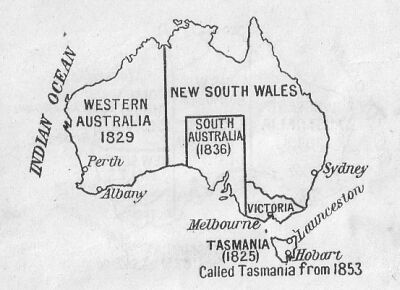


When the western boundary of New South Wales was extended from the 135th to the 129th meridian the intention was to bring within the scope of British possessions Melville Island, which was occupied in 1824. The whole of the Northern Territory was thus, at that time, within the jurisdiction of New South Wales. When Western Australia was founded, its inland boundary was naturally drawn at the 129th parallel, which thus became the eastern boundary of Western Australia and the western boundary of New South Wales. These two colonies, therefore, absorbed the whole continent.
Then South Australia was founded, on a large tract of country carved out of New South Wales, and having its northern boundary at the 26th degree of south latitude. Still the Northern Territory remained technically part of New South Wales.
Next Queensland was formed, in 1859, with its southern boundary at the 28th parallel of south latitude, whilst the western boundary, under the somewhat ambiguous terms of the letters patent, was interpreted to be the 141st meridian of east longitude, which was also the eastern boundary of South Australia. So that now the Northern Territory, though still technically part of New South Wales, was no longer contiguous to any portion of the country over which that colony exercised governing functions.
The question therefore arose,--What was to be done with this vast central slice of Australia?
Queensland very soon formed the shrewd conclusion that it would be to her advantage to secure more of the Gulf country than she already had. A. C. Gregory, the explorer, who was Surveyor-General of the young colony, pointed out that the 141st meridian would cut off Queensland from 'the Plains of Promise,' as he called the fertile tropical flats at the head of the Gulf. So in 1860 the Parliament of Queensland requested the Imperial Government to allow the western boundary to be defined, not at the 141st degree, which was mentioned in the letters patent constituting the colony, but at the 138th degree. The granting of the request in 1862, by shifting the boundary westward, enabled Queensland to annex 120,000 square miles, including the Barklay Tableland and a fine belt of fat pastures which in good seasons formed a very valuable possession.
Another slight change of boundaries was made in 1861, when the strip of country between South Australia and the Western Australian border, that is, between the 132nd meridian and the 129th--about 70,000 square miles--was transferred to the first-named province.
But the Northern Territory was still unappropriated. New South Wales could not administer it, and the Imperial Government did not wish to undertake the control of it. Sir Charles Nicholson, the Speaker of the Queensland Parliament, writing in July 1862, suggested that it should be temporarily annexed to Queensland. But that colony was not prepared to undertake financial responsibility on account of the Territory, and it did not suit the Colonial Office that there should be control without responsibility. The Permanent Secretary, writing in August 1862, observed that it would be necessary that some measures should be adopted for conferring protection and enforcing order among the squatters, who were already examining parts of it with a view of depasturing their stock upon its grass-lands. The Government desired 'to avoid expense, risk, and inconvenience,' such as would be entailed in founding a tropical colony. They did not mind whether Queensland or South Australia assumed control, as long as the Territory was provided for in some way.
While the matter was under consideration, in the second half of 1862, McDouall Stuart was making his successful overland journey from Adelaide to Port Darwin, and South Australia was eagerly awaiting his return. If he came back and reported that the Territory contained valuable pasture land or mineral deposits, South Australia wanted to get control. Very much depended upon his report. In September 1862 the Colonial Secretary, the Duke of Newcastle, had intimated that he was willing to annex to South Australia all that portion lying south of the tropic of Capricorn, leaving the remainder to Queensland. But South Australia did not want that. She desired to get control of the whole Territory if she assumed any responsibilities at all on account of it.
McDouall Stuart returned to Adelaide on December 17, 1862, and his report whetted the appetite of the colony. South Australia was now eager to annex the Territory. The real value for pastoral and other purposes of the region through which the exploring expedition had passed was now fully made known, and Sir Dominick Daly, the Governor of South Australia, reported to the Imperial Government that its importance was so well recognized that 'applications have been forwarded to my Government by stockholders of this province with a view to secure the earliest claims to parts of the pastoral lands which have thus recently been made known on the Victoria River and Arnhem's Land.'
The Imperial Government was very glad to have the Territory taken off its hands, and promptly announced to the South Australian Government (May 26, 1863), that their wishes would be acceded to. Letters patent were accordingly issued in July, annexing the Territory to South Australia 'until we think fit to make other disposition thereof.' That is to say, the Territory was not actually added to South Australia, but that province was entrusted with the administration of it.
The Government Resident, B. T. Finnis, who was sent up by the South Australian Government, selected as the seat of administration a site at Escape Cliffs, Adams Bay. The choice was adversely criticized, and the dissatisfaction led to the recall of Finnis. The opposition party wished the capital to be located on the Victoria River. But a place at Port Darwin was preferred, and the township was named Palmerston, after the Prime Minister. That name, however, did not come into general use. People preferred to speak of the place as Port Darwin, and when the Territory passed under the control of the Commonwealth the name of the town was formally changed to Darwin. When Dilke was in Australia collecting material for his book Greater Britain, he was invited by the commander of a British ship to make a voyage with him to the Northern Territory. If he would go he was promised that a cape or a town should be named after him; but he was advised to prefer a cape, as that would remain, though whether the town would retain its name, or even its existence, the officer could not guarantee. The case of Escape Cliffs was probably in his mind.
The burden of the administration of the Northern Territory continued to be borne by South Australia for close upon half a century. There was one dangerous period, in 1876-7, when the South Australian Government was in negotiation with the Government of Japan for the introduction of Japanese settlers. But the scheme broke down owing to political disturbances in Japan in 1877, and it was not revived after order was restored. (See Roberts, History of Australian Land Settlement, pp. 359-60.) In 1911 the Territory became a dependency of the Commonwealth. No less than 3,431,000 pounds of debt was incurred on account of its development, responsibility for which was taken over by the Commonwealth.
The history of the Territory has been uneventful. The most important piece of work done in it was the construction of the overland telegraph line in 1872. McDouall Stuart had pointed out that his own route 'could be made a straight line for telegraph purposes,' and this idea was taken up by the electrician, Charles Todd, who superintended the erection of the line from Adelaide to Port Darwin, connecting with the submarine cable to Singapore and the East.
Brief mention should be made here of the abortive settlement made by the British Government at Port Essington, on the extreme north-central tip of the continent, in 1838. A small station had been established at the port in 1831, in the expectancy that it would become a convenient harbour for ships. But it was very little used. When Bathurst Island was abandoned, troops were stationed at Port Essington. The Government kept up the station from 1838 to 1849. But settlement was not attracted to the spot, and the troops did not find the climate to be healthy or agreeable. An old aboriginal was still living near Port Essington in 1915, who remembered the soldiers, with whom, as a little black boy, he had been a pet seventy years before; and a traveller (Miss E. Masson, in An Untamed Territory, 1915, p. 127) who saw him relates how, at the mention of the old settlement, 'his back straightens, a curious change comes into his voice, and he feebly attempts to shout the old words of command-'Shon! eyes right!' So did the tones of some long-forgotten Cockney Sergeant-Major linger ghostlike by the shores of the Arafura Sea,' and recall a failure of the long ago.
Free scope left to the colonies--The protection afforded them-- Napoleon III and his supposed designs on Australia--The Shenandoah incident--The ballot--Constitutional reforms--Women enfranchised--Elective and nominee councils--Cowper's quarrel with the Council in New South Wales--McCulloch's protection policy in Victoria--David Syme--The Victorian constitutional struggle--The Darling grant--Payment of members-- Black Wednesday--Reform of Victorian Council.
The Australian colonies, having been endowed with complete self-governing powers in the manner previously described, were free to work out their own political destinies under the protection of the British flag, but with a minimum of interference from the British Government. They were at liberty to dispose of their lands as they chose, to raise revenue as they chose--they could tax imports from each other and from the mother-country, since no restrictions were placed upon their fiscal freedom--to make whatever laws they chose relative to their own form of government, the franchise, the relations of capital and labour, and everything else within the domain of social and political organization. They were enfranchised democracies, with scope for exercising democratic government under such favourable conditions as had rarely occurred before in the history of the world. They were relieved from trouble concerning foreign aggression, because they were sheltered by the greatest naval power in the world. That security was the dominating fact in the history of Australia. Her people, while they were developing their resources and shaping their institutions, never had any serious anxiety about the safety of their country.
There were occasional 'scares,' when wars and rumours of wars occupied the public mind, but there never was any serious danger. During the Crimean War, in 1854, the people of both Sydney and Melbourne were alarmed lest Russian cruisers should raid their ports. Sir William Denison, who was Governor of New South Wales at the time, had been an officer of the Royal Engineers, and took a lively interest in the fortification of Port Jackson. Fort Denison, which in later years came to be variously regarded as a picturesque survival or as an impediment to navigation, according to the disposition of the beholder, was constructed. Guns were also placed so as to command the entrance to the port and its channels. But the excitement was soon allayed, and there was no real cause for it, though it can be understood in view of the paucity of information as to what was happening in Europe; for there was no submarine cable at that time.
A curious document exists which, if genuine, shows that the Emperor Napoleon III at one time gave thought to the possibility of making an attack on Australia. While Lord John Russell was Foreign Secretary in Great Britain this paper came into his possession. Having read it, he put it in an envelope, scaled it up, and endorsed it with the words: 'Private. Very important. Questions drawn up by Empr. Napoleon with view of seizing our Australian colonies and reviving privateering. 1853.' The paper itself purports to reveal a series of questions 'upon the English colonies in Australia.' The questions related to the distribution of the population, whether the rule of the mother-country was popular, how many soldiers were in the country, what places were fortified, what artillery there was, whether 10,000 men would suffice to hold Victoria against any force which the English might bring to retain the colony, which would be the best points for a landing, what would be the principal obstacles to the success of such an expedition, whether Algerian troops would be well adapted for such an enterprise, and whether 'Geelong, Melbourne and Mount Alexander could be well fortified in a short space of time.' The spelling of Port Phillip as 'Port Phillippe' suggests that the person who supplied Lord John Russell with the information was a Frenchman; but the document is not in French, though it professed to be copied from an original written by Napoleon III. The copyist said, 'want of time, or rather the danger of discovery, did not allow of a complete copy being taken.'
Russell's informant was therefore, clearly, a spy, and was probably paid for the information he supplied. Whether in this instance he was supplying correct information is doubtful. Two of the questions do not indicate an intelligent knowledge of Australian geography. (1) The sensational gold discoveries at Mount Alexander in 1851-2 gave prominence to that place in the newspapers, but it is not easy to believe that Napoleon III considered that inland hill, near Castlemaine, a suitable position for fortification. (2) Another question referred to 'the colonies of Victoria and Sydney.' Although Lord John Russell thought the document 'important' in 1853, we should not now consider it as more than interesting. There is certainly nothing to corroborate the assertion of the spy that Napoleon III thought of attacking Australia.
During the last period of the American Civil War, in January 1865, the Confederate steamer Shenandoah entered Port Phillip, and her commander, Lieutenant Waddell, asked permission of the Governor of Victoria, Sir Charles Darling, to effect certain repairs to her machinery, and to take on board coal and supplies. The ship had put to sea from a port in Great Britain under the name of The Sea King, but her name had been changed to Shenandoah during her cruise, she had mounted guns of a ship of war, and had been employed in sinking vessels belonging to the Federal (or Northern) States of America. All British possessions were warned, when the civil war broke out in 1861, that it was necessary to observe strict neutrality, and the Foreign Enlistment Act forbade British subjects to take any part in the contest. The Shenandoah was entitled, under the international rules of war, to the consideration for which Lieutenant Waddell had asked, and no offence was committed against the Government of the United States (the 'Federal' Government) in permitting her to make repairs and take in supplies.
But while the ship was in dock, the American Consul in Melbourne warned the Governor that the crew of the Shenandoah was being strengthened by the enlistment of British subjects, and that at least one man had already gone on board. The Governor sent a police officer with a warrant to arrest the man. But Lieutenant Waddell refused to allow his ship to be searched for the purpose of executing the warrant. He said that the deck of a man-of-war was 'inviolable,' and that sooner than allow the police officer to make a search he 'would fight his ship.' At the same time he gave to the Governor 'his word of honour as an officer and a gentleman' that he had no British subject on board, nor had he engaged anyone, nor would he do so while he was in the port. There is no doubt that Lieutenant Waddell was not truthful in these undertakings and statements.
The Victorian Government placed a police guard to watch the ship and prevent British subjects from going on board. But despite these precautions the Shenandoah did augment her crew while she was within the port of Melbourne; and after leaving the port she committed further depredations against shipping belonging to subjects of the United States, which were computed by the Government of that country to amount to 6,300,000 dollars.
At the conclusion of the war, the United States Government made claims against the British Government for compensation on account of damage done by Confederate ships which had been allowed to sail from British ports. The greatest amount of damage was committed by the Alabama, and the whole case is consequently known by that ship's name. The claims were referred to a court of arbitration which sat at Geneva in 1872. The total amount awarded to the United States was 15,500,000 dollars (3,250,000 pounds). The arbitrators were not unanimous as to whether any sum ought to be awarded on account of the Shenandoah. Two were of opinion that no fault was committed at Melbourne; but three held that the Victorian Government had been negligent. By a majority of one, therefore, the court decided that Great Britain was liable for 'all the acts committed by that vessel after her departure from Melbourne on February 18, 1865.' As the court decided to award what it termed a 'sum in gross,' without specifying how much was allowed in particular instances, the official record does not state what sum was awarded on account of the Shenandoah; but though the amount cannot be precisely ascertained, there is evidence to show that it was about one-fourth of the total sum. Sir Alexander Cockburn, afterwards Lord Chief Justice of England, who was a member of the court of arbitration, held that the award in respect to the Shenandoah was unjust; and the Secretary of State wrote to Governor Sir Charles Darling, informing him that in the opinion of the British Government the actions of the Victorian Government in the matter had been correct.
The constitutions conferred upon the colonies were not unalterable instruments. They contained within themselves power to 'repeal, alter, or vary' any provision. Thus, if New South Wales had desired to substitute an elective for a nominated Legislative Council, she could have done it by the simple passing of an Act for the purpose, provided that the Act was passed by an absolute majority of the members of each House. That the colonies would wish to alter their constitutions in some respects was soon evident. As has already been pointed out, a very large number of those who immigrated to this country in the gold-digging era were English Chartists or men strongly imbued with Chartist or extreme radical political ideas. Men like Henry Parkes, David Syme, Graham Berry, James Service, and many others who influenced thought or directed policy in Australia, had either been actively connected with English Chartism or were imbued with Chartist principles. They quickly saw opportunities for realizing their opinions in Australia years before there was a possibility of securing substantial reforms along such lines in Great Britain.
The attainment of voting by ballot presents a good illustration of this statement. The principle was one of the six 'points' of the English Chartists, and at the time when responsible government was conferred upon the Australian colonies it had not been adopted anywhere within the British Empire. It was brought forward in the Legislative Council in December 1855. On a resolution in favour of voting by ballot in the Electoral Bill then under consideration being carried against the wish of the Government, the first Victorian Premier, Haines, resigned office. But the motion, which was submitted by William Nicholson, was adhered to by the House. Clauses embodying the ballot principle were prepared by Henry Samuel Chapman, then a member of the Victorian Legislative Council, and afterwards a judge in New Zealand. Nicholson, though his motion secured the adoption of the ballot principle, was unable to work out a practical method of giving effect to it. Chapman's legal skill came to his assistance, and he was therefore the real author of the Victorian ballot system, which was passed into law in March 1856. In April 1856, South Australia also adopted a ballot system. The other Australian colonies soon followed these examples.
Yet there were many at the time who had grave misgivings about abandoning the old familiar method of open voting at the hustings, and, curiously enough, amongst them was Hugh Childers, then the Victorian Commissioner of Customs, but afterwards a member of several Liberal Governments in Great Britain. In England, where bills to institute voting by ballot were rejected twenty-eight times by the House of Lords, and where the supporters of the principle did not succeed till 1872, the system proposed was generally called during the discussions 'the Victorian ballot'; and a learned critic of American institutions records that in that country 'secret or as they are called "Australian," official ballot laws are now in force in all the States except Georgia and South Carolina' (Bryce, American Commonwealth, vol. ii, 148)
The Australian reformers brought with them from Great Britain a stock of political ideas which those who advocated them had failed to embody in legislative shape there, but which it was much easier to enact in Australia. Phrases of English origin became the common stock of Australian politics. The phrase 'one man one vote,' which expressed the aspiration to abolish dual or multiple voting powers for the propertied classes, was coined by Major Cartwright, the English radical, in the great days of Pitt and Fox. It is the law in all the Australian States, and the Commonwealth constitution enacts that 'in the choosing of members each elector shall vote only once.'
The principle of payment of members of Parliament, adopted in all the Australian colonies, was a Chartist demand. The abolition of the property qualification for members of the popular house of legislature, which all the Australian colonies likewise adopted, was taken from the Chartist programme. So was manhood suffrage. The 'People's Charter' of the early Victorian radicals did not, it is true, embody women's suffrage; and the main arguments for that principle were borrowed by its Australian supporters from John Stuart Mill and his school. South Australia was the first of the six colonies to confer the franchise on women (1894). Western Australia (1899) was the next. New South Wales (1902) was the third. Tasmania enfranchised women in 1903, Queensland in 1905, Victoria in 1908. When the Commonwealth was established, women were enfranchised under the constitution; and are also eligible for membership of Parliament.
The two colonies (New South Wales and Queensland) whose Legislative Councils were, in the commencement of responsible government, elected as nominee chambers, adhered to that system until 1922. In that year the Legislative Council of Queensland was abolished. In the four other instances the Councils were elected by constituents possessing property qualifications. In 1934 the constitution of the Legislative Council of New South Wales was altered (see earlier, Chapter XVIII).
There was one sharp crisis with the New South Wales Legislative Council in the early years of its history. The constitution of 1855--Wentworth's Act--provided that the first Council of twenty-one members should be appointed by the Governor for five years, but that at the expiration of that term 'all future members shall hold their seats for the term of their natural lives.' It happened that during those first five years the Government headed by Charles Cowper had introduced a Land Bill designed to make it easier for poor men to acquire farms. The bill, whose author was John Robertson, embodied the contentious principle of 'free selection before survey,' which meant that a selector desiring to obtain a piece of land could enter upon any crown land--even if it were already leased to a squatter--pick out a block, and settle upon it. But the squatters who occupied large areas of land leased from the Crown objected to this proposal, because it would enable selectors to enter upon their sheep-runs, pick out the best pieces, such as well-watered and fertile parts, and leave them with the inferior land. It would also, they urged, enable men who had no real intention to settle to enter upon a leased run and select, in the hope that the squatter would pay them something to get rid of them. As the Legislative Council consisted largely of landowners and others who were friendly with the squatter class, it was quite expected that that House would amend the Cowper Government's Bill.
The bill passed the Legislative Assembly in 1861. The five years' term of the first Legislative Council was drawing to a close; and had Cowper delayed the measure for a few weeks, he would have been able to nominate such a Council as would certainly pass it. But he was impatient to get his Land Bill upon the statute-book, and when the Council amended it so as to prevent a selector from picking out land upon a leased run, he adopted the startling course of advising the Governor (Sir John Young) to appoint twenty-one fresh members. But those nominees never took their seats in the first Legislative Council of New South Wales; for when they presented themselves to be sworn in, on the last day of sitting of the last week of the five years' period, the President, Sir William Burton, at once resigned office and walked out, followed by the majority of the members. Governor Young was afterwards censured by the Secretary of State for the Colonies for accepting advice to create 'upon a sudden and for a single night' sufficient Legislative Councillors to convert a Government minority into a majority. The new Council--entirely nominated, of course, by the Cowper Government--carried its land legislation without demur.
After this incident the Cowper Government proposed to make the Council an elective body. Wentworth, who had watched the proceedings just narrated with indignation, now favoured the elective principle, since, he declared in wrathful scorn, the nomination system had enabled a Government 'to sweep the streets of Sydney in order to attempt to swamp the House by the introduction of twenty-one members.' But a committee to which the bill for establishing an elective council was referred reported strongly against establishing an upper house based on manhood suffrage; and, as Cowper had intended to make a wide franchise the complement of his scheme, and now saw no hope of doing so, he did not persist with it. In 1872 Henry Parkes made an attempt to introduce an elective element into the Council, but failed to convince Parliament that a change was desirable.
Not long after the commencement of responsible government the elective Legislative Council of Victoria became engaged in a bitter struggle with the Legislative Assembly, and public opinion in New South Wales, watching the exciting events which were occurring over the border, saw that the nominee system did after all afford a ready means of bringing the Council into harmony with the policy of the Ministry of the day, by the nomination of new members; whereas, under the system of election on a property qualification, there was a much graver risk of the two Houses getting into conflict and deadlock.
The Victorian quarrel, the first of a succession of such disputes between two legislative bodies, was of great interest in the history of parliamentary government in the British Empire; and the importance of it is increased by the fact that it was connected with the initiation of what ultimately became the economic policy of Australia as a whole. In 1864 the Ministry of James McCulloch gave its support to the principle of imposing customs duties upon imports, with a view of encouraging the manufacture of those goods in Victoria; that is, to the principle of protection. The conversion of McCulloch and his colleagues to this policy had been somewhat sudden; for in a public speech at the previous general election he had plainly declared, 'I am opposed to protection; what the colony wants is to buy in the cheapest market and to sell in the dearest.' But a strong body of public opinion had by this time been formed in favour of the protective system, largely under the influence of a man who played a silent but powerful part in Victorian politics for about half a century.
This man was David Syme, a tall, granitic Scotsman, reared on oatmeal and philosophy; a student, but also a keen man of affairs; a thinker deeply interested in the serious literature and problems of the modern world, but one who, whether engaged in cattle-breeding, or scientific speculation, or politics, brought to bear upon the question in hand the full force of a strong will and a hard, critical, somewhat sceptical intellect. He came to Australia in 1853 and tried his luck on the gold diggings. There he made some money, though he had not much taste for the work. But in 1860 he found the real vocation of his life, as well as his path to fortune, and--what he valued still more--power.
His brother, Ebenezer Syme, had also come to Australia, and was at this time writing articles for a newspaper called the AGE, which had been started in October 1854. This journal had vehemently championed the cause of the Ballarat miners, but its original proprietors had no liking for the opinions expounded by the little group of men who wrote its leading articles. Ebenezer Syme and his colleagues were, indeed, slashing about in fine style; so that the proprietors, who had simply started the paper to make money and were disappointed in that regard, sold it in December to a co-operative group of printers, who had very little capital, but plenty of energy. Then David Syme came along with the money he had made from mining. His brother advised him to buy the AGE, which was on the brink of extinction. David Syme had no belief in the speculation. He doubted whether there was scope for another newspaper in Melbourne. But he did believe in his brother, who had been assistant editor of the Westminster Review in London, and was a man of keen insight. So in 1856 when the AGE, with its plant and type, was sold at auction, it was bought for 2,000 pounds by James McEwan, a Melbourne ironmonger, on behalf of the Syme brothers. The newspaper did not make sufficient profit to maintain both of them, and David Syme engaged in contracting till his accomplished brother died in 1860, when, rather unwillingly, he took over the management himself.
On many subjects Syme had thought himself into opinions which were at variance with those commonly entertained. Nearly everybody in Australia who took a keen interest in politics at that time was a free-trader. Cobden and Bright and the Anti-Corn-Law League had triumphed in Great Britain in 1845, when they won Sir Robert Peel to their side; and English colonists, especially those who favoured liberal principles, accepted free trade as a fixed part of the British system. Syme himself said in a letter that, when he started to advocate protection for native industries in the AGE, 'there was not, so far as I knew, a man in the whole country but was a free trader.' But he came to the conclusion that it would be very difficult, if not impossible, to establish successful manufacturing industries in Victoria as long as manufactures were exposed to the unrestricted competition of British and foreign firms, commanding large capital and great output. 'A bar is put upon the attempt at the very outset,' he said in the first leading article he wrote on the subject; and unless local efforts were protected by the imposition of duties on imported manufactures, the people of this new country would 'be as utter strangers to all scientific skill and practical dexterity in the arts and manufactures of highly civilized nations as are the Bedouins of Barbary or the Tartars of Central Asia.'
Whether this was a true theory of trade or otherwise is not a subject with which we are now concerned. We have to do with historical causes and consequences; and the effect of Syme's advocacy of protection, which he maintained with unflagging vigour, was very remarkable. During a period of commercial depression he persisted in his policy, and very soon there was a strong party in Melbourne which carried the agitation to the platform and forced it forward as a political issue. Politicians who had scouted protection began to realize that Syme's journal was carrying weight with the electors. A parliamentary champion was found in Graham Berry, a London Chartist with a fervid oratorical temperament. After a general election in 1865 there was a majority of members of the Legislative Assembly in favour of imposing a protective tariff, and McCulloch, who, like many others, had swung round, pledged his Government to introduce one.
When McCulloch carried out his promise by submitting a tariff to Parliament in 1865, his Government was already engaged in a quarrel with the Legislative Council, which he had proposed to reform by reducing the property qualification and shortening the period for which the members were elected from ten years to five. The Council had promptly rejected this measure, and McCulloch judged from the tone of the debate and his knowledge of the political atmosphere that his tariff would be treated in a similar manner. He therefore determined to throw down a challenge to the combative Council by sending the tariff to it not in a separate bill, which would have been the proper procedure, but 'tacked' to the Appropriation Bill for voting money for the ordinary annual services of the country.
The expedient of 'tacking' a measure known to be repugnant to an upper house, to an annual appropriation bill, was not a new one. It had been done in England in the reign of William III, but had always been regarded by the House of Lords as an unconstitutional procedure. But McCulloch clearly meant not merely to force his protective tariff through Parliament, but also to break the Legislative Council, which he had failed to reform. By 'tacking' the tariff to the Appropriation Bill he threw upon the Council the responsibility of accepting or rejecting the whole measure, since under the Victorian constitution a bill appropriating revenue was one which the Council was not empowered to amend. It could accept or reject, but could not alter a line.
Then commenced a protracted conflict of exceptional acuteness. The Council 'laid aside' the bill. Consequently the Government did not obtain authority to spend the money which was required to carry on public works, pay the civil service, meet bills, and so forth. Meanwhile the Government continued to collect revenue from importers, who were compelled to pay duty on their goods. This they did in accordance with the British practice, which made duties of customs collectible from the time of the proposal of new rates to the House of Commons, and before they had been sanctioned by Parliament. Some of the merchants sued the Government to recover money which they held to have been illegally collected, and the Supreme Court decided in their favour. But the Government defied the Court and went on collecting the revenue, which it was legally neither empowered to take nor authorised to spend. McCulloch's ingenuity hit upon the device of borrowing 40,000 pounds from the London Bank of Australia, of which he was a director, and then inducing the Bank to sue the Government for the recovery of the money borrowed. The Government did not defend the suit, the Bank got judgment in its favour, and the Governor authorised the handing over of the 40,000 pounds. It was clever, and it enabled the Government to tide over present difficulties under shelter of law. By several repetitions of the processes of borrowing and of paying back under an order of the Court, the claims of the public creditor were met. But the difficulty between the two branches of the Legislature remained unsettled.
In November the controversy entered upon a new phase, when the Government consented to send a separate tariff bill to the Council, thus removing the 'tack' to the Appropriation Bill which had given such offence. But the bill now contained a retrospective clause, designed to render of no avail judgments which had been obtained from the Supreme Court by the merchants who had sued the Government. The Council objected to this and several other provisions of the bill, and refused to pass it. The position of deadlock between the two Houses was therefore unrelieved.
As there was no constitutional means of settling such differences, the Government determined to appeal to the country. The Governor, Sir Charles Darling, on the advice of his ministers, granted a dissolution of the Legislative Assembly. The Legislative Council, though an elective body, was not, under the constitution, affected by a dissolution. Its members held their seats during the ten years for which they were elected, no matter what happened to the other branch of the Legislature.
The general election evoked to the shrillest pitch the storm of controversy which had raged in the country during the discussion of these events. The opulent resources of the English language were fully exploited for terms of abuse which partisans hurled at each other. The issue was mainly that of protection, and the action of the Council in rejecting the tariff. The Council itself, though thoroughly unpopular, certainly had constitutional justification for refusing to pass a money bill with extraneous provisions 'tacked' to it. But the set of public opinion against what was generally regarded as a compact body of landowners fighting for their own interests was so determined that the constituencies were little inclined to weigh technical justifications. The McCulloch Government was swept back to power on a wave of popular enthusiasm, and it faced the new Parliament in 1866 with a solid and resolute protectionist majority behind it.
Even now, however, the Council would not yield. Once more it rejected the Tariff Bill, which, it must be confessed, received little consideration on its merits as a measure of protection, because it was complicated with provisions which McCulloch's pugnacious Attorney-General, Higinbotham, insisted on putting into it, and which, the Council held, ought not to form part of a bill imposing customs duties. The simple issue of tariff or no tariff was not laid before the Council. It was clogged with other principles.
McCulloch now resigned office, but the Assembly passed a resolution informing the Governor that it would not support any Government which did not persist with the bills already submitted to the Council. It was therefore plainly useless for the Governor to choose a Ministry from the opposition. No form of government which the wit of man can devise will work well unless those who live under it are prepared to oil its wheels with good-will. The British constitution, upon which the Victorian instrument was modelled, would break down unless in times of crisis a spirit of concession prevailed. But the two Victorian houses in 1865-6 had come to a condition of deadlock through a conflict of obstinate wills, and as the latter year wore on relations were strained almost to breaking point. There was much inflammatory rhetoric; revolution rumbled behind the menacing clouds of political conflict, something had to give way.
McCulloch resumed office, and reintroduced the Tariff Bill. It was passed for the fourth time and sent to the Council. But cool advice had been tendered to the members of that body, and they now proposed a conference between selected members of the two Houses. As the result of talks between fourteen representatives, the Tariff was at length accepted by the Council with the elimination of the retrospective clause and of certain expressions in the preamble declaratory of the rights of the Assembly, to which strong opposition had been made.
The protective policy, which was due mainly to Syme's advocacy, was thus initiated in Victoria amidst furious storms. Incidentally the struggle made the fortune of the AGE, and gave to Syme the pre-eminence in Victorian politics which he continued to exercise as long as that generation survived. He was a more vigorous thinker and a stronger personality than were most of the politicians, and he dictated policies to them from his newspaper office, confident that the electorate would follow his lead. His success was the result of hard fighting and a consummate understanding of how to manipulate political forces. But though the tariff issue was now settled, days of peace were by no means at hand. Rancours bubbled in the parliamentary cauldron, and fresh flames burst forth shortly.
The position of Governor Darling throughout the recent disputes had been one of exceptional difficulty. The disruption of the normal mode of financing the affairs of government, the resort to the expediency of borrowing money from a bank and getting the bank to sue the Government for the amount borrowed because Parliament had not passed the necessary Appropriation Bill, the uncompromising cleavage between the two Houses, the whole welter of bitter controversy, had thrown upon Darling responsibilities in discharging which he was bound to displease the one party or the other. He had acted upon the advice of his ministers, and that advice had been given in the heat of party conflict and for the purpose of winning party victory. But he had shown marked sympathy with his ministers, and had in an official despatch attacked certain petitioners against the action of the McCulloch ministry as guilty of 'conduct highly discreditable,' as 'ministering to their own personal and pecuniary profit' in what they had done, and as unworthy of ever holding responsible office. A review of Darling's actions during the crisis induced the Secretary of State to write a despatch censuring and recalling him.
But, however much the Legislative Council and its supporters might hate the Governor, he was a popular hero. The stalwarts of the Assembly declared that he had been victimized by the Colonial Office because he had not thwarted the popular cause. The rich squatters, they said, had compassed his ruin because he would not be their creature. Torchlight processions and public demonstrations were held in his honour, and he might have papered Government House with the illuminated addresses which poured in. The Assembly voted an address wherein it stated that Darling had saved Victoria from anarchy by adhering to the principles of popular government. As he could no longer expect employment in the Colonial Office the Assembly voted 20,000 pounds to Lady Darling.
Again the country boiled with excitement. The 20,000 pounds item was included in the supplementary estimates of expenditure, and the Legislative Council promptly rejected the bill, contending that such a grant ought to have been the subject of a separate measure. Though the new Governor, Manners-Sutton, sent a message to the Council informing it that Darling had resigned from the colonial service in the belief that the grant would be made, and that failure to make it would be in the nature of repudiation, the Council would not yield. McCulloch adopted in regard to the Darling grant the method that he had pursued on the tariff. He resigned, but his solid majority would not grant supplies to the Ministry which Manners-Sutton induced to succeed him. Then he consented to resume office on condition that he secured a dissolution which would enable him to take the verdict of the country. Once more he and his party were triumphantly returned. But this time the Imperial Government, thinking that Victoria had had enough of bitter strife, ended it by granting to Darling a pension of 1,000 pounds a year for life, whereupon he intimated that Lady Darling would not accept the 20,000 pounds which the Assembly was determined to vote.
There was another deadlock between the Victorian Houses in 1877 on the question of the payment of members of Parliament. The principle had been approved by the country, and the Legislative Council had twice (1870 and 1874) passed Acts embodying it. But these had been temporary measures, lapsing after a prescribed time. The Government headed by Graham Berry now (1877) resolved to make payment of members the permanent rule. A bill for the purpose was passed by the Assembly, but was rejected by the Council. Berry thereupon resolved to fight the Council; and he threw down a challenge to it by including the required sum in the annual Appropriation Bill. It was another instance of 'tacking,' and the rejection of the measure was a foregone conclusion. Berry was determined to exert coercive pressure upon the Council which had so often and so defiantly thwarted the Assembly.
As the Council would not pass the Appropriation Bill containing the offending item, and the Assembly would not have the bill without the item, Berry resolved to reduce expenditure and carry on government by an expedient. On January 8, 1878 (known in Victorian history as Black Wednesday), by proclamation he dismissed a considerable number of public servants from their offices. They were principally heads of departments and well-paid officials, and their sudden ejection from office, by depriving them of the means of paying rents, interest on mortgages, tradesmen's bills, and other debts, brought about an immediate collapse in the value of property. It was plainly intimated that other dismissals might follow. The plea was the necessity for reducing expenditure, but the political object undoubtedly was to bring pressure to bear on the Council and make its members sorry for their defiance. Next, Berry induced the Assembly to declare by resolution that grants of money voted by it were to 'become legally available for expenditure,' without the concurrence of the Council. Thirdly, he persuaded the Governor (Sir George Bowen), that he could legally sign what were called 'Treasury warrants,' authorizing expenditure which had been voted by the one house of legislature but not ratified by the other.
These were not strictly constitutional acts, but they were effective. In March 1878 intermediaries declared that the Council would now view the payment of members proposal in a more conciliatory spirit. The Appropriation Bill was passed without the 'tack,' and the Council agreed to a Payment of Members Bill to operate till the end of the existing Parliament, with the understanding that a permanent measure for the purpose would afterwards be accepted. In 1880 a bill making payment of members part of the regular governing system of Victoria was passed without dispute, the Council, however, stipulating that it should not apply to its own members.
There have been disputes between the two houses of legislature in other colonies, but none approaching in interest and constitutional importance, or in intense feeling, the celebrated Victorian struggles of 1865-6 and 1877-8. The memory of them caused the framers of the Commonwealth constitution to make especially careful provision for remedying deadlocks which might arise between the two houses of the federal legislature. The Victorian Council itself, moreover, recognized a little later (1881) that its own constitution was dangerously remote from popular influences, and reformed itself by reducing the property qualification of its members and electors and the size of its electoral provinces. After 1881 it became rather less of a squatting oligarchy, and somewhat more representative of human beings than of sheep than it had been in the years of its historical fights with McCulloch and Graham Berry.
Immigration--Anti-Chinese legislation--First inter-colonial conference-- Land legislation--Torrens Real Property Act--Labour questions--Trade union congresses--Labour politics--Great maritime strike--The Labour Party--Wages board system--Education, 'free, compulsory, and secular'-- The Universities--Sea-routes and steam-ships--Railways and gauges.
For the upbuilding of Australia, the first need was population to occupy its empty spaces and set its industries throbbing. The Wakefield system had provided for the application of the proceeds of land sales to the stimulation of a steady flow of immigrants from Great Britain, and a New South Wales committee on immigration which sat under the chairmanship of Chief Justice Forbes in 1835 strongly recommended that the land revenue should be 'held sacred' for this purpose. In 1842 Governor Gipps announced it as his intention to apply 'the whole of the money derived in any shape from land to the purposes of immigration.' But this policy was never consistently followed in any part of Australia.
In the days when the great squatting properties were being formed the landowners were by no means favourable to the encouragement of a constant stream of immigrant settlers. As long as they could obtain sufficient labour to shear their sheep and tend their herds they were content. They did not wish to see the good lands cut up among farmers, but considered that the country would fare better--or at all events that they themselves would derive larger profits--from the allocation of these areas among a wealthy class of sheep and cattle magnates. They were satisfied with convict labour; some advocated the introduction of coolie labour from China. But they were suspicious of the free immigration of a British peasantry and farming class, who would probably--as indeed they did--clamour for the breaking up of the large estates. Various systems of 'bounty,' 'assisted,' and 'nominated' immigration were, however, tried between the period of the thirties and that of the establishment of the Commonwealth, which was empowered under the federal constitution to assume control of immigration. In 1837 and later years George Fife Angas introduced a large immigration of German families to South Australia, where they proved themselves to be very valuable settlers. Dr. Lang also went out as an immigration missionary in behalf of his pet colonies of Victoria and Queensland, and wrote books extolling their attractions.
As early as 1841 a committee of the Legislative Council of New South Wales considered the advisableness of introducing coolie labour from Asia. The Committee reported strongly against the proposal, chiefly on two grounds. First, the introduction of an alien and servile element was deemed to be undesirable because it would alter the racial character of the population. It would prevent the maintenance in Australia of 'a social and political state corresponding with that of the country from which it owes its origin.' Secondly, coolie labour would compete with immigrants from Great Britain, and so seriously lower wages that ultimately coolie labour only would be imported. This view was supported by the ablest of Australian governors, and by statesmen in Great Britain who gave attention to Australian affairs. Sir Richard Bourke wrote that the introduction of coolie labour would mean 'a sacrifice of permanent advantage to temporary expediency'; and Lord Glenelg, the Secretary of State for the Colonies, emphatically declared that the introduction of Asiatic labour would bring agricultural work in Australia into disrepute, and consequently check the immigration of labourers from Great Britain. The clear expression of these views in the late thirties and early forties of the nineteenth century was an interesting prelude to the policy which Australia was hereafter to lay down as essential to her existence as a nation of European origin.
A disposition to exercise a filtering care in the character of immigration made itself apparent as soon as representative institutions got to work. The South Australian constitution had barred that province against the reception of convicts from the beginning; and the first Legislative Council of Victoria passed very stringent Acts against the incursion of expirees and ticket-of-leave men from Tasmania. The influx of Chinese to the gold-fields drew attention to the danger that menaced Australia from the fact that her shores lay within a few days' steaming of the overcrowded areas of Asia. In 1858 there were 33,000 Chinese on the Victorian gold-fields, whilst five years before there had been fewer than 2,000. The antipathy to them existed mainly among the miners and artisans, but there were others also who on broad grounds considered that it was undesirable to permit an admixture of races in this sparsely populated land.
The first Act to limit Chinese immigration was passed in Victoria in 1855. It imposed a poll-tax of 10 pounds on each Chinese immigrant, and forbade ships to carry more than one Chinese passenger for every ten tons of the vessel's tonnage. Four years later the law was stiffened by requiring Chinese to pay a residence tax of 4 pounds per annum. This legislation was not disallowed by the Crown, though the Secretary of State wrote that it was considered highly objectionable in principle. Queensland and New South Wales also became uneasy about Chinese immigration. Both colonies passed stringent measures. Parkes was confronted with an awkward anti-Chinese feeling in 1888. The British Government at this time was disposed to frown upon the exclusion policy, which they did not regard as being in harmony with British treaties with China. Lord Salisbury, then Foreign Secretary, had received a protest from the Chinese Ambassador. But it was impossible to disregard the repugnance of the people for whose welfare the various Australian Governments were responsible. There were riots in Brisbane, and mob violence on the gold-fields created a dangerous situation. Parkes felt it to be necessary to speak plainly. The Australians, he publicly declared, were not 'school-children who can be called to account by the Prime Minister of England'; and 'neither for Her Majesty's ships of war, nor for Her Majesty's representatives, nor for the Secretary of State, do we intend to turn aside from our purpose, which is to terminate the landing of the Chinese on these shores for ever.'
The legal right of a British colony to exclude aliens whom it does not desire to admit within its borders was determined in the Victorian case of TOY versus MUSGROVE. In this case a Chinese commonly known as Ah Toy--his full name was Chung Teong Toy--came to Victoria in 1888 in the ship Afghan. He was one of 268 Chinese in the vessel. That number was 254 in excess of the number of Chinese who could be admitted from a vessel of the Afghan'S tonnage, under the Victorian law. The collector of Customs at Melbourne, Musgrove, acting under instructions from the Minister of his department, refused to allow these persons to land. Ah Toy thereupon brought an action in the Supreme Court of Victoria, to test the legality of his exclusion. The Supreme Court, by a majority of four judges against two (Chief Justice Higinbotham and Mr. Justice Kerferd being the minority) decided in favour of Ah Toy. But the Government of Victoria appealed to the Privy Council, the highest court of appeal in the British Empire in cases from the colonies. The Privy Council, in 1891, decided that 'an alien has not a legal right, enforceable by action, to enter a British colony.' That judgment set at rest all doubt as to the right of the Australian colonies to pass laws to exclude Chinese, or any other aliens, if they thought it prudent to do so.
The common feeling on this burning question induced Parkes to call a conference of representatives of the various Governments to consider a common line of policy, and that inter-colonial conference, held in June 1888, brought all the colonies to a common line of action upon a matter of public policy.
The land legislation of Australia might very well be described by the phrase which Oliver Cromwell used concerning the laws of England--'an ungodly jumble.' In all the colonies, in the beginning, it was easy to get land. The aim of Government was to induce people to settle. An unmeasured space waited occupation. Naturally, the best land soon became the possession of comparatively few people, who acquired it cheaply and held it in large estates. But, as population increased, these large holdings were found to be inconvenient. Broadly speaking, the aim of Governments, since the era of responsible government, was that of settling a yeomanry. John Robertson's 'free selection before survey' policy in New South Wales, Charles Gavan Duffy's Land Act in Victoria in 1862, the Homesteads Act of Queensland, and many other Land Acts, had this aim in view. In all the States there were fierce conflicts between the squatters, who got there first, and the selectors, who complained that the good land had mostly gone before they were born; that the lands which were fit for cultivation were being used for feeding sheep, whilst the lands which were quite good enough for sheep but doubtfully good enough to cultivate were all that were available for the higher purpose. To the student of Australian history it will appear that such a conflict of interests was bound to arise. It could only have been avoided if the Government, from the commencement, had withheld land from those who wanted to use it for the purposes for which it was at the time most profitably adapted; or if some rigorous prescription of areas had been applied.
In later years various expedients for decreasing the great estates have been attempted: compulsory repurchase and the imposition of taxation on unimproved land values being the favourite methods. Many experiments failed. Duffy's scheme for settling farmers on crown lands on easy terms resulted in much 'dummying' by squatters and others who put up their own nominees to acquire land for them; and Robertson's free selection policy resulted in 'peacocking' by squatters who induced sham selectors--really agents of their own--to apply for and obtain the best part of leased runs on Crown lands. Many a well-intentioned act that aimed at creating opportunities for small farmers, in the long run made large estates bigger. Moreover, the diversion of much of the energy of younger generations to manufacturing industries, which sprang up behind the barrier of customs duties, weakened the pressure upon the country areas. The policy of water conservation and irrigation, in some localities, has occasioned a degree of intense culture upon small areas that would have seemed impossible to former generations.
South Australia had much less difficulty with her squatters and her land than had the other colonies. The trouble in New South Wales and Victoria was that squatters had been allowed to occupy leased runs and to spend money in making improvements upon them, without any really clear reservation of the right of the Crown to dispose of the lands to farmers in smaller areas; and the squatters, therefore, resented the intrusion of late comers who wished to pick out the best pieces for settlement. But South Australia laid down in wide terms a clear and simple rule which reserved to the Government the right at any time to resume leased lands 'for any purpose of public defence, safety, improvement, convenience, or utility.' The handling of land questions in South Australia was marked by forethought and practical wisdom; and in one conspicuous particular she devised legislation which has been copied with beneficial results not only throughout Australia but also in many colonies of foreign nations.
That reform was the Land Transfer Act, commonly known as the Torrens Act. Robert Torrens was the collector of customs at Port Adelaide. He was not a lawyer, and he knew little about the intricacies of the legal methods of land transfer which had been copied in Australia from Great Britain. If a man bought a piece of land, he became possessed of a sheet of parchment whereon was engrossed at great length the tale of the previous ownerships of the property. These parchment title-deeds were costly, and the phraseology of them, which only a legal specialist could profess to understand, had been the subject of innumerable judicial decisions. Torrens knew, from his experience as a customs officer, that shipping was bought and sold without all this engrossing of prolix jargon. There was an official register in which the change of ownership of a vessel was entered, and a simple certificate from the registrar was a sufficient token that the person named in it was the legal owner. Torrens asked himself why such a cheap and easy method should not be adapted to the transfer of land.
When South Australia acquired responsible government Torrens entered Parliament as member for Adelaide, and commenced to advocate his improved system. But he was opposed and ridiculed. Lawyers declared that land had been transferred by means of title-deeds from time immemorial, and that no other method would give an owner security of tenure. The Chief Justice said that mere registration would not suffice. When Torrens brought a bill embodying his suggestions before Parliament he was laughed at. How could a layman presume to argue that another method was easy and safe, when experienced lawyers assured him that it would never do? But Torrens insisted that it would do, and the South Australian Parliament, despite the opposition of the legal members, believed him. The Real Property Act was passed in 1858, and Torrens himself, resigning his seat in Parliament, was appointed to draw up the regulations under it, and superintend their working.
The result was completely successful. A landowner who registered his property under the Torrens Act received the duplicate of a certificate which the office retained; and this was perfect evidence of his possession. If he wished to sell, the purchaser obtained the certificate from him, and, on the sale being registered, the change of ownership was complete; if he wished to mortgage, the certificate was taken to the Registrar's Office, and the mortgage was marked upon it. There was no delay, the process was cheap, and anybody could, by paying a small fee, find out at the Registrar's Office who owned any piece of land at any time.
The other Australian colonies very rapidly adopted the Torrens system, and it was likewise applied in the French colonies. Indeed, Leroy Beaulieu, in his great treatise on Colonization Among Modern Peoples, states that such a system of land transfer is essential to the success of a colony. He claims (vol. ii, p. 25) that the idea had a Frenchman for its 'inventor' thirty or forty years before it was worked out by Torrens in South Australia. It may be so; but Torrens certainly derived his idea from his experience among shipping, as explained above, not from any book or outside suggestion.
In the last quarter of the nineteenth century labour questions began to assume an importance which they had not previously had, though there was as yet no sign of the growth of a distinct Labour Party in Australian politics. The trade unions, in the beginning, were simply industrial organizations, modelled on the lines of English societies of the same kind; and, as far as concerns their purely industrial functions, they have retained their original character. The earliest record of a combination of workmen to raise wages occurred in 1837, when a meeting of ship owners in Sydney was held to consider the demand made by seamen and labourers usually employed in the outfit of vessels that their wage should be raised from 3s. to 4s. per day. The demand was resisted because it 'did not arise from scarcity of seamen or labourers, nor from inadequacy of wages hitherto paid,' but from 'combination on the part of the men, which they believe they can carry into effect at this important and busy season of the year.'
But there is no clear evidence of the existence of organized trade unions before the beginning of the goldfields era. There was a Masons' Society in Melbourne in 1850, but whether it was a true trade union is not clear. In 1855, however, there were certainly unions of stonemasons both in Sydney and Melbourne, and they adopted from a kindred society in the same trade in Otago, New Zealand, the idea of agitating for an eight-hours working day. The eight-hours day, like trade unionism itself, and like the political projects of the Chartists, was an English working-class ideal. It was adopted in nearly all trades in which there were trade unions. After 1879 there were several trade union congresses; and the fact that the first gathering of the kind took place several years before the first inter-colonial conference of politicians on any question of public interest is noteworthy.
The object of these congresses was primarily to consider matters of concern to trade unions; but there were also manifestations of political tendency. Thus the congress of 1884 passed a resolution strongly favouring the payment of members of Parliament in those colonies where the system did not yet prevail, and one reason given for it was that it would enable the working class 'to get proper men to represent them, men who understood and knew how to advocate their wants.'
But the idea of working class representation was far other than that of forming a distinct Labour Party. The unionists of the congresses hoped at most to return a sufficient number of members of Parliament for electorates in which there were working class majorities, to influence legislation on advanced liberal lines. It was not till after 1890 that labour groups began to appear as distinct political factors, and not till after the establishment of the Commonwealth that they were serious competitors for power in the political arena.
The year 1890 was the pivot of the movement. A great maritime strike occurred in that year. A steamship captain dismissed a fireman who was a member of the Seamen's Union. The union took up the man's cause, and a strike commenced. At about the same time a society of ships' officers, having been unable to secure an increase of pay, and observing that trade union methods were generally more successful than their own had been, took steps to affiliate with the Trades Hall Council of Melbourne. To this the ship owners strongly objected. They required that the officers' society should renounce the connection before consideration was given to their rates of pay. But the society objected to its freedom to join with others being interfered with, and refused. A strike of officers ensued; and the seamen, firemen, and wharf-labourers decided to support them by striking also; so that the whole shipping trade was paralysed.
The dispute rapidly spread to other trades, for the unionists believed themselves to be face to face with an endeavour on the part of the employers to crush the unions from which they derived protection. A general unrest affected organized labour throughout Australia.
The Shearers' Union went on strike at the very time when the fleeces were ready to be cut. The issue was joined between organized labour and combined capital--between workmen who would only negotiate through their unions and objected to work with non-unionists, and employers who maintained their right to employ 'free labour.'
The maritime strike lasted three months, and was a cause of intense bitterness. It ended when the workmen had nearly exhausted their funds and saw their unions brought to the verge of bankruptcy. For they were fighting a very wealthy combination of employers, who were determined, as some of their spokesmen said, to 'break Trades Hall domination.' But the failure of 1890 changed the character of Australian unionism, and, ultimately, of Australian politics. The union leaders now began to preach the necessity for political aggression. The fight must be transferred to the legislative chambers. Parliamentary action must achieve what strikes had failed to win.
The Labour Party from this period became an aggressive political organization with independent aims. As long as its elected representatives were not strong enough to stand alone, they threw their weight into the scale in favour of policies as nearly in conformity with their own ideals as they could induce other parties to propose. Sometimes they managed to count almost as many votes as either of the two other parties, and then they supported the one which would make most concessions to them. In only one colony did a Labour Government hoist itself into being before Federation, namely, in Queensland, where in 1899 Anderson Dawson, the labour leader in the Legislative Assembly, formed a Ministry which endured only a few days. But since 1900 there have been several Labour Governments in the Commonwealth, and in every State.
The growth of manufacturing industries naturally brought into existence a number of laws regulating factories. Much attention was directed to legal methods of settling disputes between employers and workmen. The Victorian Wages Board system did not, however, originate from a desire to prevent strikes, though it has been used for that purpose, but as a means of suppressing 'sweating' in certain industries. Under cover of protective duties trades had sprung up in which there was fierce competition to supply a very limited market, and the inquiries of a Commission showed that the remuneration of labour in them was miserably low. In 1896, therefore, Alexander Peacock, the minister responsible for factory inspection in the Ministry of Sir George Turner, devised the plan of giving power to the Government to appoint a wages board for any industry in which it appeared desirable that wages should be fixed by such an agency. A Wages Board consisted of an equal number of members representing employers and employed--'a jury of trade experts'--presided over by a chairman who was not interested in the industry affected. It might fix wages, hours of labour, and piecework rates, and lay down rules for the conduct of the industry; and its determinations had the force of law. The system proved successful in the 'sweated' industries, and has since been greatly extended; so that in 1939 there were 194 Wages Boards operating in Victoria. These boards regulated wages and conditions for over 250,000 employees. The alternative to the Wages Board method of regulating wages and conditions of labour is the Arbitration Court method, which has been preferred by some States. These methods have been adopted since the rise of the Labour Party as a political force.
Education in Australia virtually has no history till after constitutional government was inaugurated. There were of course schools before then, and there were inquiries and experiments, but no real educational policy. The convict schoolmaster was at first in charge. His advertisements may be read in early Sydney newspapers: an excellent education offered at moderate fees; classics extra! Robert Lowe directed attention to the need for an improvement in 1844, when a committee under his presidency reported that more than half the children in New South Wales received no education whatever. The establishment of a Board of National Education in 1848 brought about a substantial improvement. But it was Henry Parkes, by his Public Schools Act of 1867, who set in operation the system which continued to satisfy the demands of the country till recent times, when fresh impulses were given to educational effort by a radical improvement of method, a clearer perception of aim, and a sounder system for training teachers.
The strenuous souls who fought for protection, land reform, the ballot, and manhood suffrage in the stormy years after 1855, had an educational ideal likewise. The educational system of the State must be 'free, compulsory, and secular.' In Victoria their policy was embodied in a bill introduced by Wilberforce Stephen in 1872. It set up a Department of Public Instruction, it made school attendance obligatory, it provided for opening schools throughout the country, and it prohibited teachers from giving other than secular instruction to the scholars. The Act, which came into force in 1873, has had many assailants, and the educational system of Victoria has in later years been very greatly improved, but fundamentally it remains as it was established under Wilberforce Stephen's measure. In all the Australian States there is provided a possibility of continuous education for the studious youth from the State school to the University.
Not the least of good reasons for holding the name of Wentworth in remembrance is that he was the initiator of the movement for the founding of the first Australian University, that of Sydney. He brought the subject before the Legislative Council in 1849, and three years later had the satisfaction to witness the opening of the institution. The University of Melbourne (1853) came into being owing to the suggestion of Childers, whose first official post was that of Inspector of Schools, and whose work in that capacity convinced him that the corner-stone of any scheme for raising the standard of learning in the country must be a University. Latrobe, the Lieutenant-Governor, gave his cordial support, and when the scheme reached fruition the first Chancellor, Redmond Barry, watched over the early fortunes of the University of Melbourne with paternal devotion. The University of Adelaide (1874) was the third to arise, that of Tasmania (1890) the fourth. The Universities of Queensland (1910) and Western Australia (1911) were the latest-born seats of the higher learning to be founded. All of them admit women to their degrees, following the example set by Melbourne, which took this step at the instance of the distinguished historian Charles Henry Pearson. In 1879, Pearson, while Minister of Education in Victoria, introduced a bill which provided that the degrees and diplomas granted by the University should be available to both sexes. As the bill did not pass in that year, owing to pressure of parliamentary business, the Council of the University forthwith decided to admit women to degree courses. Pearson's bill was introduced again in 1880 in order to remove any doubt as to the legality of the University's action, and was passed by the legislature. Legislation for a similar purpose was passed in respect to the University of Adelaide in 1880.
All the Universities are supported by Government grants, and some of them have also benefited from generous gifts by wealthy citizens. The Challis bequest gave Sydney an endowment of over a quarter of a million pounds, and the Russell bequest added an additional hundred thousand pounds to the funds. Sydney University also received 258,000 pounds from the G. H. Bosch Fund, and 42,000 pounds from the Fisher Estate. In addition it also receives a large annual revenue from the McCaughey bequest, while the University of Queensland received over 190,000 pounds from the same source down to 1940. The University of Queensland also received a gift of land valued at 62,000 pounds from the Mayne family, part of which is to provide a site for the new University buildings. The largest single benefaction, however, received by any Australian University was the bequest of 425,000 pounds to the University of Western Australia from Sir Winthrop Hackett; this University also received 60,000 pounds from the Gledden estate. The University of Adelaide has also had many generous benefactors, the chief being Sir Thomas Elder (100,000 pounds), Peter Waite (100,000 pounds), Sir Langdon Bonython (71,000 pounds) and Miss M. T. Murray (45,000 pounds), along with a number of other substantial endowments. The chief benefactions received by the University of Melbourne have been 60,000 pounds from Sidney Myer, 41,000 pounds from Sir Samuel Gillott, and 40,000 pounds from Helen Mackie, but there have been a number of other important bequests. The teaching functions have been aided by these and other endowments, and research has been promoted not only by the encouragement of prizes, but also under the inspiration of men whose contributions to knowledge have won for themselves distinction and for their Universities honour throughout the world of culture. The early student of Melbourne who listened to the lectures of Hearn on constitutional history sat at the feet of a master whose work was incomparably excellent in its day and is still important. A Sydney student in later times might pursue his work in geology under the direction of the discoverer of the south magnetic pole, Edgeworth David; and a Melbourne student of biology might learn more than his text-books could tell him from one whose original researches have revolutionized a branch of anthropology, Baldwin Spencer. The development of scientific research, and the application of science to the problems of agriculture, industry and every-day life, has been greatly helped through the setting up of the Council of Scientific and Industrial Research (the C.S.I.R.) by the Commonwealth Government in 1926. Already the C.S.I.R. has done most valuable work in solving practical problems, and in promoting the economic development of Australia. It employs hundreds of scientists and has an annual budget running into hundreds of thousands of pounds.
Australia is an offshoot of Europe, and its culture is European; but, in comparison with North America, which is in the like case, it labours under the disadvantage of being remote from the source. During the first half century of settlement the sea voyage generally occupied four months, or longer if unfavourable winds were encountered; and the discovery of a route which greatly shortened the time did not occur until the steamship was on the point of displacing the sailing vessel in the passenger traffic. It was in the forties of the nineteenth century that the American naval lieutenant, M. F. Maury, conducted his important scientific researches into the courses of winds and currents, and showed that if captains of ships outward bound from England to Australia, instead of running across the Indian Ocean from the Cape of Good Hope almost in a direct line, would dip down into the latitude of 48 degrees south, they would invariably meet with strong westerly winds and long rolling seas which would carry them forward very rapidly. By following his route, sailing ships made astonishingly quick runs. The JAMES BAINES in 1854 ran from Liverpool to Melbourne in sixty-three days and returned by way of Cape Horn to Liverpool in sixty-nine days, making the circuit of the globe in one hundred and thirty-two days. The MARCO POLO and other clipper ships famous in their day cut down the old sailing time by one-half. But mariners had only discovered how much more dependable the winds might be than their predecessors had supposed, when steam began to enable their services to be dispensed with. In 1856 the Peninsula and Oriental Company commenced to trade with Australia, and in later years the Australian has come to think himself imperfectly served if he is not able to read in Adelaide or Sydney letters posted in England a month before. In 1934 the development of aviation made it possible for letters to travel from London to Australia in a week. In that year the Commonwealth Government subsidised Qantas Empire Airways to carry mails, freight and passengers from Singapore to Brisbane, thus linking up with the Empire Airways service from London to Singapore. In addition, since 1920 the Commonwealth has also subsidised many air services within Australia itself. The opening of the Suez Canal in 1869 shortened the sea voyage between Australia and England, and the increased traffic led naturally to improvements in the quality as well as the speed of the service. When the Panama Canal was opened in 1914 it also gave a shorter sea-route to the West Indies and the east coast of North America. It made the sea-voyage from the east coast of Australia to New York shorter than the voyage to London.
The submarine cable has still more closely linked up this out-lying continent with Great Britain. There had been cable communication between London and the East for some years before the system was extended to Australia. In those days there was little co-operation between the colonies. Particularist lines of policy were pursued by each of them. The cable ought to have been a joint concern; but, failing that, the South Australian Government had the enterprise to step forward and do the necessary connecting work. She had in her service a skilful electrician in Charles Todd, who superintended the construction of an overland telegraph line 1,970 miles in length, following McDouall Stuart's track through the centre of Australia to Port Darwin. There it was connected with a deep-sea cable laid by an English company between Port Darwin and Java. The opening of this line in 1871 placed Australia and London within a few hours' communication. In 1902 another cable route was completed, linking up Brisbane with Vancouver across the Pacific. This line is the joint property of the Governments of Australia, Great Britain, Canada, and New Zealand. The development of wireless telegraphy led to further improvement and cheapening of overseas communications when the beam wireless service was started in Australia in 1927. In 1928 the Imperial cable and beam wireless services were brought under a single control, and are now managed by Cable and Wireless Ltd. In addition, an overseas wireless telephone service was introduced in 1930, whereby people in this country can speak to people overseas by telephone. Another important improvement in communications since 1923 has been the development of wireless broadcasting, which has enabled people in remote places to receive news and other services just as rapidly as those in closely settled areas and towns. Not only can people listen to programmes provided in their own countries, but overseas programmes from England and America can be relayed to Australian listeners. The number of listeners' licenses issued in Australia rose from 37,000 in 1924 to 1,130,000 in 1939.
The lack of co-operation between colonies which for too many years regarded each other as rivals instead of partners in the development of a great heritage had an unfortunate consequence in the era of railway construction. Efforts were made to arrive at an agreement to build to a common gauge, but they failed. Gladstone, while Colonial Secretary in 1846, recommended the adoption of a 4 ft. 8 1/2 in. gauge, but that was four years before the first line from Sydney to Goulburn was constructed. There was no railway in Victoria till after the gold diggings began, the first length having been from Melbourne to the Port (Hobson's Bay) in 1854. The first lines were owned by companies, but all the colonies afterwards determined to make railway building and railway policy state concerns.
In 1852 New South Wales appointed an Irish engineer-in-chief, who had been accustomed to the 5 ft. 3 in. gauge in Ireland, and who persuaded the Government to adopt that gauge, despite the advice of the Colonial Secretary. Victoria and South Australia, desiring to build to the same gauge as the principal colony, decided to follow suit, and both commenced to construct 5 ft. 3 in. railways. But meanwhile New South Wales appointed a new engineer-in-chief, a Scotsman, who was an intense partisan of the standard, or 4 ft. 8 1/2 in. gauge, and he 'left no stone unturned to bring New South Wales back to her first love, regardless of keeping faith with the other colonies, whose railways were now progressing with comparative rapidity, and who had already reversed their policy once in order to keep in line with New South Wales.' The Scotch engineer won his way, the 1852 Act was repealed in 1855, and 'the most lamentable engineering disaster in Australia was an accomplished fact.' (Professor W. C. Kernot, in Proceedings of Victorian Institute of Engineers, vol. vii, p. 73.)
The result was that traffic has ever since been incommoded and trade made costlier by a break of gauge at the border between the two States. The Commonwealth line from Port Augusta to Kalgoorlie (1,051 miles) was opened in 1917, completing a chain of lines from east to west. By 1939 there were 28,000 miles of railway in the country, but there had been little new railway construction since 1929. The falling off in railway construction since about 1920 has been due, of course, to the growth of motor traffic, and the development of air services. In every state a central board has undertaken the building and upkeep of main roads, and since 1922 this work has been subsidised by the Commonwealth Government. The growth of motor traffic is shown by the increase in the number of motor vehicles registered from 239,000 in 1924 to 900,000 in 1939. The development of air-traffic has been equally arresting; between 1924 and 1939 the number of passengers carried during the year increased from less than 5,000 to nearly 150,000, mails from 175,000 lbs. to 740,000 lbs., and goods from 8,500 lbs. to 1,735,000 lbs. As a result of this competition the railway departments found it harder to meet all their expenses, but they were also stimulated to improve their services.
An ever-increasing variety in the industries of Australia has enlarged the possibilities of life for her people; and improvements in agricultural methods have made country work easier and more pleasant. Much of the rough, heartbreaking pioneer labour has been done; not all by any means, but aids and agencies are available to the enterprising man of the twentieth century which were not within the reach of his forbears half a century ago. He is helped and encouraged by the State, which is the whole community of which he is a member. Every country has its own peculiar problems to solve, and Australia has presented many tough difficulties. They have been attacked with the energy and the adaptability which have been the outstanding qualities of the Anglo-Saxon colonizing genius; and the crowning result of democratic government in these circumstances has been the creation for the country of the passionate attachment of an intelligent and virile people.
A 'Monroe doctrine' for the Pacific--French annexation of New Caledonia--The New Hebrides--New Guinea--Captain Morseby's discoveries-- The colonies and New Guinea--Queensland's awakened interest--Gold discoveries--German intentions--McIlwraith orders annexation of New Guinea--Action disavowed by British Government--Strong feeling in Australia--German annexations--Lord Granville's surprise--Kanaka labour--'Blackbirding'--Queensland regulates the labour traffic.
Prevost-Paradol, a French author who wrote an excellent book on the colonies of his country in 1868, predicted that 'some day a new Monroe Doctrine would prevent old Europe, in the name of the United States of Australia, from setting foot upon a single isle of the Pacific.' A policy so exclusive has never been promulgated, though a convention of all the Australian colonies which met at Sydney in 1883 did enter its protest against any foreign power being permitted to acquire fresh territory in the Pacific south of the Equator. But until the achievement of federation the people of Australia were too much immersed in their own particularist affairs to pay attention to, or even to take the trouble to understand, what their future interests might be in the many groups of islands powdered over the face of the Pacific. Only a suddenly stimulated sense of danger warned them, almost at the last moment, to reach out a hand towards New Guinea, lying close to their doors; and their concern for other parts of the Pacific has only been aroused when they have been awakened to its imminence by some striking circumstance.
The transportation of French prisoners to New Caledonia, and their occasional escape to Brisbane and Sydney, afforded such an instance. France annexed the island in 1853, and ten years later determined to use it as a penal settlement. After the Parisian insurrections of 1871, following the Franco-Prussian War and the anarchy of the Commune, between three and four thousand political prisoners were sent to this convict colony. They included journalists, professors, artists, artisans, and a varied assortment of common rascals. The most famous of the better sort was the intrepid political writer, Henri Rochefort. The Australian colonies became uneasy about the establishment so near to their shores of a foreign imitation of the system which they themselves had happily cast off, and their anxiety increased when escapees and time-expired convicts began to find their way to the eastern seaboard of the continent. The police of New South Wales, Victoria, and Queensland reported that between 1874 and 1883, at least 247 escaped prisoners and 'expirees' were known to have landed in Australia. The Imperial Government made polite representations to the French Republic, explaining that Australia thought the transportation system vexing and its continuance in New Caledonia rather unneighbourly. The French Government, moreover, was finding that by making New Caledonia a jail it was retarding the development of the great natural resources of the island. It therefore determined to discontinue the practice, and after 1898 convictism was abandoned. Up to that date 15,000 prisoners had been transported to New Caledonia.
The British and French joint occupation of the New Hebrides presents a more complicated problem. A French company commenced to buy land in this group of islands in 1882, and organized a regular trading service between them and Noumea, the chief town in New Caledonia. For some years previously the Presbyterian Church had been conducting missions to the Pacific Islanders, and the missionaries, who were strongly posted in the New Hebrides, knew all that was happening. They spread the alarm among the churches of their denomination in Australia. The Presbyterians, being a numerous and influential body, were able to bring political pressure to bear, through the Governments of the colonies, upon the British Foreign Office, which intimated to the French Government that the annexation of the New Hebrides, if that step were contemplated, would certainly give offence in Australia. France gave an undertaking not to annex the islands, and in 1887 a convention was signed between the two Governments by which the New Hebrides were placed under a joint British and French commission of naval officers. This system of government is called the Anglo-French Condominium.
The Convention of 1887 was modified by a more detailed and elaborate convention in 1906, providing a scheme of government for the New Hebrides. It described them as 'a region of joint influence,' in which the subjects of Great Britain and France enjoy equal rights of residence, personal protection, and trade, each retaining jurisdiction over its own subjects 'and neither exercising a separate control over the group.' A British and a French Resident Commissioner were stationed at Vila, in the island of Efate. The joint Naval Commission was also continued, its functions being mainly to maintain order. This somewhat awkward arrangement cannot be said to be satisfactory or to make for just and wholesome government.
To the north of Australia, separated from it by Torres Strait, lies the great island which the Portuguese called Papua, because of the frizzled hair of the natives. The Dutch, who formed small settlements on the north-west coast, adopted the Spanish name of New Guinea, by which it was more generally known. With the exception of Australia itself, Papua is the largest island in the world, having an area exceeding three hundred thousand square miles. It was inevitable that the Australian people should concern themselves about the ownership of a territory so near to their own country. Occupied by tribes of black warriors to whom its rich soil afforded an abundant sustenance without requiring strenuous labour from them, it had never been explored for its mineral resources nor used for tropical agriculture, except for native gardens. The navigators of the sixteenth and seventeenth centuries had often cruised along its shores. Dampier had named the promontory on the north-western extremity King William's Cape, 'in honour of his present majesty William III.' Torres, Cook, Bligh, Flinders and others had threaded the intricacies of the channels between the coral reefs of the strait. The shape of the island upon the map was defined with a fair approach to accuracy, and it was known to be the home of birds of gorgeous plumage, but hardly anything had been ascertained about the interior. Some day the attention of adventurers was bound to be directed to it. In any case, it was obviously not to the interest of Australia that a foreign power should be established there.
Yet Australian politicians were very slow to appreciate the importance of Papua. If in the years when the separate affairs of the colonies were absorbing attention and so little thought was devoted to the deeper interests of Australia as a whole, some of them had spent half an hour upon the study of the map, and had given a little consideration to the future, the whole of the island not already in Dutch hands might have been secured without much trouble. In later years newspapers and public men were wont to blame the British Government for its remissness; and, truly, that Government had been tardy, and had allowed itself to be deceived by German diplomacy. But a study of the official papers shows that the colonies themselves were also at fault.
Theoretically, the eastern peninsula of Papua had been British territory since 1846, when Lieutenant Yule of H.M.S. BRAMBLE landed at Cape Possession, in the Gulf of Papua, and hoisted the Union Jack. But it is not clear that he acted under formal orders to declare British sovereignty, or that his act had more validity than had those of two East India merchantmen who 'took possession of New Guinea and other islands of Torres Strait,' in 1793. The Admiralty, in a memorandum over twenty years later than Yule's action, expressed a doubt as to whether the territory was more than nominally British.
Not until 1867 did any body of persons in Australia turn towards Papua as a field for development. In that year a small New Guinea Company was formed in Sydney. It applied to the Government of New South Wales for assistance. That Government was not prepared to grant any, but forwarded a memorandum to the Imperial Government urging the annexation of New Guinea as 'a matter of the highest importance to the Australian colonies.' Lord Derby's Ministry, which was then in power, was icily unsympathetic. It refused to give any plan of voluntary settlement the sanction of Imperial authority, nor would it undertake to confirm any titles to the acquisition of land which persons who embarked in such a venture might profess to take from the natives. The Sydney Company thereupon dropped the venture.
A party of adventurous young men who set out from Sydney in 1872 to explore Papua with a view to settlement came to misfortune by shipwreck and murder by blacks. Thus a bad beginning had been made. A failure, a disaster, and the official frown of Downing Street marked the first phase.
The discoveries of Captain Moresby in H.M.S. BASILISK (1873) opened the next phase. He discovered a magnificent landlocked harbour on the south coast, and on landing formed a very high opinion of the fertility of the soil. So he hoisted the British flag, and took possession of eastern Papua pending the decision of the Government. The ceremony of taking possession had been performed so often by this time that it must have seemed like an entertainment got up for the amusement of the natives.
The importance of Moresby's discoveries was pressed upon the Imperial Government, which inquired of the Australian colonies what their views were. This afforded an opportunity to Australia to express a strong and united demand that steps should forthwith be taken to prevent any foreign power from acquiring rights in Papua. A new administration, that of Disraeli, had just come into office in Great Britain, with Lord Carnarvon as Colonial Secretary, and, had there been a clear intimation of what was wanted, there was nothing to prevent the annexation of the whole of Papua except the western portion, where the Dutch were. But the Imperial Government found that some of the colonies were lukewarm, whilst others were opposed to assuming any responsibility. It happened that, a short while previously, Lord Derby had made a speech in which he had expressed the opinion that 'Great Britain had already black subjects enough.' People are apt to be caught by phrases, and this one ran through a large number of speeches and leading articles. Thus, Governor Bowen reported from Victoria that there were few thinking men in that colony who did not 'agree with the principle that, as a rule liable to exceptions in particular cases, Great Britain has already black subjects enough.'
Even Queensland, which a little later was to manifest a passionate interest in Papua, reported on this occasion, through Governor Cairns, that 'but little interest is taken as yet in the destiny of New Guinea by either the Ministry or the outside public of that colony.'
The only Australian statesman who at this date (1874) showed any sense of the importance of the question was Henry Parkes, then Premier of New South Wales. He wrote an emphatic memorandum pointing out that the colonization of Papua by a foreign power would give rise to many embarrassments, whilst its colonization by Great Britain would be hailed with universal approbation. But Governor Robinson, in forwarding Parkes's memorandum to London, threw cold water over its argument, and suggested doubts as to whether there was any serious public opinion on the subject. It was, at all events, clear that there was no disposition on the part of the Australian Governments to share the cost of administering the country if it were annexed by Great Britain, and, as the Imperial Government saw no reason for imposing the cost on the British taxpayer, there seemed no more to be said. So ended the second phase.
The third opened in 1875, when Queensland awoke to the fact that the contiguity of Papua to her territory, gave her a special interest in its future. The Queensland Parliament passed resolutions urging annexation upon the Imperial Government. But the other colonies refused to join in bearing the cost of administration, notwithstanding that a rumour had gained currency that Germany was thinking of planting her flag in the Pacific. Lord Carnarvon, when this fear was brought under his notice, brushed it aside as unworthy of credence. 'The German Government has, I am informed,' wrote the Secretary of State, 'very lately intimated that it has no intention of acquiring colonies, and this intimation has special reference to New Guinea.' The sequel to the story shows how ill-informed the Foreign Office was as to Germany's designs.
But at the same time Lord Carnarvon promised that the Imperial Government would move as desired if the Australian colonies would pay the expense of governing the territory annexed; and Sir Michael Hicks-Beach, who succeeded him at the Colonial Office, plainly laid down the principle 'that the Australian colonies must bear the cost of an enterprise in which this country is not directly concerned, except in so far as it is of interest and importance to those colonies.'
In 1878 gold was discovered in Southern Papua, and the incursion of a fairly large number of miners made it necessary to take steps to maintain order among them. The task was placed under the direction of the High Commissioner for the Western Pacific, an office established in 1875 with headquarters at Fiji. The Commissioner, Sir Arthur Gordon, pointed out how difficult it was for him to exert authority whilst the country was not under British sovereignty. If an English digger were murdered by an American or a German, the High Commissioner's Court would be unable to exercise jurisdiction. The offender would have to be left to lynch law, which would certainly be exercised in a mining camp where there was no legitimate authority. But even when this view was laid before the Colonial Secretary he declined to act. If the Australians wanted Papua they must pay for governing it. From that principle the Imperial Government would not depart.
The fourth phase opened in 1882, with a renewal of reports of German intentions. Lord Derby was then Colonial Secretary, and he scouted the suggestion in similar terms to those which Carnarvon had used. There was 'no reason for supposing' that the German Government contemplated such action. But Sir Thomas McIlwraith, the Queensland Premier, believed that he had better information than the Imperial Government possessed. He was satisfied that Germany was about to act, despite the denials given to the British Foreign Office by Berlin. The case was so urgent that he could not afford to parley about terms. So McIlwraith cabled to London in February 1883: 'Queensland will bear expense of government and take formal possession on receipt of Imperial authority by cable.' But Lord Derby--still haunted by the nightmare of too many black men--now disregarded his predecessor's principle, ignored the resolutions of the Queensland Parliament, and flatly refused his sanction unless he were assured 'that public opinion in the colony would approve of the annexation,' and that 'the Legislature would adopt the necessary resolutions.' He replied to that effect by letter, not by the more expeditious medium of the cable, in March.
McIlwraith was, however, a man of energetic resolution, and, knowing what German agents in the Pacific were doing, he considered that the matter was too pressing to be any longer strung out by the leisurely method of official correspondence. One morning in April, when the Colonial Secretary opened his newspaper, he found there, to his great astonishment, a telegram informing the world that the Queensland Government had taken possession of New Guinea. When Lord Derby recovered his breath he cabled to the Governor, 'Please telegraph explanation.'
What had happened was that McIlwraith had sent instructions to Chester, the police magistrate at Thursday Island, to take possession of 'so much of the island as was not already in the occupation or possession of the Dutch.' Chester executed his mission on April 4. The Queensland Government, McIlwraith informed Derby, had acted 'under the full belief that the matter was too urgent to admit of the delay necessarily involved in waiting for instructions from the Imperial Government.' From information 'obtained from various sources,' he also said, 'there appeared to be every probability of the island being taken possession of by a foreign power.'
Lord Derby was angry, and repudiated McIlwraith's action. He refused to recognize the annexation. It was unauthorised, and therefore invalid. He wrote in the most positive terms that 'the apprehension entertained in Australia that some foreign power was about to establish itself on the shores of New Guinea appears to have been altogether indefinite and unfounded, and the inquiries which have been made by Her Majesty's Government have given them the strongest reasons for believing that no such step has been contemplated.' Before many more months had passed Lord Derby was left in no doubt that the Premier of Queensland had accurately gauged the situation all along, and that the German Chancellor, Bismarck, had completely hoodwinked the agents of the British Foreign Office.
Meanwhile the Australian colonies had unanimously rallied to McIlwraith's support. His prompt action was applauded throughout the country, and the six Governments undertook to share with Queensland the cost of administering Papua. Lord Derby had these expressions of opinion brought before him repeatedly during the remainder of 1883 and the early part of 1884, but still he would not ratify what had been done. He felt safe in holding back because in June 1883 he had inquired of the Foreign Office whether the Government could 'rely with confidence' on the absence of interference by any foreign power, and the Foreign Secretary, Lord Granville, had replied (June 26) that he had 'reason to believe that no such action is intended on the part of any foreign power.' Granville also--himself a model of polished and trustful politeness--was soon to discover how the blue-eyed German had looked him in the face and sworn to the thing that was not.
In 1884 the German Ambassador to Great Britain, Count Munster, began openly to reveal an interest in the Pacific. He informed Lord Granville that the German Government was of opinion that the wild country on the north side of Papua might be available as a field for German enterprise. Now, at this very time (August 1884), under the persistent pressure of the Australian colonies, the British Cabinet had just decided to proclaim a protectorate over the whole island except the part occupied by the Dutch. But they had not yet taken definite action to that end, and the Germans were much better informed about British intentions than British statesmen had been about those of the Germans. Count Munster intervened at the opportune moment; with the result that, as stated in Lord Granville's biography by Lord Fitzmaurice (vol. ii, p. 371), 'the decisions of the Cabinet were not carried out in their entirety.' The ship which was to have conveyed the British officer to make the annexation was delayed, while the Under-Secretary for the Colonies was sent to Berlin to confer with Prince Bismarck, the German Government having intimated through the Ambassador that there ought to be 'a friendly understanding by means of a Commission.'
But while the conference in Berlin was actually in progress--a conference suggested by Germany professedly with a view of arriving at a 'friendly understanding,' but really, as will presently appear, for the purpose of enabling Bismarck to make a COUP--while the British representative, sent over in good faith, was conversing with the German Chancellor--a German ship was speeding full steam to Papua and had annexed the north part and several of the adjacent islands before the British Foreign Secretary knew that anything definite had been determined upon. 'I think the German Government have behaved very shabbily by you,' wrote the Under-Secretary to Granville, who had, indeed, in the innocence of his heart, been utterly deceived. He protested in his most gentlemanly manner: 'Her Majesty's Government were quite unprepared for such an announcement.' Bismarck knew that; but his deep bass chuckle could not be heard in London.
The Australian colonies were very sore, considering that their interests had been sacrificed, but they could do no more than protest. They had to be content with the annexation of the southern portion of the island, which was effected by Commodore Erskine in October 1884. From that date until the Commonwealth came into being the administration of British New Guinea was carried on by Queensland, at the joint expense of the six colonies.
Samoa was also annexed by Germany in 1884. Fiji had become a British possession ten years before (October 1874).
However much Lord Derby, Sir Michael Hicks-Beach, and Lord Granville may be blamed for letting northern New Guinea slip through their fingers, the historical facts make it clear that the lack of co-operation among the Australian colonies at an earlier period was really responsible for the mischance. Closely absorbed in their local affairs, they did not look beyond their own boundaries. Parkes had a wider vision, but he stood almost alone. It should, however, in justice to the colonies be remembered that they were young communities whose work of development made large demands upon their resources and energies. The wise and generous policy of the mother country would have been not to haggle about terms, but to annex as requested, trusting to the Australian Governments to assume full responsibility. The trust would not have been misplaced.
Another problem of the Pacific arose out of the importation of South Sea islanders, or Kanakas, to work in the sugar-cane fields of Queensland. The word 'Kanaka' is the Polynesian word for 'man'--though the islanders pronounce it with the accent on the first syllable, whereas in Australia the second syllable is stressed. Rudyard Kipling used it correctly when in the original version of his poem, 'The Lost Legion' (1883), he wrote:
We've shouted on seven-ounce nuggets,
We've starved on a Kanaka's pay.
But some one assured him that the second line would not scan according to Australian pronunciation, and he altered the line (1896) to 'We've starved on a seedeboy's pay.'
Kanakas had been introduced to Queensland for work in the cane-fields very early in the history of tropical agriculture in that State. There was a serious dearth of labour, without which it was impossible to make industries successful. The idea of utilizing Kanaka labour occurred to Robert Towns, an English sailor who settled in Sydney in 1842 and started to develop what became a very profitable trade with the islands of the Pacific. Towns, an eminently enterprising man, was fond of experimenting. He started a cotton plantation, and became interested in a number of station properties in northern Queensland. It was for cotton-growing that he originally imported two or three hundred Kanakas, and when he had found their labour to be useful and profitable, other growers of tropical products followed his example.
The islanders were recruited by owners of luggers, who professed to enter into contracts with them by which they were to serve for a term of years in the Queensland plantations, and were to be returned safely to their islands at the end of the period. But the natives of different islands spoke different languages, and the only common medium of speech was a pidgin English, which only a comparatively few of them understood. What they were contracting to do was very rarely realized. The 'contracts,' indeed, were but a device to obscure the real nature of this traffic in human flesh and blood, which, as practised in the fifties and sixties, was nothing better than a disguised form of slavery. Kidnapping, or 'blackbirding,' as it was popularly called, had very little respect for law, humanity, or the natural rights of the islanders. J. G. Paton, one of the best-known missionaries who worked in the islands, declared that 'many of the natives are taken away fraudulently and by force from their native lands.' The natives themselves called it, in their own speech, 'man-stealing.' Strong young men were lured on board the luggers, or carried off by superior force, not infrequently after the use of firearms, and, if they were ever returned to their islands at all, it was as experts in vices which they had acquired upon the plantations. Sometimes they were paid for their labour only in trumperies. Thus, in one certified instance, a Kanaka, after five months' service on board a vessel, received four handkerchiefs, some pipes, and a few figs of tobacco.
Grave scandals occurred in connection with the traffic. The Queensland Government in 1868 legislated to regulate it, but some of the very bad instances of kidnapping and murder occurred after the passage of that measure. The piratical exploits of the notorious 'Bully' Hayes, one of the most desperate of the blackbirding skippers, and of others engaged in the same business, were hardly distinguishable from the methods adopted by the slave-raiders of the West African coast in the days when slavery flourished as a lucrative British industry. In the later years recruiting was conducted under a more stringent system of supervision by inspectors appointed by the Queensland Government. Kidnapping ceased, and the Kanakas were paid a minimum of 6 pounds per annum. They were returned to their islands at the expiration of the contract period, and were protected while in the service of the planters. But, as soon as the Labour Party became strong in Queensland politics, a determined assault was made on the importation of Kanaka labour, and the gravity of the evils associated with making this a permanent source of labour supply for the State was appreciated generally. When Queensland entered the Federation it was quite understood that the system would be ended, and that the Commonwealth would make provision for protecting the sugar industry when it was deprived of labour from this admittedly undesirable source. The action which the Commonwealth took will be related in Chapter XXVIII.
Lord Grey's proposal--The federal spirit--The Federal Council--Its limitations--Henry Parkes--Federal Convention of 1891--Defection of New South Wales--Corowa Conference--Convention of 1897-8.
When the proposal to confer self-government upon the Australian colonies was being considered in 1849 the Committee of Trade and Plantations, to which Earl Grey referred the subject, recommended that, in addition to the Legislatures established in the various colonies, the Governor-General should have power to convene a body to be called the General Assembly of Australia. It was to consist of a single House, named the House of Delegates, whose members were to be elected, not by the people but by the Parliaments; and it was to have certain powers entrusted to it affecting the common interests of all Australia. It was to take charge of customs and excise, postal business, roads and railways, lighthouses, weights and measures; it was to set up a general Supreme Court to act as a court of appeal from colonial courts; and it was to have power to make laws on any other subject which might be referred to it by the Parliaments of all the colonies. Not a word was said about defence; that was to remain an Imperial concern.
Earl Grey adopted this idea, and endeavoured to carry it out in the measure of self-government which he submitted to the Imperial Parliament in 1850. But the time was not opportune for a movement towards federation. Neither in Australia nor in England were the clauses popular. Grey made no strong fight for them, and they were struck out by the House of Lords.
There was much that was narrow, unsympathetic, and marked by the caste-prejudice of the aristocratic Whig in the colonial policy of Earl Grey, though he wrote two substantial volumes to prove to posterity what a very enlightened policy it was. Yet in this particular he--or the committee whose ideas he adopted--showed a true perception of the inevitable tendencies of Australian politics. Here were five separate communities--six when Queensland was separated from New South Wales--all of British origin, all populated principally by British people, all speaking the same language, all living under similar systems of government. Were they to grow up as foreign nations, jealous of each other, pursuing separate and often antagonistic policies? Or were they to recognize that their place in the sun, their strength in resistance, their trade, wealth, and general well-being would be enormously increased if they pooled their powers in certain respects and presented a united front to the world? Why should not the latter alternative be chosen? The people of the Australian colonies were not different from each other, as Frenchmen were different from Germans, or Russians from Spaniards, or Italians from Swedes. The fact that one Australian colonist had a sheep run in New South Wales, that another grew wheat in South Australia, and that another was a miner in Victoria, made no radical difference in their disposition. The historical factors which make distinct nationalities were not at work here. A river boundary or a degree of longitude did not convert people of common origin into separate nations. It might have worked out so in the course of two or three centuries, but not in less than one. And even tendencies in that direction were a misfortune. There were enough causes of national discord in the old world; there was no need to introduce them in the new.
But time was required for the federal idea to germinate and grow. It could not be made to sprout by an Act of Parliament. The Australian people had to learn for themselves how much they lost by disunion. They had to become conscious of the weakening effect of particularist aims. They had to be taught by events that though it was quite a good and an honourable thing to be a Tasmanian or a Queenslander, it was a very much finer, prouder thing, and one that signifies very much more, to be an Australian. Several events impressed the lesson upon their minds. The slippery Bismarckian trick in New Guinea was one of them.
Questions of common interest frequently arose, and for a few years it was sought to deal with them by means of inter-colonial conferences. It occurred to Henry Parkes that there ought to be some permanent machinery for the purpose; and in 1883, when a cluster of subjects of urgent importance had to be considered, his suggestion, made two years previously, for the creation of a Federal Council was put into concrete shape by Samuel Griffith, the Queensland Premier. A bill to authorise the establishment of such a Council was passed by the Imperial Parliament in 1885. It gave power to the six Australian colonies, as well as New Zealand and Fiji, to pass Acts enabling the colonies to send two representatives each. Fiji sent her representatives to the first meeting of the Federal Council, held in 1886, but afterwards dropped out. New Zealand never participated.
Much graver was the defection of New South Wales. As Parkes first promulgated the idea of establishing such a Council, his action in afterwards declining to recommend New South Wales to have anything to do with it was viewed by others as a breach of faith. Parkes was a statesman of large views, but he was also, as every successful leader under a parliamentary system must be, a wily politician with a quick eye to party advantage and the popularity of a project. The Federal Council scheme had not won popularity in New South Wales. Parkes explained that he afterwards came to the conclusion that 'the body proposed to be created would not succeed,' and that it would 'impede the way for a sure and solid federation.'
In truth the Federal Council did not impede the achievement of federation, nor was there any reason why it should. But the abstention of the oldest and strongest colony certainly impeded the work of the Council. Its transactions lacked full authority because they were not those of the representatives of all Australia. Its legislative power was slight, extending only to a few questions, and even as to these it had no executive capacity and no authority to raise revenue. It could legislate on quarantine, or the influx of criminals, but any laws which it might make could only be carried out by the Governments of the colonies, by their own machinery and in their own way. The Federal Council could not order a single policeman to do anything, nor could it spend a single shilling on anything, nor tax any Australian citizen to the extent of a penny stamp. Yet its meetings, which occurred every two years, did call attention to matters of general Australian interest, its debates were on a high level, and its personnel was always distinguished.
Parkes, however, genuinely desired to see the federation of Australia, and when again he set himself to the task he performed noble work for his country. He was in the last quarter of the nineteenth century by far the most picturesque and commanding figure in Australian politics. Very tall and strong-framed, with a great leonine head, maned and bearded white, resting on massive bowed shoulders, his presence arrested attention in any gathering; and when he spoke, in a thin penetrating voice, and with slow, deliberate choice of words, his tongue was gifted with the power to move multitudes and to convince while it charmed. His origin was of the humblest. As a lad in his native Warwickshire, the son of a very poor labourer, he had worked on a rope-walk for four pence a day, and had groaned under the blows of a brutal master in a brickyard. He had shivered in threadbare shreds as a stone-breaker on the highway, and endured the rigours of an immigrant ship. But always the soul of the man burned bright. In the midst of his poverty he read and thought and wrote, teaching himself and learning to love the fine things in literature with a passion that was never dimmed down to the last days of his very long life. His little book of IMMIGRANT'S HOME LETTERS reveals the struggles and the aspirations of his early days in Australia, whither he came in 1839. His political advancement in New South Wales began with the inauguration of responsible government, and his career extended till Australia was on the threshold of national life under a federal constitution.
Parkes reopened the federal question in 1889. Politicians in other colonies with whom he communicated were still annoyed with him because they thought he had not treated the Federal Council fairly, and he derived at first little satisfaction from endeavours to enlist them in a federal movement under his leadership. But he persisted, and at length succeeded in bringing together a conference of ministers (1890) to consider means of preparing a constitution. This conference resulted in the holding of the first Australasian Federal Convention, in Sydney, in 1891. Its members were chosen from the Parliaments of the colonies, and they were representative of the best political intelligence Australia had at her command at the time.
The Convention of 1891 prepared the first draft constitution: a document which, though not finally adopted, was really the basis of the work of the later Convention, and therefore of the constitution of Australia as it came into being. The ideas embodied in it were discussed in the open Convention, but the drafting of the clauses was the work of a small committee consisting of Samuel Griffith, afterwards Chief Justice of Australia, Edmund Barton, afterwards Prime Minister, Inglis Clarke, afterwards a Tasmanian Judge, and Charles Cameron Kingston, a master hand at legislative drafting, who was afterwards a distinguished minister of the Commonwealth.
The constitution so prepared had to be adopted by the people of the colonies, the intention being that if it were accepted by any three of them it should be passed as an act of the Imperial Parliament, and become law. But New South Wales again proved to be an obstacle to union. Parkes had to encounter strong opposition in his own Parliament, where a party led by G. H. Reid--who had not been a member of the Convention--condemned it as the work of 'the great ambitious statesmen of Australia,' as insufficiently democratic in structure, and as being especially objectionable in its clauses affecting finance and trade. There was a feeling in Parkes's own Cabinet against federation on the terms proposed, whilst in the country the opposition seemed likely to be formidable. After testing the opinion of Parliament, therefore, Parkes did not proceed with the bill. In the other colonies it was deemed to be useless to take action unless there were a reasonable probability of New South Wales forming part of the federation, and, failing a lead from Parkes, nothing was done. The work of the 1891 Convention seemed, therefore, to have resulted in failure.
Parkes's period of leadership was over, and he died in 1895. The new chief of the federal party in New South Wales was Edmund Barton, then in the ripeness of his great powers, a constructive statesman of wide grasp and deep learning who had determined to make this the main purpose of his political life.
The federal movement was soon to be transferred to another arena--that in which the power of a democracy resides. Popular leagues were formed to advance the common cause; and at a conference of such bodies held at Corowa in 1895 a new plan of campaign was adopted at the suggestion of John Quick, a delegate of the Bendigo Federal League. His guiding idea was that a fresh impetus towards federation should emanate directly from the people; that a constitution should be drafted by a convention elected directly by the people; that the constitution, when drafted, should be submitted to the people for acceptance or rejection; and that, if it were accepted in two or more colonies, it should be passed by the Imperial Parliament and become law. The movement was to be popular in origin and directly dependent upon popular control throughout. From the adoption of this scheme in 1893 dates the irresistible march of the federal movement to victory. Jealousies, personal ambitions, particularist interests, the tinkering pettiness of party manoeuvring, might sprag the wheels for a while, but there could no longer be more than temporary hindrances.
To the Convention of 1897-8, which prepared the instrument that became the constitution of the Commonwealth of Australia, came ten representatives of each colony except Queensland, whose Parliament did not pass the Enabling Bill for the election of delegates. The ten from each of the other colonies were elected directly by the people, except the representatives of Western Australia. The Parliament of that State feared to adopt the method of popular election, because the gold-fields population was so overwhelmingly large that it would have swamped the voting power of the agricultural portion, which, under the franchise then in force, dominated the Legislature. Consequently, the ten representatives from Western Australia were chosen by the Parliament, and there was not amongst them one who could authoritatively voice the view of the gold-fields, where the federal feeling was very strong.
The Convention held three sessions--in Adelaide, Sydney, and Melbourne. In personnel it was the most richly endowed assemblage of political ability which had ever been brought together in Australia. Griffith now occupied one of the 'seats above the thunder,' as Chief Justice of Queensland; but the method of popular election had secured the inclusion of nearly every other man who on grounds of experience, character, weight in leadership and personal distinction, counted for very much in the politics of the time.
The problem of arranging for the surrender, by a group of self-governing States, of a large part of their independence and powers to a newly created Government erected above them is one of peculiar complexity. Rarely has it been achieved except under external pressure, or the menace of internal disruption. The federation of the United States of America was born of revolutionary warfare and the grave prospect of ills that would accrue from disunion. But there were no such impulsions in Australia. The country had never known war. It was safe from outside aggression, protected by the bulwarks of the Imperial Navy. It had never endured rebellion, or any disturbance that could not be overcome by a handful of soldiers and policemen. It was brought to federation by good reason and sound political appreciation of the disabilities of disunion. The success of the federal movement was the fruit of popular education and of the experience of a democracy in thinking out and settling its own problems. A celebrated Imperial statesman in the House of Commons spoke of the constitution drafted by the Convention as 'a monument of legislative competency.' It owed nothing to the guidance of any masters from outside, wise in affairs of State and cunning in the fashioning of laws. The Australian democracy chose its own men from its own ranks, and set them to build for it a constitutional house to dwell in. Nearly all the leaders of the Convention were native horn, and had been schooled in their own land. All were of British origin. Amongst the fifty names of the members, not one is of foreign derivation.
Responsible government and federation--The task of the Convention--Types of federal government--The Senate--The House of Representatives--Provision against deadlocks--The High Court--The Governor-General--Federal powers-- The name 'Commonwealth'--New South Wales and the constitution-- G. H. Reid's attitude--Referendums--Conference of premiers--The Bill before the Imperial Parliament--The Commonwealth proclaimed--First Parliament opened.
The task of the Convention was made easier by having the draft of 1891 as a model; and a comparison between the Constitution which it prepared and its predecessor shows both general resemblance and striking differences. Substantially the framework of the new edifice followed the lines laid down six years before. The departures lay in the widening of scope and the liberalizing of powers.
The main problem was to engraft a federal system upon responsible government after the familiar British pattern; which looks easy now that it has been done, but which appeared to be so exceedingly difficult to those who first attempted it that one who sat in both Conventions considered that 'either responsible government would kill federation or federation would kill responsible government.' The Commonwealth of Australia has not been impaled on either horn of the dilemma, but has successfully worked a system of federal government quite novel in design. Very learned men were engaged in this work of constitution building, and the student who examines the reports of the debates will see that every example of federation known to history had been studied by them. One distinguished man, a little hastily perhaps, or because it sounded well, said, in urging that exclusively British forms of government were best adapted to Australian conditions, 'As I do not wish my boots to be made in Germany, so I do not want my constitution to be made in Switzerland.' Quickly came the retort: 'I want my boots made where I find they fit me best.' The whole course of human experience was available, and the framers of the Constitution were ready to learn from every source. But certainly they did wish to retain the mode of constitutional government which the Australian people, understood, if it would work under a true federal scheme.
Australia consisted of six separate States, each endowed with complete self-government under the Crown. Not one of them need give up a shred of its independence unless it chose to do so. But in order that there might be a federation at all, these six independent States had to agree to surrender certain of their powers to the new supreme government which it was proposed to establish. When the Dominion of Canada was formed in 1867, the provincial Governments were made subordinate to the new central Government. The provincial Governors in Canada under the Dominion Constitution are appointed by the Dominion Government; and if the provincial Parliaments pass laws of which the Dominion Government disapproves, it can disallow them.
But the Australian States, in their pride of independence, were not content to agree to a union on those lines. Instead of creating a central supreme Government, which should take the powers it needed and leave the remainder to the States, they desired to grant to the Federal Government the powers which they chose to surrender, to define them in strict terms, and to retain the remainder in their own hands. They would be the granters of powers, not the recipients of such powers as the central Government did not desire to exercise.
The United States form of Federation was more to the taste of the Convention than the Canadian form. There the central Government exercises certain defined powers and cannot go beyond them. If it does, its action is illegal, and will he declared to be so by the Supreme Court of the United States. A constitution somewhat after that pattern was what Australia required, except for one very important difference.
In the United States there is not what is known as responsible government; and Australia wanted that also. The members of the President's Cabinet do not sit in Congress. They are responsible to him. Congress makes the laws, and the Executive--the President and his ministers--enforce them. But if Congress is not satisfied with the way the ministers do their work, it cannot turn them out. It can grumble, but cannot interfere. They are independent of parliamentary control. Australia wanted to have a federal Parliament in which ministers would sit, where they could be criticized face to face, where questions could be put to them, where they could be turned out of office if their policy or their administration did not satisfy the majority. So that, briefly stated, Australia wanted a form of government like that of the United States as far as regarded the strict limitation of its powers, but like the British system in respect to the responsibility of ministers to Parliament.
The Constitution was therefore made to provide that no minister shall hold office for longer than three months unless he he a member of Parliament. If a Government wishes to appoint a certain man as a minister, he must obtain a seat in Parliament. If no constituency will elect him, he cannot remain a minister.
In order to protect the rights of the States, the constitution set up a house of legislature called the Senate, to consist of six members from each State. This gave to Tasmania, with its small population, exactly the same representation in the Senate as New South Wales, with its comparatively large population, and might in that regard seem to be unfair. But the idea was to enable the less populous States to safeguard their interests if they should ever come into conflict with those of the more thickly populated States. It was considered that if there were only one house of legislature, elected on the principle of one member to a given number of electors, the smaller States would be in danger of being swamped. If, for example, an issue particularly affecting Tasmania were in question, and on a population basis she had only five representatives, whilst New South Wales had twenty-seven, she might, it was feared, suffer an injustice. But that would not be likely to occur if in the Senate all the States were on an equality. The Senate therefore was not an 'upper house,' like the House of Lords, or a House of nominated members, or of members elected on a restricted franchise like a Legislative Council, but was a States House.
The second legislative chamber which the Constitution established was called the House of Representatives, and was to consist of members chosen directly by the people on the basis of electoral equality--each elector in each State having the same voting power as his fellow, and no more. There were to be at least twice as many representatives as there were senators, and each State was to be allotted so many, according to population. No elector was to have more than one vote.
In the section defining the right of electors there were words which ensured that no elector who had acquired the right to vote in a State 'shall be prevented by any law of the Commonwealth from voting at elections for either House of the Parliament of the Commonwealth.' Those words were inserted because in South Australia women were enfranchised, and the members of the Convention from that State desired to ensure that the right to vote should not be taken away from them under the Federal Constitution. The insertion of the words virtually ensured the extension of the franchise to women throughout Australia, because, it being obviously desirable that the franchise should be uniform, the only way of securing uniformity was to give to all women the same electoral status as was enjoyed by those in South Australia.
Experience of disagreements between two legislative houses had been so unpleasant in Australia, that the framers of the constitution inserted special provisions to remove deadlocks. They also provided for setting up a High Court, invested not only with jurisdiction to hear appeals from state courts, but also to act as the sole interpreter of the Constitution. If a federal law was alleged to impinge upon the powers of the States, or if a state law interfered in a matter which was within the federal scope, the High Court alone was to have authority to prevent the encroachment.
Surmounting the federal edifice was placed a Governor-General, appointed by the Crown.
Stated in summary form, the federal structure consisted of (a) a House of Representatives, elected on a wide franchise, one elector exercising one vote and no more; (b) a Senate in which the States had equality of representation; (c) the Executive, consisting necessarily of members of Parliament; (d) the High Court, the sole authorised interpreter of the Constitution; (e) the Governor-General, representing the Sovereign.
The powers entrusted to the Federal Government were defined in thirty-seven paragraphs of section 52 of the Constitution. Their range was great, covering defence, posts and telegraphs, navigation, customs and excise, trade and commerce with other countries and among the States, currency, census and statistics, marriage and divorce, banking, insurance, weights and measures, immigration and emigration, copyright, fisheries, quarantine, naturalization, external affairs and treaties, the relations of the Commonwealth with the islands of the Pacific, conciliation and arbitration for the prevention and settlement of industrial disputes extending beyond the limits of any one State. On all these highly important subjects, and some others of lesser consequence, the Commonwealth had power to legislate, and whenever it exercised that power its laws were to override state laws. Thus, if the Commonwealth passed a new marriage law, all state marriage laws would at once cease to have validity.
The word 'Commonwealth' was first suggested as a name for the union of the Australian States by Henry Parkes, in the constitutional committee of the 1891 Convention--though that fact is not disclosed by the reported debates. When the suggestion was made it was rejected; but the name was afterwards formally proposed by Alfred Deakin, one of the Victorian delegates, and carried in the committee by the very narrow majority of one. When the matter came before the full Convention in the text of the draft bill, strong exception was taken to it. To some the word recalled the grim iconoclasts of the Cromwellian revolution--'take away that bauble'--'paint me warts and all'--Ironsides and cropped polls--and such upsettings as made nervous politicians blink! But the more it was thought about the better it sounded; especially after the scholarly eloquence of Edmund Barton had shown what a classic English word it was. Then the Convention adopted it by twenty-six votes to thirteen. When the 1897-8 Convention was called together, the name had so much taken possession of the popular mind that none other would do. Only one member took exception to it then, but he could find no support for his objection. 'Commonwealth,' said Barton, 'is the grandest and most stately name by which a great association of self-governing people can be characterized'; and it remained in the title as 'an act to constitute the Commonwealth of Australia.'
The history of the Constitution between the time when it left the hands of its framers in March 1898 and its enactment as a statute of the Imperial Parliament in July 1900 is full of interest. This, indeed, was the critical period of Australian federal history. Into those twenty-eight months were crowded many strange political adventures and a whirl of excitement, including some acrobatic feats.
The procedure laid down in the Enabling Acts which had been passed by the States, and under which the Convention had done its work, was that after the Constitution had been drafted it should be submitted to the people, and that it must, to ensure acceptance, receive a minimum number of affirmative votes in each State. The minimum required in New South Wales was 50,000. But after the Convention had prepared the bill, a professed enemy of federation in the New South Wales Parliament introduced a bill to make the minimum 120,000. It was well known that such a number of affirmative votes could not be recorded. The clear intention was to prevent the Constitution becoming law. Reid, the Premier, objected to the 120,000 minimum, but himself suggested raising it to 80,000; a figure which was sufficient to make the fate of the measure insecure.
Reid's object was to bring about a reconsideration of the bill in several important particulars. He disliked the financial clauses, and he especially objected to the clause which provided that 'the seat of government shall be determined by the Parliament.' A large body of opinion in Sydney felt that the capital of the Commonwealth ought to be in New South Wales. That was the oldest State of the group, and was also the wealthiest and most populous. Reid was not only impressed by this argument, which was very vociferously urged in Sydney, but was also so trenchant in his criticism of other provisions that nearly the whole of the first public speech in which he uttered them was a sustained argument for the rejection of the Constitution by the people of New South Wales. Much to the surprise of those who heard it, however, he concluded by saying that, notwithstanding all the defects he had pointed out, and though he could not take up the bill with enthusiasm, still he could not 'become a deserter from the cause,' and regarded it as his duty to Australia to record his vote in favour of it.
Reid's attitude bewildered many and angered more. It led the Sydney Bulletin to define it as a 'Yes-No' attitude--a term which figured largely in the controversy of the period, and found its way into the dictionary. But all leading politicians have to get accustomed to nicknames and tags. They are rarely so injurious as those who invent them suppose them to be. It is always dangerous for a political leader to make distinctions which appear to be subtle, but Reid's difficulty can be appreciated by those who survey the situation in a calmer mood than the fierce party frenzy of the day allowed. He conceived that he had a divided duty: to the Convention of which he had been a member and the bill which was its work, on the one hand, and to the assertive body of public opinion in the State of which he was the Premier, on the other. But his adverse criticism made it impossible to secure the requisite 80,000 affirmative votes, and though there was a majority for federation on the terms of the bill in New South Wales--there were 71,595 votes for and 66,228 against it--the cause of union was for the time thwarted. In Victoria, South Australia, and Tasmania there were overwhelmingly large favourable majorities. In Western Australia the obligation to submit the bill to a referendum had not been assumed by the Government.
It would have been legally possible for the three States which had adopted the Constitution to federate under it by the process of petitioning the Crown to submit it to the Imperial Parliament. But federation without New South Wales would have been absurd, and the three Governments felt that a patient policy was the better one. The question was: What amendments would satisfy Reid and his Sydney supporters? Their attitude was defined late in 1898. The Victorian Premier, George Turner, thereupon summoned a conference of State Premiers to meet in Melbourne, when, to the satisfaction of all Australia, it was joined by the Queensland Premier, J. R. Dickson, whose presence was a guarantee that the sixth State of the group was now prepared to co-operate. Five amendments were prepared by this conference. Three were financial, a fourth related to the power of the Federal Parliament to alter the boundaries of States, and the fifth was the alteration which was designed to placate the local feelings of Reid's Sydney supporters. Instead of leaving to the Federal Parliament unrestricted power to determine where the capital of the Commonwealth should be, it provided that, while the Parliament should sit in Melbourne, and the seat of government should be there pending the building of a federal capital, the permanent home of the Commonwealth Government should be within territory to be 'granted to or acquired by the Commonwealth,' but must be 'in the State of New South Wales, and be distant not less than one hundred miles from Sydney.'
These amendments made all the difference between success and failure. At a second referendum, held in June, 1899, there were 107,420 affirmative and 82,741 negative votes in New South Wales. A comparison between the voting in 1898 and 1899 is instructive. It shows an increase of federal feeling in all the States in which there were referendum polls in both years. Queensland did not vote in 1898, and Western Australia, whose Government was angling for special financial terms did not join the federation till after the bill had been passed by the Imperial Parliament. The comparison is shown by the following table:
              AFFIRMATIVE  NEGATIVE  MAJORITY

New South Wales:
     1898 referendum     71,595     66,228     5,367
     1899     ""        107,420     82,741    24,679
Victoria:
     1898 referendum    100,520     22,099    78,421
     1899     ""        152,653      9,805   142,848
South Australia:
     1898 referendum     35,800     17,320    18,480
     1899     ""         65,900     17,953    48,937
Tasmania:
     1898 referendum     11,797      2,716     9,081
     1899     ""         13,437        791    12,646
Queensland:
     1899 referendum     38,488     30,996     7,492
Western Australia:
     1900 referendum     44,800     19,691    25,109
The attitude of Western Australia was different from that of any other State. The gold discoveries had attracted thither thousands of men from other parts of Australia. They were called 'T'othersiders' by the old colonists, who, if not opponents of federation on any terms, demanded that certain amendments should be made in the Constitution. The chief amendments they wanted were a guarantee that the Federal Government, when established, would construct a transcontinental railway connecting Western Australia with the eastern States, and permission for Western Australia to impose her own customs and excise duties for a period of five years after a federal tariff was brought into force.
But the gold-fields population were federationists almost to a man. They had certain grievances against the Western Australian Government, which had refused to grant them franchise rights on an equality with the inhabitants of the rest of the State. When they demanded that the whole of the people of Western Australia should be given an opportunity of expressing an opinion on the federation issue by means of a referendum, their petition was rejected by both houses of the Parliament. The gold-fields people then determined, 'as all other constitutional means have been tried and failed,' to petition the Queen for the separation of the gold-fields from the rest of Western Australia, to establish a separate government there, and thus to enable the new State so created to become part of the Australian Commonwealth.
In view of the strength of this separation movement, the Secretary of State for the Colonies, Chamberlain, telegraphed to the Governor of Western Australia urging that his ministers should 'take into consideration the fact of the agitation by the federal party, especially on the gold-fields,' and intimating that it appeared to him to be 'of the utmost importance to the future of Western Australia to join at once.' This was a clear hint to the Western Australian Government that if they continued to stand aloof, the petition from the gold-fields might be acted upon by the Imperial Government. Sir John Forrest and his ministers thereupon came to the conclusion that the risk of separation was too high a price to pay for continued opposition to the demand for joining the Federation. They therefore took steps to enable the people of Western Australia to express their opinion, with the result that, as recorded above, the large majority voted in favour of the acceptance of the Commonwealth Bill.
The Commonwealth Bill having thus been accepted by the people of Australia, it was necessary for it to be passed by the Imperial Parliament. But now again difficulties arose. The bill, in conferring upon the High Court exclusive jurisdiction in cases involving the interpretation of the Constitution, also gave power to the Federal Parliament to make laws limiting the matters of law in which appeals might be made to the Privy Council, the highest court of appeal in the Empire. The English law officers objected to this limiting power being conferred upon the Parliament. That the High Court should (unless it chose to give special leave to appeal to the Privy Council) be the sole interpreter of the Constitution, and of the limits of the powers of the Commonwealth and of the States, was conceded. But objection was made to restricting the right of citizens to appeal to the highest Imperial tribunal on several grounds, two of which were of broad significance--first, that the Privy Council was a bond between various parts of the Empire which it should be the aim of Imperial policy to strengthen rather than to weaken; and, secondly, that the Privy Council ensured uniformity in the interpretation of the law throughout the Empire on matters of commercial and Imperial concern.
The Imperial Government did not think that so sweeping a change should be made unless they were satisfied that the demand for it was one 'that has behind it the whole force of Australian opinion.' Their inquiries had not satisfied them that such was the case.
The Secretary of State, Chamberlain, made it clear, however, that even though he and his Government felt strongly that an amendment ought to be made in this particular, they would not attempt to withstand a genuine Australian demand. Delegates had been sent to England to represent the Australian States in watching the handling of the Constitution by the British Government and Parliament, and four of them, Barton (New South Wales), Deakin (Victoria), Kingston (South Australia), and Fysh (Tasmania), made a very determined fight for the bill in an unaltered shape. Dickson (Queensland) was not so decisive. 'The delegates submit,' they wrote, 'that the federating colonies are morally entitled to have the whole bill laid before Parliament in the very form in which it stood when the votes of the people, affirming it, constituted it the Australian agreement.' They protested in a vigorous and lofty strain against having to 'choose between the bowl of intervention and the dagger of delay.' But the Imperial Government stood firmly by their objection, and on the reference of the points in dispute to a conference of Premiers which sat in Melbourne, those gentlemen represented that if a choice had to be made between the amendment of the bill as proposed or its postponement, they considered that the latter course 'would be much more objectionable to Australians generally than the former.' The appeal clause was therefore amended, and a few alterations were made in other provisions to bring the measure into harmony with the criticisms of the Imperial law officers.
In May 1900 the bill was brought before the House of Commons by Chamberlain, and was considered in a debate marked by an exalted tone of eloquent good-will. Chamberlain, a master of the art of clear exposition, gave a remarkably interesting account of the history of the federal movement, and a lucid analysis of the bill itself. He described it as 'a monument of legislative competency.' 'Considering the magnitude and the variety of the interests that we are to deal with, the intricacy and importance of the subjects with which the bill has to deal, I think,' he said, 'that no praise can be too high for those whose moderation, patience, skill, mutual consideration and patriotism have been able to produce so great a result.' Mr. Asquith, who spoke of it as 'this great fabric which has been so skilfully and laboriously built,' declared that 'the Australian Commonwealth, the Commonwealth of the future, is a whole which we believe is destined to be greater than the sum of its component parts, and which, without draining them of any of their life, will give to them, in their corporate unity, a freedom of development, a scale of interests, a dignity of stature, which, alone and separated, they could never command.' In July the bill passed both Houses of the Imperial Parliament, and it became an Act on the 9th of that month.
On September 17, 1900, by a proclamation issued by Queen Victoria from Balmoral, the Commonwealth of Australia was declared to come into being on and after January 1, 1901. The first Governor-General, the Earl of Hopetoun, swore in his first Cabinet, that of the federal leader, Edmund Barton, in Sydney on that date; and on May 9th of the same year the rich, far-carrying voice of the son of King Edward VII, the Duke of Cornwall and York, rang out in the great Exhibition building, Melbourne, as he formally opened the first Federal Parliament.
The three parties--The Barton Ministry--Reid and the Opposition--Watson and the Labour Party--The White Australia policy--Kanaka labour-- C. C. Kingston--Conciliation and Arbitration Bill--First Deakin Government--Watson Government--The Reid-McLean Government--Second Deakin Government--Retirement of Watson--Fisher leader of Labour Party--First Fisher Government--The 'Fusion' (Deakin-Cook) Government--Second Fisher Government--Cook Government--A ride for a fall--Dead-lock--Third Fisher Government--Hughes Government--The great European War.
Historical events, like mountain ranges, can best be surveyed as a whole by an observer who is placed at a good distance from them. Out of the welter of acrimony, stratagem, ambition, generous impulses, lofty aspirations, meanness, selfishness, patriotism, and all the other motive forces amid which the work of the world gets itself done, emerge at length clear to the view certain shining personalities, certain determinations fluent in consequences, which are the stuff of which history is made. Many people who made such noise while they strutted their hour become happily forgotten, and many events which were responsible for large headings in newspapers are seen to be of no particular importance. The student of the history of the first quarter of a century of the Commonwealth who enters upon his task a century hence will see things in different proportion from him who makes the attempt at closer range.
But there are things which we can be sure were not merely ephemeral, because they had to do with the laying down of main lines of policy. Where those lines will run, how they will be deflected, whether they will conduce ultimately to good or ill results, is beyond prediction. But they are important because they are main lines.
In the First Federal Parliament (1901-3) there were three political parties: the supporters of the Barton Government, which was protectionist; the official opposition led by G. H. Reid, which contended for a tariff for revenue-raising purposes only; and the Labour Party led by J. 0. Watson. The Ministry comprised five men who had been Premiers of their States before federation--Messrs. Forrest, Kingston, Turner, Lyne, and Fysh; in addition to Alfred Deakin, the most brilliant orator then engaged in politics, and one whose broad culture and personal charm won him influence beyond the political sphere. It was in experience and intellect a strong administration with which to commence operations under a new constitution, though it contained too many leaders to give promise of endurance. It was an army of generals, an orchestra of conductors; and that Edmund Barton did succeed in inducing them all to play the same tune, or fight on the same plan of campaign, during nearly two sessions, was a remarkable achievement in leadership.
The leader of the Opposition, Reid, whom nature designed in a mood of kindness to political caricaturists, was, since the death of Parkes, the most familiar figure in Australian affairs. His fund of humour was not the least of his endowments; and it was employed to give liveliness to a rare gift of dignified and impassioned eloquence, and to a quick-witted skill in debate--which would seize upon a chance word as it flew and return it as a weapon barbed.
The Labour Party counted twenty-four members in the two Houses of Parliament. Generally they supported the Barton Ministry, but they were an independent party, with aggressive aims and a clear if not as yet proclaimed intention to impose their own policy by the work of a Government of their own choice upon the Commonwealth. Their selected leader, Watson, had been a Labour member of Parliament in New South Wales, but had not secured there opportunities for distinction such as he soon showed his capacity for winning in Commonwealth politics. A man of good presence and urbane manners, he was a clear and incisive public speaker, and an astute and tactful parliamentarian.
Although a Labour Government did not come into office till 1904, the Labour Party held the key to the Australian political situation from the very commencement of the Commonwealth. On a few issues the opinions of its members were divided. Before the first Tariff was passed and protection had become the assured fiscal policy of the country, some of them, especially those from New South Wales, were strong free traders. But whenever the party was united, its compact cluster of votes was sufficient to ensure that what it insisted upon in legislation would become law. The only way of negativing the party's influence would have been for the Opposition to support the Government when the Labour Party did not concur in a ministerial proposal; but, as the main business of the Opposition was to try to turn out the Government, such support was not likely to be accorded often. The Labour Party held the key because on most important issues it assisted the Barton Government, which could not have carried its measures without Labour support. Moreover, the Labour Party had developed methods of party organization to a pitch not hitherto known in Australian politics. On issues which it declared to be essential to the carrying out of its political programme its members were pledged to vote as the majority of its members determined; on other issues they were free to vote according to their personal disposition. This system of party discipline gave to it a solid coherency which increased its strength.
Two measures of the first session were designed to give effect to what Barton described as the 'white Australia' policy. One of these was for the purpose of preventing the immigration of coloured races, the other for clearing the Kanakas out of the sugar plantations of Queensland. The strength of the feeling in Australia against indiscriminate immigration had pronounced itself very strongly since the days of the gold diggings, and it was understood that one of the earliest acts of the Federal Parliament would be to pass a comprehensive measure of exclusion. The reason for it was frequently represented to be merely that the trade unions objected to the incursion of coloured labour, which would lower wages and the standard of living among the working classes. Undeniably that motive had much weight, but the policy was supported on other grounds connected with the general well-being. Those who had studied the consequences of the importation of negroes to America might well stand appalled at the prospect of saddling the Australia of the future with such a problem, and experience of the Chinese quarters of the large cities provided ample warnings against increasing such an element of the population.
But Barton wished to be careful not to pass Australian legislation which might embarrass the Imperial Government. The Secretary of State had sounded a warning in a despatch wherein he had indicated that disqualification on the ground of race or colour was 'contrary to the general conceptions of equality which have ever been the guiding principle of British rule throughout the Empire.' In fact, however, the principle that British possessions were at liberty to regulate their immigration was already established law; and the method which the Barton Government proposed was adapted from an Act already in force in the colony of Natal. That method was the education test. Power was given to require any immigrant to submit to the test of writing not less than fifty words in any prescribed European language. (In 1905 the Act was amended by making the education test consist of capacity to write fifty words in 'any prescribed language.') This gave the officials charged with the administration of the Act scope to 'prescribe' a language in which they knew that an intending immigrant was not proficient. In practice the test has rarely been applied to European immigrants; the intention was to use it for the exclusion of coloured races. The power was abused in 1934, in an attempt to exclude the Czech writer Egon Kisch, and also a New Zealander, Gerald Griffin, for political reasons. These attempts failed, but the power was misused again (and successfully) in 1936 to exclude a British subject, Mrs. Freer. The cause in this case appeared to be nothing more than personal reasons on the part of the minister responsible for the administration of the law, and some time later the government wisely allowed Mrs. Freer to enter the country. The administration was also enabled to admit merchants, travellers, students, and visitors from Asiatic countries who were provided with passports, which are valid for one year. The criticism levelled against this method by opponents was that it did by a subterfuge what it would have been more honest to do by the simple process of direct exclusion. That process would have been preferred by the supporters of the policy, but it was considered objectionable by the Imperial Government, whilst the education test was deemed by them to be the least disagreeable mode of carrying out a policy which they did not like. The Immigration Restriction Act became law in 1901. It has been several times amended, always with the purpose of strengthening the system.
The legislation regarding the South Sea Islanders was passed at the same time. The story of the importation of Kanakas to Queensland has been related in Chapter XXV. To a large extent the grosser evils of the coloured labour traffic had been mitigated by improved state legislation, but the more it was brought into conformity with the demands of civilization, the greater the danger of Kanaka labour being made a permanent feature of the industrial life of Queensland; and against that the Commonwealth resolutely set its face. The Pacific Islands' Labourers Act gave power to the Government to return to their islands any Kanakas who should be in Australia after December 1906; but by a later Act all Kanakas who had lived in Australia for twenty years, all who could not be returned to their islands without risk to their lives, and all who owned land, were allowed to remain in Australia. About 3,600 were at length deported. The champions of the planters averred that sugar could only be grown with black labour. Without that, a collapse of the industry was confidently predicted. But the Federal Government imposed a heavy duty on sugar, to secure the Australian market for the Australian growers, and also granted bounties to those who produced sugar with white labour only. The details of the legislation of 1902 have been varied from time to time, but the principle of it has been adhered to. The predictions of failure have not been fulfilled. On the contrary, the sugar industry has prospered. The acreage under cane and the yields of sugar have increased. Whereas in 1897-8 Australia produced 1,073,883 tons of cane, in 1938-9 the production was 5,680,000 tons.
The break-up of the Barton Ministry was heralded before the close of the first Parliament by the resignation of C. C. Kingston. A burly South Australian, whose radical tendencies were in sympathy with the Labour Party's programme in very many respects, Kingston had, as Minister of Customs, prepared the first protectionist tariff, and had steered it through the Legislature. The Labour Party had pressed for a measure to establish a Commonwealth Court of Conciliation and Arbitration in labour disputes, and Kingston had taken a keen interest in its preparation. But he was not satisfied with the bill after it had been reviewed by the Cabinet. It was especially inadequate from his point of view because it did not extend to seamen engaged in the coastal trade. His colleagues, following the Prime Minister's lead, considered that the case of the seamen would be better provided for in a Navigation Bill; but Kingston would not endure their exclusion from the purview of the Arbitration Court, and left the Ministry. He was in bad health at the time, and did not figure prominently in Commonwealth politics after his resignation; for he was soon held in the grip of a long illness which ended his strenuous life on May 12, 1907.
A man of haughty temper, notwithstanding his strong democratic leanings, Kingston was at his best intellectually as a draftsman of parliamentary bills. He spoke in a series of emphatic spasms heaved forth with a voice of thunder; but when he took pen in hand to prepare an Act of Parliament he had command of a crisp precision of phrase and a sure sense of the value of words, that could express a meaning in the shortest and most unmistakable terms. Instead of saying that any person charged with an offence against the said section in the manner aforesaid and being without reasonable cause or excuse should on conviction before a court of summary jurisdiction be liable to a fine not exceeding 20 pounds, Kingston would write at the end of a tersely worded section, 'Penalty, 20 pounds'--and, oddly enough, neither courts nor persons affected ever had the least doubt as to what was meant.
A couple of months after Kingston's resignation from the Ministry the Prime Minister himself retired from the scene of strife to the dignified calm of the High Court bench. An Act constituting the Court, which was an essential element of the constitutional fabric, had been passed, and the office of Chief Justice of Australia was conferred upon Sir Samuel Griffith, then Chief Justice of Queensland. Barton himself took the second judgeship. The third went to Richard O'Connor, who had represented the Government in the Senate since the commencement of federation.
The second Prime Minister was Alfred Deakin, who at the general election, held in December, 1903, made a valiant fight to retain the ministerial party at full strength. But the Labour Party gained at the expense of both the other parties, and emerged from the polls with 24 members out of 75 in the House of Representatives, and 15 out of 36 in the Senate. It held the key to the situation still more firmly in its grip. The Government was entirely dependent upon it for support. If ever the party dissented from a matter of ministerial policy, its solid phalanx had only to be increased by a few oppositionists to place the Government in a minority, for Deakin could count no more than 27 followers, while Reid had 24.
Such a situation arose over the Conciliation and Arbitration Bill, the measure which had nearly destroyed the Barton Government. Deakin would not consent to the inclusion of a clause giving the right to servants of the States to appeal to the Federal Court to ask for an increase of pay from the Governments which employed them. Watson and his followers insisted. Aided by a number of opposition members, they carried the clause, and Deakin resigned (April 21, 1904). Then began a bewildering series of changes. A citizen of the Commonwealth might any morning have awakened wondering what Government was in office now.
First, a Labour Government under Watson took office. It endured till August 12, when, having resisted an amendment to that most explosive Conciliation and Arbitration Bill, it was defeated and gave place to a Government formed from the old Barton-Deakin party and Reid's own faithful band of Oppositionists. Reid was Prime Minister, and his principal lieutenant was the Victorian, Allan McLean. Deakin supported the combination till the end of the 1904 session, and enabled Reid to steer his Government into recess. But during that recess Deakin made a critical speech, from which Reid drew the inference that when Parliament met again he would lose the support of the remnant who looked to the ex-Prime Minister as their leader. He could not stand without them, so he deliberately rode for a fall. When Parliament met in June 1905, the Ministerial programme contained only one paragraph, announcing that an Electoral Bill would be introduced. The meaning was obvious: Reid would pass this bill, bring the session to a close, and secure a general election. He hoped that he would return from the polls with a party strong enough to keep his Government in office without reliance on the Deakin section.
But Reid was playing his cards against two extremely quick and astute politicians in Deakin and Watson. The former apparently thought--certainly some of his party hoped--that if he displaced Reid's Government at this juncture with the aid of the Labour Party, he would be able to form a coalition with Watson, and to carry out such a policy as they could both agree upon--for on very many points Deakin and his group were not far removed in sympathy from Watson and the moderate section of the Labour Party.
The first part of the scheme worked. Deakin launched a motion of want of confidence and carried it with the aid of the Labour Party, after a long debate full of vituperation, hate, malice, and all uncharitableness. But there was no coalition. If Watson himself had been agreeable, his party were not. They believed--and they were shown to be right by the course of events--that if they exercised a little patience they would soon be strong enough to form a Government of their own. But their apple of power was not yet ripe, and it was better for them to watch it reddening on the tree than to risk losing it by sharing the fruit with another. Their supporters in the country were jealous of 'labour men' who did not hold aloof from other parties. Deakin therefore, with seventeen sure supporters in the House of Representatives, of whom seven had seats in the Cabinet, formed a Government which relied mainly for support upon the Labour Party.
This Government, which commenced its career on July 5, 1905, endured till November 10, 1908, a period of three years and four months. Within that time Watson had retired from the leadership of the Labour Party (1907) and had been replaced by Andrew Fisher. Watson's subsequent retirement from Parliament was regretted by all parties, for he had made his mark as a fair fighter, a clear thinker, and a cool, courteous, and able political leader. Fisher was a Scotsman who had gone to Queensland as a young man, had entered Parliament there, and had transferred himself to the federal arena on the advent of federation. With none of the graces of speech, he had yet by constant practice at the expense of his audiences acquired some readiness in debate. His vein of Scotch caution was allied to a strong will--which, of course, his opponents described as sheer obstinacy. Shrewd, if rather slow; keen, if a little insensitive; he never lacked personal dignity, and when unruffled by the passions of conflict was courteous to all. He once said in public, 'I know my limitations,' and he did know them so well that he never attempted what was beyond his powers. That he was also a thoroughly loyal friend and a man of staunch rectitude counted for very much in the attainment of the success that came to him.
Under Fisher's leadership the Labour Party made its long-contemplated step forward to the attainment of independent political power. It had supported the Deakin Ministry until certain contentious matters of policy, to be discussed in the following chapter, had been disposed of. Fisher then intimated, in cold terms, that that support would no longer be accorded. With the under-pinning removed, the Government collapsed, and the first Fisher Ministry took its place.
What happened simply was that the larger of the two parliamentary groups which had kept the Deakin Government in office now became the governing group, whilst the smaller one helped it to keep its place by giving to it a sufficient though critical support. The question was: how long this state of things would last. The Government had not a majority of its own, and it would naturally try to secure one at the next election. The probabilities were that it could only win extra seats at the expense of the very members who were now its supporters, many of whom represented constituencies wherein there was a very strong Labour element. These members, therefore, were in the position of one who should feed an animal with the certainty that at a favourable opportunity it intended to devour him. Politicians are no more fond of being devoured than are other people. The time for a general election was approaching, and every day made these non labour supporters of the Labour Government more and more uneasy. Behind the scenes negotiations went on between some of them and the Opposition led by Reid. Both groups thought it would be well for them to join forces to defeat the Government.
But who was to lead the attack? Reid was not PERSONA GRATA with many of the Deakin group. His political lieutenant, Joseph Cook, was not very acceptable to them either. They must have Deakin himself. He had publicly stated that he did not intend to take office in any Government formed as the result of a combination of parties. But pressure was brought to bear, and Deakin's nature was peculiarly susceptible to the pressure of friends. He was not in good health, and would have preferred a few years of rest from leadership. But he yielded at length, and forwarded a polite and friendly note to Fisher informing him that the support hitherto given to his Government would be withdrawn. Again the underpinning was removed, and another Government fell from this cause.
The new combination, which took office in June 1909, was known as the Fusion, or Deakin-Cook, Government. Reid was sent to London as first Commonwealth High Commissioner. But at the general election held in April, 1910, the electors of the Commonwealth, many of whom must have become confused by the complicated changes which have been detailed, showed themselves adverse to the Ministry. The tide ran high and full for the Labour Party, and swept it back to Parliament with a majority in both the Senate and the House of Representatives. In the former House it captured every seat--that is, eighteen, for only half the members of the Senate retire at a general election--and counted 23 votes in a House of 36. In the House of Representatives it secured 42 seats for its own members, and had in addition the benevolent neutrality of two independents.
Fisher was thus for the second time Prime Minister. His Government was chosen on this occasion by a method that was quite new in the history of constitutional government. The usual mode in Australia, as in England, was for the Governor-General--in England the Sovereign--to send for the political leader who was indicated by the debates and divisions to possess the confidence of the majority, to commission him to form a Ministry, and for the Prime Minister so chosen to select his ministers. But the Federal Labour Party was differently organized from other political parties. Its members were pledged to a political programme drawn up by an annual Labour Conference. This Conference in 1905 had registered the decree that henceforth Labour Governments should not be chosen by the Prime Minister, but should be selected by the full body of the federal Labour members. Fisher, recognizing that his strength depended upon the widespread and very powerful organizations of the party in the country, initiated the observance of this rule. The members of the Government which held office from April 1910 till the next general election in May 1913 were therefore chosen by ballot by the party which supported them in Parliament. During Fisher's second period as Prime Minister, the Commonwealth Bank was established by law, and it commenced business in January 1913.
The election of 1913 witnessed the retirement from active politics of Deakin, whose health had been shaken by the strain of so many years of official work and bitter conflict. Cook was chosen to head the Fusion party, and fortune turned a rather wry smile upon him at the polls. So wry was it that it was hardly a smile. The Labour Party lost some seats, and Cook was able to re-enter the House of Representatives with a majority of one. That meant that when his supporters had elected a Speaker they had no majority at all. Moreover, the Labour Party still had an overwhelming preponderance in the Senate. So that the new Cook Government could not carry a scrap of legislation without the grace of its opponents, who very soon showed their determination to exert their power to the full. The parliamentary machine was clearly unworkable under these conditions. Cook met the situation by a bold, deliberate challenge. He was pledged to two items of policy in regard to which the issue between his party and Fisher's was clearly drawn. These were, a measure to restore voting by post, which the Labour Party had abolished because of allegations of improper practices in the use of it; and a measure to destroy the preferential treatment of trade unionists by the Arbitration Court. The two bills were forced through the House of Representatives after very tough fighting, and were promptly rejected by the Senate. Planning then to bring into use the machinery of the Constitution for the removal of deadlocks, the Government forced their bills through the House of Representatives again, expressly to provoke the Senate to reject them a second time. This having been done, the Prime Minister advised the Governor-General to dissolve both Houses.
A new Governor-General, Sir Ronald Munro-Ferguson, had only just assumed office, and the situation was a very perplexing one for him to handle. The Labour Party denied that there was justification for dissolving a Parliament not yet one year old, and in which only one political leader had been tried. There was no precedent for such a stroke in the history of constitutional Government. But there was no precedent for the situation which existed.
Munro-Ferguson was himself a very experienced parliamentarian. He was no amateur amid the whirl and clang of party, for he had been a 'whip' in the House of Commons; and he was endowed with a capacity for cool judgment and firm decision. Moreover, he knew what his own powers were under the Constitution. His reading of the position was that no satisfactory results could be expected from a Parliament such as the last election had provided. He therefore dissolved both Houses. Events justified the discretion which he exercised. The Labour Party at the election of 1914 was returned with an ample majority in both Houses, and the third Fisher Government took office less than six weeks after the outbreak of the great European War. The difficulties they had to face then were not parliamentary, but imperial and international.
Fisher resigned at the end of 1915 in order to take up the duties of High Commissioner in succession to Reid. The Prime-Ministership then fell to his brilliant and energetic Attorney-General, William Morris Hughes.
Such then, in brief, is the history of party warfare under the Commonwealth during its first fifteen years. To the superficial and cynical observer it may have seemed a 'scuffling of kites and crows.' But these confused and clamorous happenings meant more than that. Political forces, like the forces of nature, often tear and rend in a manner disturbing to the placid ease of good-natured equanimity. The men who fought these battles were not mere self-seeking 'caterpillars of the commonwealth,' but sincere and serious leaders of opinion, who were contending for different sets of principles. The rapid rise of a new party--that is, of a new force--necessarily entailed a fresh adjustment of political relations.
The federal capital--Choice of Dalgety--Choice revoked and Canberra finally selected--Papua and the Northern Territory--The Kalgoorlie to Port Augusta railway--The amendment of the constitution--The referendums--Defence policy--The naval agreement--Compulsory military service--The Kitchener and Henderson reports--The new naval squadron--The AUSTRALIA--The Sydney-Emden fight at Cocos.
Amid all the distractions which have been described, the Commonwealth Parliament found occasion to exercise powers in a great variety of instances, and it laid down lines of policy which must influence Australia for many generations to come. Together with the subjects already mentioned, there was legislation under at least thirty of the thirty-nine paragraphs of the section of the Constitution wherein Commonwealth powers are defined; in addition to which many laws were passed on subjects over which the Commonwealth has exclusive jurisdiction, and some highly important machinery measures, to enable the processes of government to work efficiently, were brought into being.
About the choice of the site of the federal capital there was thorough inquiry by experts and by members of Parliament. At first, in 1904, Dalgety, on the Monaro tableland, was selected--certainly a beautiful site, watered by the Snowy River, ringed round with mountains, and with the huge mass of Kosciusko dominating the landscape. But the choice did not give pleasure to a number of influential persons in New South Wales, and before the steps necessary for commencing to mark out the federal territory were taken a feeling that the subject should be reconsidered gained ground in Parliament. It was rumoured that Watson had found a place called Canberra some sixty miles to the north of Dalgety, and consequently nearer to Sydney, which would meet the requirement far better. A ballot was taken in 1908, with the result that Canberra was finally selected by the Parliament. The New South Wales Government facilitated the acquirement by the Commonwealth of an area of 900 square mile with a strip of land running down to the sea at Jervis Bay where also two square miles of land were ceded for the purposes of a Commonwealth port and naval base. The required area was formally handed over by New South Wales to the Federal Government in 1909. The first meeting of the Commonwealth Parliament at Canberra occurred in May 1927, when the new Parliament House was formally opened by H.R.H. the Duke of York.
The manner in which British New Guinea was annexe was described in Chapter XXV. The cost of administering the territory had been shared by the States, but it was felt to be proper that the Commonwealth should undertake the responsibility. An Act for this purpose was passed in 1905. By this measure the old Portuguese name of Papua was restored. The Possession has since been a dependency of the Commonwealth, and is governed by a Lieutenant-Governor and Council, very much as a British Crown Colony is ruled.
The Northern Territory, that great slice of central and northern Australia which South Australia had undertaken to manage, became a Commonwealth possession in 1911.
Norfolk Island, which had been a dependency of New South Wales since 1788, was taken over by the Commonwealth in 1914.
A question of vital interest to Western Australia was that of the construction of a railway connecting Perth with the eastern States. Forrest was wont to say that the principal reason which led the western State to join the Commonwealth was that assurances were given to him that the railway would be built. The railway, he maintained, was the inducement offered to Western Australia, just as the possession of the federal capital within her territory was the inducement to New South Wales. But the Constitution imposed no obligation to construct the line, and nobody had any authority to pledge the Commonwealth in advance to do anything which the Constitution did not require to be done. The alleged compact may not have weighed with the Federal Parliament, but the undesirableness of having a whole State cut off by a great distance from the rest of the Commonwealth, without railway connection, certainly did. If only for military reasons, it was felt that the chain of steel should be forged. The project was promised in the programme of the Barton Government in 1901, and had been part of the policy of every successive Ministry. The whole of the Western Australian members were continually insistent about it. At length, in 1907, an Act was passed providing money for the survey of the 1,051 miles of route between Port Augusta, at the head of Spencer's Gulf, and Kalgoorlie, in the western State, whence a railway already ran to Perth. The surveyors found, as was expected, that the country to be traversed by the line is largely unfit for human habitation; but they also found plenty of good grass-land which in favourable seasons will be valuable. Acting on the surveyor's report, the Fisher Government, in 1911, secured the passage of a measure to authorise the construction of the line. It was opened for traffic in 1917.
Very much of the energy, and a large expenditure of the passion, of political parties has been devoted to efforts to amend the Constitution. That instrument itself provides the machinery for its own alteration. A proposed law having amendment in view must first be passed by an absolute majority of each house of Parliament; it must then be voted upon by the people; and if a majority of the electors voting, in a majority of the States, signify their approval, the Constitution is altered accordingly. The Labour Party, after failing to carry out its designs in reference to the scope of the Conciliation and Arbitration Act and the control of commercial trusts and monopolies, decided to ask the people to amend the Constitution in two aspects mainly. First, they desired to remove the limitation which confined the jurisdiction of the Federal Arbitration Court to industrial disputes extending beyond the limits of any one State. They wished to give power to the Court to act as to wages and conditions of labour and employment in any trade, industry, or calling, including disputes which might arise among the employees of state railways. Secondly, they wished to have power to make laws for the control of commercial corporations, for regulating trade and commerce within any State as well as inter-state, and for 'nationalizing' any industry which Parliament might declare to be 'the subject of any monopoly.'
These propositions were first submitted to the electors in 1911, but were rejected by five States out of the six--Western Australia being the only State favourable to the enlargement of federal power. Regardless of this defeat, the Labour Party, considering that it could make little headway with its policy without the proposed amendments of the Constitution, submitted them to a second referendum in 1913. They were then carried by three States, Western Australia, South Australia, and Queensland but were rejected by the other three. Failing a majority in a majority of States, the attempt failed again. But the affirmative votes in 1913 showed a marked advance on those recorded in 1911. Then the Labour policy was rejected by majorities of over a quarter of a million. In 1913, however, the difference between success and failure was very narrow-less than 30,000. Encouraged by the advance, the party nailed its flag to the mast and announced that it would try again; and there would have been a third referendum on the same questions at the end of 1915 but that the outbreak of the European War induced the dropping of schemes of constitutional alteration.
One of the strongest reasons for the formation of the federal union was in order that a better defence system might be adopted for Australia. Before 1901 each of the six States had its own little military force, under the command of an officer engaged from the British Army; and each contributed towards the upkeep of a squadron of the Imperial Navy, under a Rear-Admiral, which was maintained in Australian and New Zealand waters. But there was no attempt at co-operation between the six military forces. There was no unity of command. There was no common system of training and equipment. If Australia had had to fight for her existence, whatever co-ordination there was would have had to be arranged at the last moment and in the face of the enemy. The forces were militia, with a small corps of garrison artillery in each capital city. There were also small naval forces in some States. But these were not the main factors in the defence of Australia. Everybody knew that, regardless of geography, the country nestled under the lee of the great and efficient navy controlled from Whitehall.
Very early in the history of the new Commonwealth the question of the efficiency of the defence system and of whether it was on proper lines forced itself on public attention. In 1903 a new naval agreement with the Admiralty had to be made, to replace the old agreement between the Admiralty and the separate States. Barton had made an arrangement, subject to ratification by Parliament, that the Commonwealth should contribute a subsidy of 200,000 pounds per annum towards the cost of the squadron. He managed to carry it, but experienced great difficulty in doing, so. The idea of a subsidized navy was objectionable to many. Had not the time arrived when Australia should make provision for her own defence, both naval and military?
This view was emphatically urged by many influential men and journals--notably by the Sydney Bulletin, which during the early years of federation, when policy was being formulated, rendered memorable service by some remarkably clear thinking and forcible writing about problems of the future. 'The alternative to the naval tribute proposed by Mr. Barton,' wrote this journal in 1902, 'is the expenditure of a like sum of money, or if necessary a much larger sum of money, on an Australian Navy. This Navy would, in times of peace, be used as a training squadron for Australian men. In times of war it would be available for the defence of Australia, and, there is no doubt, for the assistance of Great Britain in other waters if that were called for.' That passage embodies the view which eventually gained general acceptance. It seemed in advance of the probabilities in 1902, but there is a very remarkable likeness between what was then proposed and what ultimately happened.
If anyone had predicted before 1900 that Australia, with her democratic tendencies, would be the first portion of the British Empire to adopt compulsory military service, he would have been deemed absurd. But, as the defence problem was more thoroughly studied, men asked themselves why it should be considered undemocratic to compel citizens to train themselves for the defence of their country. The payment of taxes is not voluntary, though it is never very agreeable. The observance of health acts and factory regulations is not voluntary. Why, then, men said, should it be left to the choice of the individual as to whether he should make himself efficient to defend the country whose protection he enjoys? And, if a democracy was not prepared to defend itself, had it any more reason to expect that it would survive than other forms of government had done elsewhere?
A remarkable circumstance affecting the new Australian defence policy was that, although the political parties of the country were bitterly at enmity, as shown in the previous chapter, they all, at about the same time, became converts to the principle of compulsory military service, and all became eager supporters of the establishment of an Australian Navy. Indeed, after these two things had been enacted, there was some brisk controversy as to which party had first proposed them. Defence became a nonparty issue. At one time it seemed that there could not be such a thing as a non-party issue in Australian politics; But these two very far-reaching changes did actually attain to that unique distinction.
During the first eight years of the Commonwealth its defence legislation made no radical departure from old methods. But opinion had been ripening, and in 1909 Deakin introduced the first measure which embodied the principle of compulsory military training. It also made provision for establishing a military college for the education of officers. The bill passed through Parliament, but, before the proclamation which was to bring it into operation was issued, the Deakin Government was ejected from office. The Fisher Ministry gave its wholehearted support to the compulsory principle, but amended the Act of 1909 in several important respects by an Act of 1910, which was introduced by Senator Pearce, who was Minister of Defence in all the Labour Governments after the first one. Many amendments were made on the advice of Lord Kitchener, who visited Australia at the invitation of the Commonwealth Government in 1909, made a thorough study of the strategic requirements of the country, and inspected its troops during field manoeuvres. Lord Kitchener prepared a report containing many valuable recommendations, which the Government was glad to accept.
Under these Acts provision was made for training lads in two classes, junior and senior cadets, and young men between the ages of eighteen and twenty-six. All male persons liable for training were required to register; and heavy penalties were imposed for evasion of service, or, in the case of an employer, for preventing an employee from rendering the personal service required of him.
The fundamental defence Acts of 1909-10 were amended in detail, as experience showed alterations to be desirable; but their main principle, that of liability to be trained for defence, became a fixed part of Commonwealth policy. A military college was opened in 1911 at Duntroon, within Commonwealth territory, for the training of officers, entrance to it being by competitive examination. A naval college was also established at Jervis Bay.
A wide departure was made when the Commonwealth resolved to build a navy of its own, and to, make provision for manning it with Australian seamen. Expert opinion in Great Britain was divided as to the expediency of having separate navies within the Empire, but at an Imperial Defence Conference, held in London in 1909, both the Australian and the Canadian representatives made it clear that the Commonwealth and the Dominion desired to build up what were called local navies. The Admiralty thereupon gave its most valuable advice, and a scheme was prepared to enable Australia to get the best service possible within her means. Rear-Admiral Sir Reginald Henderson was sent out to examine sites for naval bases, and to advise generally; and his report (1911) like that of Lord Kitchener on military defence, was taken as a basis upon which the Government could proceed with a naval scheme.
Great impetus was given to the movement for creating an Australian Navy by the revelations of the desperate efforts which Germany was making to build a fleet of battleships which, professedly, were designed to challenge the sea supremacy of Great Britain. In no part of the British Empire was the significance of this development more fully appreciated than in Australia, whose people thoroughly realized that the safety of their country depended upon the sea power of the motherland. A movement was started to present a Dreadnought to the Imperial Navy, but a more far-sighted realization of the needs of the situation insisted that a comprehensive naval scheme was required; and the Imperial Defence Conference of 1909 brought forth a clear set of principles and a programme of development which satisfied those who wished to work for an Australian Navy. To a very large extent, therefore, the new Navy grew out of the peril disclosed by the revelations as to German preparations.
But it was recognized quite frankly by the most thorough supporters of an Australian naval policy that unity of direction was essential in naval warfare. It was not desired to place up-to-date and well-armed ships in Australian waters, and leave them there in time of war without regard to the requirements of Imperial naval strategy. The legislation affecting the Navy therefore provided that in time of war the squadron should automatically pass under the control of the Admiralty; and that step was taken immediately after war broke out between Great Britain and the Germanic Powers on August 4, 1914.
The British Government treated Australia very generously once the new policy had been decided upon, handing over to the Commonwealth, as a free gift, the whole of the building and equipment at the naval base at Sydney. The Admiralty also offered to contribute a quarter of a million pounds per annum to the upkeep of the Australian squadron, recognizing its value in the protection of British interests in the Pacific and the East. This offer, however, was declined, the Commonwealth preferring to defray the whole cost itself.
The Australia, flagship of the fleet, a battle-cruiser of the very rapid, heavily-armed Indomitable type, was completed in 1913, and her arrival in Australian waters in that year was convincing evidence that the new naval policy was in operation. In a little over a year that policy was justified in a very startling manner, when the great European War broke out, and German cruisers were at large in the Pacific. Australian ports would have been good targets for the guns of Admiral von Spee's squadron but for the presence of the Australia, with her great superiority of speed and gunnery. Two smaller cruisers, the Sydney and the Melbourne, also arrived from England, where they were built, in 1913. The fight of the former with the German cruiser Emden at Cocos Island on November 9, 1914, gave the young Australian Navy its first battle experience, and the opportunity was very worthily seized. The Australia remained as the most powerful vessel in the Australian fleet until 1924. Under the conditions of the international agreement made at a conference at Washington in 1921, the naval forces of all the Powers were reduced. The Australia was one of the ships condemned to be destroyed. She was then obsolete as a ship of war; but a certain sentiment attached to her as the first Australian capital ship to take part in great naval operations. As, however, she had to be destroyed, she was for the last time put under steam on the morning of April 12, 1924, steered outside the heads of Port Jackson, and sunk in the Pacific.
Outbreak of war--The double dissolution--'The last man and the last shilling'--Third Fisher Government--The A.I.F--The Sydney-Emden fight-- Defence of the Suez Canal--The Dardanelles--The Gallipoli campaign-- 'Anzac'--On the Somme--Monash's Army Corps--Battles in France--The Palestine campaign--The Australian soldier--The split in the Labour Party--Conscription Referenda--The cost in men and money--The mandates-- The Bruce Government.
At midnight on August 4, 1914, messages were telegraphed from London to all parts of the British dominions announcing that a state of war with the German Empire existed from that hour. Australia was prepared for the news. Information from the Imperial Government had warned Commonwealth ministers, and the cablegrams in the newspapers had kept the public informed of the intense anxiety and breathless suspense existing in Europe during the interval between the assassination of the heir to the Austrian throne, the Archduke Franz Ferdinand, at Sarajevo, on June 23, and the ultimatum presented by Austria to Serbia on July 23. The probability that if a war broke out, as a consequence of this crime in the Balkans, it would be a world war, was perhaps realized only by those who were close students of foreign politics. Day by day the news flashed through the cables that Serbia, though innocent of all official knowledge of the murder, which was committed in Austrian territory, had accepted practically all Austria's demands, but that Austria nevertheless continued to mobilize her forces with a view to crushing Serbia; that Russia had intimated that she would be compelled to intervene it Serbia were attacked; that Germany would in that event hurl her huge army against Russia; and that France, faithful to her alliance with Russia, would then make war on Germany.
The British Foreign Office was exerting its utmost efforts to preserve the peace; and for a few hours, on July 30 and 31, a spark of hope flickered fitfully, flattering the optimism of those who thought that these exertions would be successful. Both Russia and France gave undertakings to Great Britain that they would not commit any aggressive acts against Germany, or do anything to spoil the negotiations that the Foreign Office was conducting, with the aim of holding back the deluge of war. But on July 31 Germany served Russia with an ultimatum demanding that she should countermand her military preparations within twelve hours; and on August 2 German troops invaded Luxemburg, a neutral state lying between her territory and France.
During these anxious days the Secretary of State for Foreign Affairs in London thrice warned the German Government that if Belgium were invaded, the treaty engagements under which Great Britain was bound to maintain the neutrality of that country would be honoured. But Germany, having declared war on Russia on August 1, and having planned to attack Russia's ally, France, by an invasion through Flanders, demanded of Belgium on August 3 that permission should be given for German troops to march through. Permission was refused by the Belgian Government. The German Government thereupon threatened to compel Belgium by force of arms to permit her territory to be used for an attack on France. The King of the Belgians on August 4 appealed to Great Britain to safeguard the integrity of his country, and a promise that this would be done was promptly given. The British Foreign Office at the same time telegraphed to Berlin that unless satisfactory assurances were given by 12 o'clock that night, the British Government would feel bound to take all steps in its power to uphold the neutrality of Belgium. The German Chancellor expressed to the British ambassador his astonishment that Great Britain should be prepared to go to war to uphold her treaty engagements--'just for a scrap of paper.' As the undertakings required were not given, war was declared. Of all the stages in the process of precipitating the civilized world into disaster, the Australian public was well informed.
When this calamity broke upon the nations, Australia was in the midst of a domestic political crisis. The Cook Government, which attained office after a general election in June 1913, submitted to Parliament two bills, which had been passed by the House of Representatives, but were rejected by the Senate. The Commonwealth Constitution (section 57) provides that if the Senate rejects a bill which has been passed by the House of Representatives, or makes amendments in it which the House will not accept, and if after an interval of three months the House of Representatives again passes the bill, and the Senate again refuses to accept it, the Governor-General may dissolve both Houses simultaneously. In the first half of 1914 bitter controversy raged over the two measures which the Cook Government, with its very fragile support, insisted on forcing through Parliament. Twice were the bills, which were submitted as 'tests,' driven through the House of Representatives, though the casting vote of the Speaker was the only nail on which the fate of the Government hung. Twice were the bills rejected by the Senate, where the Labour majority regarded the threat of a double dissolution as 'bluff.' On July 30 the Governor-General, on the advice of ministers, decided to use his power under section 57, and dissolved both Houses. Australia was, therefore, busily occupied with preparations for the general election, which took place on September 5, at the time when the great guns were thundering on two fronts in the deadly conflict in which the great Powers of the world were locked.
Both the Prime Minister who was in office at the time of the commencement of the war, Cook, and the leader of the Opposition, Fisher, were agreed as to what the imperative duty of Australia was. Cook said on July 31: 'whatever happens, Australia is a part of the Empire and is in the Empire to the full; when the Empire is at war, Australia is at war.' Fisher was equally emphatic: 'Should the worst happen after everything has been done that honour will permit, we Australians will help and defend the mother country to our last man and our last shilling.'
When the electors of Australia went to the poll, therefore, they had before them the plain assurances of both the party leaders that Australia would be faithful to her obligations. Some party leaders, including W. M. Hughes, urged that a way should be found for avoiding an election in such circumstances. What were the manoeuvrings of political groups in comparison with the magnitude of the issues at stake? Australia's very existence as a free democracy was menaced; for it was keenly realized that the triumph of Germany in the war would mean a redistribution of territories such as, in past great wars, had transferred the sovereignty of vast dominions.
But the constitutional wheels had been set revolving, and they had to grind on till a new Parliament emerged. The result was that the strength of the Labour Party was increased from 37 to 42 in the House of Representatives, and from 29 to 31 in the Senate. The Cook Government fell, and Andrew Fisher became Prime Minister for the third time on September 14. It was under his administration, and particularly under the direction of his experienced Minister of Defence, G. F. Pearce, that the first contingents of the Australian Army steamed away to war. Within about a month of the declaration of war Australian and New Zealand ships and troops had lowered the German flag in every one of the possessions of that Empire in the Pacific. On August 31 Samoa was surrendered to the AUSTRALIA. Early in September the Union Jack was hoisted at Rabaul, the capital of German New Guinea (Kaiser Wilhelm's Land), and at Herbertshohe, the administrative centre of the Bismarck Archipelago.
Within four days of the outbreak, the Inspector-General of the Australian military forces, Major-General Sir William Bridges, had, with his staff, worked out the details for the organization of the Australian Expeditionary Force--the A.I.F. The call for enlistment evoked an enthusiastic and eager response from every quarter of the continent. Training camps were established. All the resources the Government could command were strained to the utmost to produce equipment, uniforms, and all the multiple requirements of an army. Steamships were chartered to transport men and horses. With marvellous rapidity an army nearly as large as the British part of the army commanded by Wellington at Waterloo, was fitted out for service, complete to the last button; and within eight weeks of the declaration of war it was ready to leave for the front. That its departure was delayed was due to the fact that the sea was not yet sufficiently secure for a large flotilla to be moved.
The transports were concentrated at King George's Sound. Thither steamed from all the Australian States and from New Zealand the ships crowded with troops--thirty-eight ships, convoyed by the Australian cruisers Melbourne and Sydney, the British cruiser Minotaur, and the Japanese cruiser Ibuki. On the early morning of November 1 this great fleet, each unit in its appointed place in the long rank, the four protecting cruisers one ahead, one astern, and one on each flank, headed for the Indian Ocean on the voyage to Egypt, where the army was to undergo its last stages of war-training to prepare it for the desperate enterprises which lay ahead.
At the outbreak of the war Germany had in the Pacific two fast modern cruisers, the Gneisenau and the Scharnhorst, and two light cruisers, the Emden and the Koenigsberg. The Australia, the flagship of the Australian Navy, was a more powerful and a swifter ship than either of the German large cruisers, and either the Sydney or the Melbourne was capable of destroying the other two. But for some weeks after the commencement of hostilities the commodore of the German squadron, Von Spee, managed to conceal the whereabouts of his vessels. Occasionally fragments of wireless messages were picked up, but Von Spee, who probably knew that he must be annihilated some time by superior force, was resolved to do as much damage as he could before he went to the bottom. The Australia searched for him in the vicinity of the German Pacific possessions, but he was careful to keep far enough away from the range of her guns. The Emden, commanded by Karl von Muller, was known to be somewhere in the Indian Ocean when the first contingent left Australia. This vessel had been playing the part of the bull in the china shop among the British mercantile marine in eastern seas. In two months von Muller had sunk or captured seventeen ships. Only a day or two before the A.I.F. left King George's Sound, the Emden, disguised by a dummy funnel and a neutral flag, dashed into Penang Roads, torpedoed a French destroyer and a Russian cruiser, and swiftly vanished again. If this busy little hornet of the sea could have got among the thirty-eight transports at night, it would have found fierce employment for its sting. As long as the Emden was afloat the ocean routes were not safe, and news of its whereabouts was eagerly desired.
On the morning of November 9 the fleet was about fifty miles from Cocos Island, a small coral atoll in the Indian Ocean, in latitude 12 degrees 5 minutes S., longitude 90 degrees 55 seconds E. The wireless station upon the island, before 7 o'clock, sent out the S.O.S. call for help, with the message that a strange ship of war was approaching. The message was repeated a few minutes later. After that the Cocos wireless station ceased to answer calls. It was conjectured that the Emden was the ship mentioned, and the Sydney (Captain Glossop) was ordered off at the top of her speed to investigate. By 11 o'clock the Emden was a shapeless heap of scrap iron on the palm-fringed beach of North Cocos. It had fought a gallant running battle for more than an hour, but its 4 in. guns afforded no effective answer to the 6 in. guns of the Sydney.
The first phase of warfare in which Australian military forces were occupied was in beating off a Turkish attack upon the Suez Canal in February 1915. Turkey entered the war as an ally of the Germanic powers in the previous October, against the wishes of the Sultan and the Grand Vizier, whose hands were forced by a military party led by Enver Bey, who was manipulated by German officers. The objects of the Turkish move against the Suez Canal were, first, to deprive Great Britain of one of her most important maritime routes, and secondly to stimulate a Moslem rising m Egypt. The attack was made on February 2. It was met by a force of English, Indian, and Australian troops--these commanded by Brigadier-General McCay. After three days' fighting the Turkish effort withered away, and no later attempt to capture the Suez Canal zone was dangerous.
The great movement in which the Australians and New Zealanders participated during the first year of the war was one wherein their valour won for them supreme renown and honour. It was the assault upon the Gallipoli Peninsula. The reasons why this enterprise was undertaken were as follow.
The gigantic military struggle on the western front, in Flanders, reached a deadlock. The first onrush of the German armies was stopped. The German commanders had counted on crumpling up all resistance and smashing their way through to Paris, where they would dictate terms to the defeated Allies. These plans failed. But though the Germans were held up by the French and British defences, they were strongly entrenched in their own positions. Two great armies dug themselves in. From their trenches and from the air they hurled at each other thousands of tons of shells, bombs, and rifle bullets. Attacks and counter-attacks at various points along the far-stretched lines were successful, or they failed, whether undertaken by the Allies or by the Germans; but ground gained one week was lost the next. The war had become one of attrition. It was desirable to develop an attack in some other direction, which might secure a successful conclusion. Further, it was desirable to force the Dardanelles, wrench Constantinople from Turkish control, cut off Turkey from the Germanic powers, and, by opening the Black Sea, place Russia in easy communication with her allies. Russia had great stores of wheat in her southern ports, which she could spare for Great Britain and France, and she needed supplies of war material, which the Allies could furnish. The clearing of the Dardanelles, if it could be effected, would, as was said by the author of the idea (Winston Churchill) mean 'victory in the sense of a brilliant and formidable fact.'
In January 1915 the British War Council determined that the attack upon the Dardanelles should be made. But the Turks, anticipating trouble, had constructed strong fortifications upon the Gallipoli Peninsula; and though some of the most powerful battleships in the British Navy rained shell upon the works, the bombardment did little towards reaching the object in view. The naval attack was a failure. It became apparent that the goal would not even be in sight unless military forces were landed, who would drive the Turks out of their fortified positions. The mistake made from the beginning was in attempting to open the Dardanelles by naval warfare only. In March, therefore, it was determined to send an expeditionary force to the Gallipoli Peninsula, and endeavour to destroy the Turkish batteries, preparatory to sending ships through the Straits. The operations were placed under the command of General Sir Ian Hamilton.
The Australian Army in Egypt, commanded by Lieut.-General Sir William Birdwood, was ordered at the beginning of April to embark for the island of Lemnos, which was selected as the base for the grand attack upon Gallipoli.
Some weeks before the troops left Egypt on 'the great adventure,' the name 'Anzac' had been coined. It was in the first instance simply a word of convenience; it became a name hallowed by a tragic and glorious history within that fatal year. A telegraphic code word was required. The initial letters of the words 'Australian and New Zealand Army Corps,' stencilled on cases of supplies, suggested to a clerk that Anzac would be a useful short name for telegraphic purposes, and, with General Birdwood's approval, it was adopted.
English as well as Australian troops took part in the Gallipoli campaign. Here we are concerned only with the phases of the operations which are relevant to this narrative; and even these can be related only in outline. Any narrative which would do adequate justice to the superb, reckless courage with which the landings were effected, to the heroic fortitude with which every inch won from the Turks was held, to the stubborn valour which marked the incessant fighting throughout the occupation, would require not a few paragraphs, but more than one volume.
On April 25 landings were forced at two places. Feint attacks were simultaneously made at four other points, in order to occasion a dispersal of the Turkish forces, and to conceal from them the exact places which it was intended to hold. The 29th Division, consisting of British regiments, in co-operation with a naval division and a French contingent, landed at Cape Helles, the nose of the Gallipoli Peninsula. The Anzacs landed at a little cove to the north of a rugged promontory which the Turks called Gaba Tepe. By noon 10,000 men were ashore at Anzac Cove. All the morning since dawn the transports from Lemnos had been bringing up their freights of splendid men in the pink of condition. The sun shone from a cloudless blue sky upon the sparkling waters of the Aegean as the ships moved inshore. From the land defences a hail of bullets spattered the sea, and shells from heavy howitzers screamed through the air, dealing out death to many of the men in the boats which dashed through the shallow waters from the transports to the shore. One boat full of dead men drifted aimlessly in the surf. Overhead, shells from the cruisers covering the landing poured upon the Turkish positions. Seaplanes floated above the storm, reconnoitring, and signalling messages to the officers.
Singing and shouting, the Anzacs scaled the cliffs, hundreds of them mown down by the Turkish fire; but the dauntless remainder pressed on, and dug themselves in on the top. The fighting was incessant from the early morning of the 25th, all through that day, all through the night, all through the following day. Not for a moment did the rattle of rifle fire and the boom of the big guns cease. The losses were terrific--but the landing was achieved; and that troops were able to gain a footing at all on that steep and rocky peninsula, under constant fire from concealed positions, was the result of a great feat of arms not eclipsed for daring and endurance by any during the war.
The purpose of this desperate attempt, the conquest of the peninsula, was never accomplished. Every phase of the campaign has been the subject of controversy, and it will be discussed, in respect to its origins, its probability of success had military effort accompanied naval work from the beginning, the strategy, the command, the tactics, and everything connected with it, as long as military history is studied. To describe the many battles which raged on that narrow strip of soil would be beyond the present purpose; merely to enumerate them would be to dispose in a few words of splendid deeds of heroism wasted on vain attempts. After the landing, and the failure of the Turks to dislodge their assailants, there was a period of three months during which the position was one of stalemate, resembling that on the western front. In August, General Hamilton launched attacks on the mountain range of Sari Bair, and 12,000 men went down in five days in the fierce fights by which it was attempted to dislodge the Turks from that stronghold. In the same month endeavours to capture fresh positions by effecting a landing at Suvla Bay were defeated. The last battles were fought during August 21 to 27, when the Anzacs set themselves to hurl the Turks from an advanced post known as Hill 60. They gained the crest, and dug themselves in, but the enemy were still in control of the eastern slopes.
By the middle of August the purpose for which this deadly campaign was undertaken, the capture of the Dardanelles, became regarded as too costly and too little likely to be successful with the strength that could be spared from the main theatre of war. General Sir Charles Munro, who was sent out to take command in succession to General Hamilton, reported that the position so far won on Gallipoli 'possessed every possible military defect.' Lord Kitchener, the Minister of War, visited the peninsula to form an opinion on the prospects. Munro recommended withdrawal; Kitchener confirmed his judgment. The decision to evacuate was arrived at on December 8. By the 20th, 80,000 men, 5,000 horses, and all guns and stores were removed. But 35,000 brave men were left buried on that war-mangled piece of ground, of whom 8,500 were Australians.
Meanwhile fresh Australian contingents had been raised, equipped, and trained; and from March 1916 until the close of the war these men took part in the titanic military operations in France. They distinguished themselves nobly in a series of great battles from July 1-31 on the Somme. The capture of Pozieres on the 24th, and the holding of the place against wave after wave of fierce German counter-attacks, was a singularly fine achievement. General Birdwood's Anzac corps, too, played a valiant part in the holding of Bullecourt (May 1917), an advanced salient against which the Germans hurled every weapon of attack they possessed. For this work warm congratulations were won from the Commander-in-Chief, Haig.
The capture of Messines Ridge (June 1917), the share taken in the third battle of Ypres (November 1917), the defence of Amiens (March and April 1918), and the defeat of the Germans at Villers Bretonneux (April 1918) were the most memorable and distinguished pieces of fighting by Australians on the western front before the crowning glory of August.
During 1918 the Australian divisions had been reorganized and placed for the first time under the command of an Australian general. Lieutenant-General Sir John Monash was an engineer by profession, a graduate of the University of Melbourne in the three faculties of arts, laws, and engineering. He was a man who was accustomed to undertaking extensive and difficult enterprises. The tasks of the day, large or small, presented themselves to his mind as problems to be solved; and he brought to bear upon the military perplexities which confronted him in war, exactly the same kind of rapid and devising intelligence as he had been in the habit of exercising upon his professional work. Since his youth he had served in the Victorian militia, and he had a flair for soldiering. He was one of the earliest of those who presented themselves for service in the A.I.F., and had endured the agonies and disappointments at Gallipoli. Now, in the second half of 1918, he found himself at the summit of his ambition as a soldier, in command of an army corps of seasoned veterans, his own countrymen, men already famous for their achievements and still eager for distinction. The troops and officers serving in his command had a profound respect for his intellect, and no general ever had more complete confidence in his staff and men than Monash felt. That mutual trust was sorely tried and completely justified during the great days of the third battle of the Somme.
The task which the Australian Army Corps had before it was to break through the German defences in the centre of a line which was to be assaulted by the 4th British Army, commanded by General Rawlinson. The Australians had the Canadians on their right, and English corps on their left. The battle commenced shortly after 4 o'clock in the morning on August 8. Before 6 o'clock the Australians had achieved the task entrusted to them, and advanced, the Canadians keeping pace with them, driving the Germans six miles beyond the line which they were holding on the previous day. The highest tribute to the effectiveness of this day's fighting that could be paid came from General Ludendorff, the chief of the German staff, in the book which he wrote after the war, that after August 8 he gave up the last vestige of hope.
From that date the Germans were kept 'on the run.' The Australians, elated with victory, had a full share in keeping them moving eastward. Day after day, following that wonderful beginning on the 8th, more and more ground was won from the enemy. There was no looking back. By September 18 the Allied Armies had advanced to the formidable Hindenburg line, an immensely strong complication of trenches, three deep, protected by machine guns, heavy artillery, barbed-wire entanglements, and every device that science and ingenuity could suggest to a resourceful enemy. The Australian Army Corps shared with French, British, Canadian, and American troops the assault upon this last outwork of the German defences, on September 18. The fighting was severe, as indeed it had been since the beginning of these operations. Between August 8 and October 5 the Australians had lost 8,700 men killed and 24,000 wounded. But by the latter date the Hindenburg line had been smashed and the Germans were in retreat. The Australians had been fighting continuously for six months, and had earned the rest which was granted to them. By that time the war was virtually over; for though an armistice was not granted to Germany till November 11, her war leaders knew that they were beaten long before that date. There was no longer any doubt about the result.
In another theatre of war, meanwhile, in Palestine, Australian light horse and camel corps, under the command of Lieutenant-General Sir Harry Chauvel, were engaged in important operations against the Turks. The defeat of the enemy at Romani, and again at E1 Arish, in June 1916, were the preludes to a series of battles fought on ground rich with the history of three thousand years. The military map shows thirty-six sites of battles between the Suez Canal zone and Damascus where these splendid troops fought during 1916-18. Three battles were fought at Gaza. Places famed in antiquity and modern times for their connection with great events--Beer-sheba, Jaffa, Jerusalem, Jericho, Joppa, the Jordan Valley, Galilee, and Tiberius--had fresh chapters in their long and chequered history written during these campaigns in which the bronzed men in brown uniforms from the southern continent swept the Turks before them till Palestine was cleared. In the final offensive of September 18, in which the whole operations were commanded by General Allenby, with the Australian cavalry and camel corps as his swift and terribly efficient thrusting weapon, Damascus was wrenched from the Turks after a sovereignty of four centuries. The campaign ended its unbroken spell of victory on October 30. It had been fought in great heat and discomfort, and the supplying of a large mounted army fighting in such difficult country was in itself a triumph of skilful organization. No more brilliant military work was achieved anywhere during the war than during the Palestine campaign; and throughout the country's thousands of years of history no more splendid spectacle was witnessed in it than the advance of Chauvel's massed squadrons of camels and cavalry, ever victorious where Napoleon sustained defeat.
The Australian soldier established for himself on these campaigns on Gallipoli, in Flanders, and in Palestine a reputation for courage, resource, endurance, and intelligent initiative which filled his countrymen with pride and experienced soldiers with admiration. Marshal Foch, summing up their qualities after the war, said of them: 'From start to finish they distinguished themselves by their endurance and boldness. By their initiative, their fighting spirit, their magnificent ardour, they proved themselves to be shock troops of the first order.'
We turn now to the occurrences in Australia during the war. In October 1915 Andrew Fisher resigned the Prime Ministership on accepting the post of High Commissioner in London. His successor at the head of the Government, William Morris Hughes, held that office during a most anxious and eventful period in the history of Australia, from October 1915 to February 1923. It is the fate of politicians who attain to high rank to endure violent alternations of popularity and disfavour, and Hughes experienced both in uncommon measure. He evoked enmities by his policy and by his methods. But only a churlish and rancorous opponent would deny that his fervent Celtic temperament was deeply stirred by the war, and that, realizing its fateful significance for Australia, he devoted himself unsparingly to stimulating the spirit of her people and maintaining the effectiveness of her armies.
In 1916, after a visit to Great Britain and to the battlefields of France, Hughes came to the conclusion that the need for reinforcements was so serious that every capable man of military age in Australia ought to be pressed into service. His Government and his parliamentary party were sharply divided on the issue. One of the members of the Cabinet resigned as soon as the question of conscription was raised. Hughes agreed that if during a stipulated period voluntary enlistment proved sufficient to keep the army up to strength, he would not press conscription upon the country. But the numbers required were not realized. There was also the difficulty that he could not count upon sufficient votes in the Senate to carry a bill enacting conscription. It was therefore determined to take a referendum of the people on the question: 'Are you in favour of the Government having in this grave emergency the same compulsory powers over citizens in regard to requiring their military service for the term of this war, outside the Commonwealth, as it now has in regard to military service within the Commonwealth?' The voting took place on October 28, 1916. There were affirmative majorities in three States--Victoria, Western Australia, and Tasmania. The total number of affirmative votes was 1,087,557; but the negative votes numbered 1,160,033.
Hughes's action in this matter destroyed him as leader of the Labour Party. There had been signs of revolt against his leadership before the conscription issue was raised, but this policy brought the movement against him to a crux. His parliamentary party held a meeting (November 16) at which a motion was submitted expressing the party's lack of confidence in him. He met it by leaving the room, followed by twenty-four members who approved of his policy. His Government was at once reconstructed, four ministers being among the opponents of his war policy. The Labour Party as it had existed before the emergence of this crucial issue, which was canvassed with an intensity of bitterness exceeding anything known in Australian politics hitherto, went to pieces.
Hughes now depended for his parliamentary support upon a party consisting of the former Opposition, strengthened by those former members of the Labour Party who bad followed him in November. Another reconstruction of the Ministry was necessitated. The Australian National War Government, which commenced in February 1917, consisted of Hughes himself, still Prime Minister, and four of his old colleagues, with five others recruited from the ranks of the old Opposition--including Sir Joseph Cook and Sir John Forrest (who was created a peer with the title of Lord Forrest of Bunbury in 1918, but continued to sit as a member of the House of Representatives). The new Government faced a general election in May 1917, and was returned with strong majorities in both houses of the Parliament.
This Government was impressed with the need for obtaining recruits in greater numbers than were coming forward for voluntary enlistment. Moreover, conscription had been adopted in Great Britain, in New Zealand, and in the United States, which had entered the war in 1917. It was believed by ministers, and by many in the country, that the Australian people would now be prepared to consent to compulsory service being made the rule for the purpose of maintaining the strength of the contingents which had been winning such fame in the war. The Government explained, in a proclamation published throughout the country, that they desired to ensure recruiting to the extent of 7,000 men per month, and that they proposed to ask for authority to call up by ballot single men between the ages of 20 and 44, only to the extent that voluntary enlistment did not provide the numbers required. To attain this definite purpose the question was submitted to the electors at the second referendum, on December 20, 1917: 'Are you in favour of the proposal of the Commonwealth Government for reinforcing the A.I.F. oversea?' Majorities against the proposal. were recorded in four States--New South Wales, Victoria, Queensland, and South Australia. The number voting in the negative was 1,181,747; the affirmative votes numbered 1,015,159. Soldiers on service voted at both referenda, their votes being included in the totals of the States to which they belonged. The majority of the soldier votes was only slightly in favour of the conscription proposal. At the first referendum they recorded 72,399 affirmative and 58,894 negative votes; and at the second referendum 103,789 affirmative and 93,910 negative votes.
During the war Australia despatched 329,883 soldiers abroad. Of these, 59,342 were killed and 166,818 were wounded or 'gassed.' The cost of Australian war services from 1914 to the end of 1919 was 265,800,433 pounds. Up to 1939 the total, including the cost of pensions to disabled soldiers and dependants, had mounted to over 925,000,000 pounds.
After the important part that Australia had taken in the war, it was but fitting that her statesmen should be consulted as to the terms of peace. A delegation from this country, headed by Hughes, participated in the discussions which determined the terms imposed upon Germany and the Germanic powers; and the treaty of Versailles, signed June 28, 1919, contained the signatures of the Prime Minister and the Minister of Defence, Senator Pearce, as well as of the representatives of the other British Dominions, and of the Great Powers which had formed the Alliance during the war. Australia also accepted from the League of Nations--which was established under the treaty of Versailles--mandates for the administration of what had been German New Guinea and the island of Nauru. The mandate made Australia responsible to the League of Nations for the proper administration of these territories, and for promotion of the material and moral well-being of the natives.
The Hughes Government continued till after a general election in December 1922; but when the new Parliament met in February 1923 the party which had hitherto supported the Prime Minister desired that a change should be made. Hughes therefore retired, and the Prime Ministership was attained by Stanley Melbourne Bruce, who had served as a soldier in the war and was wounded on service. Bruce had found a seat in Parliament, and was soon promoted to ministerial rank, entering the Hughes ministry as Treasurer in 1921. His rise to the chief place in Australian politics was without precedent for rapidity.
Events in Europe from 1919 to 1939--Soldier Settlement and Assisted Migration--The 'boom years' of the 'twenties--The Great Depression--The 'Premiers' Plan--The 'Lang Plan' and the 'New Guard'--Ottawa Conference-- Recovery from Depression--Dearth of Social Legislation--The Second World War.
The period between the end of the first World War 1914-18 to the outbreak of the Second World War in 1939 was one of chequered growth for Australia as for many countries in the world. It was a period that began with great hopes of building a new era of peace and prosperity, with the League of Nations to settle disputes between countries and to preserve the peace of the world. The countries of Europe in particular had suffered so much from the war, and then from the disorders which followed upon it and the Russian Revolution of 1917, that there was a widespread longing for peace. What was needed was some machinery that would settle international disputes without the disastrous resort to war. The establishment of the League of Nations by the Treaty of Versailles in 1919 was an attempt to fulfil these hopes, and it was mainly due to the work of President Wilson of the United States that this body was set up. But in 1920 Woodrow Wilson was defeated in the American presidential elections, and the new Harding Administration refused to have anything to do with the League of Nations or any 'foreign entanglements.' The new government in Soviet Russia also refused to have anything to do with the League, saying that it was an organization of 'imperialist and capitalist powers'; they accused it of wanting to destroy the new socialist government of Russia. Thus the League was weakened from the outset by the absence of some of the great powers, whilst Germany was not admitted till 1926. In spite of this, and in spite of economic difficulties and unrest, the countries of Europe were not long in restoring the devastation caused by war, and by 1926 they had got back to normal peace-time conditions. For a few years the chances of peace and prosperity looked bright, but at the end of 1929 a worldwide economic depression began to cause unemployment and poverty on a large scale, and conditions grew worse for the next three or four years. In this situation the various countries tried to solve their own problems of unemployment by tariff duties, by prohibitions and quotas on each other's goods. By doing so each of them added to the difficulties of the others. In 1933 a World Economic Conference was held to devise common action, but it was too late and it was a failure. Meanwhile Japan had invaded Manchuria in 1931, and brought it under her control, although China was a fellow-member of the League of Nations. The League of Nations disapproved of the Japanese action, but as the great powers were not willing to do anything to stop the Japanese there was nothing the League could do about it. The seizure of Manchuria was one of the ways in which Japan tried to find a way out of the depression, so the setback to prosperity meant a setback to peace also. In Europe, too, the depression provided an atmosphere favourable to those elements which were opposed to the League of Nations and the Treaty of Versailles. Quite soon after that treaty had been signed, parties had risen in Germany and Italy which aimed at upsetting the peace settlement. In Italy the Fascist party, as it was called, was able to profit by a period of disorder and a weak government to seize power in 1922, and Mussolini became dictator of Italy. The Fascists were absolutely opposed to socialists, communists, and parliamentary democracy, all of which were suppressed in Italy. Quite soon after the end of the war a similar party had arisen in Germany, which called itself the National Socialist (Nazi) party. It blamed Germany's defeat on socialists, communists, and (for good measure) the Jews. The Nazis claimed that Germany had not been defeated by the Allied armies in the field, but by 'a stab in the back.' They were also opposed to the League of Nations and parliamentary democracy, and wanted to tear up the Treaty of Versailles. In 1923 they tried to seize power at Munich, but the rising was a fiasco and Adolf Hitler, the Party leader, spent nine months in gaol. During the next five years the Nazis made no headway, but lost influence while Germany gained stability and prosperity as a parliamentary Republic. But the depression gave Hitler and the Nazis their opportunity. With over 6,000,000 unemployed, men became ripe for any desperate remedies; many began to believe that the Treaty of Versailles was the cause of all their troubles, and millions flocked to Hitler's banner. In January 1933 the old President, von Hindenburg, made Hitler Chancellor of Germany. The Nazis seized power, and suppressed all their opponents; the Republic gave way to the Nazi Empire. Germany left the League of Nations, and the Disarmament Conference ended soon after in failure. Russia, fearing attack from Germany, now joined the League of Nations, but again it was too late. In October 1935 Italy invaded Abyssinia, though both countries were members of the League of Nations, and Abyssinia was soon conquered. In 1936 both Germany and Italy assisted the revolt against the Spanish Republican Government which was led by General Franco. After more than three years of terrible fighting the Republicans were defeated, and Franco set up a government somewhat similar to that in Italy and Germany. By this time Germany, Italy and Japan had all signed a pact which declared that communism was the great menace to world order and peace, and that it must be destroyed. For some years it had been plain that these Axis Powers (as they called themselves) were out to re-draw the map of the world in their own interest, and were preparing for war in order to do so. But there, were many people in Britain, America, France and Australia who were unable or unwilling to see this fact. Others hated the communists so much that they hoped Germany would attack Russia. But most ordinary people had come to think of war as a brutal and wasteful business, they found it hard to believe that anyone would deliberately embark upon it. The leaders of the Axis countries mistook this distaste for war for fear, and Hitler forcibly annexed Austria (1938) and Czecho-Slovakia (1939). The British and French saw they must call a halt to this method of altering the political boundaries of Europe. They warned Hitler that any further aggression would be resisted by force, and when the Germans invaded Poland both Britain and France declared war on Germany on 3rd September, 1939. The Australian Prime Minister, Mr. R. G. Menzies, announced the same day that Australia was at war with Germany alongside Britain. For the second time in twenty-five years Australia was involved in a world war that had its origins in Europe. Such has been the background of Australian history in the period since the Treaty of Versailles in 1919. Let us now look at what had been happening in Australia itself.
The first ten years after the victory of the Allied Powers in 1918 were marked on the whole by prosperity and economic progress in Australia. There was during this period a good deal of political strife mainly over industrial matters arising out of a number of big strikes. But on the whole people were busy making money and enjoying themselves and, if some suffered distress from unemployment, for example in the slump of 1920-21, the great majority were not much affected and conditions soon improved. The world outside was prepared to buy our wool, wheat, butter, fruit and metals, and to pay good prices for them, so Australian production expanded in response to demand. The Commonwealth and the State governments were busy promoting closer settlement, and particularly in providing farms for returned soldiers who wished to go on the land. They bought over 5,000,000 acres of private land (for 29,000,000 pounds), and also set apart 23,500,000 acres of Crown Land for farms for soldier settlers. In the long run Australia lost nearly 24,000,000 pounds on these ventures. But meanwhile many ex-soldiers settled in the irrigation areas of the Murray valley in Victoria, New South Wales and South Australia, and the effect of this settlement can be seen in the great growth of production of citrus fruits, dried fruits, table grapes and wine which took place between 1919 and 1939. Other ex-soldiers took up wheat farming (particularly in Western Australia), dairy-farming, or sheep-raising. There were many others besides ex-soldiers who were also going into farming, and in addition there were many being employed in factories or other businesses in towns. During the war the number of factories in Australia had grown considerably, partly because we could no longer get the goods we had previously imported. In 1921 many of these war-time industries succeeded in getting tariff duties to protect them from overseas competition, and so not only farm production, but also factory production entered upon a period of rapid expansion.
It is, perhaps, not surprising that in these circumstances governments and many people were confident and optimistic about our future progress. At the census of 1921 the Australian population numbered 5,436,000 and statesmen in this country and overseas thought this number could be rapidly increased. They thought, moreover, that we should have a bigger population in the interest of our security and prosperity, as well as in the interest of the Empire as a whole. It was simply a matter of 'men, money, and markets,' in the opinion of Mr. S. M. Bruce, who was Prime Minister of Australia from 1922-1929. During his term of office there was a considerable amount of unemployment in Great Britain, and British leaders as well as Mr. Bruce thought it would be a good idea to encourage emigration from Britain to Australia. Britain was also willing to lend Australia money to enable her to establish these settlers on the land, or in other employment. So in 1922 the British government passed the Empire Settlement Act so that it could lend money on easy terms to the dominions, and help to pay the passages of British emigrants. Three years later the Commonwealth entered into an agreement with the British government whereby Britain was to lend Australia 34,000,000 pounds on easy terms; in return Australia was to take 450,000 British emigrants within ten years. This was known as the '34,000,000 pounds Agreement.' The money was to be used in building roads and railways, schools and hospitals and to provide all the other public needs of a growing community. As a matter of fact not 34,000,000 pounds, but more than ten times this amount (410,000,000 pounds) was spent by Australian governments and public bodies between 1919 and 1929 to promote settlement in Australia. Much of this money (about 20,000,000 pounds each year) was borrowed in London, and it played a big part in the prosperity of that period. For a few years British immigrants came to Australia in large numbers, but our population grew even more by natural increase. By the end of 1929 our population had grown by a million more than at the census of 1921. We had certainly succeeded to a large extent in getting the men, and even more in getting the money for settlement. But what about the markets?
British and Australian statesmen had both thought that most of the British immigrants would settle on the land, and produce farm products that would be sold mainly in Britain. Great plans were made for closer settlement in addition to the soldier settlements that already had been started. The gigantic Hume Weir was planned to provide more water for irrigation settlements. It was thought that the British market would take all that could be produced, but the problem of markets was not so simple. Within a few years there was such an increase of dried fruits that prices fell, and growers were threatened with ruin. The Commonwealth urged the British government to give a preference to Australian wine and dried fruit, by putting a higher duty on foreign than on Australian products. The British government was not keen to do this, because Britain has to sell most of her exports to foreign countries and they might retaliate by putting higher duties on her goods. However, it was urged that Australia could not take so many British immigrants unless this were done, so in 1925 the British government gave way. But what was to happen when the British people had all the raisins, currants, and wine they wanted? Other nations would not be prepared to take them on better terms than were given to growers in Greece or California. However, for the present the British market served our needs. But meanwhile the dairy-farmers were also complaining that their prices were not profitable enough; they complained that the cost of the manufactured goods they had to buy was raised by the duties on imports. They could not get these duties reduced, and Britain would not put duties on foreign butter, so they could not get a British preference. However, the Paterson Butter Plan gave them what they wanted in 1926. Australian consumers were charged a higher price for butter than it fetched on overseas markets, while New Zealand butter was kept out by a duty. Similar arrangements were already being used for dried fruits and sugar, and so the production of all these went on increasing; so did the production of wheat, wool and metals. By 1929 there was a relative overproduction of primary products on the world's markets; their prices dropped heavily and a world depression began that was to have widespread and disastrous results. The causes were many and complicated, and cannot be detailed here. We are more concerned with its results for ourselves, but before looking at those we must notice some other things that were happening in the expansive nineteen-twenties.
In addition to the great growth in farm production there was a great growth in the number of Australian factories and of the people employed in them. Actually the value of factory goods grew faster than that of farm products, and the number of factory workers certainly grew much faster than those on farms. It was a period of great prosperity for Australian manufacturers, and it was marked by the growth of the iron and steel industry, textile manufactures, rubber goods and many other things. We were making more and more things that had previously been imported, and our people were becoming skilled in more and more occupations, which of course is very desirable. But there were also some disturbing features about this growth of manufactures, because much of it was only possible because of high duties on imported goods. We have already noticed how this had led Australian farmers to ask for tariff duties and for financial assistance. But high duties also enabled manufacturers to make good profits, and this encouraged wage earners to ask for higher wages. This was only to be expected, and their demands were hard to refuse because they were continually getting stronger through their organization in trade unions. Accordingly there were quite a lot of industrial disputes in these years, and some of them were very bitter. In 1925 there was a great shipping strike throughout Australia, and the Commonwealth government tried to deport two of the seamen's leaders, Walsh and Johnson, on the ground that they were 'undesirable immigrants.' The High Court held, however, that the Commonwealth did not legally have power to do this. Trade unions continued to press for higher wages and better conditions for their members, and there was a good deal of industrial unrest. But when prices and profits began to fall it was no longer possible to get these demands granted. In 1928 and 1929 there were two big but unsuccessful strikes by the timber workers and the waterside workers; in both cases the men refused to accept an award of the Commonwealth Arbitration Court. This Court, set up in 1904, had done a great deal to improve wages and conditions, especially under the presidency of Henry Bourne Higgins from 1907 to 1921. But the Prime Minister, Mr. Bruce, in 1929 decided that the system was not working satisfactorily, and proposed to abolish the Commonwealth court, and to leave industrial arbitration to the States. He was overwhelmingly defeated in the elections at the end of 1929, and Labour returned to power under the leadership of Mr. J. H. Scullin, after a period of 13 years 'in the wilderness.'
It was the misfortune of Mr. Scullin's government that it had to grapple with the problems of the greatest depression in history. To add to his difficulties the Labour party had been so long out of office that all the old tried and tested leaders of Fisher's day were dead, or retired from active politics. All except Mr. W. M. Hughes, who had left the Labour party in 1916, and was now one of its chief political opponents, although he frequently proved disconcerting to his own party as well. Australia was feeling the effects of the world depression through the fall in prices of primary products. Farmers in particular were suffering a serious loss of income, and since they could not buy so many manufactured goods, unemployment was growing in town and country. To make matters worse, in these circumstances we could not borrow overseas, so loans from Britain stopped and public works had to be curtailed--result, more unemployment and poverty. There even began to be a danger that our exports would not be able to pay for our necessary imports together with the interest on the loans raised overseas, mainly in London. The Commonwealth tried to avoid this danger by reducing imports through higher duties; they even prohibited the import of many luxury goods altogether. But although this helped us to pay our interest bill, the situation continued to get worse. The British government also gave some relief by cancelling the payments due on our war debt to them; but this relief was also inadequate. So great was the fall in prices of our exports that by 1931 importers were willing to pay up to 130 pounds (Australian) in order to obtain 100 pounds sterling in London, so that they could carry on their business. This fall in the value of the Australian currency in relation to sterling, dollars, and francs gave some relief to those producing for export, for it meant that for every 100 pounds sterling they received in London they could get 130 pounds in Australia. At the end of 1931 the Commonwealth Bank took over this regulation of 'the rate of exchange,' and fixed the rate at 125 pounds (Australian) for 100 pounds sterling, and this rate has since been maintained. This certainly did something to help our farmers and exporters, but meanwhile many other difficulties plagued the harassed governments.
The fall in people's incomes meant that there was also a fall in the revenue of the Commonwealth and State governments; they were unable to meet their normal expenditure and 'balance their budgets.' It is not difficult to understand why, when it is realized that the national income (that is the total of people's incomes), fell by about 30 per cent. during the worst of the depression. At first governments were not inclined to reduce expenditure very much, and the Federal government looked to the Commonwealth Bank to lend it money to tide it over its difficulties. But in April 1931 the Commonwealth Bank Board told the Federal government that the Bank could not lend them any more. The Commonwealth government then proposed to alter the Commonwealth Bank Act so as to make the Bank do what it wanted; but it did not have a majority in the Senate, and the Senate refused to pass the bill. The result was that the Commonwealth and State governments were now compelled to reduce expenditure, and at a Premiers' Conference in June 1931 a plan was agreed on to reduce public expenditure by 20 to 25 per cent. This 'Premiers' Plan' within a few years had the desired effect of balancing budgets, and it did provide a policy for meeting the depression. But it entailed severe sacrifices for many people. Salaries of public servants were reduced, and there was much bitter opposition from trade unions and wage-earners at this 'attack on the standard of living.' However, this was the price that had to be paid in order to get assistance from the banks, and it was made somewhat more acceptable by the fact that all holders of government bonds had to accept a similar reduction in interest. Without this it would have been impossible to balance budgets. In addition the Commonwealth Arbitration Court in January 1931 had ordered a 10 per cent. cut in the real basic wage, so that there was a general reduction of wages, salaries, and rates of interest. All incomes had suffered, and the reductions made under the Premiers' Plan were advocated in the interests of 'equality of sacrifice' as well as of balancing the budget. But many people believed that these reductions, or much of them, could have been avoided if the banks had acted differently. Labour's supporters began to say it was a question of 'the people versus the banks,' and to blame the Scullin government for accepting the 'Premiers' Plan.' This was particularly so in New South Wales among the followers of Mr. J. T. Lang, the Labour premier. He had also put forward his plan. The main points of the 'Lang Plan' were that interest on government bonds should be reduced to 3 per cent., and that Australia should pay no more interest to British bondholders until they agreed to a similar arrangement. He had a number of supporters in the Federal parliament, where the position of the Scullin government was seriously weakened by these divisions in the Labour ranks. Mr. Lang was really bent on wrecking the 'Premiers' Plan,' and in November 1931 his supporters voted with the opposition to defeat the Scullin government. J. A. Lyons then left the Labour party to form a national (United Australia) government, and became Prime Minister. The elections in the following month, which were fought largely on the question of the nationalization of banking, were an overwhelming defeat for Labour. For ten years Labour was to remain out of office, and Joseph Lyons remained Prime Minister until his death in April, 1939.
With the Lyons government in office the argument about a policy for the depression was virtually settled, but Mr. Lang continued to resist for a little longer in New South Wales. He had already in April 1931 failed to pay interest on overseas debt, but the Commonwealth Government shouldered the responsibility. He introduced bills to reduce interest in New South Wales, though these were blocked by the Legislative Council. There was a run on the Savings Bank of New South Wales, and it had to close in April 1931. Mr. Lang's policy caused such strong feeling in New South Wales that his opponents organized a semi-military body, the New Guard, to call a halt by force if need be. Mr. Lang's supporters began to talk about 'the rise of fascism,' and the situation was certainly disturbing. But in 1932 Mr. Lang by acting unconstitutionally brought about his dismissal by the governor, Sir Philip Game, and Mr. B. S. B. Stevens became premier. Again at the ensuing elections in June 1932 Labour suffered heavy defeat, and remained out of office for the next nine years. Mr. Lang himself subsequently lost the leadership of the Labour party in New South Wales, but Labour throughout Australia was for many years handicapped by the dissensions which he caused in the movement.
Though the political issues were settled by June 1932 the economic situation was still extremely bleak. Unemployment amongst trade unionists had just reached the record figure of 30 per cent. of their membership, and prices for exports were still extremely low. In July 1932 Australia sent representatives to an Imperial Economic Conference at Ottawa, in an attempt, along with Britain and the other dominions, to increase inter-Empire trade. The Ottawa Agreements provided that the dominions should reduce the duty on British goods, and so increase the tariff preference which they already had over foreign goods. Britain, on the other hand, undertook to put tariffs on foreign goods, and to admit Empire products at lower rates of duty. At last Britain had succumbed to dominion and colonial pressure for Imperial Preference, which had been shrewdly and steadily applied for some 25 years. The result was that trade within the Empire certainly increased after 1932, but it was very largely at the expense of foreign countries. It is very doubtful whether the increased inter-Empire trade was worth the worsening of international relations that followed. Moreover, although the Ottawa Agreements gave some relief to Empire producers, they did not solve all the problems of export production. It was impossible, for example, for Britain and the Empire to buy even half the Australian wool clip. For this, and for many other products, Empire producers had to depend largely on sales to foreign countries. In 1938 Britain and the dominions recognized that Ottawa had not really solved the problem; to parody the words of Nurse Cavell, 'Ottawa was not enough,' what was required was a recovery of world trade. Fortunately this did begin to recover in 1933, and Australia benefited from it.
The years from 1933 to 1939 saw a marked economic recovery in Australia, as in most other countries of the world, though there was another temporary setback in 1938, owing to a fall in export prices. By 1937 the loss in national income had been completely restored, unemployment had fallen to pre-depression levels, and wages were restored to their previous levels and even above them. This recovery was, of course, largely due to the rise in prices of our exports, but it was also largely due to the policy followed in Australia. After 1931 the Federal government and the Commonwealth Bank worked harmoniously together. The various governments carried out the 'Premiers' Plan,' and the Commonwealth Bank helped them by providing money to meet deficits until they could balance budgets. The Commonwealth and the States through the Loan Council (established in 1928) also planned public works for which the Bank helped to provide the funds. These works not only helped to increase production and income, but also increased employment. Private business also recovered, and in particular there was a great expansion of manufacturing industry which surpassed all previous levels of output and employment. In some ways the depression had helped in this expansion. The fall in wages had reduced manufacturers' costs and helped them against overseas competitors, whilst keen competition forced them to be more efficient. In particular there was a great expansion of iron and steel production; by 1934 it passed all previous records, and then doubled in the next three years. This was to be very useful to Australia when she found herself again at war in 1939, for steel is essential for tanks and guns, battleships and munitions. The companies which had exploited the mineral wealth of Broken Hill began to make steel in 1915, and the Broken Hill Proprietary Ltd. by 1937 was able to make steel as cheaply and efficiently as anywhere in the world. It draws its iron ore from Iron Knob in South Australia through the port of Whyalla, which has itself become a steel producing and shipbuilding centre. But the main B.H.P. works are at Newcastle, and they draw their coal from the company's own mines in that district. Other industries like textiles, chemicals, engineering and motor body works also expanded greatly, and proved immensely valuable when war came. The production of aircraft was also begun, and though this is an industry which takes time to establish soundly, we have been able to produce hundreds of planes for service duty. In the war of 1914-18 Australian armies were mainly equipped with British guns, shells, and tanks, but in the Second World War we have provided for practically all their needs except tanks, some aeroplanes, and some other very specialized equipment. There was also a considerable expansion of primary production, particularly in dairying, and meat production By 1929 the number of sheep had just recovered, after a period of droughts and low prices from 1890 to 1910, to the figure reached in 1891 (106,000,000), but they went on increasing to the record numbers of 116,000,000 in 1939. Production of butter, cheese, meat, sugar and dried fruits also went on increasing, but the wheat farmers still suffered adversity. Prices on the whole remained low and unprofitable for many, and the area under wheat declined though the production on the average showed no fall. A number of farmers gave up wheat-growing for other occupations. Reviewing the period of the depression and recovery, there were some exciting events when feelings ran high and at times some people feared disorder and even revolutionary risings. The communists were a bogey to the respectable classes and much was made of the 'red menace,' particularly at elections. But in actual fact their numbers were small and the danger was exaggerated, although their ideas did gain more sympathy and support in the dark days of depression. But as prosperity returned and men got jobs and better wages, the influence of communist ideas declined. The experience of the depression left its mark on peoples' minds, however, and public opinion grew in favour of governments doing more to control booms and slumps, and taking measures to protect people from the disastrous effects of unemployment. Governments and the Commonwealth Bank were both doing something in this direction, and in 1938 the Lyons government passed a National Insurance Act to insure wage-earners against unemployment, sickness, old-age, and invalidity. But many sections were dissatisfied with the actual measure, and it did not come into operation.
The whole period from 1919 to 1939 appears, in fact, to have been almost barren of great social reforms. It is in no way comparable to the period before 1914, when old age pensions and industrial arbitration were introduced, and the Commonwealth Bank established. We do find some States passing social legislation; in particular Queensland introduced Unemployment Insurance (1923), and New South Wales introduced Child Endowment (1927). The Commonwealth had introduced a limited scheme of child endowment for its own public servants in 1920, but there was no system for Australia as a whole until it was introduced by the Menzies government under the pressure for higher wages in 1941. Australians seem to have been too complacent about their 'high standard of living,' and to be unaware of the improvements that were going on in other parts of the world. It is true that they sent representatives to the annual conferences of the International Labour Office, set up at Geneva in 1919 for the improvement of social and labour conditions throughout the world. Sometimes we even adopted the labour conventions framed at these conferences in Geneva. But in general our representatives went in a condescending manner, thinking they had nothing to gain by this international co-operation. They were mistaken, for a number of countries were outstripping us in the field of social legislation. We have begun to realize this, and it is possible that after the war we shall take steps to carry out considerable social reforms.
But though there was little that was new in the field of social legislation, there was a considerable expansion of existing 'social services,' and of expenditure on health, education, and social welfare. Between 1914 and 1939 the expenditure on health, old-age and invalid pensions, and maternity allowances, increased from 5,000,000 pounds to 34,000,000 pounds. Allowing for growth of population and changes in the value of money, this represented a threefold increase in real expenditure per head. Because of rising incomes per head people were also able to make increased provision on their own account against old age and infirmity, through savings banks, friendly societies, and life assurance. In education, also, we find increased expenditure by governments, but the increase is not nearly so marked as in the field of health and social welfare. Australia, in fact, has been lagging behind in the provision of educational facilities, and the time is ripe for considerable improvement and extension of education. Both Commonwealth and State governments were obliged to make large grants of money during the depression for the relief of unemployment, but the assistance given was not very adequate. Also since the amount of assistance for each person was a matter for the States, it tended to vary from one State to another. In the future we may hope to have a high level of employment, and the Commonwealth has introduced a Social Security Act (1944), so that those who may become unemployed will be better cared for. It is worth noting that the death-rate in Australia, and in particular the infant death-rate, are among the lowest in the world. That is partly due to our relatively high income per head and our healthy climate, but it is also due in large part to our public health services and the increased expenditure on them. But there is still room for improvement, and no grounds for complacency.
It is also worth noting that population grew between 1929 and 1939 by only 560,000 compared with more than 1,000,000 in the previous ten years. The depression largely accounted for this, since it discouraged immigration and for five years out of the ten we actually lost people by emigration. Taking the ten years as a whole we only gained about 10,000 people by immigration, whereas in the previous ten years we gained nearly 330,000. The rest of the difference was accounted for by a lower birth rate, which during these years began to cause grave concern. Our population was just reaching 7,000,000 at the end of 1939, but it was growing very slowly.
In the field of international relations we might also have done more to shoulder our obligations and responsibilities. Certainly our governments co-operated readily in the work of the League of Nations, and we still pay our contribution to its work. But on the whole we have not taken as much interest in foreign affairs and international relations as we should. We have not made a special study of the needs of other countries, especially our Pacific neighbours, nor of the ways in which we might co-operate with them to our mutual benefit. We have been ready enough to give assistance in times of disaster, for example at the time of the great Japanese earthquake which destroyed most of Tokyo in 1923. On the other hand we have been rather unaware of the effects, for example, of our trade and tariff policies; these add to the difficulties of Asiatic countries, which have a much lower standard of living than ours. During the depression and the recovery our trade with Japan increased greatly, in spite of the Ottawa Agreements, and Japan became our second best customer. But in 1936 we suddenly made a change in our trade policy, which discriminated sharply against both Japan and the United States. This 'Trade Diversion' policy, as it was called, was intended to give Britain a larger share of our market, but it at once brought retaliation from both Japan and the United States and loss to ourselves in trade and good relations with our Pacific neighbours. We had to abandon the policy within a couple of years, but much harm had been done. Again although Australia carried out all her formal obligations to the League of Nations in this period, it may be doubted whether our governments did all they possibly could to make a success of the League. It is true that when the League 'imposed sanctions' on Italy for attacking Abyssinia, Australia broke off trading relations with Italy in accordance with the decision. But it can hardly be said that our governments fully realized the importance of making a success of the League in the interest of our own security and well-being. It is probable that they still thought that in case of war Britain and the rest of the British Commonwealth would be able to guarantee our safety. This idea proved to be quite wrong in 1942, but the possibility should have been seen at an earlier date. Even when it became clear that the League, because of the vacillation of its leading members, could not prevent aggression, our governments still seemed blind to our danger. In 1936, when Italy had conquered Abyssinia, both Germany and Italy were helping to overthrow the Spanish Republic in order to forward their own designs in Europe. But our government was reducing taxation, and our defence expenditure was insignificant. Compulsory military training had been suspended by the Scullin government in 1929 as an economy measure, and it was not re-introduced till 1940. In 1937 the defence expenditure was increased to 11,500,000 pounds, which was much less than we were paying for old-age and invalid pensions. Our military forces, however, were much less numerous than old-age pensioners, and were totally inadequate for a war footing. Even in 1938 after the 'Munich Crisis,' when war almost broke out in Europe, our defence budget was only 16,800,000 pounds, although this was revised at the end of the year when it was decided to spend 63,000,000 pounds on defence over the next three years. But this was quite insufficient, and before another budget was presented Australia was at war.
But if the expenditure on defence in the years immediately before the war was inadequate, at least the Commonwealth government had made some preparations in other directions. Steps had been taken for the production of military aircraft in Australia, and in June 1939 the Government compiled a National Register of manpower, industry and private wealth, in order to organize our resources for war purposes. A survey was also made of our resources of raw materials in order to build up stocks of those which were essential, especially those which had to be imported. These, and many other measures were taken, so that when the long-threatened war occurred we would not be entirely unprepared.
The Second World War was finally precipitated by the German invasion of Poland on 1st. September, 1939. Great Britain and France declared war on Germany on 3rd September. Russia remained neutral, having made a non-aggression pact with Germany in August, 1939. As a result of this agreement the Germans felt quite safe in attacking Poland, for they knew quite well that Britain and France on their own could do nothing to prevent its conquest. Within a month the Germans had defeated the Poles, and Russia and Germany divided Polish territory between them. The war then entered a stage of comparative inactivity. The British and French were maintaining a naval blockade of Germany, and there was some activity by sea. German submarines sank Allied vessels, and they in turn were hunted by Allied warships. But little else happened, and it is not surprising that in America someone coined the phrase that it was a 'phoney war.' The United States was neutral; so were Italy and Japan at this stage. Only France and Britain, together with the members of the British Commonwealth, were at war with Germany. And even of the British dominions Eire remained neutral. The Germans said that France and Britain might as well accept the conquest of Poland, and make peace; the Russians agreed with them. But the British and French leaders knew by now that hat there would be no peace, but only an uneasy truce until Hitler was ready to pounce again. The Russians really knew this too, and occupied the Baltic states of Latvia, Esthonia, and Lithuania. The Finns, however, refused the Russian demands, and Russia went to war against Finland in November, 1940. The Finns fought bravely and skilfully through a winter campaign, but within four months they were defeated by overwhelming weight of men and material. By the spring of 1940 the Germans were ready to move again. In April they quickly occupied Denmark and Norway by surprise tactics. In May they over-ran Holland and Belgium, and burst through the Ardennes and the Meuse valley into France. They drove a wedge between the British expeditionary force in Belgium and the main body of the French armies. By skill and good fortune the bulk of the British forces were evacuated through Dunkirk, but all the heavy equipment and material was lost. Within a month the French armies were rolled back over the Seine, defeated and bewildered by the speed of the German mechanised columns; by the middle of June a French government, headed by Marshal Petain, capitulated to the Germans. Just before the fall of France Mussolini declared war on Britain and France, being convinced that Germany would be victorious and wishing to obtain some share of the victors' spoils. Britain was now left alone, in a very vulnerable situation, with only the help of the Empire to withstand the German and Italian attack. But though she was greatly inferior in military strength, Britain's naval superiority made a German invasion of England difficult and dangerous. The Germans therefore tried to pave the way for invasion by destroying British aerodromes. Hundreds of bombers were sent over in daylight bombing attacks, but they were decisively beaten in the great air battles of August to October, 1940. The skill of British pilots and the quality of the Spitfire fighter planes saved Britain from invasion. The Germans then tried to knock Britain out of the war by the concentrated bombing of British cities by night. This phase lasted for about eight months, to May, 1941, but it was no more successful in its purpose. Meanwhile the Italians had attacked the Greeks in order to obtain control of the eastern Mediterranean, and the first rounds of the North African campaign had been fought in Egypt and Libya. But the Greeks put up such good resistance that the Germans also joined in the attack on Greece, overrunning Yugo-slavia on the way. British troops again had to be evacuated; Greece fell in April and Crete in June, 1941.
Confident in the power of Germany and Italy to conquer and control the Mediterranean, Hitler now hurled his armies against Russia on 22nd June, 1941, intending to smash Russian military strength and to obtain control of Russian wheat, oil, and minerals. Doubtless he imagined that when this was done the final defeat of Britain would be easy. But he miscalculated. Though his armies bit deep into Russian territory and millions of Russians were killed, the Russians were not defeated and Britain and the United States sent them as much help as possible. Ever since the fall of France, Franklin Roosevelt, as President of the United States, had shown that he would do everything possible 'short of war' to help Britain, and to prevent an Axis victory. When Russia was attacked the same aid was readily given to her. It became clear that it was probably only a matter of time before the United States was actually in the war herself, but the matter was put beyond all doubt at the end of 1941. On 7th December, 1941, the Japanese simultaneously attacked the Americans at Pearl Harbour and in the Philippines, and also the British in Malaya. The line-up of the rival powers was now almost complete. On the one side were the Axis Powers, with most of Europe under their control, and the active assistance of Hungary, Rumania, and Finland. On the other side were the United Nations of Britain, Russia and the United States, with the British Dominions (except Eire), the 'free' forces of France, and of the refugee governments of Poland, Czechoslovakia, Norway, Holland, Belgium, Yugo-slavia and Greece. Also with the United Nations were the great people of China, who had been fighting the Japanese without respite ever since 1937. Most of the Central and South American countries also joined the United Nations, though Argentina was a notable exception and remained neutral.
The Japanese by their surprise attack at Pearl Harbour dealt the American navy a heavy blow, and 1942 was a black year for the United Nations. Within a few months the Japanese had conquered Malaya; Singapore, the great British naval base, fell on 15th February. The Philippines fell soon after and then Burma, while the American bases at Guam and Wake Island had already gone. In Russia the Germans reached the northern Caucasus, and the River Volga at Stalingrad. In North Africa the Germans and Italians were only stopped at El Alamein, 90 miles west of Alexandria and Cairo. Australia came under the menace of invasion with the fall of Malaya and of the Dutch East Indies, when the Japanese advanced into New Guinea and the Solomons. On 19th February, 1942, for the first time in our history, Australia came under enemy attack, when Japanese bombers practically wiped out Port Darwin. Broome and Wyndham had their turn a couple of weeks later. Already in January, 1942, the Japanese had taken Rabaul, and early in March they landed in strength on the mainland of New Guinea at Salamaua; they began to advance towards Port Moresby by the Markham Valley. But by this time American aid, particularly air and naval forces, had arrived to help defend Australia. Australian ground forces repelled the advance by the Markham Valley, while American air forces stopped the Japanese invasion fleet at Salamaua. General MacArthur landed in Australia on 17th March, 1942, from the Philippines, and took charge of the Allied forces in the South-West Pacific. Another southward drive by a Japanese invasion fleet was checked by American air and naval forces in the Battle of the Coral Sea in May, 1942. But on the New Guinea mainland the Japanese still strove to take Port Moresby by land and sea advances. Both these attempts were defeated, but not until the Japanese had reached within 30 miles of Port Moresby. The tide at last turned when Australian troops pursued the Japanese back across the Owen Stanley Ranges in October and November, but the chief factor in checking the Japanese drive was the American success in the Solomons. In August, 1942, American forces seized the Japanese airfield and base at Guadalcanal, and after several months' desperate fighting threw the Japanese out of the island with heavy losses.
From that time the fortunes of war began to swing in favour of the United Nations; the Axis countries had reached the summit of their success about August, 1942. At that time the Japanese were entrenched as far to the south-east as New Guinea and the Solomons, and to the south-west upon the eastern borders of India; the German armies were at Stalingrad and in the Caucasus, and the Germans and Italians at El Alamein. By the end of the year the Germans were reeling back from Stalingrad and the Caucasus; in Egypt Rommel had suffered a decisive defeat from Montgomery at El Alamein, and the Japanese had been completely stopped by the Americans in the Solomons. In fact, by their attack on the United States in December, 1941, the Axis Powers had made their ultimate defeat certain. Although they gained some initial advantages from the Japanese surprise attacks, and their early successes, they also brought into the war the most powerful country in the world. Once the United States had the time to mobilize her millions of men, and to turn her tremendous wealth and productive forces to war purposes, there could be little, doubt about the outcome. Once her strength was effectively added to the already great resources of Russia and the British Commonwealth the tide began to turn in their favour. In November, 1942, American and British forces landed in Morocco and Algeria, and by June, 1943, the Axis forces were defeated and thrown out of Africa. The invasion of Sicily followed soon afterwards, and then of the Italian mainland. This brought about the fall of Mussolini, and Italy was defeated; but the Germans were in Italy in strength and the complete freeing of Italian soil was to be a slow and painful business. In Russia the Germans were driven back beyond the Don in 1943, and in New Guinea by hard fighting the Japanese were driven from Salamaua, Lae, and Finschhafen. The year 1944 saw further great Russian advances, the Germans being driven from Russian soil; in June the Americans and British invaded France, and by a decisive victory in the Battle of Normandy brought about the liberation of French territory. Against the Japanese, General MacArthur carried out a series of brilliant actions which gave him a chain of bases along the north coast of New Guinea, and enabled him to carry out a successful invasion of the Philippines. The beginning of 1945 (when this narrative is being written) saw the liberation of Northern Burma by the Allied forces, and the reopening of the Burma Road to Chungking; for 2 1/2 years it had been closed by the Japanese conquest of Burma. In Europe, East Prussia was being overrun by the Russians, who swept across Poland and invaded Prussia and Silesia from the East. The Americans, British, French and Canadians were hammering at the western frontier of Germany, and the defeat of the second Axis partner in 1945 seemed certain. Then the combined might of the United Nations could be turned against Japan; her defeat also seemed inevitable. The nations would then be given an opportunity to enter into a new set of relationships; if the terms of peace settlement are wisely drawn up this great struggle may prove to have been the starting point of an era of human happiness, peace and prosperity. If not, there will probably be another period of uneasy peace in a prelude to further disastrous conflicts between the nations of the earth.
In the Second World War which began in 1939 Australians took part in operations in many parts of the globe. The first squadrons of the Royal Australian Air Force reached England in December, 1939. Their exploits, for example, in the Sunderland flying-boats of Coastal Command, have made them famous. Australian pilots in the Royal Air Force took part in the Battle of Britain in August-October, 1940, and in subsequent years thousands of Australian airmen trained under the Empire Air Training Scheme fought in Europe, the Middle East, the Pacific and elsewhere. The first divisions of the second Australian Imperial Force raised for overseas service were despatched in 1940. The 6th Division was sent to the Middle East; the 7th Division was also en route to Egypt, when the fall of France caused it to be diverted to England, where it went to action stations against the expected German invasion. Australian troops in the Middle East proved a very useful addition to the Imperial forces in that area, particularly after the fall of France. They took part in the first Libyan campaign of December, 1940, to February, 1941, in which General Wavell, the British commander, inflicted a crushing defeat on the Italians; Bardia, Tobruk, Derna and Benghazi were captured, and over 130,000 Italians were taken prisoners. Unfortunately many of the troops were then sent to Greece (March, 1941), amongst them some of the Australian 6th Division. This enabled Rommel, the German commander in Africa, to carry out a counter-offensive which forced the Imperial troops back into Egypt; but an Allied force, including the Australian 9th Division, successfully held the port of Tobruk from March until November when it was relieved by another British offensive. Meanwhile the British and Imperial troops in Greece, after fighting a delaying action against overwhelming odds, were forced to withdraw; the evacuation took place at the end of April, 1941. Most of their heavy equipment was lost, and many of them landed in Crete with practically nothing. In May the Germans carried out an air-borne invasion of Crete, and Australian and New Zealand troops took part in the bitter fighting that followed, without any support from fighter planes; another defeat and evacuation followed. Meanwhile reinforcements had built up the strength of the A.I.F. to several times the strength of the original 6th Division. The British decided to occupy Syria in order to prevent the Germans and the Italians from establishing themselves in Asia Minor, in order to drive upon the Suez Canal from both sides. The Vichy French Government seemed to be following a policy of collaboration with Germany and Italy, and the occupation of Syria was the merest common sense. Vichy troops resisted the occupation, but a five weeks' campaign in June-July, 1941, brought Syria under Allied control. Australian troops took part in this and in all the subsequent fighting backwards and forwards across North Africa during 1941-42, until they were withdrawn to meet the threatened Japanese invasion of Australia. The last Australian division to leave the Middle East was the 9th, and it did not leave until after the victorious offensive at El Alamein, in which it did its full share in contributing to the eventual defeat of the Axis forces in North Africa. The 8th Division of the A.I.F. had been sent to Singapore in February, 1941, to form part of the British force in Malaya. They took part in the Malayan campaign against the Japanese from December, 1941, to February, 1942. Although they fought gallantly they had little or no air support against Japanese bombers. With the fall of Singapore some 17,000 troops of the 8th Division became prisoners of war in the hands of the Japanese.
Since early in 1943 the sphere of operations of the Australian Army has been confined to New Guinea and the adjacent islands. During 1942 they scored their first decisive success against the Japanese at Milne Bay in August, when they severely defeated a Japanese landing assault. This stemmed the coastal advance to Port Moresby. When the Japanese were driven back over the Owen Stanley Ranges in October and November, Australian troops linked up with Americans to capture Gona and Buna. In February, 1943, they inflicted a sharp defeat on the Japanese at Wau, which the Japanese tried to capture. The crushing defeat of the Japanese in the Battle of the Bismark Sea in March, when a whole Japanese convoy was wiped out by the American Air Force, paved the way for further successes on land by the Australian troops. Woodlark and the Trobriand Islands were occupied by the Allies in June, and in September Salamaua, and Lae were taken. By October Finschhafen was captured, and Satelberg followed in November. Along the Ramu Valley and across the rugged Finisterre Ranges, Australian soldiers fought through some of the worst jungle and mountain country in the world to link up with American forces, and to drive the Japanese from the Huon Peninsula in February, 1944. The American forces then went on to make successful landings in the Admiraltys in March, and at Hollandia (Dutch New Guinea) in April. In both these and subsequent landing operations during 1944 at Wakde, Biak, Noemfors, Morotai, and the Philippines, Australian air and naval units took part, while Australian troops remained in New Guinea to deal with the Japanese garrisons that had been by-passed during this series of operations.
The Royal Australian Navy has played an equally meritorious part in operations during this great struggle. At the outbreak of war our naval units had important duties in convoy and patrol work, while some were posted to serve with the British Mediterranean squadron. It was here that the cruiser H.M.A.S. Sydney, under Captain Collins, sank the Italian cruiser Bartolomeo Colleoni in July, 1940. Thousands of Australian naval men went to serve in British corvettes and submarine chasers, especially in the dark days from June, 1940, to the end of 1942, when the submarine menace was particularly grave. The destroyers and sloops of the R.A.N. played their part in supplying and reinforcing the garrison of Tobruk, during their world-famous defence of the port from March to November in 1942. The Royal Australian Navy suffered heavy losses, particularly after the Japanese entered the war; in fact, in proportion to its numbers it has suffered much more heavily than any of the other services. The cruiser H.M.A.S. Sydney was sunk in the Indian Ocean in November, 1941, with the loss of all on board, in circumstances which are not yet generally known. Presumably she was sunk by a German raider, which itself went down before the Sydney disappeared burning fiercely. In February, 1942, the cruiser H.M.A.S. Perth and the sloop Yarra were lost in the Battle of the Java Sea, when an Allied force under the Dutch Admiral Helfrich engaged a Japanese fleet. The R.A.N. suffered another heavy blow when the cruiser H.M.A.S. Canberra was sunk in action in the Solomons in August, 1942. Three of our five cruisers had now been lost in action, and in September the British Government presented the cruiser Shropshire to the Australian Government to replace the Canberra. But despite the losses the R.A.N. continued to expand its numbers, and destroyers and smaller ships of war were built to replace the lost vessels. The number of ships and men rose to higher levels than ever before, and the Australian squadron continued to take an active part in the war against the Japanese. It took part in all the major landing operations in the campaign from New Guinea to the Philippines. In these engagements two cruisers, the Hobart and the flagship Australia, suffered considerable damage, but their crews had the satisfaction of sharing in victories instead of suffering reverses.
Thus in every branch of the services by air, land, and sea, Australian forces played their part worthily in the struggle against the Axis Powers. In 1942 when the nation was fully mobilised for war, it was estimated that there were about 800,000 men in the Australian forces, and some tens of thousands of women in the auxiliary organizations. But a nation does not successfully organize for war merely by putting people in uniform. It is necessary to provide all the supplies and equipment that will enable them to fight at least on equal terms with the enemy. In this field Australia was able to do far more than she had done in 1914-18. Not only has she provided all the guns, rifles and ammunition for her armies, but in 1940 when Britain was faced with invasion she sent these in considerable quantities to England. She has built aeroplanes, and practically all her materials of war except tanks and some other very specialized and expensive equipment. She has supplied some millions of tons of food, raw materials and supplies to Britain, U.S.A., and her other Allies. These things were not done easily or very quickly, and they called for considerable changes in the way of life of the Australian people. They were also accompanied by important political changes. In the first year of the war the Commonwealth Government, led by Mr. R. G. Menzies, started to organize Australian production for war, and to raise an Australian army for service overseas. But it was not very clear whether Australian troops would be wanted, or where they could be best used. The chief step taken was to take part in the Empire Air Training Scheme, to train airmen for service wherever they might be wanted; this was begun in December, 1939. But at the outbreak of war there were considerable numbers of men in Australia who were unemployed, and so for the first year or so men could be recruited for the services, and production could be expanded, without any shortage of labour or lengthening of hours of work. In the first half of 1940 there was even a widespread strike in the coal-mining industry, which lasted for many weeks. But when the Germans invaded the Low Countries and burst into France in May, 1940, the strike soon came to an end. With the fall of France there was a rush of men to the colours, and factories began to work overtime to turn out supplies. Compulsory military service for the defence of Australia was re-introduced, although voluntary enlistment for overseas service was retained. The general election in 1940 returned Mr. Menzies as Prime Minister, but his supporters in the House only had an unstable majority of one, after a Speaker had been chosen!
In 1941 Mr. Menzies visited Britain, going by air via Singapore and the Middle East. His conferences with Mr. Churchill, the British Prime Minister, and his own experiences during a period of terrific German bombing raids on British cities, convinced him that Australia should quicken the pace of her war preparation and increase the scale of taxation. The situation called for efforts similar to those being made in Britain; the cutting down of all unnecessary expenditure and a sterner war effort. But his party, which was really a coalition of the United Australia and Country parties, was not prepared to accept the programme he proposed; doubtless they feared that their parties would lose political popularity. Moves were made to replace Mr. Menzies by another leader, and in August, 1941, Mr. A. W. Fadden, leader of the Australian Country Party, succeeded Mr. Menzies as Prime Minister. But his tenure of office was short-lived, for in October Mr. Fadden was defeated on his budget, and Mr. John Curtin, the leader of the Labour Party, became Prime Minister. At last, after ten years in opposition, Labour again had charge of the government of the Commonwealth, although it hardly had power. Its majority depended upon two independent members of parliament, but the Curtin Government took up its task with such vigour, determination, and sincerity that it maintained its position until a general election was due in 1943. When this took place in August, 1943, the Curtin Government was returned with an overwhelming majority. The people of Australia had appreciated the way in which Mr. Curtin and his government had successfully organized the nation for war, particularly when Australia was under the threat of a Japanese invasion. His measures called for self-sacrifice and hard work; men and women worked longer, and submitted to rates of taxation never previously contemplated. They contributed hundreds of millions of pounds to war loans, and they submitted to rationing of tea, sugar, butter, meat and clothing. Australians felt the pinch of war in a way they had never felt it in the war of 1914-18, yet most of them put up with all these shortages and inconveniences willingly in the national interest. The presence of hundreds of thousands of American service men in Australia also put a great strain upon Australian supplies and services, but American help was indispensable in defeating the attempted Japanese invasion.
With Labour in power as well as in office after August, 1943, it was natural that the Curtin Government should try to introduce some of Labour's social programme, and to realize some of the objectives proclaimed in the Atlantic Charter by Winston Churchill and Franklin Roosevelt in August, 1941. The Menzies Government, faced by a strong demand for an increase in the basic wage in 1940 and 1941, had introduced a system of Child Endowment in June, 1941, paying 5/- per week for each child in a family after the first. In February, 1944, the Curtin Government passed a Social Security Act to provide a national health and unemployment scheme, and thus give security from poverty and want. It also began to lay its plans for the return to Peace-time conditions after the war, and passed a bill to alter the constitution, so as to give the Commonwealth power to control employment and production. These powers were possessed by the States, and to transfer them to the Commonwealth it was necessary that the people should approve the alteration of the constitution at a referendum. However, by the time the referendum was held in August, 1944, the danger of a Japanese invasion was past. The people were beginning to become weary of the prolonged strain, and of the close control over their activities that had been necessary in a time of danger. Only two States out of the six voted in favour of the measure, and it was defeated by a considerable majority. The figures were as follows:
STATE                NO VOTE  YES VOTE   INFORMAL   MAJORITY FOR NO

New South Wales     911,680    759,211    23,228       +152,469
Victoria            614,487    597,848    15,236       + 16,639
Queensland          375,862    216,262     7,444       +159,600
South Australia     191,317    196,294     4,832       -  4,977
Western Australia   128,303    140,399     3,637       - 12,096
Tasmania             83,769     53,386     2,256       + 30,383
                  ---------------------------------------------
Totals            2,305,418  1,963,400    56,633       +342,018
                  ---------------------------------------------
It is possible that the people of Australia may suffer considerable inconvenience as a result of their decision at this referendum, for at the end of the war the return to peace-time conditions will present governments with many difficult problems. These problems will be nation-wide in scope and the national government, the Commonwealth, would be able to deal with them much more effectively if it had wider powers and was more clearly paramount over the States. In addition to the internal problems to be faced, the Commonwealth Government will also have to take its part in laying down the terms of a peace settlement after the war. Our responsibility and our share in this will not be nearly as great as in the case of great nations like the United States, Russia, and Britain. But our voice will depend to a large extent on the contribution we make to final victory, and it should be heard. It is very desirable that our voice should be used to advocate a wise and long-sighted settlement in order to obtain an era of lasting peace among the nations of the earth. This would be the best reward for the sacrifices endured by this generation in this country and many others throughout the world.
British colonial policy--Grey--Disraeli--'A person named Rogers'--'The crimson thread of kinship'--Colonial Conference of 1887--Second Colonial Conference--Preferential duties--The old colonial system and the new-- Soudan contingent--Australia and the South African War--Anzac--Race sentiment among Australians--Poetry and painting.
The constitutions conferred upon the Australian colonies in 1855 contained the most liberal endowment of self government that had ever been secured in the history of colonization by dependencies from a mother-country. The attitude of British statesmen towards oversea dominions had recently undergone a rapid and sweeping change. Only a few years before, Lord Grey had maintained that Great Britain had a perfect right to ship her felonry to the colonies despite their reluctance to receive them. He could not understand the resistance offered by the Cape of Good Hope, by Victoria, and by New South Wales. But the same Lord Grey, having failed to perpetuate transportation, became the sponsor of measures which left the Australian colonies free to do as they pleased within very wide limits, while affording them complete protection. Not all British statesmen agreed with this liberal policy. Disraeli, for example, said some years later in a public speech, that self-government in the colonies ought to have been conceded as part of a great policy of Imperial consolidation. 'It ought to have been accompanied,' he said, 'by an Imperial tariff, by securities for the people of England for the enjoyment of the unappropriated lands which belonged to the Sovereign as their trustee, and by a military code which should have precisely defined the means and the responsibilities by which the colonies should have been defended and by which, if necessary, this country should call for aid from the colonies themselves.' But Disraeli, who had also spoken of 'these wretched colonies' as millstones hanging round the neck of the mother-country, never understood the problem or the people whom it affected; and it is certain that attempts to control either the land or the economic policy of Australia from London would have resulted in failure. The colonies had to be free to work out their own destiny--making mistakes, perhaps, but paying for those mistakes themselves, and able to rectify them by their own means.
A school of English political thought, which had representatives in high official places, believed that self-government would work towards the separation of the colonies from the mother-country, and that it would be no lamentable occurrence if such were the case. Frederic Rogers, afterwards Lord Blachford, who was Permanent Under-Secretary of the Colonial Office from 1869 to 1871, wrote, in a piece of autobiography: 'I had always believed--and this belief has so confirmed and consolidated itself that I can hardly realize the possibility of anyone seriously thinking the contrary--that the destiny of our colonies is independence, and that in this point of view the function of the Colonial Office is to secure that our connection, while it lasts, shall be as profitable to both parties and our separation, when it comes, as amicable, as possible.' The views of Rogers were quite commonly entertained in England, though they have often been falsely attributed to some eminent men who both repudiated and worked against them--to Gladstone, for example. But that they were the views of the official who was mainly responsible for guiding British colonial policy during a critical period indicates that relations were not likely to be maintained on very sympathetic lines. Higinbotham's scornful reference to the Colonial Office and its permanent chief during the exciting Darling Grant crisis in Victoria, was a castigation of the official attitude in terms that were meant to scorch, and did. 'It was said of the Athenian republic in its best days,' said Higinbotham, 'that it was governed by the poodle dog of a courtesan, and the BON MOT was made out with great ingenuity. It was said that the poodle dog engrossed the attentions of its mistress, the mistress engrossed her lover, and the lover ruled the fierce democracy and controlled its policy. I believe that a similar remark might be applied with far more truth to the present relations between the Colonial Office and these countries. I believe it might be said with perfect truth that the million and a half of Englishmen who inhabit these colonies, and who during the last fifteen years have believed they possessed self-government, have been really governed during the whole of that time by a person named Rogers. He is the chief clerk in the Colonial Office. Of course he inspires every minister who enters the department, year after year, with Colonial Office traditions, Colonial Office policy, Colonial Office ideas.'
Yet, despite the frequently strained relations between ministers in Australia and the Colonial Office officials, there never was any antagonism between the Australian people and the mother-country. There was always, on the contrary, a deep and sincere bond of affection between them. Henry Parkes's famous and vivid phrase, 'the crimson thread of kinship runs through us all,' was no mere piece of rhetorical decoration. It was an expression of the living faith of the man and of those for whom he spoke. How thoroughly British the population of Australia has always been, how trifling has been the foreign admixture, is a great fact in the history and in the psychology of the country which has been all too inadequately appreciated. In an earlier chapter it was pointed out that every name of those who framed the Commonwealth constitution was a name of British origin. A related fact of much significance is that from the very beginning of responsible government, the head of every Government which has held office in any of the six States, and in the Commonwealth, bore a British name. The names of nearly all the judges and ministers of State answer to the same test of origin.
Over thirty years after responsible government was initiated it occurred to the Imperial Government that it might be advantageous to confer with representatives of those oversea countries which had been allowed to go their own way, and had not, to the surprise of many, become independent republics. A new spirit began to make itself manifest in the speeches of British public men. Lord Goschen told his countrymen that 'statesmanship had never found a home at the Colonial Office,' and that it was time that the relations between the parts of the British Empire were seriously considered. The summoning of the first Colonial Conference in 1887 marked the beginning of a new era.
Yet it is doubtful whether there would have been a Conference then had it not been that in 1887 Queen Victoria attained the Jubilee of her accession, and representatives of the colonies had to be invited to take part in the celebrations. To that circumstance in part, at all events, is to be attributed the holding of the first of a series of gatherings which opened the eyes of British politicians to the fact that the colonies had grown into political communities whose opinions must be regarded. 'There was a time perhaps,' said Deakin, one of the Victorian representatives, at the first day's sitting, 'when an invitation to a conference such as this would not have been sent from the mother-country; but there has never been a time when such an invitation would not have been cordially responded to by the Australian colonies.' A purely consultative conference it necessarily was, but some practical results nevertheless flowed from it, and it served above all to awaken British ministers to the fact that these distant English-speaking populations must be treated in a fashion different from the old practice.
There was a second Conference in 1897, when the Colonial Secretary happened to be a statesman who took his office seriously, and entertained broad imperial views. He concurred in the opinion that such gatherings ought to be held periodically, and not be dependent upon the occurrence of such an event as a jubilee or a coronation. Ten years between the first and the second Conference was too long a gap. In 1902, therefore, Chamberlain summoned a third Conference. By that time Australia was a federation, and was represented by her Prime Minister, Barton. A fourth--now called an Imperial, not a colonial--conference was held in 1907, when again the Prime Minister (Deakin) was present; and a fifth in 1911, when Fisher represented the Commonwealth. In addition there have been special conferences for special purposes, notably that on Imperial Defence in 1909, and that relating to the European War in 1916. On these and many subsequent occasions the dominions and the mother-country have conferred on subjects of common interest, and their statesmen have met on equal terms in the trusteeship of a great imperial heritage. The conferences completely dissipated the old suspicion on the one side and official obtuseness on the other, and removed the once prevalent feeling of inevitable dissolution. Constructive statesmanship set its gaze on ideals of growth towards closer union and complete co-operation.
The personal link between Australia and Great Britain since the dawn of responsible government was the colonial Governor; since federation the Governor-General has been an additional source of strength. The Australian States have not followed the Canadian example, in choosing provincial governors within the country. However, in 1931 the Commonwealth Government, then led by J. H. Scullin, a Labour prime minister, secured the appointment of a distinguished Australian, Sir Isaac Isaaes, as Governor-General. It is the practice in making these appointments for the Crown to be guided by the wishes of the government of the day. But when Sir Isaac Isaaes retired in 1936 he was succeeded as Governor-General by Lord Gowrie, and the practice of appointing native-born Australians to the position has not become established, although it may still be followed. In 1939 the appointment of the Duke of Kent as the next Governor-General was announced, but owing to the outbreak of war later in the same year, the prince did not take up his office. In August 1942 the Duke of Kent was killed in an accident while on an official mission, when his aeroplane crashed into a mountain in Scotland. But the principle of appointing a member of the royal household as Governor-General marked an important development in relations between the Commonwealth and the mother-country. This precedent was followed again when at the end of 1943, Mr. Curtin, the Labour prime minister of the Commonwealth, announced that the Duke of Gloucester, brother of the Duke of Kent and King George VI, had accepted appointment to the office of Governor-General. A large number of men have held the Sovereign's commission in Australia, before and since the era of responsible government, and many of them have been men of exceptional ability and high character. Some have had very difficult situations to handle, and could not avoid giving offence to one party or the other. But the rules which a Governor should follow are well defined, and a man who follows them firmly, tactfully, and with as little to say as need be, cannot go far wrong.
A step in the direction of closer trade relations with the mother-country was made by the tariff of 1908, which gave a preference of 5 per cent. to British goods over those of foreign origin. This policy was one upon which Deakin felt keenly. The preference affected British goods to the total of over 20,000,000 pounds, and the diminished duty upon them amounted to over one million pounds per annum. The preferential rate was maintained in subsequent amendments of the tariff.
The student of British colonial history who makes a comparison between the relations of the mother-country and her oversea possessions under the old system, and those prevailing under the new, must be struck with the violent contrast. When in the eighteenth century England was fighting the French for dominion in North America, the war was one in which the colonies themselves were vitally interested. If the French had secured the waterway of the Mississippi and the Ohio, and had connected Canada with Louisiana by a chain of forts, the westward expansion of the English colonies stretched along the Atlantic seaboard would have been blocked. The war was in behalf of the colonies. Yet we find them not only reluctant to aid, haggling in jealous distrust of each other, having to be bought, coaxed, and bullied to supply men and equipment, but positively making money by supplying goods to the enemy. We find the contrary result under free institutions.
The first indication that Australia meant to play a part in Imperial affairs on the wider field of world politics, occurred in 1885, when W. B. Dalley, then acting-Premier of New South Wales, raised and equipped an expedition for service alongside the British Army in the Egyptian campaign. When the South African War broke out in 1899, Australia was not yet federated, but each of the six States despatched contingents which took part in the two-and-a-half years' fighting, and earned for themselves a brilliant reputation for valour, initiative, and resource. Before the South African War was finished another Australian expedition took part in British operations in China (1900) connected with the suppression of the Boxer rebellion.
Upon the outbreak of the great European War in August 1914, Australia flew to arms on the instant. German military and Political writers had predicted that, if a great war occurred, Australia would declare her independence, and set up a republic. They might as truthfully have prophesied that Yorkshire would declare its independence, or that Manchester would become a republic.
It has stood for very much in the development of Australia that her people have been proud of their race and sensitive to maintain its best traditions. British history is their history, with its failings to be guarded against and its glories to be emulated. British in origin, they can at this distance of time survey the causes of the foundation of settlement in their country, and be without regrets that for want of better ones those proved fruitful, because this land thus became a field for the exercise of their racial genius for adaptation and for conquering difficulties.
To this country of fertility, sunshine, and vast spaciousness they have brought whatever civilization Europe had to give them, and have added to it the fruits of their own inventiveness. So it has also been with their literature. The riches of English letters are theirs, and the best things are read with no deeper zest anywhere than here. But new scope for life, the spirit of an ancient race flourishing in fresh conditions, call for new interpreters; and have found them. Tellers of stories, writers of poems, painters of landscape--of these Australia has had her own.
Henry Kingsley, in Geoffrey Hamlyn (1859) wrote a tale of squatting life which has pleased many thousands of readers during half a century, and is likely to stand the test of time. Marcus Clarke, drawing his basic facts from authentic sources, produced the classic novel of the convict days in his grim and powerful For the Term of his Natural Life (1874). 'Rolf Boldrewood' (T. A. Browne) knew intimately the life which he described in his tales, Robbery Under Arms (1888), The Miner's Right (1890), Nevermore (1892), The Squatter's Dream (1892), and others; and their fidelity will give them endurance, though some readers may grow impatient with the author's slipshod style. When Robbery Under Arms first appeared as a serial in the Sydney Mail it proved to be of thrilling interest to readers in the farthest corners of Australia; and Browne used to relate that, when it was nearing its conclusion, a party of shearers in a far-out sheep station, to whom the instalments had been read, impatient to know the fate of 'Starlight,' sent a messenger on horseback to the nearest telegraph office many miles away, to telegraph to Sydney for the conclusion.
Henry Lawson wrote stories of 'back-blocks' life that are full of vigour, vividness, and humour, especially those in his first prose volume, While the Billy Boils. Louis Becke's many tales of the Pacific Islands are pastels by a beach-comber whose talent for story-telling and wealth of experience were discovered by J. F. Archibald, the first editor of the Sydney Bulletin. Even the very far interior has found an author to describe its way of living, in Mrs. Gunn's truthful and entertaining We of the Never-Never.
Australia has never run short of poets. The rain may sometimes fail to fall when it should, and the rivers may dry up in their glistening beds, but the Pierian spring flows constantly and copiously. There are things in verse which each generation can produce for itself, and things which can only be the work of one man at one time. Of the former kind there is very much in Australian literature, of the latter not a large quantity. Amongst earlier generations of writers Henry Clarence Kendall (1841-82), Adam Lindsay Gordon (1833-70) and James Brunton Stephens (1835-1901) are worthily held in remembrance, but only the first named of the three was Australian born. Kendall possessed a rich and limpid lyric gift, loving the quiet places where meditation brought forth flowers; and his verses breathe an atmosphere of 'unfooted dells and secret hollows dear to noontide dew.' Gordon, horse-breaker, steeple-chase rider, dreamer and ne'er-do-well, friend of jockeys and shepherds, came to Australia in 1853. Educated at Cheltenham and the Woolwich Military College, he never lost the mark of the scholar and gentleman there impressed upon him; and the memory of his sporting life in England coloured several of the poems he wrote in Australia:
   I remember the lowering wintry morn,
   And the mist on the Cotswold Hills
   Where I once heard the blast of the huntsman's horn,
   Not far from the seven rills.
But his main inspiration was Australian. Here he wrote things which are known by heart and repeated in camps and shearing-sheds. It is the kind of immortality that he would have liked. His horse ballads, with the hoofs clattering along the lines, are his best guarantee of popularity. He read his Horace by candle-light in redolent. stables, and scribbled his poems in pencil on odd scraps of paper. To Swinburne, whose fiery genius was in full efflorescence during Gordon's writing period, he owed much, as is apparent in such lines as these:
   In the spring when the wattle gold trembles
   Twixt shadow and shine,
   When each dew-laden air-draught resembles
   A long draught of wine
   When the sky-line's blue burnished resistance
   Makes deeper the dreamiest distance,
   Some song in all hearts hath existence
   Such songs have been mine.
There is a fine vein of romance and an atmosphere of wide expanses in Gordon, mingling with his native melancholy. He loved the life he wrote about, and he loved writing about it.
Brunton Stephens was a scholarly clerk in a Government office in Brisbane, with his Dante never very far from his elbow; and he wrote some very noble verse, sincere in spirit, chaste in diction, and charged with emotion. His best piece is his prophetic ode on 'The Dominion of Australia' (1877):
   She is not yet; but he whose ear
   Thrills to that finer atmosphere--
he, the seer, knew that she must come to be, and that in the attainment of unity--
Our bounds shall be the girdling seas alone.
In a younger generation Australia has found a fresh band of poets to sing her songs and chant her ballads of the life that is her own--of the mines and the cattle camps, the forests and the mountains, of the great wide expanses where the stockman,
   Sees the vision splendid of the sunlit plains extended,
   And at night the wondrous glory of the everlasting stars.
A deeper spiritual note, too, has been struck in the chants of Bernard O'Dowd, who has woven into rhythms the thought of a complex and swiftly changing age. Andrew Paterson ('The Banjo') has given his countrymen, in 'The Man from Snowy River,' perhaps the most popular poem that has ever been written in Australia, a piece of picturesque ballad-writing that is known by heart by many a man who only knows greater poets by name. Henry Lawson's often rough but very real poetry is hot from the heart of a man of temperament and experience. There are passages in his virile 'Star of Australasia' that ring like the authentic message of prophecy, written as this poem was nearly a quarter of a century before the name of Anzac blazed into being:
We boast no more of our bloodless flag, that rose from a nation's slime; Better a shred of deep-dyed rag from the storms of the olden time. From grander clouds in our 'peaceful skies' than ever were there before I tell you the Star of the South shall rise--in the lurid clouds of war.
   There are boys out there by the western creeks who hurry away from school
   To climb the sides of the breezy peaks or dive in the shaded pool,
   Who'll stick to their guns when the mountains quake to the tread of
      a mighty war--
   And fight for a Right or a Great Mistake as men never fought before;
   When the peaks are scarred and the sea-walls crack till the furthest
      hills vibrate,
   And the world for a while goes rolling back in a storm of love and hate.
Victor Daley was the most finished artist who wrote verse in this country; and there is strong feeling in the often haggard stanzas of Barcroft Boake.
Perhaps not many of the writings of these men are well known outside Australia; but what of that? She has her own life, and it is good; they wrote for her about the things that are hers; and they have helped her people to understand their country, their destiny, and themselves.
The things which are most characteristic of Australia, in landscape as in life, have only been truly seen by those who have steeped themselves in the atmosphere of the land. It is interesting to observe that pictures painted by artists of real merit in the early years seem to-day to be not Australian pictures, so much as pictures of European scenes 'with a difference.' The light, the colour, and above all the character, are not Australian. To some observers, indeed, it seemed that Australian scenery could never be attractive to the landscape painter. A writer in an early edition of the Encyclopaedia Britannica said that this was 'no very beautiful or picturesque country, such as is likely to form or to inspire a poet.' There was nothing in the scenery, the writer thought, 'to expand the heart or fancy.' Barron Field, Charles Lamb's friend, in his Memories of New South Wales, laid it down that 'no tree to my taste can be beautiful that is not deciduous. What can a painter do with one cold olive green?'
But a later school of painters, born in the country, knowing its moods and familiar with its most intimate spirit, have found an infinite diversity and depth of beauty where earlier comers saw only sameness and dullness. The rich colour of the eucalypts makes the canvases of Hans Heysen glow with a warmth that is transmitted to them by a painter who loves the great trees of the forest. Such pictures as Arthur Streeton's 'The Purple Noon's Transparent Might,' in the Melbourne Gallery, and George Lambert's 'Black Soil Plains' in the Sydney Gallery--both landscapes of striking beauty and power--are the work of men who, having grown up amidst Australian scenery, have afterwards studied abroad and brought to the interpretation of the characteristics of their own country a technical accomplishment acquired in the best schools.
In the creation of an Australian spirit the poets and the painters have had their part; and in the days to come their service will be esteemed hardly less than the excellence of their achievement.
Australian government from the beginning of settlement to the present time has passed through all the phases from tyranny to freedom. The five early governors--Phillip, Hunter, King, Bligh, and Macquarie (1788-1820)--were little short of absolute rulers. The Secretary of State, from his office in London, could check them if he did not approve of their actions, but he was, in time-distance, nearly six months away, his despatches were written at leisurely intervals, and his comments rarely had much restraining influence.
From 1823-8 there was Crown-colony government, through the Governor and a nominated Council. This system was modified from 1828-42 by the admission of a few elected members. From 1842-56 there was representative, but not responsible, government. In 1856 the era of responsible government began.
The new system, however, was itself subject to a process of development. Its full meaning was not grasped at the beginning, either by governments in the Australian colonies or by Colonial Secretaries in England. Thus, in 1878, when the Premier of Victoria, Graham Berry, involved the Legislative Council and the Legislative Assembly in a bitter quarrel, he went on a mission to London with the object of persuading the Colonial Office to intervene. The Secretary of State properly refused. Victoria had her constitution, which could be amended by regular means, but it was not the duty of the Colonial Office to do anything to alter that constitution. That was an example of a colonial Premier failing to understand what was implied by responsible government.
On the other hand, the Secretary of State occasionally assumed an unreasonable attitude. In 1888 the Governorship of Queensland being vacant, the Premier of that State, McIlwraith, learnt that a certain gentleman was likely to be chosen, who, he believed, would not be persona grata to large numbers of the people. The Premier asked to be consulted before the appointment was made. The Secretary of State maintained that the Premier of a colony had no claim to be consulted. A Governor was the representative of the Crown, and a colony must accept the person whom the Secretary of State advised the Crown to appoint. But as soon as this issue was raised it was seen that an unpopular Governor would not be a fit representative of the Crown; so that the Secretary of State had to retreat, and nominate another person. This, and a similar case which arose a little later in South Australia, established the practice of inquiring before a Governor was appointed whether a gentleman whose name was submitted in confidence would be acceptable to the colony concerned--a reasonable and courteous procedure which worked perfectly.
A more serious instance of failure to consult an Australian Government regarding a matter of importance occurred in 1907. In that year the British Government came to an agreement with France regarding the New Hebrides, and failed to inform the Government of the Commonwealth that such action was even contemplated. In this instance the explanation given was that a change of government had occurred in Great Britain, and the new Secretary of State had overlooked the obligation of informing Australia of what was proposed until the agreement with France had been signed.
These misunderstandings arose not so much as to what responsible government was, as about all that it implied. But there was good will on both sides which prevented any serious differences from arising. Tempers were somewhat ruffled for a short while, but no enduring sense of grievance resulted.
Forms of government, however well designed they may be, can never remain permanently rigid. Even despotisms are subject to modifications, often with consequences unfortunate for the despots. Circumstances and conditions of life change; the minds of men in successive generations change; and the best government is not that which attempts to be in all its parts fixed beyond amendment, but that which can be adapted to the requirements of those who have to live under it. Changes should, indeed, be made with studied prudence. Reckless change is madness. But 'panic dread of change' does not signify sanity. And no congregation of law-makers is wise enough to frame a scheme of government which shall stand like the Pyramids of Egypt, defiant of time. The ideal is a government which shall fit the people like a glove, not restrain them like a straight-jacket.
That British people in the homeland and in the Dominions have effected a series of changes in their mode of government, adapting it ever more closely to altered conditions and ideas, testifies to their political intelligence. Respect has been shown for their history and traditions by making these changes along lines of natural development. The changes have been not revolutionary but evolutionary. Each reform has grown out of preceding reforms; each has been brought about when educated public opinion had become ripe for another step forward.
The first great change in the government of the Dominions flowed from Lord Durham's important report on Canada in 1840. Thereby responsible government was attained. But Durham did not propose to leave the disposal of unoccupied land--of which there were immense areas in Canada, Australia, South Africa, and New Zealand--to the Governments of those countries. He would have left the control of crown lands to the Colonial Office. He thought that the defence of the colonies was entirely a matter for the Imperial Government. He did not contemplate the probability that the colonies under responsible government would adopt economic policies which did not harmonize with the trading interests of Great Britain. He did not foresee that Dominion Governments might desire to make treaties with foreign Powers. Yet in these and several other important directions responsible government did permit of the Dominions pursuing policies which were within their self-governing powers, and did not lessen their fidelity to the British Imperial system.
These developments were bewildering to foreign writers, who could not understand how an Empire could continue to be an Empire unless all its parts were controlled by a central authority. But they did not puzzle people who had watched or studied the developments step by step, and who knew how deeply the principle of self-government is implanted in the minds of British people. For them, the process, and the reasons for it, were plain.
The time came, however, when it was considered desirable to define in legal form the position of the Dominions and their relations with Great Britain. A step in that direction was taken by the Imperial Conference in 1926 when it passed a resolution declaring that 'every self-governing member of the Empire is now the master of its destiny.' But that was somewhat vague. 'Destiny' is beyond 'mastery' by definition. Many empires and nations which no longer exist supposed themselves to be masters of their destiny, but were not saved from extinction nevertheless. The Imperial Conference also adopted a declaration, drafted by Mr. A. J. (afterwards Lord) Balfour, defining the Dominions as 'autonomous communities within the British Empire, equal in status, in no way subordinate one to another, in any aspect of their domestic or external affairs, though united by a common allegiance to the Crown and freely associated as members of the British Commonwealth of Nations.' But the Imperial Conference, though composed of very influential men, had no legislative authority. It could formulate principles, but could not bring them out of the region of opinion into that of law. What was wanted was a statement in black and white, in the form of a statute, of the relations between Great Britain and the Dominions. That purpose was attained by the passing of the Statute of Westminster, 1931.
That Act sets forth that 'the Crown is the symbol of the free association of the members of the British Commonwealth of Nations.' It guarantees the legislative independence of the Dominions by providing that no law passed by the Parliament of a Dominion shall be void on the ground that it is repugnant to the laws of England. No Act of the Imperial Parliament shall extend to a Dominion unless a Dominion requests to be brought under it. These two provisions, then, leave the Dominions beyond control by any legislation of the Imperial Parliament, and enable them to legislate free from restraint by the Imperial Government.
This short Act of Parliament brought to a conclusion a process of historical development within the British Empire. The Dominions, by its means, form the group of States which are named in the Act itself 'the British Commonwealth of Nations.' That descriptive group-name does not separate them from the British Empire, but indicates that they occupy a distinctive position within it. They are all Free States, and their people enjoy the privileges of British citizenship.
This defined 'Dominion Status' implies obligations on both sides. That the Imperial Parliament will not interpose in a matter affecting the relations of the Commonwealth and the States was shown in 1934-5, when the unfortunate movement in Western Australia for the secession of that State resulted in a petition being prepared for presentation to the Lords and Commons. The petitioners desired the Imperial Parliament to pass an Act providing that after a proclaimed date Western Australia should cease to be a State of the Commonwealth of Australia. The House of Lords and the House of Commons appointed a joint committee to advise whether the petition should be received. This committee in its report (May 22, 1935) pointed out that in addition to the fact that the Constitution of the Commonwealth, which Western Australia had accepted in common with the other States, provided that all the States of Australia had 'agreed to unite in one indissoluble constitution under the Crown,' the Statute of Westminster affirmed the rule that the Parliament of the United Kingdom would not pass any law affecting a Dominion except at the request of that Dominion. The Western Australian petition asked for legislative action 'which it would be constitutionally incompetent for the Parliament of the United Kingdom to take, except upon the definite request of the Commonwealth of Australia conveying the clearly expressed wish of the Australian people as a whole.' Therefore the petition was 'not proper to be received,' and both Houses of the Imperial Parliament declined to receive it.
'Dominion Status' also implies that the advantages derived by the Dominions from their association with the British Commonwealth of Nations--the defensive power which they thereby acquire, the prestige which they share from membership of a world-wide political system--shall carry the obligation of fidelity to the British Empire in the event of war. It is true that in the Second World War that began in 1939 the Irish Free State remained neutral, and legally all the other Dominions were free to do the same if they had wished. But in fact all the other dominions declared war on Germany, because once Britain was at war they all considered that their own interests and security were at stake. If the other dominions had followed the example of Eire, then it would probably have spelt the end of the British Commonwealth of Nations before very long. But the Australian people felt that so long as they accept the advantages of membership of the British Commonwealth, they must also share its dangers and responsibilities.
The British Commonwealth is a great confederacy of nations, independent within their own sphere, each member enjoying freedom to shape its own destiny, as far as destiny can be shaped by policy. But the whole is not only mightier than its parts, but grander. A French author has expressed the view that the British Commonwealth 'furnishes the most praiseworthy example of political creation which the world has known since the dissolution of the Roman Empire.' And the British Commonwealth is something more than a 'political creation.' It has a moral cement which the Roman Empire lacked even in its best period. It is founded on goodwill and animated by the spirit of co-operation. It has grown into its present shape because its people desired that it should develop in such a direction; and its achievement is beneficial to them and to the world at large.
A sufficient bibliography of Australian history would absorb more space than it would be judicious to allot to it in a work having the scope and aim of this volume; nor is it proposed even to give a complete list of the books which have been used by the author. But a few brief notes concerning each chapter, to guide the reader who desires to obtain more information on particular points, may be useful. A valuable working bibliography is Mr. Arthur Wadsworth's CATALOGUE OF THE LIBRARY OF THE COMMONWEALTH PARLIAMENT (1912), which, though not complete, is very full. It is arranged on the Dewey system, and has a good index.
General histories of Australia include Rusden, HISTORY OF AUSTRALIA, 3 vols. (1897); Jenks, HISTORY OF THE AUSTRALASIAN COLONIES (1895), especially valuable on legal points; Jose, HISTORY OF AUSTRALASIA (the edition of 1911, published in Sydney, is excellent); and the same author's AUSTRALASIA (London, 1901), which, though brief, is good. Shann's ECONOMIC HISTORY OF AUSTRALIA (Cambridge, 1930) is also very useful.
CHAPTER I.--The pieces printed in R. H. Major's EARLY VOYAGES TO TERRA AUSTRALIS (1859) are all of great value. They include Torres's 'Relation' of his voyage. Beazley's PRINCE HENRY THE NAVIGATOR gives a good account of the Portuguese voyages. Markham, VOYAGES OF QUIROS, translates and discusses the Spanish navigator's adventure at the New Hebrides. Collingridge's FIRST DISCOVERY OF AUSTRALIA (1906) and the same author's DISCOVERY OF AUSTRALIA (1895) are excellent surveys. The best work on the subject is that of G. Arnold Wood, THE DISCOVERY OF AUSTRALIA (1922). It is well illustrated with maps.
CHAPTER II.--J. E. Heeres, in THE PART BORNE BY THE DUTCH IN THE DISCOVERY OF AUSTRALIA (printed in Dutch and English, 1899), gives a well-illustrated account of that part of the subject. Backhouse Walker's volume, EARLY TASMANIA (Hobart, 1902), includes an excellent sketch of the life and voyages of Tasman. Coote's collection of REMARKABLE MAPS (Amsterdam, 1895 et seq.) is an invaluable work.
CHAPTER III.--Dampier's VOYAGES have been reprinted, 1906. His Life, by Clark Russell, is a good brief sketch. Cook's Journal, edited by Admiral Wharton (1893), contains the authoritative account of the Endeavour Voyage. Cook's log, and the journals of some of his officers, are printed in Part I, Vol. I, of the HISTORICAL RECORDS OF YEW SOUTH WALES. There are many biographies of Cook. The latest is by Kitson (second edition, 1911).
CHAPTER IV.--The principal documents respecting the foundation of Sydney are printed in the HISTORICAL RECORDS OF NEW SOUTH WALES, Vol. I., Part II. Becke and Jeffery's ADMIRAL PHILLIP is a serviceable biography of the founder of Sydney. Phillip's AUTHENTIC JOURNAL (1788) records the events of the voyage and the arrival of the First Fleet. Scott's LIFE OF LAPEROUSE (Sydney, 1912) relates the reasons for the appearance of the French ships in Botany Bay and the fate of the expedition. Collins's ACCOUNT OF THE ENGLISH COLONY IN NEW SOUTH WALES (reprinted 1910) is very valuable for this period.
CHAPTER V.--The literature concerning the convict system is extensive. Many details are to be found in Vols. II. to VII. of the HISTORICAL RECORDS OF NEW SOUTH WALES and the HISTORICAL RECORDS OF AUSTRALIA. The reports of the House of Commons Committees on Transportation, 1812 and 1837, and J. T. Bigge's reports, 1823, are of the utmost value. Glimpses of the life of the convict settlement are given in such books as R. W. Eastwick's MASTER MARINER, the MEMOIRS OF JOSEPH HOLT, Roger Therry's REMINISCENCES, Macarthur's NEW SOUTH WALES (1837), etc.
CHAPTER VI.--Documents relative to the governorships of Hunter, King, and Bligh are printed in Vols. III. to VI. of the HISTORICAL RECORDS OF NEW SOUTH WALES, and the despatches of Hunter and King are contained in Vols. I. to V. of Series I. of the HISTORICAL RECORDS OF AUSTRALIA. The EARLY RECORDS OF THE MACARTHURS OF CAMDEN (Sydney, 1914) contains much useful information.
CHAPTER VII.--Bass's Journal of his whale-boat voyage to Westernport is printed in Vol. III. of the HISTORICAL RECORDS. Scott's LIFE OF FLINDERS (1914) treats of the work of Bass as well as of the subject of the book; and the same author's TERRE NAPOLEON (1910) deals with Baudin's French expedition. The LOGBOOKS OF THE Lady Nelson by Ida Lee (London, 1915) is very valuable. Flinders's VOYAGE TO TERRA AUSTRALIS (1814) is a fundamental authority. Collins is also of first-class importance.
CHAPTER VIII.--The material for this chapter is very scattered, and much of the documentary information is unpublished. Amongst the books which are useful are Bonwick's DISCOVERY AND SETTLEMENT OF FORT PHILLIP (1856) and the same author's PORT PHILLIP SETTLEMENT (1883), West's HISTORY OF TASMANIA (1832), Backhouse Walker's papers on the foundation of Hobart and the first settlement of the Derwent in his EARLY TASMANIA (1902), Labilliere's EARLY HISTORY OF VICTORIA (1878), and Gyles Turner's HISTORY OF THE COLONY OF VICTORIA (1904).
CHAPTER IX.--The HISTORICAL RECORDS OF NEW SOUTH WALES come to an end with the commencement of Macquarie's governorship, but Vol. VII. contains interesting material relative to his first two years of rule. A COLONIAL AUTOCRACY by M. Phillips (1909) is an excellent study of his administration. Bigge's Reports (1822-3) are of extreme importance. Macquarie's Journals are in manuscript in the Mitchell Library, Sydney.
CHAPTER X.--Cramp's STATE AND FEDERAL CONSTITUTIONS IN AUSTRALIA (1913) summarizes the early constitutional enactments in a useful manner. The history of the period has to be gleaned largely from the columns of such journals as the Australian, the Atlas, and the Monitor, all published in Sydney. Patchett Martin's LIFE AND LETTERS OF ROBERT LOWE, VISCOUNT SHERBROOKE, is also useful.
CHAPTER XI.--Mrs. N. G. Sturt's LIFE OF CHARLES STURT (1899) and Sturt's own TWO EXPEDITIONS INTO THE INTERIOR OF SOUTHERN AUSTRALIA (1833) are invaluable records of these remarkable achievements. Mitchell's THREE EXPEDITIONS INTO THE INTERIOR OF EASTERN AUSTRALIA (1848) is an essential authority. Favenc's HISTORY OF AUSTRALIAN EXPLORATION (1898) and the same author's EXPLORERS OF AUSTRALIA AND THEIR LIFE WORK (1908) are very good and dependable works.
CHAPTER XII.--The official papers respecting the foundation of Western Australia, printed in the House of Commons Papers for 1829, Vol. XXIV., 1830, Vol. XXI., are of primary importance. Irwin's STATE AND POSITION OF WESTERN AUSTRALIA (1835) is a little book from the pen of one who was a Governor of the colony. Evidence as to the transportation system in Western Australia is contained in the ENGLISH PARLIAMENTARY PAPERS for 1856, Vol. XVII. See also Battye's HISTORY OF WESTERN AUSTRALIA (1924).
CHAPTER XIII.--Wakefield's ART OF COLONIZATION, published in 1849, has been reprinted (1913). The best account of the application of Wakefield's theories in Australia is in R. C. Mills, THE COLONIZATION OF AUSTRALIA, THE WAKEFIELD EXPERIMENT IN EMPIRE BUILDING (1915). Hodder's HISTORY OF SOUTH AUSTRALIA (1893) was written largely from the papers of George Fife Angas. The reports of the Colonization Commissioners contained in the English Parliamentary Papers, 1836, Vol. XXIX., and 1839, Vol. XVII.; and the reports of the select committee on South Australia 1841, Vol. IV., are of the utmost value. Henderson's LIFE OF SIR GEORGE GREY (1907) devotes particular attention to his work in South Australia. A later work of importance is A. Grenfell Price's FOUNDATION AND SETTLEMENT OF SOUTH AUSTRALIA (1924).
CHAPTER XIV.--The works of Labilliere and Gyles Turner, already cited, and Bonwick's JOHN BATMAN (1867), are to be recommended. A paper by the author on 'Lonsdale and the foundation of Melbourne' in the VICTORIAN HISTORICAL MAGAZINE, Vol. IV. (1915), contains some fresh material. Finn's ('Garryowen') CHRONICLES OF EARLY Melbourne (1888) cannot be overlooked.
CHAPTER XV.--The histories of Tasmania by West and Fenton are the best general sources of information. The Report of the House of Commons Committee on Transportation, 1837-8, is full of interesting material. Backhouse, NARRATIVE OF A VISIT TO THE AUSTRALIAN COLONIES (1843), Bonwick, THE LOST TASMANIAN RACE (1884) and Boxall, AUSTRALIAN BUSHRANGING, are good.
CHAPTER XVI.--Much of the important printed material concerning squatting and land is contained in pamphlet literature and in the legislation bearing upon the question. The whole subject requires more study than has yet been given to it. The most comprehensive work is S. H. Roberts's HISTORY OF AUSTRALIAN LAND SETTLEMENT (1924). The several books of the Rev. Dr. LANG--PHILLIPSLAND (1847), COOKSLAND (1847), HISTORICAL AND STATISTICAL ACCOUNT OF NEW SOUTH WALES (1834), etc., contain much that is interesting. Several memoirs by squatters, such as Curr's RECOLLECTIONS OF SQUATTING IN VICTORIA (1883), the REMINISCENCES OF ALEXANDER BERRY (1912), yield some interesting points. The EARLY RECORDS OF THE MACARTHURS OF CAMDEN (1914) contains authentic material.
CHAPTER XVII.--'The resistance to the convict transportation system' is studied in a paper by the author in the VICTORIAN HISTORICAL MAGAZINE, Vol. I. (1911). The reports of the English Prison Commissioners for the period covered by the chapter explain what the new system was. Lord Grey's COLONIAL POLICY OF THE ADMINISTRATION OF LORD JOHN RUSSELL (1853) expounds the official case. The Sydney and Melbourne newspapers of the period reveal the strength of the resistance to the new transportation policy.
CHAPTER XVIII.--The 'Papers re proposed alterations in the Constitutions of the Australian Colonies' contained in the English Parliamentary Papers, 1849, Vol. XXV., and those published during 1850-56 are of much interest, and the debates in the House of Commons and the House of Lords on the Bill of 1850 are not negligible. Chapters VII. and XL of Jenks's HISTORY OF THE AUSTRALASIAN COLONIES are a valuable commentary on the constitutional history of the country.
CHAPTER XIX.--Information concerning gold and other mining in Australia is scattered over a wide variety of publications. The books detailed in pp. 382-4 of the CATALOGUE OF THE COMMONWEALTH LIBRARY have been taken as a guide for the chapter. A comprehensive treatise on Australian mining from the historical and social point of view is much required. The story of the Eureka Stockade is told in Gyles Turner's OUR OWN LITTLE REBELLION (1912).
CHAPTER XX.--Grey's TWO EXPEDITIONS OF DISCOVERY IN AUSTRALIA (1841), Eyre's JOURNALS OF EXPEDITIONS OF DISCOVERY (1845), McDouall Stuart's EXPLORATION ACROSS THE CONTINENT OF AUSTRALIA (1861-2) and his EXPLORATIONS IN AUSTRALIA (1865), Leichhardt's JOURNAL OF AN OVERLAND EXPEDITION (1847), Landsborough's EXPLORATIONS OF AUSTRALIA (1867), and his JOURNAL (1862), Sturt's NARRATIVE OF AN EXPEDITION INTO CENTRAL AUSTRALIA (1849), Mitchell's JOURNAL OF AN EXPEDITION INTO THE INTERIOR OF TROPICAL AUSTRALIA (1848), Forrest's EXPLORATIONS IN AUSTRALIA (1875), are all first-hand narratives. Despatches respecting Burke and Wills are in the English Parliamentary Papers, 1862, Vol. XXXVII.
CHAPTER XXI.--Coote's HISTORY OF QUEENSLAND (1882) covers the early period. Lang's COOKSLAND is useful. The story of the Port Curtis settlement is told in J. F. Hogan's THE GLADSTONE COLONY (1898). Papers on the separation of Moreton Bay from New South Wales are in the House of Commons Papers for 1859, Vol. XVII.
CHAPTER XXII.--The story of South Australia's undertaking to administer the Northern Territory is contained in the documents in the South Australian Parliamentary Papers from 1863-66. There are interesting letters about the Port Essington settlement in the English Parliamentary Papers, 1843, Vol. XXXIII.
CHAPTER XXIII.--The parliamentary debates and papers of the period covered by the chapter need to be consulted to gain a thorough insight into the controversies. Morris's MEMOIR OF GEORGE HIGINBOTHAM, (1895) is good. Gyles Turner's HISTORY OF THE COLONY OF VICTORIA is strongly biased against McCulloch and Berry. Sir George Bowen's THIRTY YEARS OF COLONIAL GOVERNMENT (1889) is very valuable. Pratt's DAVID SYME (1908) throws some sidelights on the questions at issue.
CHAPTER XXIV.--The papers and parliamentary proceeding of the six States, which are very voluminous records, are the chief sources of information. Torrens's book on the SOUTH AUSTRALIAN SYSTEM OF CONVEYANCING BY REGISTRATION OF TITLE (1859) explains his Real Property Act. The facts about the various subjects discussed in the chapter are drawn from too wide a field to be conveniently summarized.
CHAPTER XXV.--The parliamentary papers relating to the Pacific and New Guinea are of unusual interest. The New Guinea documents are in the House of Commons Papers 1876, Vol. LIV., 1883, Vol. XLVII., 1884, Vol. LV. The papers for 1884 also contain documents relating to New Caledonia. The Kanaka labour traffic is dealt with in the papers for 1867-8, Vol. XLVIII. George Palmer, in his KIDNAPPING IN THE SOUTH SEAS (1871), gives a personal narrative of experiences. Jacomb, FRANCE AND ENGLAND IN THE NEW HEBRIDES (1914), is useful.
CHAPTER XXVI.--Quick and Garran's ANNOTATED CONSTITUTION OF THE AUSTRALIAN COMMONWEALTH (1901) contains an excellent history of the federation movement. The debates of the 1891 Convention were published in one volume.
CHAPTER XXVII.--Quick and Garran, and Harrison Moore's COMMONWEALTH OF AUSTRALIA (second edition, 1910), contain the best commentaries. The debates of the 1897-8 Convention are printed in four volumes. B. R. Wise, in THE MAKING OF THE AUSTRALIAN COMMONWEALTH (1913), gives a racy account of the process, but is not free from personal and political prejudices.
CHAPTERS XXVIII and XXIX.--The materials for a study of the work of the Federal Parliament and Government are to be found in the Acts, Votes and Proceedings, Debates, and Parliamentary Papers. Gyles Turner (1911) published a review of the FIRST DECADE OF THE AUSTRALIAN COMMONWEALTH, strongly coloured by the political views of the author. See also M. Willard's HISTORY OF THE WHITE AUSTRALIA POLICY (1923).
CHAPTER XXX.--The books relating to Australia's participation in the war are numerous, and it is not proposed here to give a complete list of them. The most important are selected. C. E. W. Bean (part author and general editor), OFFICIAL HISTORY OF AUSTRALIA IN THE GREAT WAR, is published under the authority of the Commonwealth Government. It is very full, consisting of twelve volumes, and is lavishly illustrated. Sir Charles Lucas (general editor), THE EMPIRE AT WAR, records the Australian effort as part of the general imperial history. Sir John Monash, THE AUSTRALIAN VICTORIES IN FRANCE, is of first-class importance. P. F. E. Schuler, AUSTRALIA IN ARMS, A NARRATIVE OF THE A.I.F., one of the earliest of the Australian war books, was written by a young soldier who lost his life in the war. F. M. Cutlack, THE AUSTRALIANS, THEIR FINAL CAMPAIGN, is a notably good work. Sir Ian Hamilton, GALLIPOLI DIARIES, is a fascinating narrative by the commander of the Gallipoli campaign. Staniforth Smith, AUSTRALIAN CAMPAIGNS IN THE GREAT WAR, is a useful general summary. Sydney de Loghe, THE STRAITS IMPREGNABLE, and John Masefield, GALLIPOLI, are both eloquent and vivid. W. J. Denny, The Diggers; P. MacGill, THE DIGGERS, THE AUSTRALIANS IN FRANCE; C. E. W. Bean, LETTERS FROM FRANCE; St. John Adcock, AUSTRALASIA TRIUMPHANT; Sir E. Ashmead-Bartlett, DESPATCHES FROM THE DARDANELLES, AN EPIC OF HEROISM; H. W. Nevinson, THE DARDANELLES CAMPAIGN, are all notable books. W. S. Kent-Hughes, MODERN CRUSADERS; and C. Barrett, AUSTRALIA IN PALESTINE, are valuable. L. E. Reeves, AUSTRALIANS IN ACTION IN NEW GUINEA, and F. S. Bassett, AUSTRALIA VERSUS GERMANY, THE STORY OF THE TAKING OF GERMAN NEW GUINEA, deal with phases of the war in the Pacific. The following books are concerned with the work of particular regiments and sections: A. D. Ellis, THE STORY OF THE 5TH AUSTRALIAN DIVISION; F. C. Green, THE FORTIETH; T. H. Darley, WITH THE NINTH LIGHT HORSE; W. Devine, THE STORY OF A BATTALION; H. B. Collett, THE 28TH; E. Fairey, THE 38TH BATTALION; M. B. B. Keatinge, WAR BOOK OF THE THIRD PIONEER BATTALION. K. F. Cramp, AUSTRALIAN WINNERS OF THE VICTORIA CROSS, is also useful.
CHAPTER XXXI.--The material for this chapter comes from a variety of contemporary records, particularly the COMMONWEALTH YEAR BOOKS and other official publications, especially for the war years the DIGEST OF DECISIONS AND ANNOUNCEMENTS.
CHAPTER XXXII.--The official reports of the Colonial and Imperial Conferences contain material which is essential for the study of the relations between the dominions and the mother-country in recent years. The works of the writers mentioned in the chapter are all easily procurable. There are several anthologies of Australian verse. The best are those edited by Bertram Stevens (1906) and Walter Murdoch (1918).
The original plan for a settlement of small holdings--The growth of large estates--Organization on capitalist basis--Rise of trade unions--Effect of gold discoveries on social conditions--The growth of trade unions after 1850--The depression of the 'nineties and the 'Great Strikes'--The growth of industrial arbitration and the rise of the Labour Party--William Lane and 'New Australia!--The development of a 'middle class'--The growth of social services--Education, health and social welfare--The standard of living in Australia.
The original plan of the British government was to establish a settlement of small farmers and traders in Australia. Governor Phillip had instructions to make small grants of land to convicts who had served their sentences, and somewhat larger areas to free settlers and members of the armed forces, who wished to settle. But free settlers and officers soon found there was not enough profit to be made out of small holdings, for the land round Sydney was not fertile and productive. They began to buy up the land of ex-convicts and soldiers, and to acquire large estates worked by labourers--mainly ex-convicts or 'assigned' convicts. The growth of large holdings was strongly encouraged by John Macarthur's success in sheep-breeding, and by the fact that he received a grant of 5,000 acres at Camden Park (near Sydney) in 1805. Thereafter land grants were made in proportion to a settler's capital, and so grants of thousands of acres were frequent. These large holdings were partly necessary because of Australian soil and conditions, but also because from about 1820 sheep-farming became more important than agriculture. Crops were grown only for local consumption, whereas grazing not only provided meat for the local market but also exports of wool which steadily grew in importance. By 1850 Australia had become the world's chief EXPORTER of wool, and this was nearly all produced on large 'runs.' This meant that the original plan of settlement was scrapped; instead of Australia becoming a country of small farms worked by their owners, as in Europe or in Ireland, most farms were large and were worked by labourers.
Thus from an early period in Australian history there was a relatively small class of employers and a relatively large class of wage-earners. This is a fact of importance because until the wage-earners were able to organize in strong trade unions, and to obtain political rights, they were not able to do much to improve their wages and working conditions, or their living conditions generally. Thus while the 'squatters' were frequently able to make fortunes, or at least to make very comfortable provision for their old age, this was not so easy in the case of wage-earners who might often become a burden on their families. Wages for shepherds employed on stations in the period 1830-1850 were about 25 pounds a year with 'keep'; for hut-keepers on 'stations' they were about 20 pounds a year with 'keep.' These were perhaps the worst paid jobs and were mostly filled by 'old lags' (ex-convicts), or even by 'assigned' convicts down to 1840. The colonial-born Australians were generally able to earn better wages than these; they took up more active jobs such as shearers and teamsters, or horse-breakers and drovers, and were generally a much more independent type. It is not difficult to understand why the squatters wanted transportation to continue, for convicts were a source of cheap labour to them. But by about 1835 British prisons were no longer able to supply enough convicts to meet the needs of the growing wool industry. That is partly why Britain began to assist emigrants to go to Australia from 1832, by paying the greater part or even the whole of their passage money. When transportation came to an end, the squatters were glad to have these assisted immigrants, and right down to recent times employers have been the chief supporters of assisted migration to this country.
So long as employers depended mainly on 'assigned' convicts for labour it was impossible of course to have trade unions. But gradually in the towns, especially in Sydney, the number of free labourers began to grow. As early as 1831 there were organizations among the skilled artisans, such as printers and cabinet-makers, in Sydney. Since it was illegal at this time to form trade unions they called themselves 'benefit societies'--to-day known as friendly societies--but there is no doubt that they were also trade unions in the modern sense. Their growth was slow until after 1850; they were confined to the capital cities, and to skilled workers who were better able to take a stand against their employers because their numbers were limited. The assisted immigration of free labourers helped the growth of trade unions a little, but it was the great flood of population that came with the gold rushes after 1850 that enabled them to make their first great advances.
The gold finds of the eighteen-fifties had revolutionary effects upon Australian society. The total population, which had been about 438,000 at the end of 1851, was 1,168,000 by the end of 1861. About three-quarters of the increase had come from immigration, and these immigrants swamped the old ex-convict stock. But more than that, these immigrants came in the first place to dig for gold, to work for themselves. For the first ten years most of the gold was won by 'alluvial' mining--by washing the surface dirt. Then it became increasingly difficult to make a living from 'alluvial' mining, and those who stuck to mining had to take jobs with companies which had the capital to sink deep shafts and install expensive machinery. But during the eighteen-fifties there was a great shortage of labourers, because so many went off to work on the 'diggings.' Moreover the rapidly growing population meant a rapidly increasing demand for goods, so that those who did take jobs could obtain higher wages. This was seen particularly in the building trades, because there was a housing shortage even worse than that at the end of the war of 1939-45. In 1857 more than 45,000 dwellings were of canvas, so that a large proportion of the population were living in tents. Consequently between 1855 and 1858 the workers in the building trades in Sydney and Melbourne were able to obtain an eight-hour day. They were able to do this, and also to get higher wages, because of the greatly increased demand for labour and a relative shortage of supply. Workers generally were able to obtain higher wages; just before 1850 wages for skilled workers were about 4/- to 5/- a day, but in 1855 they were 25/- to 30/-. Of course, rates did not stay at this level. As unsuccessful 'diggers' went looking for jobs wage-rates began to fall, and by 1860 they were down to 10/- to 16/- a day. But wages never fell back to the old rates that prevailed before 1850.
The rise in wages was due to several causes. In the first place workers were producing a greater value per head, and so employers could afford to pay more. But in addition there were other avenues opening up for men beside a job at wages. The Selection Acts after 1861 made it possible for men to take up small farms (40 to 320 acres, later up to 640 acres), and to buy them over a period of years on reasonable terms. There was a good demand for their produce--wheat and dairy products--so that sheep and wool-raising no longer had a practical monopoly of the field. A third reason was that men were making more use of trade unions to bargain with employers, and to maintain their wages and conditions. Still another factor from 1865 was the rise of factory industries which also offered alternative employments. It was no accident that Victoria was the first State to use protective tariffs to establish industries, because most of the gold miners were there and the Victorian government was anxious that when they left mining they should not drift away. So the first factories for woollen textiles, boots and shoes, and leather goods were established in Victoria. Factory workers are easier to organize than scattered rural workers, and so the growth of trade unions was helped by factory development. Nevertheless, in spite of closer settlement and new industries wages fell till about 1870, when the daily wages for a skilled worker were from 8/6 to 10/-; still about double what they had been twenty years earlier. They were kept at those rates for the next twenty years, while a slight fall took place in the cost of living. In 1903 Sir Timothy Coghlan, formerly Government Statistician for New South Wales, said that the years 1872-1893 were 'the brightest period in Australia's history for the wage-earners.'
Trade unions played an important part in maintaining these gains in this period. Outside the capital cities we see the first successful trade unions being formed among the miners, first the coal miners of the Newcastle district in 1861, and then the gold miners in the Amalgamated Miners' Association of Victoria in 1872. A few years later this became the Amalgamated Miners' Association of Australasia, taking in members even in New Zealand, and reaching a membership of about 25,000. William Guthrie Spence became secretary of the A.M.A., and a few years later he was asked to organize the shearers. Here was a field where a trade union was certainly needed, for some of the 'bosses' gave their 'hands' the roughest conditions imaginable. In 1886 shearers' unions were organized in Queensland and Victoria; within a year Spence had enrolled 9,000 members in the Amalgamated Shearers' Union. This became the Australian Workers' Union (A.W.U.) in 1893, and ten years later had a membership of 50,000. It still remains the chief organization for rural workers--shearers, cane-cutters, fruit-pickers--and is one of the leading unions. The Shearers' Union was able to bring about great improvements in wages and conditions.
As a result of these developments the strength of the trade union movement steadily increased down to about 1890. In 1840 there was only one trade unionist in every 320 people in Australia; in 1885 there was one in every 54. Nowadays there is about one in every seven, but the law is very much more favourable towards them to-day than it was before 1885. Before 1850 trade unions were prohibited by law on pain of imprisonment, but after 1855 Australian governments became more tolerant, and ceased to prosecute workers for taking part in trade union activities. Once again the 'diggers' were largely responsible for this, just as they were for the Selection Acts to unlock the land, and tariff protection to foster secondary industries. It was their pressure in the eighteen-fifties which was largely responsible for, or the adoption by, the States of democratic constitutions with MANHOOD suffrage. With a democratic franchise governments had to treat wage-earners more carefully--or risk defeat at the next elections. Moreover the legislatures were no longer dominated by employers to the same extent, and wage-earners were sometimes able to protect their conditions by legislation. This was seen in matters of immigration, when wage-earners in Victoria were able to obtain an act restricting the immigration of Chinese as early as 1855. This was followed by nearly all the other States, and was the beginning of the 'White Australia' policy. But wage-earners also objected to their governments bringing ASSISTED immigrants to Australia to compete in the labour markets here, and so by 1890 Victoria, South Australia, New South Wales and Tasmania, had all ceased paying for passages for assisted immigrants. Moreover, through their political power, wage-earners were able to gain improved status for trade unions. Although they were no longer suppressed after 1850 trade unions were not recognized as 'legal entities' in the way that joint-stock companies were. Consequently they could not sue anyone in the courts to protect their property and funds. South Australia was the first State to give legal recognition to trade unions in this way in 1876, following the British example. All the other States did likewise before 1890.
Another advance in this period was the organization of trade unions on a national basis. Some of the workers, like the shearers and the miners, were not confined within state boundaries. Their work might take them across state boundaries, and it was clearly in the interest of wage earners that wages and conditions should not be very different in different States. So 'national' unions began to develop. Moreover it was to the advantage of wage earners that the trade unions should as far as possible have a common policy, whether they were state or national. So in 1879 the first Australian Conference of Trade Unions was held in Sydney, and these have been held frequently ever since. These conferences were interested in such matters as getting uniform factory laws in the various States, in a uniform immigration policy, in obtaining payment for members of parliament and extending the franchise. The first Shops and Factories Acts were also passed in this period in order to limit the hours of work, and to see that working conditions did not fall below a certain standard. By 1900 all States except Tasmania had passed such legislation.
There is abundant evidence above that wage-earners in Australia were able to improve their 'standard of living' in many ways between 1850 and 1890. The average wage earner in 1890 was vastly better off than his counterpart in 1850. But after 1890 this advance suffered a check, and it took some ten years or more to recover from this setback. The experience of the decade after 1893 showed very clearly that the continued improvement of the 'standard of living' depended on the general prosperity of the country being maintained. In 1893 began one of the worst economic depressions in our history. It was caused in the first place by the fall in prices of our exports such as wool, metals and wheat. It became impossible to raise loans in England to build railways and other necessary works, as had been done on a large scale for some twenty years. So unemployment grew, wages fell, and working conditions grew worse. Trade unions tried to resist the reduction of wages, and the worsening of working conditions, and the years 1890-95 were marked by some of the most serious labour disputes in our history--the 'great strikes of the 'nineties.' The conflict began with a maritime strike, but soon the powerful shearers' union was involved, and two more shearers' strikes occurred in Queensland during the next few years. These were accompanied by acts of violence on both sides. and the miners were also involved in a lengthy dispute at Broken Hill in 1892. The unions were defeated in all these struggles because there were so many unemployed as a result of the depression. Hungry men, with no unemployment relief to keep them alive, volunteered for work which the strikers refused; the solidarity of labour was broken. Neither the employers nor strikers came out of the conflict with much credit, and the general public suffered a great deal as a result of this turmoil. There was a good deal of public sympathy with the trade unionists, and little liking for some of the tactics of the employers, but in the end the public got rather tired of being pushed around by the two contending parties. They were very ready to find some scheme for peaceful settlement of industrial disputes.
So the 'big strikes of the 'nineties' had several important results. First, the trade union movement was broken for the time being, and it did not regain its numbers for about fifteen years. It was in no position to make any important gains for its members during this period. But this had the effect of causing wage-earners to seek improvements by political action, and led to the growth of the political Labour Party. This actually began in New South Wales in 1890, and it was soon in a position in the parliaments of the various states to hold the balance of power between the two older political parties. Thus they were able to obtain many concessions in return for supporting one of the older political parties in office. Out of the failure of the strikes also came the movement for industrial arbitration in Australia--though of course this had to be introduced by political action, by act of parliament. Thus came about the establishment of Wages Boards in Victoria in 1896, and of a Court of Industrial Arbitration in New South Wales in 1901. The industrial court has been the form adopted by all the other states except Tasmania; it was also adopted by the Commonwealth in 1904. The Commonwealth Court of Conciliation and Arbitration is only concerned with disputes extending beyond one state, but it quickly became the most important since most trade unions are national in scope, with members in more than one state. Trade unions are not obliged to resort to the court, but if they favour industrial arbitration they register with it, and then all their disputes must be referred to it. The dispute is settled if possible by a conference of the parties involved, and if this fails then the court gives judgment and imposes its decision.
A rather curious result of the defeat of trade unionism in the 'nineties was an attempt to found a socialist settlement called New Australia in Paraguay. The inspirer of this Utopian venture was William Lane, who settled in Brisbane in 1883. He had been the leading figure in the Queensland labour movement while Spence had been busy in the South. He did a great deal of hard work in building up the trade unions in Queensland, and also a political party. But disillusioned by defeat in 1894 he led a band of followers to build a new Jerusalem in Paraguay. Socialism is not built, however, by adherents who run away from their defeats to begin again in some 'green and pleasant land.' It was no easier to establish socialism in Paraguay in 1894 than in Queensland; in fact Queensland to-day is probably closer to socialism than Paraguay, for although Lane departed others remained to work for his ideal.
While the wage-earners were organizing to improve their conditions there had also been a growth of a 'middle class,' especially of small farmers. The selection acts helped to make land available for them, and when an export-trade in wheat to England and Europe began about 1870 it made possible a great expansion of wheat-farming. By 1890 Australia had become one of the important wheat-exporting countries, and thousands were occupied in growing wheat on farms most of which were worked by the farmer and his family. The discovery of refrigeration and the cream separator made it possible after 1885 to develop a similar export trade in dairy products, and so thousands were also able to take up dairying on small family-worked farms. Refrigeration also made it possible to develop an export trade in frozen beef, mutton and lamb--and fat-lamb raising could be carried on on medium-sized properties where there was a good rainfall or irrigation. Irrigation began in Victoria after 1886, and was mainly used in the Mildura and Renmark (South Australia) districts for growing vines and citrus fruits. These are still the main centres of the dried fruits and citrus fruit industry in Australia, and they have been greatly expanded by a system of weirs and locks on the river Murray. This encouragement of 'closer settlement' by small farmers has continued right down to the present. As a result we do not depend as much as we used to on the pastoral industry, though its output is still more valuable than that of agriculture or dairying alone.
But although closer settlement has helped to increase the number of the middle class, their proportion of the population between 1911 and 1933 remained fairly steady. The censuses of these years showed that wage and salary earners are easily the biggest class. In 1933 they made up 77 per cent. of the working population, while workers on their own account (i.e. farmers, small shopkeepers etc.) were only 15 per cent., and employers 8 per cent. It was only natural therefore that under political democracy both State and Commonwealth governments should take account of the needs and wishes of wage-earners, especially with the rise of political Labour parties.
It is mainly in the period since federation that governments in Australia have undertaken to provide 'social services'--such as public health and education--for the people, and raised the money for these purposes by taxation. This has come about largely because it is cheaper for the State (or Commonwealth) to provide these on a large scale, and also because if the government did not provide these services in many cases they would not be provided at all. So governments, sometimes local governments, have also provided railways, tramways, gas and electricity supply, water supply and irrigation, in response to public needs and demands. All parties have done their part in this growth of collective action to provide public services, but probably the Labour Party has been mainly responsible for measures of relief for the needy and unfortunate though they certainly have not had a monopoly of legislation of this kind. But measures such as the Workers' Compensation Acts, providing compensation for injury incurred at work, were introduced by the various States and the Commonwealth by 1915, largely as a result of Labour pressure and in return for Labour support.
The introduction of compulsory education goes back much before this date. A system of 'free compulsory and secular' education was the ideal of those who fought for democratic institutions in the days of the gold rushes. This policy was adopted in Victoria in 1872, and by New South Wales in 1880; it has been followed in all the States of the Commonwealth. The provision for public education by the various States has increased considerably since 1900; just before war began in 1939 it was really about double the amount per head that was spent in 1901. But there were many people who thought that much more needed to be done, especially in certain States, and that the school leaving age should be raised above 14 years. In Tasmania it has already been raised to 16 years, in New South Wales to 15, and Victoria is to make it 15 years as soon as school accommodation has been provided for the increased numbers. The Commonwealth also came into the field of education during the war of 1939-1945, by providing allowances for University students as well as money for research work to be done in the Universities. The chief reason for this was that Australia needed more trained scientists, doctors and engineers in order to make our best effort in the common cause of the United Nations, but it seems likely that this assistance to education will continue in the future. The opportunities for everyone to obtain education are better now than they have ever been--which is not the same as saying that they are as good as they could or should be.
Just before federation the States began to make better provision for public health, and South Australia passed a Public Health Act in 1898; Queensland followed in 1900. By 1915 all the other States had passed similar legislation to raise the standard of health of the people. The Commonwealth also has powers to promote public health, especially powers of quarantine to prevent the introduction of diseases from overseas. But in addition the Commonwealth established its own Department of Health in 1921. It makes its main contribution to the health of the community by providing for a School of Tropical Medicine (at Sydney), for research into causes of diseases, and also through the Commonwealth Serum Laboratories. The latter make available the necessary serums for protecting the people by inoculation against disease, and also undertakes the production of penicillin, the great new discovery in the field of medicine.
Closely allied to the work of public health is the care for the welfare of old people and invalids, of widows and orphans, of mothers and babies. Some of these 'welfare services' have been carried out by the health departments of the various States, for example by the establishment of baby health centres which help mothers to look after the health of their children. As a result of this work, of improved medical care and knowledge, as well as the rising standard of living, there has been a great reduction in the deaths of children in their first year. In 1901 more than 10 per cent. of babies died in their first year, but by 1941 it was only 4 per cent. There has also been a great reduction in the death rate of the population as a whole, which fell from nearly 15 per 1,000 in 1891 to less than 10 per thousand in 1941. The average length of life has grown because as a community we have been growing richer, and because our knowledge of how to combat disease has been increasing. But it is also because we have taken steps to make better provision for the old, the needy, the sick and injured; this work is no longer left mainly to voluntary charitable organizations.
In 1908 the Commonwealth passed an Old Age Pensions Act, to provide modest pensions for old people whose means were not sufficient for their support. In 1912 it also provided maternity allowances to assist mothers to meet the cost of bearing children. Invalid pensions were also provided by the Commonwealth (1910) for people who by reason of illness and incapacity are unable to maintain themselves. Pensions for widows who are left with inadequate means of support have also been introduced by the Commonwealth in the year 1942. In addition all the States through the Workers' Compensation Acts see that people injured in the course of their work are compensated. But one great evil remained unprovided for by the governments until recently--that was unemployment. Queensland introduced a system of Unemployment Insurance in 1923, but there was no similar provision by other States. Nevertheless during the great depression from 1930-34 all States found it necessary to impose special unemployment taxes, and to spend large sums on relief of the unemployed. This experience drew attention to the need for a national system of health and unemployment benefits, and after an abortive attempt in 1938 this was eventually provided by the Commonwealth in the Social Security Act (1944). These measures have been very important in raising the standard of living of the community as a whole. The amount spent by the Commonwealth and States on public health and welfare in this way amounted in 1939-40 to 34,000,000 pounds. This was nearly 5 pounds per head of population, and represented three times as much as was being spent in the year before the war of 1914.
Some people have criticized these measures for the welfare of the poor and needy on the grounds that they will destroy people's self-reliance, and their willingness to make provision for themselves. The provision made, however, has not been so generous that people in receipt of pensions or unemployment relief are as well off as if they were fully employed. Nor is there any convincing evidence that public care for the welfare of the people has decreased their will to save and make provision for themselves. Before the introduction of old-age pensions, workers' compensation and sickness benefits, wage-earners commonly made provision against these things by membership of friendly societies, such as the Australian Natives' Association, or through their trade unions. In 1912 nearly 10 per cent. of the population belonged to friendly societies, and it was still nearly 9 per cent. in 1938. The slight decline in reliance on the friendly society has been due largely to the growth of private insurance. People have made more and more use of life assurance, and 'industrial assurance,' to meet the needs of old age, illness, and accident. Between 1920 and 1938 life policies increased from 692,000 to 1,181,000, and their average value from 243 pounds to 342 pounds; industrial policies grew from 904,000 to 2,368,000 and their average value from 29 pounds to 45 pounds. At the same time deposits in savings banks went on increasing steadily, except in the depression, and the average per head of population grew from 8 pounds in 1901 to 35 pounds in 1939. There is little indication here of a decline in the willingness to save, but rather of a greater capacity to save because of rising incomes.
The mention of rising incomes brings us to consider the question whether the wage-earner is any better off than he was before the great depression of the eighteen-nineties. Are his 'real' wages, that is, measured in things that they will buy, any better? The answer is that the average real wage in 1938 was over 30 per cent. higher than in 1891. How has this come about? Mainly because the working population was able to produce more value per head because of better knowledge and equipment. Over this period the output per person in work increased about 50 per cent., and this made possible a rise in all incomes. But a rise in the value of output produced does not AUTOMATICALLY bring a rise in wages, any more than a fall brings about a reduction. These are matters which have to be settled by bargaining--and sometimes by strikes and lockouts. We have already seen how the suffering and loss caused by industrial disputes in the 'nineties led to the introduction of industrial arbitration. This has become the method by which alterations of wages and working conditions are most commonly brought about in Australia. The system of industrial arbitration which is in vogue in Australia and New Zealand has not prevented strikes and lock-outs in many cases, but it is fairly certain that it has greatly reduced the amount of time lost through industrial disputes.
Nor has arbitration done away with the need for trade unions; on the contrary it has fostered them, because the arbitration courts have recognized trade unions as the representatives of the wage-earners. So although some people are still very hostile to trade unions, and though we may grumble when we suffer inconvenience, trade unions have come to be accepted as one of our social institutions. For many years now it has been recognized that our trade union movement is one of the most effective in the world.
A particular feature of industrial arbitration in Australia is the fixing of a basic wage, that is a minimum wage, for those industries which are subject to awards of the Commonwealth or State Arbitration Courts. The basic wage is the lowest wage that can be legally paid in any industry that is subject to an award, but certain classes of workers, for example domestic servants, do not work under awards. However, the great majority of wage-earners have their wages regulated by awards, or 'determinations' of wages boards. The basic wage was first laid down by an award of the Commonwealth Court, which was given by Henry Bourne Higgins in 1907 in the famous Harvester Judgment. This wage was supposed to be the minimum sufficient for an unskilled worker with a wife and three children. It became the basis of future awards not only by the Commonwealth but also by the State arbitration courts. It has been criticized by some who think it is too little especially for a married man with children, and by others who claim it is too high especially for unmarried men. With regard to the first criticism it must be remembered that the majority of workers under awards receive more than the basic wage, because they receive 'margins for skill' or because of the prosperity of their industry which can afford to pay rates above the basic wage. When Justice Higgins declared that a 'fair and reasonable' wage for an unskilled worker would be 42/- a week, this was a considerable advance on the average unskilled wage of 33/- in 1907. Since 1920 the basic wage has been adjusted to the cost of living at regular intervals of six months, and since 1923 every three mouths. In 1922 the basic wage was increased by the addition of 3/- a week by Justice Powers--the 'Powers three shillings'--but in the depression in 1931 it was reduced by 10 per cent., which meant on the average a fall in the basic wage from 86/- to 77/- a week. This reduction was partly restored in 1934, and the real basic wage was more than fully restored in 1937. It is possible that in view of the increase in output per worker over the last forty years that the basic wage ought to be higher, but few people in Australia quarrel with the PRINCIPLE that a minimum wage should be prescribed.
There was certainly point in the criticism that the basic wage was not enough for the married man with a large family. This was recognized by the government of New South Wales which introduced a system of allowances for children by a Child Endowment Act in 1926. But the example was not followed in other States, and in 1940 the Commonwealth introduced a system of child endowment. This was a payment of 5/- a week, later raised to 7/6 a week, for each child in the family, after the first, under the age of sixteen. In effect then the basic wage became the minimum wage for the unskilled worker, his wife, and one child; the incomes for all married workers with more than one child were raised.
While wages have risen during the fifty years between 1891 and 1941 the average length of the working week has been reduced. Although many unions had been able to get the eight-hour day, and the 48-hour week for their members before 1891, the AVERAGE working week was much longer. Even as late as 1907 the average working week was about 50 hours. This has been steadily reduced by awards until in 1940 the average working week was 44 hours. In addition the working conditions have also improved as a result of increased knowledge, and of the work of factory inspectors, trade unions, arbitration courts and enlightened employers.
As a result of improved social conditions the attitude of wage-earners towards immigration seems to be changing. As Australia began to recover from the long period of depression between 1893 to 1908 the demand for labour increased rapidly, and tens of thousands of British immigrants came into Australia in the years just before the war of 1914. Also the States returned to a policy of assisting these immigrants by paying most of their passage money. This policy was resumed after the war of 1914-18 as a result of joint action by the Commonwealth and the British Governments. During the nineteen-twenties there was considerable opposition from our trade unions to this ASSISTANCE being given, since there was a certain amount of unemployment from year to year even before the depression. There does not at any time seem to have been any objection to those who came at their own expense. With the onset of the depression the Scullin (Labour) Government brought the scheme of assisted migration to an end. It was never revived to any important extent down to 1939. But during the nineteen-thirties people began to realize that our population was growing very slowly, and that it might even cease to grow and begin to decline within about forty years if things continued as they were. This was regarded as undesirable for a number of reasons. Partly as a result of this, partly because of the growth of 'social services,' and partly because the policy of maintaining high employment has been accepted by all parties, hostility towards assisted immigration has declined. The Chifley (Labour) Government in 1945 began negotiations with the British Government to help British people settle in Australia as soon as conditions are suitable, and as soon ha housing conditions are good enough. It is not likely, however, that immigration by itself will be able to prevent an eventual decline in our population. The only certain way to prevent this is some increase in the average size of the Australian family.
Besides taking action to raise the standard of living by means of social services, and by legislation to improve working and living conditions, much has been done in other directions also. Commonwealth, state and local governments have often undertaken to provide services which are essential, or which tend to be 'natural monopolies.' In the latter case public ownership and control are generally exercised so that the public will not be exploited through excessive charges. So state or local governments in Australia have undertaken to provide tramway and other transport services, the supply of gas, water, and electricity. Some of the most important public enterprises of this kind are the State Electricity Commission's plant at Yallourn, Victoria, and the Tasmanian Government's hydro-electric plant at Great Lake. Equally important for a country of scanty rainfall are the great works which store water for irrigation and other purposes, such as Burrinjuck (N.S.W.), the Hume Weir on the upper Murray, and the weirs on the Dawson and Stanley Rivers in Queensland. Railways are also a service which have been provided almost entirely by the States and the Commonwealth, and in relation to our population our railway mileage is one of the largest in the world. The growth of motor traffic since 1900 has also led the various States to set up main roads boards to build and keep up the main roads. Since 1926 they have been helped by the Commonwealth, which has used some of the money raised by the import duty on petrol to subsidise road-building by the States.
There is little doubt that Australians are a fortunate people. Though they number little more than seven millions, (the figure reached in 1939), they have a continent at their disposal. Though one-third of this continent is sand or desert country, and another third is semi-arid land good only for sparse grazing, there still remains a large area that is suitable for closer settlement. Our country is rather deficient in rivers and forests, but we can use our knowledge to make the best of these resources and conserve them carefully. Our mineral resources though not nearly so rich as those of America are fairly good, and certainly adequate to develop the manufacturing industries that we need. We are sometimes criticized because about two-thirds of our population live in cities, but this in a common feature in countries which have adopted modern mechanical methods of production. We have been fortunate in having been able to draw on the knowledge and resources of the Old World, and especially the British Isles, to develop our country and to achieve a high standard of living. Our rural industries are among the most efficient in the world, and if we follow policies of wisdom our manufacturing industries should gradually increase in efficiency and develop an important export trade. But if we wish to continue in the peaceful enjoyment of our continent it is not enough that we should be able to enjoy what is, relatively to many other countries, an easy and pleasant life. We need to make our own peculiar contribution to the well-being of the rest of the world, and to assist in raising the standards of living of countries less fortunately placed than ourselves. This would be a counsel of self-preservation, as well as being in keeping with the Australian ideal of what is fair and reasonable.
This site is full of FREE ebooks - Project Gutenberg Australia


